Showing posts with label knitting sheath gansey. Show all posts

Sunday, February 10, 2008

Back to basics

Here, I am knitting a sock with sock needles and a nice little knitting sheath made out of a Brittany Birch crochet hook.

This little system is light, inexpensive, and is the fast way to knit socks. The knitting sheath allows Me to knit faster than I can knit without it. For Fair Isle and standed knitting I can knit a whole lot faster. Your results may vary.


This is another view of the the knitting sheath shown above. I refer to this style of knitting sheath as "Flemish".


This is a classic "goose wing" shaped knitting sheath that I made from piece of oak. This style was common in Yorkshire. For scale it is shown with 10" long, #3 needles.


This it the goose wing knitting sheath in use. Note the differece in position between this the "Flemish" design in use with the sock needles above. Some Flemish designes work very in this position. Some do not. The most beautiful knitting sheath that I ever carved is Flemish style. It works well with sock needles, but falls out when I try to tuck it at my side in this position. It is just too polished. I was trying too hard to to avoid the "old wooden spoon" look.


Here is a "Cornish fish" style of knitting sheath. This one is carved of California Black Walnut, and is one of the best knitting sheaths I have ever produced. Unfortunatly, it is about worn out and will be tossed in the fire soon.

It is as ugly as an old wooden spoon, but it has served me well.

Saturday, February 09, 2008

Funky


For hundreds of years, most knitters made their own knitting sheaths. Many must have been "funky.” Certainly, we have examples of sailors scrimshaw and sailor carved knitting sheaths that were real art. These became sentimental keepsakes. However, knitting sheaths as tools wore out in a couple of thousand hours, the knitter made themselves another and they tossed the old one into the fire.

Knitting sheaths were tools that wore out. They carved themselves a knitting sheath that was the right size and shape, and had a nice feel, but it was just a tool that would be tossed in the fire in 6 months.

As I started making knitting sheaths, I was looking for, “What would work?” “What was the right size?” I make a bunch of rather “funky” knitting sheaths. Many did not work very well. Some of them worked. Some of them worked very well. One of the very best is in the photo.

It was on the kitchen table this morning. My wife said, “That looks funky!” Nobody would want it. She did admit that it had a lovely feel to it in the hand.

It was carved from California Black Walnut, and it does have a nice feel to it. It feels good in the hand, it feels good in the belt, and it works very well. It is not pretty, but it works very well and it is a pleasure to use. It only cost me a few minutes whittling to make, and when it wears out, I will toss it in the fire. It is not a pretty keepsake, but it is a good functional tool.

Monday, March 26, 2007

Real Ganseys are Real Warm

This project of knitting a gansey was started because I wondered how did the fishermen of old, stay warm? The hand knit "fisherman's sweaters" that I knew, simply were not warm enough to keep a fisherman warm on an extended fishing trip.

Thus, I have knit a traditional fisherman's gansey. Is it warm enought to keep a fisherman warm on an extended fishing trip? That would presume extended exposure to temperatures in the 30F to 50F range with winds of greater than 15 mph. I live in California, so skiing would a beginnning test. The air temperature was about right, and I could ski fast to simulate wind.


I wore my "Cornish gansey" for two days of skiing at Sierria Tahoe and Kirkwood. The air temperature was 30F to 50F, the slopes were not crowded, so we were able to ski fast to generate real, sustained wind effects.

The results were very surprising. The garment is perhaps the single best ski garment that I have ever worn. It was warm enough to keep me warm during fast runs early in the morning or in the afternoon shade. It was warm enough that I could wear it while skiing in shorts, while my companions were wearing long ski pants, long underwear, and ski parkas. On the other hand, it was cool enought that I could wear it on the sun deck or indoors. (With jeans, it is comfortable up to about 62F.) Thus, I was first in the beer line as my companions took off their ski gear, and I was first in the lift line as my companions geared up. I can imagine the virtues of sleeping in such a garment when all hands are called on deck to shorten sail.

Since this was a test, I wore the gansey with a variety of other garments including at least two different under garmnents. You can just see the blue collar of a shirt that I wear when running in cold weather sticking up from under the gansey in the picture where I am wearing shorts. However, the gansey proved to be more versital worn by itself, as shown in the picture where I am wearing the black ski pants.

This gansey has loose cuffs and collar. I fully expected that in the event of a fall, snow would get under the gansey. This did not happen. In fact, I took a good fall on the ice on upper
Zachary and expeced to slide all the way down to Home Run, but did not as a result of the greater friction between wool and ice as compared to the friction between nylon and ice. In any case, we skiied pretty much all of the double black dimond runs at Kirkwood, and there was no problem with snow getting into the gansey. The open slope above and behind me as I am seated is the "Wall" and a good example of what we skiied that day. >>Yes, we started above the cornice.

This was the first time that I had ever been perfectly, comfortably, warm skiing in a hand knit sweater. The great downside to this gansey is that it has no pockets. This convinces me that the purpose of the elaborate fishermen's sweaters was to keep the fishermen warm. The decorative stitch patterns provide additional warmth. The tight knitting provided wind proofing and warmth. The loose cuffs and collar provide ventilation as required.

This summer, this gansey will get a real test off the coast of Novia Scotia. I have no fear about it passing test.

This gansey was knit from Lion Brand fisherman's wool on 2.25 mm gansey needles yielding more than 8 stitches per inch. The stitch patten is Lizard Lattice. It was knit in round up to the armholes, then the front and back were knit separately and joined at the shoulder. The neck stitches were picked up and neck knit, then the shoulder stitches were picked up and each sleeve knit.

This is very different paradigm of constructing a warm garment.

Bottom line, if you want warm, knit tight.

Post Script
The success of the first test inspired a second test. A while back, I knit a fishing sweater for myself, so when a cold rain storm came through the area yesterday, I spent an hour walking around in the rain in that sweater. I was warm and toasty, and I stayed dry. Then, I put on a favorite, commercial "fisherman's" sweater that my wife had bought for me in New Brunswick, and which I had used as a standard of knitting excellence for several years. in the New Brunswick sweater, I started out into the rain again. I could feel every drop against my skin, I was wet in minutes. I was cold in 15 minutes. I put the sweater that I knit back on, and in minutes I was warm and dry again. Both sweaters had been washed in the same wool wash with lanolin in it, so they were similarly oiled. Both are knit at 5 spi. What is the difference? The yarn I used was about 25% heavier, thus was more tightly knit. However, because of shorter sleeves and less ease, the sweater I knit weighs 600 g compared to the 800 grams that the commercial sweater weighs. Thus, a lighter, but tighter knit sweater is much warmer.

Wednesday, March 07, 2007

Cornish Fisherman's Gansey

New years Day, I cast on for a Cornish Fisherman's Gansey as described by Mary Wright in book. This gansey was pattern was selected because swatch testing indicated that the "Lizard Lattice" was the warmest stitch pattern, and it was a common stitch pattern for contract knit fishermen's ganseys.

My Cornish Gansey was finished last week. It is shown here modeled by my climbing buddy, Bob Williams.

Of course, it was filthy after some 130 hours of knitting and frogging. It was knit on steel needles. Half way through, I gave the needles I was working with away, and the replacement needles that I pulled out of the stash had to be polished. I guess I did not get those needles real clean after polishing, and that contributed to the filth on the sweater. Anyway it needed a full wash before blocking.


The gansey is quantitatively different from any other garment that I have ever worn. It is a very clever design. It is comfortable in a temperature range between 40 F and 60F. At higher temperatures, or when I am more active it automatically vents and remains comfortable. It is basically windproof up to about 20 knots. At 990 g it is twice as heavy as most of my medium weight synthetic technical pull overs and in the weight class of my heavier multilayer garments which run about 770 g. I have scheduled a head to head test in the snow.
The body of the gansey was knit using traditional steel gansey needles. These needles are 18 inches long and are 2.3 mm in diameter (US size 1). Five needles are used in the knitting. Below is a photograph of me knitting 16 inch needles, showing how the held and flexed during use. with longer needles, the knitting sheath is slid a couple of inches back on the belt.


Wednesday, July 12, 2006

Knitting sheaths

The gansey in Fisherman's Wool is at some 40,000 stitches. Considering that a typical fisherman's sweater knit with worsted weight at 4.5 spi is only 25,000 stitches, mine is getting along. Considering that this garment will have more than 150,000 stitches in it when it is finished, I've got a ways to go.

But, I am going up the leaning curve on knitting sticks. I have made a dozen prototypes so far, some of which are quite effective. That is what this note is about.

I saw pictures of continental style knitting sheaths or sticks, so that is what I started making. I did not like them.

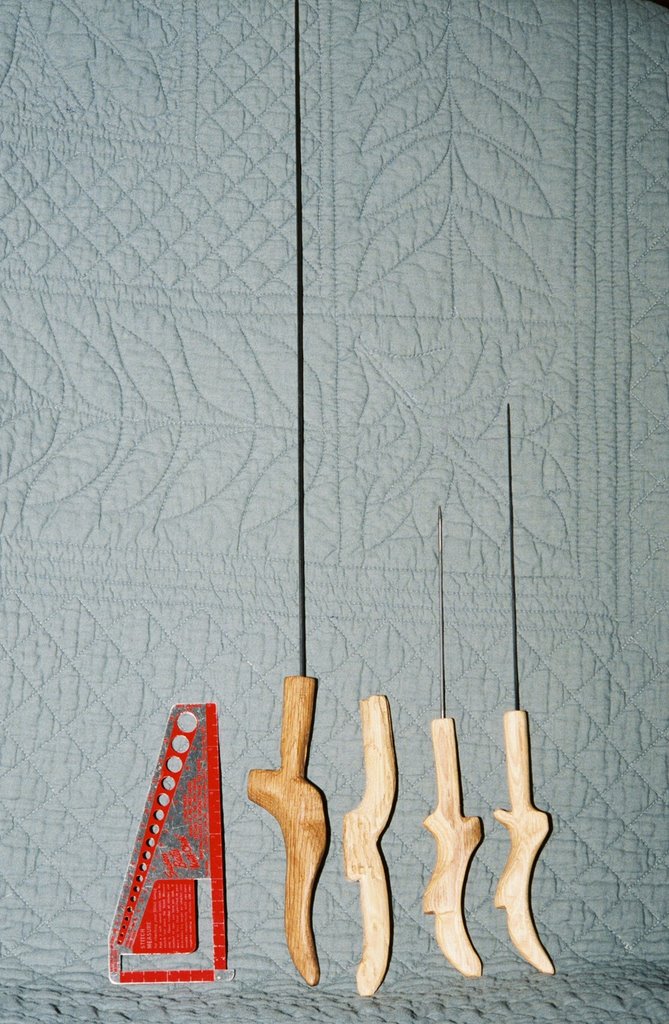
Then I saw http://www.daelnet.co.uk/features/knitting/ksticks.htm and I started working along those lines. I find these shapes more comfortable and more effective. Here are two views of four knitting sheaths that I have made along these lines. The light colored wood is hickory, and the darker wood is red oak. The oak is more of the classic shape. That classic shape is really a good design. With an over all length of 6 3/4 inches, it has enough leverage to stabilized long gansey needles, but it fits comfortably under your belt, and does not poke holes in your easy chair. Turned upside down, it tucks nicely into apron strings.


These are two views of the same needles. The needls are polished steel and their dark color is artifact of the camera flash. Note that 3 of the sheaths have "notches" that catch on a belt loop on my jeans which gives the knitting sheath extra stability without additional length or bulk. The extra stability is useful with long, heavy (2mm) needles, but is really not needed with 1.5 mm and smaller needles.


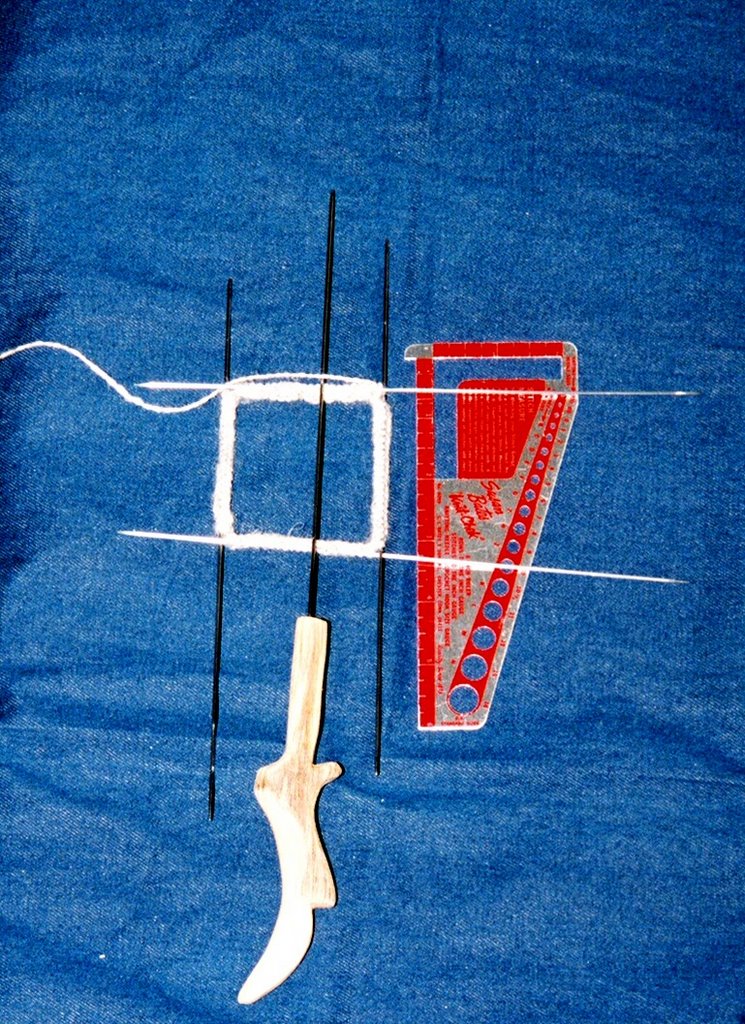
This is another photo of one of the knitting sheaths shown above with 5 - 11 inch 1.5 mm steel needles. The 2 horizontal needles show their true polished steel color. The yarn in this photo is Bartlett's sport and the guage comes to about 10 spi, which you will find to be warmer than worsted weight yarn knit at 4.5 spi.

So, what does 40 K stitches look like? Here is a shot of my favorite knitting sheath with the gansey in progress.

Thursday, February 02, 2006

Experience revised, and methods compared!

Surprise surprise!

This gansey is a mess. 10,000 stitches knitted on 4 different systems: Old circular (#1), new circular (#1), continental and English with knitting stick on US # 1 tight and US # 0 loose, so there are some variations in tension. What a weaver would call, "Lazy Lines." But, the average is about 7spi with a yarn weight of 1,100 yd/lb.

With the circular needles and continental knitting method, the effort to push the stitches around the needle was substantial. I never had this problem before when knitting looser fabric with GOOD circ. needles. Perhaps I would have done better to have knitted more loosely with #0 needles, but that would have taken more effort just to form such small stitches with this thick yarn. As it was, the effort to consistently form tight stitches was substantial. Nevertheless, circular needles/ continental method were the clear winner for travel and safety.

With the DPN, knitting stick, and yarn controlled with right index finder; the effort to move the stitches on the needles is much less, and the effort to maintain consistently tight stitches is less, while the actual speed of stitch formation is similar or better than continental method. I have some trouble with the first 10 stitches on a needle, so I just knit the first 10 stitches on each DPN in continental style before putting the needle in the knitting stick and switching the yarn to my left hand. All things considered, the time to move the yarn back and forth between my right and left hands is much less than the time to move stitches around the circ. needles. Over all, I am getting more knitting done with less effort. This fast and easy production is offset by the real issues of long sharp steel DPN.

Some old texts say that it is important to keep the tips of the knitting needles smooth and polished to avoid fraying the yarn. SHEEP POOP! It is important to keep the needle tips smooth to protect your fingers. I was in a hurry to test some new needle designs and did not polish the reground tips carefully. I ended up ripping my right index finger tip to bloody shreds!

While this gansey is clearly a beginner's practice piece, I am beginning to really see the potential of what I am calling high definition knitting. I think it is worth the effort.