I mentioned the other day that it was hard to use my 18" "gansey" needles in the overstuffed chairs in front of the TV. Thus, when watching TV I used shorter needles. I fixed that. I made yet another knitting sheath that works well in those overstuffed chairs.
Showing posts with label knitting sticks. Show all posts
Monday, March 28, 2016
YAKS
I mentioned the other day that it was hard to use my 18" "gansey" needles in the overstuffed chairs in front of the TV. Thus, when watching TV I used shorter needles. I fixed that. I made yet another knitting sheath that works well in those overstuffed chairs.
Saturday, January 30, 2016
Back to leverage
Ultimately, knitting needles are levers for moving loops of yarn. For hand held needles such as circular needles or DPN, the thumb is usually the fulcrum, and total leverage is ~1:3. With a knitting sheath or knitting stick or knitting pouch as the fulcrum, the leverage is between 1:20 and 1:100. With the gansey needles/knitting sheath that I am using for sock knitting these days, my leverage is about 1:50.
That means, a knitter with with circular needles must apply about 17 times as much force as I do to move the yarn loops. In fact, it is possible to knit as tight as needed with circular needles. I wore through the plating on 2 sets of US1 Addi Turbos doing just that. As an old rock climber, I have reasonably strong hands. There was a time when I spent 2 hours per day at Indian Rock hanging from my fingers, just to strengthen them.
Some knitters, say that they have very strong hands and can knit as I do using circular needles. Their hands would have to be 17 times as strong as my hands are. That is like claiming that if Aaron can lift a hundred pounds, they can lift 1700 pounds, over and over. They may be that strong, but human hands cannot endure such stress indefinably. Using gansey needles and a knitting sheath, my hands and wrists are subject to only 5% (e.g., 1/17 th) of the stress of their hands and wrists are subjected to as they knit. It is a level of stress that my hands can endure indefinably. I let my steel needles take the stress, and save my hands.
I think that is a smarter way to knit.
That means, a knitter with with circular needles must apply about 17 times as much force as I do to move the yarn loops. In fact, it is possible to knit as tight as needed with circular needles. I wore through the plating on 2 sets of US1 Addi Turbos doing just that. As an old rock climber, I have reasonably strong hands. There was a time when I spent 2 hours per day at Indian Rock hanging from my fingers, just to strengthen them.
A very easy training climb on Mt. Tam.
There was a time when I climbed the 2,500 feet of Mt. Tam.
every day. When they closed Mt. Tam because of the trail-side shootings,
I climbed it every night.
Some knitters, say that they have very strong hands and can knit as I do using circular needles. Their hands would have to be 17 times as strong as my hands are. That is like claiming that if Aaron can lift a hundred pounds, they can lift 1700 pounds, over and over. They may be that strong, but human hands cannot endure such stress indefinably. Using gansey needles and a knitting sheath, my hands and wrists are subject to only 5% (e.g., 1/17 th) of the stress of their hands and wrists are subjected to as they knit. It is a level of stress that my hands can endure indefinably. I let my steel needles take the stress, and save my hands.
I think that is a smarter way to knit.
Swaving using curved needles with a knitting sheath
provides uses compound leverage, to yield
very high effective leverage.
The crew of one the last wooden cargo
ships to go around the Horn. Notice
the commercially knit Guernseys.
Friday, February 22, 2013
Torque, Tension, and swaving
Long needles require longer knitting sheaths (mostly) to withstand the torque of the long lever arm provided by the length of the needle. Knitting sheaths for swaving do not need to withstand that torque. I may have been absolutely wrong about the short spindle form knitting sheaths in Brears. They may be to scale, but were used for swaving.
It turns out that my trouble with doing decreases while swaving was in part because I was knitting very tightly. And, swaving, allows knitting much tighter than in any other form of knitting that I know.
However, it is also possible to knit very loosely while swaving, giving swaving a larger range of fabric types for a given needle size than I am accustomed. It is like hand held continental where one can knit very loose fabrics with small needles.
However, with continental, one can just switch from tight knitting to loose knitting, or from loose to tight. However with swaving it seems to take about 4 rows. Anyway the bottom line is that one can knit loose fabrics while swaving, and that such looser knitting makes decrease stitches much easier. However, knitting loosely while swaving does mean knitting slower because the fabric has less spring to it to pop the needle out of the stitch.
Swaving is much faster than I could ever knit with long needles (gansey needles), and I do not seem to be near a peak speed. It is nice to have objects that seem to just sort of fall off the needles. I have to be more careful to always count rows or check the length frequently. In the old days, an evening of TV was a 4" sock cuff. I could cast on and knit all evening without checking the length. The next morning, in the light I could finish the cuff, and turn the heel. In the evening, I could knit most of the foot, and finish the sock in the morning's light. Thus, most of my work socks have about 5" cuffs. I was not paying attention, so the current pair on the needles has 6.5" cuffs. I will save them for winter wear. It will be OK.
I had been using brass inserts in the needle adapter for swaving needles/pricks, as this reduced the friction, and allowed the needle to rotate more easily. However, installing a brass insert was extra effort. Now, I am moving to simply making the needle adapters for swaving out of rosewood, black walnut, or similar. With a bit of bee's wax , these woods seem to make a perfectly good bearings, allowing free rotation of the needle. How they wear will be another question. I have not decided if the extra bother of working with these woods is more or less than the bother of a brass insert. However, everyone seems to think the rosewood turnings look nice.
These are two Yorkshire knitting sheaths that I made along time ago. (Long before I worked out swaveing.) They mostly differ by the direction of the spiral design carved on them. First, I made the one on the left, and it never worked (with the straight needles that I was using at the time). The one on the right worked acceptably when tucked into thin apron strings, but was never good enough to keep me from moving on to other designs. However, for swaving, their performance is excellent and substantially indistinguishable. (Both always had brass inserts.) Now, I have to go back and reconsider a lot of styles and designs that I had previously discarded. The only thing wrong with some of those designs for swaving is the hole for the needle is too deep. Relatively short swaving needles do not have to be inserted as deep into the knitting sheath because they do not have to withstand the torque. For swaving, needle holes less than 0.5" deep work well, while I had to make holes for long needles more than a inch deep to keep the long needles from popping out of the knitting sheath and into the furniture.
Two different spindle form knitting sheaths for the same size and length of needle, but since different knitting knitting techniques are used the knitting sheaths are different. The long sheath is of the Dutch style and works very well with 6" straight needles (sock needles) and the short one is for 6" curved needles that rotate in the knitting sheath.
This raises the obvious question, "Can one swave with a leather/horse hair knitting pouch". Yes, but it is not as fast or easy as with a properly designed/ lubricated knitting sheath. It is kinda like handheld knitting with wooden needles; there are many reasons to knit with wooden needles, but more speed is not one of those reasons.
It turns out that my trouble with doing decreases while swaving was in part because I was knitting very tightly. And, swaving, allows knitting much tighter than in any other form of knitting that I know.
However, it is also possible to knit very loosely while swaving, giving swaving a larger range of fabric types for a given needle size than I am accustomed. It is like hand held continental where one can knit very loose fabrics with small needles.
However, with continental, one can just switch from tight knitting to loose knitting, or from loose to tight. However with swaving it seems to take about 4 rows. Anyway the bottom line is that one can knit loose fabrics while swaving, and that such looser knitting makes decrease stitches much easier. However, knitting loosely while swaving does mean knitting slower because the fabric has less spring to it to pop the needle out of the stitch.
Swaving is much faster than I could ever knit with long needles (gansey needles), and I do not seem to be near a peak speed. It is nice to have objects that seem to just sort of fall off the needles. I have to be more careful to always count rows or check the length frequently. In the old days, an evening of TV was a 4" sock cuff. I could cast on and knit all evening without checking the length. The next morning, in the light I could finish the cuff, and turn the heel. In the evening, I could knit most of the foot, and finish the sock in the morning's light. Thus, most of my work socks have about 5" cuffs. I was not paying attention, so the current pair on the needles has 6.5" cuffs. I will save them for winter wear. It will be OK.
I had been using brass inserts in the needle adapter for swaving needles/pricks, as this reduced the friction, and allowed the needle to rotate more easily. However, installing a brass insert was extra effort. Now, I am moving to simply making the needle adapters for swaving out of rosewood, black walnut, or similar. With a bit of bee's wax , these woods seem to make a perfectly good bearings, allowing free rotation of the needle. How they wear will be another question. I have not decided if the extra bother of working with these woods is more or less than the bother of a brass insert. However, everyone seems to think the rosewood turnings look nice.
Sunday, December 02, 2012
First video of swaving
The rain has paused, and there is enough light for video. Unfortunately the I have a limited number of good swaving needles at this time the the good needles have this 6-ply navy yarn on them that just sucks light out of the frame.
Here are some very short clips. These are done very slowly for the camera, and the motions do not really work that well when done slowly.
Swaving "needles' are called pricks. The pricks, sheath and setup are here:
I find that short pricks work better. Long pricks tend to get torqued off axis and become difficult to rotate. Thus, I like swaving pricks that are no more than 8" long. The curvature is so slight that the needle will fit into 1/2" pipe. Thus, when the prick is rotated in the sheath, the tip describes a circle of less than 1" in diameter. The arc of movement is limited by the legs of the previous stitch. Thus, fine motion control of the working prick is not required. Then the left prick simply follows the right needle, and since they are both in the same stitch, the left prick follows the same circular motion as the working needle.
The are three motions in the formation of a knit stitch. Push into the stitch. Loop yarn. Pull back. At the end of the pull back the stitch pops off the left needle, but remains on the working needle.
For a purl stitch (not shown) the yarn is brought forward, the working prick is pulled into the stitch, the yarn looped, and the pricks pushed away so the yarn pops off.
While there are 3 motions, the yarn looping is a continuation of the first motion, so the direction of motion of the hands only changes once in the course of a stitch, and is very fast. The tension of the stitches is also very uniform (and tight!)
For comparison here is my knitting with the same yarn and needles:
Note that there are 4 motions, each of which require fine motion control. Yes, swaving is faster. And, while knitting can be done with a loosely secured needle, swaving requires that the working needle rotate easily on a fixed axis.
Swaving has become my knitting style of choice because it is fast and it gets more knitting done for the same effort. On the other hand, it must be done fast. It does not work for slow knitting for relaxation. It is a high effort activity, that results in getting a great deal of knitting done rapidly.
Wednesday, June 17, 2009
UK knit circa 1800?
How did folks in the UK knit circa 1800?
1) Certainly, hand-held DPN (or needles held, supported, or controlled in the arm pit) with the yarn in either the right or the left hand. These needles develop a very slight curve and distinctive wear marks at the extreme tip that allows them to be distinguished from broken awls. The disadvantages are that knitting firmly can put a stress on the wrists, knitting is slower than with a knitting sheath, and long needles are difficult to control.
2) Short (6- 12 inches), straight (more or less), DPN held in a knitting sheath under the right elbow or over the point of the right hip, with the yarn in either the right or the left hand. These knitting sheaths were 6 to 10 inches long in a variety of designs. These designs for such sheaths included bundles of feathers bound together with a bit of waste yarn or a cone of leather filled with horse hair for tucking into the waist band. of the sheath designs work very well tucked into apron strings. Many Other designs allow for separate tapes or belts. In general, the needle flexes along its length, and does not rotate in the needle hole of the knitting sheath. Many of the needles pick up a significant curve or arc with use. These needles have distinctive wear marks in an annuls ~1 cm form the shoulder of the needle tip. If you see this band of linear striations, you know the needle was used with a knitting sheath, and that it was a knitting needle and not something else. Such knitting sheaths can be used with 3+1 needles for small objects or many needles if a large carpet or blanket is required. The side of the right hand pushes the needle into the stitch and the base of the thumb pushes the working needle back through the stitch. It is a low stress knitting technique suitable for people with tender hands and wrists. It can be a very pleasant way to knit at a reasonable pace. It can also be done quite aggressively to knit very rapidly. This technique allows knitting fabrics much tighter than any other method on this page. These are most of the old knitting sheaths that people liked, and kept, and that one still finds in the collections.
3) Knitting sheath as above in 2) but used with 2 needles for lace items knit flat.
4) Gansey needles (14 -18 inch long steel DPN) used with a knitting sheath firmly attached to a strong belt over the right buttock, with the working needle arched forward under the right arm. The belt is worn much lower on the body than in the short needle technique above. The weight of the right arm rests on the needle. The needle is forced downward into the stitch, the right hand loops yarn over the tip, and the spring action of the needle lifts the loop of yarn back through the old stitch to form the new stitch. This is a powerful, industrial knitting technology. It can be done very fast, and then it is very hard work. On the other hand it is the easy way to knit a real gansey.
5) Curved, blunt needles called “pricks” used with very large knitting sheaths (40 -50 cm) tucked into a belt worn low on the hips. The yarn is controlled with the left hand. The prick rotates in the needle hole of the knitting sheath. The prick is “popped” into the working stitch with a down and out simultaneous impulse of both hands that caused the prick to pick up the yarn as it stretches the forward leg of the working stitch. The stretch of the yarn and fabric provide a spring action that push the prick and yarn back through the working stitch, which then pops off as the next stroke starts. The process is very fast and very demanding. This was a method for commercial knitting. As soon as the need passed, these big sheaths were tossed in the fire, and people reverted to straight needles with smaller knitting sheaths. The nature of the spring process means that everyone using the same sized needles and the same yarn will tend to knit at the same speed. Thus, everyone in the room can sing to the pace of their knitting, knit to the pace of the song, and at the end of the evening, everyone will have knit the same number of stitches.
6) Knitting belt/pouch with DPN. Very similar to 2) above, excellent with the blunter needles used for the softer spun yarns used in Fair Isle knitting. The needles are not as firmly held and have less of a tendency to develop an arc and develop polish rather than marks on the shaft of the needle. Perhaps not quite as fast as knitting sheath but very good for travel.
7) Knitting hearts – very small, decorated knitting sheaths, designed to pin to a lady’s dress to support very fine knitting needles used for knitting lace.
I am a bit pedantic, but I would say that circa 1800, there were at least 11 different and distinct knitting styles in Great Britain, the use of which employed at least 7 different tool kits.
A note, at one time, I thought that gansey needles were very difficult to manage without a knitting sheath. Now, I know some knitting styles that allow use of long needles without the use a knitting sheath. One of these methods is the knitting style of Miriam Tegels. (A second is s Spanish style of "Pit Knitting.") However, I still think that if Miriam Tegels and I sat down together to knit ganseys, for the first day or two she might blow me away, but that by the time we had knit a dozen ganseys, she would be a convert to knitting sheaths. I know that I just sold a set of knitting sheaths to a knitter that had learned excellent pit knitting skills as a girl in Spain. I showed her how to use the knittng sheaths, let her play with them for a while, and at the end of the session, they went in her knitting bag.
1) Certainly, hand-held DPN (or needles held, supported, or controlled in the arm pit) with the yarn in either the right or the left hand. These needles develop a very slight curve and distinctive wear marks at the extreme tip that allows them to be distinguished from broken awls. The disadvantages are that knitting firmly can put a stress on the wrists, knitting is slower than with a knitting sheath, and long needles are difficult to control.
2) Short (6- 12 inches), straight (more or less), DPN held in a knitting sheath under the right elbow or over the point of the right hip, with the yarn in either the right or the left hand. These knitting sheaths were 6 to 10 inches long in a variety of designs. These designs for such sheaths included bundles of feathers bound together with a bit of waste yarn or a cone of leather filled with horse hair for tucking into the waist band. of the sheath designs work very well tucked into apron strings. Many Other designs allow for separate tapes or belts. In general, the needle flexes along its length, and does not rotate in the needle hole of the knitting sheath. Many of the needles pick up a significant curve or arc with use. These needles have distinctive wear marks in an annuls ~1 cm form the shoulder of the needle tip. If you see this band of linear striations, you know the needle was used with a knitting sheath, and that it was a knitting needle and not something else. Such knitting sheaths can be used with 3+1 needles for small objects or many needles if a large carpet or blanket is required. The side of the right hand pushes the needle into the stitch and the base of the thumb pushes the working needle back through the stitch. It is a low stress knitting technique suitable for people with tender hands and wrists. It can be a very pleasant way to knit at a reasonable pace. It can also be done quite aggressively to knit very rapidly. This technique allows knitting fabrics much tighter than any other method on this page. These are most of the old knitting sheaths that people liked, and kept, and that one still finds in the collections.
3) Knitting sheath as above in 2) but used with 2 needles for lace items knit flat.
4) Gansey needles (14 -18 inch long steel DPN) used with a knitting sheath firmly attached to a strong belt over the right buttock, with the working needle arched forward under the right arm. The belt is worn much lower on the body than in the short needle technique above. The weight of the right arm rests on the needle. The needle is forced downward into the stitch, the right hand loops yarn over the tip, and the spring action of the needle lifts the loop of yarn back through the old stitch to form the new stitch. This is a powerful, industrial knitting technology. It can be done very fast, and then it is very hard work. On the other hand it is the easy way to knit a real gansey.
5) Curved, blunt needles called “pricks” used with very large knitting sheaths (40 -50 cm) tucked into a belt worn low on the hips. The yarn is controlled with the left hand. The prick rotates in the needle hole of the knitting sheath. The prick is “popped” into the working stitch with a down and out simultaneous impulse of both hands that caused the prick to pick up the yarn as it stretches the forward leg of the working stitch. The stretch of the yarn and fabric provide a spring action that push the prick and yarn back through the working stitch, which then pops off as the next stroke starts. The process is very fast and very demanding. This was a method for commercial knitting. As soon as the need passed, these big sheaths were tossed in the fire, and people reverted to straight needles with smaller knitting sheaths. The nature of the spring process means that everyone using the same sized needles and the same yarn will tend to knit at the same speed. Thus, everyone in the room can sing to the pace of their knitting, knit to the pace of the song, and at the end of the evening, everyone will have knit the same number of stitches.
6) Knitting belt/pouch with DPN. Very similar to 2) above, excellent with the blunter needles used for the softer spun yarns used in Fair Isle knitting. The needles are not as firmly held and have less of a tendency to develop an arc and develop polish rather than marks on the shaft of the needle. Perhaps not quite as fast as knitting sheath but very good for travel.
7) Knitting hearts – very small, decorated knitting sheaths, designed to pin to a lady’s dress to support very fine knitting needles used for knitting lace.
I am a bit pedantic, but I would say that circa 1800, there were at least 11 different and distinct knitting styles in Great Britain, the use of which employed at least 7 different tool kits.
A note, at one time, I thought that gansey needles were very difficult to manage without a knitting sheath. Now, I know some knitting styles that allow use of long needles without the use a knitting sheath. One of these methods is the knitting style of Miriam Tegels. (A second is s Spanish style of "Pit Knitting.") However, I still think that if Miriam Tegels and I sat down together to knit ganseys, for the first day or two she might blow me away, but that by the time we had knit a dozen ganseys, she would be a convert to knitting sheaths. I know that I just sold a set of knitting sheaths to a knitter that had learned excellent pit knitting skills as a girl in Spain. I showed her how to use the knittng sheaths, let her play with them for a while, and at the end of the session, they went in her knitting bag.
Saturday, May 02, 2009
More Tools
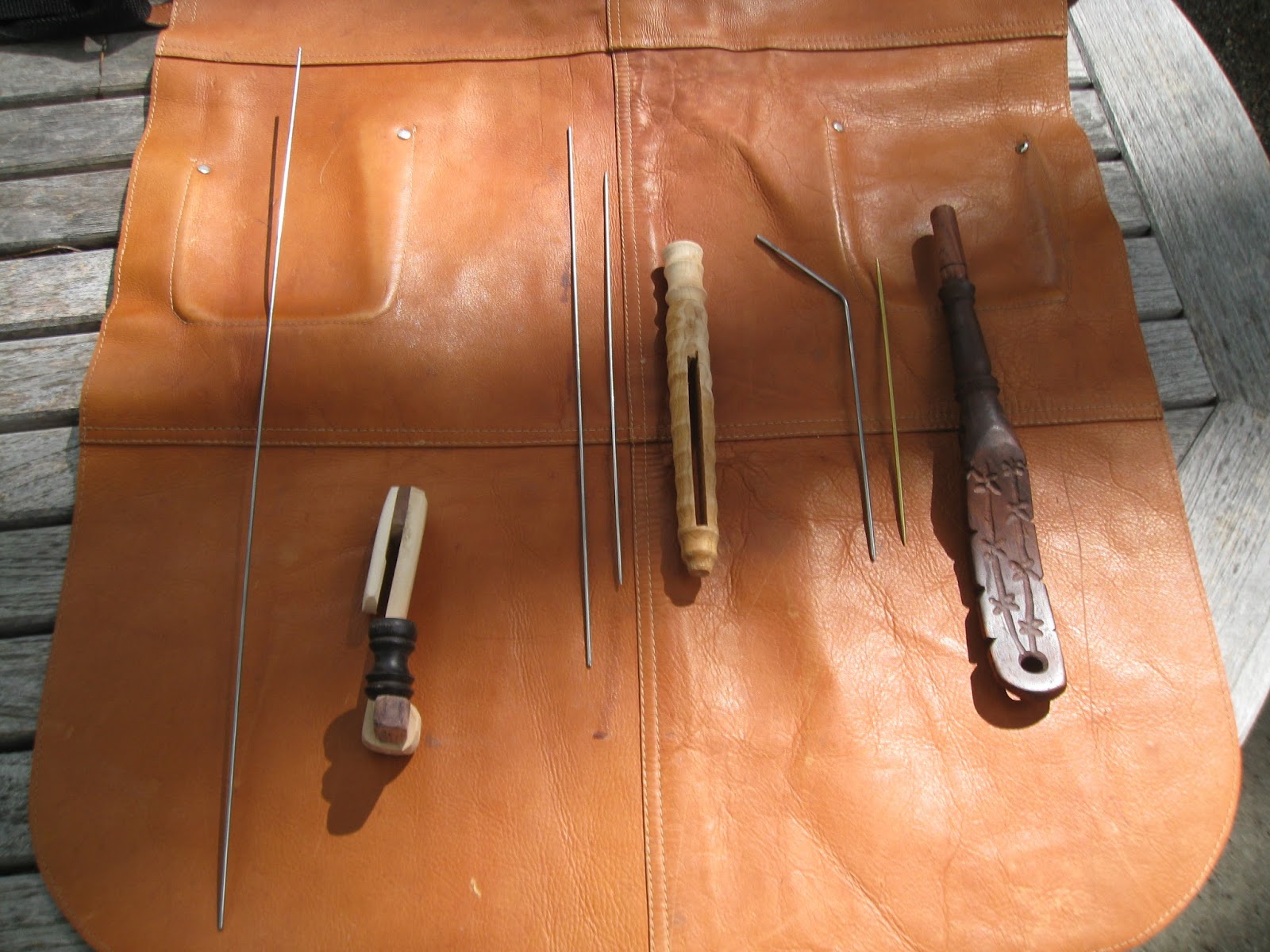
People want knitting sheaths and gansey needles.
Nobody else wanted to make them, so I am.
I bought some bigger tools.
And, I put up a store on Etsy: "Agres's Shop".
Anyway, good knitting sheaths and steel knitting needles are available.
Labels:
knitting sheaths,
knitting sticks,
Knitting tools,
steel DPN
Subscribe to:
Posts (Atom)

.jpg)