Monday, January 16, 2012

First conceptual project

The start of the first conceptual project:  A Jersey

The yarn is 6-ply sport weight. The construction is cabled 3 X 2-ply.  Two plies are always gray Cotswold.  This gives a "silver sheen" to fabric. Then, two plies are white and two plies are brown. The brown accentuates the silver sheen.  Two plies are fine wool and two plies are "Shetland".  When the Shetland is white, then the brown is Rambouillet.  When the white is Cormo  then the brown is Jacob (very like Shetland). Thus, there are always 4 plies of  high luster wool in the yarn and 2 plies of finer, lower luster wool to contrast. Each yarn ball is ~ 2 oz. All plies are spun worsted.  About half of the plies are already spun.

The sweater will be knit in round, on 2.38 mm gansey needles. The fabric is smooth and dense but elastic. Garment will be a basic blouse, Plan 1 from Knitting in the Old Way. 

Wednesday, January 11, 2012

Thunder and lighting

Alden Amos has "FIXED" my wheel.  Now it is 10 to 15% faster, with measured flier speed in the range of 2,500 rpm, the disagreeable vibration at 1,600 rpm is gone, and it is like WOW! This flier reduces the effort to spin 250 yards of  11,000 ypp worsted single per hour from "moderate" to "easy".  Treadle effort is less. All from a new flyer/bobbin assembly.  Production of threads in the 40,000 - 50,000 ypp range is 4 or 5 times faster than I could mange with the stock Ashford DD flier.

We did not even touch the Mother of All. We are still using standard Ashford flier bearnings.  Alden made three bobbins for this flier, with DRS set for grists of 6,000, 11,000 and 50,000 ypp.  The price and wait was reasonable for such custom work.


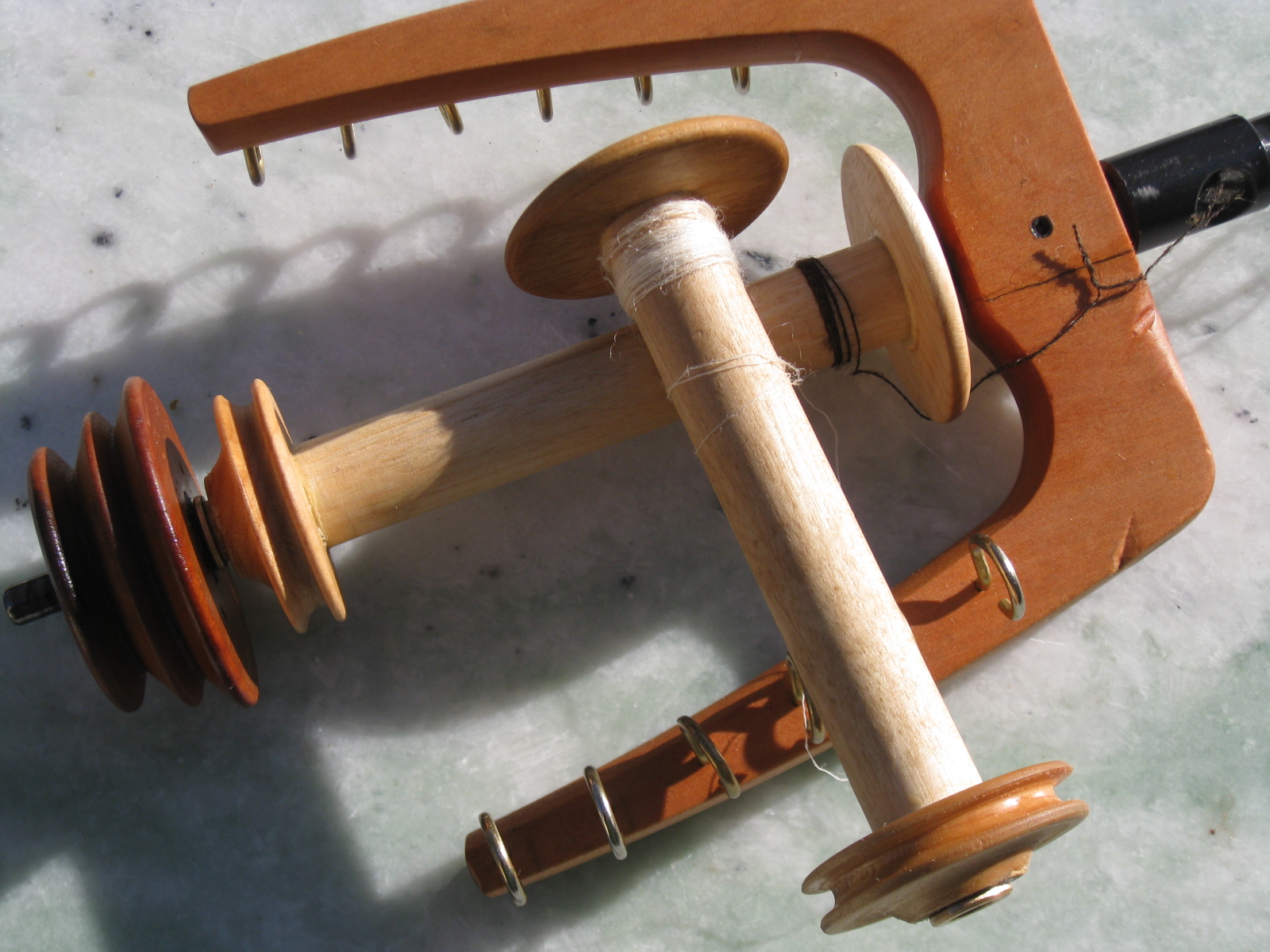
Flier/bobbin as made by Alden.
If I had this flier early on, I would not have spent so much time messing with drive bands.   Note that it was not the bearings that were the problem, it was the aerodynamics of the flier.  If you are going to spin at 1,000 rpm, you do not need to mess with all of this stuff (e.g., aerodynamics & drivebands), but it will take you all morning to spin 560 yards of  11,000 ypp worsted single.


 Single wound off  of a bobbin I made this morning.  
It is something of a pain in the neck,
 because it is a bit finer than the rest of the singles for this project.
The tachometer tells me the flier hit speed of 3,800 rpm while spinning this.

I out sourced the flier, because I cannot do dynamic balancing.  I can make a flier that will run at 1,000 rpm.  I cannot make a flier that runs this smooth, at these speeds. Flier/bobbin assemblies made by other wheel makers may be prettier and have fancier bearings, but they do not have the specific differential rotation speed (DRS) that I wanted. Alden Amos is the only wheel maker that I know, who really understands DRS.

Every design has compromises, and every designer weights those compromises differently.  Out of long experience with what people do to their spinning equipment, Alden's designs are conservative. Alden's designs always work, and they endure.  

Monday, January 09, 2012

Another video of spinning

Spinning a thicker, thread that can be seen more easily by the camera:

This is a Merdian Jacob fiber from a fleece I got in 2010.  I did a bunch of 2-ply jumper weight, and I am just spinning a bit more of what was on the bobbin, because it is thick enough to show on the camera.

The flier looks like it is going slowly, but that is a strobe effect from the camera shutter speed.  Actual flier speed is in the range of 400 to 500 rpm.

 DRS is 1.05 with a 5/8" bobbin core.

Again, this is spinning slowly for the camera.  Normally, I would be running the flier at more than 1,600 rpm

Wednesday, January 04, 2012

How I spin; A video

Here is a better video of how I spin. From over my left shoulder:

And from over my right shoulder:


The fiber is an indifferent prep of Shetland that somebody gave me, and I fixed.  The grist is in the 11,000 ypp range, and the flier rpm is ~500. Twist is in the range of 12 tpi. Twist and to a lesser extent, grist  is set by the DRS (~1.017 with a bobbin core of  ~5/8") of the flier/bobbin assembly.  Thus, I can switch bobbins, and bingo, I have right twist for 14,000 or 25,000, or 50,000 ypp.  All I have to do is make sure the grist is right for the twist. If I need other grists, I make other bobbins as in the last post.

The main thing is that this is a continuous process that produces a true worsted single. Note the use of a distaff.  The distaff is necessary to keep the fibers just behind the drafting zone aligned and parallel.  The fibers are fully aligned as the twist enters them. Of course, these video sequences are much slower than I normally spin, but you can see there is minimal hand motion, so that my hands can keep up when spinning much faster. This technique is a very fast way to produce a true worsted yarn.

These singles will get cabled up  into 8-ply (fingering) for a sweater.  I insert some slubs so you can see the progress of the single.  In the second video, the twisted single is invisible at this resolution. Sorry about that.

First new tools of 2012


I started off the year by making some new bobbins:

The one in the flier is for singles in the range of 11,000 ypp (20s) and the one on top is for finer singles (20,000 + ypp, 40s; these numbers have changed as I use different fibers, different fiber prep, and made better measurements).  These bobbins are a little lighter and the wider whorls allowing slippage for spinning finer yarns than the DRS would suggest.  On the other hand, that slippage slows everything down, particularly as speed increases and the aerodynamics of the flier start to consume significant power.  I do need a more aerodynamic flier.  (The oil finish is drying on one right now!)

They look small, but they will both hold a little over an ounce of  singles.  An ounce of 20s is 700 yards.  An ounce of 40s is 1,400 yards. Thus, I have no problem winding off full hanks of 560 yards from these bobbins.

The physical flier ratio is 22:1.

They took about half a day to make.  I bored 5/8" maple dowel with a 9/16" hole on their axis by holding them in the wood lathe.  I enlarged the axis boring at each end by 3/8" x 7/16" to hold the brass bushing bearings.  For the ends, I cut a 2" square piece of 3/4" maple stock, trimed the corners to ease the start of turning, and on the drill press, bored a 5/8" hole through the center. On the band saw, I cut the ends apart, one ~ 1/4" thick and the other ~1/2" thick.  I glued the ends on the core.  A couple of hours later, on the wool lathe, I rough turned the thin end, and then the thick end.  Then I finish turned the thin end, making sure it cleared the flier. Then I finish turned the whorl using the scrapers that I made last year and posted below.
The bushing bearings were inserted, and held in place with a dab of silicon adhesive.  A bit of sanding, some Danish oil, and they got left on the rack to dry while I made dinner for my wife.

Normally, I would let the core/ends-blank glue-up dry overnight, but this time, I got away with only ~ 2 hour set time.  

Sunday, January 01, 2012

Favorite tools of 2011

We went to Yellowstone last summer and saw everything.  There was a lot of walking to the geyser basins and waiting, waiting, and waiting for the geysers to erupt. I was knitting boot socks from hand spun Romney.  I had the whole knitting bag with me but one knitting sheath became the choice :


As I look at pictures of sailing this fall, there it is, always with 9" long, 2.38 mm steel DPN.  I will say that on some of those sailing trips, the needles got doused with sea water, and rusted. Everything was wet for a couple of days.  Still a bit of crocus cloth brought the needles back to perfect conditions in minutes.

There was a lot of sampling of series of yarns.  Many of these were done on a very light weight knitting sheaths tucked into an elastic pant waist band:


This one was made from redwood.  The redwood is much too soft to support the small steel needles, and hence needs a hardwood adapter, maple in this case.  Moreover, the redwood is too weak to hold interchangeable adapters tightly, and thus the adapter must be glued, and it is not interchangeable.  Just the tool to knit yarn hot off the plying bobbin.

And the winner:
My Ashford flier with standard high speed whorl (22:1) and a bobbin with a 5/8" core and DRS of 1.017  for spinning singles in the range of  10,000 ypp.  This has been a good setup for spinning singles in the 9,000 to 15,000 ypp range.  It is simple, inexpensive, and it works!  This rig will spin 11,200 ypp singles, faster, easier, and more consistently than any of the mass produced spinning assemblies.  Only Alden Amos' flier assemblies are faster.

Saturday, December 31, 2011

How Fast Can Someone Comb Wool?

These days, I comb Jacob at around a half a pound per hour. It is slower than Cotswold, but is similar to Shetland that many people comb these days.  Even a pound per hour is much slower than professional wool combers prior to 1850, but it is about as fast as I can go at this time. I could make myself bigger combs and work faster, but for the small amount of wool that I handle, it is not worth it.

My method is to start with clean oiled fleece, and give it a pass through the drum carder to make sure everything has been opened up and the oil distributed.


Then, I lash 3 or 4 ounces onto a large, single-pitch comb mounted on my combing bench, and use a 6” wide 2-pitch to comb off. Then, I mount the 2-pitch (with the wool on it) on the pad, and comb off onto a pair of 4” wide 5-pitch combs. Then, each 5-pitch gets combed off onto another 5-pitch, which, when full, is mounted on the comb pad, and combed onto another 5-pitch. Then, those combs are mounted on the comb pad, and their beards drawn off into short planks. If I work quickly, it only takes 6 or 7 minutes to get from carded fiber to 2 planks of an ounce (sometimes closer to 2 oz) each. (~3 hours hours to plank a sweater's worth of wool). The planks are arranged in a large bin.
When the bin is full, it is turned out on a table and the planks arranged for uniformity of fiber. The planks can be stored for a while
The planks get lashed onto 5-pitch combs, combed off, and then combed back (two complete transfers). This takes 3 or 4 minutes for between 1 and 2 oz. (22.5 oz /hr).
Then the beard is drafted off using a diz, and wound on the distaff. Total time to comb a sweater's worth, right on the close order of 6 hours. 
However, I suggest that the final combed and drafted fiber be used within a couple of weeks. That is, every few days, I take a few planks out of their bin, and final comb/draft them into slivers for the next few days of spinning.
For long wool, I skip the carding. The Romeny that I did last spring went faster, while the Rambouillet, Jacob and Shetland goes slower.
To achieve a reasonable rate, I had to make myself larger combs. On cold days, I warm the combs. I also use a spray bottle of water. See Peter Teal’s book for instructions. 
To get here, I had to time myself, and look for ways to speed up the process.
So, this lady said,"I've been wool combing for 5 years, I have five sets of combs, but I do not know if I have ever combed enough wool for a sweater."  My reply was, "If you have been wool combing for 5 years, then you should have combed about 5 tons of wool.  Me? I spent more than a hundred hours learning to card, and maybe 20 hours of making better tools and less than 20  hours of real wool combing.   I have big bins of wool to show for that effort.  In my book, just having combs in the closet does not count as time spent wool combing.  Nor, does having a spinning wheel sit in the living room count as spinning time.  


Sampling Cable plied yarn

This post is so important to me that I am going to Shout!


If you are spinning fine singles, it is worth doing a  series of exercises in plying/cabling.  If you have the singles on hand, it is easy to run up samples of  6, 8, 9, and 12-ply cabled yarns, and knit them into fabric to find the fabrics that you like.


I like my 2.38 mm needles.  These days, I make the yarns that I like to knit on that size needles. Knit on them, 6-ply cabled from 10,000 ypp singles makes a nice, skin-soft fabric.  It is warm, and elastic.  8-ply (1,200 ypp) makes a nice outer wear sweater. It is a thin yarn, it knits into a thin fabric - that is remarkably warm, and has wonderful drape.  This is not for sweaters that hang like bags.  It is for sweater designs that are worth all the work.


You are going to say, "Nothing is worth that much work to knit".  Look at your favorite knit wear (tee shirts, underwear, polo shirts, rugby shirts, and even sweat shirts), they are all knit from yarns with very fine plies.  If people wanted  fabrics from yarns with coarser plies, then  textile makers would use coarser yarns, (it would be much cheaper for them!) But no!, as a rule, for actually wearing, people like fabrics made from yarns with fine plies.  


I like quick and easy as much as the next fellow.  However, I find fine plies for the clothes I wear, worth the effort.


It is not very impressive, but here is  a photo of the first swatch that I did from 6-ply fingering Rambouillet (1,300 ypp):


 #1 needles on a swatch from hand spun 6-ply, 1,500 ypp yarn.


That bit of "nothing" was the confirmation of year's work. It was a proof of concept; fine plies work.  On the other hand it was the beginning of more work.  Fine plies ARE more work. Fine plies make good worsted worthwhile - that means I do enough worsted combing to get good (and fast) at the combing process.  However, the fabrics are wonderful.


When I started all this it took forever to comb a pound of wool.  However, I made some combs that help me  comb faster, and now, it takes me an hour to comb a pound of wool.  Anybody that cannot comb a pound of wool in an hour, is not trying.


I have said that it is not worth while for me to have fancy socks because I wear them out, and it is not worth while for me to have nice mittens because I lose them.  Well, it is worth while for me to have socks and mittens knit from yarns with fine plies because such fabrics are worth the extra effort.


Such fine ply yarns have become my standard yarn construction.  Here you see 2-ply Cotswold, Rambouillet, and Jacob waiting their turn to be cabled up into 6 and 8-ply knitting yarns. The needle is 2.38 mm.


Sunday, December 04, 2011

A Milestone: Competence in Spinning

In the early going, I read that "spin count" was the fineness that a competent spinner could spin a particular wool.  I then set my definition of a competent spinner to "being able to spin wool at its spin count."

Today, I can spin the common fleece at their spin count with reasonable confidence and ease.  In short, now I am a spinner.

 Learning to spin has been an obsession over the last year.  Learning to spin disrupted my life.  It was worse than learning calculus.  With calculus, there were very good texts and very good teachers to show the way.  Every physics, chemistry, and math grad student could do calculus, and were happy to parade their expertise in their role as teaching assistants.  However, try finding a spinning course where the objectives of the course include spinning singles at 50,000 ypp.  I do not know how many hand spinners can spin fine wool at its spin count, but it is not something that gets mentioned in course descriptions at fiber shows.

Everyone who reads this blog knows that I like yarns plied up out of 10,000 ypp singles.  What I have not talked about it that 30,000 ypp (Shetland) singles are remarkably strong and elastic.  Unless you have handled such singles, they are like nothing you have handled.  As 2-ply they (@15,000 ypp) they are as strong as the cashmere plied with silk yarns used for Russian lace, but they are more elastic.  If you want drape and flow, go with 2 plies of wool. The elasticity of the fine wool singles makes such lace wonderful.  It is not something that we understand anymore.  It is not a property that can be seen when the lace is mounted in a museum case.  It is something that you feel when you wear the lace. These hand spun yarns are much thinner, stronger, and more elastic than the commercial lace yarns.  However Shetland is not as soft and does not have the softness of the cashmere/silk lace yarn.  If you want just soft, go with the cashmere plied with silk.

Other wools can run a bit softer than Shetland, including  Rambouillet and Cormo.  These can be spun fine and plied into nice soft lace yarns. The finest Shetland is about as soft as very good Merino.  However, the Shetland is easier to spin very fine.  I think any competent spinner can spin the yarn for a nice wedding ring shawl.  Since you only need a couple of ounces of fiber, so you can buy the best fiber and still have an inexpensive project.

The idea of lace is all very interesting, but the real point of learning to spin fine was to be able to spin thicker yarns better.  For that alone, it was worth learning to spin fine.

It has also give me a very different view of how wonderful wool yarn can be.

Thursday, November 17, 2011

Seduced by the Soft Side

Now that I can spin finer and faster, softer wools are more attractive.  I acquired a couple of Rambouillet fleece.  Spun semi-worsted at just over 16 hanks per  pound (~9,000 ypp) and cabled into a 6-ply fingering (1,300 ypp @ 40 wpi), it is is perhaps the nicest knitting yarn I have ever worked with.

The fine plies give it strength and durability despite the fine, skin-soft fiber.  Knit on #1 needles at 9.5 spi, the fabric is thin, light in weight, but very elastic, and very warm. The elasticity was something of surprise. It is far, and away, the nicest fabric that I have ever knit.

Relaxed, the fabric is nearly weatherproof.  Stretched, it opens up and ventilates, making it very good for active winter sports.  It is like Helio, only more so.

Estimated time for me to spin/ply enough for a Jersey is ~50 hours, which does not count fiber prep.   You can buy nice Rambouillet roving for half the price of Jacob or Shetland.  Rambouillet is finer than Shetland and much longer than Merino, so it is nice to spin. And, there is a lot of it around.  Rambouillet is similar in fineness and length to Cormo, but this season Cormo is in fashion, so Rambouillet is a bargain. The thin yarn means that you need less wool. ( Less than 1.5 lb compared to ~ 2.5  lb for sweater designs using commercial worsted weight wool,  but this sweater will be warmer.) Well, yes thin yarn means there is more spinning and knitting - but is that really so bad?  I mean we like spinning and knitting soft fibers - right?  My estimated total time for a Jersey is on the order of  150 hours.

And, it is just in time, as I hear that Wingham's has stopped producing gansey yarn due to equipment failure.  It was one of the best yarns on the market and it will be missed.


Friday, November 11, 2011

WPI

There is a long standing convention in the textile industry on wraps per inch (wpi). Pack to refusal!  They wind the thread into a slot or gap and they pack to refusal.  (It is a gentle and careful packing that does not  deform the yarn.)  This results in an accurate and precise number that can be related to yards per pound (ypp).

Knitters on the other hand, when making wpi measurements wind their "wpi" loosely, (well not too loosely),  and they get a number that is "fuzzy".  See for example http://www.yarnfwd.com/tension.html  or http://www.hatchtown.com/tools/misc-tools/wpi-wraps-per-inch. It is a more modern method, but it will not give a precise and accurate number. And, it does not differentiate between worsted, woolen, and cotton/silk  It is a different culture. Then, they call the textile guys, "wrong" for using the old, precise method.  The only thing the fuzzy method is good for is putting the yarn in a Craft Yarn Council category.  And, that does not provide a lot of useful information. Particularly for somebody like me who is likely to be spinning fine yarns.  Trying to wrap 20,000 ypp singles (35s) loosely, but not too loosely, is an exercise in futility.   However, with the right gauge one can pack to refusal, and get a precise number.

So here is a solution. Use a gap gauge, wrap the yarn around it, and pack to refusal.  Then, for worsted add 10% and take the square of the number.  That will be a good estimate of the yards per pound.  For Woolens, add 16% and take the square of the number and you will have a good estimate for the ypp.  For silk and cotton add 7%, take the square of the number and you will have a good estimate for the ypp.  That is useful information.

Divide the number of wraps per inch packed to refusal by 2, and you will have a good estimate of the number that is defined as "wpi" by the Craft Yarn Council  and used by American knitters as "wpi.

If you have the yards per pound, take the square root and divide by 2, and you will have the knitters' wpi. Or, you can take the square root of  yards per pound, subtract 10 percent (16% for woolen, 7% for silk and cotton) and you will have the wraps per inch, which is the reciprocal of the thickness of the yarn. This gives the diameter of the yarn. This tells you something useful about the your yarn or thread.

In Judith MacKenzie 's the intentional spinner, she does not tell how to do wpi, but when we look at her projects we see that she says a  semi woolen yarn at 2475 ypp has 27 to 30 wpi; 1460 ypp has 18-20 wpi ; 300 ypp has 5 - 6  wpi.  She does not even try to get a number more precise than a range of 10%.  Shannon Okey's Spin to Knit,  on page 57 says that if  want to know more about grist, see Alden Amos's Big Book of Hand Spinning.  Well, Alden says, "Pack to refusal!"  Then Okey contradicts Alden on page on her page 126 by saying one can just wrap the yarn around a ruler.  No, that is not "pack to refusal".

This having two different measures in related fields, with the same name causes some confusion.  For example, yarn, that I say is 100 wpi, most knitters would call 50 wpi, and then they would say I do not know what I am taking about.  Well that is yarn spun at 22 hanks per pound or 12,000+ ypp.  I work with those kinds of threads every day.  Do they?  Measuring the yarn as 100 wpi tells me something useful about the yarn.  Measuring it as 50 wpi tell me that it is "lace weight", and I knew that without picking up a ruler.

Alden Amos gets it correct in his Big Book of Handspinning. I just wish that Alden had put in corrections for yarn construction and yarn fiber.  Then the wrap per inch  number in the table on his page 383 would be 7% to 16% less.    Peter Teal in Hand Woolcombing and Spinning gets it correct, and his Appendix III is the best conversion table. (However, he only addresses worsted yarns, and grist is stated in spin count.)  Better is scanned at http://www.cs.arizona.edu/patterns/weaving/books/pea_fa_2.pdf.


Wednesday, November 09, 2011

Oil it!

Few people,(including myself), oil their spinning wheel often enough.

It does not have to be much - a fraction of a drop is enough, but it needs to often.

Monday, November 07, 2011

Better or Authentic??!

I look to history to find ways to make better textiles.

In the days when hand knitting was a profession, there were a great many talented professional hand knitters with the elan that separates the talented professional from the merely competent amateur.  I looked to this group and learned about knitting sheaths as an approach to producing better textiles.  Modern amateur knitters and historians suggested that such knitting was not "authentic."  Since then, some of these folk have gone on to write extensively about the history of knitting sheaths.  Good for them!  However, their writing would have more authenticity if they would become more proficient in the use of the various knitting sheath technologies.

Prior to the spinning jenny, there were a great many talented professional hand spinners with the elan that separates the talented professional from the merely competent amateur. Competition drove some of them to produce better products.  In contrast, today we have very few talented professional hand spinners.  If modern hand spinners were producing yarns that really satisfied me, I would not have been plowing history looking for better yarns, now would I?   Some of the amateur spinners that made denigrating comments about the historical use of knitting sheaths, are now saying that my hand spinning of better yarns is not historically accurate.

I really do not care.  The yarns are fabulous!  The virtues of yarns worsted spun from spun long wool with fine plies have been long and widely documented. Cotswold wool came into prominence  in Roman times and from the nature of the wool we can guess that they were spinning the same kind of yarns that I am now spinning.  The truth is that the talented professional hand spinners had customers that wanted better yarns and who were willing to pay for them.  I expect talented professional spinners produced a range of better yarns for different uses.  I say that the right yarn for the job is the right yarn for the job, and a talented spinner with elan will find, and make, the right yarn for that job.

And while I am on the topic, Shetland spun into fine worsted plies is the right yarn for other jobs.  Warmer than the Cotswold, I am spinning this week, but still very durable.  Start with lace yarn and keep plying.  The  fiber is thinner so you can spin thicker plies and still have drape.

My feeling is that over the last 40 years, few hand spinners had the skill to spin such yarns or the elan to see the possibilities inherent in such yarns. When those experienced spinners see a new spinner producing yarns they did  not think could be produced by hand, they respond by saying it is not authentically historic - just as they did when I brought up knitting sheaths.  If modern knitting had been adequate for my wants, I would not have been plowing history looking for a better way to knit.  Likewise, modern hand spinning was not adequate for my wants so I went to history to find a better way.

Friday, November 04, 2011

apology

It would seem that I owe everybody an apology.

When I am doing a lot of knitting, I use hand lotion.  My favorite kinds are Udderly SMOOTH, Bert's Bees Hand salve, and Bag Balm.These hand lotions contain mixes of lanolin, olive oil, bees wax, petrolatum, plus blending agents. A project knit over several days is like to see more than one kind, of hand lotion used on it, and possibly all three. The net effect was that all of my knit objects were made of dense yarns, and those dense yarns were impregnated with hydrophobic materials.

When I finish knitting an object, I wash the object with soap and warm water. This is a sink of suds and enough scrubbing to full the wool. It is not gentle.  However, it seems that the washing has not been aggressive enough to remove all of the hand lotion from the core of the yarn. Thus, my knitting is impregnated with lanolin and other hydrophobic materials from the get go.  It is why water does not wet my knitting.   Even when the hydrophobic materials were washed off the surface of the yarns, a few days of wear would bring the lanolin and etc out of the core of the yarn, and the yarn would be water repellent again.

However, this does not change the fact, that more loosely knit (and oiled) fabrics are not weatherproof. A rain drop hits them and breaks into tiny droplets that go right through a loosely knit garment.  In contrast, when a rain drop hits a tightly knit garment, the raindrop breaks into tiny droplets that are stopped by the tight knitting.  When I did comparisons between objects knit on small needles similar objects knit on big   (i.e., http://www.craftyarncouncil.com/ recommended ) needles, both were were knit using the same mix of hand lotions, thus both were equally oiled. It is jut that I already moved to knitting with hand lotions before I started working with finer needles.

Tighter is warmer was and is a valid result.

Tuesday, November 01, 2011

Connecting the Dots

The Yorkshire textile industry went from local for local consumption to industrial scale for export in the period circa 1350 to 1370.  This is the period and region when and where the term "hank" (skein of 560 yards) came into English.  We can assume that the industrialization of the (wool sorting, combing, spinning, and weaving) industries included the count system.  The count system specified wool fineness in hanks per pound that could be spun from the wool by a competent spinner. The yarns from those wools were specified in hanks per pound.  With a common technical language the weavers, spinners, combers, wool sorters, wool growers, and all of the associated middle men and factors could specify needs, and products.  Thus, 16 count refers to a coarse wool, and 16s refers to a single spun so that a hank weighs one once.  Then, "20s" refers to singles spun to 20 hanks per pound.


Prior to 1350, it is hard to know what Yorkshire spinners were spinning.  However, by 1375, a lot of Yorkshire spinners were spinning worsted 16s,  20s, 40s, and etc.  These were standard yarns used by weavers to make cloth that was being produced by the ship load.  There were pack trains of such singles being carried across Yorkshire.  We know that some of these singles were dyed and plied, i.e., were not going to weavers.


The period of 1350 to 1375 is also the period during which the English navy was established, and had its first winter engagements with the (new) French navy.  It was also the beginning of British fishing in Icelandic waters. Thus, there was an increased demand for warmer clothing for sailors and fishermen.


The implication is that fine worsted singles were plied up to knitting yarns.  This makes sense.  In those days wool was valuable.  They wanted as much warmth as possible from the least weight of wool.  The way to do that is to work with yarns that have very fine plies.  If the sailor-boys were cold, it was easy to produce warmer garments by plying up thicker yarns from the fine plies that were being produced for the very large weaving industry, and then knitting the thicker yarns.


Hand spin worsted 16s (8,960 ypp) and ply them up into 3-ply (2,700 ypp), knit it on fine needles, and it will be warmer than modern mill spun sport weight (1,000 ypp) knit on # 4 needles.  Weird but true! The fabric knit from the modern mill spun will look thicker and warmer, but the eye is deceived. On the other hand, that hand spun, worsted spun, 3-ply is going to be very thin.  It will as thin as what we call "lace-weight".  My point is that those old hand spun Shetland shawls knit from "lace-weight" on "knitting pins" were warmer than a shawl that a modern knitter would knit from modern mill spun sport weight on the recommended needles. Modern mill spun gansey yarn (5-ply worsted sport weight) knit on #1 needles is warmer than hand spun 3-ply (worsted, 2,700 ypp).  The other side of this is that when I ply my hand spun worsted 20s up into a 16 wpi yarn, it is much denser, stronger, and warmer than any modern mill spun 16 wpi knitting yarn.  When that hand spun, fine ply, 16 wpi is knit on fine needles, it is much warmer than any modern mill spun knitting yarn knit on any needles.


Yes, the pre-mill-spun knit fabrics did tend to be made from thin yarns made from fine plies - because that was what worked.  If I need a warm sweater, I will spin fine singles and ply up to what ever yarn thickness I need, because a few extra hours of spinning will bring greater warmth and years of durability.  I can do this because  I can easily spin 16s. or 20s or even 24s.  So could the old spinners.  It is what they did, all day, day after day.


When mill spun made yarn cheap, we lost our professional hand spinners in the period of a generation. Yes, there were still hand spinners around the world, supplying family and local markets. However, hand spinning on a large scale was gone, and with it went a variety of skills and tools.


Some of these tools and skills are still known by a few, but are ignored by most hand spinners.  Consider differential rotation speed (DRS).  DRS is well documented in Amos's "Big Book of Handspinning", and yet DRS is ignored and even denied by a great many spinners.  Peter Teal was an engineer, who wrote an important book on Wool Combing and Worsted Spinning.  However, he never understood DRS.  Abby Franquemont wrote a well respected book on spinning, but judging from her posts on Ravelry, she does not understand DRS.


How do I know DRS works?  Because I use it to spin worsted  20s and 30s quickly and easily. Certainly, 20s,  30s and even 235s can be spun using a spindle or ST wheel or an Irish Tension/German Tension wheel, but not as quickly and easily.  The only tool that comes close to DRS is Great Wheel with a Miner's Head, and there quality problems tend to intrude at speed. The DD system with a precise DRS solution is likely to be 30% faster.  The other tool required for such spinning is a distaff. 


Friday, October 28, 2011

Fifth grade physics

Let us consider the world of Peter Teal - Hand Woolcombing and Spinning.  PT puts a lot of effort into combing, planking, and drawing off a uniform sliver of parallel wool fibers, then he put a lot more effort into drafting them "inch worm".  If he had just thought about his fifth grade physics, he would have realized that there is an easier way.  A way that was long utilized and memorialized in art.  It is the art of the distaff.

Wool is long, flexible fibers with little scales on them which tend to catch on other wool fibers.  If you have a short, neat sliver of  parallel fibers of wool, and pull fibers out of one end, then the scales on those fibers will catch other fibers, and pull the other fibers out of parallel, and into "disarray".  With the fibers at the drafting tip of the sliver in disarray, then the spinner must resort to inch worm drafting to pull them straight and parallel again.

The fifth grade physics approach is to avoid the disarray by anchoring the upstream end of the fibers by attaching the far end of the sliver to a distaff.  Then the entire sliver is under tension, and the tension holds all fibers straight and parallel.  Near the drafting triangle, the drafting hand maintains a taper from the main sliver to the drafting triangle so that the upper end of all of the draftable fibers are in contact with more fibers than the drafting end of those fibers.  Thus, there is more friction at the sliver end of those fibers and the process of drafting tends to hold those fibers straight and parallel.  The reason that the distaff was call "the rock" is because the spinner was always pulling against the distaff.

When the drafting process inherently aligns the fibers, then the drafting can be a continuous process.  As a continuous process, it can be very fast.  With a distaff, one can draft worsted style singles as fast or faster as long draw woolen spinning.  Further more, if all the fibers in the drafting triangle are aligned, then the spinner can allow twist to run up into the drafting triangle and still have worsted yarn.

I started spinning about 3 years ago.  Prior to that I was reading about spinning, and watching spinners.  I read the modern literature on hand spinning, and I go to spinning guild meetings and fiber shows.  And I spin.
Merino, spun "worsted" as 20s, and made up into 2-ply.  The grist of the above 2-ply yarn is ~5,000 ypp or just over 10 meters per gram. The yarn is very soft, very stretchy, and silky smooth.  It is not something Peter Teal could have spun because he did use a distaff.  With a distaff, it is easy.

I trashed the first few video clips I shot of this process because I was intending to spin 9,000 ypp and I was spinning 11,000 ypp and the camera could not pick up the fine thread.  Over the last few weeks, I have had to relearn how to spin thicker singles, i.e., the 5,600 ypp and 9,000 that were the base of all my yarns.  Now, I am redesigning my yarns because with finer plies, I can make nicer yarns, and finer is nicer.  It is softer, smoother, stronger, and more durable.  Nicer!

Here is the setup (with the new distaff.)  I am putting a lot of time in on distaff design, not because it is hard, but because distaffs are so important.


And here is the spinning.  As you can see, the single is worsted and the process is long draw.  The pinch from my left hand (on camera) prevents twist from running into the draft triangle which goes off to the right of the frame.


Thursday, October 27, 2011

Double Flier Spinning Wheels

The Han Chinese  (2,000 years ago) had treadle powered, double spindle spinning wheels so that a cotton spinner could spin with both hands.  In 1598, the British Parliament passed a law requiring spinning schools to teach their students how to spin with both hands and to have double flier spinning wheels so the students could practice the art.  It was one way to spin faster in a world without spinning mills.


Now, I have one!  Well, I do,  if a pile of  worm eaten oak counts?


She is broke, and has had major repairs at least twice in her life - done at a level of craftsmanship that is much lower than the original wheel.  The poor quality of the rather extensive repair distracts from the fact that the wheel was originally rather fine. At one time, she did a good bit of spinning because both of the flier/bobbin assemblies are worn, and the axle of the replaced bobbin is very worn.

The wheel diameter is ~15".  Wheel to bobbin ratio is ~ 1:10.  DRS is ~ 1.2, however, in the original bobbin, the whorl is very deep and narrow, so that actual DRS would depend on the width of the cord.  The drive wheel has two grooves, and the flier/bobbin assemblies were offset, so that each could have their own DD drive band and each flier/bobbin assembly has its own tension adjustment screw.  The hecks were set only 1/8th inch apart.  The bobbins are captive in the fliers, and the orifices are ~3/16th inch.

ETA 10/28 (not captive, just lots and lots of gunk in the way.)
ETA 10/30 Made in Germany circa 1900.

Monday, October 24, 2011

Handspun 10-ply Aran yarn

It can be done.

10-ply,. 700 yards per pound. 16 wpi.    That right!

If you take the singles that were hand spun worsted for weaving at 16 hanks per pound from Shetland wool, and ply them up as 5 X 2-ply you get a yarn that the same thickness as the Yorkshire gansey yarn, but is 30% denser and thus much warmer.  The first small skein is being blocked now,


and will go to the Guild meeting  for show and tell.

I figure ~100 hours to spin the yarn for a Aran fisherman's sweater and a 100 hours to knit.  A wife could do an Aran in 3 months just working on it 2 or 3 hours per day.  It would be much much warmer than a gansey made of Yorkshire 5-ply @ 1000 ypp ( 50 hours to spin and  80 hours to knit) .  Well worth the extra effort if your man is fishing the North Sea.

The little square wooden thing is a "plying comb".  It helps to organize the singles and makes producing 5-ply yarn much easier, and the yarn more consistent.  I like historians - even long dead ones  : ).  They tell me about the the tools I need to do the job right.

The first skein off  the wheel this morning was 5-ply @ 1,800 ypp.  Interesting, but not much practical value that I can see.

The process that I now like  is to spin 16 or 18 hank/ lb singles and make 2-ply.  (Come on, you spin for fun.  Spinning fine means more fun per pound.  And, it means fabrics that are lighter, more durable, and warmer.) The 2-ply is stronger more stable, and easier to handle. Then, 2 X 2-ply is light fingering, 3 X 2-ply is  sport and 4 X 2-ply is worsted weight.  Of these the 3X 2-ply is the winner for most knitting.   The more plies make it  more consistent, warmer, and more durable than the 2 or 3-ply worsted weight that is more common.  More plies allow the fabric to be softer and more flexible than the 5-ply of similar grist and twist.

Thursday, October 20, 2011

Anything that can be done, can be done better


The spindle with removable whorl got shown to a Portuguese historian. She will be starting extensive travels in the near future. We played with the spindle for a while (we were at the LYS) and decided it (with a distaff) was as fast as any of the traveling wheels in the store. So, I gave it to her. I believe in giving nice gifts to the people that write history.  

Thus,   I needed a new spindle.  Mark II:


It is 15 grams lighter than the Mark I.

It did not work!  The weight or dynamics were wrong and it wobbled too much.  Put that puppy on a diet.


Thinned, with a deeper groove and a heavier nut, it works.  It wants a distaff.  And, it wants to spin much finer than I was trying to spin the blue Romney above.  Details matter.


Sunday, October 16, 2011

The Sum of All

It is possible to hand spin worsted yarn using a "long-draw" technique.  ( Not what you have been told before, now is it? )

It requires special tools.  One must have a DD wheel with the appropriate differential rotation speed (DRS) and bobbin core size to insert the correct twist and to take-up at the correct rate.  It requires well combed top on a well designed distaff.

It only works at fairly high grist (9,000 ypp and up depending on fiber), and it only works for spinning at a brisk pace.

The process involves the drafting hand teasing fiber out of the sliver attached to the distaff.  The fibers are kept under some tension as they stream into the drafting hand where they are spread to form the base of the drafting triangle. The tip of the drafting triagle is a narrow ribbon of fibers feeding between the forefinger and thumb of the pinching hand. The drafting hand and pinching hand are moved together and apart for precise control of the grist,  The pinching hand keeps enough pressure on the tip of the drafting triangle to keep the twist from traveling up into the drafting triangle, but not so much pressure as to stop the continuous stream of fibers through the "pinch".  The thumb and forefinger of the pinching hand move back and forth to facilitate movement of the fibers through the pinch.

With lower grist singles, it is not possible to stop the twist from moving up into the drafting zone. Without a distaff, it is not possible to get the fibers aligned as they enter the drafting zone.

I had though the technique possible shortly after I started working with controlled DRS systems, however, I had not been able to make it work.  The addition of a distaff was required to actually make the concept work.

The process is very fast.

Pictures and details to come.