Showing posts with label fine knitting. Show all posts

Tuesday, August 31, 2021

Spinning fine to replicate traditional yarns

I acquired my copy of  Patterns for Guernseys, Jerseys, and Arans by Gladys Thompson  (GT), shortly after I posed the question of : "How did the old seamen stay warm in wooden, square rigged ships?" almost 20 years ago. It is now stained with coffee and red wine. It is more stained than almost any other book in my collection.

Certainly, throughout GT there are a number of problems. I would not think of attacking any of those garments without the wisdom in Knitting in the Old Way, by Gibson-Roberts and  Robson. However, KitOW will not get you to the weatherproof garments in GT unless you use a knitting sheath/knitting stick/knitting shield - which is not addressed in either GT or KitOW

Another problem we have in replicating the objects described in GT is yarn. Many of the objects in GT were knit from yarns produced in mills with traditional equipment. When that equipment wore out the mills closed. Circa 2006, my favorite gansey yarn mill in Yorkshire closed, and I saw the writing on the wall - and started spinning. 

5-ply gansey yarn was my first focus, and I spun miles of it. The singles were 5,600 ypp. I learned to spin it at 9 tpi.  Most of  the objects in GT could knit from yarns plied up from those singles. Such 5-ply yarns also became a favorite for knitting into gear for for hiking, skiing, sailing, camping, and sailing. I plied the same singles into 10-ply yarns and tested them. I did not write about those objects, because they tended to be too warm and heavy.  I compared what I could knit from hand spun gansey yarn to what I could knit from various modern commercial yarns, and how ever nice/functional the objects knit from commercial yarns were, the hand spun was better.

The objects in GT not based yarns derived from 5,600 ypp singles are the Norfolk/ Sheringham patterns starting on page 83. Over the years, I bought various sock yarns and fine(r) needles, hoping to be able to replicate these objects and get some understanding of them. Early last spring, with Covid and everything, I swore to study "sock-like" fabrics until I understood these objects.

GT says, "Dunraven 3-ply". I thought they were 3 plies of 5,600 ypp for a total grist of 1,680 ypp -  a common modern commercial sock yarn - a yarn that I could produce in my sleep.  That was easy, but like many easy answers, it was wrong. Dunraven 3-ply was  3 plies of of  11,200 ypp for a total grist of  3,360 ypp. And then there was BeeHive - that I knew as the modern 2,500 ypp 4-ply yarn. However, in the old days there was also a 3-ply, 3,360 ypp Beehive yarn.  

Ya, that kind of yarn is out there - for a price, but I have bins of "Heinz-57" that I got as a "Spinzillia Special" from the Woolery, sitting under the combing bench. It has a spin count of 52- with some focus I can spin it into 20s (11,200 ypp).

My spinning throne, on the patio, under the umbrella - forecast high - 100F

Starting to spin 20s of Heinz-57

White singles on tension box for ply

Fiber on my distaff and in a bin
(I have a heavy duty distaff, before a car wreck, it was a 
fancy photo tripod. It makes a great distaff!)

Spinning a natural dark fiber into 20s to use as marker and twist indicator
Singles in tension box
Starting to ply

A bobbin of plied yarn


After its bath! 
It is real close to 3,360 ypp! 
Variation in yarn diameter is variation
in twist that disappears as the yarn is snugged up in knitting.


On UK16 needles (actually 1.3 mm) it  knits up at ~12 spi and ~20 rpi. With UK17 needles, this 3-ply handspun yarn knits at ~14 spi and ~24 rpi.

The weather has cooled off, and my focus has improved.  I was just sitting on the patio spinning the Heinz-57 at 14,000 ypp (25s).  No problem, just a more relaxed fiber prep.

It took 6 months of work, and a pile of self directed evolutions, but now I think I have a reasonable handle on sock fabrics. The hard part was jumping from singles of 5,600 ypp to singles of 11,200 ypp. It only took a few seconds but it was the hard part of the year.


Saturday, August 21, 2021

Stitch markers

 I love the idea of stitch markers.  Over the years, I have bought, made, used, and lost hundreds of stitch markers.

 I just started the most complicated knitting that I have attempted in some time. The assembled knitting project kit, included a tray of stitch markers. (The yarn is navy blue worsted 3-ply, 1,680 ypp, that has been in my stash for 16 years, under the label, "Big, Blue, Lump".  I bought it as that Yorkshire wool mill was going out of business.  It is being knit on 12" long 1.5 mm steel knitting pins.  The knitting gauge is 12 spi  and 20 rpi. It will be wet finished.   Good stash should be treasured until you are ready. This object is the first step of an "evolution" that I planed to teach myself about "sock fabric".)

Half, of using a knitting sheath is getting it to stay in the right place. For this project, I am wearing my leather wood turning apron - buckling the nylon straps in front. The knitting sheath is tucked under the nylon belt, and counter balanced with a clew that holds the cake of the yarn as I knit. I find using counter-balanced knitting sheaths most useful with finer needles.  

The knitting will take a couple of days, but this is a first step toward learning real knitting.

However,  I find myself using strands and loops of yarns in various contrasting colors and grist for stitch markers.  As I said, this is an evolution.  Short strands are inserted into the knit fabric with a crochet hook to mark reference points. Loops of yarn are knotted and slipped onto the needles to remind me where panels start and end.  

As I return to my knitting, I will dump that tray of  metal and plastic stitch makers back into the tool chest in my office. 

As you may have guessed, the pattern is at :http://www.northfolk.org.uk/ganseys/shering.html 


Have fun.

ps, 8/23/2021 based on swatch results, that knitting has been ripped out, and restarted on 12" long 1.3 mm spring steel needles. It is an evolution, if I learned something - it was not a waste.

Tuesday, August 17, 2021

A super resource

 Ganseys (northfolk.org)

A great Resource!

I note that these fine, tightly knit fabrics, were knit with minimal wearing ease - hence the stitch pattern had to stretch to allow motion related to work or athletics.  This is somewhat different from vertical and horizontal cables used to protect seamen from bruising when they bump against spars (topmen) or rails (fishermen).  

I also note that various moss patterns are very good at increasing the warmth of the fabric, while diminishing its ability keep out wind and water.  Thus, I think some these garments were either not intended to either be worn "on deck"; or were intended to be worn under other garments, e.g., under an officer's uniform coat. This would be consistent with the minimal wearing ease.  

My conclusion is that "Sheringham ganseys" were knit for officers. And the cost and fineness of these ganseys emphasized the authority and importance of the wearer. Standing watch on deck is a cold business. A common seaman had his work to keep him warm. Just standing on the deck, supervising others as they work was a cold, damp business.

Knitting shields, knitting sheaths, and leather knitting belts.

Twenty years of experimenting with knitting sheaths, knitting shields has taught me that they support at least a dozen different knitting techniques. Different techniques allow the production of different fabrics.  

I find that leather knitting belts work best with pointed needles, and thus are much superior for knitting lace. Leather knitting belts/pointed needles are the tool kit of choice for lace and Fair Isle.

In contrast, I find that knitting sheaths/shields work much better with blunt, and even flat ended needles. The connection of the knitting sheath to the needle is better, and there is less wear on the knitting sheath, and the needle is less likely break.

Flat ended, spring steel needles allow faster knitting, because motions can be smaller.  The right needle tip is slid (by flexing the needle) along the left needle, into the stitch to be knit. (The motion is driven by the large muscles of the upper arm. If I suddenly do a lot of knitting, it is my right deltoids and left bicep that get sore.) The motion of the right hand as it holds the working needle positions the finger carrying the yarn over the working needle's tip. Then a dip of the finger loops yarn over the working needle.  I release the pressure on the working needle, and spring action of the needle pops it out of  the old stitch. The relaxation of my arm  pulls the new stitch onto the right needle, keeping it from being dropped as the needle is flexed /slid into the next stitch on the left needle.  The angle between the needles must change by about 20 degrees when purling.  When you work out the required needle angle to allow the working needle to slide into the front of the stitch for purling, purling becomes just as fast.  I find switching back and forth between knitting and purling to be a bit slower, but still faster than anything I could do with  pointed needles. 

You may need to keep a crochet hook and a fine pointed needle handy to fix some problems. I also use them for bobbles. 

A leather knitting pouch and pointed needles will support very fast knitting, but the gauge will not be weatherproof gansey tight. For additional warmth, tried knitting Fair Isle (e.g., knitting a second yarn into the fabric).  This was warmer, but I never got to "weatherproof". When knitting tighter fabric, the fabric got  gets stiff before it gets "weatherproof". However, you can build a very warm comfortable fabric for wear in indoors or under an oil skin.)


Sunday, July 11, 2021

Irish Cottage or Lever Knitting

 It can be fast! It  can reduce stress on the wrist and hand. It can be done with tools bought at any knitting store. For some knitters these are overwhelming advantages.  I wish them well!

On the other hand, it is not particularly good for fine needles, and hence is not particularly good for fabrics that must be weatherproof. Irish Cottage Knitting is not particularly good for fine socks.

Starting in 1999, I set out to knit weatherproof fabrics. It was soon apparent that Irish Cottage Knitting was not a good option for my needs 

Knitting sheaths have similar motions, so  techniques using a knitting sheath are just as fast or faster! Using a knitting sheath, I can work with very fine needles of any length. 

Yes, I had to make the knitting sheaths. The first few knitting sheaths I made were crude, functional, and the time invested was less than the time saved by knitting (the first project) faster. I put a lot more effort into later knitting sheaths, but they have been used on hundreds of knitting projects, and have saved me a lot of knitting time. And, they allow me to knit fabrics that I could not otherwise knit.

This summer, I am learning to knit "sock fabric". I am knitting worsted spun, high twist yarns in the 2,500 ypp to 1,200 ypp class. The fabrics are knit at  between 9 and 15 spi, and include fabrics in the 12 spi by 20 rpi as reported by GT for Sheringham ganseys.  I am not real thrilled by modern sock knitting yarns. I find myself making/spinning my own yarns.  Wool fibers have scales and crimp, that with twist hold the yarn together and give it durability.  Super wash wool does not have the scales, so it has less durability. If I am going to put the effort into knitting, I want durable. Still there is a difference between knitting a sock at that gauge and knitting a sweater at that gauge.  In particular, worsted spinning 6-ply "sock yarn" 17 tpi singles is an easy week's work for a pair of socks, but a sweater's worth of that yarn takes longer. 

Wool is less flammable than synthetics, and for a sweater that I am going to wear out and about, I want less flammable. 

Nylon goes into sock yarns because it is cheaper than wool; it is a filler. For various reasons the wool wears away from the nylon; people see the residual nylon and think nylon makes a durable sock. No, it just helps the wool wear out faster. If I am going to put the effort into knitting, I want durable. That goes double for a fine sweater.

The effort to spin good yarn is less than the effort of buying most commercial yarns, them knitting more socks (or sweaters) because that yarn was designed not to be durable. Some, like Frangipani are very durable, but have a high ply twist, so the yarn has less fill and even when knit firmly produces a fabric that is well suited to modern centrally heated conditions.  Sweaters knit from Frangipani are not well suited to -- taking a nap in the snow. The lesson is : If you wear your beautiful Frangipani sweater to the pub on a cold night, call a taxi, rather than trying to walk home in the snow! ( : 

Irish Cottage Knitting is fast, but it is not suited to producing dense, durable fabrics. Rather the assumption is that the objects will go threadbare or sag, and you will have to knit new objects.  

My points are:

  • Spinning is faster than knitting yarn designed to fail.
  • Good knitting is faster than knitting twice. 
  • If you just like knitting, there are always people that need well knit objects.

Saturday, April 21, 2018

Gansey Needles Revisited


I went to 18”, pointy gansey needles because that was the conventional wisdom on what was used to  knit fine ganseys, and I wanted very fine ganseys. It took me a long time to learn to make them really useful. Folks sold “gansey kits” of yarn and needles, but the long pointy needles are not useful without a knitting sheath that can be fastened over the right buttock.  The physics are strongly against hand held “gansey” needles.  And, long steel pointy needles have issues - I had to get bigger knitting bags to hold 18” knitting needles.  I had to make point guards to keep them from sliding right through the fabric of my knitting bags. And, pointy needles cause more wear on knitting sheaths.  On the other hand, the spring action of these needles driven in a vertical motion by the weight of my right hand, was the very fastest and easiest way I knew how to knit.

However, for the last few years, I have been making better knitting sheaths that can attach to a strong belt below the right elbow.  These sheaths can comfortably take the stress of flexing the 3/32” spring steel that I like for knitting cold weather gear.

Now that I am using blunt needles, less needle motion is required, and I can get the required motion from 12” needles.  The motion is still driven by the weight of my hand, so it is a very fast, low effort way of knitting.  I use 6+1 needles for a gansey to fit my ample girth, so the weight of a set of needles remains the same, but they fit in a much smaller bag, and because they are blunt, I do not have to worry about them going through the bag.  Overall, 18” needles are faster because there are fewer needle changes.  With long needles, if you have some space to spread out without poking someone with your needles, you can use vertical or horizontal motions that change the working muscle, without changing the fabric (with practice).  And, 18” US3 needles is the only way I know how to do good tight weatherproof Aran (10-ply/500 ypp) fabrics.
 
(If you are doing brioche stitch or lots of bobbles, stick with pointy needles and a not too splitty yarn.)

These days, I often use finer sock needles, so I can get almost the same motion from 9” needles, but the needles are soft enough to flex sideways (or vertically) with just the effort from the base of my thumb, opening up additional styles of knitting small objects. Since, I now use the same needle adapters for straight needles and swaving pricks, in a small knitting bag, I have the tools for a good variety of knitting styles that quickly produce good uniform knitting, for when I need to get a knit object finished quickly without over working one set of muscles/joints. If you are going to knit seriously, you need different knitting techniques that use different muscles, but which produce identical fabric. The shorter needles also allow knitting in the car or plane or boat.  Long gansy needles (even blunt needles) are not well suited to knitting on public transportation.

One can make a good pair of fine, warm socks in a couple of days. If you can get someone else to drive, you can get much of the work done on the ride up to camp.  And yes, I still think the motion of the longer needles is smoother. But swaving works very well even on rather rough roads.

In the old days, I often knit while walking and hiking – I saw the old pictures of people knitting as they walked and thought it was “cool”. After I discovered knitting sheaths and knitting belts, I found that knitting sheaths were not very good while walking, and I decided that hand-held needles could not produce the quality of knitting that I could make with knitting sheaths/knitting belts.  Thus, I gave up on knitting-while-walking. If I am going to knit, I sit or stand in one place. Knitting with a knitting sheath while standing does work fairly well.  In Jane Austin’s time (and before), women often had knitting sheaths in the form of jewelry stitched to the gowns they wore to social assemblies, so they could knit lace while they stood together and talked. The first time I went to the V&A, such knitting sheaths were only labeled as “jewelry”.  It is worth noting that Jane Austin did not knit.

Tuesday, July 12, 2016

Knitter's skills

How can I call myself a good knitter if I have not worked with a wide variety of  different yarns??

By wide variety of yarns I mean everything from Peace roving and Lopi to fine hoisery yarns suited for knitting blue stockings for a duchess or a gansey for a submariner. That calls for a trip to the local yarn shop.  

We know that 6-ply, 1680 ypp, spun from long wool makes a nice lustrous sock for everyday wear.  Do we see any in our LYS?   So, if we are going to be the kind of knitter than can knit "blue stockings" for suited for a duchess (and perhaps her queen), we are going to have to spin the yarn ourselves (or find a spinner that can spin such yarns.)  

One thing that I have learned from patknitter is that even modern knitters that consider themselves excellent and sophisticated knitters have no idea how different the fabrics from plied yarns and cabled yarns can be.  Cabled yarns have become rare in LYS and are rarely hand knit these days. 

An easy path to cabled 1,680 ypp yarns is to buy commercial 2-ply warp yarns, and cable them up. It is a very nice yarn, but it is not the classic yarn for "blue stockings".  No, for real blue stocking we need long wool, worsted-spun at high twist singles with a grist of 12,000 to 15,000 ypp (~28 m/g). Then, such singles are used to construct 6-ply yarn. Such fine, high twist, long wool singles are not routinely in your LYS. Even in commercial channels, fine singles from long wool have become rare.  Today, wool singles of such grist tend to be spun from fine (short) wool.

How many spinners do you know that can produce such singles, and ply them? (There is a certain knack to producing 6-ply from such singles.  Not even the Big Blue Book will get you there.) In the past,  it was common for wools like Shetland and Suffolk to be spun at their spin count (more than 30,000 ypp) so spinning them at 15,000 ypp was easy spinning. Not so much anymore, but a good knitter should know how yarns constructed of such singles behave. Thus, in learning by doing, we need to at least knit swatches of fabrics from such yarns.

Where do we get the yarn?  LYS?  Not likely, in the same way that you are not likely to find $100,000 jewels at your local Zales Jewelry store.  That does not mean that such jewels do not exist, just that such jewels are somewhere else.  Likewise, some yarns are not in your LYS, even as extended by mail order.  

In fact, the knitter with focus, may have to make some of their own yarns.


Some of these yarns may not be easily produced with commercially available hand spinning equipment.  Many spinners do produce singles at those grists in small quantities from fine fibers, but ask them to spin such yarns from long wool, and they will think you are crazy. A few spinners can produce such singles from long wool but ask them for enough yarn to knit a pair of fine hose, they will think you are crazy.  Truth is, it may be faster to spin it yourself -- even with the time required to learn the spinning skills and make the tools.   If you want the yarn, you have to make the tools to make the yarn.   Thus, making spinning tools becomes the path of the focused knitter.  In this context, good wood turning skills become part of the necessary skill set of the focused knitter.  These days, spinning your own yarn seems to be the only way to be able to knit a full spectrum of yarns.  And, unless one has knit a full spectrum of yarns, one cannot consider oneself an expert knitter.

This is silly. Wheel makers should be making such wheels, but they are not. Folks like AA did try selling such wheels at one time, but modern spinners did not know how to use them and returned them.  The old CPWs, earned their reputation as DRS wheels that could produce fine worsted singles, but they have all (or at least the ones I have seen) been fixed ( a change of millimeters)  so they will easily produce fat singles, which limits their capacity to produce thin singles.

I have a fast wheel, so if I want 6-ply, worsted spun, long wool yarn at 1,680 ypp, I can sit down and spin it. Even with a fast wheel it is slow work. The 800 yards of finished yarn for a pair of hose, takes me  about 20 hours.  Spinning this yarn for a sweater takes the better part of 2 weeks, which is nothing compared to the 10 or 12 weeks that it takes to knit a good sweater from this grist of yarn.

Certainly, a good knitter should have worked with the commercially available 6- strand cabled 840 ypp yarn and know how the produced fabrics differ from the fabrics produced by knitting 5-ply, 1,200 ypp gansey yarn. This is as basic as diagramming sentences is to an English major. The astute knitter, will have acquired and  knit real 10-ply Aran yarn, in the same way that the astute English major will have read Chaucer.  The old school  knitter, will have knit Paton's 4-ply Beehive (or comparable) and drawn conclusions in the same way that the old school English major will have explored Shakespeare from comedy to tragedy to sonet. 

Still, some knitters that brag that they are accomplished because they have knit 3 different brands of 5-ply yarn, all sport weight, and all of the same construction. That is like saying that you know wines, because you have tasted all the brands of white wines at the local 7-11.  There is a universe of wine, and there is a universe of yarn - and in many ways, the two universes are about the same size.  

Grapes vary by variety, region and year.  Wools vary by breed, region and year. Wine makers and spinners are both important to the final product, and they learn, mature, and retire.  Some vintners focus on quality, and others focus on uniformity.  Likewise for wool mills.  Many of us buy our wine on the mass market and we miss many of the fine and reasonably priced local wines that are not produced in quantities large enough to be of interest to national distributors.  Likewise, many specialty yarns are not going to make it into national distribution.  

How do I get the yarn that I want for my next sweater? I think about the likely uses of the sweater, until I have a definite fabric in mind. Can I get a yarn to make that fabric from one of the commercial mills?  This is different from the old days when a knitter might have half a dozen hand spinners within 10 minutes walk, any of which would be willing to spin a few hanks of a special/custom yarn.  The easy availability and diversity of fine yarns facilitated the age of great knitting.   Yes, our commercial yarns are more consistent, have more and brighter colors, and they have better packaging, but are they better yarns?  I am likely to end up spinning the yarn that I want.

The core skill of a knitter is to be able to knit the needed fabric, and in a great part, that is a matter of finding the right yarn and the right tools.


Friday, June 24, 2016

Yarn Craft Council

http://www.craftyarncouncil.com/ is a marketing organization to sell yarn.

They set standards that help their members sell yarn craft products, and ensure the maximum profit on those products. They are good at marketing.  They know how to tell you myths you believe. They teach you myths that are impervious to facts. I do weatherproof knitting, but many knitters prefer factproof knitting.

Twist in yarn is very expensive to insert. Energy to insert twist is the largest single cost of a yarn mill.  Low twist yarns are therefore cheaper to produce, and more profitable.

Low twist yarns are less durable, so objects knit from low twist yarns do not last as long, and must be replaced.  Thus, selling low twist yarns can help the mills sell more yarn.  Since the yarns are less durable, the mills add nylon to sock yarns.  Nylon is cheaper than wool, so the mills save productions cost.  However, the nylon appears to improve the durability of yarn, so the mill can charge a premium for adding nylon. In truth, the nylon fibers are slippery and allow the wool to slip out of the yarn under abrasion, leaving the nylon and making it appear that nylon improves durability.  It is brilliant marketing.

When I spin hoisery singles from long wool (22,400 ypp, 17 tpi), and ply them up into a 9-ply sock yarn, the resulting yarn is held together by some 170 tpi, and is very durable.   The 6-ply,  1, 640 ypp sock yarn that I make is held together by almost 90 tpi and is more durable than the commercial sock yarn, but does not endure like a true hoisery yarn.The  3-ply 1,640 ypp  commercial sock yarns (that are 25% nylon) held together by something less than 36 tpi, and tend to go thread bare.

However, hoisery yarn requires 170 total twists per inch.  A pair of socks for me takes ~1,000 yd (~ 200 gm) of yarn.  That will take the most of 4 days of spinning.  Ouch! I can spin 5-ply for a sweater in less than half that time. This is an all wool yarn that knits up into socks that endure.  In a LYS, such yarn would present sticker shock, and not sell -- because we have become accustomed to cheap socks that wear out quickly.  As long as we buy into their  "wear out quickly" concept of socks, the mills can sell a lot of  high-profit yarn.

Still, even the large effort to make good sock yarn is much less than the effort to knit another pair of socks.  That is the incremental effort to re-knit socks is much more than the additional cost of more durable yarn.  Or, over a period of years, it is less effort to just knit good socks or sweaters or . . . ..  And, this is the reason for worsted spun 5-ply.  Knit it once, and you are done for a long time.

Note that the YCC members do not make/sell the kind of multi-ply yarns commonly used to knit durable fabrics. Their goal is to sell you more yarn, not to sell you excellent yarn. 

And, fabrics that are firmly knit tend to be more durable. 

To promote the myth that all yarns wear out quickly, the Yarn Craft Council suggested yarn band content does not include information that helps estimate durability.  Durability indicators would include how much twist is in the singles or the fineness of the wool. Instead YCC suggests (in other materials) that fine wool (often Merino) is the best for all skin contact fabrics, including socks. I know that is a myth that most of my readers have accepted, will retain, no matter how many facts I lob at them.  However, look at how many fine lace objects were knit from Shetland lace yarns for ladies and even infants.  These objects were silken to the touch.  

The truth is that well graded, well combed, worsted spun yarns are smooth and comfortable against the skin. Suffolk is perhaps my favorite fleece for hoisery singles.  And, finer knitting can make the fabric much smoother, more silken.  I would describe some very finely knit  fabrics as "slick".  

These days, I knit 840 ypp 6-ply boot sock yarn on 2 mm needles. I knit 1,640 ypp, 6-ply sock yarn on 1.5 mm needles.  I am swatching the current generation of hand spun hoisery yarns on needles in the range of 1 to 1.3 mm looking for the fabric I like; something slick! 

Thursday, June 23, 2016

Why don't I just leave Ravelry?

Because there is a stream of new folk coming into Ravelry, and Mother Nature does not post there.  Somebody needs to make sure that there is some echo of the truth in Ravelry for new seekers to find.

Truths:


  • Yarn matters!  Regardless of what patknitter asserts, both grist and yarn structure matter to the quality and ease of knitting a fabric.  Yarn density affects the drap and hand of the fabric. 
  • Knitting affects the warmth, durability, drape, hand.  Using finer needles can cause knit wool fabrics to be "smooth" and even "slick", without being stiff and losing drape. Most people do not see such fabrics these days because few knitters do fine knitting. And hand is something that needs to be felt. Seeing a picture or looking through glass is not the same.
  • Wool yarn can be spun so there are only 20 staples in the cross section.  This can be down with a supported spindle, or a Scotch Tension wheel or a DRS controlled double drive wheel. Working with fine wool the grist of a single can be on the close order of 100 m/gram (45,000 ypp). The fine long wools such as Shetland yield  yarns  of ~ 30,000 ypp ( 70 m/gram). As 3-ply, these were the base for the great Peacock lace yarns of the Victoriana.  Long wools spun at 17 tpi (22,400 ypp, 50 m/gram) were the base for the great hosiery yarns.
  • Yarns can be hand spun at a reasonable pace.  With a good wheel 45,000 ypp singles can be hand spun at more than 100 yards per hour.  Singles with a grist of 5,600 ypp which make an excellent base for ordinary knitting yarns can be spun at more than 500 yards per hour.  It is very reasonable to spin enough worsted spun, 5-ply sport weight yarn for a sweater in a day and a half.  Enough 2-ply yarn for a sweater can be spun in a morning.
  • Knitting yarns with several plies are warmer, more durable, and produce fabrics with better drape and hand. Fabrics knit from multi-ply yarns can yield astonishing warmth with minimal bulk.  (e.g., figure flattering)  Finely knit, these yarns produce figure flattering fabrics.
  • Knitting sheaths are the knitting tool of choice to produce fine fabrics at a reasonable rate.  Knitting sheaths are the tool of  choice for knitting very fine fabrics (couture) , or fabrics which must be very warm ( objects for cabmen or seamen) or very durable (socks and objects for men working in an industrial environment) are best knit with a knitting sheath.
  • Knitting sheaths have a wide variety of form factors and  support several very different knitting techniques.  These techniques produce fabrics that cannot be practically knit with circular needles or handheld DPN
  • Knitting belts are an excellent tool to produce fine, soft fabrics that do not need the higher density  that can be delivered by a knitting sheath.  Knitting belts are the tool of choice for decorative Fair Isle objects.
All of the above are easily demonstrated to anybody with an open mind. These are not subtle effects that require statistics to tease out. These are bold effects.  When seen in person, they are as startling as getting hit in the face by a large, live salmon.  

Fine hand spinning and knitting are traditional skills that we should preserve for the future.  Certainly the concept of DRS spinning is in Alden Amos, but a more practical and concrete example does not hurt.

Traditional use of knitting sheaths by full professional knitters is in the literature. I merely point out what a diverse, powerful, and practical set of technologies they are.

Mother Nature always has the last word.


Monday, June 20, 2016

Ravelry

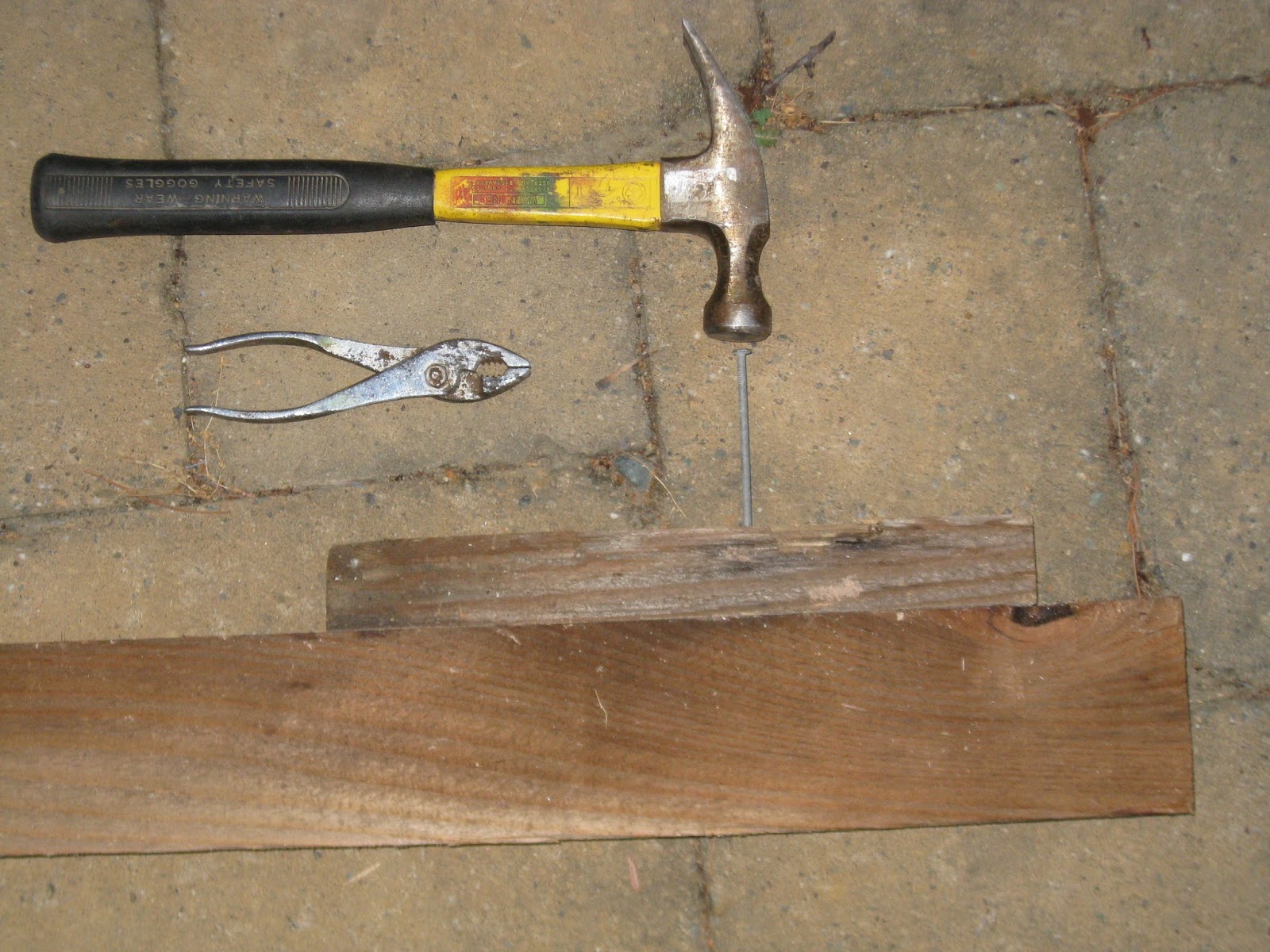
At one point, my grandfather was a carpenter for the Union Pacific Railroad in Oklahoma. They built whole towns of  buildings using wood and nails. 

Now the quiz:

Which tool in the picture below is the correct tool for driving nails into wood?

Both the hammer and the pliers are applications of  levers

Of course it is the hammer!; because it provides the useful leverage for the job.  It allows professional grade nail driving. 


Which tool below it the correct tool for knitting "gansey" yarn into weatherproof objects?

Shown above are 3mm circular needles and 2 mm DPN with 
a good knitting sheath

The DPN with knitting sheath provides much more leverage putting much less stress on the hands and the circular needles are just too big. And, those big needles leave big needle holes in the fabric; you are never going to get to "weatherproof" leaving such big holes in the fabric.  Use 2mm circs, and there still is too much stress on the hands.

What tools are needed  for the knit objects that  GT calls "ganseys" knit from 2,700 ypp yarns at 12 spi and 20 rpi?

A good knitting sheath with 1.3 mm needles.  It makes a lovely soft, warm, durable fabric that I also use for gloves and socks,  as in this very well tested (worn) sock knit from 6-ply, 1680 ypp wool yarn, knit at 12 spi and 16 rpi:

This is actually a heavier yarn than the old  Patons Beehive,
 thus this is a denser fabric - more like the Dunraven.

You are not going to get there with circular needles!  I know, I tried very hard for years. and years.  My grandfather could not have built cities of wood by pounding in all of those nails with a pair of pliers (although he always carried a pair of pliers in his pocket.)  No, he used the right tool - he used a hammer to drive those nails home.  Likewise, to knit the kind of fabrics that I like, I have to use DPN and a knitting sheath.


Raverly's take on tools;

Some groups have been taken over by populist bullies (e.g., boss cows) that tell us that  3.25 mm needles will produce the same fabrics as 2.4 mm needles. (If we slice that salami, they imply that any fabric can be knit on any sized needle.) Then, they get agrees and loves on such nonsense. Some, or even most, groups on Ravelry have become a popularity contest among folks with limited technical skill, that negates Ravelry's ability to be a clearinghouse of useful textile knowledge and skills. There is more speculation from ignorance than knowledge from actual compartive testing of  tools, materials, and techniques.  People who say this technique is better, are considered to "discriminate" against the folks who use that technique.  

Some will call this "sour grapes" on my part.  Not at all.   I make my rounds of the textile crafts world, and see what suits my needs.  I adopt any tool or technique that is better than what I have.

One thing that I see is that the boss cows at Ravelry spend so much time protecting their turf, and keeping the herd in line  that they have no time to improve their spinning and knitting.

I see the folks who told me ten years ago that it was not possible to hand spin 5-ply -gansey yarn, still spin as they did 10 years ago.  It took me months and months to spin that first kilo of 5-ply gansey yarn.  Since then, I have learned skills and made tools that allow me to hand spin the worsted spun 5-ply yarn for a good gansey or Guernsey in about 12 hours. I did not learn those new skills on Ravelry.  What I heard on Ravelry, was "Cannot be done."

I do not care how experienced spinners spin!

 I do care about what options they offer to beginning spinners.  Beginning spinners need to know that there are ways to spin fast. Beginning spinners need to know that there are ways to spin fine, both woolen and worsted.

Many folks that disparage my knitting sheaths, still knit the way they did when I started using knitting sheaths.

I do not care how anybody knits.  

I do care when experienced knitters make an effort to hide or wrongly  depreciate other knitting techniques. Beginning knitters need to know that there are ways of knitting warmer objects.  Beginning knitters need to know that there are ways to knit more durable objects.

Current tools and skills allow me to knit fabrics that cannot be hand knit without a knitting sheath - not even with a leather knitting belt - which is a wonderfully powerful tool.  The power of a knitting sheath is infinite. It allows me to hand knit fabrics that cannot be reasonably knit with any other knitting technique.  It transforms the impossible into  the possible. Beginning knitters and spinners need to know what is possible, so they can choose their tools, and what skills to learn.

On Ravelry, advanced spinning and knitting techniques are hidden behind what is popular. 

Gansey Nation is proud to knit commercial 1,200 ypp, 5-ply "gansey yarn" on 2.25 mm circular needles at 9 spi and 11 rpi, (99 stitches per inch^2) working half an hour per day 
 ( see http://www.ganseys.com/knitting-ganseys/preparation/stitch-gauges-and-sizing/ ). He does not think that ganseys can be knit "weatherproof''.    This is  the conventional wisdom among folks that never learned to use a knitting sheath, and which specifically includes Bishop Rutt.  It is the doctrine, and cannon, on Ravelry. They believe.  They are a community of Believers.   They are not a comunity of  testers looking for the best way to make textiles.

In contrast, I knit such yarns at 120 and 140 stitches per inch^2 respectively.  I got there by testing, testing, testing! These fabrics are absolutely weatherproof, but Gansey Nation/ Ravelry consider these impossible fabrics.   Impossible - because they never bothered to learn to use a knitting sheath. I agree, using circular needles, such fabrics are not practical to knit.  Gansey Nation considers the very concept of  a weatherproof gansey to be a myth.   This is well accepted at Ravelry.  I see it as simply a failure to learn the required knitting technique. Ravelry is not not a comunity of  testers looking for the best way to make textiles. Rather it is a community of Believers that  proselytize

However, if they had some intellectual curiosity, they would have done some testing.  Testing would have told them that the fast way to knit a weatherproof seaman's sweater is to use MacAusland 3-ply (or similar) yarns  ( http://www.macauslandswoollenmills.com/), and long 3 mm DPNs with a knitting sheath. HELL YES!, I knit  weatherproof seaman's sweaters from Patons Classic Wool Yarn!!  At 108 stitches per inch^2 it is as much knitting effort as knitting worsted 5-ply, and it is not as durable, so I would rather put the effort into more durable objects knit from worsted 5-ply.  Still, sometimes I need to prove the concept.

Paton Classic Wool
knit at 9 spi by 12 rpi
Weatherproof! (when oiled)
  And skin soft.
This is a nice fabric to live in when it is cold!.
(No, it cannot be knit with circular needles.) 

The truth is that it is more difficult to knit a weatherproof object from high-twist, worsted spun, 5-ply than from a woolen yarn. Woolen yarn can be a 40 hour path to a seaman's sweater that is weatherproof! It is a lot of work, but it is fast. By the modern knitting terminology, it is not a "gansey" but it is a seaman's sweater that is functional, very functional.  Ravelry has forgotten about functional!   Such a sweater at its best, will not be as warm (for it's weight) or as durable as one knit from high twist worsted yarn.  In the long run (years), a series of the more difficult to knit worsted sweaters takes less wool and less total knitting time than a series of  woolen spun sweaters. It was the dual virtues of great warmth from light weight and durability that made the British seaman's sweater, the Masterpiece of Hand Knitting.

I have never gotten good advice on Ravelry on how to knit really functional objects.  I have never seen anyone else post really good advice on how to knit warm objects.  The standard Ravelry advice is to knit loosely to produce "air space" as an insulator.  Nobody seems to like it when I point out that the right sized air space for warmth is 40 microns - twice the thickness of a Merino staple.  The other side of that 40 micron air space is that the fabric is very durable, by being firmly knit, and not bulky considering its great warmth. Great warmth with minimum bulk and weight is a great attribute in a textile for some uses.

I have never seen good advice on Ravelry on knitting durable objects - notably socks. My 3 principles are; 1) knit to fit (e.g., no stress points), 2) knit firmly, and 3) use worsted spun wool yarns with many fine plies. These points work, but they do not generate many "agree"s on Ravelry, quite the opposite

Many of the "experts" on Ravelry have or had close ties to the modern commercial yarn industry, e.g., they own or work for LYS.  They recommend what is commercially available.  LYS sell what is popular - not what produces great fabrics.  Yarns that produce great fabrics tend to have higher production costs and hence higher price points.  Go down to the designer botiques at a Needless Markup Department Store, and see which of the great fashion designers are using yarns like the yarns you can get at your local yarn store. Last dozen times I looked - zero.  Even the yarns used to make the knit goods at Textures in Santa Monica are not available at LYS.  I would not depend on Ravelry for a understanding of the universe of yarn. When was the last time you saw the 6-strand worsted that I like in the Ravelry database?  When was the last time you saw a 6-strand all wool, 1,680 ypp sock yarn (as above) in the  Ravelry database ? 

 Ravelry is a terrible place to be a beginning spinner or knitter because it tends to hide the paths to excellent textiles. Ravelry is dominated by "pretty textiles". However, "pretty" changes with fashion. Good textiles are both attractive and functional.  Excellent textiles, are very functional, very durable, very attractive, and have a timeless style and beauty that is immune to fashion.  I like excellent textiles. 

Saturday, June 18, 2016

US3 Needles


  1. Back in the summer of 2013, patknitter was saying that she could replicate my fabrics, using US3 needles. On July 28, 2013, I posted that I would buy her a case of brandy if she could actually do that. see http://gansey.blogspot.com/2013/07/a-case-of-brandy.html

  2. At that point, I had been working on how to hand-knit warmer fabrics for 14 years.  I understood all of the approaches.  I knew what needles produced which fabrics, and which fabrics could be produced with what needles.  I had done my homework.  I had knit 50 gallon  drums full of gauge swatches, most of which are still in my office.

  3. She never sent me proof of meeting the challange, and more recently she has been claiming  on Ravelry that she did meet the challange, but that I did not pay off. This was, and is deceitful, underhanded, and libel. The moderators of Ravelry: Guernseys - Ganseys - Knit Frocks group  have allowed this. 

  4. Her solution was to use a thinner yarn.  The thinner yarn made it a different fabric. The different yarn construction that she used was another degree of difference. There is simply no way that the fabric which she claims is the same as the pictured  fabric, is similar to the fabric pictured in the case of brandy post, and again below. Her claim has no merit.

  5. Moreover, attempting to knit the defined yarn on US3 needles at 5.5 spi produces a stiff board like fabric that is unlike the fabric pictured.  The pictured fabric has decent hand and drape. Been there, done that, enough to know what works, and what does not work.  patknitter is simply ignorant of how to knit either fine or dense fabrics of high quality and good wearability.

  6. 6-strand, cabled (wool sock yarn) knit (by me) at 8 spi on US3 needles
  7. This time the yarn grist is 1680 ypp rather than 
  8. the 850 ypp of the challange fabric.
  9. ~8 spi and 10 rpi


  10.  challange fabric knit from brandy post
  11. 6-strand cabled 850 ypp wool yarn
  12. ~ 6 spi and 11 rpi
  13. yarn grist matters in knitting

  14. Of course, I knew that finer yarns could be knit at 6 spi (or 8 spi) on US3 needles.  That is why I was careful to say the challange was to replicate the fabric, and not the stitches per inch, as she claims. The fabric of the challange cannot be knit on US3 needles, even when the yarn is stretched to its breaking point. That is determined by the physics of wool.

  15. A case of good brandy is thousands of dollars. I did not underestimate patknitter. I expected the required effort to be more than the tasks of Hercules - more like the labor of  Sisyphus.  However, with the tide of group sentiment running against me, I relented and offered to send patknitter enough of the right yarn to make her demonstration, in case her stash was not up to the task. However, I do feel that anyone that brags about being a "gansey knitter" should have a variety of multi-ply and multi-strand cabled yarns on hand.  In fact, the bully gansey knitter should have gauge swatches of such yarns ready at hand - all labeled with the type of  yarn and the needles used.

  16. It is shameful that Ravelry: Guernseys - Ganseys - Knit Frocks group (http://www.ravelry.com/groups/guernseys-ganseys-knit-frocks---fishermens-sweaters)
  17. has supported her wrongful claims and dishonesty.

  18. This kind of thing is why I have basically stopped using Ravelry.

  19. I find that groups like  Guernseys - Ganseys - Knit Frocks group  are full of misinformation like patknitter's claim that fine, dense fabrics can be knit on US3 needles by just knitting tighter, and keeping the yarn at a higher tension. In the past, on this blog, I have mentioned other Ravelry groups commonly posting misinformation,  but sometimes I took that as misdirection to preserve a competitive advantage. Now, I have to say that misinformation on Ravelry is simply endemic. Lies that I heard as I began knitting run rife.  It took me years to track down or discover better approaches. 

  20. Now, the lies get group approval and better technical approaches get group disapproval.  These days textile craftsmanship on Ravelry is discouraged in favor of mediocrity.  Easy is prefered to excellent. Fast is prefered to durable. Everything is focused on "hobby grade". There is no disciplined pursuit of excellence.

  21. Problems with patknitter's assertions include;
  22. First, wool yarn is simply not that elastic. A stitch formed by wrapping yarn around a 3.25 mm needle will always be larger than a stitch formed by wrapping yarn around 2.4 mm needle.  The yarn will break before the 7.5 mm of yarn measured for a stitch by a 2.4 mm needle, can be stretched to the 10.2 mm required to go around a 3.25 mm needle.

  23. Second, fabric knit with tightly held yarn tends to be stiff, board like, and have poor hand and drape. Fabric knit to the same spi/rpi by using smaller needles, with less yarn tension tends to have better hand and drape.  Finer needles tend to produce fabrics that are more comfortable to wear.  That  is because the yarn loosely knit on the finer needles is not under tension, so the fabric is relaxed and feels more pleasant.

  24. The bottom line is that the way to knit fine fabrics (Arans, Guernseys and Ganseys included) is to use the correct sized needles and  knit with just enough tension in the yarn to ensure that wrapping the yarn around the needle produces a uniform stitch.

  25. This is an important issue, both as a matter of  quality of knitting and the ergonomics of knitting.  However, patknitter gets many "agree"s and "love"s for her assertions that reduce the quality of knitting, and increase the chance of injury while knitting. She is a populist leader, and a bully.  She is not a proponet of excellence in knitting.  In the early days of Ravelry, there were many proponents of excellence on Ravelry. I do not see them posting on Ravelry any more.  I  suspect that like me, they have gotten tired of the tone of many groups on Ravelry.  A tone that emphasizes personality over technical merit.

  26. Knitters that accept what patknitter says as true cannot become excellent knitters. I do not care how well any particular knitter can knit, but I am pointing out that patknitter and others like her form a significant social barrier to technical excellence in textiles.  I think expert knitters and spinners should make a point of removing technical and social barriers to better knitting.  

  27. I am not interested in environments where mediocrity is king.  I do not participate in  groups that tolerate deceit. I do not like people that engage in libel.


Friday, June 17, 2016

The Truth

Feynman was famous for getting to the truth.  Like Feynman, I find that many "experts" get wound up in refinements that lead them into error.  Often these refinements are from problems with defining or bounding the system under study.

In modern hand spinning and knitting, the problem is often a failure to take enough measurements to establish a baseline. The result is pile of myth and misconceptions that constitute a set of lies. People accept the lies, and pass them around until the lies become accepted as the truth.  And, nobody stops to check the math.  I am tired of those lies.  I campaign for truth and accuracy in hand made textiles.  

I measure, and check all the math.  I get different answers from what circulate in craft circles.  I get the truth. However, everyone is so mired in the lies that few believe me.  That is not my problem.  My problem is to find the truth in a sea of mud.

The system is wool yarn.  I know the diameter of the wool staples. I can easily count the number of wool staples in the yarn's cross section.  I know the old "Spin Count" system - a  professional truth that is beyond doubt. I have a accurate gram scale and an accurate skeiner.  I know my grist as calculated from length and weight is the same as calculated by Spin Count. I have these measurements in dated contemporaneous log books that would be accepted as evidence by either US or English libel courts.  And, I can always take my wheel into court and spin a sample.  The grists that I spin are beyond dispute.

I have good clocks.  I measure how long it takes for me to spin a batch of yarn. I log my rate of spinning in contemporaneous log books that would be accepted as evidence by either US or English libel courts.  And, I can always take my wheel into court and spin a sample.  My rate of spinning is beyond dispute.

Ask a modern spinner how fine a particular single is and the term "fine as frog hair", may be invoked. That implies that the yarn is as fine as can be practically hand spun, which is generally a lie. It it the lie of diminished expectations.  Generally, singles described as "fine as frog hair" have a grist of less than 25,000 ypp. Even Alden Amos never got around to spinning much finer than 25,000 ypp.  However, traditionally professional hand spun singles were classed as "fine" only for grists of  33,600 ypp and higher.   Today, most modern hand spinners have never "seen" hand spun yarns finer than 25,000 ypp.  Oh, they walked past such yarns in the Louvre, Victoria and Albert,  St-Janshospitaal, Getty, and etc, but they never really saw the yarns as a standard for modern hand spinning.  Modern spinners assume that we can no longer spin that fine. That is very wrong.  It is "foolish".

I know the grists of the yarns that I knit with, and I know the diameter of the needles that  I use to knit. The combination of yarn grists and needle sizes that I use were common among fine expert knitters at one time. Now people look at these stitch gauges and do not believe them.  These combinations of yarn grists and needle sizes were used because they produce lovely fabrics.  Fabrics that were/are warm and durable. Fabrics that had/have wonderful drape and hand. These fine fabrics are not commonly hand knit these days.  Most modern knitters tend to knit looser. Modern knitters tend not to use knitting belts and knitting sheaths, which makes finer knitting easier and faster, much faster!  

One of the lies that I really hate is that one can knit very fine fabrics on big (US2) needles, just by knitting tighter.  No!, not even if you are  knitting so tight that the yarn is breaking in your hands.  And, fabrics knit with highly tensioned yarns do not have the nice hand and drape of fabrics knit at the same number of stitches per inch, but achieved by knitting more loosely with smaller needles.  

I really do not care how you spin or knit.  I do care that the crafts of fine hand spinning and fine hand knitting are preserved.  I care that someone does fine hand spinning and fine hand knitting.  I teach how wonderful yarns can be spun. I know that it is more effort than many amateurs are willing to expend.  That is not my problem.  My problem is to elucidate the tools, methods, and materials that allow the reasonable production of fine yarns and fine fabrics.

I have gone where most modern spinners have not. Even spinners like Alden Amos did not explore the speed of DRS to allow spinning finer singles. I had to balance  precariously on his shoulders to look beyond what AA did. And, he was a giant among spinners.  I have made a lot of mistakes, but as I go forward I find better solutions, and I report them. Whenever I find a different way, I test the new way against the best way that I knew previously, and then use whichever way proves better. Details matter. Often, one approach is better for a particular application, while another approach is better for other applications.  Likewise, one approach will be worse for a particular application. There is no best way, there are only better ways to do particular applications.  And, there is always a better way for every application. 

The problem is always finding the most appropriate way for this application with the budget, scope, and schedule available.


The truths:

  • Higher grist singles are worth the effort, because finer singles lead to fabrics with nicer hand and drape. (Go into your "Needless Markup Department Store" and look at the grist of the yarns in the fabrics with nicer hand and nicer drape.)
  • High grist singles are much easier to spin with higher speed flyer/bobbin assemblies. Higher speed (RPM) is most easily achieved with double drive set so there is little slip in the system.  Therefore, to achieve higher speed, differential rotation speed control must be built into the system or the single will simply break off.  
  • DRS controlled flyer/bobbin systems will run 2 or 3 times faster than bobbin lead systems, flyer lead systems, or double drive systems that allow slippage. These days, RPM is easily measured with a digital tachometer or strobe system.  These are now available and inexpensive. There is no excuse for not understanding this issue.  As an old bicycle racer, my normal cadence is ~90, which yields ~3,200 RPM with the the AA #1 /flyer/bobbin assembly, and ~ 3,600 RPM with the AA #0 /flyer/bobbin assembly. None of Alden Amos' treadle wheels were every designed to go that fast.  Alden never expected me to run those flyer/bobbin assemblies faster than 2,000 RPM.  SG's wheels do not go that fast.
  • To run at speeds of more than 3,000 RPM, wheels must be double treadle to spread the stress of the power delivery through the full rotation of the wheel. Drive belts must be designed to deliver more power, and if cotton or linen, must have belt dressing. And, belt dressing will build up on the flyer/bobbin assembly whorls.  Whorls should be board cut, despite the fact that the end grain accumulates belt dressing. Belt dressing accumulating in the whorls changes the DRS!  Drive belts must be dressed and whorls cleaned on a regular basis. Oiling is critical. Service the wheel every time you take a "bio-break".
  • With a DRS controlled wheel, wool can be spun at its spin count. (http://store.msuextension.org/publications/AgandNaturalResources/MT198380AG.pdf )
  • Fine wool can be easily spun at 10 or 20 or 30 hanks of 560 yards per pound rather quickly.   Almost any wool can be spun at 10 hanks per pound (5,600 ypp, 12.3 m/gram, e.g., 9 twists /inch) at about a hank per hour.  Fine wool can be spun into 45,000 ypp (~100 m/gm) singles at a rate of about a hank per day. Ten grams of 2-ply, 20,000 ypp yarn takes 3 long days to prepare. A hank of 80s single weighs just under 5.7 grams.  I call them "little shits" because of the difficulty I had in managing the first few hanks that I made.  Henry Clemes is developing a reel that makes managing such singles easier. 
  • Fine singles need to be blocked.
  • Quality of singles is highly dependent on quality of fiber preparation. 
  • A good spinner can keep 2 or 3 good knitters busy.
  • A good weaver can keep 2 or 3 good spinners busy.

  • Finely knit fabrics, knit using fine yarns and fine needles have superior hand and drape. Such fabrics can be cool or very warm. 
  •  Finely knit fabrics have superior durability. If you want socks that last, choose yarns with more plies or strands and finer needles. The finer spinning will affect the time to produce much less than the extra knitting effort resulting from using finer yarns.
  • If you want warmer or more weatherproof fabrics, finer needles are the best path.
  • Knitting belts are a great general purpose tool.  Knitting belts are to knitters, what pliers are to mechanics.
  • Knitting sheaths are more specialized tools which allow knitting things that cannot be practically knit using circular needles or even DPN with a knitting belt. Knitting sheaths are to a knitter what a rachet and socket set, and an air impact wrench, and an electric impact driver are to a mechanic.  
The bottom line is that you may not understand how the Hutchinson 3G access technology in your cell phone works, but that does not mean that somebody at the phone company has fooled himself.  The fact that the technology works is proof that nobody was fooled.  DRS spinning technology has functioned perfectly for centuries. It works.  Knitting sheaths have functioned perfectly for centuries.  It works.  It is simply a matter that you may not have been paying close attention to each of these technologies.   

Tuesday, March 01, 2016

Love and Hate of the Classics

Over the years, I have had a love and hate relationship with Paton's Classic Wool (PCW).


A large swatch of Paton's Classic Wool knit on 2.4 mm needles was the  was the first clue that I was on the right track.  However, ultimately I generally decided that  the fabric that I was producing was not worth the effort, resulting in a large number of WIP sitting around.  Finer needles seemed like more effort for not that much better fabric.

Exploration of blunt needles over the last few months has allowed exploration of knitting PCW on finer needles.

Knit on 2 mm needles, I get 9 spi and 12.5 rpi for 112.5 stitches per square inch, and on 1.6 mm needles I get 9.5 spi and 12.5 rpi for 118.75 stitches per square inch.

While the numbers are similar, the fabrics are different. In fact, the numbers would seem not that far off of the 7 spi by 10 rpi (70 stitches per square inch),  that I get with 2.38 mm needles, and yet the 3 fabrics are very different.

Knit on the 1.6 mm  needles, the fabric has a smoother surface that allows water to just run off in ways that just does not happen with the fabrics knit on larger needles. It is also surprisingly abrasion resistant.


Knit on the 2 mm, the fabric is thicker and has more surface texture, but is still very weatherproof.  The extra thickness/ softness gives better drape, and the surface can be brushed into a very nice nap.  Over all, the fabric knit on 2 mm needles is softer and wickedly warm.  It is a nice Guernsey fabric, that is much, much warmer than what most folk knit as "gansey" fabric.

These fabrics are firm, so they need to be knit to fit, rather than knit from a generic pattern.  However, these fabrics have more stretch and elastisity than woven fabrics.  They can form a warm second skin that allows free and easy movement.  And, they have tremendous warmth for the weight.

In many ways, these are fabrics that I have been trying to knit since 1998, but I did not have the tools and skills to knit.  Oh, there were hints, such as the fact that "mak'n pins", were often only 1.5 mm in the old days.  When I first read that, I should have jumped forward to 1.5 mm needles.  And, when I read about how long it took a professional knitter to make a set of needles.  That should have told me that they are not tapered to the tip, but rather blunt.

And, you are not going to get to PCW knit at 70 stitches per square inch with circular needles. I have knit small swatches of such fabrics on circs, but that convinced me that sweaters from such fabrics were not plausible. I tried over and over. Swatches of these fabrics can be knit with a knitting belt, but those swatches told me that that it imposed significant wear on my knitting belt. so I moved on to wooden knitting sheaths.  Maple, rosewood, and even cherry, endure the stress very well. I got here using 12" blunt needles with my latest generation of knitting sheaths.

My point is not that PCW is the best yarn, only that it is a very good yarn, and a great value. And it sets new standards for hand spun - it tells us that rather generic woolen yarns can be knit into great objects. It opens the door for finer fabrics knit from finer woolen yarns.  And, it suggests that generic worsted spun yarns can produce great fabrics. And, if that is the case, why is there such a variance in price?


The evolution of my knitting sheaths, 
with newer sheaths to the left.
The needles on the left are old.


The horizontal knitting sheaths were made in the last 3 months, and the vertical sheaths are older.   The gansey needles are 10 years old. (And, for large objects, longer needles are faster!)  Sizes of needles in photo range from US1 to US0000, and all can be accommodated with various needle adapters in the photo.  Special needle adapters are made for swaving.  Number and color of bands on the adapters indicate size, and placement of the band(s) indicates gansey or swaving. These needle adapters work better with the swaving needles than the knitting sheaths that the swaving needles were originally made to fit.  (However, currently the swaving needle adapters work better with my Durham style knitting sheaths. The Durham sheaths put the swaving needles into a better ergonomic zone.)

Note that the needle adapters allow use of one sheath with many different sets of needles.  The knitting sheaths work much better when they are made to fit one style of work belt, and are then used with  the belt they were made to fit.  Between the old and new knitting sheaths are (on the block of maple)  examples of  the threaded inserts currently used to attach the needle adapters to the knitting sheaths.

In the context of thousands of hours of planned knitting, taking a couple of hours to make a knitting sheath that might increase productive by a couple of percent is perfectly rational, regardless of the discount rate.   When those same knitting sheaths move better fabrics from the realm of plausible dreams into practical reality, it is silly, not to be making better and better knitting sheaths.

I keep the old knitting sheaths around to later, check, verify, and validate the data related to each transition.  As Feynman said, "It is important not to  fool yourself."