Showing posts with label fast hand spinning. Show all posts

Monday, June 20, 2016

Ravelry

At one point, my grandfather was a carpenter for the Union Pacific Railroad in Oklahoma. They built whole towns of  buildings using wood and nails. 

Now the quiz:

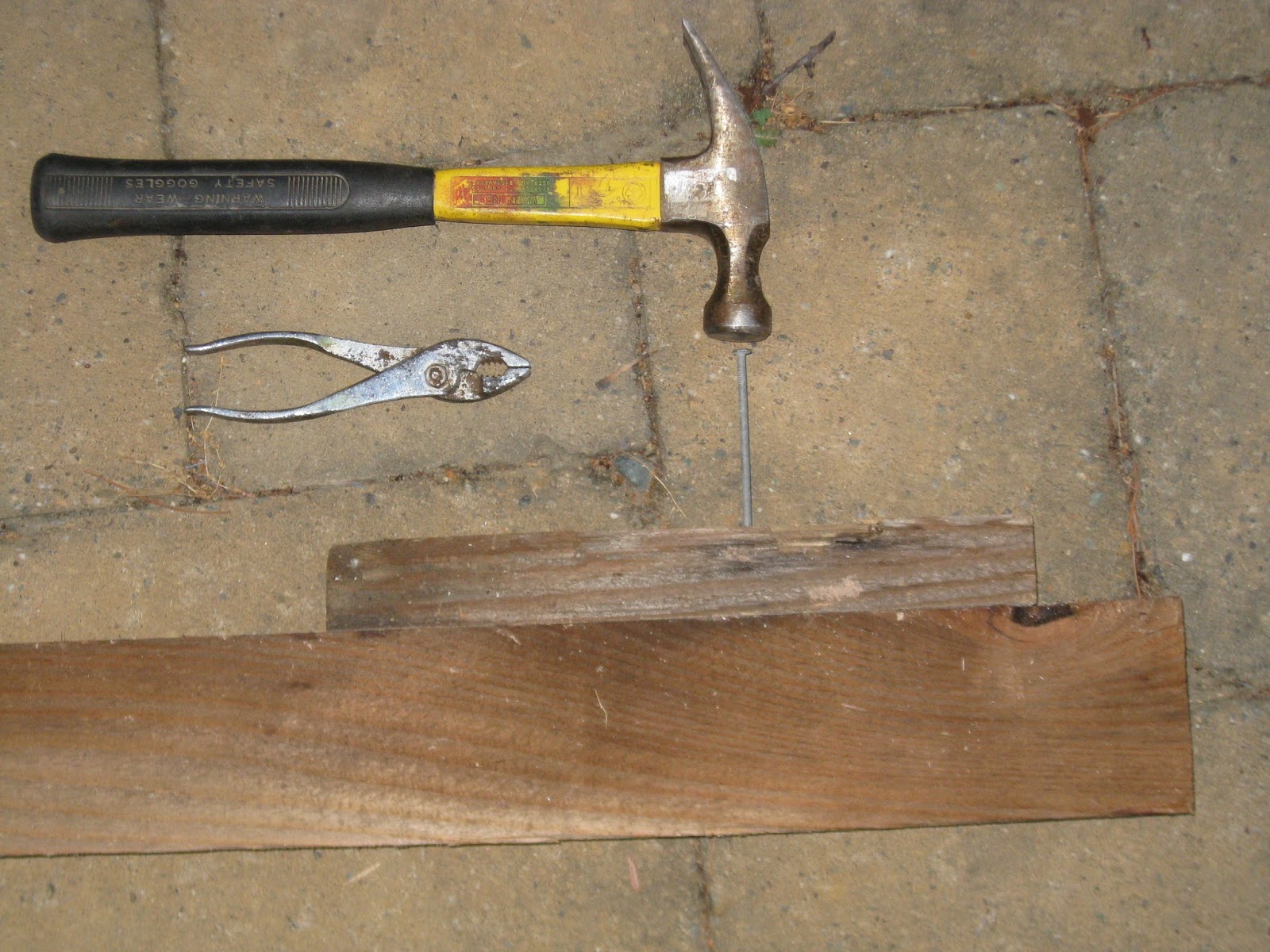
Which tool in the picture below is the correct tool for driving nails into wood?

Both the hammer and the pliers are applications of  levers

Of course it is the hammer!; because it provides the useful leverage for the job.  It allows professional grade nail driving. 


Which tool below it the correct tool for knitting "gansey" yarn into weatherproof objects?

Shown above are 3mm circular needles and 2 mm DPN with 
a good knitting sheath

The DPN with knitting sheath provides much more leverage putting much less stress on the hands and the circular needles are just too big. And, those big needles leave big needle holes in the fabric; you are never going to get to "weatherproof" leaving such big holes in the fabric.  Use 2mm circs, and there still is too much stress on the hands.

What tools are needed  for the knit objects that  GT calls "ganseys" knit from 2,700 ypp yarns at 12 spi and 20 rpi?

A good knitting sheath with 1.3 mm needles.  It makes a lovely soft, warm, durable fabric that I also use for gloves and socks,  as in this very well tested (worn) sock knit from 6-ply, 1680 ypp wool yarn, knit at 12 spi and 16 rpi:

This is actually a heavier yarn than the old  Patons Beehive,
 thus this is a denser fabric - more like the Dunraven.

You are not going to get there with circular needles!  I know, I tried very hard for years. and years.  My grandfather could not have built cities of wood by pounding in all of those nails with a pair of pliers (although he always carried a pair of pliers in his pocket.)  No, he used the right tool - he used a hammer to drive those nails home.  Likewise, to knit the kind of fabrics that I like, I have to use DPN and a knitting sheath.


Raverly's take on tools;

Some groups have been taken over by populist bullies (e.g., boss cows) that tell us that  3.25 mm needles will produce the same fabrics as 2.4 mm needles. (If we slice that salami, they imply that any fabric can be knit on any sized needle.) Then, they get agrees and loves on such nonsense. Some, or even most, groups on Ravelry have become a popularity contest among folks with limited technical skill, that negates Ravelry's ability to be a clearinghouse of useful textile knowledge and skills. There is more speculation from ignorance than knowledge from actual compartive testing of  tools, materials, and techniques.  People who say this technique is better, are considered to "discriminate" against the folks who use that technique.  

Some will call this "sour grapes" on my part.  Not at all.   I make my rounds of the textile crafts world, and see what suits my needs.  I adopt any tool or technique that is better than what I have.

One thing that I see is that the boss cows at Ravelry spend so much time protecting their turf, and keeping the herd in line  that they have no time to improve their spinning and knitting.

I see the folks who told me ten years ago that it was not possible to hand spin 5-ply -gansey yarn, still spin as they did 10 years ago.  It took me months and months to spin that first kilo of 5-ply gansey yarn.  Since then, I have learned skills and made tools that allow me to hand spin the worsted spun 5-ply yarn for a good gansey or Guernsey in about 12 hours. I did not learn those new skills on Ravelry.  What I heard on Ravelry, was "Cannot be done."

I do not care how experienced spinners spin!

 I do care about what options they offer to beginning spinners.  Beginning spinners need to know that there are ways to spin fast. Beginning spinners need to know that there are ways to spin fine, both woolen and worsted.

Many folks that disparage my knitting sheaths, still knit the way they did when I started using knitting sheaths.

I do not care how anybody knits.  

I do care when experienced knitters make an effort to hide or wrongly  depreciate other knitting techniques. Beginning knitters need to know that there are ways of knitting warmer objects.  Beginning knitters need to know that there are ways to knit more durable objects.

Current tools and skills allow me to knit fabrics that cannot be hand knit without a knitting sheath - not even with a leather knitting belt - which is a wonderfully powerful tool.  The power of a knitting sheath is infinite. It allows me to hand knit fabrics that cannot be reasonably knit with any other knitting technique.  It transforms the impossible into  the possible. Beginning knitters and spinners need to know what is possible, so they can choose their tools, and what skills to learn.

On Ravelry, advanced spinning and knitting techniques are hidden behind what is popular. 

Gansey Nation is proud to knit commercial 1,200 ypp, 5-ply "gansey yarn" on 2.25 mm circular needles at 9 spi and 11 rpi, (99 stitches per inch^2) working half an hour per day 
 ( see http://www.ganseys.com/knitting-ganseys/preparation/stitch-gauges-and-sizing/ ). He does not think that ganseys can be knit "weatherproof''.    This is  the conventional wisdom among folks that never learned to use a knitting sheath, and which specifically includes Bishop Rutt.  It is the doctrine, and cannon, on Ravelry. They believe.  They are a community of Believers.   They are not a comunity of  testers looking for the best way to make textiles.

In contrast, I knit such yarns at 120 and 140 stitches per inch^2 respectively.  I got there by testing, testing, testing! These fabrics are absolutely weatherproof, but Gansey Nation/ Ravelry consider these impossible fabrics.   Impossible - because they never bothered to learn to use a knitting sheath. I agree, using circular needles, such fabrics are not practical to knit.  Gansey Nation considers the very concept of  a weatherproof gansey to be a myth.   This is well accepted at Ravelry.  I see it as simply a failure to learn the required knitting technique. Ravelry is not not a comunity of  testers looking for the best way to make textiles. Rather it is a community of Believers that  proselytize

However, if they had some intellectual curiosity, they would have done some testing.  Testing would have told them that the fast way to knit a weatherproof seaman's sweater is to use MacAusland 3-ply (or similar) yarns  ( http://www.macauslandswoollenmills.com/), and long 3 mm DPNs with a knitting sheath. HELL YES!, I knit  weatherproof seaman's sweaters from Patons Classic Wool Yarn!!  At 108 stitches per inch^2 it is as much knitting effort as knitting worsted 5-ply, and it is not as durable, so I would rather put the effort into more durable objects knit from worsted 5-ply.  Still, sometimes I need to prove the concept.

Paton Classic Wool
knit at 9 spi by 12 rpi
Weatherproof! (when oiled)
  And skin soft.
This is a nice fabric to live in when it is cold!.
(No, it cannot be knit with circular needles.) 

The truth is that it is more difficult to knit a weatherproof object from high-twist, worsted spun, 5-ply than from a woolen yarn. Woolen yarn can be a 40 hour path to a seaman's sweater that is weatherproof! It is a lot of work, but it is fast. By the modern knitting terminology, it is not a "gansey" but it is a seaman's sweater that is functional, very functional.  Ravelry has forgotten about functional!   Such a sweater at its best, will not be as warm (for it's weight) or as durable as one knit from high twist worsted yarn.  In the long run (years), a series of the more difficult to knit worsted sweaters takes less wool and less total knitting time than a series of  woolen spun sweaters. It was the dual virtues of great warmth from light weight and durability that made the British seaman's sweater, the Masterpiece of Hand Knitting.

I have never gotten good advice on Ravelry on how to knit really functional objects.  I have never seen anyone else post really good advice on how to knit warm objects.  The standard Ravelry advice is to knit loosely to produce "air space" as an insulator.  Nobody seems to like it when I point out that the right sized air space for warmth is 40 microns - twice the thickness of a Merino staple.  The other side of that 40 micron air space is that the fabric is very durable, by being firmly knit, and not bulky considering its great warmth. Great warmth with minimum bulk and weight is a great attribute in a textile for some uses.

I have never seen good advice on Ravelry on knitting durable objects - notably socks. My 3 principles are; 1) knit to fit (e.g., no stress points), 2) knit firmly, and 3) use worsted spun wool yarns with many fine plies. These points work, but they do not generate many "agree"s on Ravelry, quite the opposite

Many of the "experts" on Ravelry have or had close ties to the modern commercial yarn industry, e.g., they own or work for LYS.  They recommend what is commercially available.  LYS sell what is popular - not what produces great fabrics.  Yarns that produce great fabrics tend to have higher production costs and hence higher price points.  Go down to the designer botiques at a Needless Markup Department Store, and see which of the great fashion designers are using yarns like the yarns you can get at your local yarn store. Last dozen times I looked - zero.  Even the yarns used to make the knit goods at Textures in Santa Monica are not available at LYS.  I would not depend on Ravelry for a understanding of the universe of yarn. When was the last time you saw the 6-strand worsted that I like in the Ravelry database?  When was the last time you saw a 6-strand all wool, 1,680 ypp sock yarn (as above) in the  Ravelry database ? 

 Ravelry is a terrible place to be a beginning spinner or knitter because it tends to hide the paths to excellent textiles. Ravelry is dominated by "pretty textiles". However, "pretty" changes with fashion. Good textiles are both attractive and functional.  Excellent textiles, are very functional, very durable, very attractive, and have a timeless style and beauty that is immune to fashion.  I like excellent textiles. 

Sunday, August 23, 2015

Craftsman

Craftsmen (male, female, or other) make quality goods. They make better quality goods than folks that are just out to make a buck.  Hobbyists may actually produce higher quality objects, because they are not limited by resources.  That is, a hobbyist can put unlimited time and resources into an object, but craftsmen must keep the cost of objects within the price range of their clients.  Craftsmen produce the best possible product at the most reasonable price, all things considered.


If  someone needs a warm object, then a craftsman knitter will knit an object that is as warm as is required.  If someone needs a durable object, then the craftsman knitter will knit an object that is a durable as it required.  If someone needs a lace christening gown, then the craftsman knitter will knit an object that is elegant enough to uphold the status of the family. Along the way, for each product, the craftsman will make the compromises needed to meet the requirements including cost and schedule. The craftsman can work to a bid/plan/schedule so the cost of the object is as agreed with the client, and the craftsman does not lose money on the project.


Most modern spinners see spinning as a hobby.  They do not care about the cost of the yarn that they produce, or speed of production. And, they are not interested in making better yarn, they only want soft, pretty yarn.  


In contrast, I see spinning as a craft. I want better yarn. I want stronger yarn, I want more flexible yarn, I want more durable yarn and so forth.  And, I want less expensive yarn. I want yarn that has fewer man hours invested in it. I put a lot of effort into working out how to spin faster with less effort. I want yarn that that is just as good but is made from lower cost fibers. That is, I seek to find better fibers at a lower cost. And, I seek yarns that require less fiber, for the same warmth, durability, or strength.  Every spinning project that I do has requirements, schedule, and budget.  When a spinning project does not meet its requirements, schedule, or budget, I pull the plug on it. 


I started spinning because I was a knitter, and I was not happy with the available mill spun yarns. I wanted better.   When I started spinning I was told that it was not possible to hand spin the  worsted spun, 5-ply sport weight yarns, called "gansey yarn".  I was told these yarns had never been hand spun.  It took me 9 months before I was hand spinning such yarns, but the process was so slow as to be impractical.  The yarns I was making were better than mill spun, but they were too expensive.  I had to work out how to make them less expensively.  The obvious solution was to spin faster.  Today, I spin much faster.  That means that my yarn is much less expensive.  I like better yarns that are less expensive.


The first step to spinning faster was to understand differential rotation speed (DRS) as discussed in Alden Amos and the Victorian authors. DRS allows the flyer/bobbin assembly to run at much higher speed, and it changed the nature of the drafting, allowing true worsted yarns to be produced much faster. Part of this step was learning different spinning techniques that allowed me to take advantage of DRS. This really was an effort. This development of other spinning techniques was perhaps the single most important aspect of the spinning faster process. 


The second step was to have Alden Amos make me faster flyers.  I considered having him make me a custom wheel, but the Ashford Traditional drive wheel actually produced more speed than the wheels Alden was making at the time.  That is, an engineering analysis selected the Ashford drive wheel over the Alden product.  It was not a capricious or sentimental decision.  Part of this step was the development of "gang whorls" so that as the effective diameter of the bobbin changed,  I could change whorls rather than stopping to wind off.  I had to design and fabricate the gang whorls. This facilitated the production of longer, continuous singles.


The third step was to make an accelerator for my Alden Amos/DRS/Ashford hybrid.  Again it was an engineering analysis.  It was not a capricious or sentimental decision.  The result was the accelerator/Alden Amos/DRS/Ashford hybrid with advanced drafting technique.


The net result is that my wheel spins woolen singles between 2 and 4 times faster than any  wheel on the market.  My wheel spins worsted singles between 3 and 10 times faster than any wheel on the market.  This was not an accident. It was attention to detail, and doing the engineering correctly.  It was understanding the technique so I could make the required tools.  It was understanding the tools, so I could develop the technique.


Since spinning/twist insertion is the single largest cost in spinning, my yarn is much less expensive than other hand spun. I (the knitter and weaver) is the customer for I (the spinner).  I (the knitter and weaver) like the lower cost of the faster spinning. I (the knitter and weaver) like the shorter delivery times for the faster spinning. All around, I like the faster project development and production cycles. 


This allows me to (inexpensively) dream-up, produce, and test yarns that are not made by mills and which I have never seen before.  I learned to make more flexible yarns.  I learned to make stronger yarns.  I learned to make more durable yarns, and so forth. I would never have had time for this experimentation if I had to spin as slowly as most spinners spin. Without DRS, you will never really understand sock yarn. 


I can plan an object, spin and test samples of a yarn that I have never before spun, and then spin and produce the object, all in a reasonable time frame. I (the knitter and weaver) know in advance what the cost of the yarn will be that I (the spinner) will produce for the project. 


I am a craftsman spinner with just one rather demanding client.  Myself.  If I spin better and faster, then I improve my product and lower my costs.  Then, I am happy.

Saturday, August 01, 2015

GW 2

These days, I do not keep a great wheel.  I do have 2 motor driven spindles and 2 spindles that fit onto my treadle wheel.  None of these are as impressive to look at as a GW, but they are faster. And, they all allow me more use of both hands for drafting true worsted.

The motor driven spindles are easy to pause or stop, but hard to reverse.  Therefore, I had to learn how to wind-on with the spindle going in the same direction as when spinning.  It can be done, the answer is "out there", and I have no interest in teaching driven spindle technique.

If one does not have to reverse the spindle, then one does not have to stop, or pause the spindle, and the spindle can rotate continuously in the same direction.  One CAN spin a entire hank of single on a great wheel without ever reversing the wheel to wind on.  This can be much faster/easier than reversing rotation to wind-on depending on the inertia of the rotating system.

Nevertheless, the spindle must be slowed at various points in the spinning/drafting/wind-on process. Even though the spindle/wheel always rotates in the same direction, the slowdown/speedup cycle wastes energy. And, the wind-on cycle slows production of yarn. 

A spindle on my treadle wheel can insert twist many times faster than the flyer/bobbin assembly,  but the DD flyer bobbin assembly will spin and wind-on much more yarn in a minute or an hour or a day.  One of the motor driven spindles can insert twist many times faster than either spindle on my treadle wheel, but net production of single is not much different. Net production of spun yarn by a spindle is limited by the nature of its cycle, rather than by its peak speed.

A DRS flyer/bobbin assembly is the fastest hand spinning device for most natural fibers. Ring spinning can be faster for silk, but that is a specialized application.  Yes, those old double drive spinning wheels were the fastest way to spin.  They used the two loops of the drive band to synchronize the rotation of the bobbin and flyer to insert just the right amount of twist as the yarn was wound in at just the correct rate for the inserted twist. They did not have the drive band slip that is built into modern double drive wheels.  The result is that a double drive wheel without drive band slip that can produce singles much faster than a great wheel.  This is a truth that you have heard before.  It is just that all  modern DD wheels do have drive band slip and thus, spin more slowly than a GW.   In fact, a DRS flyer/bobbin assembly can produce true worsted spun yarn 5 times faster than a great wheel.  Every sock knitter should think about that.

And, since DRS is faster, sock yarns of more and finer (true worsted spun)  plies are possible.  These are very nice yarns that are simply out of reach of even the best spinners using a GW.  The use of DRS opens up spinning true worsted 5-ply gansey or even 10-ply Aran yarns.  And, it makes spinning true worsted warp for the loom much more feasible.

 On the other hand, a DRS flyer/bobbin assembly requires real skill to setup and maintain. I have seen two old DRS double drive wheels where the original DRS ratios had been "repaired", and the wheel converted to  modern standards.   As a result of the repairs, they could spin lower grist yarns, but could only do so --- slowly. These had been true collector's items and the owners were very proud of how fast they could spin -- if they only know how fast those wheels had been originally designed to spin, they would have been agast!   The difference between these wheels as designed and these wheels as "repaired" was only millimeters, and yet it made a huge difference in their performance. If one can teach the basics of using a GW in a 4-day workshop, then I would say that one could teach the basics of using DRS in a 4-week workshop.

Yes, Holin, my old Ashford can spin/ply a 500 yd hank of sport weight, worsted spun, 5-ply (gansey yarn) in an easy day.  How long does it take your GW?  In less than 14 hours, I can spin/ply a 500 yd hank of  worsted spun, 3x2-ply cabled, 1,600 ypp "sock yarn".  How long does that take your GW?  Shall we set up a demonstration in front of a judge and jury?  I want spinners like Judith MacKenzie and Stephenie Gaustad who know, and appreciate,  worsted spun yarns involved.

I have only been spinning for 6 years. (And, I was sick with Lyme Disease for much of that time!)  How long have you been spinning?  What will I be spinning when I have spun as long as you have been spinning?


Friday, January 23, 2015

RPM update

The new geometry is faster, and it took me months to learn to use it.  Net drive ratio is on the order of just over 58. so with my normal treadle cadence of 90, I should get just over 5200 rpm of spin insertion. I have not even come close.

Drive band(s) slip was on the order of 20%, meaning actual twist insertion was only about 4,200 rpm.

However, 4200 was as fast as I could spin for months.  Now, I am more comfortable with that kind of speed.

Thus, last night, some more tension on the drive bands, (using a pair of 8 oz weights with a spring between them), and this morning twist insertion is up around 4,800 rpm.

For 9 tpi worsted, that is ~14 yards per minute, which is faster than I can pull fiber off the distaff, so I am working on a new distaff design and geometry.

On the other hand it will do 17 tpi shirting singles at ~ 8 yards per minute, which is a nice pace.

When I first sat down at the Traddy some years ago, it felt like a race car that wanted to go faster. Now, it feels like a race car that is running near its design speed. It is like an old Ferrari,  tuned by the factory race team, running time trials at Sebring.  It is going almost as fast as it can go.

http://www.sebringraceway.com/sebring-events/12-hour-race/12-hour-race-information

Spinning oil
(applied frequently)

Commercial cap  and later ring spinning frames ran at about 5,000 rpm.  My best guess is that 5,000 rpm is about the maximum speed for flyer/bobbin spinning to run on a routine and sustained basis.

Do I  think Scotch tension systems can run this fast - not likely.  Single drive, bobbin lead (Irish Tension) is mechanically more like the  cap spinning devices.  On the other hand there were hundreds and hundreds of patents for bearings and geometries before the commercial cap spinners were able to run that fast,  and then the technology was only used for a few years, before better spinning devices came along.  I think an Irish tension is a hard way to get to 5,000 rpm.  That said, I do use Irish Tension for plying with jumbo bobbins, and it runs at - 3,000 rpm using a ratio of 33:1.  Irish Tension at 3,000 rpm is easy.

A note on ergonomics.  If you do not have to spin as long to get a project done, then there is less  total stress on the body.  And, DRS hugely reduces the stress of spinning - particularly on the drafting hand, drafting hand wrist, and drafting hand forearm. I could not spin as much as I do, if my drafting hand had to resist the ongoing tension of Scotch tension.

My lazy kate has a tension box so there is essentially no stress on my hands while plying.  I just sit there and treadle, pausing every so often to move the flyer heck, and place new bobbins of singles on the lazy kate. 

Monday, January 05, 2015

Limits to spinning speed

One limit to spinning speed is how fast one can draft.  I would say that the limit imposed by drafting is on the close order of 8 to 10 yards per minute.  Certainly, one can draft much faster, but the quality of the yarn goes down dramatically.

One can draft woolen much faster, but woolen requires more twist, so the flyer/bobbin must rotate much faster.  1,700 ypp singles require only 4 to 6 tpi, so one can easily draft and spin these yarns well in excess of 8 yards per minute with a wheel that has a flyer/bobbin assembly running at 1,200 rpm.  I have little interest in these yarns, and have not explored the limits.

Thus, here you see that modern commercial wheels will allow one to spin worsted weight yarn as fast as is useful, and this is a rational for making wheels designed to spin at 1,200 rpm.

Lace weight singles (10s, 5,600 ypp) need 9 to 12 tpi depending on whether they are spun worsted or woolen.  Thus, a 1,200 rpm wheel spinning woolen lace singles is down to ~100 inches/min or ~2.7 yards/minute. However, lace weight singles can also be drafted at 8 yd/min, but you need a flyer bobbin assembly  running at 3,500 rpm to insert that much  twist and form a woolen lace single into a  competent yarn.  Looking at the last post, we know you are not going to get here with small whorls and a "screw tensioner" on your wheel.

Shirting weight yarn (40s, 22,400 ypp) was a common product made by traditional hand spinners for weaving.  A bolt of shirting fabric requires ~250,000 yards of yarn, so spinners spun a lot of this yarn. Typical twist is 17 tpi, so spining the 8 yd/ min that can be reasonably drafted requires a wheel running at almost 5,000 rpm.  These days my wheel has no problem running at over 4,000 rpm for sustained periods.  With my wheel, spinning the yarn for a bolt of shirting would be 6 months sustained and continuous full time work.  Having a fast wheel is no assurance that a spinning project can be done quickly. The amount of spinning required to support the weaving of fine fabrics is stunning. Shirting was also plied into hosiery yarns.

Yesterday, during the Dowton Abby bingewatch, I was spinning 10s from (commercial) combed long wool at between 5 and 8 yards per minute.  This was using DRS, so if my drafted grist drifted off spec., I would break off.  Thus, a yard of finished 5-ply yarn costs me ~ a minute, but during bingewatch, the minutes are free, so the yarn is free  :  )  Spinning 10s at 5 to 8 yd/minute can be easy.

Some lace spinners talk about spinning 30,000 ypp lace singles.  Worsted spun, such singles require ~20 tpi, so  I am happy to spin 5 or 6 yards / minute on my wheel, and a 1,000 rpm little Shetland wheel running at 1,000 rpm will produce ~50 inches or 1.4 yards per minute.

30,000 ypp (54s)  is far, far beyond cobweb. As a knitting yarn it needs to be plied, so finished yarn production is on the order of  22 yards per hour.  Much of what many lace spinners claim to be 30,000 ypp is no more than shirting weight. In fact, at one time the best Shetland lace sold to Victorian ladies was knit from 3-ply made up from shirting singles.  That has a grist of ~7,500 ypp compared to the 7,000 ypp of modern cobweb (e.g., http://www.shetlandwoolbrokers.co.uk ).  However the 3-ply is more stable, stronger, more durable, and more uniform. Compare also with the 12,000 ypp  Gossamer yarns from http://www.heirloom-knitting.co.uk/cart/ordergossamer_merino.php.  From this we see that commercial  "gossamer lace" is just 2 plies of shirting.    

Spinning shirting singles quickly and easily was, and is, a broadly and deeply useful skill.  However, it takes a wheel that inserts a lot of twist, fast.  Working on a slow wheel means the yarn tends to drift apart between drafting after drafting. It takes a lot more skill to spin shirting on a slow wheel than on a fast wheel.   I have great sympathy for anyone and everyone that spins such yarn on a slow wheel.  Spinning shirting drove much of my effort in making a faster wheel.

Fines (70s and 80s, 45,000 ypp) require some 23 or 24 tpi to produce a competent worsted yarn. I am lucky to spin these at 4 or 5 yards per minute. These may be the finest yarns that can be drafted at a good pace. It is not that hard, there is plenty of time to draft, as one waits for enough twist to be inserted.  If twist insertion is too slow, then the yarn drifts apart.  This problem of the yarn drifting apart is a major barrier to spinning very fine yarns on slow wheels (or spindles) and a major reason why I think the old spinners had faster wheels.  My problems with these yarns is not in their spinning, but in handling the singles.

The question is not how fast can one spin, but how fast can one produce the yarn that is wanted.  The craftsman spinner dreams the yarn, and then develops the technology that makes producing that particular and specific yarn feasible.  And, differential rotation speed (DRS) is to the fine spinner, what a table saw is to the fine woodworker.  DRS makes spinning fine threads much easier and faster.


Saturday, January 03, 2015

Shelves and hooks

Some folk talk of shelves, but some folk talk of "material handling systems".  A material handling system includes shelves.  It also includes conveyer belts, girls on roller skates, folks with hand trucks or forklifts, or these days, little robots whizzing around.

A hook is like a shelf.  A heck array is a material handling system! On a flyer, the heck array transports the yarn from the point of twist insertion (barrel of flyer) to the bobbin for storage. The heck array does this without creating undue tension that would break the yarn or undue slack that would allow the yarn to tangle.  A hook is an object, but a heck array is a yarn transport system.

If I take a class of elementary school kids on a tour of a warehouse, I will point out the "shelves". Depending on the level of their study, I might or might not use the term,"material handling system". If I am teaching a class on Value Engineering to a group of Bechtel professional engineers, then I will certainly use the term "material handling system".  One chooses one's vocabulary depending on the audience.  Many modern hand spinners may know words such as "heck", without understanding subtleties of the concept. Spinning teacher and authors know this and do not use words/concepts that their students do not fully understand. Heck is a word that a hobby spinner is not going to fully understand, and thus it does not get used until the student demonstrates an understanding of the concepts.

If one thinks of a heck as just a "hook", then there is no reason to put a heck on a Lazy Kate, NONE! And if you look around, modern commercial Lazy Kates do not have hooks (or hecks) on them.  I think Will Taylor's Lazy Kates are beautiful, but they do not work at all for the fine, high twist singles that I use.  Peter Teal had that problem of fine, high twist singles tangling, but his tubing solution is not practical for making 5-ply.   Likewise, the various "tensioned" Lazy Kates change the tension as the effective diameter of the bobbin changes, so all bobbins must be of the same type and must have the same amount of yarn on them to start, and still must continuously adjusted as the bobbins empty.  This is not practical for my projects.

However, if one thinks of a heck array as a material handling system to transport yarn at a controlled tension, then one does put a heck array on one's Lazy Kate.  I do!!

I went through generations and generations of "yarn guides" of all kinds in various trials of various kinds of lazy kates. Yarn guides as "yarn guides" do not work very well for avoiding tangles in yarn coming off bobbins in a lazy kate.  What does work with superb effectiveness is a set of  yarn guides designed to control tension and avoid tangling - a yarn transport and management system - a heck array.

The lazy kate that I use these days has a "heck array" that controls and delivers up to 5 singles with uniform tension, regardless of the kind of bobbin or the effective diameter of the bobbins. It works for grists in the range of 2,000 to 22,000 ypp. Yesterday, I plied some 1,500 yards of  sport weight 5-ply using this lazy kate. Yes, this heck array does have 2 hooks, but it is defined by its function - transport of tensioned yarn, rather than by its mechanical shape.  At this time it is optimized for the blocked singles that I use for warp.  Unblocked singles require another row or two of dowels /hecks to increase tension and reduce tangle.

I think that the reason we do not have commercial lazy kates with a yarn transport and management system (heck array) is because, in general, modern hand spinners in the mood to buy do not think in terms of functional systems - they want something that looks like a fairytale decoration.  And, they like to make fun of spinning tools that are functional and actually work effectively. (Yes, YOU!, Rubbernecker!)

This version of my lazy kate will hold 2 Ashford jumbo bobbins, and is actually easily convertible to 8, 10, or 12 ply, if I use the small bobbin size shown lower left. The pix is of the device is as it was used to make the 1.5 pounds yarn that I need to finish a sweater. I stopped when I emptied a bobbin, which got tossed in the "empties bin".  This morning's empties bin and long wool 10s to refill.

Note that each skein is a hand spun hank of 560 yards.

There are 18 hanks, so that is ~10,000 yards. Yesterday's plying consumed another 8,000 yards of those singles, so yesterday morning there were 18,000 yards of worsted -spun,  lace weight singles from that batch of long wool.  When I started that sweater back in October, I had plenty of the 5-ply on hand, based on the   ~ 5 lb / 50 hanks / 28,000 yards of these singles that I did for Spinzilla.  That was all I had from Spinzilla because because most of the Spinzilla week was spent driving my wife around the Eastern Sierra, Bodie Ghost Town, and Mono Lake. (We  were the last campers in Buck Eye Campground for the season, as in, camping in the high Sierra was starting to get cold.) Then, my wife took me shopping, and while she shopped, I knit ski socks and used up a couple of pounds of handspun 5-ply. Thus, I am down to the last third of the singles spun during Spinzilla. The advantage to being a hand spinner is that this is not a problem.

Wednesday, November 05, 2014

My Favorite Yarn (11/2014)

Some of you know that I always seek as much warmth as possible from a minimum amount of wool.  This is a result of too much hiking with heavy backpacks.

I like sport weight yarns, I think they are a nice compromise between patterns with fine detail, and stitches that are large enough to see.  And, sport weight works with my favorite needles.

I tried 10-ply worsted spun sport weight and ended up cabling it so it always seemed harsh.  It was very durable but it never made it past boot sock heels. I still have a ton of it up stairs.

More recently, I have been spinning the Rambouillet from Anna Harvey
( http://www.annagotwool.com/ )  as woolen and semi-worsted weft.  Of course some of that gets plied up as knitting yarn, and I find that I love the semi-worsted as 5-ply sport weight.

It is not as durable as my worsted spun 5-ply, but it is much more elastic, and it has more loft.  After knitting and blocking, I brush up a nap and it is a very skin friendly fabric. The samples have been properly abused, but do not seem to pill -- the extra twist in the fine singles seem to keep the fibers from pulling out and pilling.   With all that twist in it, it is more durable than any mill spun sport weight or worsted weight yarn that I know of - even those yarns made for knitting boot socks with large amounts of nylon them.

And this stuff has luster.  JM has told me that Rambouillet never has luster, but this stuff does. Sometimes it gleams and glints like the sparkly synthetics.

The singles need about 15 tpi, but I have not made up the whorls for that yet, so I just fudge it by using the 18 tpi whorl and a slightly larger effective bobbin diameter, e.g., I wind off frequently, and leave a layer of yarn on the bobbin.

This stuff is about 60% more spinning effort than worsted spun gansey yarn.  Is it worth it?  Not sure yet.  Maybe 3-ply semi-worsted sport weight is good enough?  Or maybe not - not sure the 3,400 ypp singles have enough twist to give the final yarn enough elasticity or whether those singles are fine enough to drop out as much VM.   They are OK for weaving, but knitting is different.

I tend to think the old timers understood things well enough that when they settled on 5,400 ypp singles as a building block of knitting yarns, they had good reasons. I should understand what they knew, before I try to reinvent the wheel.  Perhaps, it really is worth while to just spin the 5,400 ypp singles.

It is a great yarn -- and I have already spun a few miles of the 5.400 ypp semi- worsted single for it.

Saturday, August 30, 2014

Students

When I started spinning, I wanted certain yarns.

I saw that certain skills and certain tools were required.

I set myself a group of evolutions to learn the skills.

I bought tools, and modified them to make the yarns I wanted.

Together the tools and skills allow me to spin fine and fast.  They allow me to make the yarns that I want on a practical basis. I spin "lace" weight singles at 600 or 700 yards per hour. (These are actually for weaving and 5-ply.  When spinning lace, I spin more carefully and slower.)  I can sit down with Romney fiber and spin  40s (150 wpi/ 22,000 ypp / 45 meters/gram) at more than 300 yards per hour.  This is not bragging, it is a report of results.  I can sit down with the cheap, flock run 56 count American wool right out of the shipping box (from Halcyon Yarns) and spin 30,000 ypp worsted singles at a couple of hundred yards per hour.  I know the fiber, I just finished spinning 28,000 yards (16 miles) of  10s (75 wpi) from it.  I can do this anywhere.  I can do this in front of a courtroom with trial  judge and jury watching.  I can do it in the Ravelry Corporate Offices. I do it at guild meetings. The accelerator wheel that I had at CNCH last spring was about 40% slower.

This is not about me, it is about a set of skills and a set of tools.  Anyone with the skills and tools can spin that fine and that fast.  These skills and tools were common 300 years ago.

If you do not have the tools and skills, that is not my fault, do not blame me. On the other hand, I believe in picking my teachers with care and my students with more care.

In my evolution on spinning finer, I pushed to the finest yarns that can be spin from wool. There is a lot of practical and theoretical science on the topic.  Once you understand the physics, it is just a matter of  making the tools.  You need DRS set for 35 tpi.  That will actually meet the needs of spinning 7 staple bundles, which is about as fine as wool will tolerate. Finer than that and the wool fibers kink and break before they get enough twist friction to hold together.  Do not worry, you can win Longest Thread and set a new world's record with singles that average 7 or 8  staples in the singles.  If someone tells you that they spin singles of only 5 staples, ask to see a sample and examine it with your microscope, and count the staples.  All textile artists need a microscope.

With good tools and skills, singles comprised of a bundle of 20 staples can be produced quickly and easily. That fact was the basis of wool grading and trading. It defined spin count.  Every competent spinner could spin wool at its spin count at a commercial rate. Commercial rate was much faster than most modern spinners dream is possible.

Practical yarn needs to be produced at a useful rate, so I made my wheel faster.  When I started spinning, folks told me it was not feasible to spin 5-ply gansey yarn.  They were ignorant, and they paraded their ignorance. With my wheel, these days, it only takes ~ 7 hours to spin and ply 500 yards of gansey yarn that is MUCH better than the mill spin. I did not need to buy a power mini-mill for the little bit of yarn that I want.  If you spin 4 hours per evening, you can spin the yarn for a gansey in a week. I am not bragging, I am saying what reasonably can be spun.  Some people do not want to spin that fast.  I do not care how fast they spin.  I want to get it spun, and knitted.

Spinners who do not have the appropriate skills and tools try to make this about me and say that I have a bad personality or psychological problems.  I am a nerd, a geek, and that about sums it up. Those skills and traits helped me find and follow a path to faster and finer spinning.   I chose to learn to spin fine and fast.  Others chose not to learn those skills.  That is not my problem.


Thursday, August 28, 2014

Spinzilla

Last night's guild meeting sorta became a celebration of Spinzilla.

This morning as I flip thorough some of the material, I have some comments.

At http://www.spinzilla.org/category/spinzilla-blog/ there is a discussion by Stephanie Flynn Sokolov on whorls.  However, she neglects to mention that as the whorl size gets smaller, it is more likely to slip against the drive band resulting in less speed of the flyer/bobbin assembly. I suggest a bit of drive band dressing will do more to give you more speed.  There is a recipe in Alden Amos.  It works.  It can double your spinning speed.  Get the powdered rosin from a sporting goods store - it is cheap.  Get a very small amount of turpentine from artist supply store (unless you use it on a regular basis),

Make some.  I put mine in the little 2 oz plastic containers that the local burrito place uses to package salsa. One of  Alden's recipes will make 5 or 6 cakes and a cake will last a busy spinner a long, long time.  The only excuse for not doing this is if you use plastic drive bands.  Otherwise have a project day at the spinning guild and make everybody a 1/2 oz cake of drive band dressing.  A dab will do ya!

Double drive is likely to be fractionally faster than any single drive wheel.  Modern DD wheels are made with a DRS that is about right for 1,600 ypp woolen, and that is likely to be the fastest yarn to produce.  Most (wheel) spinning contest winners end up producing ~1,600 ypp woolen,  For Spinzilla that means you will need a lot of fiber and will end up with a lot of worsted weight, 2-ply knitting yarns.  Not a bad thing if you like such yarns. 

Spinzilla is biased against spinners that produce fine yarns.  1,600 ypp woolen needs about 4 tpi, and 5,600 ypp worsted needs about 9 tpi, so somebody spinning the finer single must insert more than twice as much twist per inch as they make yarn.  That means that spinner doing lace weight either needs to treadle twice as fast, or work twice as long or have twice as fast a wheel.  And usually faster wheels have smaller whorls with less swept area resulting in more drive band slippage.   

You can reduce drive band slippage by increasing drive band tension, but that puts more stress on the bearings, increasing treadle effort.  It also means that you drive band will fail more frequently.  If you are going to be running at high drive band tension, have a spare drive band standing by, ready to go. 
 
Sara Lamb at http://saralamb.blogspot.com/   talks about spinning @ 2,000 ypp and it takes her 6.5 hours to spin a pound for a pace of just over 300 yards per hour which means she was inserting twist at ~800 rpm. Twist for 2,000 ypp is about 4.4 tpi.  

That likely sets standard for typical spinning pace, that is more realistic than the 90 yards in 15 minutes at SOAR  spinning competitions. For various reasons, I do not think spindle spinners will be competitive.  If there were divisions for finer yarns, it would be a different story.

Jacey Boggs says she finds thinner spinning faster, and likes the fact that bobbins do not fill as fast, but does not address the issue of finer singles requiring more twist. The truth is that fine yarns require a lot more twist, and twist is effort, and that effort has to come from somewhere.

Stephenie Gaustad recommends long draw woolen at low grist. 

Ergonomic factors will likely limit total spinning to around 8 hours per day, so even very dedicated spinners will likely spin no more than 50 hours for a total production on the order of 15,000 yards, call it 26 hanks. And, if you are spinning 1,600 ypp woolen, you will use almost 10 pounds of fiber.


Thursday, August 21, 2014

More on spin count

The distaff is dressed with 60 count flock-run long wool, and the task at hand is 40s (150 wpi) for weaving warp. I need a good bit of the warp, and I am working on it diligently.

However, spinning 60s from 60 count wool is so easy and so relaxing that I do find myself accumulating bobbins of 60s - and this is only with flock run fiber -  and not well graded fiber. After "working" on the 40s for a while, I flip the drive band over to the 20 tpi whorl and spin 60s for fun.  I may just change my mind, and just spin the warp from 40 count wool.  I had intended to spin the weft as 22,400 woolen singles from 80 count Rambouillet.  Samples of woolen singles of from 40 count fibers are not that soft, but they are faster and easier to spin.    Frankly, at this point, I find worsted singles in these grists easier to handle than woolen, and singles management is becoming a big deal.  

This rather upsets things as I have a lot of fine (80 count) wool ordered for this project- all based on the conventional wisdom that it would be easier to spin 22,000 ypp singles from finer wool. As I get into this, what I find is that it is easier to spin 22,000 ypp/150 wpi from 40 count wool (34 micron)  than from 80 count (20 micron) wool - - if you have the correct equipment.  And this goes for both worsted and woolen singles.

Let me say this over and over.  If you have a single drive wheel, then yes, it is easier to spin 40s/22,000ypp/150 wpi from finer fiber.  If you are working on a DRS controlled spinning wheel then is is easier to spin 40s from 40 count wool, and 80s from 80 count fiber.  And, a DRS wheel will let you spin 40s about 5 to 8 times faster than a single drive wheel.  NOT twice as fast, but more like 5 times faster -- or even more.  This is spinning.  Why do not the "experienced" spinners / teachers talk about it?  Because it takes some math and skill in setting up the wheel.  I think spinning 8 or 9 times faster is worth a little math.

The bobbin core on the AA#0 flier is 0.95", the bobbin whorl is 45.00 mm in diameter, and the flyer whorls for 40s, 60s and 80s are 45.9, 45.72, and 45.63 mm respectively..   These must be calculated, and not guessed. And then, a bit of dirt on whorl can spoil everything.  These combinations insert approximately 18, 20, and 23 twists per inch to produce 22,000, 30,000 and 45,000 ypp singles. That flier runs at over 4,000 rpm. The bobbin whorl on the AA#1 flier is 50.00 mm, and its flyer whorls produce 10s, 20s, and 40s. That flier runs at over 2,500 rpm.

I need a quarter million yards of 22,000 ypp (40s) singles.  I need easy!!  I need fast. Last winter, before the improvements on the wheel, I thought the path to fast and easy was finer wool.  Now, I know better. If I am going to write a check for $1,500 for the fiber for one project, I want to make sure I am buying the correct fiber.

The extra speed of from the new accelerator and the additional precision from the larger ~(50) mm DRS seem to facilitate the spinning.  Over all DRS as a technology resolves most of the difficulties enumerated by other authors discussing the spinning of fine singles. I am going to revisit this real soon.

However, watching the fine thread slipping through the fingers at 3 or 4 yards per minute does tire the eyes and ultimately bring on vertigo.  This can be avoided by spinning by feel.

I can watch DVDs while spinning.  The only thing is that I must limit wood working to retain sensitivity in the finger tips to allow spinning with minimal looking. However, with limited woodworking, I can spin even 80s (200 wpi) mostly by feel.


Monday, August 18, 2014

Overview of Spinning at the Spin Count


  1. Select the desired grist and nature of the single.
  2. Select a wool with a spin count that is the desired grist, and which has a nature that will produce the desired single.
  3. Use differential rotation speed to set the flyer/bobbin assembly to insert the correct twist for that grist.
  4. Prepare the wool as combed top, dressed onto a distaff. Combing with 5 pitch combs is how they did it for years and years, and it works.
  5. Use a high bobbin/flyer rpm -- 2000 is good, 3,000 is better. Accelerator wheels work.
  6. The hands will be a good distance apart and a good distance from the orifice.  Hand motions are very small, and limited to advancing wool into the drafting triangle and bringing stray staples to the area when the single is forming.
  7. Yarn is wound off as when the effective circumference of the bobbin (and hence the inserted twist) changes. If you are spinning 60s, you can likely get 500 yards (8 grams) on a 3.5" bobbin before the twist changes more than 10%, and that is close enough for hand spinning.
The key to the whole process is that one needs to use DRS to insert the correct amount of twist for the takeup. Then, one needs to use a fiber with a spin count appropriate to the grist being inserted.   These two factors must work together.

Modern spinners find spinning these grists (20,000 ypp - 45,000 ypp, 140 to 200 wpi) difficult. This is because they either use spinning wheels with too much take-up or spindles which are slow. Then, modern spinners try to make the spinning easier by using the finest possible fibers.  In fact, the use of finer fibers changes the dynamics of the twisting process, and increases the requirements for drafting.  This is not noticed because these systems already require significant drafting effort.  In contrast, I set up my system to require minimal drafting effort.

I can spin 22,400 ypp single from Romney faster and easier than I can from Merino, and much, much easier than I can from that mix of silk, alpaca, and Merino that I was spinning over the weekend. All those fine fibers disrupt the system's ability to self-assemble the single. 

There is 60 count long wool on the distaff right now and I have been spinning it into 22,400 ypp singles. Spinning it at 30,000 ypp/60 count is just a matter of changing the flyer whorl, and Bingo, I am spinning at the spin count and everything is copesthetic.  The 22,400 ypp requires some drafting, The single at the wool's spin count just sort of self assembles with less attention. This is about small increments of faster and easier.

Get it all correct, and one can spin worsted grists of 20,000 ypp - 45,000 ypp at 350 to 200 yards per hour.  And the uniformity will be unbelievable in the context of modern hand spun.  A rather small investment in learning the physics of spinning brings huge rewards in easier spinning.  This has been my refrain for several years now.  The book that gets the physics of spinning correct is Alden Amos's, Big Book of Hand Spinning. Read it.  I know of two famous spinners that recommend it and still make mistakes about the content.  Learn it.  cf  Alden's analysis of spinning garment weight singles on the great wheel.  Flyer/bobbin systems are much easier, and much faster.

One can make much faster spindles that work very well for this technology, but I do not see many of them around.  

I have seen the larger spinning community deny that this is possible, and I see waves of anger.  No adult should ever get angry over a bobbin of lace  yarn.  A bobbin of lace is nothing, it a few grams of fiber and a couple hours of spinning. However, if you have a quarter of a million yards of 22,000 ypp singles, then you can weave a bolt of shirting. In the middle ages,  hundreds of bolts of shirting were being traded around Europe. That means that hand spinners were spinning tens of millions of yards of 22,000 ypp singles every year.  It was an industry that made families rich, and cities powerful.  And, that was in addition to what was being spun for other weaving.   That kind of money and power is something to get excited about.


Wednesday, August 13, 2014

Rodeo

We should have a real spinner's "Rodeo" or Exhibition

Yesterday the wheel went into the shop, for some touchups and tuning.

This morning, it spins lace weight singles at 600 yards per hour -- not bad for an old man that has not run a marathon since 1980.  And, even at that rate, it is fairly low effort. It is low enough effort that I can keep it up all day without a problem.  I think I could keep the pace up all week. 600 x 40 hr/ wk = 24,000 yd/week => ~1.2 million yd/year.

Do I think the old time spinners worked that fast?  Hard to tell.  As is, the flyer/bobbin assembly has one ball bearing in it.    I do not think that one ball bearing makes that much difference, still ball bearings are an 18th century technology.

I think that even in 1500, professional spinners kept their wheels tuned up.


Saturday, July 05, 2014

50 mm whorls

The new whorls are about dialed in. I am pleased that they allow sustained bobbin speeds in the range of 3,400 rpm.  That is not peak bobbin speed, but is sustained bobbin speed. When spinning 5,600 ypp worsted (10s), that is 10 yards per minute.  Suddenly, turning out a knot free hank of 560 yards in less than 90 minutes is not a problem.  The intended weight of such hanks is 45 grams, and mine are running between 40 and 50 grams.  I think pretty good for hand spinning.  Spinning 20s (22 grams) goes at about the same rate or even a little faster.

My critics look at my pix, and say that I spin "thick and thin".  Perhaps!, but the average comes out to the grist that I want.  Can they sit down and spin their "uniform" singles, to produce 560 yards of the grist that they intend in 90 minutes?

With DRS, and these speeds, the spinning process is different.  There are videos of the way that I spin on this blog.  The top is wound onto the distaff, and is pulled off with my right hand.  DRS controlled takeup pulls the yarn out of the tip of the drafting triangle, while  my left hand controls how much twist runs into the drafting triangle.  The fibers in the top are parallel, and remain parallel in the drafting triangle, so that the final thread is full worsted. In other modern worsted drafting techniques, the fibers have a tendency to become skewed in the drafting triangle, and thus they must be pulled out straight and parallel again. This skewing of the fibers is inherent in the tension required to oppose the continuous take-up from a flyer/bobbin assembly not controlled by DRS.  I do not have  to resist that continuous take-up so I do not bunch up the fibers and push them out of their parallel alignment. My right hand controls attenuation, and my left hand controls twist, I do not draft per se.  This is not a process that works with Scotch Tension, Irish/German Tension, or double drive where DRS is not strictly controlled. It works better with finer singles. This is the fast and easy way to hand spin fine worsted singles.  And, If I have the drive band in the correct groove in my whorl, I know that the resulting hank will be close to the intended grist.

A video of the process shows me sitting there, making tiny hand motions.  It looks like I am treadling and nothing is happening.  The flier is moving much too fast to be captured on video. And, the video does not capture the thread being formed and wound.  At higher grists, the thread just disappears, so it looks like I am just sitting there treadling with no evidence that thread is being formed.

Yesterday, I did make a whorl for shirting/hosiery singles (soft and firm twist 40s, 22,400 ypp).  In a world where much of the wool was 40 count, it may very well be, that for spinners, it was faster to let the fiber flow through their fingers as above, to produce 40s, than to put extra effort into drafting thicker singles.  That is, the spinners traded more treadling effort for less drafting effort. And, the weavers gladly accepted the finer plies because it gave the fabrics a much nicer drape and hand.

Wood blanks to make whorls for "fines" are stacked  on the work bench beside the lathe. These will be for the #0 flier, but I have not designed that bobbin yet.  And, there is a real chance that fines will need a higher ratio accelerator.

A good production rate for shirting using these tools/techniques is 5 or 6 yards per minute, and the drafting technique works better at rates above 3 yards per minute.  This makes it seem like 240 yards per hour (bobbin =3,000 rpm) was a good commercial rate for a hand spinner.  Thus, a spinner could likely produce 4 worsted hanks per day.  Woolen spun requires more twist for the same grist, and thus with a wheel, my woolen yarn production at this grist is close to 200 yph.  For spinning fines, I have pushed bobbin speed as high as 5,000 rpm, allowing fines (more than 30,000  ypp) to be produced at 5 or 6 yards per minute.  This is fairly high effort and noisy, and I am not sure whether this could be a commercial rate.  

This rate of production can be easily sustained without ball bearings.  A wheel running at 3,000 rpm using leathers, bronze against steel and wood against metal bearings can sustain such speed when lubricated with lard oil. It is noisy, but all those bearing surfaces seem to last for at least 4,000 hours of use.

All in all, I think that professional spinners with flyer/bobbin wheels could have spun between 200 and 400  yards per hour of singles in the range of  5,600 ypp -10,200 ypp and between 200 and 250 yph  for grists in the range of  22,400 ypp (e.g., shirting and hosiery) .

Thursday, May 08, 2014

The History Mash


I started "mashing" history when I was looking for clues as to how seaman and fishermen on square rigged ships stayed warm.  Academic history had missed the importance of knitting sheaths and knitting belts. Knitting sheaths and knitting belts allow the knitting of warmer garments. Knitting sheaths and knitting belts were important tools in the day to day life of Europe and GB as furs became less common, and wool became the primary material for warm clothing.  Knitting sheaths and knitting belts allow knitting warmer fabrics than can be knit with only hand held needles.  This is a truth that can be easily proven.

I came to hand spinning in 2009 because I wanted better yarn for my knitting.  That means I wanted useful quantities of  better yarn in a reasonable time frame.

However, hand spinning was in the doldrums.  Everyone was spinning slow.  Sure, I know people that in 2008 hand spun enough yarn for 12 sweaters.   Still, everyone accepted the concept that hand spinning was inherently very slow. And, they were spinning fat 2-ply, which requires minimum twist. There were discussions about which was faster, a (drop) spindle or a wheel and  "slower by the hour and faster by the week" had currency.  Most of my ideas about better yarn include more twist.

As I tried out spinning wheels to buy, they all seemed like they had governors on them to keep them from going too fast.  So, I made a point of buying a wheel that would be easy to modify. It was something that I could modify into a 'hot rod".  However, there was no manual on how to turn a spinning wheel in to a hot rod, and the comments were, " Don't be silly, it can't be done!!"  I used that wheel to learn to spin. After a couple of years, I could spin, and I wanted more speed.  DRS gave me more speed, but I wanted more.

There were stories about CPW being fast. Will Taylor let me spin on his.  I had looked at a number of CPWs, and Will's was far and away in the best condition.  If any CPW was fast, it would be Will's.  My Ashford hot rod was already much faster.   So much for the myth of the CPW, and the people who believe in such myths lost credibility.

I made a series of trips up to Jackson to meet Alden Amos and Stephenie Gaustad, and spun on their wheels.  I ended up buying a pair of  high speed fliers from Alden.  The decision was based on a good bit of historical research into the traditions of spinning.

I was not doing research for an academic paper, so I was not bound by any academic standards in any way.  The sole standard for success or failure in my historical research was Better Spinning as I defined it.  If I become a better spinner the research was a success.  There was a ton of fine academic research out there, but it did not describe a Yellow Brick Road to spinning fine and fast. For example,  The academic researchers do not come out of their academic research on old textiles as great hand spinners.  They research history, not spinning.   I had to go off road. I was researching spinning, not history. I had to think outside of the academic history box. I had to think things that nobody else was thinking.  Many spinners like academic history.  Going "off road" infuriated spinners as a group.  It still infuriates spinners as a group.

Of course my mash of  historical research was only part of the process. The mash developed a set of options, each of which had to be tested. Options that did not test as well were dropped.  What you saw here were options that worked.  Modern textile historians are not good  hand spinners.  In contrast, some of the Victorian historians that my critics disparage were very, very good spinners. (Much, much better hand spinners than the folks who disparage them!)  If I am looking for lessons in spinning, the history written by a very good spinner is likely to be more useful.  My criteria is always, "Does it teach me something me something useful about the practical process of spinning? --  not will it be accepted by the modern academic community.  Remember that the paradigm of  "slower by the hour and faster by the week" came out of the academic community. Those researchers did not do their homework to understand how fast a full time professional spinner could work.

The truth from my mash of history is that it is very possible to spin 500 yards of  worsted 5,600 ypp yarn (10s) per hour on a wheel.  A talented professional might do much better.  Nobody can do that on a spindle.  The wheel/ spindle speed debate was nonsense based on a lack historical information.  If one uses a commercial wheel of the style used by the best commercial spinners circa 1500, the wheel is always faster.  That in 2009, there was still a discussion  as to whether a drop spindle could be faster than a wheel points to the absolute failure of academic historical research to resolve hand spinning questions.  The superiority of a wheel is even more apparent with hosiery and shirting yarns (22,400 ypp).  On these issues, I will not take the word of any historical researcher that has not spun such yarns in commercial quantities on both a wheel and a spindle.  This is not something one can understand unless one has actually tied leases in a a hank of  fresh shirting singles, dyed them, warped, and woven the result.  Actually doing it lends perspective.  

I know spinners that spend more time spinning than I do.  However, I produce more yarn than they do.  And by spinning faster, I have more time to knit, weave, and do other things. Also, at some grists, spinning faster is easier. Just spending more time spinning is not a path to spinning faster and finer. (Assuming you have put in the 4,000 hours needed to learn to spin.)    If one in going to learn to spin finer and faster, one must learn on an ongoing basis from those who have spun finer and faster.  However, they are dead.  If we want to spin finer and fast we have to take lessons from history.

The lessons from modern academic research did not lead to finer and faster spinning (as of 2009).  However, my mash of history did get me to spinning finer and faster.  By my standard, it was an outstanding success.  If you want to claim that academic research is better, then show me that you are a finer and faster spinner, and that you become such a spinner as a result of  historic research conforming to academic standards, and not by using my mash of history results.  I find that the folks that assert the virtues of academic work in spinning tend to recite from rote, rather than explaining logically from critical thinking.  The  comments critical of this blog often sound like the honking of  a flock of geese.  I can recognize the individuals, but they are all saying that I should not doubt the conventional wisdom of the group.   Some are the same individuals that said I should not doubt the conventional wisdom of the knitting group, and I should not use a knitting sheath.  Sorry, but without a knitting sheath it takes me much longer to knit a gansey.  The knitting sheath saves me time, and lets me knit objects that cannot be knit without a knitting sheath.  The group is wrong about knitting sheaths.

Now,  I have blazed a trail to finer and faster spinning.  It is a path that few others will  follow.  Most will  continue spinning thick yarn, slowly.  That is their way. It is not a bad thing.  Still, I expect there are one or two who seek to spin finer and faster.

Today, my Traddy runs many times faster than it did new out of the box. That is the primary result of my history mash. That is a testable result.  It means that this afternoon, I can spin better.  I care about that.


Tuesday, April 29, 2014

8 hours of spinning

Yesterday, after lunch (1 pm ) sat down to spin, and at 9 pm, I had the above skein of 400 yards of 5-ply (~6 oz), sport weight yarn. The 8 hours includes spinning 2,000 yards of singles, plying, all wind-off and yarn management, and changing flyers. Within that time, I also fixed a nice dinner for my wife and ate with her, had some coffee, and did some garden chores, so it was not like race conditions.

The point is, one can easily spin and ply 400 yards of gansey yarn in 8 hours, so 30 to 40 hours of  spinning time is a very reasonable estimate for total spinning time for the yarn for a  gansey.

Note the ends are tied together, but there are no leases on the skein.  In this project, the singles are not being blocked, so the yarn comes off the plying bobbin reasonably balanced.

Tuesday, April 08, 2014

The great disconnect

The best weavers in history were the professional hand weavers.
The best knitters in history were the professional knitters.
The best spinners in history were the professional spinners.

There are still a few professional hand weavers around, and they are very good, but we no longer have whole guilds of them where they can exchange ideas and compete.  And, they no longer have sources of fine hand spun yarns.  It is only by doing something everyday, in the company of other talented professionals, and in competition with those talented professionals that one can become the best. And, one produces the best product by working with the best materials.  Modern weavers are very limited by the lack of fine hand spun yarns.  Spinning has disconnected from its heritage of providing fine yarns for fine weaving.

First, the professional needs professional tools.  Tools used by professionals are different than the tools used by amateurs.   Professionals are always concerned about production rates and capital cost. Whatever else they are, a professional's tools are always cost effective.

Consider spinning. Good spinning is at the heart of any superior textile.  What modern spinning wheel is cost effective?  Babe - not expensive, but not highly productive.  Alden Amos's wheels are easy to spin on; but as built are limited to ~ around 2,400 rpm -- that imposes an absolute limit on how fast one can spin fine yarn.
If I am a good spinner, then I can draft fine yarns at 5 or 6 yards per minute, and I do not want a wheel that limits me to 3 or 4 yards per minute. No, because then I am only making half as much as I am capable, and that half capacity is likely the difference between possible and not possible projects.

I have been reading about weaving in the old days and the loom's web for a bolt (80 yd) of fine cloth required about 800 hanks of yarn, supplied by ~10 hand spinners.   That means the spinners averaged 80 hanks every 6 weeks or something over 2 hanks per day of  22,400 ypp singles.  Modern spinners cannot conceive of spinning that much yarn because they have been trained to spin slowly. And, they have been trained to use spinning wheels that spin slowly.

It has taken me 5 years to learn how to spin fine yarns fast. Why so long?  Because there were not other spinners that that spun fine yarns, fast.  Another reason is that there are no longer commercially available hand spinning wheels that will spin fast.

On paper, some wheels have a drive ratio that suggests that they are designed to insert twist at 4 or 5 thousand revolutions per minute.  Do they?  Check with your tachometer.  You don't have a tachometer? Then, get one!  Every serious spinner needs a tachometer and a small microscope.  Sell one of your wheels and buy some serious tools.  You can buy a tachometer mail order and have it in your hands in less than a week for less than $50.  Or, sit down at one of those fast wheels and see if the wheel will spin 140 yards of 40s (22,400 ypp)  in 48 minutes, because that is a minimum of how fast it must be to spin 80 hanks in 6 weeks.  That means those wheels were averaging 2,100 rpm, and sometimes they were going faster.   And, this is just for 40s. Fines require a third more twist.  If you are spinning fines, you will want a spinning wheel that goes a third faster.  If you want to average 2.4 hanks of  fines per day, you will want a wheel that will average 3,000 rpm. Such a wheel will let you spin 10s (5,600 ypp) pretty much as fast as you can draft. That is nice.  It is better than a video game. Suddenly, spinning is less boring.

All of a sudden the virtues of an accelerator wheel become very, very apparent.  In the old days when a spinner's income was depended on how fast the spinner could spin, accelerator wheels were more common.  In my case, where I spin because I want the yarn, the advantages of an accelerator wheel are obvious. An accelerator wheel lets me spin as fast as I can draft.

The great disconnect is that the best spinners were talented professionals that both exchanged ideas and competed. They produced quality yarns, and they worked fast.  Fine woven textiles require fine yarns. And fine woven textiles are more valuable than coarse textiles.  The coarse textiles of traditional subsistence cultures have their virtues, but these virtues are very different from the virtues of  luxury textiles made by professionals for an export market.

A professional spinner with the requisite skill, could make more more income by spinning finer yarns. A professional with the requisite skill, could make more more income by spinning faster.   The best spinners had faster wheels. And that was true from the first introduction of driven spindles.  Ok, you claim to be a better spinner with a faster wheel, can you spin 2 or 3 hanks of worsted shirting per day?  You want to earn my respect?  Spin  an ounce of shirting yarn in a day.  Look at that little bobbin of yarn. To somebody that has never spun such a bobbin of yarn, it is not very impressive. Wind that little single into a skein, and you will understand why I like little bobbins, tension boxes,  and sectional beams.  Spinners have disconnected from all of this, and no longer understand little bobbins, tension boxes, and sectional beams.

To say that one is a competent spinner is say that one can produce the yarn required for high-quality textiles. - including fine woven textiles.  And yet, spinning fine and fast has been lost from the definition of what is a competent spinner.  Many fiber festivals have spinning contests - who can spin with gloves on, who can spin while blind folded and etc.  Very few fiber festivals have contests on who can just spin fine and fast, e.g., how many hanks can you spin from 10 grams of fiber in an afternoon?  My  original definition of a competent spinner was someone that could spin wool at its spin count.  As a weaver, I have to add, that a competent spinner can spin wool at its spin count at a good commercial pace - otherwise I will never finish the yarn for my next weaving project.  Only being able to spin fine and fast makes that project remotely feasible.

Consider a master's spinning program (e.g., http://www.oldscollege.ca/continuing-education/special-interest/fibre/master-spinner-off-campus-course-offerings/index) and they are talking about 6:1 ratio wheels.  If the student has a  - cadence of 90 treadles/minute, then the twist inserted is 540 rpm. If one is spinning yarn for weaving shirting, then that is less than 40 yards per hour - not what I would call the output of a master spinner. And, in the context of weaving project requiring half a million yards (800 hanks), not a useful yarn output at all. Their tpi chart goes up to 12 tpi, that will get you to 11,200 ypp worsted or 5,600 ypp woolen, but that is only the tip of the iceberg of what can be spun.  Shirting is 22,400 ypp, and wants about 20 tpi for warp and ~ 24 tpi for the woolen weft, so they are not even thinking about fine yarns for fine cloth. One expects a master spinner to be able to spin anything that a weaver might need, including fines for a lady's shawl. There is nothing in the syllabus that says, "Oh by the way, a master spinner can spin fine and fast."  The syllabus suggests that the mark of a master spinner is the ability to do a workbook.

No! No! No! The mark of a master spinner is ability and elan to make the yarns used to make great textiles. Competent spinners can make the yarns necessary to making any ordinary textile including shirting, suiting, underwear, and household linens. The competent spinner spins all of these with excellent quality, and spins them fast enough to make useful quantities.  The master spinner goes a step farther and finds a way to make their yarn exceptional.  The master spinner teaches, so that the next generation of competent spinners spin better yarn.  Then, the next generation of master spinners, must find some way to make their yarn exceptional. Being a master spinner is about always finding a way to spin better.

The  master spinner enables the master weaver.


Friday, March 14, 2014

Fiber prep for high speed woolen

Good spinning requires good fiber preparation.  Spinning very fine and very fast requires near perfect fiber preparation.

My first fines were all worsted, so early on, I climbed the learning curve for combing wool.

Now that I need fine woolen spun singles for weaving, I am climbing the woolen prep learning curve.  It is just as long and steep, as the worsted combing learning curve.  For a long time, I would divide a batt from a drum carder length-wise, and call  what I spun from that "woolen".    Well, it was more woolen than the worsted singles I spun for ganseys.  It was/is  really semi-woolen.  Spun slowly, it could be mostly woolen and that was good enough for my needs.  And, in fact I preferred that semi-woolen yarn because it was denser, warmer, more durable.  It was/is a very nice knitting yarn that I still like.

Now, I am thinking bout woven fabrics that are "fulled".  And, fulling requires true woolen spun weft. A lot of it, so to get enough of it to be useful, I have to spin very fast.

To spin true woolen, the fiber prep must be carded and then rolled up into a rolag. Spinning fine and fast requires a uniformity in the fiber prep that one is not going to get with hand cards. If you are spinning fast, you need high uniformity from throughout the rolag and from rolag to rolag.  This kind of uniformity requires blending with drum carder.  If you try to spin rolags from hand cards fast and fine, there will be break-offs that will slow you down, until net productivity is higher simply by spinning much slower so that one has some time to adapt so that there are fewer break-offs.

If you must spin fine and fast, you will need the uniformity in you rolags that comes only from very good fiber prep tools. Details matter.  I had been rolling rolags on 3/8" acrylic cores.  Henry Clems suggested that I use use  a 1/2" birch core. That 1/8 inch in diameter, and difference in texture matters.  Half-inch birch is better than half-inch acrylic.  Half-inch birch is better than 3/8" birch. And, 3/4" is too big.  And, if the cores make that much difference, the quality of the carding cloth makes more difference.  Anyway, it turns out that making rolags is a major art from.

These days, Henry and Roy (Clems and  Clems) are the smartest guys on woolen fiber preparation, and they make the best tools for fiber preparation.  (This does not mean that I think 1/2" birch dowel is the very best possible rolag form in the world, but I would agree that it is likely the most cost effective.) These days, their drum carders and blending boards are without equal.   At this point they have hit a nice compromise between the makers of the tools using the tools on a daily basis, and industrial production techniques to achieve outstanding uniformity and quality control at a reasonable price point.   They have gotten to the point where they are starting to have a waiting list.  At this point the waiting list is only a few days, but if you are going to need fiber prep tools this summer, order now.

If you know that you only want to spin one kind of fleece, then one of the drum carders with changeable drums makes sense.  However, I spin about equal parts long wool and fine wool, and I like being able to card both of them on the same carder.

A bit off topic, true woolen requires more twist per inch  than worsted.  The difference is small at low grist, but at  higher grist, the difference is about 50%.  If you want to spin fine, and have a slow (low ratio) wheel, then spin worsted.  I find spinning worsted fines to be reasonable on a slower wheel, but spinning woolen fines on a low ratio wheel is always a long, slow, slog.  Spinning fine is made much easier with a very fast wheel.  Fine yarns that were very difficult on a slow wheel become easy on a fast flyer.  Fine yarns that are easy on a fast flyer are much more difficult on a slow flyer.  This is true at, and well beyond, the spin count.  

Tuesday, March 11, 2014

The Accelerator

Yarns "made up" in the process of tuning the accelerator. From top to bottom, 6-strand cabled fingering weight from 2-ply commercial warp, 5-ply semi-worsted sport weight from Romney, and 5-ply woolen sport weight from Rambouillet.

The beast that spawned them:


Top with Ashford Jumbo flyer used at speeds of 1,600 to 1,000 rpm ( the two skeins of cable were done as one big bobbin full.) And, below is the AA #0 (Competition) flier used at speeds of 2,400 to 4,200 rpm.


The Jumbo flyer has 4 drive whorls.  One would expect that the little 1.75" whorl to give more speed than the 2.75" whorl, but there is so much slippage that it does not. Spinning wheel drive belts slip a great deal. Still with the accelerator, and using the larger whorls, plying/cabling goes about 40% faster than is possible just using the Jumbo Flyer (with a Alden Amos Bumpless drive band to minimize drive band slippage.)  With the stock Ashford drive band, I never got the Jumbo Flyer over ~450 rpm. When plying up gansey yarn at 9 tpi, that is slow!!!!!!!!!

That bobbin of  the AA#0 will hold about 12 grams (0.3 oz. ) of yarn. If one is spinning 40s, that is a neat 560 yards. Amazing how that works out.  With the accelerator, I run it at about the same speed as I did without the accelerator, but I can treadle much slower. This is set up with the flier/bobbin mounted with ball bearings.  A test shows that it will go just as fast using bronze bearings (with more frequent lubrication.)

Why not just go to an e-spinner?  While I do not "count", spinning is very rhythmic, and my cadence sets the beat for everything else.  It took a couple of days to get used to the accelerator, because now my hands have to go twice as fast relative to the cadence.  With an e-spinner, there is no cadence so my hands do not know how fast to move.