If the fine yarns the Sheringham ganseys were knit from had/have the beauty of the yarns I am spinning, then I can very much understand the fascination with Sheringham ganseys as objects of art and beauty.
Showing posts with label ganseys. Show all posts
Showing posts with label ganseys. Show all posts
Wednesday, September 29, 2021


Sunday, July 11, 2021
Irish Cottage or Lever Knitting
It can be fast! It can reduce stress on the wrist and hand. It can be done with tools bought at any knitting store. For some knitters these are overwhelming advantages. I wish them well!
On the other hand, it is not particularly good for fine needles, and hence is not particularly good for fabrics that must be weatherproof. Irish Cottage Knitting is not particularly good for fine socks.
Starting in 1999, I set out to knit weatherproof fabrics. It was soon apparent that Irish Cottage Knitting was not a good option for my needs
Knitting sheaths have similar motions, so techniques using a knitting sheath are just as fast or faster! Using a knitting sheath, I can work with very fine needles of any length.
Yes, I had to make the knitting sheaths. The first few knitting sheaths I made were crude, functional, and the time invested was less than the time saved by knitting (the first project) faster. I put a lot more effort into later knitting sheaths, but they have been used on hundreds of knitting projects, and have saved me a lot of knitting time. And, they allow me to knit fabrics that I could not otherwise knit.
This summer, I am learning to knit "sock fabric". I am knitting worsted spun, high twist yarns in the 2,500 ypp to 1,200 ypp class. The fabrics are knit at between 9 and 15 spi, and include fabrics in the 12 spi by 20 rpi as reported by GT for Sheringham ganseys. I am not real thrilled by modern sock knitting yarns. I find myself making/spinning my own yarns. Wool fibers have scales and crimp, that with twist hold the yarn together and give it durability. Super wash wool does not have the scales, so it has less durability. If I am going to put the effort into knitting, I want durable. Still there is a difference between knitting a sock at that gauge and knitting a sweater at that gauge. In particular, worsted spinning 6-ply "sock yarn" 17 tpi singles is an easy week's work for a pair of socks, but a sweater's worth of that yarn takes longer.
Wool is less flammable than synthetics, and for a sweater that I am going to wear out and about, I want less flammable.
Nylon goes into sock yarns because it is cheaper than wool; it is a filler. For various reasons the wool wears away from the nylon; people see the residual nylon and think nylon makes a durable sock. No, it just helps the wool wear out faster. If I am going to put the effort into knitting, I want durable. That goes double for a fine sweater.
The effort to spin good yarn is less than the effort of buying most commercial yarns, them knitting more socks (or sweaters) because that yarn was designed not to be durable. Some, like Frangipani are very durable, but have a high ply twist, so the yarn has less fill and even when knit firmly produces a fabric that is well suited to modern centrally heated conditions. Sweaters knit from Frangipani are not well suited to -- taking a nap in the snow. The lesson is : If you wear your beautiful Frangipani sweater to the pub on a cold night, call a taxi, rather than trying to walk home in the snow! ( :
Irish Cottage Knitting is fast, but it is not suited to producing dense, durable fabrics. Rather the assumption is that the objects will go threadbare or sag, and you will have to knit new objects.
My points are:
- Spinning is faster than knitting yarn designed to fail.
- Good knitting is faster than knitting twice.
- If you just like knitting, there are always people that need well knit objects.
Thursday, February 04, 2016
Good Knitting
I get asked if I consider myself a"good knitter" on a fairly regular basis. Usually, it is as a snide, "Do you think you are an expert knitter?"
That is a hard question to answer, because what is an "expert knitter"?
Is it someone that has been through the Master's Knitting Program? No, I have not been through the any MKP.
I think being a good knitter is being able to knit the required fabric to size and finish the object appropriately. For example, boot socks need to be durable; and, socks knit for winter wear should be warm, while boot socks knit for summer wear should be cool. Objects knit to be decorative should be beautiful, and stay beautiful for an extended life span. Knit sportswear, should have appropriate warmth for the activity, be attractive, and stay attractive for many seasons of wear. Objects knit to be worn during work should be very suited to the nature of the work. In any case, the knit object can be no better than the fabric. At the core of being a good knitter is being able to knit, not just a good fabric, but the right fabric for the object. And, the object can be no better than its fit. Thus, at a minimum, I think that a good knitter can produce excellent fabrics with near perfect fit and finish in a reasonable time period. And, an expert knitter can produce exceptional fabrics with perfect fit, and finish, very quickly.
Traditionally, British seaman's sweaters were considered masterpieces of knitting. A catalog of such objects is Gladys Thompson's, Patterns for Guernseys, Jerseys, and Arans (PGJA).
However, most modern knitters do not knit the fabrics as described in the PGJA. The first sweater in the book is A Channel Island's Guernsey as knit on a commercial basis for working seamen. The suggested yarn is 5-ply worsted spun, at ~ 1,000 ypp, and the pattern says that 416 stitches give a chest of 44 inches in pattern. That is 9.5 spi or 37 stitches per 10 cm in pattern. Total number of stitches per square inch is around 150. I expect a good knitter to have knit such objects at the stated gauge, and had them fit very well. That yarn, knit at that gauge, has virtues, which do not appear when the yarn is knit more loosely. Knitting "tightly" is a misnomer, as the virtues are achieved by knitting with finer needles to produce more stitches per square inch, rather than knitting "tighter". A good knitter knows how to work with these virtues because the knitter has made and tested a variety of such objects. Such knitters have worked with fine needles before, and climbed the substantial experience curve. One does not knit such objects on a first try. (cf: Rae Compton's patterns)
Another set of examples in PGJA are the Sheringham Guernseys and ganseys that are knit with finer yarns, resulting in as many as 240 stitches per square inch. Again, the path to the finer fabric leads through finer needles, not tighter knitting. The needles used for Sheringham ganseys, are so thin e.g., (1.5 mm) and flexible, that "knitting tighter" is simply not an option. Yarn tension is absolutely limited by the spring constant of the needles.
Finer fabrics require finer needles. And, more stitches per square inch requires faster knitting to finish objects in a reasonable period of time. It can be done. It is a matter of knowing the craft, and having the right tools.
For years, I worked almost exclusively with US1 needles, but over the last several months, I have converted to needles in the 1.5 mm range. The full transition took a couple of years. The first part of that transition was leaning that blunt needles allowed knitting fast enough to finish finely knit objects in a reasonable time. It required understanding the physics, visualizing the skills, making the tools, and then actually developing the skills. Again, the bottom line is that both tools and skills matter. The skills without the tools are nothing. The tools without the skills are just junk. However, I do not see instructions in modern knitting text on how to practically produce such fabrics, and such fabrics are ignored in modern master's knitting courses.
The bottom line is that I think Gladys Thompson's, Patterns for Guernseys, Jerseys, and Arans, as written, sets an enduring standard of knitting excellence. A careful reading of Weldon's Practical Knitter, tells us that, yes people did knit like this, but the gauges are not as clearly stated. In fact, the Woolen Guernsey Frock in Weldon's Twenty-First Series, is similar in gauge the first Guernsey in PGJA but includes some additional finishing detail that the expert knitter may wish to use. If one can knit the objects in PGJA ( or Weldon's) as written, then that is a much sterner test than any modern master knitting program. What master knitting programs teach -- is how to knit in the fashion of our time. Such knitting is not an enduring standard of excellence.

There are ~10,000 stitches on the (6 x 1.5 mm x 12") needles at this point. If I was knitting an Elizabeth Zimmerman sweater (e.g., 5 spi), it would be ~ 1/4th done.

That is a gauge that one is NOT going to get with larger needles, regardless of how strong their hands are.
The project box contents for a Sheringhan gansey differs by the kind of yarn, and a few more stitch markers. These days, I knit the Sheringham fabrics very much in the style of the sock fabric below. For a pair of downhill ski socks, I use the 5-ply yarn, and the same needles, but sometimes I swave the feet. For a pair of sport socks, I use 6-strand, worsted spun, 1,650 ypp yarns with 1.5 mm swaving needles.

They are all nice fabrics, each with its own virtues.

That is a hard question to answer, because what is an "expert knitter"?
Is it someone that has been through the Master's Knitting Program? No, I have not been through the any MKP.
I think being a good knitter is being able to knit the required fabric to size and finish the object appropriately. For example, boot socks need to be durable; and, socks knit for winter wear should be warm, while boot socks knit for summer wear should be cool. Objects knit to be decorative should be beautiful, and stay beautiful for an extended life span. Knit sportswear, should have appropriate warmth for the activity, be attractive, and stay attractive for many seasons of wear. Objects knit to be worn during work should be very suited to the nature of the work. In any case, the knit object can be no better than the fabric. At the core of being a good knitter is being able to knit, not just a good fabric, but the right fabric for the object. And, the object can be no better than its fit. Thus, at a minimum, I think that a good knitter can produce excellent fabrics with near perfect fit and finish in a reasonable time period. And, an expert knitter can produce exceptional fabrics with perfect fit, and finish, very quickly.
Traditionally, British seaman's sweaters were considered masterpieces of knitting. A catalog of such objects is Gladys Thompson's, Patterns for Guernseys, Jerseys, and Arans (PGJA).
However, most modern knitters do not knit the fabrics as described in the PGJA. The first sweater in the book is A Channel Island's Guernsey as knit on a commercial basis for working seamen. The suggested yarn is 5-ply worsted spun, at ~ 1,000 ypp, and the pattern says that 416 stitches give a chest of 44 inches in pattern. That is 9.5 spi or 37 stitches per 10 cm in pattern. Total number of stitches per square inch is around 150. I expect a good knitter to have knit such objects at the stated gauge, and had them fit very well. That yarn, knit at that gauge, has virtues, which do not appear when the yarn is knit more loosely. Knitting "tightly" is a misnomer, as the virtues are achieved by knitting with finer needles to produce more stitches per square inch, rather than knitting "tighter". A good knitter knows how to work with these virtues because the knitter has made and tested a variety of such objects. Such knitters have worked with fine needles before, and climbed the substantial experience curve. One does not knit such objects on a first try. (cf: Rae Compton's patterns)
Another set of examples in PGJA are the Sheringham Guernseys and ganseys that are knit with finer yarns, resulting in as many as 240 stitches per square inch. Again, the path to the finer fabric leads through finer needles, not tighter knitting. The needles used for Sheringham ganseys, are so thin e.g., (1.5 mm) and flexible, that "knitting tighter" is simply not an option. Yarn tension is absolutely limited by the spring constant of the needles.
Finer fabrics require finer needles. And, more stitches per square inch requires faster knitting to finish objects in a reasonable period of time. It can be done. It is a matter of knowing the craft, and having the right tools.
For years, I worked almost exclusively with US1 needles, but over the last several months, I have converted to needles in the 1.5 mm range. The full transition took a couple of years. The first part of that transition was leaning that blunt needles allowed knitting fast enough to finish finely knit objects in a reasonable time. It required understanding the physics, visualizing the skills, making the tools, and then actually developing the skills. Again, the bottom line is that both tools and skills matter. The skills without the tools are nothing. The tools without the skills are just junk. However, I do not see instructions in modern knitting text on how to practically produce such fabrics, and such fabrics are ignored in modern master's knitting courses.
The bottom line is that I think Gladys Thompson's, Patterns for Guernseys, Jerseys, and Arans, as written, sets an enduring standard of knitting excellence. A careful reading of Weldon's Practical Knitter, tells us that, yes people did knit like this, but the gauges are not as clearly stated. In fact, the Woolen Guernsey Frock in Weldon's Twenty-First Series, is similar in gauge the first Guernsey in PGJA but includes some additional finishing detail that the expert knitter may wish to use. If one can knit the objects in PGJA ( or Weldon's) as written, then that is a much sterner test than any modern master knitting program. What master knitting programs teach -- is how to knit in the fashion of our time. Such knitting is not an enduring standard of excellence.

Current contents of my knitting project box including a leather apron,
2+ hanks of 5-ply worsted spun LONG WOOL,
knitting journal, PGJA, knitting sheath,
crochet hook, tapestry needle, and stitch markers.
There are ~10,000 stitches on the (6 x 1.5 mm x 12") needles at this point. If I was knitting an Elizabeth Zimmerman sweater (e.g., 5 spi), it would be ~ 1/4th done.

Close-up of needle tips.

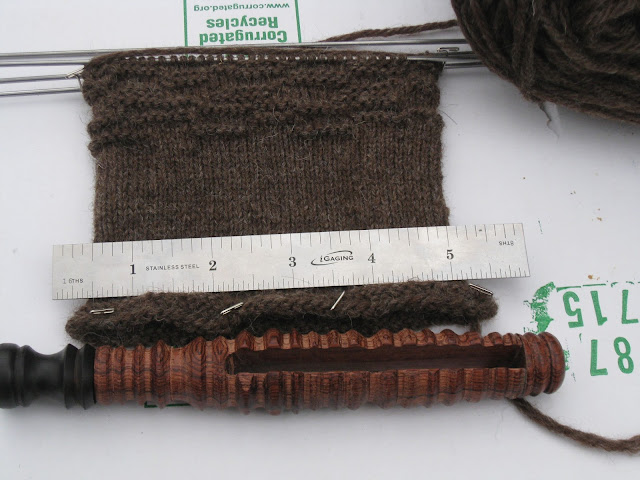
A gauge swatch, knit in the round, on gansey needles for the current set of projects.
Gauge is ~150 stitches per square inch with the 5-ply, ~1,000 ypp worsted spun yarn.
This is absolutely one of the best fabrics that I have ever knit as outer wear in foul weather. It is very much on a par with the Aran weight MacAusland (the great gardening gansey) knit on the 1/8th inch steel needles, but is a great deal less work to knit. And, while just as warm, it is much lighter in weight and more comfortable to wear.

Swaved sock in progress on 1.5 mm needles.
6-strand, worsted spun, 1,650 ypp yarn
This cabled yarn is cool and the fabric breathes very well.

Return from a Memorial Day climb in Yosemite.
The previous day and night, our camp, (4,000 feet higher, and on the west side of the ridge) got several feet of snow that promptly blew into drifts many feet deep. We were equipped for an early summer climb, not for a descent in deep snow. Getting out was quite a slog. We said some unkind things about weathermen. On the other hand, Bishop and Lone Pine did get only a trace of rain that week,
These are the kind of guys that get the gear I knit. We go, we look, we touch, we feel. In those days, we wore poly-pro, and we smelled. Wool is better!
Thursday, January 21, 2016
Lion Brand Fisherman's Wool
The warmest object that I have ever knit, is from the Old Lions Brand Fisherman's Wool.
Then they moved to production to China, and I tried the new version, and am on record as not liking it. I owe Lions Brand a deep apology!!
I had swatched the old Fisherman's Wool and settled on US1 needles. When I tried the new Fisherman's Wool I just went ahead with those US1 needles without swatching it. That was a big mistake.
Somehow the other day, I ended up knitting the new, produced in China, Fisherman's Wool on US1 (2 mm or AWG 12 needles) and love the fabric for Guernseys.
Gauge in stockinette is just over 9 spi / 11 rpi (close to 100 stitches per square inch). Today, it is my yarn of choice for knitting sweaters for the temperature range from about 20 F to 45 F.
This has nothing to do with the lanolin in the wool which will washout and be replaced many times in the life of a sweater that does things, and everything to do with the construction, twist, and fiber in the yarn.
Then they moved to production to China, and I tried the new version, and am on record as not liking it. I owe Lions Brand a deep apology!!
I had swatched the old Fisherman's Wool and settled on US1 needles. When I tried the new Fisherman's Wool I just went ahead with those US1 needles without swatching it. That was a big mistake.
Somehow the other day, I ended up knitting the new, produced in China, Fisherman's Wool on US1 (2 mm or AWG 12 needles) and love the fabric for Guernseys.
Gauge in stockinette is just over 9 spi / 11 rpi (close to 100 stitches per square inch). Today, it is my yarn of choice for knitting sweaters for the temperature range from about 20 F to 45 F.
This has nothing to do with the lanolin in the wool which will washout and be replaced many times in the life of a sweater that does things, and everything to do with the construction, twist, and fiber in the yarn.
Tuesday, January 19, 2016
Size 12 or 13 needles
The first pattern in Gladys Thompson is A Channel Islands' Guernsey.
The pattern was provided to GT by de Cararte and le Patourel of Guernsey. They owned a very old commercial firm that produced hand knit objects for export for sale to sailors at ports from Gibraltar to Reykjavik and St Petersburg. De Cararte and le Patourel were only one of several firms in the Channel Islands that exported knitwear for seamen and fishermen. Shiploads of fine knitwear was produced and shipped from the Channel Islands. Thus, we can be sure that there was a lot of knit wear worn by seamen, all knit to a similar level of fineness.
Some say, they do not find it in the museums.
Where did it all go? Good husbands/ sons/ brothers, discarded it, and took a bath as soon as they got to shore. Bad husbands/ sons/ brothers wore them home, so their wife/mother/sister had to cut it off them, and burn it while the seaman took a bath with lye soap. Real seaman's knit wear was not likely to end up in a museum.
In the Guernsey pattern, 334 stitches are used for a chest size of 38 inches. That means there were ~8.8 spi or 35 stitches per 4" or 10 cm. The Guernseys were knit very tight. Since it was a competitive industry, we can assume that the other firms knitting for seamen knit similarly tightly. Why? Because it is a warm, weatherproof fabric. I know, I have knit a lot of it for myself and my friends. I knit it because it is our favorite fabric for foul weather wear.

However, there is a group that claims such fine tight knitting was never common or useful. That is because they do not know how to knit such fabrics. They have not knit such fabrics. And, they have not tested such fabrics in serious foul weather.
However, knitting such objects is easy - if you know how. First you use long needles called "gansey" needles. If you have gotten this far, you know I have been working with gansey needles for 10 years. With gansey needles you need a fulcrum so you can apply leverage for fast and powerful knitting. You can use a knitting belt as your fulcrum, but a real knitting sheath is a more controlled fulcrum and allows much faster knitting.
On page 7, GT tells us to use Size 12 or 13 needles for knitting the Guernsey. Because of the group that claims 8 spi is as tight as necessary for gansey yarn, we assume the "Size 12 or 13" refers to the UK sizes in the range of 2.25 - 2.75 mm. Such needles do produce the 7 to 8 spi the the group likes to think is as tight as such yarn can be knit.
However, The Channel Islands are not the UK. The 12 or 13 does not refer to UK needle sizes. Once one drops the assumption that the 12 or 13 is UK sizing, then one does what one always does, and one swatches until one gets to 8.8 spi. I have knit a lot of 5-ply gansey yarn at 8.8 spi, so I know that it happens on 1.5 mm gansey needles with a knitting sheath. I have a great number of such needles, because I like the fabric that results from knitting this yarn at this gauge. If I was knitting objects for sale to seamen, 8.8 spi is the gauge I would choose, because seamen would appreciate the warmth of the fabric. Remember, this is the gauge that I knit for the guys that have saved my life.
If you flip thorough the various standards for wire sizing, it turns out the the needles I use are in fact Size 13 in AWG. So, yes I get 8.8 spi from gansey yarn using Size 13 needles, just not UK13!
The pattern was provided to GT by de Cararte and le Patourel of Guernsey. They owned a very old commercial firm that produced hand knit objects for export for sale to sailors at ports from Gibraltar to Reykjavik and St Petersburg. De Cararte and le Patourel were only one of several firms in the Channel Islands that exported knitwear for seamen and fishermen. Shiploads of fine knitwear was produced and shipped from the Channel Islands. Thus, we can be sure that there was a lot of knit wear worn by seamen, all knit to a similar level of fineness.
Some say, they do not find it in the museums.
Where did it all go? Good husbands/ sons/ brothers, discarded it, and took a bath as soon as they got to shore. Bad husbands/ sons/ brothers wore them home, so their wife/mother/sister had to cut it off them, and burn it while the seaman took a bath with lye soap. Real seaman's knit wear was not likely to end up in a museum.
In the Guernsey pattern, 334 stitches are used for a chest size of 38 inches. That means there were ~8.8 spi or 35 stitches per 4" or 10 cm. The Guernseys were knit very tight. Since it was a competitive industry, we can assume that the other firms knitting for seamen knit similarly tightly. Why? Because it is a warm, weatherproof fabric. I know, I have knit a lot of it for myself and my friends. I knit it because it is our favorite fabric for foul weather wear.

A doodle in the round on "A Channel Islands' Guernsey" patterns.
The stockinette has a gauge of just over 9 spi and the
pattern variations are at just under 9 spi.
The needles are size 12.
The yarn is a commercial 5-ply worsted spun
with a grist of ~950 ypp
However, there is a group that claims such fine tight knitting was never common or useful. That is because they do not know how to knit such fabrics. They have not knit such fabrics. And, they have not tested such fabrics in serious foul weather.
However, knitting such objects is easy - if you know how. First you use long needles called "gansey" needles. If you have gotten this far, you know I have been working with gansey needles for 10 years. With gansey needles you need a fulcrum so you can apply leverage for fast and powerful knitting. You can use a knitting belt as your fulcrum, but a real knitting sheath is a more controlled fulcrum and allows much faster knitting.
On page 7, GT tells us to use Size 12 or 13 needles for knitting the Guernsey. Because of the group that claims 8 spi is as tight as necessary for gansey yarn, we assume the "Size 12 or 13" refers to the UK sizes in the range of 2.25 - 2.75 mm. Such needles do produce the 7 to 8 spi the the group likes to think is as tight as such yarn can be knit.
However, The Channel Islands are not the UK. The 12 or 13 does not refer to UK needle sizes. Once one drops the assumption that the 12 or 13 is UK sizing, then one does what one always does, and one swatches until one gets to 8.8 spi. I have knit a lot of 5-ply gansey yarn at 8.8 spi, so I know that it happens on 1.5 mm gansey needles with a knitting sheath. I have a great number of such needles, because I like the fabric that results from knitting this yarn at this gauge. If I was knitting objects for sale to seamen, 8.8 spi is the gauge I would choose, because seamen would appreciate the warmth of the fabric. Remember, this is the gauge that I knit for the guys that have saved my life.
If you flip thorough the various standards for wire sizing, it turns out the the needles I use are in fact Size 13 in AWG. So, yes I get 8.8 spi from gansey yarn using Size 13 needles, just not UK13!
Thursday, December 10, 2015
Money
Some say that in the study of knitting, the study of fishing and its history is a red herring.
Fishermen and sailors supported many thousands of professional knitters for hundreds of years. And, fishermen and sailors consumed the products of many millions of hours of knitting by wives, mothers, and sisters. In return for those millions of hours of knitting by family, the sailors and fishermen contributed to the cash flow of the family. If the knitters knit poorly, then fisherman or sailor died and did not bring home his wages. This put a premium on good knitting, and both the professional knitting and the home knitting was labor of large economic value. The economic value of knitting is very germane to the study knitting and its history.
Fishing was for food and oil. The products of fishing were essential to medieval civilization.
Unless we can offer a suitable alternative clothing, then we have to accept knit objects as the clothing of sailors. Furs pelts, and leather are warmer, but need to be fully dried every few days. Thus furs and pelts were not an option for the longer fishing voyages as on shore fish were fished out in the 12th century. Woven fabrics are denser but not as thick and hence not as warm. Quilted objects are warm, but are bulky and do not allow the freedom of movement for working the rigging of a square rigged ship. Quilted objects are very well suited to junks where the sails can be handled from deck. What else is left? -- Well knit wool!
The requirements imposed by realities of the sailing and fishing industries tell us the knitting standards met by generations of both professional and home knitters. Those standards were very high indeed.
Fishermen and sailors supported many thousands of professional knitters for hundreds of years. And, fishermen and sailors consumed the products of many millions of hours of knitting by wives, mothers, and sisters. In return for those millions of hours of knitting by family, the sailors and fishermen contributed to the cash flow of the family. If the knitters knit poorly, then fisherman or sailor died and did not bring home his wages. This put a premium on good knitting, and both the professional knitting and the home knitting was labor of large economic value. The economic value of knitting is very germane to the study knitting and its history.
Fishing was for food and oil. The products of fishing were essential to medieval civilization.
Hand knitting was essential to industrial fishing from the 13th century until the invention of the knitting frame circa 1590. We know that sailors did wear knit clothing from various sources including Chaucer. We know where they were fishing from Kurlansky. Cross referencing with modern paleoclimatology and the nature of wooden square rigged ships, we can estimate the required warmth of the clothing used.
Unless we can offer a suitable alternative clothing, then we have to accept knit objects as the clothing of sailors. Furs pelts, and leather are warmer, but need to be fully dried every few days. Thus furs and pelts were not an option for the longer fishing voyages as on shore fish were fished out in the 12th century. Woven fabrics are denser but not as thick and hence not as warm. Quilted objects are warm, but are bulky and do not allow the freedom of movement for working the rigging of a square rigged ship. Quilted objects are very well suited to junks where the sails can be handled from deck. What else is left? -- Well knit wool!
The requirements imposed by realities of the sailing and fishing industries tell us the knitting standards met by generations of both professional and home knitters. Those standards were very high indeed.
Mostly, modern knitters do not use knitting technologies that allow the production of very warm knit fabrics required by sailors and fishermen on wooden ships without engines . The knitting technologies currently in use do not affect or diminish the effectiveness of the old knitting sheath system.
Five years ago, I pointed out that modern yarns do not produce fabrics as warm and durable as yarns widely used in the past, but which are no longer in fashion. For example, the old Lion Brand Fisherman's Wool could be easily knit into fabrics that are warmer than modern 5-ply "gansey " yarns. Then production of LB Fisherman's Wool Production was moved to China, and the new LB Fisherman's Wool is not nearly as suited for knitting warm fabrics. I have knit objects from MacAusland's wool that are warmer than comparable objects knit from "5-ply gansey yarns." And, my hand spun can be easily knit into fabrics that are warmer than what I believe can be reasonably knit from either the old LB Fisherman's Wool or the MacAusland's.
Very warm knit fabrics evolved under the economic stimulus of money and need by the sailing and fishing industries. Without the influence of the sailing and fishing industries, recreational knitting has lost the technical skills to produce the very warm fabrics produced in the past by hand knitters for the sailing and fishing industries.
I do not care what knitting technology any particular modern knitter uses. However a knitter that thinks 5-ply gansey yarn knit on circular needles produces the warmest possible fabric has a very shallow knowledge of their craft. And, in particular, a very shallow knowledge of the needs of the clients that shaped medieval knitting.
I suspect that they do not like my views because I compare various aspects of modern knitting to the best of traditional knitting which was supported by huge economic flows from the sailing and fishing industries. They think, I am saying that they should knit like that. I am not, I am only saying that such knitting was done and is possible.
Some days, I think that no amateur can can be as competent as a professional. On these days, I do not think that modern amateurs can ever match the knitting of long dead, talented and trained professionals. On the other hand, I know amateur wood turners that produce better bowls than professionals, because the amateurs can lavish more time and resources on the their objects, while the professionals must control costs to meet a sales price point. On such days, I feel that the modern recreational knitters, freed from a need to control costs and limit labor can brilliantly exceed the best knitting of the past.
Very warm knit fabrics evolved under the economic stimulus of money and need by the sailing and fishing industries. Without the influence of the sailing and fishing industries, recreational knitting has lost the technical skills to produce the very warm fabrics produced in the past by hand knitters for the sailing and fishing industries.
I do not care what knitting technology any particular modern knitter uses. However a knitter that thinks 5-ply gansey yarn knit on circular needles produces the warmest possible fabric has a very shallow knowledge of their craft. And, in particular, a very shallow knowledge of the needs of the clients that shaped medieval knitting.
I suspect that they do not like my views because I compare various aspects of modern knitting to the best of traditional knitting which was supported by huge economic flows from the sailing and fishing industries. They think, I am saying that they should knit like that. I am not, I am only saying that such knitting was done and is possible.
Some days, I think that no amateur can can be as competent as a professional. On these days, I do not think that modern amateurs can ever match the knitting of long dead, talented and trained professionals. On the other hand, I know amateur wood turners that produce better bowls than professionals, because the amateurs can lavish more time and resources on the their objects, while the professionals must control costs to meet a sales price point. On such days, I feel that the modern recreational knitters, freed from a need to control costs and limit labor can brilliantly exceed the best knitting of the past.
Monday, January 26, 2015
Warmth, again and again
If you want real warmth in clothing, it needs to block air flow like a fine bed sheet.
With knit wool that means lots of twist in the yarn, and yarns knit tightly together.
Lots of twist means very fine plies. For most things, I like singles of ~5,600 ypp.
Then I do not ply yarn very tightly, so that as yarn is knit, the yarn deforms and "fills" all gaps.
The commercial yarn that this concept is built on is the old Lions Brand Fisherman's Wool. This yarn is no longer made. Production was moved to China, and the new Lions Brand Fisherman's Wool is different. The new Fisherman's Wool is much more pleasant to knit, but the resulting fabric is not as warm or durable.
To block air flow through the yarn, the wool fibers must be between 20 and 40 microns apart. Closer and they tend to conduct heat. Farther apart and air flows between the fibers carrying heat. Keeping fibers that close together takes a lot of twist.
For wet weather, I like long wool, spun worsted at 5,600 ypp. Twist is about 9 tpi. These singles get loosely plied up into a sport weight (1,000 ypp) yarn.
Once you get below freezing, things can get really cold. There, I like fine wool, spun woolen at 5,600 ypp and 12 tpi. These get plied up into 5-ply at 1,000 ypp or Aran weight at 500 ypp for Arctic (or Antarctic) conditions.
Ok, these yarns are a bit of extra work, but they are warm, and nothing is worse that being really cold.
The the yarn needs to be knit so tightly with fine needles, so there are no gaps in the fabric.
If you knit with 2 or 3-ply yarns there will not be enough twist to hold the individual wool fibers close together and the wind will blow right through the yarn.
If you use a 5-ply with enough ply twist to hold the yarn round, then there will be gaps between the yarn and the wind will blow through the fabric carrying heat away from the body.
Hand spun, hand knit fabrics can be so warm that they feel like magic. Most do not make the cut.
With knit wool that means lots of twist in the yarn, and yarns knit tightly together.
Lots of twist means very fine plies. For most things, I like singles of ~5,600 ypp.
Then I do not ply yarn very tightly, so that as yarn is knit, the yarn deforms and "fills" all gaps.
The commercial yarn that this concept is built on is the old Lions Brand Fisherman's Wool. This yarn is no longer made. Production was moved to China, and the new Lions Brand Fisherman's Wool is different. The new Fisherman's Wool is much more pleasant to knit, but the resulting fabric is not as warm or durable.
To block air flow through the yarn, the wool fibers must be between 20 and 40 microns apart. Closer and they tend to conduct heat. Farther apart and air flows between the fibers carrying heat. Keeping fibers that close together takes a lot of twist.
For wet weather, I like long wool, spun worsted at 5,600 ypp. Twist is about 9 tpi. These singles get loosely plied up into a sport weight (1,000 ypp) yarn.
Once you get below freezing, things can get really cold. There, I like fine wool, spun woolen at 5,600 ypp and 12 tpi. These get plied up into 5-ply at 1,000 ypp or Aran weight at 500 ypp for Arctic (or Antarctic) conditions.
Ok, these yarns are a bit of extra work, but they are warm, and nothing is worse that being really cold.
The the yarn needs to be knit so tightly with fine needles, so there are no gaps in the fabric.
If you knit with 2 or 3-ply yarns there will not be enough twist to hold the individual wool fibers close together and the wind will blow right through the yarn.
If you use a 5-ply with enough ply twist to hold the yarn round, then there will be gaps between the yarn and the wind will blow through the fabric carrying heat away from the body.
Hand spun, hand knit fabrics can be so warm that they feel like magic. Most do not make the cut.
Monday, November 03, 2014
lanolin
Many, many modern knitters attribute the warmth of the old knit woolens to lanolin. However, lanolin oxidizes, and then when it gets wet it has a nasty sheepy smell. Lanolin also attracts moths.
Thus, modern mills remove lanolin from their yarns (mostly), and modern knitters use this as an excuse for not knitting warm garments.
The truth is that there are 2 aspects of knitting warm garments. One is knitting tight, and the other is oiled yarn. Except that there are many ways to get oiled yarn, baby oil works as well as lanolin but baby oil does not smell sheepy or attract moths.
That is, modern knitters use a lack of lanolin as an excuse to knit loosely. And, they do not substitute other oils for lanolin. The result is that modern hand knit objects are not very warm.
Thus, modern mills remove lanolin from their yarns (mostly), and modern knitters use this as an excuse for not knitting warm garments.
The truth is that there are 2 aspects of knitting warm garments. One is knitting tight, and the other is oiled yarn. Except that there are many ways to get oiled yarn, baby oil works as well as lanolin but baby oil does not smell sheepy or attract moths.
That is, modern knitters use a lack of lanolin as an excuse to knit loosely. And, they do not substitute other oils for lanolin. The result is that modern hand knit objects are not very warm.
Friday, March 15, 2013
Getting to swaving
Some seem to feel that what I do is either an arrogant lie or an accident.
No it a matter of taking some clue out of history and working on it until I come up with something useful.
Perhaps the Holy Grail was "swaving". (After," How did the old fishermen on the banks stay warm?) My grandmother told stories of very fine, hand knit, camel, ladies gloves. And. we had limited information on the Terrible Knitters of the Dales swaving fine gloves. The hints were tantalizing, but, "What was the truth?" What was the technique?
Clearly the needle rotated in the knitting sheath. This makes swaving dramatically different from any other modern hand knitting technique. Lever knitting was based on needle pitch / yaw motions. In contrast, swaving was based on needle rotation.
So I bent some DPNs and tried it. The fabric was wonderful, but the process was so high effort that a 2" by 2" swatch knit in an evening would leave my hands stiff and sore for days. For several years, I could not find a needle configuration that reduced the effort. I could produce wonderful fabric, but the effort was impossible. I came to believe that swaving was inherently, a high effort activity, and that the high effort required was why it disappeared. I was wrong.
Then, I saw a glover's needle in a museum collection that was obviously used for swaving and I made a set of replicas. They worked - for glove fingers. All of a sudden, swaving (glove fingers) was an easy and low effort way to knit. Scaling that needle/sheath geometry to longer needles suitable for socks and glove cuffs and palms was matter of many generations of needles over a period of 3 years. So, when I say that I can "swave" it is not the result of one trial or a few trials, it is the result of many trials, and taking many little baggies of swatches to many guild show and tells.
Everyone is so accustomed to knitting being a pitch/yaw motion, that their eyes are fooled, and nobody sees the rotation of the needle in swaving. No wonder Rutt did not see it. It is an optical illusion, and I must apologize to Rutt.
Here is a pictorial history of the tools I have tried and abandoned, to the tools that I currently use:


Today, swaving is my preferred way to knit. It produces a very nice fabric (with ridges when knitting back and forth). It is very fast. It is very easy on the hands It is very low effort. The needles are compact and blunt (read as "safe in a knitting bag"). The bent needles (pricks) tend not to leave ladders, even in sock fingers. And, it is very easy to knit firm (weatherproof) fabrics from even very fine yarns. Thus, the technique is ideal for gloves and socks. Today, I have, and use swaving needles down to 1.2 mm.
In contrast, gansey knitting with long straight needles and a knitting sheath is a fast and easy way to knit large objects such as sweaters. Gansey knitting is for objects involving cabling, bobbles, and lace. Gansey needles are long, and sharp enough to slide right through most knitting bags and poke holes in anything that might be precious or valuable. On the other hand, when you must knit a very warm sweater, very fast, gansey needles with a knitting sheath are tool of choice. And one can knit back and forth without ridges. : )

No it a matter of taking some clue out of history and working on it until I come up with something useful.
Perhaps the Holy Grail was "swaving". (After," How did the old fishermen on the banks stay warm?) My grandmother told stories of very fine, hand knit, camel, ladies gloves. And. we had limited information on the Terrible Knitters of the Dales swaving fine gloves. The hints were tantalizing, but, "What was the truth?" What was the technique?
Clearly the needle rotated in the knitting sheath. This makes swaving dramatically different from any other modern hand knitting technique. Lever knitting was based on needle pitch / yaw motions. In contrast, swaving was based on needle rotation.
So I bent some DPNs and tried it. The fabric was wonderful, but the process was so high effort that a 2" by 2" swatch knit in an evening would leave my hands stiff and sore for days. For several years, I could not find a needle configuration that reduced the effort. I could produce wonderful fabric, but the effort was impossible. I came to believe that swaving was inherently, a high effort activity, and that the high effort required was why it disappeared. I was wrong.
Then, I saw a glover's needle in a museum collection that was obviously used for swaving and I made a set of replicas. They worked - for glove fingers. All of a sudden, swaving (glove fingers) was an easy and low effort way to knit. Scaling that needle/sheath geometry to longer needles suitable for socks and glove cuffs and palms was matter of many generations of needles over a period of 3 years. So, when I say that I can "swave" it is not the result of one trial or a few trials, it is the result of many trials, and taking many little baggies of swatches to many guild show and tells.
Everyone is so accustomed to knitting being a pitch/yaw motion, that their eyes are fooled, and nobody sees the rotation of the needle in swaving. No wonder Rutt did not see it. It is an optical illusion, and I must apologize to Rutt.
Here is a pictorial history of the tools I have tried and abandoned, to the tools that I currently use:

Note that the needles that work well have their bend about 2" from the end of the needle.

The needles that I currently use are about as blunt as possible. This goes against current thinking that one needs sharp needles to knit fast. Needles that work very well have just enough bend to fit snugly in 3/4" pipe, regardless of the length of the needle. Needles that work best are less then 8" long. My glove needles are 4" long with the bend in the middle. Thus, the glover's needles have a sharper bend.
Today, swaving is my preferred way to knit. It produces a very nice fabric (with ridges when knitting back and forth). It is very fast. It is very easy on the hands It is very low effort. The needles are compact and blunt (read as "safe in a knitting bag"). The bent needles (pricks) tend not to leave ladders, even in sock fingers. And, it is very easy to knit firm (weatherproof) fabrics from even very fine yarns. Thus, the technique is ideal for gloves and socks. Today, I have, and use swaving needles down to 1.2 mm.
In contrast, gansey knitting with long straight needles and a knitting sheath is a fast and easy way to knit large objects such as sweaters. Gansey knitting is for objects involving cabling, bobbles, and lace. Gansey needles are long, and sharp enough to slide right through most knitting bags and poke holes in anything that might be precious or valuable. On the other hand, when you must knit a very warm sweater, very fast, gansey needles with a knitting sheath are tool of choice. And one can knit back and forth without ridges. : )

A sock and glove kit that is going to a friend next week.
(I am moving from storing needles in irrigation pipe to storing needles in acrylic tubing.)
Tuesday, February 12, 2013
Slop
John Marchant’s Dictionary (2d ed 1760) defines jacket as a short outward garment such as a sailor might wear. Thus, what you would call a gansey or Guernsey would be called a shirt if worn as an under garment and a jacket if worn as an outer garment, and a frock if rather loose. And if long, it would be a gown. Consider John Boyd’s A manual for naval cadets, where only in one reference are they called “knitted worsted jackets” and other times simply “jackets". Note well the use of “jackets” by Liardet, for the garment the crew is wearing to sleep in on cold nights. (Liardet was a sea captain who wrote a large number of texts on seamanship and military/ merchant ship management.) Likewise, knit wear may be called a “frock”, per Mary Wright
If sold by the ship (slop chest), they would all be known as “slop”. See for example; The Royal Navy, 1790-1970 by Wilkinson-Latham.
Additional information is in the Fourth Report of the Commissioners for Revising and Digesting the Civil Affairs of His Majesty’s Navy (1806). These reports include full details and history of the operation of the slop chests. In The laws, ordinances and institutions of the Admiralty, (1746, Vo.l 2 pg 301) we see both broad cloth coats and “Kersey gowns” are to be sold at 19 shillings. each. (~twice the price of a "striped suit" of clothes, or 3 time the price of a "blue suit") In The accounts of the Lord High treasurer of Scotland: 1473-1498, we see that “Kersey” is a finely knit fabric. From both contexts, Kersey was expensive.
The Nautical Magazine: A Journal of Papers on Subjects Connected ..., Volume 2 (1833), at that time there are worsted, white knitted jackets. and in Admiralty Orders, &c. &c.
(Circular, No. 83.) Admiralty, 23d October, 1832, we have blue knitted jackets.
And note the that the slop chests did not sell “oil skins”. We know that some war ships had infrequent “make and mend” days.(see for example Liardet on warship management. Other sources say some war ships went months between M&M days. Sailors on warships were not given time to knit. This is no surprise as the Captain made a profit on all slops sold to his crew.) Thus if a man was pressed, and came aboard, he could buy a knit gown, and various kinds of cloth, but it might be months before the sailor could fashion a set of oil skins. Thus, we know that the “gown” had to be very warm. It had to be weather proof.
It is worth noting the difference between the Navy's selling slops to seamen and the way the British Army and Marines were clothed. In Reports from Committees of the House of Commons: Repr. by Order ..., Volume 13 (1803) pg 622 et seq., we see that clothing and equipment was issued to these forces, and if they remained in the service for 8 months, the soldier owned the clothing/equipment. As we look at navy accounts pg 166 et seq we see line items for purchase of slops (to be sold to seamen) and clothing for prisoners of war,but no item for any other kind of clothing for seamen. Thus, there was no funding for oil skins to be issued to seamen. The sailor either brought an oil skin aboard, or made an oil skin on a "make and mend day" or went without. On the other hand the "striped suits" were lined with duck would have been reasonably wind proof, but not comfortable against the skin when wet, and very slow to dry.
Academic and scientific works do not cite common knowledge such as is available in basic texts and encyclopedias. The above information is in the basic seamanship texts and encyclopedias of the time. It was in the government reports on the topic from the time. It can be found in multiple other sources. Anyone with a basic knowledge of British or European shipping or fishing or naval operations circa 1750 should have be aware of this information.
The only question was, “How warm or weather proof, are such fabrics?” The answer is VERY! The proof is in the knitting and testing of such fabrics. That is what I have been saying, ‘the proof is in the knitting!” The only peer review would be of the knitting, and that would require a knitter with expertise in knitting with long needles and a knitting sheath.
Thursday, February 07, 2013
Why Seaman's Sweaters?
Or, Why didn't they just change their clothes and put on rain gear as required?
Back in school, I had a professor that said, "One must make a thousand pots of tea, before one is ready to make one tea pot". He meant that one must understand how the product will be used, before one can make a truly excellent product. One must remember that Russian tea is served differently than Japanese tea. In this vein, one must understand the life of that sailor before one can understand the clothes of that sailor.
Back in school, I had a professor that said, "One must make a thousand pots of tea, before one is ready to make one tea pot". He meant that one must understand how the product will be used, before one can make a truly excellent product. One must remember that Russian tea is served differently than Japanese tea. In this vein, one must understand the life of that sailor before one can understand the clothes of that sailor.
On sailing ships (pre-1830), top men were stationed in the top of the
ship’s rigging because with every change of weather or course, there was ship’s
work that had to be done promptly. There
was not time to climb down, change clothes, and climb back up. And there was no way to store clothes in the
top, and in a squall, there was no way to change clothes in the top. (Yes, oil skins could be lashed to the mast, but one is not going to be able to don oil skins in the top of a ship during a squall. Modern skippers do not even allow crew in the rigging in such conditions.) The
clothes that a top man wore as he climbed into the top, were all that he had
for his 4 hour watch, regardless of what squalls should blow up (or blow away).
Their rigging and sails were natural fiber, when it got wet,
the fiber swelled and the lines shortened and had to be slacked – rather promptly.
When the weather cleared, the lines and
sails dried, and had to be trimmed – rather promptly. The times when a land lubber would have the sailors changing their
clothes, are in fact the exact times the sailors had the real work of a sailor to do.
If a weather event required "all hand"s, they came on deck in
whatever clothes they wore while sleeping.
A modern racing crew can sleep in their rain gear for the duration of a
race, but a seaman did not sleep in his oil skins every night for years on
end. He slept in his sweater, and
trusted that to keep him warm during all hands calls.
Real seamen could do real work, on real ships, because they
had real sweaters. Sweaters that shed
rain, but vented under warmer conditions.
The technology to knit such sweaters includes long needles and a
knitting sheath. The technology can be
used to knit other things, but it did make good seaman’s sweaters. It is a technology that most modern knitters have forgotten and product that few modern knitters can imagine.
How much clothing and gear did a seaman have? Space on board a ship was very limited. An officer or midshipman could have a sea chest, but a seaman kept his things in a sail cloth bag, perhaps a foot in diameter and 2' long. He would have the clothes that he wore and slept in; including a neck cloth, leather belt, belt knife, and marlin spike. He could swing out of his hammock, and go on deck ready to work. He would have a change of clothes for shore wear. He would have a couple of pairs of mittens, a couple of pairs of socks, a knit helmet, a cap, an oil skin & rain hat, an extra sweater, perhaps some knit drawers, and a pair of sea boots. There would be his sailor's palm and needle, thread, beeswax, a razor, and a bible if he could read. There might be a pipe and some tobacco. In some fleets, there would be a cup, spoon and bowl. A fisherman would have a pair of knit nippers. Sail cloth could be purchased from ship's stores to make other items.
I estimate that it would take on the close order of 500 hours to knit all the knit wear. I estimate that it would take a thousand hours to hand spin 5-ply for that much knit wear. Thus, a young sailor's kit was a large investment.
In the Navy, the entire seaman's bag would be lashed to the railing inside the seaman's hammock and blanket while the seaman was on watch or at battle stations. The sun and air killed the lice. It made theft more difficult. And, during battle it reduced the number of splinters from the railings - Splinters from the railing were actually the most common cause of injury during naval battles. It is no surprise that we do not find seaman's gear in ship wreaks.
Typical water rations on board sailing ships was 3 liters per day for cooking, drinking, and washing. There was no fresh water for washing clothes. (Except when it rained, and a rain squall was not likely a good time for sailors to stop work and wash.) Woolens were "washed' by dipping them in stale urine and letting them dry in the sun. It does a better job of cleaning wool than trying to wash it in sea water. Soap will not lather in sea water, and tightly knit wool tends to strain little critters out of sea water. Then, the little critters die and rot, making the fabric smell like rotting sea life. Stale urine was the best dirt extractor that they had.
Oops, that may be a bit more than you wanted to know. : )
Subscribe to:
Posts (Atom)
.jpg)