Showing posts with label lace. Show all posts

Sunday, January 13, 2013

Swaving and knitting pouches

My progress on learning to swave has been good. Overall,  I am not yet as fast as with ordinary knitting, but stress on my hands is less, allow more knitting to be done in a knitting session. Individual stitches are faster, but the process is not smooth and continuous.   Decreases and repair of mistakes are much slower and suck up any time gained by making stitches faster.

The quality/consistency and tightness of the fabric is the is as good or better than I can achieve with long gansey needles.  Since socks are hard to do on long needles, this is the very best sock fabric that I have ever produced.

Can swaving be done with Shetland style leather knitting pouches?  The pouch can be used to hold the prick as it is rotated to produce single stitches. However, the pouch has too much friction to allow the spring of the fabric to drive a continuous process as with a knitting sheath.  And, the angles are wrong.  It is not ergonomic.

Knitting pouches are the tool of choice for knitting fine, soft fabrics including fine lace and soft Fair Isle.

Friday, July 22, 2011

The trail to 9,000 ypp

Last year, I was making 5-ply gansey yarn from ~5,600 ypp singles.

Why that odd number?  Going back to England in the 15th century, yarn was measured in hanks of 560 yards.  If one spins a pound of fiber in to 10 hanks (10s), then it comes out to 5,600 ypp.  And, a good spinner can spin a hank of 10s every couple of hours. All of which made nice round numbers for professional spinners working in a cottage industry.  In a very long day of spinning, a spinner could produce 500 yards of 5-ply yarn. (Ply 5 hanks of 10s together, and the twist of the ply shortens the length to 500 yd plus something for grandmother.) This would also imply that there were other traditions for the spinning of finer singles from finer wools.

However, the Irish and Scots seem to have (hand) spun to a standard of 16 hanks per pound.  These finer singles were then plied up to produce yarns that were similar in weight to the English yarns, but they would have been warmer and more durable.  This would off set the fact that the more labor was required.  I wanted to investigate the trade off between the extra labor and the increased warmth and durability.

I started spinning such 16 hank /pound singles, but it was slow and hard.  I looked for a faster wheel to buy but ended up building the "hot rod".  That took a while.  However, it was worth it.  Now, I can produce such fine (and finer) yarns at a rapid pace.  I am spinning singles for multi- ply yarns at rates close to a hank per hour.  Singles for lace that must be very nice, smooth, and uniform are much slower.

Some of that speed comes from practice.  However, in spinning, tools matter.  My output using my DD bobbin/ flier assembly with controlled DRS is about twice my best output using the Ashford lace flier (with a similar ratio.  There is more to spinning than just ratios.

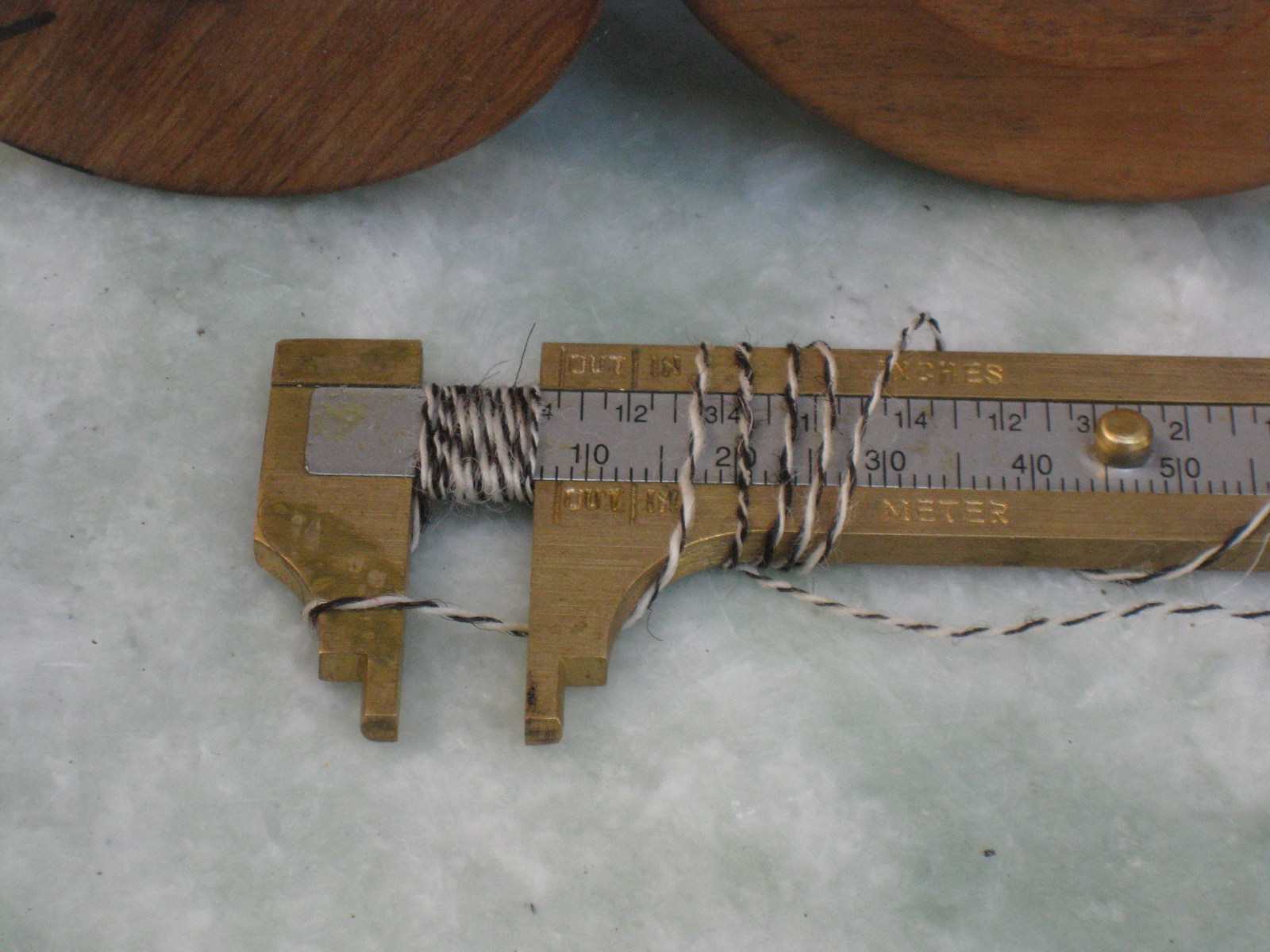
A bit of Jacob and Shetland singles,  plied together and wrapped  around a caliper. 
The two ply is in the 18-20 wpi range.  

Bobbins of singles in the 16 hanks per pound range.  Fibers include (clockwise from dark Jacob) Cotswold, 
Shetland, Romney (blue), grey Romney, blend (~~8,000 ypp), Shetland, Merino (blue) and CVM (10,000 ypp). edited to add:  A hank (560 yd) of the Natural Romney weighed 1.125 oz = 7,964 ypp. The others ran closer to an once per hank or 8,960 ypp. The CVM hank weighed .75 once for 11,947 ypp. I guess something about that bobbin is a little off. 


This was not a post about how fine I can spin, it was a post about learning to spin fast. Recently, I ended up with some nice Romney from Royal Fibers (http://www.royalfibers.com/).  The spinning bobbin at hand was for finer singles. I just wound it off, and in comparison to any of the singles above, it is very fine.


Two spinning bobbins and their flier whorl.  The  different sized whorls on the two bobbins tend to produce different sized singles.  The one  on the right tends to produce singles that run about 16 hanks per pound and the bobbin on the left produces singles that run about 20 hanks per pound. The difference between the two is a few thousandths of an inch. I have another spinning bobbin that tends to spin at 50 hanks per pound.


Sunday, November 08, 2009

A Path Foreward - Lace!

I started this reseach because I wanted to know how seamen of old stayed warm. Now, I know, they knit tighly to produce a warm fabric. They saved their wrists by using a knitting sheath.

The process works. I proved it with prototype samples. And, my knitting sheath prototypes do look like engineering prototypes. They feel like something that would be at home in a machine shop. They have the solid feel of utilitarian tools used for making the most utilitarian of garments - a fisherman's gansey.

However, we know that knitting sheaths were also used in the production of lace. One of Rutt's informants on knitting sheaths was using her knitting sheath to make lace. The great "wedding ring" shawls knit in the Shetland Islands were knit on the same tools used to knit ganseys. Why?

Well, because a knitting sheath is the easy way to knit lace. It really is.

I have been swatching lace. I am not real thrilled with "modern lace" as taught in most contemporary texts on knitting. I do not like the fabric. I mean, really, do you like these fabrics?

That little swatch in the photo does not look like much, but it is 650 stitches. It is also a nice fabric. No, it is a very nice fabric. It something a REAL lady would want to wear. A knitting sheath lets one knit fast enough that one can actually finish a lacey something in a reasonable length of time. A knitting sheath also helps maintain even tension.

Anyway, I have drunk the "Kool-Aid", and I am going to the "Dark Side". I am going to do some lace -- just as soon as I finish a couple of pair of house socks and a gansey.

Likewise, it is time to move past my "engineering prototype" style of knitting sheaths and make some that not only work, but that have some aesthetic appeal to folks other than locomotive machinists. I really am working on this. No more knitting like a pirate.

The lace needles in the photo are from various sources and about 1.4 to 1.5 mm by 20 or 25 cm long. I am going to say it right now,"Commerical lace needle makers focus more on making needles pretty than on making them functional. Lace kntters aided and abetted this by buying needles that were more pretty than functional.

Knitting hearts were used by ladies in Jane Austin's time to support fine needles for knitting lace. These hearts were jewlery in every sense of the term. However, such hearts required fairly stiff gowns to support the hearts, so I do not think I will go in that direction. However, if someone wants such jewlery, let me know and I will work with my sister (www.golddreams.com) to help you design a knitting heart that fully functional.