Tuesday, March 01, 2016

Love and Hate of the Classics

Over the years, I have had a love and hate relationship with Paton's Classic Wool (PCW).


A large swatch of Paton's Classic Wool knit on 2.4 mm needles was the  was the first clue that I was on the right track.  However, ultimately I generally decided that  the fabric that I was producing was not worth the effort, resulting in a large number of WIP sitting around.  Finer needles seemed like more effort for not that much better fabric.

Exploration of blunt needles over the last few months has allowed exploration of knitting PCW on finer needles.

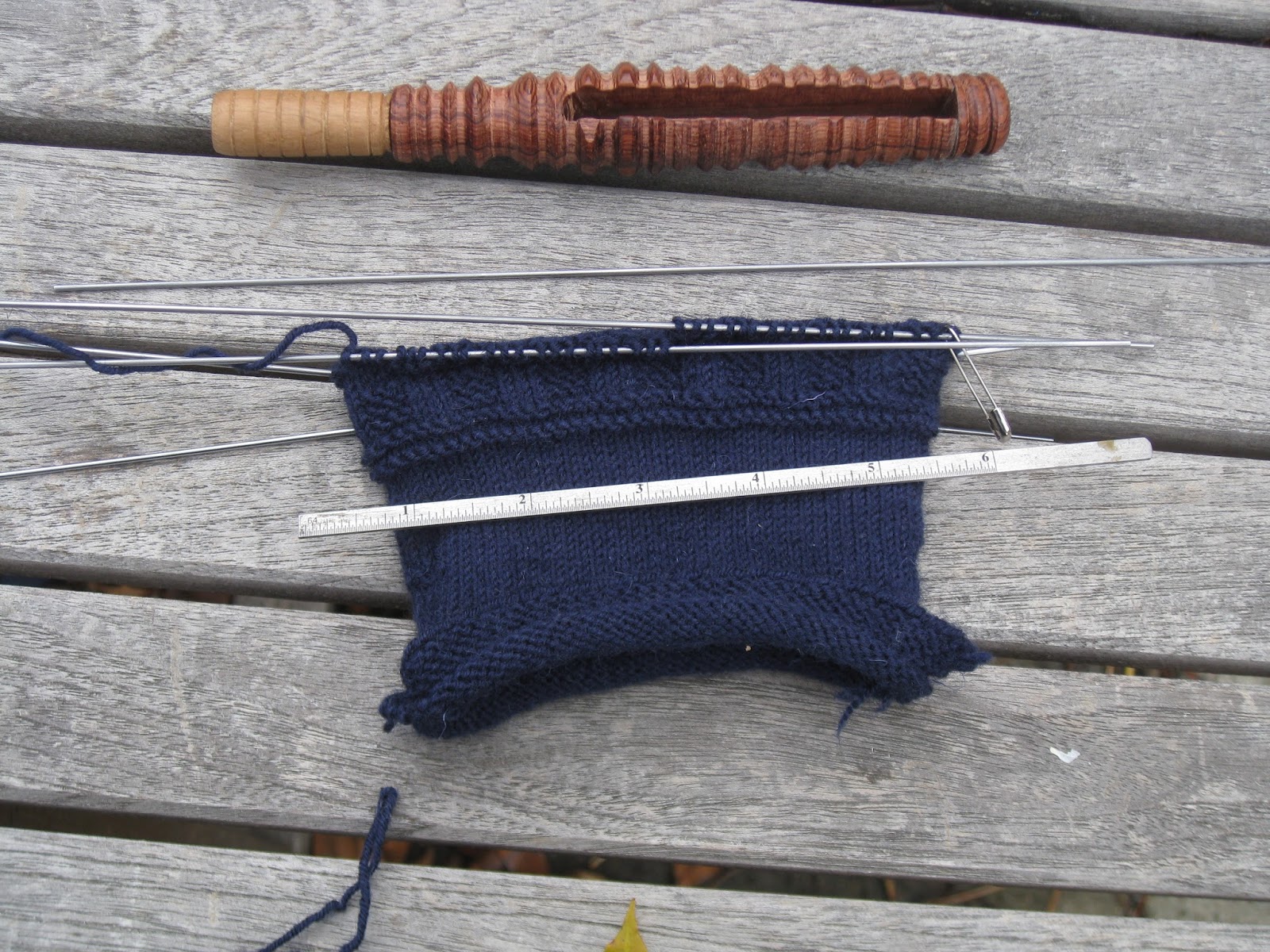
Knit on 2 mm needles, I get 9 spi and 12.5 rpi for 112.5 stitches per square inch, and on 1.6 mm needles I get 9.5 spi and 12.5 rpi for 118.75 stitches per square inch.

While the numbers are similar, the fabrics are different. In fact, the numbers would seem not that far off of the 7 spi by 10 rpi (70 stitches per square inch),  that I get with 2.38 mm needles, and yet the 3 fabrics are very different.

Knit on the 1.6 mm  needles, the fabric has a smoother surface that allows water to just run off in ways that just does not happen with the fabrics knit on larger needles. It is also surprisingly abrasion resistant.


Knit on the 2 mm, the fabric is thicker and has more surface texture, but is still very weatherproof.  The extra thickness/ softness gives better drape, and the surface can be brushed into a very nice nap.  Over all, the fabric knit on 2 mm needles is softer and wickedly warm.  It is a nice Guernsey fabric, that is much, much warmer than what most folk knit as "gansey" fabric.

These fabrics are firm, so they need to be knit to fit, rather than knit from a generic pattern.  However, these fabrics have more stretch and elastisity than woven fabrics.  They can form a warm second skin that allows free and easy movement.  And, they have tremendous warmth for the weight.

In many ways, these are fabrics that I have been trying to knit since 1998, but I did not have the tools and skills to knit.  Oh, there were hints, such as the fact that "mak'n pins", were often only 1.5 mm in the old days.  When I first read that, I should have jumped forward to 1.5 mm needles.  And, when I read about how long it took a professional knitter to make a set of needles.  That should have told me that they are not tapered to the tip, but rather blunt.

And, you are not going to get to PCW knit at 70 stitches per square inch with circular needles. I have knit small swatches of such fabrics on circs, but that convinced me that sweaters from such fabrics were not plausible. I tried over and over. Swatches of these fabrics can be knit with a knitting belt, but those swatches told me that that it imposed significant wear on my knitting belt. so I moved on to wooden knitting sheaths.  Maple, rosewood, and even cherry, endure the stress very well. I got here using 12" blunt needles with my latest generation of knitting sheaths.

My point is not that PCW is the best yarn, only that it is a very good yarn, and a great value. And it sets new standards for hand spun - it tells us that rather generic woolen yarns can be knit into great objects. It opens the door for finer fabrics knit from finer woolen yarns.  And, it suggests that generic worsted spun yarns can produce great fabrics. And, if that is the case, why is there such a variance in price?


The evolution of my knitting sheaths, 
with newer sheaths to the left.
The needles on the left are old.


The horizontal knitting sheaths were made in the last 3 months, and the vertical sheaths are older.   The gansey needles are 10 years old. (And, for large objects, longer needles are faster!)  Sizes of needles in photo range from US1 to US0000, and all can be accommodated with various needle adapters in the photo.  Special needle adapters are made for swaving.  Number and color of bands on the adapters indicate size, and placement of the band(s) indicates gansey or swaving. These needle adapters work better with the swaving needles than the knitting sheaths that the swaving needles were originally made to fit.  (However, currently the swaving needle adapters work better with my Durham style knitting sheaths. The Durham sheaths put the swaving needles into a better ergonomic zone.)

Note that the needle adapters allow use of one sheath with many different sets of needles.  The knitting sheaths work much better when they are made to fit one style of work belt, and are then used with  the belt they were made to fit.  Between the old and new knitting sheaths are (on the block of maple)  examples of  the threaded inserts currently used to attach the needle adapters to the knitting sheaths.

In the context of thousands of hours of planned knitting, taking a couple of hours to make a knitting sheath that might increase productive by a couple of percent is perfectly rational, regardless of the discount rate.   When those same knitting sheaths move better fabrics from the realm of plausible dreams into practical reality, it is silly, not to be making better and better knitting sheaths.

I keep the old knitting sheaths around to later, check, verify, and validate the data related to each transition.  As Feynman said, "It is important not to  fool yourself."

Sunday, February 28, 2016

The Best and Brightest on SLR

Ice melt, sea level rise and superstorms: evidence from paleoclimate data, climate modeling, and modern observations that 2 °C global warming is highly dangerous


We suggest that ice sheet disintegration is a highly nonlinear process and poses a danger of rapid sea level rise. We find evidence in paleoclimate observations and in global climate simulations supporting the existence of amplifying feedback processes that would contribute to nonlinear ice sheet response. Modern observations reveal that these processes are already underway, including cooling of the Southern Ocean surface. We conclude that a 2°C limit on global warming is not a safe “guardrail".

Hundreds of comments addressed by the authors 


Abstract:
We use numerical climate simulations, paleoclimate data, and modern observations to study the effect of growing ice melt from Antarctica and Greenland. Meltwater tends to stabilize the ocean column, inducing amplifying feedbacks that increase subsurface ocean warming and ice shelf melting. Cold meltwater and induced dynamical effects cause ocean surface cooling in the Southern Ocean and North Atlantic, thus increasing Earth's energy imbalance and heat flux into most of the global ocean's surface. Southern Ocean surface cooling, while lower latitudes are warming, increases precipitation on the Southern Ocean, increasing ocean stratification, slowing deepwater formation, and increasing ice sheet mass loss. These feedbacks make ice sheets in contact with the ocean vulnerable to accelerating disintegration. We hypothesize that ice mass loss from the most vulnerable ice, sufficient to raise sea level several meters, is better approximated as exponential than by a more linear response. Doubling times of 10, 20 or 40 years yield multi-meter sea level rise in about 50, 100 or 200 years. Recent ice melt doubling times are near the lower end of the 10-40 year range, but the record is too short to confirm the nature of the response. The feedbacks, including subsurface ocean warming, help explain paleoclimate data and point to a dominant Southern Ocean role in controlling atmospheric CO2, which in turn exercised tight control on global temperature and sea level. The millennial (500-2000 year) time scale of deep ocean ventilation affects the time scale for natural CO2 change and thus the time scale for paleo global climate, ice sheet, and sea level changes, but this paleo millennial time scale should not be misinterpreted as the time scale for ice sheet response to a rapid large human-made climate forcing.


Selected passage
6.2 Southern Ocean, CO2 control knob, and ice sheet time scale
Our climate simulations and analysis of paleoclimate oscillations indicate that the Southern Ocean has the leading role in global climate change, with the North Atlantic a supporting actor. The Southern Ocean dominates by controlling ventilation of the deep ocean CO2 reservoir. CO2 is the control knob that regulates global temperature. On short time scales, i.e., fixed surface climate, CO2 sets atmospheric temperature because CO2 is stable, thus the ephemeral radiative constituents, H2O and clouds, adjust to CO2 amount (Lacis et al., 2010, 2013). On millennial time scales both CO2 and surface albedo (determined by ice and snow cover) are variable and contribute about equally to global temperature change (Hansen et al., 2008). However, here too CO2 is the more stable constituent with time scale for change ~103 years, while surface albedo is more ephemeral judging from the difficulty of finding any lag of more than order 102 years between sea level and polar temperature (Grant et al., 2012). Here we must clarify that ice and snow cover are both a consequence of global temperature change, generally responding to the CO2 control knob, but also a mechanism for global climate change. Specifically, regional or hemispheric snow and ice respond to seasonal insolation anomalies (as well as to CO2 amount), thus affecting hemispheric and global climate, but to achieve large global change the albedo driven climate change needs to affect the CO2 amount. We also note that Southern Ocean ventilation is not the only mechanism affecting airborne CO2 amount. Terrestrial sources, dust fertilization of the ocean, and other factors play roles, but deep ocean ventilation seems to be the dominant mechanism on glacial-interglacial time scales.
The most important practical implication of this “control knob” analysis is realization that the time scale for ice sheet change in Earth’s natural history has been set by CO2, not by ice physics. With the rapid large increase of CO2 expected this century, we have no assurance that large ice sheet response will not occur on the century time scale or even faster.


Emphasis added by Aaron
Note that on a current basis, CH4 is 80 times more powerful greenhouse gas than CO2.  Thus, 404 ppmv of CO2 plus 1.8 ppmv of CH4 is the same as 548 ppmv of CO2, However, because CO2 and CH4 work at slightly different spectra the mixture is a slightly more powerful greenhouse gas than pure CO2.  A conservative estimate of the current setting on the CO2 "control knob" is actually ~550 ppmve of CO2. CO2 plus CH4 was => 486  ppmve twenty-five years ago.  Even with the great thermal inertia of ice sheets, we should be seeing some melt, AND WE ARE!  Even 50 years ago, CO2 plus CH4 added up to more than 400 ppmve of  CO2.  It is legitimate to use the higher equivalence value of  CH4 for CO2 because the concentration of CH4 has increased, rather than the declining concentration as assumed in the IPCC models that allows their use of an equivalence factor of only 20 for a hundred year period.


Friday, February 26, 2016

The Transition(s)

It took me 3 or 4 years to transition from hand held needles (e.g., circular needles) to knitting sheaths and knitting belts.

I would knit something with circs, and see if I could knit it with a knitting sheath.  Here the greatest challange for the knitting sheaths (with DPN) was Moebius knitting.  Ultimately it was clear that any Moebius knitting could be done with a knitting sheath, and some Moebius objects that are not practical to knit with circular needles and can be knit expeditiously with a knitting sheath.

Then, I would knit objects with knitting sheath technology and see if I could knit them with hand held needles. First, it was clear that knitting with a knitting sheath was easier on my hands and wrists, allowing knitting to be done faster, easier and with less stress on the hands and wrists. Then,  I was able to knit fabrics that were much tighter and more weatherproof than anything I could knit with circular needles. Third, Fair Isle and stranded techniques were much faster and easier. The difference in productivity and level of effort was huge.  Over all, it took about 4 years to convince myself that anything that could be knit on circular needles could be knit faster and easier with a knitting sheath. That is it took me 4 years of serious effort to set aside the teaching of the experts that I had so carefully learned. However, I was still knitting things that I could, in theory, knit with circular needles.  I was simply using a knitting sheath because it is faster and easier.

I knew I was on the correct track when I took a large swatch knit from Patons Classic Wool into the knitting instructor at a very high-end yarn shop, and she looked at it for half a minute, with her mouth open, turning it over and over and feeling it, but saying nothing for a long time.  I thought she was going to berate me for bringing cheap wool into her high-end shop, At long last, she asked, "How did you every knit anything so wonderful?  Can you show me how you knit?  "

About halfway through my transition from circular needles to  knitting sheaths, I started looking for better yarns, and spinning, Yes, better yarns lead to better knitting, but most importantly, a better knowledge of yarn leads to better knitting.  Today one of my favorite sock yarns is a 1,650 ypp, 6-strand cable that I make up from commercial 5,600 ypp, 2-ply warp yarns.  I would never have found that yarn if I had not learned to spin.  I would not be able to ply it up quickly, as a high quality knitting yarn if I had not learned good spinning skills. 

Spinning also taught me about the glories of fine yarns. 

Since moving firmly to knitting sheaths, I have started knitting things that I cannot imagine knitting on circular needles. Knitting sheaths allow me to finely knit large objects in a reasonable rate.  When I first came across Jamieson's Spindrift, I was as still using circular needles, but I did not like the fabric as produced at 7.5 spi on US3 needles.  With a knitting sheath, today I knit Spindrift on 1.5 mm needles, and I like the fabric. Now, I knit Spindrift at ~13 spi and ~16 rpi for about 200 stitches per square inch. On a 4" by 4" swatch, that is 3,200 stitches.  Most importantly, Spindrift taught me  what I could do with 2-ply, 2,000 ypp, woolen spun yarns.  Knit on fine needles, such yarns produce wonderful fabrics.

I may lack imagination, but I cannot dream of knitting a sweater with 200 stitches per square inch on circular needles. However, it is very feasible with a knitting sheath.   I also knit my 1,650 ypp, 6-strand cable yarns on 1.5 mm needles at ~ 10 spi by 17 rpi, and it makes a nice fabric that I love for a multitude of uses. It is a great sock yarn,and works when ever I need a wool jersey.  I knit commercial 5-ply gansey yarn on US00 / 1.6 mm needles to produce a fine dense fabric - that is weatherproof.  You may not like it (or need it),  but, I find that it far out performs the products by Marmot (https://marmot.com/products/men), which I use as standard.

Today, knitting sheaths allow me to knit such objects on a practical basis.  I love the fabrics.  If you can knit such fabrics with circular needles on a practical basis, then more power to you.  I do not find it practical, and I love fine fabrics,so I keep using knitting sheaths.  On the other hand, I do not stop looking for better ways to knit  -- as in my transition to blunter needles over the last couple of years. Even last night I was grinding blunter points on 6" steel sock needles that I made 10 years ago for use with Dutch style knitting sticks.  Yes, pointy needles can be faster than blunt needles when hand held, but with a knitting stick, blunter needles are much more productive.  And, many of my old knitting sticks have been upgraded to take 1.5 mm needles.  And, when knitting sock fabrics at 170 stitches per square inch - I need the speed.

My finding of knitting sheaths as a more productive way to knit finer fabrics is not a "belief'", it is the summary of hundreds of tests relating to knitting productivity during my transition period, and subsequent feasibility testing as I have moved to finer yarns over the last few years. Moreover, it is consistent with the use of knitting sheaths by many generations of professional knitters.  And, it is consistent with the physics and ergonomics of knitting.   Any reasonable assertion that circular needles are as good for knitting should be supported by substantial tests of knitting productivity by both methods,  address the use of knitting sheaths by professional knitters, and the physics/ergonomics of knitting.

I do not see such testing and analysis. The people that I have taught to use knitting sheaths knit faster - without exception. And, some of these were awe inspiring, fast knitters from childhood when they met me. Some of them were teaching me to knit faster, a few hours after they got their knitting sheaths. When somebody says that a knitting sheath does not allow  her to knit faster, I know she has not bothered to learn the technique.


Wednesday, February 24, 2016

Old stuff

Team discovers fabric collection dating back to Kings David and Solomon

http://phys.org/news/2016-02-team-fabric-dating-kings-david.html


"The possession of copper was a source of great power, much as oil is today," Dr. Ben-Yosef said. "If a person had the exceptional knowledge to 'create copper,' he was considered well-versed in an extremely sophisticated technology. He would have been considered magical or supernatural, and his social status would have reflected this."
To support this "silicon valley" of copper production in the middle of the desert, food, water and textiles had to be transported long distances through the unforgiving desert climate and into the valley. The latest discovery of fabrics, many of which were made far from Timna in specialized textile workshops, provides a glimpse into the trade practices and regional economy of the day. 
"We found linen, which was not produced locally. It was most likely from the Jordan Valley or Northern Israel. The majority of the fabrics were made of sheep's wool, a cloth that is seldom found in this ancient period," said TAU masters student Vanessa Workman. "This tells us how developed and sophisticated both their textile craft and trade networks must have been." 
"'Nomad' does not mean 'simple,'" said Dr. Ben-Yosef. "This discovery strengthens our understanding of the Edomites as an important geopolitical presence. The fabrics are of a very high quality, with complex designs and beautiful dyes."


Read more at: http://phys.org/news/2016-02-team-fabric-dating-kings-david.html#jCp

And, fuel to smelt the copper!  They all miss that point.  They used Holm Oak charcoal, and in the process turned the "wilderness" into a desert.

Monday, February 22, 2016

Ridge and Furrow

A famous pattern for gasney sweaters, also works to keep debris out of hiking socks, and to give added flex and stretch at the ankle to avoid wads, creases, or stress on the heel that can result in wear.

On low socks, a ridge and fur pattern can keep the sock from slipping down into the shoe.

Ease and Durability of hand knit sock.

I knit my socks to fit.  That raises the question of how much negative ease to avoid the wads and creases that can cause blisters.

The thing is that too much negative ease causes socks to wear quickly.  Thus, negative ease should be minimal.  And, a firmly knit fabric requires much less minimum ease to avoid blisters.

Firmly knit fabric, knit to fit, works well for socks.

Then, put a clock on the ankle to make the sock easier to put on and take off.

Clocks on Socks

These days, clocks on socks are mostly seen as decorative.  However, clocks can also be functional.

Clocks can provide extra padding around the ankle to protect the ankle.  They can provide extra warmth around the lower leg which can be very helpful in cold environments and particularly for fisherman's rubber boots.  And, pattern at the ankles can provided extra ease for putting on  and taking off firmly knit (warm) socks.

Between the extra thickness and the extra ease, clocks can greatly increase the warmth,, wear ability, and speed of knitting socks for cold weather wear.

Saturday, February 20, 2016

Must Read British Bronze Age Life

British Bronze Age Life


http://www.mustfarm.com/wp/wp-content/uploads/MustRead-June2012.pdf
http://www.mustfarm.com/bronze-age-river/discoveries/

http://www.mustfarm.com/bronze-age-river/archaeology/
http://www.mustfarm.com/bronze-age-river/more/

Bronze Age textiles and boats in Britain along the shore.  This was before the cod were fished out. The Channel was full of cod.  Big cod came up into shallow water in the winter. Britons have been fishing the Channel for a long time.

Britons had wool and they had bronze.  This is where I would look for earliest English knitting. 

Wednesday, February 17, 2016

Six things that raise your blood pressure

Keeping your blood pressure under control can mean adding things to your life, like exercise, that help lower it. But, you may not realize that it also means avoiding things that raise your pressure. A healthy blood pressure level means you're less likely to have a heart attack or stroke.

 read more at: http://medicalxpress.com/news/2016-02-blood-pressure.html

My take is: 

  • Get/Stay thin, and you do not have to worry about salt nearly as much.
  • Treadle wheels are much better than e-spinners. Long draw is healthier than inch worm.  Great wheels are even healthier.  An hour of spinning very fast (on a double treadle wheel) is healthier than 4 hours of gentle, slow  spinning. 
  • Use a knitting sheath so effort is transferred to the upper arm and shoulder when knitting - then knit like a demon to keep the blood flowing.


I still do not like great wheels for my own spinning!

It is the Fat who get fatter


Research sheds new light on whether we are all getting fatter

February 17, 2016

http://medicalxpress.com/news/2016-02-fatter.html

A study of trends in Body Mass Index (BMI) since 1992 for England has found that whilst BMI is rising across both sexes and within all social groups, there have been larger increases in those who already have the highest BMIs.
Researchers from the University of Liverpool's Department of Geography analysed data from the Health Survey for England, an annual health survey that captures health information including height and weight measurements for adults aged over 20.


Get thin, live long, and prosper.

Being thin and living without meds is easier than being fat and taking meds.  In particular, the meds for blood pressure have nasty side-effects.

And, high blood pressure kills.  Fat causes high blood pressures; therefor fat kills.


Fat has a direct link to high blood pressure

Researchers reveal new links between heart hormones, obesity, and diabetes

February 17, 2016

A new research study has revealed an important relationship between proteins secreted by the heart and obesity, glucose intolerance, and insulin resistance. The findings, published today in Obesity, offer a new approach to treating metabolic disorders, including type 2 diabetes, by targeting the pathway that controls the proteins' concentration in the blood.

read more at http://medicalxpress.com/news/2016-02-reveal-links-heart-hormones-obesity.html

Another nail in the coffin of the "Fat and Healthy" myth.

A BMI of 25 is good, a BMI of 23 is much better.

Friday, February 12, 2016

Fat causes cancer

Fat people can expect to get cancer.  That is not healthy.


Study finds mechanism by which obesity promotes pancreatic and breast cancer


Massachusetts General Hospital (MGH) investigators may have uncovered a novel mechanism behind the ability of obesity to promote cancer progression. In their report published online in the journal Clinical Cancer Research, the research team describes finding an association between obesity and an overabundance of a factor called PlGF (placental growth factor) and that PlGF's binding to its receptor VEGFR-1, which is expressed on immune cells within tumors, promotes tumor progression. Their findings in cellular and animal models, as well as in patient tumor samples, indicate that targeting the PlGF/ VEGFR-1 pathway may be particularly effective in obese patients.

Read more at ( http://medicalxpress.com/news/2016-02-mechanism-obesity-pancreatic-breast-cancer.html )

Note, it holds for both men and women.

OK, the only diet that I know of that allows fast and sustained weight loss is Dr. Fuhrman's Diet ( http://www.drfuhrman.com/ )   You can get his book Eat for Health at your local used book store for ~$8.  Eat for Health does not have as many cites and references as his earlier books, but it has more useful stuff that works. If you must have the references, go to his earlier books, find where he discusses that topic, and there are the references. Or, just look up the topic on Google Scholar.

If you need meds to get a normal blood pressure, then you are not healthy.
If you need meds to get a normal lipid panel on your blood test, then you are not healthy.
If you need meds to get normal blood sugar, then you are not healthy.
If you are fat, you will need meds to get normal blood pressure, normal lipid panel, or  normal blood sugar.  Perhaps you do not need the meds today, but if you stay fat, then, someday soon, you will need the meds to get into the normal range.

My Dad (age 91 ; BMI ~25) has been "pre diabetic" for years.  And for years, he bragged about keeping his blood sugar under 120.   (In fact, it frequently pops well over 120.) He came out and stayed with us for 10 days, and when he got home his blood sugar was 78 - same as mine -- both without meds.  (We did not even stay within level 1 diet guidelines.) He went back to his previous diet, and his blood sugar went back to 116.

Now, my Dad very is interested in the Fuhrman Diet.

The core of the diet is :

  1. A large salad every day (no limit on size, but no oil in the dressing)
  2. A serving of beans every day (in soup, or salad, or main dish)
  3. At least 3 servings of fresh fruit every day (may be from frozen if no sugar added)
  4. At least one ounce of raw nuts or seeds every day
  5. At least one large (double sized) serving of steamed green vegetables every day

All summarized as G-BOMBS 

(Greens, Beans, Onions, Mushrooms, Berries, and Seeds)

Do that, and you can pretty much eat anything you want as long as you avoid:
  1. barbecued, processed, and cured meats and commercial red meat
  2. fried foods
  3. full fat dairy, butter, cream, whole milk, and trans-fat (margarine)
  4. soft drinks, sugar, and artificial sweeteners.
  5. white flour products.


 Umm, if you have Lyme Disease, getting rid of the LD, makes losing weight much easier.

The Answer

I get complaints that I do not answer questions.  That is not quit correct, rather I do not answer the question in the format expected. They want a brief, direct quote, as one quotes  Bible scripture to support a view.  I am more likely to have drawn on a variety of sources and made both deductions and inductions.

My answers are more like that of  a Shoalin  master addressing a Shoalin monk. I assume that you know all the scriptures and are seeking deeper meaning.  My answers may be either technical points from my notebooks, or broadly philosophical, but they are not going to from a single cite.


Tuesday, February 09, 2016

When the path starts to spiral into a point

Will we know when we get to the point where knitting is the best that it can be?  I take historical knitting as a standard, and try to reverse engineer the skills and technology, so I can knit like they did.  I will never achieve it, because they learned details and skills as children, so the could do their best work while still bright eyed, and nimble fingered.  In contrast, I am still struggling with the technologies as I am past my prime. Somebody should have taught me all of this when I first learned to knit in back in 1972.

 I  often say that one of the hardest points of using a knitting sheath is knowing how to secure it in place.  To a certain extent this is controlled by the choice of knitting sheath and other wardrobe.

When KIP or doing a bit of knitting, it does not matter much which tools I use.  Any of my current cycle of knitting sheaths:


Tools from beside my knitting chair

and, any belt will work, allowing me to knit faster and more uniformly than I can knit with hand held needles.  For KIP, the rosewood knitting sheath:

3-ply sock fabric
Also very good for sweaters
 threaded onto a belt worn with jeans, is very effective and not conspicuous. It does not go astray (or over board) when KIP.   And, with different needle adapters it works with different needles to for different gauges.  It is usually on my belt.


5-ply guernsey fabric


However, if I need to get substantial knitting done as fast, and as well as I can, then I use my best tools and my skill at fastening the knitting sheath in place to make the session as productive as possible.

The hint is in Figure 1 of Mary Thomas's Knitting Book, the Knitters of Gayle.


 At this point, my best solution is a soft leather welder's apron with soft leather work belt holding the sheath against it, as in:


Leather support for knitting fast.

The combination of the soft, split leather apron and the soft leather belt provide enough stability to hold the knitting sheath and give a very good spring action to the steel needles within the ergonomic zone.  I find this system holds the knitting sheath firmer, than any cloth apron, and is much better than just a belt through the belt loops in a pair of  pants, and is less stiff than my full grain leather, wood turning apron. For just practical knitting, it cannot get much better.  Ok, it is ugly, but it works. You   know me, "First make it work, then make it pretty".

When I have to get some knitting done, I put on my welder's apron, and belt my knitting sheath on over  the apron, under my right elbow. I look funny, but it lets me get more knitting done, faster.

This also means that I am using flat-tipped 12"-  long UK18 needles for much of my knitting rather than rather than the pointy 18"- long UK13 needles that I previously favored.   I knit faster, but have more needle changes per round.  The needle instructions in the first pattern in Gladys Thompson (PGJA), suggests that this may be a worth while trade off for fine knitting,and actually lead to greater over all productivity on many objects. However, If I could have only one set of needles, and I HAD to knit a lot of  lace, then I would have to go with pointy needles.

The old knitters were very smart.

I bought this apron when I first started working with fine, pointy lace needles and they went through my pants into my thighs.  In truth, this is not my welder's apron, it is my "Lace Apron"!

Sunday, February 07, 2016

Common sense

We can't trust common sense but we can trust science

http://phys.org/news/2016-02-common-science.html

It's an interesting phenomenon that no one laments his or her lack of rationality. We might complain of having a poor memory, or of being no good at maths, but no one thinks they are irrational.
Worse than this, we all think we're the exemplar of the rational person (go on, admit it) and, if only everyone could see the world as clearly as we do, then all would be well.

Science is not common senseIt's important to realise that science is not about common sense. Nowhere is this more evident than in the worlds of quantum mechanics and relativity, in which our common sense intuitions are hopelessly inadequate to deal with quantum unpredictability and space-time distortions.
But our common sense fails us even in more familiar territory. For centuries, it seemed to people that the Earth could not possibly be moving, and must therefore be at the centre of the universe.
Many students still assume that an object in motion through space must have a constant force acting on it, an idea that contradicts Netwon's first law. Some people think that the Earth has gravity because it spins.
And, to return to my opening comment, some people think that their common sense applied to observations of the weather carries more weight on climate change than the entire body of scientific evidence on the subject.
Science is not the embodiment of individual common sense, it is the exemplar of rational collaboration. These are very different things.
It is not that individual scientists are immune from the cognitive biases and tendencies to fool themselves that we are all subject to. It is rather that the process of science produces the checks and balances that prevent these individual flaws from flourishing as they do in some other areas of human activity.
In science, the highest unit of cognition is not the individual, it is the community of scientific enquiry.
Thinking well is a social skillThat does not mean that individuals are not capable of excellent thinking, nor does it mean no individual is rational. But the extent to which individuals can do this on their own is a function of how well integrated they are with communities of systematic inquiry in the first place. You can't learn to think well by yourself.
In matters of science at least, those who value their common sense over methodological, collaborative investigation imagine themselves to be more free in their thinking, unbound by involvement with the group, but in reality they are tightly bound by their capabilities and perspectives.
Emphasis added by Aaron/ spelling as in the orginal

Similar things were said in a very different way by 

 Hans Rosling:
The best stats you've ever seen 


http://www.ted.com/talks/hans_rosling_shows_the_best_stats_you_ve_ever_seen

In short, some of my readers, were brought up with very strong preconceptions about knitting.  They call these ideas, "common sense".  These preconceptions from childhood form a system of belief.  I accept science, but I believe very little.  One thing I do believe, is that Han's Rosling's 10 year old presentation is still a good reminder to update one's facts on a regular basis.

In contrast, I knew nothing about hand knitting until the mother of a fellow student in a silver smithing class at the university taught me taught me to knit (circa 45 years ago).  I had been tasked with helping setup a traveling display of knitting tools made by Fabergé, and how could I set up an intelligent display if I did not know how the tools were used?  So, I learned to knit, long after I was trained as a scientist.

I am well aware of the childhood preconceptions that I bring to any, and every issue. I always tend to go back to the basic science of the issue, which is what I did learn in childhood.  Since then, Steve Weil, taught me to always go back and check my memory of the science, and what studies on the topic have come out recently.  I love http://www.feynmanlectures.caltech.edu/ and http://phys.org/ .  And I recommend http://www.ahmeddemir.net/wp-content/uploads/2015/07/Thomas-Calculus-12th-Edition-George-B.-Thomas.pdf, because it is handy.

What my critics miss is that I learned the knitting techniques that my critics use, and I seek better.  I see each advance in knitting that I make; as a step forward on a long path, rather than the end of  a journey.  I report each advance because it is better, not because it is the end of the path. Every day, I hope for insight that will help me become a better knitter.

Friday, February 05, 2016

Old Needles

I was flipping through Weldon's Practical Knitter, First Series and got to looking at the drawings in the Details of Knitting. I noticed (with the aid of my linen tester) that the ends of the needles looked very much like the ends of the needles in sets of antique needles that I have.  Some are flat, some are pointy, some are blunt, and some seem to have just been cut with a wire cutter, leaving a sharp wedge at the end of the wire.

This suggests that artist doing illustrations for Weldon's used whatever needles were available as the illustrations were being drawn. Likely, the available needles were those owned and used by the knitters that knit the examples in the illustrations.

Since many of the cuts show needles with rounded or blunt or flat ends, and flat or rounded ends do not work nearly as well when hand-held as when used with a knitting sheath,  and blunt needles work better then pointy needles with a knitting sheath,  I  deduce that many of the fabric samples were knit using a knitting sheath. Then, the fabric and needles were held in the Weldon fashion as a model for the illustrations.  After all, knitting sheaths were tools of professional knitters, and the artist was likely to hire professional knitters to make the knitting samples and then use the same knitter as the hand model.  Oh, yes, objects like the Ladies Knitted Under-vest, Child's Shetland Sleeveless Vest were clearly drawn from real models, and it would have taken a professional knitter or group of professional knitters to produce the examples of the various articles to meet the publishing schedule.

Thus, I conclude that the various knit objects illustrated in Weldon's were in fact knit using knitting sheath(s) and were not knit using hand-held needles as shown in the illustration. In comparison, I would say that the examples in Mary Thomas were knit with hand held needles and those in Gladys Thompson were knit with a knitting sheath.

Thursday, February 04, 2016

Good Knitting

I get asked if I consider myself a"good knitter" on a fairly regular basis.  Usually, it is as a snide, "Do you think you are an expert knitter?"

That is a hard question to answer, because what is an "expert knitter"?

Is it someone that has been through the Master's Knitting Program?  No, I have not been through the any MKP.

I think being a good knitter is being able to knit the required fabric to size and finish the object appropriately.  For example, boot socks need to be durable; and, socks knit for winter wear should be warm, while boot socks knit for summer wear should be cool.  Objects knit to be decorative should be beautiful, and stay beautiful for an extended life span.  Knit sportswear, should have appropriate warmth for the activity, be attractive, and stay attractive for many seasons of  wear.  Objects knit to be worn during work should be very suited to the nature of the work.  In any case, the knit object can be no better than the fabric. At the core of being a good knitter is being able to knit, not just a good fabric, but the right fabric for the object. And, the object can be no better than its fit. Thus, at a minimum, I think that a good knitter can produce excellent fabrics with near perfect fit and finish in a reasonable time period. And, an expert knitter can produce exceptional fabrics with perfect fit, and finish, very quickly.

Traditionally, British seaman's sweaters were considered masterpieces of  knitting. A catalog of  such objects is  Gladys Thompson's, Patterns for Guernseys, Jerseys, and Arans (PGJA).

However, most modern knitters do not knit the fabrics as described in the PGJA. The first sweater in the book is A Channel Island's Guernsey as knit on a commercial basis for working seamen. The suggested yarn is 5-ply worsted spun, at ~ 1,000 ypp, and the pattern says that 416 stitches give a chest of 44 inches in pattern. That is 9.5 spi or  37 stitches per 10 cm in pattern.  Total number of stitches per square inch is around 150.  I expect a good knitter to have knit such objects at the stated gauge, and had them fit very well. That yarn, knit at that gauge, has virtues, which do not appear when the yarn is knit more loosely. Knitting "tightly" is a misnomer, as the virtues are achieved by knitting with finer needles to produce more stitches per square inch, rather than knitting "tighter".   A good knitter knows how to work with these virtues because the knitter has made and tested a variety of such objects.  Such knitters have worked with fine needles before, and climbed the substantial experience curve. One does not knit such objects on a first try. (cf: Rae Compton's patterns)

Another set of examples in PGJA are the Sheringham Guernseys and ganseys that are knit with finer yarns, resulting in as many as 240 stitches per square inch. Again, the path to the finer fabric leads through finer needles, not tighter knitting.  The needles used for Sheringham ganseys, are so thin e.g., (1.5 mm) and flexible, that "knitting tighter" is simply not an option. Yarn tension is absolutely limited by the spring constant of the needles.

Finer fabrics require finer needles.  And, more stitches per square inch requires faster knitting to finish objects in a reasonable period of time. It can be done.  It is a matter of knowing the craft, and having the right tools.

For years, I worked almost exclusively with US1 needles, but over the last several months, I have converted to needles in the 1.5 mm range. The full transition took a couple of years. The first part of that transition was leaning that blunt needles allowed knitting fast enough to finish finely knit objects in a reasonable time. It required understanding the physics, visualizing the skills, making the tools, and then actually developing the skills. Again, the bottom line is that both tools and skills matter.  The skills without the tools are nothing.  The tools without the skills are just junk. However, I do not see instructions in modern knitting text on how to practically produce such fabrics, and such fabrics are ignored in modern master's knitting courses.

The bottom line is that I think Gladys Thompson's, Patterns for Guernseys, Jerseys, and Arans, as written, sets an enduring standard of knitting excellence. A careful reading of  Weldon's Practical Knitter, tells us that, yes people did knit like this, but the gauges are not as clearly stated. In fact, the Woolen Guernsey Frock in Weldon's Twenty-First Series, is similar in gauge the first Guernsey in PGJA  but includes some additional finishing detail that the expert knitter may wish to use. If one can knit the objects in PGJA ( or Weldon's)  as written, then that is a much sterner test than any modern master knitting program. What master knitting programs teach -- is how to knit in the fashion of our time.  Such knitting is not an enduring standard of excellence.


Current contents of  my knitting project box including a leather apron,
2+ hanks of 5-ply worsted spun LONG WOOL,
knitting journal, PGJA, knitting sheath,
 crochet hook, tapestry needle, and stitch markers. 


There are ~10,000 stitches on the (6 x 1.5 mm x 12") needles at this point. If I was knitting an Elizabeth Zimmerman sweater (e.g., 5 spi), it would be ~ 1/4th done.


Close-up of  needle tips.


 A gauge swatch, knit in the round, on gansey needles for the current set of projects.
Gauge is ~150 stitches per square inch with the 5-ply, ~1,000 ypp worsted spun yarn.

That is a gauge that one is NOT going to get with larger needles, regardless of how strong their  hands are.

This is absolutely one of the best fabrics that I have ever knit as outer wear in foul weather.  It is very much on a par with the Aran weight MacAusland (the great gardening gansey) knit on the 1/8th inch steel needles, but is a great deal less work to knit.  And, while just as warm, it is much lighter in weight and more comfortable to wear. 


The project box contents for a Sheringhan gansey differs by the kind of yarn, and a few more stitch markers.  These days, I knit the Sheringham fabrics very much in the style of the sock fabric below. For a pair of downhill ski socks, I use the 5-ply yarn, and the same needles, but sometimes I swave the feet. For a pair of sport socks, I use 6-strand, worsted spun, 1,650 ypp yarns with 1.5 mm swaving needles.


Swaved sock in progress on 1.5 mm needles.
6-strand, worsted spun, 1,650 ypp yarn
This cabled yarn is cool and the fabric breathes very well.


They are all nice fabrics, each with its own virtues.


Return from a Memorial Day climb in Yosemite. 

The previous day and night, our camp, (4,000 feet higher, and on the west side of the ridge) got several feet of snow that promptly blew into drifts many feet deep. We were equipped for an early summer climb, not for a descent in deep snow. Getting out was quite a slog. We said some unkind things about weathermen.  On the other hand, Bishop and Lone Pine did get only a trace of  rain that week,  

These are the kind of guys that get the gear I knit.  We go, we look, we touch, we feel.  In those days, we wore poly-pro, and we smelled.  Wool is better!

Saturday, January 30, 2016

Back to leverage

Ultimately, knitting needles are levers for moving loops of yarn. For hand held needles such as circular needles or DPN, the thumb is usually the fulcrum, and total leverage is ~1:3.  With a knitting sheath or knitting stick or knitting pouch as the fulcrum, the leverage is between 1:20 and 1:100.  With the gansey needles/knitting sheath that I am using for sock knitting these days, my leverage is about 1:50.

That means, a knitter with with circular needles must apply about 17 times as much force as I do to move the yarn loops. In fact, it is possible to knit as tight as needed with circular needles.  I wore through the plating on 2 sets of US1  Addi Turbos doing just that.  As an old rock climber, I have reasonably strong hands.  There was a time when I spent 2 hours per day at Indian Rock hanging from my fingers, just to strengthen them.

A very easy training climb on Mt. Tam.
There was a time when I climbed the 2,500 feet of Mt. Tam.
every day.  When they closed Mt. Tam because of the trail-side shootings, 
I climbed it every night.

Some knitters, say that they have very strong hands and can knit as I do using circular needles.  Their hands would have to be 17 times as strong as my hands are.  That is like claiming that if Aaron can lift a hundred pounds, they can lift 1700 pounds, over and over.  They may be that strong, but human hands cannot endure such stress indefinably. Using gansey needles and a knitting sheath, my hands and wrists are subject to only 5% (e.g., 1/17 th)  of the stress of their hands and wrists are subjected to as they knit.  It is a level of stress that my hands can endure indefinably.  I let my steel needles take the stress, and save my hands.

I think that is a smarter way to knit.


Swaving using curved needles with a knitting sheath
provides uses compound leverage, to yield
very high effective leverage.


The crew of one the last wooden cargo 
ships to go around the Horn.  Notice 
the commercially knit Guernseys.


Friday, January 29, 2016

Female knitters bragging like men

I suggest an easier way to knit, and these knitters respond by bragging about how how strong their hands are. That is a silly brag.

One of the great virtues of womanhood is that they often find better, faster, easier, smarter ways of doing work.  In this case, they are bragging about being strong enough to to knit the hard way.

I do not care how strong one is, if one works smart, one can get more done, with less stress to the body.  In short, they are bragging that they are strong enough to be able to work dumb.  That is a man's brag of the worst kind.

Monday, January 25, 2016

Fairy Tales

Phylogenetic analyses suggests fairy tales are much older than thought


Ancient population expansions and dispersals often leave enduring signatures in the cultural traditions of their descendants, as well as in their genes and languages. The international folktale record has long been regarded as a rich context in which to explore these legacies. To date, investigations in this area have been complicated by a lack of historical data and the impact of more recent waves of diffusion. In this study, we introduce new methods for tackling these problems by applying comparative phylogenetic methods and autologistic modelling to analyse the relationships between folktales, population histories and geographical distances in Indo-European-speaking societies. We find strong correlations between the distributions of a number of folktales and phylogenetic, but not spatial, associations among populations that are consistent with vertical processes of cultural inheritance. Moreover, we show that these oral traditions probably originated long before the emergence of the literary record, and find evidence that one tale ('The Smith and the Devil') can be traced back to the Bronze Age. On a broader level, the kinds of stories told in ancestral societies can provide important insights into their culture, furnishing new perspectives on linguistic, genetic and archaeological reconstructions of human prehistory. 

Read more at: http://phys.org/news/2016-01-phylogenetic-analyses-fairy-tales-older.html#jCp


Notably, Wilhelm Grimm, of the famous Grimm brothers who published many fairy tales back in 1812, wrote that he believed the tales were many thousands of years old—that notion was discredited not long after, but now, the researchers suggest, they believe he was right all along.
This dating puts the stories at times when major technologies were being introduced into Europe, and  it point out the confusion between technology and magic.

Thursday, January 21, 2016

Lion Brand Fisherman's Wool

The warmest object that I have ever knit, is from the Old Lions Brand Fisherman's Wool.

Then they moved to production to China, and I tried the new version, and am on record as not liking it.  I owe Lions Brand a deep apology!!

I had swatched the old Fisherman's Wool and settled on US1 needles.  When I tried the new Fisherman's Wool I just went ahead with those US1 needles without swatching it.  That was a big mistake.

Somehow the other day, I ended up knitting the new, produced in China, Fisherman's Wool on US1 (2  mm or AWG 12 needles) and love the fabric for Guernseys.

Gauge in stockinette is just over 9 spi / 11 rpi (close to 100 stitches per square inch).  Today, it is my yarn of choice for knitting sweaters for the temperature range from about  20 F to 45 F.

This has nothing to do with the lanolin in the wool which will washout and be replaced many times in the life of a sweater that does things, and everything to do with the construction, twist, and fiber in the yarn.


Tuesday, January 19, 2016

Dear John,

The modern hand knitting community is dominated by folks who knit for fun. For many years, the fun knitters have rudely pushing aside the folks that want to knit functional objects. (We will get back to functional!)

Fun knitters do not check their work, so many myths have grown up, and now echo around and around the community, with some leaders saying they are experts and the myths are the truth.
Then, intermediate level knitters repeat what they have been told without checking its truth.

Here are my favorite myths:

  1. Myth -hand knitting is warm/ loose is good because air traps heat
    1. no! STILL air traps heat -air can easily move through most hand knit objects
    2. to trap and keep air still to hold heat, the fibers need to be ~40 microns apart - twice the thickness of a Merino staple.  do the physics - http://www.feynmanlectures.caltech.edu/
    3. thus, for max warmth, you want the yarn fibers and the yarns to be about 2x the thickness of a merino fiber apart.
    4. knitting with circular needles does not pack yarns or fibers that tightly together.
  2. Myth- gansey yarn is always warm
    1. not if there are gaps between the yarns where air can flow
    2. gansey knitting can pack the yarns together to produce a warmer fabric.
    3. swaving can pack the yarns together to produce a warmer fabric
    4. woolen yarns are often easier to pack together to produce a very warm fabric if you have the leverage - circular needles are no
  3. Myth - gansey yarns are more durable
    1. most modern commercial gansey yarns are spun from fine fibers that are not particularly durable. woolen spun rug wool may be more durable
  4. Myth- nylon makes yarn more durable
    1. nylon is slippery and lets wool fibers fall out of the yarn while the long nylon stays
    2. yarn makers add nylon because it is cheap
    3. super wash is also less durable then untreated wool
Truths to replace the myths
  1. Gansey knitting and swaving pack yarns together making a fabric that is much warmer than can be knit with hand held needles.
  2. Gansey knitting and swaving can produce fabrics that are much more durable than can be produced from the same yarn with hand held needles.
  3. Gansey knitting and swaving can produce fabrics that are much smoother to the skin that the fabrics produced with hand held needles.
Truths for a knitter to live by:

  1. Finer is better - finer yarns can be knit tighter with less effort - ultimatly warmth is not about thickness, it is about not having holes in the fabric where air can pass through.  For example go look at the best new technologies at Patagonia, Marmot, and North Face.  Thin, light, and no holes.
  2. Finer is better -  yarns with finer plies result in more flexible fabric, with better drape when knit tight.
  3. Finer is better - finer needles leave smaller holes in the fabric for the fibers to fill.
  4. Finer is better - finer fabrics have more warmth for the weight.
Path to the truth
  1. long needles.  12" is good, 14" is better
  2. knitting belt. e.g., http://www.journeyman-leather.co.uk/knittingbelt8.html
  3. making your own knitting sheath is very much like a Jedi Knight making his own light saber. It is its own path and the process is the end.  I have made thousands of knitting sheaths, but the very best one was made just last month.
Functional.  I knit light weight, warm, and often weatherproof objects.  The first took me hundreds of hours to knit.  I could have worked at minimum wage, saved my money and bought objects of similar weight and warmth faster. If we price my time at my full billing rate, then my knit objects are very expensive and not functional for the price.  However, I have to be somewhere, and I can be knitting. We are going to watch the movie anyway and I can be knitting.  We are going to drive some where, so I let someone else drive and I knit.  I can still talk and navigate, while I knit.  Thus, I can value my knitting time at a very low rate and my objects are very cost effective. They are functional in the extreme.


Mostly I use Grizzly tools.  Needle blanks are made on a carbide grinder and are finished on a Sorby-Pro. Knitting sheath blanks are cut on a band saw.  I use threaded inserts to hold the needle adapters to the body of the knitting sheath. The needle adapters are made on a wood lathe.  The blog is full of pix of various designs.  


However, I have made excellent knitting sheaths with just a hand saw or even just a pocket knife, making the hole by heating steel rod or even a nail in a candle and burning the hole.

No one source says very much about gansey knitting and knitting sheaths.  To the best of my knowledge, this blog is the single largest source on gansey knitting and knitting sheaths.


I am likely to go back into making knitting sheaths fairly soon.


AL

Size 12 or 13 needles

The first pattern in Gladys Thompson is A Channel Islands' Guernsey.

The pattern was provided to GT by de Cararte and le Patourel of Guernsey. They owned a very old commercial firm that produced hand knit objects for export for sale to sailors at ports from Gibraltar to Reykjavik and St Petersburg.  De Cararte and le Patourel were only one of several firms in the Channel Islands that exported knitwear for seamen and fishermen.  Shiploads of fine knitwear was produced and shipped from the Channel Islands. Thus, we can be sure that there was a lot of knit wear worn by seamen, all knit to a similar level of fineness.

Some say, they do not find it in the museums.

Where did it all go?  Good husbands/ sons/ brothers, discarded it, and took a bath as soon as they got to shore.  Bad  husbands/ sons/ brothers wore them home, so their wife/mother/sister had to cut it off them, and burn it while the seaman took a bath with lye soap. Real seaman's knit wear was not likely to end up in a museum.

In the Guernsey pattern, 334 stitches are used for a chest size of 38 inches.  That means there were ~8.8 spi or 35 stitches per 4" or 10 cm.  The Guernseys were knit very tight. Since it  was a competitive industry, we can assume that the other firms knitting for seamen knit similarly tightly.  Why?  Because it is a warm, weatherproof fabric.  I know, I have knit a lot of it for myself and my friends. I knit it because it is our favorite fabric for foul weather wear.

A doodle in the round on "A Channel Islands' Guernsey" patterns.
The stockinette has a gauge of just over 9 spi and the
pattern variations are at just under 9 spi.
The needles are size 12. 
The yarn is a commercial 5-ply worsted spun
with a grist of ~950 ypp

However, there is a group that claims such fine tight knitting was never common or useful.  That is because they do not know how to knit such fabrics.  They have not knit such fabrics.  And, they have not tested such fabrics in serious foul weather.

However, knitting such objects is easy - if you know how.  First you use long needles called "gansey" needles. If you have gotten this far, you know I have been working with gansey needles for 10 years. With gansey needles you need a fulcrum so you can apply leverage for fast and powerful knitting.  You can use a knitting belt as your fulcrum, but a real knitting sheath is a more controlled fulcrum and  allows much faster knitting.

On page 7,  GT tells us to use Size 12 or 13 needles for knitting the Guernsey. Because of the group that claims 8 spi is as tight as necessary for gansey yarn, we assume the "Size 12 or 13" refers to the  UK sizes in the range of 2.25 - 2.75 mm. Such needles do produce the 7 to 8 spi the the group likes to think is as tight as such yarn can be knit.

However, The Channel Islands are not the UK. The 12 or 13 does not refer to UK needle sizes. Once one drops the assumption that the 12 or 13 is UK sizing, then one does what one always does, and one swatches until one gets to 8.8 spi.  I have knit a lot of  5-ply gansey yarn at 8.8 spi, so I know that it happens on 1.5 mm gansey needles with a knitting sheath.   I have a great number of such needles, because I like the fabric that results from knitting this yarn at this gauge. If I was knitting objects for sale to seamen, 8.8 spi is the gauge I would choose, because seamen would appreciate the warmth of the fabric.  Remember, this is the gauge that I knit for the guys that have saved my life.

If you flip thorough the various standards for wire sizing, it turns out the the needles I use are in fact Size 13 in AWG.  So, yes I get 8.8 spi from gansey yarn using Size 13 needles, just not UK13!

Sunday, January 17, 2016

How fast?

I getting asked, "How fast can you knit?"

Knit what kind of yarn?  What grist of  yarn?  On what size needles? In what pattern?  At what tension?

It is obvious that both the grist and the construction of a yarn affect how fast it can be knit.

The design, absolute size of  the needles, and the size of the needle relative to the grist of the yarn affect the rate of knitting.

The stitch being knit is critically important to how fast one can knit.  For example, stockinette knit flat is much slower than stockinette knit in the round.

People that want to be speed knitters practice with the yarns and needle types and sizes acceptable in the standard knitting contests.  I practice with the yarns and needles that produce the fabrics that I like rather than what is acceptable under knitting contest rules.

So, a while back I was in a knitting group, knitting along on US1 needles with a knitting sheath  at a good pace.  I had gotten there early and had been knitting for a couple of hours. A lady sat down next to me, and began to knit using US6 needles and  the newly popular Irish Cottage technique. Everyone mentioned on how fast she was knitting, but said nothing about how fast I knit, despite the fact that I was knitting 8 stitches for every 5 stitches she knit. Anyway, she knit for ~3/4 of an hour, put her knitting aside, sat and chatted with the group as a couple of us continued to knit.

Since then, I have doubled my knitting speed, while she still knits with the same technique at about the same speed.  Thus, I now knit at about 16 stitches for every 5 stitches she knits, but if you ask the most of the members of that knitting group, she knits much faster than I do.

But then, I use smaller needles, I use flat ended needles, I use gansey yarn, and I knit stockinette in the round. It is not a level contest.  If I was knitting woolen yarn, flat, with big needles, I would knit slower.

When she knits a sweater, it has about 25 stitches per square inch.  When I knit a sweater for wearing around town, it has about 88 stitches per square inch, so we knit at about the same number of square inches per hour, but with a knitting sheath my knitting is almost effortless, and I can do it all day, while she is lucky to do it for an hour.  The point is that knitting fine does not mean that an object must take longer, because fine stitches can be knit faster because the motions can be smaller.

In the days when I knit with Addi Turbos, I looked at the old stories of  knitters knitting at 200 stitches per minute,  the knitting of Hazel Tindall and Miriam Tegel, and considered the stories implausible.  Today, I consider 200 stitches per minute a reasonable pace for certain kinds of knitting. It is not a pace that can be sustained for very long, but for bursts of stockinette, it is feasible.  

Friday, January 15, 2016

Evidence

If we want medicine to be evidence-based, what should we think when the evidence doesn't agree?

http://medicalxpress.com/news/2016-01-medicine-evidence-based-evidence-doesnt.html

Applies to all fields and activities.


quote:
A meta-analysis is nothing more than just a fancy weighted average of its component studies. We were surprised to find that approximately 63 percent of the included studies were unique to one or the other set of meta-analyses. In other words, despite the fact that the two sets of meta-analyses would presumably look for the same papers, using similar search criteria, over a similar period of time and from similar databases, only about a third of the papers the two sets had included were the same.
It seems likely that most or all of these differences come down to the fact that Cochrane insists on tougher criteria. A meta-analysis is only as good as the studies it includes, and taking the average of poor research can lead to a poor result. As the saying goes, "garbage in, garbage out."
Interestingly, the analyses that reported much higher effect sizes tended to get cited again in other papers at a much higher rate than the analyses reporting the lower effect size. This is a statistical embodiment of the old journalistic saying "If it bleeds, it leads." Big and bold effects get more attention than results showing marginal or equivocal outcomes. The  is, after all, just human.

Why does this matter?At its most basic level, this shows that Archie Cochrane was absolutely correct. Methodological consistency and rigor and transparency are essential. Without that, there's a risk of concluding that something works when it doesn't, or even just overhyping benefits.
But at a higher level this shows us, yet again, how very difficult it is to generate a unified interpretation of the medical literature. Meta-analyses are often used as the final word on a given subject, as the arbiters of ambiguity.
Clearly that role is challenged by the fact that two meta-analyses, ostensibly on the same topic, can reach different conclusions. If we view the meta-analysis as the "gold standard" in our current era of "evidence-based medicine," how is the average doctor or policymaker or even patient to react when two gold standards contradict each other? Caveat emptor. 

Sunday, January 10, 2016

Koolaid

I have been knitting, and had a pile of stuff around my knitting chair.

I put excess stuff away, and there remained 6 WIP. One is a Guernsey from Aran weight yarn on 2.25 mm gansey needles. 3 are sport weight yarns being knit on 1.5 mm needles. And, the other 2 are finer yarns on finer needles.

I have drunk my own Koolaid and like finer needles.


Frangipani  knit on 1.5 mm needles
weatherproof gansey fabric
~ 116 stitches per square inch


The same yarn knit last year at 80 and 90 stitches per square inch.
Note that there is a quantum difference in texture! At
116 stitches the little holes are gone, and
the fabric feels smoother.


a swatch left over from last year!
5x2-ply = 10-strand sport weight
gansy yarn
knit on 1.84 mm needls @ 106 stitches per square inch
weatherproof gansey fabric.
10-strand has better drape than the 5-ply at the
same grist/ tension.