Showing posts with label knitting history. Show all posts

Friday, February 05, 2016

Old Needles

I was flipping through Weldon's Practical Knitter, First Series and got to looking at the drawings in the Details of Knitting. I noticed (with the aid of my linen tester) that the ends of the needles looked very much like the ends of the needles in sets of antique needles that I have.  Some are flat, some are pointy, some are blunt, and some seem to have just been cut with a wire cutter, leaving a sharp wedge at the end of the wire.

This suggests that artist doing illustrations for Weldon's used whatever needles were available as the illustrations were being drawn. Likely, the available needles were those owned and used by the knitters that knit the examples in the illustrations.

Since many of the cuts show needles with rounded or blunt or flat ends, and flat or rounded ends do not work nearly as well when hand-held as when used with a knitting sheath,  and blunt needles work better then pointy needles with a knitting sheath,  I  deduce that many of the fabric samples were knit using a knitting sheath. Then, the fabric and needles were held in the Weldon fashion as a model for the illustrations.  After all, knitting sheaths were tools of professional knitters, and the artist was likely to hire professional knitters to make the knitting samples and then use the same knitter as the hand model.  Oh, yes, objects like the Ladies Knitted Under-vest, Child's Shetland Sleeveless Vest were clearly drawn from real models, and it would have taken a professional knitter or group of professional knitters to produce the examples of the various articles to meet the publishing schedule.

Thus, I conclude that the various knit objects illustrated in Weldon's were in fact knit using knitting sheath(s) and were not knit using hand-held needles as shown in the illustration. In comparison, I would say that the examples in Mary Thomas were knit with hand held needles and those in Gladys Thompson were knit with a knitting sheath.

Monday, November 16, 2015

How long do knitting sheaths last?

A while back, I made my "coffin" series of knitting sheaths:

They were fast and easy to make, and I made them in various sizes from various woods. They are very compact, and I like them for both gansey needles and sock needles. I often used them for knitting when I was out and about.

The one on the right above, is from a relatively soft wood (cherry) and is sized for US1 needles. I was sitting out somewhere knitting the other day, and decided that it had worn out, and the needle no longer sat snugly in its hole. (Not necessary for studio knitting, but handy for KIP.)

Certainly, I have other  knitting sheaths that I made for the purpose of KIP:
But somehow, this series does not provide quite as much support to take advantage of needle flex and spring as the coffin series.

Thus, the other day, despite having dozens of knitting sheaths in the house, I found myself making a new knitting sheath.

It works with all my belts, and takes adapters to fit all my needles, it provides enough support for knitting with US1 steel needles of any length, and it does not fall out even when I have run to catch the train.

Counting up, I think the cherry knitting sheath lasted for about 7 or 8 hundred hours of knitting. That is, if a busy knitter made their knitting sheath from a soft wood like cherry, or other other fruit, or nut woods, it would last perhaps 6 months, while a knitting sheath made from yew or maple or tropical hard wood would last a year or more.

From this we know that most of hand carved, wooden knitting sheaths in collections were keepsakes rather than the work-a-day knitting sheath of a busy knitter.

Metal or ceramic knitting sheaths seem to last forever. The knitting sheaths where I lined the needle adapter with brass tubing also seem to last very well.

Sunday, June 07, 2015

Flat tipped needles work with leather knitting pouches

I was wrong.  Flat tipped needles work very well with Shetland knitting pouches for ordinary knitting, purling, and decreases.

Since the motions are smaller, the knitting is faster and less effort.  As I get more comfortable knitting with flat tipped needles, the process gets faster.  My original estimates of 10%- 15% likely understate the speed advantage of flat tipped needles.

Also the knitting sheath needle adapters are much easier to make for cylindrical needles, and they work much better. As a system, flat tipped needles with knitting sheaths is simpler and works better.

Using a Journeyman knitting pouch with US#1 flat tipped needles did not seem to cause any delay in inserting the needle into the pouch. This was very much a surprise as I had expected that the point of the needle was essential to quickly inserting the needle into the knitting pouch.

At this point, I see pointy knitting needles as only for hand held knitting techniques.

At this point, I guess that with a Shetland knitting pouch and flat tipped needles, all of the stitches used in traditional Shetland lace of the Victorian period can be produced with flat tipped needles.  I have not tested this, and will have to get out my old lace patterns and see if it is true.


Wednesday, March 18, 2015

Shepard's knitting

In my inventory of knitting methods I included the hooked knitting by the shepherds of Lands referenced by Mary Thomas.

I got a number of comments back on that.

However, if one constructs the equipment as instructed, the results are as indicated.
 Hooked needles made from steel (like umbrella ribs), used for knitting coarse yarn.
Knit while rapidly pacing the family room.

It is knitting, no crochet.  The working stitch is held behind the hook, where the needle diameter is at a minimum, the other hook is inserted, the yarn looped around the working needle, the yarn loop is pulled through the working stitch, and the motion pulls the stitch off the left hand needle.

The hooks simply act as little stoppers, keeping stitches from falling off the needles as one walks while knitting. It is a brilliant solution to knitting rapidly while walking even on rough terrain.  The little hook faces one way for knitting and the other way for purling.  The hooks facilitate a different angel of motion,  and do not impede knitting what so ever. 

Wednesday, July 10, 2013

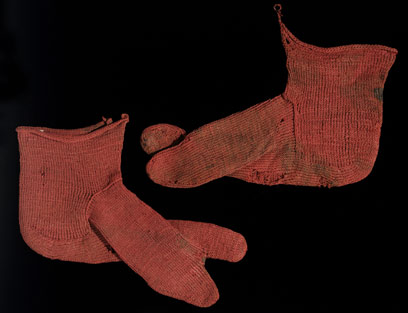
Nalbinding - not

Consider : http://www.knitty.com/ISSUEspring06/FEAThistory101.html and in particular photos

and
identified as 'nalbinding'.

On the other hand there is 


All, the result of a few minutes (time to drink one beer on a warm California afternoon) of my knitting some crochet thread.  Looks like the same stitch to me. This is about 10 spi. ( 450 stitch swatch).  Nalbinding, it would have taken longer than one beer.  If you want finer, I have finer (red) crochet thread and much finer knitting needles.  It would not be hard to run up a much finer fabric. It is a firm, dense fabric, utterly unlike most modern hand knitting. If you knit to fit, it is a nice sock fabric.  On the other hand, with its limited stretch, it must be knit to fit.  I think those old red toe socks are just knit from loom waste (short pieces of yarn).  In particular, the way the heel was turned looks like knitting.  I see the very same lines on the boot socks that I knit.  Someone working nalbinding would have turned the heel differently.  There are many heels that work well with nalbinding, but none of them produce those lines that look like my knit boot socks.

Some rows of the old red socks have a spiral or threaded appearance. Compare that to this well used gansey knit sock:

The difference is that the old red toe sock has crossed stitches, and is cotton 2-ply, rather than wool 5-ply of the gasney sock.  

There are good instructions on the internet on how to do the Coptic Stitch in nalbinding.  However, such instructions will not get you to the gauge used to make the old red toe socks.  Practice will make you better, but the nalbinding technology is not suited to produce the fine evenness and uniformity that we see in the Coptic socks.  However, gansey knitting and swaving easily product that style, gauge, and quality of fabric.  A good knitter could come close to a sock a day. 

 And trying to knit fine, tight, crossed stitches without the leverage of a knitting sheath will put a lot of stress on your wrists. You could knit a pair, but not 2 pair a week as a commercial knitter.

I will keep this opinion until I see modern nalbinding as firm, even, and at the same gauge as the original red toe sock.  Mary Thomas handled the old red toe socks and pronounced them KNIT.  She knew about nalbinding.  She also knew about knitting sheath technologies. Modern textile people tend not to know about knitting sheaths and what kinds of work they enable.


Friday, July 05, 2013

knitting in Europe circa 1280


Paul Lacroix quoting  French historian and archaeologist. Jules Étienne Joseph Quicherat (13 October 1814–8 April 1882) :

"Towards the year 1280," he says, "the dress of a man--not of a man as the word was then used, which meant serf, but of one to whom the exercise of human prerogatives was permitted, that is to say, of an ecclesiastic, a bourgeois, or a noble--was composed of six indispensable portions: thebraies, or breeches, the stockings, the shoes, the coat, the surcoat, or cotte-hardie, and the chaperon, or head-dress. To these articles those who wished to dress more elegantly added, on the body, a shirt; on the shoulders, a mantle; and on the head, a hat, or fronteau.

The braies, or brayes, were a kind of drawers, generally knitted, sometimes made of woollen stuff or silk, and sometimes even of undressed leather. .... Our ancestors derived this part of their dress from the ancient Gauls; only the Gallic braies came down to the ankle, whereas those of the thirteenth century only reached to the calf. They were fastened above the hips by means of a belt called the braier."

By chausses was meant what we now call long stockings or hose. The stockings were of the same colour and material as the braies, and were kept up by the lower part of the braies being pulled over them, and tied with a string."


Lacroix and Quicherat were both experts on the middle ages and anybody that wants to disagree with both of them had better have all their arguments in good order.


Manners, Custom and Dress During the Middle
Ages and During the Renaissance Period has been reprinted by Skyhorse Publishing, in which the quote above starts on page 529. It is also available as a 
Project Gutenberg EBook and the quote is adjacent to fig 417.

Wednesday, March 27, 2013

Not Magic

There is a class of knitters that knit as a social pastime.  Social pastimes have conventions that function like the rules of a game.  Like a game, social pastimes have winners and losers. (see for example the work of  Eric Bern,  http://www.ericberne.com/structure-and-dynamics-of-organizations-and-groups/ , http://en.wikipedia.org/wiki/Convention_(norm) )  The pastime of recreational knitting results in some knitters acquiring higher status.  This has significant value in their circles.

One of the social conventions and contracts of modern recreational knitting is that it uses hand-held needles. The use of other technologies would allow production of  high quality knit objects with lower effort, and thereby diminish the status of  recreational knitters who produced their objects using only hand held needles. The use of other technologies is thus not allowed except in the past, in  far away places, and behind the closed doors of commercial establishments.  Breaching this convention against such other technologies is met with shunning. Advocating that others also breach this convention is met with the full spectrum of social enforcement mechanisms.  People with high status, tend to vigorously defend that status.

Mary Thomas writing in the 1930s consigned knitting sheaths to museums, even though she knew that knitting sheaths were still being used professionally because they allowed faster knitting of finer and more uniform fabrics.  Rutt interviewed elderly knitters that had swaved in the 1930s, but he made no effort to preserve the technology.  Thomas and Rutt were recreational knitters, and they conformed to the social conventions of the pastime even as they discussed other hand knitting technologies.  Gladys Thompson used a knitting sheath, but does not mention that fact in her book, Patterns for Guernseys, Jerseys & Arans.  Nor does Elizabeth Zimmerman mention the fact in her 1971 Note for American Knitters, where she does talk about long needles. This was dishonest in the extreme.  Only in the context of knitting sheaths is Patterns for Guernseys, Jerseys & Arans a useful book on knitting.

Thus, recreational knitters made no effort to preserve the knitting technologies that use a knitting sheath.  These were not mythical or magically ways to knit; they were real world textile production technologies in use by professionals.   We know something of what they were, and we know something of what they were not. From that information the technologies can be reverse engineered.  Come on, this is knitting, it is not rocket science.

Anybody that needs to knit a large number of objects quickly, discovers that with hand held needles, the knitter's hands get tired and their wrists get sore. Eventually the other end of the working needle gets wedged in the thigh crease or tucked into the arm pit. More advanced are pads of straw and feathers as discussed in Mary Thomas.  However, professional knitters need better tools, and leather pouches stuffed with horse hair are much better than pads of straw and feathers.  However, Mary Thomas gives straw pads and Shetland knitting pouches each a single paragraph suggesting that they are equally valuable to the modern knitter.  In this, she dismisses both, and I at least did not find her instructions for using either a knitting sheath or knitting pouch to be useful. Certainly her illustrations of how to knit are for a Weldon style of  needle management. This is not fair to the reader that needs to knit a large number of objects quickly and picks up MT hoping for hints on how it can be done.  One might use Weldon for test knitting a pattern, but a professional knitter with an order for 6 dozen pairs of hose did not to use Weldon.

MT gives knitting sheaths 3 paragraphs of their own, but there is no hint in MT that knitting sheaths in fact support 3 very different knitting technologies; one based on the pitch/yaw of a stiff needle, one based on needle flex and spring, and one based on the rotation of a curved needle.  Thomas,  Rutt, and even Brears display an astonishing lack of interest in the functional details of how knitting sheaths were used.   The only explanation is that they considered all  use of knitting sheaths and knitting pouches to be outside the social conventions of modern recreational knitting.

I am not a recreational knitter.  Some days, I am a researcher.  Some days, I am a  textile artist. Some days, I am a subsistence knitter.  And, some days, I am a professional knitter.   I am not constrained by the social conventions of knitting as a pastime. Therefore, I am free to knit with any technology necessary to produce the fabrics that I want at the rate that I need.  I am willing to talk over the heads of all the  modern recreational knitters to other researchers, artists, subsistence knitters and professional knitters.  I want others to be able to knit better, and knit faster. I want others to know that there are a variety of hand knitting technologies.

One of those knitting technologies is based on the "roll" (rotation) of  a short, stiff, curved, blunt knitting needle with the axis of the roll fixed by one end of the needle inserted into the bore of a knitting sheath. A short forward stroke followed by a back stroke comprises the knitting technique that I call "swaving".  Details of needle and knitting sheath design and materials make the technology more functional, but do not change the name.  However, as I review the account of the invention of the knitting frame and the resulting mechanics of  frame knitting, it is likely that it was based on a knitting motion resulting from the rotation of curved needles.  Thus, circa 1590, what I call swaving was likely also known as "knitting".

As  S. M. McGee-Russell told us on the first day of class, "Everything has a proper name.  Use it!  If you find something without a proper name; name it, and write a paper."  If you go for a walk, you are likely to see plants and critters.  Most have species names, but finding those species names may take some work and require specialized knowledge.   Knitting by rotating the working needle has a name, and knitters that know their craft can figure it out.  The knitters that only knit as a social pastime are unwilling to say what swaving was, and what swaving was not.  They want swaving to be something very vague, that cannot occur today.  This is logically equivalent to asserting that swaving (was) a mystical, magical activity.   

Friday, February 22, 2013

Torque, Tension, and swaving

Long needles require longer knitting sheaths (mostly) to withstand the torque of the long lever arm provided by the length of the needle.  Knitting sheaths for swaving do not need to withstand that torque.  I may have been absolutely wrong about the short spindle form knitting sheaths in Brears. They may be to scale, but were used for swaving.


These are two Yorkshire knitting sheaths that I made along time ago. (Long before I worked out swaveing.)  They  mostly differ by the direction of the spiral design carved on them.  First, I made the one on the left, and it never worked (with the straight needles that I was using at the time). The one on the right worked acceptably when tucked into thin apron strings, but was never good enough to keep me from moving on to other designs.   However, for swaving, their performance is excellent and  substantially indistinguishable.  (Both always had brass inserts.)  Now, I have to go back and reconsider a lot of styles and designs that I had previously discarded.  The only thing wrong with some of those designs for swaving is the hole for the needle is too deep.    Relatively short swaving needles do not have to be inserted as deep into the knitting sheath because they do not have to withstand the torque. For swaving, needle holes less than 0.5" deep work well, while I had to make holes for long needles more than a inch deep to keep the long needles from popping out of the knitting sheath and into the furniture.


Two different spindle form knitting sheaths for the same size and length of needle, but since different knitting knitting techniques are used the knitting sheaths are different.  The long sheath is of the Dutch style and works very well with 6" straight needles (sock needles) and the short one is for 6" curved needles that rotate in the knitting sheath.

This raises the obvious question, "Can one swave with a leather/horse hair knitting pouch". Yes, but it is not as fast or easy as with a properly designed/ lubricated knitting sheath.  It is kinda like handheld knitting with wooden needles; there are many reasons to knit with wooden needles, but more speed is not one of those reasons.


It turns out that my trouble with doing decreases while swaving was in part because I was knitting very tightly.  And, swaving, allows knitting much tighter than in any other form of knitting that I know.

However, it is also possible to knit very loosely while swaving, giving swaving a larger range of fabric types for a given needle size than I am accustomed.  It is like  hand held continental where one can knit very loose fabrics with small needles.

However, with continental, one can just switch from tight knitting to loose knitting, or from loose to tight.  However with swaving it seems to take about 4 rows.  Anyway the bottom line is that one can knit loose fabrics while swaving, and that such looser knitting makes decrease stitches much easier.  However, knitting loosely while swaving does mean knitting slower because the fabric has less spring to it to pop the needle out of the stitch.

Swaving is much faster than I could ever knit with long needles (gansey needles), and I do not seem to be near a peak speed.  It is nice to have objects that seem to just sort of fall off the needles.  I have to be more careful to always count rows or check the length frequently.  In the old days, an evening of TV was a 4" sock cuff.  I could cast on and knit all evening without checking the length. The next morning, in the light I could finish the cuff, and turn the heel.  In the evening, I could knit most of the foot, and finish the sock in the morning's light. Thus, most of my work socks have about 5" cuffs.  I was not paying attention, so the current pair on the needles has 6.5" cuffs.  I will save them for winter wear.  It will be OK.

I had been using brass inserts in the needle adapter for swaving needles/pricks, as this reduced the friction, and allowed the needle to rotate more easily.  However, installing a brass insert was extra effort. Now, I am moving to simply making the needle adapters for swaving out of rosewood, black walnut, or similar.  With a bit of bee's wax , these woods seem to make a perfectly good bearings, allowing free rotation of the needle.  How they wear will be another question. I have not decided if the extra bother of working with these woods is more or less than the bother of a brass insert.  However, everyone seems to think the rosewood turnings look nice.


Sunday, February 17, 2013

Diversity of knitting sheaths

A knitting sheath is as simple or complex as a hammer. Their essence is the same, they are tools that provide leverage.  My tool dealer (Grizzly industrial)  offers 157 different kinds of hammers, and that does not include antique hammers such as a cobbler or wheel wright might have.  Thus, it is reasonable to think that there might be a large number of different kinds of knitting sheaths - each used for a different kind of knitting. And there are.

If we look at the various knitting sheaths drawn by Peter Brears in The Knitting Sheath, published in Folk
Life vol 20 1981-82.  We see the following kinds of knitting sheaths:


     Fig 2


Fig 3


Fig 4


   Fig 5


Fig 6


   Fig 7


     Fig 8


I am struck by several factors.  One is that he does not distinguish between knitting sheaths used for swaving and those for use with long needles. he does not indicate the size of the needle that fits the sheath.  And, he does not distinguish between, professional tools, 'love tokens' intended to be functional, and love tokens intended to be purely decorative or sentimental.With only one exception, Brear does not indicate wear marks (or lack of wear marks).

In Fig. 3 Nos. 1 and 8 are clearly utilitarian tools. Nos. 2, 3, 7, 10, and 11 are functional tools with decorative carving that enhances their functionality.  While Nos, 4, 5, and 9 have carving that diminish their functionality, and  Nos, 6, 12, 13, 14, 15, and 16 were likely never intended for any use what so ever. No.6 is heavy. The woods that are soft enough to carve ball-in-cage are to soft to make good knitting sheaths.  The  ball-in-cage structures in nos. 12, 13, 14, 15, and 16 are not likely to be to survive the stress of knitting with long needles.  The  ball-in-cage in No. 4 is not required to transmit the full stress of the needles, but only survive handling.  It could survive handling in the context of careful knitting for the family, but is not likely to survive sustained professional / commercial use.  Thus, some knitting sheaths were made for use, and others were purely for sentimental and decorative purposes.  And some were made to show off whittling ability.

Brears

The Knitting Sheath
by
Peter C.D. Brears published in Folk Life  A Journal of Ethnological Studies Volume Twenty 1981-82
deserves some careful review.  Therefore over the next few posts, I am going to annotate several aspects of the work.

Several thing jump to mind.  The first is that this is a peer reviewed academic journal that can be found in research libraries and reprints were sold at a nominal cost at various museums in Yorkshire.  (My copy cost  95 p at the Castle Museum.)  The second is his acknowledgement of hand knitting as a profession and industry. The third is his noting that the knitting sheath was used in this industry almost without exception. And, the fourth is his reference to William Howitt's description of knitters in Dentdale.


Anybody that says they could not find Howitt's passage on knitting, just was not looking.  I may make mistakes, but I go look.

Wednesday, February 13, 2013

Waist Coats & Vests

If we look at the standard references on clothing, waistcoats and vests were made from woven material.

However, Mary Thomas gives a stranded knitting technique (weaving) that she said was much used for Victorian waistcoats. In Weldon's Practical Knitter, we see a large number of  patterns for waist coats, vests and under vests, some of which are long sleeved. 

Thus, it is clear that the Victorians wore knit vests and waist coats without this practice intruding into fashion history.

One advantage of weaving is that it produces a warmer fabric with less need for knitting tightly. For the same warmth, a waist coat of this kind of knitting requires more wool and is heavier and bulkier than a waist coat knit with long needles and  knitting sheath of the same warmth.

When I knit with circs, I did some weaving  and as I moved to long needles/knitting sheath, because it was very easy.   However, as I came to understand how warm fabrics knit on long needle with a knitting sheath could be, I stopped weaving because it added weight and bulk to an already warm fabric.

It is interesting that directions for weaving do not appear in the Weldon instructions. 

And when we look at Colonial trade of Maryland, 1689-1715 (1914) by M. S. Morriss, in Appendix II, (imported from England) we do find  both cloth and “ worsted” stockings and both wool and worsted waistcoats, which I take to mean that there were knit waist coats. The book is reprinted in The Johns Hopkins University Studies in Historical and Political Science (1914) by Herbert Baxter Adams 

Taken in the context of the  above imported garments, the material at http://www.history.org/history/clothing/men/mglossary.cfm tells us that a sailor’s waistcoat could have sleeves, be called a jacket, and be worn outer most.  This is certainly consistent with seamanship texts from 1750 to 1840.

Tuesday, February 12, 2013

Slop


John Marchant’s Dictionary (2d ed 1760) defines jacket as a short outward garment such as a sailor might wear. Thus, what you would call a gansey or Guernsey would be called a shirt if worn as an under garment and a jacket if worn as an outer garment, and a frock if rather loose.  And if long, it would be a gown. Consider John Boyd’s A manual for naval cadets, where only in one reference are they called “knitted worsted jackets” and other times simply “jackets". Note well the use of “jackets” by Liardet, for the garment the crew is wearing to sleep in on cold nights. (Liardet was a sea captain who wrote a large number of texts on seamanship and military/ merchant ship management.) Likewise, knit wear may be called a “frock”, per Mary Wright
If sold by the ship (slop chest), they would all be known as “slop”. See for example; The Royal Navy, 1790-1970 by Wilkinson-Latham.
Additional information is in the Fourth Report of the Commissioners for Revising and Digesting the Civil Affairs of His Majesty’s Navy (1806). These reports include full details and history of the operation of the slop chests. In The laws, ordinances and institutions of the Admiralty, (1746, Vo.l 2 pg 301) we see both broad cloth coats and “Kersey gowns” are to be sold at 19 shillings. each. (~twice the price of a "striped suit" of clothes, or 3 time the price of a "blue suit") In The accounts of the Lord High treasurer of Scotland: 1473-1498, we see that “Kersey” is a finely knit fabric. From both contexts, Kersey was expensive.

Edited to say this is clearly wrong.  Kersey was a woven fabric.  Thus we still have the question of, " how did the top men stay warm." Twill fabric, even with a nap does not solve the problem.
Thus, we have knit upper body garments in the British navy slop chests in 1746, based on official government reports available in the national archives.  And the garments brought aboard by volunteers and merchant seamen are repeatedly referenced in the basic texts of the time.  The existence of such garments given the authority and the number of such references is beyond doubt.

If we must look to Admiralty documents, 

The Nautical Magazine: A Journal of Papers on Subjects Connected ..., Volume 2 (1833), at that time there are worsted, white knitted jackets. and in Admiralty Orders, &c. &c.

(Circular, No. 83.) Admiralty, 23d October, 1832, we have blue knitted jackets.
And note the that the slop chests did not sell “oil skins”. We know that some war ships had infrequent  “make and mend” days.(see for example Liardet on warship management. Other sources say some war ships went months between M&M days.  Sailors on warships were not given time to knit. This is no surprise as the Captain made a profit on all slops sold to his crew.) Thus if a man was pressed, and came aboard, he could buy a knit gown, and various kinds of cloth, but it might be months before the sailor could fashion a set of oil skins. Thus, we know that the “gown” had to be very warm. It had to be weather proof.
It is worth noting the difference between the Navy's selling slops to seamen and the way the British Army and Marines were clothed. In Reports from Committees of the House of Commons: Repr. by Order ..., Volume 13 (1803) pg 622 et seq., we see that clothing and equipment was issued to these forces, and if they remained in the service for 8 months, the soldier owned the clothing/equipment.  As we look at navy accounts pg 166 et seq we see line items for purchase of slops (to be sold to seamen) and clothing for prisoners of war,but no item for any other kind of clothing for seamen.  Thus, there was no funding for oil skins to be issued to seamen.  The sailor either brought an oil skin aboard, or made an oil skin on a "make and mend day" or went without.  On the other hand the  "striped suits" were lined with duck would have been reasonably wind proof, but not comfortable against the skin when wet, and very slow to dry. 
Academic and scientific works do not cite common knowledge such as is available in basic texts and encyclopedias. The above information is in the basic seamanship texts and encyclopedias of the time.    It was in the government reports on the topic from the time. It can be found in multiple other sources. Anyone with a basic knowledge of British or European shipping or fishing or naval operations circa 1750 should have be aware of this information.
The only question was, “How warm or weather proof, are such fabrics?” The answer is VERY! The proof is in the knitting and testing of such fabrics. That is what I have been saying, ‘the proof is in the knitting!”  The only peer review would be of the knitting, and that would require a knitter with expertise in knitting with long needles and a knitting sheath.

Thursday, February 07, 2013

Why Seaman's Sweaters?

Or, Why didn't they just change their clothes and put on rain gear as required?

Back in school, I had a  professor that said, "One must make a thousand pots of tea, before one is ready to make one tea pot".  He meant that one must understand how the product will be used, before one can make a truly excellent product. One must remember that Russian tea is served differently than Japanese tea.  In this vein, one must understand the life of that sailor before one can understand the clothes of that sailor.


On sailing ships (pre-1830), top men were stationed in the top of the ship’s rigging because with every change of weather or course, there was ship’s work that had to be done promptly.  There was not time to climb down, change clothes, and climb back up.  And there was no way to store clothes in the top, and in a squall, there was no way to change clothes in the top.  (Yes, oil skins could be lashed to the mast, but one is not going to be able to don oil skins in the top of a ship during a squall. Modern skippers do not even allow crew in the rigging in such conditions.) The clothes that a top man wore as he climbed into the top, were all that he had for his 4 hour watch, regardless of what squalls should blow up (or blow away).

Their rigging and sails were natural fiber, when it got wet, the fiber swelled and the lines shortened and had to be slacked – rather promptly.  When the weather cleared, the lines and sails dried, and had to be trimmed – rather promptly.  The times when a land lubber would have the sailors changing their clothes, are in fact the exact times the sailors had the real work of a sailor to do.

If a weather event required "all hand"s, they came on deck in whatever clothes they wore while sleeping.  A modern racing crew can sleep in their rain gear for the duration of a race, but a seaman did not sleep in his oil skins every night for years on end.  He slept in his sweater, and trusted that to keep him warm during all hands calls. 

Real seamen could do real work, on real ships, because they had real sweaters.  Sweaters that shed rain, but vented under warmer conditions.  The technology to knit such sweaters includes long needles and a knitting sheath.  The technology can be used to knit other things, but it did make  good seaman’s sweaters.  It is a technology that most modern knitters have forgotten and  product that few modern knitters can imagine.

How much clothing and gear did a seaman have?  Space on board a ship was very limited. An officer or midshipman could have a sea chest, but a seaman kept his things in a sail cloth bag, perhaps a foot in diameter and 2' long. He would have the clothes that he wore and slept in; including a neck cloth, leather belt, belt knife, and marlin spike. He could swing out of his hammock, and go on deck ready to work. He would have a change of clothes for shore wear. He would have a couple of pairs of mittens, a couple of pairs of socks, a knit helmet, a cap, an oil skin & rain hat, an extra sweater, perhaps some knit drawers, and a pair of sea boots.  There would be his sailor's palm and needle, thread, beeswax, a razor, and a bible if he could read.   There might be a pipe and some tobacco.  In some fleets, there would be a cup, spoon and bowl.  A fisherman would have a pair of  knit nippers.  Sail cloth could be purchased from ship's stores to make other items.

 I estimate that it would take on the close order of  500 hours to knit all the knit wear.  I estimate that it would take a thousand hours to hand spin 5-ply for that much knit wear.  Thus, a young sailor's kit was a large investment.  

 In the Navy, the entire seaman's bag would be lashed to the railing inside the seaman's hammock and blanket while the seaman was on watch or at battle stations.  The sun and air killed the lice. It made theft more difficult.  And, during battle it reduced the number of splinters from the railings - Splinters from the railing were actually the most common cause of injury during naval battles. It is no surprise that we do not find seaman's gear in ship wreaks.

Typical water rations on board sailing ships was 3 liters per day for cooking, drinking, and washing.  There was no fresh water for washing clothes. (Except when it rained, and a rain squall was not likely a good time for sailors to stop work and wash.)  Woolens were "washed' by dipping them in stale urine and letting them dry in the sun.  It does a better job of cleaning wool than trying to wash it in sea water. Soap will not lather in sea water, and tightly knit wool tends to strain little critters out of sea water.  Then, the little critters die and rot, making the fabric smell like rotting sea life.  Stale urine was the best dirt extractor that they had.

Oops, that may be a bit more than you wanted to know.  : )


Monday, November 26, 2012

more Swaving

The key to ergonomic swaving is the correct needles.  When I first made up swaving needles, I was working from a sample of  a glove needle, and I tried to scale it up to 6" and 8" needles.  It does not work.  The longer needles were not ergonomic  :  (  As I found out!

The sample glove needle had a 90 degree bend in the middle, so as it rotates in the knitting sheath, the tip describes a circle with a radius of 2".  Turns out that is about right for my hands/style.  If I take a 6" sock needle and put a 90 degree bend in the middle, then the tip describes a circle with a radius of 3". That does not work as well for me.

Now, I bend the 6" and 8" needles much more gently so that as they rotate in the knitting sheath their tips describe a circle with a radius of ~ 2" or less -- yes-- the gentile curve that we see in old needles.  About the gentile curve that we see in well used wooden or bamboo needles.

However, swaving needles have a ball tip, with essentially no taper. My swaving needles started as sock needles, but now the tips have been ground round, because that works much better. Note that it is much easier to grind the tips before bending.  : (  My needles are hard to bend. Addis are much easier, but they are plated, so you do not want to go grinding Addi tips.  Some steel DPN are made from tubing, which is likely to crumple when bent.

The needle is "popped" into the stitch, yarn looped, then both hands push down and out in a short, brief, powerful motion. In my style,as the hands are pushed down, the palm or ball of the thumb pushes the upper end of the knitting sheath down about 3/8" of an inch, the knitting sheath pivots, and the working needle levers the yarn through the stitch using the leg of the last stitch as a fulcrum, while at the same time pushing the working stitch open to allow the loop of yarn to come through. This happens suddenly!  The needle with its loop of  yarn pops through, and the small (3/8") motion of the left hand slides the stitch off the needle.

The system allows very large forces to be applied to the knitting. And the system works better when the firmness of the fabric can add to the "spring" that pops the stitch.  At this time, I actually do not know if the system will produce the soft fabrics produced by CYC (http://www.craftyarncouncil.com/weight.html) recommendations. I have been knitting medium (4) yarn on 2.38 mm needles at 7 spi (28 s/4").  I like the fabric. I do have some finer needles, and someday, I will move on to finer yarns.

Swaving is very good for crossed stitches, and it is very good for garter stitch.

/Edited on 7/27/2013  Here I was knitting crossed garter stitch.  Eastern Crossed stitch at a firm gauge is not possible with blunt pricks./

 Likely, one of the reasons for the popularity of crossed stitch fabrics in the old days was that crossed stitched garter results in fabric that has a minimum number of stitches per area, and thus was fast (cheap) to knit.

The process works with firm and very firm fabrics.  The produced fabric is more like high quality machine knit sock fabric than like most modern "hand-knit" fabric. (This may just be me as I like this fabric.)

Stitches tend to lay along the curve of the needles right down to the tip.  Dropping stitches is a much larger problem, but ladders and even tension is less of a problem.

On can knit/purl with swaving needles, but swaving does not happen with straight needles.  One can use the same knitting sheath, but the needles are not really interchangeable for production work.   For me at least, ordinary knitting/purling with a knitting sheath and curved needles is much slower than ordinary knitting/purling with a knitting sheath.  On the other hand knitting/purling with a knitting sheath is much faster than knitting/purling without a knitting sheath.

I have not figured out how to purl with a swaving motion. I have to just purl.

/Edited on 7/27/2013 - I have gotten very good at purling using the swaving motion.  It just took a lot of practice./


Saturday, July 28, 2012

Why Cables?

Like a Socratic question or a question used to teach Shaolin monks, this question has many layers.

First, why gansey knit? (i.e., knit with a knitting sheath and long steel needles)  The gansey knitting technology allows knitting tighter than can be achieved without the leverage provided by the knitting sheath.  The tighter, gansey knit fabric is more weatherproof than can be achieved with hand held needles.  The fabric  is remarkably thin for its warmth, which is a real advantage in the cramped quarters onboard a working fishing ship, and it is remarkably warm which in an a real advantage in the cold and windy conditions under which commercial fishing is often conducted.  That is reasonable, but why cables?

Cables provide some additional ventilation between the sweater and the oil skin (water proof layer) to reduce wetness under oil skins as a result of moisture from the sailor's skin condensing on the cold inside of the oil skin.  This is a good reason.  It may abe reason enough.  Cables provide some additional comfort when sleeping in a canvas hammock.  This is a good reason.  Cables provide an artistic outlet for the knitter.  This is a good reason.  Cable patterns help identify the sweater (and I assert, at one time the cable pattern indicated the wearer's job and fleet.)  That is a good reason.  However, none of these are really compelling  reasons.

To really understand cable patterns, you have to go back to the reason for for ganseys; warmth with light weight. The early (13th centrury) fishermen on the North Atlantic lashed barrels to the rails of their small (70 foot) ships.  Then, the fishermen stood in the barrels with straw to help keep them warm , and jigged for cod.    (later they jigged for mackerel, and trawled for herring).  In those days, a single cod could weigh more than 100 pounds.  Bringing up a cod was like hauling a iron manhole cover up through 300 feet of water, and they would do it every 10 minutes. Except this is the North Atlantic, so there are large waves and everything is rocking.  What did they do?  They braced themselves against the edge of the barrel.

Put on a sweater and climb into a barrel, grab hold of a manhole cover and have 2 of your brothers rock the barrel violently as you repeatedly lift the manhole cover for a week. At the end of a week you have a big hole in your sweater where it rubbed against the edge of the barrel.

(Later generations of fishermen worked from dories and braced themselves against the gunnels of the dory.)

After they caught the fish, they cut fish.  With the ship still rocking, you take a fish in one hand and a sharp knife in the other and you brace your self against the cutting table - except by now your gansey has a hole in it, and there is only a thin apron between your belly and the cold slime and wet from the cutting table.   You get back to St Peter Port  and you  go to your knitter, and tell them that you want a sweater that will last more than a week.  So they  knit you one - with cables on the belly where it rubs against the barrel, and the design was so good, that in some way copied by 50 generations of knitters. Thus, fisherman's sweaters have cables or fisherman's welt on their fronts.

The third job of the fisherman was to get where the fish were, and  stay where the fish were.  That meant sailing up wind  in all weather.  The weather blew the ship off the fish, so the fisherman must constantly sail up wind. Sailing up wind is an uncomfortable business.  Moreover, the harder the wind blows, the more uncomfortable it is, but also, for a commercial fisherman who must catch his catch as fast as possible, the more important it is to work to windward, to stay over the fishing grounds.

During a storm on the Grand Banks, the expected wave period is only 20 seconds.  On a ship, anything that is not lashed down is going to get thrown about.  Lead sinkers jump 2 feet in the air, twice a minute.  Sailors get thrown about. The ships were oak and the sailors, mortal flesh. Today under those conditions, we would be wearing layers of  polyester fleece (and life jackets/ float coats/immersion suits) and that would provide some protection.  However, gansey fabric was thinner and provided less padding.  Hence, cables all over the sweater provided some padding in an otherwise thin garment.  Again, likely a concept developed by knitters on the Channel Islands, and copied by others knitting for sailors for 50 generations.

We can look at the differences between the sweaters worn by sailors and fishermen and those worn by life boat men to take another bearing on the concept.  The ganseys worn by life boat men do not seem to have had cables.  Life boat men did wear oil skins, so we can drop the ventilation concept. What they did not do is brace themselves against the railing or gunnels to haul fish to the surface.  The lifeboat's prize was already at the surface.  They rowed out, picked it up, and rowed back.  Nor did the lifeboat men take the beating of sailing to weather for days or weeks on end.  It is not that rowing a lifeboat is easy, just there is less to bang against.  So while lifeboatmen's gamseys without cables do not prove my theory of cables as padding, they  does not disprove my theory either.

Having worn ganseys with and without cables, while sailing in serious weather, I find the concept of cables as padding the most compelling reason for cables.   Anybody that disagrees should have tried sailing in ganseys with and without cable patterns on them in serious weather.  To have any credibility, on this topic you need to have been out fishing when the waves were bigger than the boat.  You need to understand that the key to getting work done while wearing a Type 1 PFD is motivation.  To have any credibility, on this topic you need to have been knitting while lead sinkers were thumping on their racks.

Wednesday, April 07, 2010

Nothing in the mud?!

How many knitted seaman’s frocks would YOU expect to find from the medieval period? We will not know that there were medieval ganseys unless we have a model that estimates how many, and where, we are likely to find ganseys. Then, we estimate the number of samples that are likely to be required to find that number of ganseys over the expected area, and based on the results of our sampling we accept or reject the hypothesis that there were knit fishermen's frocks in the medieval period.
To find such an artifact, 4 rather improbable things must occur:

1) The frock must be knitted. Knit fabric is 8 to 100 times more expensive than woven and is thus only selected where the properties of knit material are required or where it is being used as conspicuous consumption. J. M. Synge’s “The Aran Islands” make it clear that in 1900, “ganseys” were are rare on the Aran Islands as silk suits are in Wal-Mart. Woven cloth was cheaper, and that is what they used, layers and layers of woven wool. This worked for an impoverished subsistence farmer that had to sometimes row out to the steamer or to another island. On the other hand, note that the men that went off island and worked for wages as seamen, did have knit sweaters.

2) The knit frock had to be discarded. Seamen had one gansey and they wore it all the time.

How many sailor’s frocks would we expect to find in the wreck of the Mary Rose or the General Carlton? Every sailor was wearing his knit frock. If he had an extra, it would be lashed in his hammock to the deck railing. (And, the railings are one of the first parts of a wooden shipwreck to be lost.) If he survived, his frock went with him. If he drowned, his body cavity filled with decomposition gases, and floated away carrying the frock with it. If he died of trauma, then the nutrients in his body attracted scavengers (sharks and crabs) that would also damage the gansey. Thus, our hope of finding a gansey is to find the “slop chest” on board. Was the “slop chest” found? If not, the probability of finding a gansey at the wreck site is almost zero.


Moreover, if the wreck was salvaged at all, any seaman’s frocks would have been valuable and easy to carry away. The slop chest would have been a target for anybody that could get to the wreck.

What happened to “ganseys” on shore? In hand-spun days, last year’s gansey was un-raveled and the resulting yarn re-plied to make next year’s gansey. (Or, socks for the kids.) The sailor either wore this year’s gansey to his death and Davy Jones Locker, or it became last year’s gansey and was un-raveled and re-plied. Thus, in “hand-spun days”, I would not expect to find a fragment of a gansey. I would expect the first old ganseys to show up about the time mill-spun started to gain acceptance and knitters did not have a spinning wheel handy. In environmental science, this is what we call “fate and transport.”


In short, ganseys were not something left lying around.


3) The gansey had to survive after being discarded. Given the number of bugs, critters and molds that destroy wool, discarded ganseys would survive only if they were dropped into acid bogs or anaerobic muck. Certainly small items were trod into the mud of York, but an entire gansey is harder to lose. At some point, a rag picker sees it in the mud and picks it up.

4) Archeologists must sample the acid bogs or anaerobic muck until they find the gansey. Mostly, archeologists look at centers of population. However, if it was a center of population, then some contemporaneous rag picker would have recovered and recycled the yarn. Thus, to find old discarded ganseys, archeologists are going to have to sample bogs and muck from the period away from centers of populations. We have to find some sailor that wore a gansey, fell in a bog, and his body never floated to the surface. (Rare, because most bodies that were not staked to the bottom of the bog, do float to the surface. If he was alive, he would have recovered his gansey, and gone on his way.) The method of calculating the required number of samples to find such textile fragment(s) can be derived from Gilbert’s text on Statistical Methods for Environmental Pollution Monitoring or for a more general case, Cochran’s Sampling Techniques. We are going to need more archeologists.
I would like to point out how few artifacts of spinning wheels we have from some periods when we know that they did have spinning wheels. At first thought, there are not as many artifacts as one would expect for the amount of spinning that we know was done. However if we think about spinning wheels as tools of production rather than as sentimental items of decor, we understand that they are kept until they are worn out, then they are repaired and used some more. These days we discard obsolete technology. Prior to 1780, there was no such thing as an obsolete spinning wheel. There was only spinning wheels and firewood. Second thought, brings forth the realization that spinning wheel artifacts would be very rare indeed. This is consistent with what is found in the field.


As for searches for “gansey” in news papers: while “gansey” does occur in Howlett (1840) it did not make it into an OED cited source until 1851. Clearly, in 1840, it was a term of art in use by contract knitters and not in general use. I trusted OED, and looked to “frocks” for richer pickings.


Given the variations in population as famines and pestilence swept the medieval period and the way that cultural material is lost every time a structure is abandoned for even a short period, I would be very surprised if any sample of a pre-1700 sailor’s frock is ever found. (Richer families could protect their structures in downturns, but knit frocks were still work clothes that got recycled. There was also a class of knit goods that served as conspicuous consumption. Part of the conspicuous consumption was that the garments were always in good repair, and thus recycling was part of the conspicuous consumption. At the end of its life as a frock, the yarn became socks and hats. Again, such knit goods are likely to be as rare as Armani suits in a Salvation Army thrift store. That does not mean that they did not exist, it only means that you are not going to buy a good Armani suit for $5 in a Salvation Army Thrift Store.


I spent the weekend looking at homestead sites that had known dates of abandonment over the last hundred years. The people with me were astonished at how fast a farmstead could become an archeological site, and how fast materials and contents were lost. Some of those sites are being rebuilt today and an archeologist looking at the material in 200 years would think that there was essentially continuous habitation, as there has been some continuous, dateable, deposition on the sites. We need to remember that areas that we consider to be continuously inhabited were subject to plagues and famines that caused drops in local population and temporary abandonment of some buildings and structures with resulting loss of cultural material. These were frequently periods of salvaging. A single sock in the mud might be overlooked, but a gansey was trove of yarn that could be unraveled, and from which much could be made.


Looking for a gansey in the midens of Yorkshire is like looking for a Rolls Royce in the auto junk yards of America. It is not that Rolls Royce were never in wrecks in America, it is that there were relatively few of them, and they were so valuable they were taken out of the junk yards and reused. You can look, but I can tell you right now, that you will not find a Rolls Royce in an American junk yard.

In my model, it is unlikely that any reasonable number of samples is likely to reveal gansey artifacts. If we should suddenly find a bunch of 17th century ganseys, then my model is faulty. In short, old ganseys are rather like neutrons, in that they can only be detected indirectly. We have evidence that they exist today, but our evidence that they existed yesterday is indirect—unstable isotopes for the neutrons and square rigged ships for the ganseys. Never the less, we can be sure that both existed “yesterday”, even if we did not specifically see those particular neutrons and ganseys. Do I “believe in neutrons”? It is a model that explains the observations without exception. Do I “believe in ganseys”? It is a model that explains the observations without exception. Do I believe in Irish Fairies? No, there are simpler explanations.


Lord Kelvin got a lot of things correct, but he was way off in his estimate of the age of the sun. Ussher, Kepler, and Newton all placed the creation of the Earth around 4000 BCE. This forced the compression of the timelines affecting all branches of human development. Now, we know that Cornwall/Wales were trading tin to Carthage in 500 BC, and Carthage was also trading to Syria and India at the time. The timeline has expanded. The Han had treadle spindles for spinning cotton; and, the silk road was a fact when the Romans got to Britain. However, textile arts have been slow to decompress their timelines, and they still write of “inventing” treadle spindles 1500 years after the Han. Modern Knitters seem to cleave to an old model that says knitting is new, more on a basis of what we have not found, than of careful analysis.  We need to look beyond Wright, Rutt, and Tompson, just as Einstein  looked beyound Newton.


I look for skill sets that we have lost.  Some of those skill sets are like a gansey in the mud -- they have value.  The awe and greed on the faces of the people touching and feeling my products this weekend tell me that I am on the right track.

Sunday, February 21, 2010

Citations

I do not give many citations. Suppose I cite British customs taxes from the 14 th century? The few folks that would go to London and check the original customs ledgers know where they are and how to get permission. For anyone who is not going to check the original manuscript, there are variety of transcriptions and summaries of those documents. However they are mostly in collections and you have to go to the library or collection, put on the white gloves and look. Just having the title of the document does not ensure that I did not transpose some numbers when I was taking notes on my little steno pad.
There are a lot of library skills that I take for granted. My dear Readers should take that as a complement.

I said, “that we do not do fine knitting any more”, and we do not. Bug knits is tiny stitches, but it is novelty work. There is a wonderful collection of similar work in a knitting shop on the North Shore of PEI, and I am sure that there are many other similar artists around. The lady on PEI said that each of the little garments required more than 200 hours of work. In contrast, the Pope’s Stocking was a fragment of men’s hose that was designed to be worn.

As late as the start of WWII, a good deal of fine knitting was still being done in the couture houses in Paris. These were finely knit, one of kind objects, which were not publicized. They also required thousands of hours of hand knitting. By the mid-1980s those knitting divisions at the couture houses were phased out. One of the last of those professional knitters now works as a sales clerk at Saks Fifth Avenue in SF. She is one of the few people in the US that I have met that knows how to knit with a knitting sheath, but most of the knitting when she was working in the couture houses was looser, and done with circs.

Folks today do knit gansesys. Gorden knits beautiful ganseys on circs, but he knits for half an hour per day and it takes him a YEAR to knit a gansey. Dawn9163 on Ravelery knit her son a wonderful gansey on circs in only 6 weeks, but at the end, her wrists were sore. The days of "terrible knitters" doing a gansey in a day are passed. I can knit a plain (but absolutely weatherproof) gansey in a week without hurting my wrists. I can knit a good, weatherproof sailor's kit in two weeks. I made many determined attempts to knit such fabrics on circs, and never could do it (fast enough to suit my needs for winter wear). At one time, I had a whole bin of failed attempts. For the first couple of years after I moved to DPN/knitting sheath, I would go back to my circs and make another stab at knitting such fabrics on circs.  I always failed.  No! that is not quite right. I COULD do it, but I could not do it fast enough or long enough at a time to to make it a practial method of production.   I would freeze before I got enough knit to keep me warm.  With a knitting sheath, I can easily keep myself and all my skiing and hiking buddies supplied with weatherproof knit wear.


The French had year-round navy patrols of the English Channel in the last couple of decades of the 14 th century. Why? Who knows? The British Crown was too broke to mount an invasion. Would you have volunteered for winter patrol in the English Channel? Not considering their ships, lack of charts, lack of coastal facilities, poor food, and lack of weather forecasts. No, France pressed their sailors. Press gangs worked later, and they worked just as well in 1380. We know that the Channel Islanders were knitting garments for sea faring men, and some of that product went to France. It is very likely some of it went to the sailors on Channel patrol. Ships are expensive, and hypothermic sailors result in lost ships. No, France bought their sailors tightly knit ganseys so the sailors could keep the ships a float. It is worth noting that 100 years later, France was still one of the largest customers for English wool. Trade routes tend to persist for generations.

Friday, February 19, 2010

My View of Knitting History

I am highly amused by the reaction that I get when I talk about knitting sheaths in history groups. Knitting sheaths are tools, like rocks and hammers. Sometimes they are the right tool, sometimes they are the wrong tool for the job. However, for me, it is funny for somebody that has never used a knitting sheath to vehemently say that knitting sheaths are unnecessary. That is like somebody that has never used a hammer telling a carpenter that hammers are unnecessary. I have to think that this is a residue of the Victorian loathing for the poverty associated with “knitting for pence”, and the Victorian distain for the tools of the impoverished contract knitters.


Actually, I thought about felt quite a lot. However, we have good knowledge that it was not much used aboard square rigged, sailing ships. So the real question is why was felt not used more? The answer is that felt clothing does not suit the kind of work done on a (square rigged) ship. As a result, the great sea faring centers have museums devoted to knitting, not felting. Felt clothing was very practical and popular on steam ships starting in the Victorian Era.


Knitting for subsistence fishing could be performed by wives, sisters, mothers, and other family members. However, Great Britain was a great sea faring nation with a navy that pressed crews - no chance for a mother to knit for her son while he served in His Majesty’s’ Navy. So there was commercial knitting for seamen as early as there were navy press gangs – and in France that was um – 1380? Customs tax records suggest that the wool that those French navy sailors wore came from England and was knit in the Channel Islands. Knitting was such a large industry in the Channel Islands that for a while customs tax on British wool exported to the Channel Islands was the primary income for the British Crown. When the Tudor Wool Act was passed, (to protect the Yorkshire knitting Industry) the Channel Islands turned to piracy, which was only resolved when Sir Walter Raleigh reestablished knitting on the Channel Islands as an industry. In those days, knitting was big business.


In Victorian days, knitting became conspicuous consumption in the tradition of Thorstein Veblen, Gary Becker, and Kevin Murphy. Knitting loosely proved that a lady’s house had central heat. Ladies wrote new knitting manuals to teach their students how to knit slowly and elegantly. Another great virtue of knitting slowly and loosely is no stress on the wrists. Thus, the ladies were able to discard the distained knitting sheaths. The old professional knitters did not write their skills down, and subsequent generations of knitters from all walks of life looked to the knitting manuals written by Victorian ladies. However, later generations of knitters forgot that those Victorian ladies had a distain for practical professional knitting.

As Mary Thomas writing in 1938 said,

Knitting sheaths, or sticks, as they were sometimes called, are now a feature of museum interest, but at one time, when hand knitting was a vast and flourishing industry and speed a matter of pence, every knitter owned and used these implements. . . .

 Mary Wright was one of the first to address the subject of knitting sheaths openly in her 1979 book, Cornish Guernseys & Knit frocks. (It is also worth noting that she damaged her wrists knitting a replica gansey on circular needles.)


In the old days, when knitting was an important technology, they were very, very good at it. One of the finest examples of knitting that we have is a fragment of silk hose with designs in gold filaments from the Arab world, knit in the Ninth Century. That was knit with the élan that separates the talented professional from the merely competent amateur. Yes, today we have people that do things like: http://www.ravelry.com/projects/dawn9163/whitby-gansey, but it took her more than a month and she had sore wrists afterward.

In the Victorian era, we lost much our heritage of these professional knitting tools and expertise. We no longer have cadres of talented professional hand knitters with trade secrets, advancing their craft generation by generation. We forgot how to knit ganseys without sore wrists. We have forgotten how to hand knit silk and gold at 30 stitches per inch. With a few exceptions, now, we do “hobby” knitting. Our professional knitters are designers that make a living doing designs for “hobby knitters”. I look to history, not for history per se, but for clues that can let me be a better knitter in the future.


Knitters that come to me for “history” are going to be disappointed. Knitters coming to me for ideas on how to knit better are going to be amazed and delighted. I have used rocks (Clovis blades) to cut my meat, but sometimes a steel knife is - just better. I have pounded nails with a rock, but sometimes a carpenter’s hammer is – just better. I have used Addi Turbos, but sometimes DPN with a knitting sheath is - just better.


He, who knows only his own generation, remains always a child.

Wednesday, February 03, 2010

An approach to using different sized needles with the same knitting sheath

Many Victorian knitting sheaths have adapters that allow several different sized needles to be used with the same knitting sheath.   Many of these Victorian knitting sheaths with adpaters have a look about them that make me think of vocational school projects for teaching young men to use a variety of power tools.  That is, these are not tools made by a knitter.  Moreover, I do not see much in the way of wear marks on such tools suggesting that they were often gifts and keepsakes.


Several knitters have asked about how to use several different sized needles with one knitting sheath, and this is certainly a workable approach. The photo shows two knitting sheaths that I made which accept  adapters.  By changing the adapter, different sized needles can be used with the knitting sheath.  Thus, with these 4 adapters, US # 0, 1, 2, or 4 needles can be used with either of these knitting sheaths.
These are crude prototypes, but they work very well.

Another advantage of this system is that the knitting sheath can be made of a light weight or decorative wood while the adapter can be made of a harder wood such as maple. Thus, the  design life of the system can be longer, that the design life of a system with the (steel ) needle flexing against a softer wood.

On the other hand, these adapters are tricky little fellows and I expect they will tend to runoff, join the circus, and never to be seen in a knitting bag again. 


Wednesday, June 17, 2009

UK knit circa 1800?

How did folks in the UK knit circa 1800?

1) Certainly, hand-held DPN (or needles held, supported, or controlled in the arm pit) with the yarn in either the right or the left hand. These needles develop a very slight curve and distinctive wear marks at the extreme tip that allows them to be distinguished from broken awls. The disadvantages are that knitting firmly can put a stress on the wrists, knitting is slower than with a knitting sheath, and long needles are difficult to control.

2) Short (6- 12 inches), straight (more or less), DPN held in a knitting sheath under the right elbow or over the point of the right hip, with the yarn in either the right or the left hand. These knitting sheaths were 6 to 10 inches long in a variety of designs. These designs for such sheaths included bundles of feathers bound together with a bit of waste yarn or a cone of leather filled with horse hair for tucking into the waist band. of the sheath designs work very well tucked into apron strings. Many Other designs allow for separate tapes or belts. In general, the needle flexes along its length, and does not rotate in the needle hole of the knitting sheath. Many of the needles pick up a significant curve or arc with use. These needles have distinctive wear marks in an annuls ~1 cm form the shoulder of the needle tip. If you see this band of linear striations, you know the needle was used with a knitting sheath, and that it was a knitting needle and not something else. Such knitting sheaths can be used with 3+1 needles for small objects or many needles if a large carpet or blanket is required. The side of the right hand pushes the needle into the stitch and the base of the thumb pushes the working needle back through the stitch. It is a low stress knitting technique suitable for people with tender hands and wrists. It can be a very pleasant way to knit at a reasonable pace. It can also be done quite aggressively to knit very rapidly. This technique allows knitting fabrics much tighter than any other method on this page. These are most of the old knitting sheaths that people liked, and kept, and that one still finds in the collections.

3) Knitting sheath as above in 2) but used with 2 needles for lace items knit flat.

4) Gansey needles (14 -18 inch long steel DPN) used with a knitting sheath firmly attached to a strong belt over the right buttock, with the working needle arched forward under the right arm. The belt is worn much lower on the body than in the short needle technique above. The weight of the right arm rests on the needle. The needle is forced downward into the stitch, the right hand loops yarn over the tip, and the spring action of the needle lifts the loop of yarn back through the old stitch to form the new stitch. This is a powerful, industrial knitting technology. It can be done very fast, and then it is very hard work. On the other hand it is the easy way to knit a real gansey.

5) Curved, blunt needles called “pricks” used with very large knitting sheaths (40 -50 cm) tucked into a belt worn low on the hips. The yarn is controlled with the left hand. The prick rotates in the needle hole of the knitting sheath. The prick is “popped” into the working stitch with a down and out simultaneous impulse of both hands that caused the prick to pick up the yarn as it stretches the forward leg of the working stitch. The stretch of the yarn and fabric provide a spring action that push the prick and yarn back through the working stitch, which then pops off as the next stroke starts. The process is very fast and very demanding. This was a method for commercial knitting. As soon as the need passed, these big sheaths were tossed in the fire, and people reverted to straight needles with smaller knitting sheaths. The nature of the spring process means that everyone using the same sized needles and the same yarn will tend to knit at the same speed. Thus, everyone in the room can sing to the pace of their knitting, knit to the pace of the song, and at the end of the evening, everyone will have knit the same number of stitches.

6) Knitting belt/pouch with DPN. Very similar to 2) above, excellent with the blunter needles used for the softer spun yarns used in Fair Isle knitting. The needles are not as firmly held and have less of a tendency to develop an arc and develop polish rather than marks on the shaft of the needle. Perhaps not quite as fast as knitting sheath but very good for travel.

7) Knitting hearts – very small, decorated knitting sheaths, designed to pin to a lady’s dress to support very fine knitting needles used for knitting lace.

I am a bit pedantic, but I would say that circa 1800, there were at least 11 different and distinct knitting styles in Great Britain, the use of which employed at least 7 different tool kits.

A note, at one time, I thought that gansey needles were very difficult to manage without a knitting sheath. Now, I know some knitting styles that allow use of long needles without the use a knitting sheath. One of these methods is the knitting style of Miriam Tegels. (A second is s Spanish style of "Pit Knitting.") However, I still think that if Miriam Tegels and I sat down together to knit ganseys, for the first day or two she might blow me away, but that by the time we had knit a dozen ganseys, she would be a convert to knitting sheaths. I know that I just sold a set of knitting sheaths to a knitter that had learned excellent pit knitting skills as a girl in Spain. I showed her how to use the knittng sheaths, let her play with them for a while, and at the end of the session, they went in her knitting bag.