Thursday, June 23, 2016

Knitting techniques

I went through the full circle of  popular knitting techniques before I moved onto knitting sheaths.

The last was continental.  There was an online knitting group, and I asked how could I knit faster.  They told me, learn to knit continental style with yarn in your left hand.  I tried it, found it to be a bit faster, and did continental knitting with circular needles for about 4  or 5 years.  During that period, I attempted to knit the patterns in Gladys Thompson, and did not have much success, particularly with the Norfolk patterns at 12 spi and 20 rpi.

I reread EZ's note for American knitters, and tried long needles.  Long needles by themselves were no help.

However, long needles with a knitting belt were much better!  This was the first clue that the experienced knitters were not telling all. Even short DPN with a leather knitting belt were much better.   EZ was writing from second hand accounts and not from experience. Shame on her.

That led me to begin exploring knitting sheaths. Knitting sheaths turned out to not all be the same.  Different knitting sheath designs support widely different  knitting techniques.  Some depend on the stiffness of the knitting needle, some depend on the spring of the knitting needle, and some depend on the curvature of the knitting needle.  These techniques are more differentiated than say continental and Portuguese.  And, knitting sheaths allow knitting fabrics that cannot be knit  by either continental or Portuguese knitting techniques.

For the first few years of  using knitting sheaths, I would test and compare production times and quality of objects and swatches produced by continental or the various knitting sheath techniques I was developing. Without fail, the knitting sheath was faster, and produced better quality.  It also allowed me to knit fabrics that I simply could not knit with hand held needles (either continental or Portuguese.  

By the time this blog started, I had 55 gallon drum liners full of  swatches knit to compare knitting techniques and the comparative density of the produced fabrics.  I knew that I liked the fabrics that I could produce with a knitting sheath better than the fabrics that I could produce with hand held needles. I experimented with "crease knitting", "pit knitting", tucking needles in pockets or waist bands or belts, and found that a knitting sheath designed and made for a particular knitting technique/ type of needle (stiff, spring, bent) was well worth the effort.

Fabric density was routinely tested by using a calibrated mechanical blower to blow air through a standardized 2" by  2" swatch and measuring the pressure differential created by the air passing through the swatch.  These measurements were cross checked by wearing objects knit of  tested fabrics skiing, sailing, snow camping, fishing, and particularly walking in the rain. I would put on one sweater, and put 2 or 3 more sweaters in my backpack, and go walking in the rain.  Then, every 15 minutes, I would change sweaters and  record results and conditions in my little moleskin notebook.  With 15# of sand in the backpack, I could multitask sweater testing and fitness training.  Or, I could take my knitting and sit in the rain and wind on top of Acalanes Ridge, changing my sweater every 15 minutes and noting which sweaters kept me warm and which did not.  I drove my ski buddies crazy by insisting that we ski runs over and over, with me changing my sweater for each run.  I drove my wife crazy, inner tubing on the ice cold Big Sur River, and changing my sweater after every decent. (First day. After that, I wore only the Filey. Other sweaters that I had with me were painfully cold.)

It was clear that I liked sports wear knit from 840 to 1,000 ypp yarns  knit on long 2.4 mmm spring steel needles using a good knitting sheath. The yarns are firmly spun, multi-ply yarns, and are often of coarse/ rug wool.  (In part because the rug wool is durable, and it stops slides when I fall on on icy steeps.)  The right needle was fixed into knitting sheath fixed over the knitters right butoock, and flexed forward under the knitter right armpit, so the knitting can rest their right forearm on the needle.  The left needle is in near vertical orientation  The right needle was flexed/ pressed,  downward into the stitch using the right hand palm driven by upper arm muscles as the right arm rests on the needle.  While the right hand was pushed forward, looping yarn over the working needle.   Then, the right side  muscles relaxed as the left hand moves the left needle diagonally up and to the left.  The spring of the working needle finishes the stitch, which is pulled off the left needle by the tension of the fabric. Note that this process will result in wear on the right shirt sleeve cuff.  All of my rugby and sweat shirts show such wear.

In the period from ~2008 to 2014, I moved from knitting socks on 6" stiff needles and goose wing knitting sheaths that pivot on the  point of my hip, or Dutch style knitting sticks with the working needle pushed into the stitch with the palm and pushed out of the stitch with the thumb or ball of the right hand to using 9" spring steel needles that had much the same action as the longer needles I was using for sports wear. 

In this period I also worked on the technique of swaving.  (Curved needles rotate in the knitting sheath.) The working needle is rotated into the working stitch by a short, symmetric push by both hands, the yarn is looped over the working needle, and the needle rotated out of the stitch as the hands return to start position, with the tension of the fabric pulling the stitch off the left needle. While the full mass of both arms move, the motion is very small and can be very fast.  The working needle is completely stabilized by the knitting sheath, and the left needle is stabilized by being in the same stitch as the working needle.  

Circa 2014, I began to get comfortable with finer singles and yarns plied up from finer singles.  This precipitated a slide toward much finer yarns and much finer needles.  

Swaving is ideal for fine and very fine yarns.  It is wicked fast. I accept that the old stories of knitters knitting at 200 stitches per minute was for swaving.  Moving swaving to finer yarn was just a matter of making finer needles.

The needle motions for finer yarns could be smaller, so I no longer needed the 18" "gansey" needles.  Today, I ;use 18" needles for 840-1000 ypp yarns, and  14" and 12" needles for finer yarns.  With the finer yarns, I blunt the tips so the needle motion can be even smaller.  Finer yarns need a lot more stitches per square inch, so knitting motions need to be as small as possible so they can be as fast as possible to achieve some real production in a reasonable time.  The finer needles are no longer strong enough to support my right arm.  

On the other hand the spring constant of the finer needles is less, so less effort is required to flex the needles, and the finer yarns require less effort to move.  Thus, the working needle motion is diagonally downward and to the left, driven by upper arm muscles with working needle contact by my right palm. To release the working needle, the left needle is lifted up and to the left, with fabric tension advancing the stitches.

Anyway, I had given up handheld needles/continental knitting circa 2006, and I was not sure I remembered how to do it, but no, when I tried it last night,  there it was, in all of its simple elegance. On the other hand, it is slow and a lot of work for a little bit of knitting.   With what I know today, yes I could figure out ways for me to knit continental faster than I do today. However, the physics handheld needles will never be as fast as a knitting sheath.  Not even close.  

So she says, "You (Aaron) are fooling your self."  I think we should get together and have a little face to face knit-a-long.

Knitting techniques

I went through the full circle of  popular knitting techniques before I moved onto knitting sheaths.

The last was continental.  There was an online knitting group, and I asked how could I knit faster.  They told me, learn to knit continental style with yarn in your left hand.  I tried it, found it to be a bit faster, and did continental knitting with circular needles for about 4  or 5 years.  During that period, I attempted to knit the patterns in Gladys Thompson, and did not have much success, particularly with the Norfolk patterns at 12 spi and 20 rpi.

I reread EZ's note for American knitters, and tried long needles.  Long needles by themselves were no help.

However, long needles with a knitting belt were much better!  This was the first clue that the experienced knitters were not telling all. Even short DPN with a leather knitting belt were much better.   EZ was writing from second hand accounts and not from experience. Shame on her.

That led me to begin exploring knitting sheaths. Knitting sheaths turned out to not all be the same.  Different knitting sheath designs support widely different  knitting techniques.  Some depend on the stiffness of the knitting needle, some depend on the spring of the knitting needle, and some depend on the curvature of the knitting needle.  These techniques are more differentiated than say continental and Portuguese.  And, knitting sheaths allow knitting fabrics that cannot be knit  by either continental or Portuguese knitting techniques.

For the first few years of  using knitting sheaths, I would test and compare production times and quality of objects and swatches produced by continental or the various knitting sheath techniques I was developing. Without fail, the knitting sheath was faster, and produced better quality.  It also allowed me to knit fabrics that I simply could not knit with hand held needles (either continental or Portuguese.  

By the time this blog started, I had 55 gallon drum liners full of  swatches knit to compare knitting techniques and the comparative density of the produced fabrics.  I knew that I liked the fabrics that I could produce with a knitting sheath better than the fabrics that I could produce with hand held needles. I experimented with "crease knitting", "pit knitting", tucking needles in pockets or waist bands or belts, and found that a knitting sheath designed and made for a particular knitting technique/ type of needle (stiff, spring, bent) was well worth the effort.

Fabric density was routinely tested by using a calibrated mechanical blower to blow air through a standardized 2" by  2" swatch and measuring the pressure differential created by the air passing through the swatch.  These measurements were cross checked by wearing objects knit of  tested fabrics skiing, sailing, snow camping, fishing, and particularly walking in the rain. I would put on one sweater, and put 2 or 3 more sweaters in my backpack, and go walking in the rain.  Then, every 15 minutes, I would change sweaters and  record results and conditions in my little moleskin notebook.  With 15# of sand in the backpack, I could multitask sweater testing and fitness training.  Or, I could take my knitting and sit in the rain and wind on top of Acalanes Ridge, changing my sweater every 15 minutes and noting which sweaters kept me warm and which did not.  I drove my ski buddies crazy by insisting that we ski runs over and over, with me changing my sweater for each run.  I drove my wife crazy, inner tubing on the ice cold Big Sur River, and changing my sweater after every decent. (First day. After that, I wore only the Filey. Other sweaters that I had with me were painfully cold.)

It was clear that I liked sports wear knit from 840 to 1,00 ypp yarns  knit on long 2.4 mmm spring steel needles using a good knitting sheath. The yarns are firmly spun, multi-ply yarns, and are often of coarse/ rug wool.  (In part because the rug wool is durable, and it stops slides when I fall on on icy steeps.)  The right needle was fixed into knitting sheath fixed over the knitters right butoock, and flexed forward under the knitter right armpit, so the knitting can rest their right forearm on the needle.  The left needle is in near vertical orientation  The right needle was flexed/ pressed,  downward into the stitch using the right hand palm driven by upper arm muscles as the right arm rests on the needle.  While the right hand was pushed forward, looping yarn over the working needle.   Then, the right side  muscles relaxed as the left hand moves the left needle diagonally up and to the left.  The spring of the working needle finishes the stitch, which is pulled off the left needle by the tension of the fabric. Note that this process will result in wear on the right shirt sleeve cuff.  All of my rugby and sweat shirts show such wear.

In the period from ~2008 to 2014, I moved from knitting socks on 6" stiff needles and goose wing knitting sheaths that pivot on the  point of my hip, or Dutch style knitting sticks with the working needle pushed into the stitch with the palm and pushed out of the stitch with the thumb or ball of the right hand to using 9" spring steel needles that had much the same action as the longer needles I was using for sports wear. 

In this period I also worked on the technique of swaving.  (Curved needles rotate in the knitting sheath.) The working needle is rotated into the working stitch by a short, symmetric push by both hands, the yarn is looped over the working needle, and the needle rotated out of the stitch as the hands return to start position, with the tension of the fabric pulling the stitch off the left needle. While the full mass of both arms move, the motion is very small and can be very fast.  The working needle is completely stabilized by the knitting sheath, and the left needle is stabilized by being in the same stitch as the working needle.  

Circa 2014, I began to get comfortable with finer singles and yarns plied up from finer singles.  This precipitated a slide toward much finer yarns and much finer needles.  

Swaving is ideal for fine and very fine yarns.  It is wicked fast. I accept that the old stories of knitters knitting at 200 stitches per minute was for swaving.  Moving swaving to finer yarn was just a matter of making finer needles.

The needle motions for finer yarns could be smaller, so I no longer needed the 18" "gansey" needles.  Today, I ;use 18" needles for 840-1000 ypp yarns and  14" and 12" needles for finer yarns.  With the finer yarns, I blunt the tips so the needle motion can be even smaller.  Finer yarns need a lot more stitches per square inch, so knitting motions need to be as small as possible so they can be as fast as possible to achieve some real production in a reasonable time.  The finer needles are no longer strong enough to support my right arm.  

On the other hand the spring constant of the finer needles is less, so less effort is required to flex the needles, and the finer yarns require less effort to move.  Thus, the working needle motion is diagonally downward and to the left, driven by upper arm muscles with needle contact by my palm. To release the working needle, the left needle is lifted up and to the left, with fabric tension advancing the stitches.

Anyway, I had given up handheld needles/continental knitting circa 2006, and I was not sure I remembered how to do it, but no, when I tried it last night,  there it was, in all of its simple elegance. On the other hand, it is slow and a lot of work for a little bit of knitting.   With what I know today, yes I could figure out ways for me to knit continental faster than I do today. However, the physics ( see for example, http://www.feynmanlectures.caltech.edu/) tells me that without a doubt, handheld needles will never be as fast as a knitting sheath.  Not even close.  

So she says, "You (Aaron) are fooling your self."  I think we should get together and have a little face to face knit-a-long.

Monday, June 20, 2016

Ravelry

At one point, my grandfather was a carpenter for the Union Pacific Railroad in Oklahoma. They built whole towns of  buildings using wood and nails. 

Now the quiz:

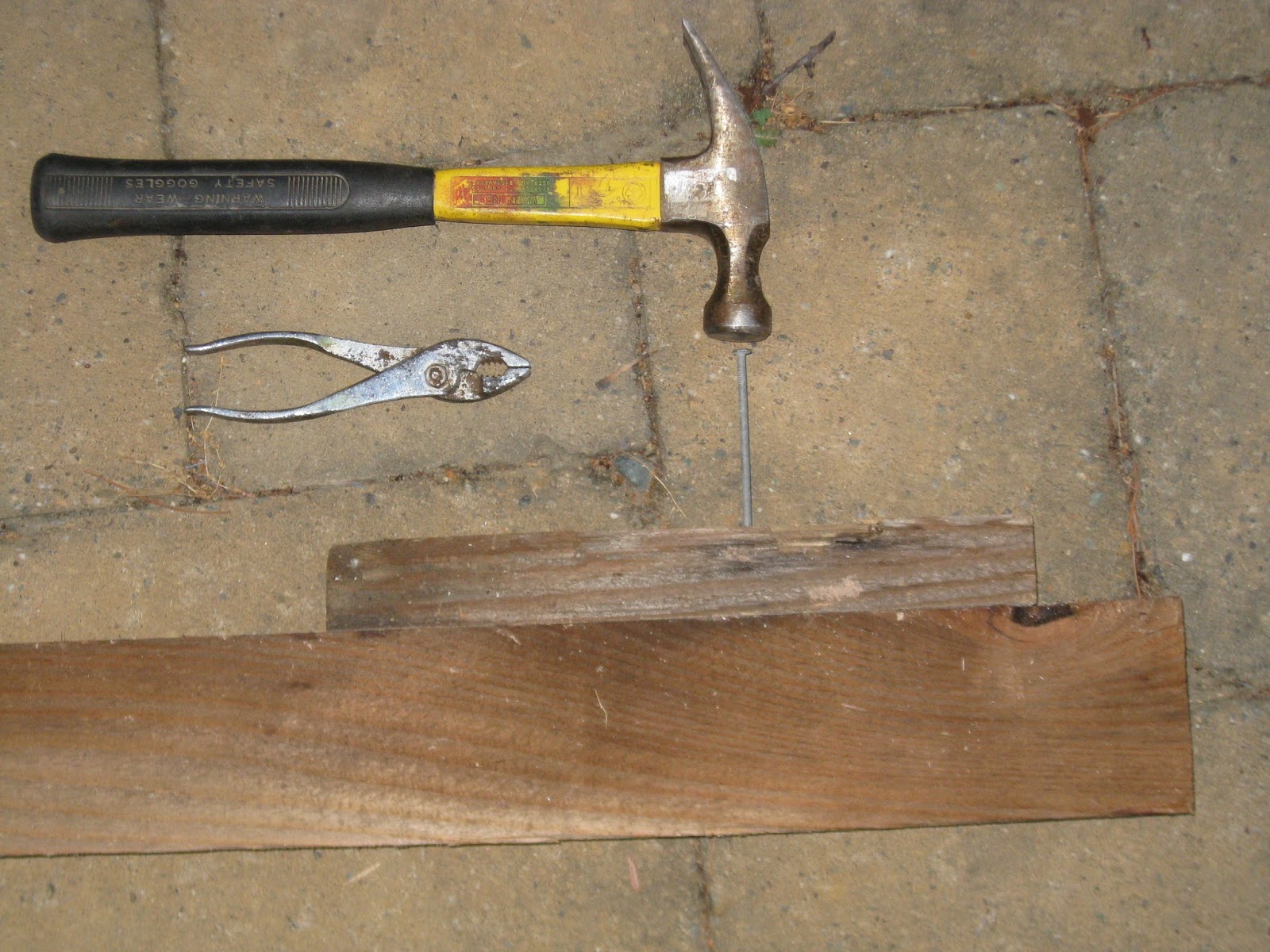
Which tool in the picture below is the correct tool for driving nails into wood?

Both the hammer and the pliers are applications of  levers

Of course it is the hammer!; because it provides the useful leverage for the job.  It allows professional grade nail driving. 


Which tool below it the correct tool for knitting "gansey" yarn into weatherproof objects?

Shown above are 3mm circular needles and 2 mm DPN with 
a good knitting sheath

The DPN with knitting sheath provides much more leverage putting much less stress on the hands and the circular needles are just too big. And, those big needles leave big needle holes in the fabric; you are never going to get to "weatherproof" leaving such big holes in the fabric.  Use 2mm circs, and there still is too much stress on the hands.

What tools are needed  for the knit objects that  GT calls "ganseys" knit from 2,700 ypp yarns at 12 spi and 20 rpi?

A good knitting sheath with 1.3 mm needles.  It makes a lovely soft, warm, durable fabric that I also use for gloves and socks,  as in this very well tested (worn) sock knit from 6-ply, 1680 ypp wool yarn, knit at 12 spi and 16 rpi:

This is actually a heavier yarn than the old  Patons Beehive,
 thus this is a denser fabric - more like the Dunraven.

You are not going to get there with circular needles!  I know, I tried very hard for years. and years.  My grandfather could not have built cities of wood by pounding in all of those nails with a pair of pliers (although he always carried a pair of pliers in his pocket.)  No, he used the right tool - he used a hammer to drive those nails home.  Likewise, to knit the kind of fabrics that I like, I have to use DPN and a knitting sheath.


Raverly's take on tools;

Some groups have been taken over by populist bullies (e.g., boss cows) that tell us that  3.25 mm needles will produce the same fabrics as 2.4 mm needles. (If we slice that salami, they imply that any fabric can be knit on any sized needle.) Then, they get agrees and loves on such nonsense. Some, or even most, groups on Ravelry have become a popularity contest among folks with limited technical skill, that negates Ravelry's ability to be a clearinghouse of useful textile knowledge and skills. There is more speculation from ignorance than knowledge from actual compartive testing of  tools, materials, and techniques.  People who say this technique is better, are considered to "discriminate" against the folks who use that technique.  

Some will call this "sour grapes" on my part.  Not at all.   I make my rounds of the textile crafts world, and see what suits my needs.  I adopt any tool or technique that is better than what I have.

One thing that I see is that the boss cows at Ravelry spend so much time protecting their turf, and keeping the herd in line  that they have no time to improve their spinning and knitting.

I see the folks who told me ten years ago that it was not possible to hand spin 5-ply -gansey yarn, still spin as they did 10 years ago.  It took me months and months to spin that first kilo of 5-ply gansey yarn.  Since then, I have learned skills and made tools that allow me to hand spin the worsted spun 5-ply yarn for a good gansey or Guernsey in about 12 hours. I did not learn those new skills on Ravelry.  What I heard on Ravelry, was "Cannot be done."

I do not care how experienced spinners spin!

 I do care about what options they offer to beginning spinners.  Beginning spinners need to know that there are ways to spin fast. Beginning spinners need to know that there are ways to spin fine, both woolen and worsted.

Many folks that disparage my knitting sheaths, still knit the way they did when I started using knitting sheaths.

I do not care how anybody knits.  

I do care when experienced knitters make an effort to hide or wrongly  depreciate other knitting techniques. Beginning knitters need to know that there are ways of knitting warmer objects.  Beginning knitters need to know that there are ways to knit more durable objects.

Current tools and skills allow me to knit fabrics that cannot be hand knit without a knitting sheath - not even with a leather knitting belt - which is a wonderfully powerful tool.  The power of a knitting sheath is infinite. It allows me to hand knit fabrics that cannot be reasonably knit with any other knitting technique.  It transforms the impossible into  the possible. Beginning knitters and spinners need to know what is possible, so they can choose their tools, and what skills to learn.

On Ravelry, advanced spinning and knitting techniques are hidden behind what is popular. 

Gansey Nation is proud to knit commercial 1,200 ypp, 5-ply "gansey yarn" on 2.25 mm circular needles at 9 spi and 11 rpi, (99 stitches per inch^2) working half an hour per day 
 ( see http://www.ganseys.com/knitting-ganseys/preparation/stitch-gauges-and-sizing/ ). He does not think that ganseys can be knit "weatherproof''.    This is  the conventional wisdom among folks that never learned to use a knitting sheath, and which specifically includes Bishop Rutt.  It is the doctrine, and cannon, on Ravelry. They believe.  They are a community of Believers.   They are not a comunity of  testers looking for the best way to make textiles.

In contrast, I knit such yarns at 120 and 140 stitches per inch^2 respectively.  I got there by testing, testing, testing! These fabrics are absolutely weatherproof, but Gansey Nation/ Ravelry consider these impossible fabrics.   Impossible - because they never bothered to learn to use a knitting sheath. I agree, using circular needles, such fabrics are not practical to knit.  Gansey Nation considers the very concept of  a weatherproof gansey to be a myth.   This is well accepted at Ravelry.  I see it as simply a failure to learn the required knitting technique. Ravelry is not not a comunity of  testers looking for the best way to make textiles. Rather it is a community of Believers that  proselytize. 

However, if they had some intellectual curiosity, they would have done some testing.  Testing would have told them that the fast way to knit a weatherproof seaman's sweater is to use MacAusland 3-ply (or similar) yarns  ( http://www.macauslandswoollenmills.com/), and long 3 mm DPNs with a knitting sheath. HELL YES!, I knit  weatherproof seaman's sweaters from Patons Classic Wool Yarn!!  At 108 stitches per inch^2 it is as much knitting effort as knitting worsted 5-ply, and it is not as durable, so I would rather put the effort into more durable objects knit from worsted 5-ply.  Still, sometimes I need to prove the concept.

Paton Classic Wool
knit at 9 spi by 12 rpi
Weatherproof! (when oiled)
  And skin soft.
This is a nice fabric to live in when it is cold!.
(No, it cannot be knit with circular needles.) 

The truth is that it is more difficult to knit a weatherproof object from high-twist, worsted spun, 5-ply than from a woolen yarn. Woolen yarn can be a 40 hour path to a seaman's sweater that is weatherproof! It is a lot of work, but it is fast. By the modern knitting terminology, it is not a "gansey" but it is a seaman's sweater that is functional, very functional.  Ravelry has forgotten about functional!   Such a sweater at its best, will not be as warm (for it's weight) or as durable as one knit from high twist worsted yarn.  In the long run (years), a series of the more difficult to knit worsted sweaters takes less wool and less total knitting time than a series of  woolen spun sweaters. It was the dual virtues of great warmth from light weight and durability that made the British seaman's sweater, the Masterpiece of Hand Knitting.

I have never gotten good advice on Ravelry on how to knit really functional objects.  I have never seen anyone else post really good advice on how to knit warm objects.  The standard Ravelry advice is to knit loosely to produce "air space" as an insulator.  Nobody seems to like it when I point out that the right sized air space for warmth is 40 microns - twice the thickness of a Merino staple.  The other side of that 40 micron air space is that the fabric is very durable, by being firmly knit, and not bulky considering its great warmth. Great warmth with minimum bulk and weight is a great attribute in a textile for some uses.

I have never seen good advice on Ravelry on knitting durable objects - notably socks. My 3 principles are; 1) knit to fit (e.g., no stress points), 2) knit firmly, and 3) use worsted spun wool yarns with many fine plies. These points work, but they do not generate many "agree"s on Ravelry, quite the opposite

Many of the "experts" on Ravelry have or had close ties to the modern commercial yarn industry, e.g., they own or work for LYS.  They recommend what is commercially available.  LYS sell what is popular - not what produces great fabrics.  Yarns that produce great fabrics tend to have higher production costs and hence higher price points.  Go down to the designer botiques at a Needless Markup Department Store, and see which of the great fashion designers are using yarns like the yarns you can get at your local yarn store. Last dozen times I looked - zero.  Even the yarns used to make the knit goods at Textures in Santa Monica are not available at LYS.  I would not depend on Ravelry for a understanding of the universe of yarn. When was the last time you saw the 6-strand worsted that I like in the Ravelry database?  When was the last time you saw a 6-strand all wool, 1,680 ypp sock yarn (as above) in the  Ravelry database ? 

 Ravelry is a terrible place to be a beginning spinner or knitter because it tends to hide the paths to excellent textiles. Ravelry is dominated by "pretty textiles". However, "pretty" changes with fashion. Good textiles are both attractive and functional.  Excellent textiles, are very functional, very durable, very attractive, and have a timeless style and beauty that is immune to fashion.  I like excellent textiles. 

Saturday, June 18, 2016

US3 Needles


  1. Back in the summer of 2013, patknitter was saying that she could replicate my fabrics, using US3 needles. On July 28, 2013, I posted that I would buy her a case of brandy if she could actually do that. see http://gansey.blogspot.com/2013/07/a-case-of-brandy.html

  2. At that point, I had been working on how to hand-knit warmer fabrics for 14 years.  I understood all of the approaches.  I knew what needles produced which fabrics, and which fabrics could be produced with what needles.  I had done my homework.  I had knit 50 gallon  drums full of gauge swatches, most of which are still in my office.

  3. She never sent me proof of meeting the challange, and more recently she has been claiming  on Ravelry that she did meet the challange, but that I did not pay off. This was, and is deceitful, underhanded, and libel. The moderators of Ravelry: Guernseys - Ganseys - Knit Frocks group  have allowed this. 

  4. Her solution was to use a thinner yarn.  The thinner yarn made it a different fabric. The different yarn construction that she used was another degree of difference. There is simply no way that the fabric which she claims is the same as the pictured  fabric, is similar to the fabric pictured in the case of brandy post, and again below. Her claim has no merit.

  5. Moreover, attempting to knit the defined yarn on US3 needles at 5.5 spi produces a stiff board like fabric that is unlike the fabric pictured.  The pictured fabric has decent hand and drape. Been there, done that, enough to know what works, and what does not work.  patknitter is simply ignorant of how to knit either fine or dense fabrics of high quality and good wearability.

  6. 6-strand, cabled (wool sock yarn) knit (by me) at 8 spi on US3 needles
  7. This time the yarn grist is 1680 ypp rather than 
  8. the 850 ypp of the challange fabric.
  9. ~8 spi and 10 rpi


  10.  challange fabric knit from brandy post
  11. 6-strand cabled 850 ypp wool yarn
  12. ~ 6 spi and 11 rpi
  13. yarn grist matters in knitting

  14. Of course, I knew that finer yarns could be knit at 6 spi (or 8 spi) on US3 needles.  That is why I was careful to say the challange was to replicate the fabric, and not the stitches per inch, as she claims. The fabric of the challange cannot be knit on US3 needles, even when the yarn is stretched to its breaking point. That is determined by the physics of wool.

  15. A case of good brandy is thousands of dollars. I did not underestimate patknitter. I expected the required effort to be more than the tasks of Hercules - more like the labor of  Sisyphus.  However, with the tide of group sentiment running against me, I relented and offered to send patknitter enough of the right yarn to make her demonstration, in case her stash was not up to the task. However, I do feel that anyone that brags about being a "gansey knitter" should have a variety of multi-ply and multi-strand cabled yarns on hand.  In fact, the bully gansey knitter should have gauge swatches of such yarns ready at hand - all labeled with the type of  yarn and the needles used.

  16. It is shameful that Ravelry: Guernseys - Ganseys - Knit Frocks group (http://www.ravelry.com/groups/guernseys-ganseys-knit-frocks---fishermens-sweaters)
  17. has supported her wrongful claims and dishonesty.

  18. This kind of thing is why I have basically stopped using Ravelry.

  19. I find that groups like  Guernseys - Ganseys - Knit Frocks group  are full of misinformation like patknitter's claim that fine, dense fabrics can be knit on US3 needles by just knitting tighter, and keeping the yarn at a higher tension. In the past, on this blog, I have mentioned other Ravelry groups commonly posting misinformation,  but sometimes I took that as misdirection to preserve a competitive advantage. Now, I have to say that misinformation on Ravelry is simply endemic. Lies that I heard as I began knitting run rife.  It took me years to track down or discover better approaches. 

  20. Now, the lies get group approval and better technical approaches get group disapproval.  These days textile craftsmanship on Ravelry is discouraged in favor of mediocrity.  Easy is prefered to excellent. Fast is prefered to durable. Everything is focused on "hobby grade". There is no disciplined pursuit of excellence.

  21. Problems with patknitter's assertions include;
  22. First, wool yarn is simply not that elastic. A stitch formed by wrapping yarn around a 3.25 mm needle will always be larger than a stitch formed by wrapping yarn around 2.4 mm needle.  The yarn will break before the 7.5 mm of yarn measured for a stitch by a 2.4 mm needle, can be stretched to the 10.2 mm required to go around a 3.25 mm needle.

  23. Second, fabric knit with tightly held yarn tends to be stiff, board like, and have poor hand and drape. Fabric knit to the same spi/rpi by using smaller needles, with less yarn tension tends to have better hand and drape.  Finer needles tend to produce fabrics that are more comfortable to wear.  That  is because the yarn loosely knit on the finer needles is not under tension, so the fabric is relaxed and feels more pleasant.

  24. The bottom line is that the way to knit fine fabrics (Arans, Guernseys and Ganseys included) is to use the correct sized needles and  knit with just enough tension in the yarn to ensure that wrapping the yarn around the needle produces a uniform stitch.

  25. This is an important issue, both as a matter of  quality of knitting and the ergonomics of knitting.  However, patknitter gets many "agree"s and "love"s for her assertions that reduce the quality of knitting, and increase the chance of injury while knitting. She is a populist leader, and a bully.  She is not a proponet of excellence in knitting.  In the early days of Ravelry, there were many proponents of excellence on Ravelry. I do not see them posting on Ravelry any more.  I  suspect that like me, they have gotten tired of the tone of many groups on Ravelry.  A tone that emphasizes personality over technical merit.

  26. Knitters that accept what patknitter says as true cannot become excellent knitters. I do not care how well any particular knitter can knit, but I am pointing out that patknitter and others like her form a significant social barrier to technical excellence in textiles.  I think expert knitters and spinners should make a point of removing technical and social barriers to better knitting.  

  27. I am not interested in environments where mediocrity is king.  I do not participate in  groups that tolerate deceit. I do not like people that engage in libel.


Inflation

Traditional "5-ply gansey yarn" had a grist of  1,000 yards per pound.  And a "hank" of gansey yarn was 8 ounces and 500 yards.

This worked because the traditional singles hank was 560 yards, and the ply-twist to form the yarn took up ~10%, so a hank of worsted spun knitting yarn was ~510 yards.  And, the traditional wools were lustrous long wool. Objects knit from them had a different appearance than objects knit from modern, commercial yarns spun from finer wools.

These days I note that a favorite commercial 5-ply gansey yarn is about 1,200 yards per pound, so it is thinner; -- more the grist of  traditional 4-ply worsted spun yarns.   Wendy's is now ~ 1,115 ypp. Penzance is now about the only traditional grist 5-ply Guernsey yarn at  996 yards per pound. At the same price as other favorite purveyors,  http://www.knitwitspenzance.co.uk/index.php delivers 20% more wool per cone.


However, the modern, thin 5-ply gansey yarn has more twist, so it is not well suited to being used double as some of the Gladys Thompson patterns use 4-ply yarn.  If you want to work with doubled 4-ply, try the Lion Brand Fisherman's Wool.  That combination has tremendous fill and makes a very good Aran weight fabric.

If knit to the traditional patterns, the fabric from modern thin 5-ply gansey yarn will be softer, and much less "weatherproof."   For most modern uses, not a bad thing.  However, the softer material will cause stitch patterns to be NOT as clearly defined and the fabrics will not provide as much padding if a seaman gets tossed about.  The Penzance will give a thicker, warmer fabric with clearer stitch patterns.

I have nothing against the thinner 5-ply, but I knit it on 2 mm needles.

It takes just under 900 yards of  yarn to knit a gansey, that is  ~5,000 yards of singles;  That is about 9 hanks, plus 900 yards of  plying.  That is about 12 hours of reasonably paced spinning.  At 35$/hour, that is more than $400 worth of spinning labor, plus $15 worth of wool, plus labor to clean and prep the wool.  Hand spun from long wool, the yarn costs on the order of $500.  $71.80 plus shipping seems pretty reasonable for  a couple cones of commercial 5-ply gansey yarn - either the thick or the thin versions.  On the other hand, if you must have the authentic fabric, then today, it will be hand spun.

Friday, June 17, 2016

The Truth

Feynman was famous for getting to the truth.  Like Feynman, I find that many "experts" get wound up in refinements that lead them into error.  Often these refinements are from problems with defining or bounding the system under study.

In modern hand spinning and knitting, the problem is often a failure to take enough measurements to establish a baseline. The result is pile of myth and misconceptions that constitute a set of lies. People accept the lies, and pass them around until the lies become accepted as the truth.  And, nobody stops to check the math.  I am tired of those lies.  I campaign for truth and accuracy in hand made textiles.  

I measure, and check all the math.  I get different answers from what circulate in craft circles.  I get the truth. However, everyone is so mired in the lies that few believe me.  That is not my problem.  My problem is to find the truth in a sea of mud.

The system is wool yarn.  I know the diameter of the wool staples. I can easily count the number of wool staples in the yarn's cross section.  I know the old "Spin Count" system - a  professional truth that is beyond doubt. I have a accurate gram scale and an accurate skeiner.  I know my grist as calculated from length and weight is the same as calculated by Spin Count. I have these measurements in dated contemporaneous log books that would be accepted as evidence by either US or English libel courts.  And, I can always take my wheel into court and spin a sample.  The grists that I spin are beyond dispute.

I have good clocks.  I measure how long it takes for me to spin a batch of yarn. I log my rate of spinning in contemporaneous log books that would be accepted as evidence by either US or English libel courts.  And, I can always take my wheel into court and spin a sample.  My rate of spinning is beyond dispute.

Ask a modern spinner how fine a particular single is and the term "fine as frog hair", may be invoked. That implies that the yarn is as fine as can be practically hand spun, which is generally a lie. It it the lie of diminished expectations.  Generally, singles described as "fine as frog hair" have a grist of less than 25,000 ypp. Even Alden Amos never got around to spinning much finer than 25,000 ypp.  However, traditionally professional hand spun singles were classed as "fine" only for grists of  33,600 ypp and higher.   Today, most modern hand spinners have never "seen" hand spun yarns finer than 25,000 ypp.  Oh, they walked past such yarns in the Louvre, Victoria and Albert,  St-Janshospitaal, Getty, and etc, but they never really saw the yarns as a standard for modern hand spinning.  Modern spinners assume that we can no longer spin that fine. That is very wrong.  It is "foolish".

I know the grists of the yarns that I knit with, and I know the diameter of the needles that  I use to knit. The combination of yarn grists and needle sizes that I use were common among fine expert knitters at one time. Now people look at these stitch gauges and do not believe them.  These combinations of yarn grists and needle sizes were used because they produce lovely fabrics.  Fabrics that were/are warm and durable. Fabrics that had/have wonderful drape and hand. These fine fabrics are not commonly hand knit these days.  Most modern knitters tend to knit looser. Modern knitters tend not to use knitting belts and knitting sheaths, which makes finer knitting easier and faster, much faster!  

One of the lies that I really hate is that one can knit very fine fabrics on big (US2) needles, just by knitting tighter.  No!, not even if you are  knitting so tight that the yarn is breaking in your hands.  And, fabrics knit with highly tensioned yarns do not have the nice hand and drape of fabrics knit at the same number of stitches per inch, but achieved by knitting more loosely with smaller needles.  

I really do not care how you spin or knit.  I do care that the crafts of fine hand spinning and fine hand knitting are preserved.  I care that someone does fine hand spinning and fine hand knitting.  I teach how wonderful yarns can be spun. I know that it is more effort than many amateurs are willing to expend.  That is not my problem.  My problem is to elucidate the tools, methods, and materials that allow the reasonable production of fine yarns and fine fabrics.

I have gone where most modern spinners have not. Even spinners like Alden Amos did not explore the speed of DRS to allow spinning finer singles. I had to balance  precariously on his shoulders to look beyond what AA did. And, he was a giant among spinners.  I have made a lot of mistakes, but as I go forward I find better solutions, and I report them. Whenever I find a different way, I test the new way against the best way that I knew previously, and then use whichever way proves better. Details matter. Often, one approach is better for a particular application, while another approach is better for other applications.  Likewise, one approach will be worse for a particular application. There is no best way, there are only better ways to do particular applications.  And, there is always a better way for every application. 

The problem is always finding the most appropriate way for this application with the budget, scope, and schedule available.


The truths:

  • Higher grist singles are worth the effort, because finer singles lead to fabrics with nicer hand and drape. (Go into your "Needless Markup Department Store" and look at the grist of the yarns in the fabrics with nicer hand and nicer drape.)
  • High grist singles are much easier to spin with higher speed flyer/bobbin assemblies. Higher speed (RPM) is most easily achieved with double drive set so there is little slip in the system.  Therefore, to achieve higher speed, differential rotation speed control must be built into the system or the single will simply break off.  
  • DRS controlled flyer/bobbin systems will run 2 or 3 times faster than bobbin lead systems, flyer lead systems, or double drive systems that allow slippage. These days, RPM is easily measured with a digital tachometer or strobe system.  These are now available and inexpensive. There is no excuse for not understanding this issue.  As an old bicycle racer, my normal cadence is ~90, which yields ~3,200 RPM with the the AA #1 /flyer/bobbin assembly, and ~ 3,600 RPM with the AA #0 /flyer/bobbin assembly. None of Alden Amos' treadle wheels were every designed to go that fast.  Alden never expected me to run those flyer/bobbin assemblies faster than 2,000 RPM.  SG's wheels do not go that fast.
  • To run at speeds of more than 3,000 RPM, wheels must be double treadle to spread the stress of the power delivery through the full rotation of the wheel. Drive belts must be designed to deliver more power, and if cotton or linen, must have belt dressing. And, belt dressing will build up on the flyer/bobbin assembly whorls.  Whorls should be board cut, despite the fact that the end grain accumulates belt dressing. Belt dressing accumulating in the whorls changes the DRS!  Drive belts must be dressed and whorls cleaned on a regular basis. Oiling is critical. Service the wheel every time you take a "bio-break".
  • With a DRS controlled wheel, wool can be spun at its spin count. (http://store.msuextension.org/publications/AgandNaturalResources/MT198380AG.pdf )
  • Fine wool can be easily spun at 10 or 20 or 30 hanks of 560 yards per pound rather quickly.   Almost any wool can be spun at 10 hanks per pound (5,600 ypp, 12.3 m/gram, e.g., 9 twists /inch) at about a hank per hour.  Fine wool can be spun into 45,000 ypp (~100 m/gm) singles at a rate of about a hank per day. Ten grams of 2-ply, 20,000 ypp yarn takes 3 long days to prepare. A hank of 80s single weighs just under 5.7 grams.  I call them "little shits" because of the difficulty I had in managing the first few hanks that I made.  Henry Clemes is developing a reel that makes managing such singles easier. 
  • Fine singles need to be blocked.
  • Quality of singles is highly dependent on quality of fiber preparation. 
  • A good spinner can keep 2 or 3 good knitters busy.
  • A good weaver can keep 2 or 3 good spinners busy.

  • Finely knit fabrics, knit using fine yarns and fine needles have superior hand and drape. Such fabrics can be cool or very warm. 
  •  Finely knit fabrics have superior durability. If you want socks that last, choose yarns with more plies or strands and finer needles. The finer spinning will affect the time to produce much less than the extra knitting effort resulting from using finer yarns.
  • If you want warmer or more weatherproof fabrics, finer needles are the best path.
  • Knitting belts are a great general purpose tool.  Knitting belts are to knitters, what pliers are to mechanics.
  • Knitting sheaths are more specialized tools which allow knitting things that cannot be practically knit using circular needles or even DPN with a knitting belt. Knitting sheaths are to a knitter what a rachet and socket set, and an air impact wrench, and an electric impact driver are to a mechanic.  
The bottom line is that you may not understand how the Hutchinson 3G access technology in your cell phone works, but that does not mean that somebody at the phone company has fooled himself.  The fact that the technology works is proof that nobody was fooled.  DRS spinning technology has functioned perfectly for centuries. It works.  Knitting sheaths have functioned perfectly for centuries.  It works.  It is simply a matter that you may not have been paying close attention to each of these technologies.   

Thursday, June 16, 2016

Comprehensive revision

I have Lyme Disease.  It crept up on me, starting circa 2005, and I did not realize how very disabled I was.

It dramatically affected my strength, endurance, vision, balance, and coordination.

Thus, circa 2011, as I set out to discover just how fast a professional hand spinner could spin in the era 1550 to 1750, I was significantly disabled.

 Now! after more than a year of intensive antibiotic treatment, I am better.   I am not well yet, but I am better. Today, I have more strength, endurance, and coordination than I had in 2011 and a great deal more than I had in say 2014.  Thus, today I do spin spin faster. Therefore, all of the timed spinning in previous posts is conservative.

One could expect a healthy, professional hand spinner with moderately good equipment to spin faster.

My current considered judgment is:

  •  That a DRS controlled flyer/bobbin assembly with an accelerator wheel operated by a professional hand spinner should be able to produce 560 yards of worsted spun 5,600 ypp commercial grade warp yarn (10s) per hour, even if the spinner has substantial health issues.  Woolen spun yarns of about the same twist ( 9 TPI) can be spun faster. 
  • That a a DRS controlled flyer/bobbin assembly with an accelerator wheel operated by a competent hand spinner can spin woolen or worsted yarns with ~ 20 wool staples in cross-section at a good commercial pace. Romney is easy to spin at more than 20,000 yards per pound, Shetland can be spun at more than 30,000 ypp, and  fine wools such as Merino or Rambouillet can be spun at more than 40,000 ypp.  Fine worsted singles can be reasonably spun at rates of more than 3 yards per minute. Thus, 20,000 ypp 2-ply worsted yarn can be prepared at an over-all rate of 60 yards per minute.
  •  20,000 ypp 2-ply is finer than any American entry in the last longest thread competition.  A reasonable time budget to spin, and ply, 10 grams of 20,000 ypp 2-ply using  a DRS controlled flyer/bobbin assembly with an accelerator wheel is on the close order of  25 hours.
  • Wool yarns of less than 20 fibers are either fragile or require excessive twist resulting in a unpleasant yarn. I stopped producing wool singles finer than ~ 50,000 ypp.  My goal is to spin better yarns, not finer yarns.
I thought that I needed to make a new spinning bobbin for the Aldan Amos #0 flyer that I was using for fine singles. Along the way, I was going to photograph and describe the DRS spinning bobbin production process. With my revived coordination, I find that a new bobbin is not necessary, so I am just going to post pictures of the spinning bobbins that currently fit the AA flyers.

The AA #0 flyer/bobbin as delivered :
 Single on bobbin is the test single spun by SG.


  AA bobbin detail (ends bored out, brass flange bearings inserted, wood rings glued in to cover brass bearings)

Detail of AA whorl


Flyer with the (2d generation) DRS bobbin/whorl by me:
Bobbin and whorl of  tropical hardwood with Delrin bearings (thanks to Henry Clemes).  The wood was a scrap picked up inexpensively at a Rockler promotion.


Flyer/bobbin disassembled


Ends of bobbin bored out to receive bearings

AA #1 Flyer bobbin with 3d generation - DRS bobbin and whorls

These 11 whorl diameters provide ability to spin woolen and worsted singles from ~3,000 ypp to more than 45,000 ypp. Note the difference between whorl diameters is small.

Bearings for this flyer/bobbin assembly are replacement bearings for skate boards.  Bearing wise, this is over kill as differential rotation is only ~50 rpm.  However, the center of the bearing fits AA's flyer shaft, and this saves me some effort. The skate board bearings are much better than what my local hardware store sells, and much cheaper than what the local bearing specialist charges.


Detail of borings to receive bearings


Detail of bobbin shaft inserted into board cut bobbin end/whorl

All in all, not particularly pretty, but wickedly effective. The oak in the #1 bobbin is recycled from our kitchen remodel. Since then, I have moved to turning ALL whorls from maple to get a more even texture around the whorl, and avoid belt dressing build up at the cross grain.


Storage bobbins to fit 0.25" spindle:


 Front,  Right to Left; board cut redwood ends on redwood barrel, 2x redwood turned from solid blank, blank
Back, Right to Left;  reels for blocking singles, 2x board cut maple ends/whorl on maple barrel, blank for maple barrel. 

Turning tools:


For 5,600 ypp singles, and 50 mm whorls, required accuracy of whorl diameter is about 0.5 mm.
For 40,000 ypp singles, required accuracy of whorl diameter is higher.  Thus, turn a little larger than needed and sand down to final required diameter.  (If your tools are really sharp, no sanding is required for appearance.)

Use HSS tools and keep them very sharp.  A good procedure is to grind to shape, and then hone.  For honing, I use 400 grit emery belts on the Sorby Pro, or a diamond hone.  Do not try to burnish HSS turning tools.


My OLD Bedan  is carbon steel, and it can be BURNISHED and is sometimes used to clean up where the ends meet the barrel. (But was not used on the current generation of spinning bobbins  : )

Burnished tool steel is sharp, but does not hold an edge 
as well as honed HSS.  

If you use a good hone, and get the angles correct, then HSS is as sharp as the very best burnished tool steel edge, but a HSS edge lasts 10 times longer.  Finishing whorls, I figure the edge on my HSS tools lasts 10 minutes, thus a burnished tool steel edge lasts for ~ one cut.  Turning redwood bobbins from solid blanks, I can do a dozen bobbins in a hour without honing the HSS skew chisel I use.  Using tool steel tools, I have to stop and sharpen frequently, and only get half as many bobbins made in an hour.

Thursday, June 02, 2016

American Education and how we see the future!


See  https://www.facebook.com/HuffPostScienceTech/videos/10154086208461083/

The Future can be better when we think!

The Future is worse when we do not think!

America become great via "Yankee Ingenuity"!  Now, people promoting, "Make America Great", are mostly folks who disparage science and thinking.  

Education should not be about filling students heads with facts, it should be about giving students some tools so their curiosity and drive to explore allows them blaze a path to a better world.  Education is about opening student's eyes so they can see the world around them.  Not just looking at at what is around them, but actually seeing and understanding it.

Not withstanding the Louisiana Purchase and Alaska, America did not become great by doing deals; rather America become great by accepting reality, seeking to understand reality, and working together.  Chinese, Polish, Italian, Jewish, and Irish immigrants were all disparaged, and discriminated against; and all helped to build a greater America than would have been possible without those waves of immigration bringing new blood and new ideas to the American process. 

Trump Tower would be impossible without the work of a Polish immigrant; Charles Proteus Steinmetz.  America could not have won WWII without the work of  immigrants (e.g., http://www.vanderbilt.edu/AnS/physics/brau/H182/Term%20Papers/Eric%20Weiss.html ).  America could not have settled Kansas or Texas without Irish working in the steel mills or laying track.  The wealth of California was made possible by rail roads built with Chinese labor. The railroads fed America's East Coast cities including Boston, NYC, and Washington, DC.  You cannot point to anything that has made America great that was not helped along by immigration.

I am not an advocate for immigration, I am a advocate for the truth.
The scientific method, which underpins these achievements, can be summarized in one sentence, which is all about objectivity:

Do whatever it takes to avoid fooling yourself into thinking something is true that is not, or that something is not true that is.

This approach to knowing did not take root until early in the 17th century, shortly after the inventions of both the microscope and the telescope. The astronomer Galileo and philosopher Sir Francis Bacon agreed: conduct experiments to test your hypothesis and allocate your confidence in proportion to the strength of your evidence. Since then, we would further learn not to claim knowledge of a newly discovered truth until multiple researchers, and ultimately the majority of researchers, obtain results consistent with one another.

This code of conduct carries remarkable consequences. There’s no law against publishing wrong or biased results. But the cost to you for doing so is high. If your research is re-checked by colleagues, and nobody can duplicate your findings, the integrity of your future research will be held suspect. If you commit outright fraud, such as knowingly faking data, and subsequent researchers on the subject uncover this, the revelation will end your career.

It’s that simple.

See https://www.facebook.com/HuffPostScienceTech/videos/10154086208461083/


http://www.huffingtonpost.com/neil-degrasse-tyson/what-science-is-and-how-and-why-it-works_b_8595642.html

Friday, May 13, 2016

Vacation time and knitting kits

A kit for summer vacations including camping and runs up to experience Shakespeare at Ashland. Technique is more "Dutch Knitting Stick for stiff needles", than the much faster spring / gansey technique used for large expanses of fabric. These needles/knitting sheath are not much faster than a leather knitting belt but, this knitting sheath is more compact and better for travel than a knitting belt.


.

The needles are short enough to be used anywhere, and this model of knitting sheath can be used everywhere. This sheath can also be used with glover's needles or swaving pricks. The needles are US0 or ~ 2 mm allowing knitting 6-strand, 840 ypp yarns in low light situations.


A kit for knitting at home and around town. These needles are US000 or ~1.6 mm.


Snug socks look better, but tight socks wear faster. Thus, "one should knit to fit!" However, using a tape measure or ruler or rule of thumb, it is hard to get to get an exact measure of the sock. I make "story boards" that are the exact size of that person's foot, and when the story board fits, the sock fits. The notch tells me the height of the heel, and the round hole tells me where to begin decreases for the toes. Kit used with four-ply to 6-ply gansey yarns in the 2,500 to 1,600 ypp range. Good socks can be knit on 12" needles using 3 plus 1 needles, with sweaters for BIG men knit on 6 plus 1 of the 12" needles. With dark yarns in low light situations, distinct expletives will occur.


See also the work of Ben Crystal, and his father David, on Shakespeare in original pronunciation. (Actually, SF Bay Area has more OP Shakespeare than Ashland.)

https://www.hayfestival.com/p-8985-david-and-ben-crystal.aspx?skinid=16 

(Allows knitting while listening.) Shakespeare begins at minute 35 +, but the first 35 minutes give background, and the rest ties it to Shakespeare.  Shakespeare is full of rhyme and pun; it is fun!

https://www.youtube.com/watch?v=gPlpphT7n9s


https://www.youtube.com/watch?v=qYiYd9RcK5M


http://www.npr.org/sections/monkeysee/2012/03/24/149160526/shakespeares-accent-how-did-the-bard-really-sound


http://vashakespeare.org/2015/10/the-once-and-future-shakespeare-a-lecture-by-ben-crystal/


http://www.theguardian.com/books/2012/apr/20/audiobooks-shakespeare


http://muviza.net/watch?v=9FF5K8VlcRI


http://originalpronunciation.com/