Showing posts with label gansey yarn. Show all posts

Monday, June 20, 2016

Ravelry

At one point, my grandfather was a carpenter for the Union Pacific Railroad in Oklahoma. They built whole towns of  buildings using wood and nails. 

Now the quiz:

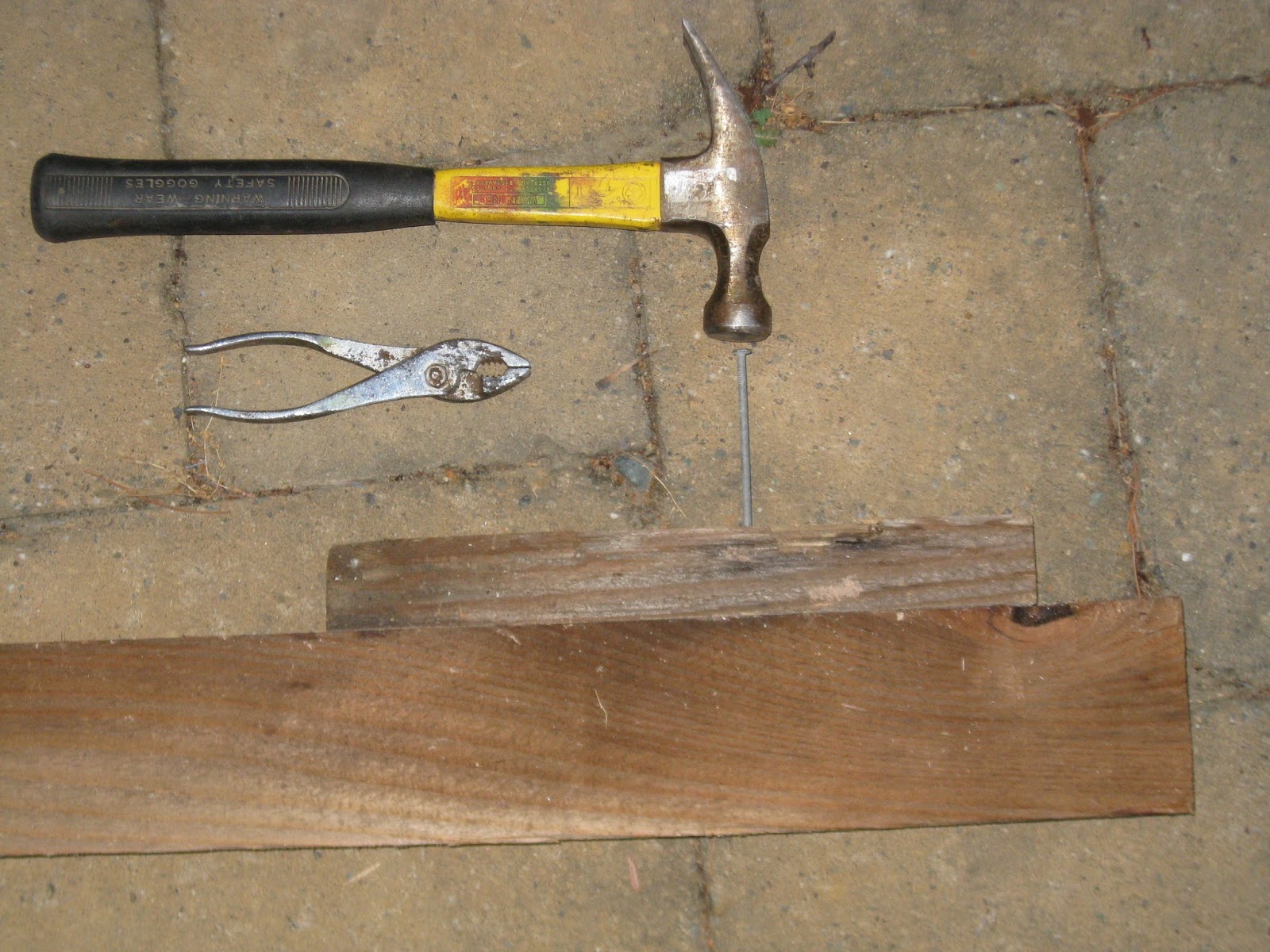
Which tool in the picture below is the correct tool for driving nails into wood?

Both the hammer and the pliers are applications of  levers

Of course it is the hammer!; because it provides the useful leverage for the job.  It allows professional grade nail driving. 


Which tool below it the correct tool for knitting "gansey" yarn into weatherproof objects?

Shown above are 3mm circular needles and 2 mm DPN with 
a good knitting sheath

The DPN with knitting sheath provides much more leverage putting much less stress on the hands and the circular needles are just too big. And, those big needles leave big needle holes in the fabric; you are never going to get to "weatherproof" leaving such big holes in the fabric.  Use 2mm circs, and there still is too much stress on the hands.

What tools are needed  for the knit objects that  GT calls "ganseys" knit from 2,700 ypp yarns at 12 spi and 20 rpi?

A good knitting sheath with 1.3 mm needles.  It makes a lovely soft, warm, durable fabric that I also use for gloves and socks,  as in this very well tested (worn) sock knit from 6-ply, 1680 ypp wool yarn, knit at 12 spi and 16 rpi:

This is actually a heavier yarn than the old  Patons Beehive,
 thus this is a denser fabric - more like the Dunraven.

You are not going to get there with circular needles!  I know, I tried very hard for years. and years.  My grandfather could not have built cities of wood by pounding in all of those nails with a pair of pliers (although he always carried a pair of pliers in his pocket.)  No, he used the right tool - he used a hammer to drive those nails home.  Likewise, to knit the kind of fabrics that I like, I have to use DPN and a knitting sheath.


Raverly's take on tools;

Some groups have been taken over by populist bullies (e.g., boss cows) that tell us that  3.25 mm needles will produce the same fabrics as 2.4 mm needles. (If we slice that salami, they imply that any fabric can be knit on any sized needle.) Then, they get agrees and loves on such nonsense. Some, or even most, groups on Ravelry have become a popularity contest among folks with limited technical skill, that negates Ravelry's ability to be a clearinghouse of useful textile knowledge and skills. There is more speculation from ignorance than knowledge from actual compartive testing of  tools, materials, and techniques.  People who say this technique is better, are considered to "discriminate" against the folks who use that technique.  

Some will call this "sour grapes" on my part.  Not at all.   I make my rounds of the textile crafts world, and see what suits my needs.  I adopt any tool or technique that is better than what I have.

One thing that I see is that the boss cows at Ravelry spend so much time protecting their turf, and keeping the herd in line  that they have no time to improve their spinning and knitting.

I see the folks who told me ten years ago that it was not possible to hand spin 5-ply -gansey yarn, still spin as they did 10 years ago.  It took me months and months to spin that first kilo of 5-ply gansey yarn.  Since then, I have learned skills and made tools that allow me to hand spin the worsted spun 5-ply yarn for a good gansey or Guernsey in about 12 hours. I did not learn those new skills on Ravelry.  What I heard on Ravelry, was "Cannot be done."

I do not care how experienced spinners spin!

 I do care about what options they offer to beginning spinners.  Beginning spinners need to know that there are ways to spin fast. Beginning spinners need to know that there are ways to spin fine, both woolen and worsted.

Many folks that disparage my knitting sheaths, still knit the way they did when I started using knitting sheaths.

I do not care how anybody knits.  

I do care when experienced knitters make an effort to hide or wrongly  depreciate other knitting techniques. Beginning knitters need to know that there are ways of knitting warmer objects.  Beginning knitters need to know that there are ways to knit more durable objects.

Current tools and skills allow me to knit fabrics that cannot be hand knit without a knitting sheath - not even with a leather knitting belt - which is a wonderfully powerful tool.  The power of a knitting sheath is infinite. It allows me to hand knit fabrics that cannot be reasonably knit with any other knitting technique.  It transforms the impossible into  the possible. Beginning knitters and spinners need to know what is possible, so they can choose their tools, and what skills to learn.

On Ravelry, advanced spinning and knitting techniques are hidden behind what is popular. 

Gansey Nation is proud to knit commercial 1,200 ypp, 5-ply "gansey yarn" on 2.25 mm circular needles at 9 spi and 11 rpi, (99 stitches per inch^2) working half an hour per day 
 ( see http://www.ganseys.com/knitting-ganseys/preparation/stitch-gauges-and-sizing/ ). He does not think that ganseys can be knit "weatherproof''.    This is  the conventional wisdom among folks that never learned to use a knitting sheath, and which specifically includes Bishop Rutt.  It is the doctrine, and cannon, on Ravelry. They believe.  They are a community of Believers.   They are not a comunity of  testers looking for the best way to make textiles.

In contrast, I knit such yarns at 120 and 140 stitches per inch^2 respectively.  I got there by testing, testing, testing! These fabrics are absolutely weatherproof, but Gansey Nation/ Ravelry consider these impossible fabrics.   Impossible - because they never bothered to learn to use a knitting sheath. I agree, using circular needles, such fabrics are not practical to knit.  Gansey Nation considers the very concept of  a weatherproof gansey to be a myth.   This is well accepted at Ravelry.  I see it as simply a failure to learn the required knitting technique. Ravelry is not not a comunity of  testers looking for the best way to make textiles. Rather it is a community of Believers that  proselytize

However, if they had some intellectual curiosity, they would have done some testing.  Testing would have told them that the fast way to knit a weatherproof seaman's sweater is to use MacAusland 3-ply (or similar) yarns  ( http://www.macauslandswoollenmills.com/), and long 3 mm DPNs with a knitting sheath. HELL YES!, I knit  weatherproof seaman's sweaters from Patons Classic Wool Yarn!!  At 108 stitches per inch^2 it is as much knitting effort as knitting worsted 5-ply, and it is not as durable, so I would rather put the effort into more durable objects knit from worsted 5-ply.  Still, sometimes I need to prove the concept.

Paton Classic Wool
knit at 9 spi by 12 rpi
Weatherproof! (when oiled)
  And skin soft.
This is a nice fabric to live in when it is cold!.
(No, it cannot be knit with circular needles.) 

The truth is that it is more difficult to knit a weatherproof object from high-twist, worsted spun, 5-ply than from a woolen yarn. Woolen yarn can be a 40 hour path to a seaman's sweater that is weatherproof! It is a lot of work, but it is fast. By the modern knitting terminology, it is not a "gansey" but it is a seaman's sweater that is functional, very functional.  Ravelry has forgotten about functional!   Such a sweater at its best, will not be as warm (for it's weight) or as durable as one knit from high twist worsted yarn.  In the long run (years), a series of the more difficult to knit worsted sweaters takes less wool and less total knitting time than a series of  woolen spun sweaters. It was the dual virtues of great warmth from light weight and durability that made the British seaman's sweater, the Masterpiece of Hand Knitting.

I have never gotten good advice on Ravelry on how to knit really functional objects.  I have never seen anyone else post really good advice on how to knit warm objects.  The standard Ravelry advice is to knit loosely to produce "air space" as an insulator.  Nobody seems to like it when I point out that the right sized air space for warmth is 40 microns - twice the thickness of a Merino staple.  The other side of that 40 micron air space is that the fabric is very durable, by being firmly knit, and not bulky considering its great warmth. Great warmth with minimum bulk and weight is a great attribute in a textile for some uses.

I have never seen good advice on Ravelry on knitting durable objects - notably socks. My 3 principles are; 1) knit to fit (e.g., no stress points), 2) knit firmly, and 3) use worsted spun wool yarns with many fine plies. These points work, but they do not generate many "agree"s on Ravelry, quite the opposite

Many of the "experts" on Ravelry have or had close ties to the modern commercial yarn industry, e.g., they own or work for LYS.  They recommend what is commercially available.  LYS sell what is popular - not what produces great fabrics.  Yarns that produce great fabrics tend to have higher production costs and hence higher price points.  Go down to the designer botiques at a Needless Markup Department Store, and see which of the great fashion designers are using yarns like the yarns you can get at your local yarn store. Last dozen times I looked - zero.  Even the yarns used to make the knit goods at Textures in Santa Monica are not available at LYS.  I would not depend on Ravelry for a understanding of the universe of yarn. When was the last time you saw the 6-strand worsted that I like in the Ravelry database?  When was the last time you saw a 6-strand all wool, 1,680 ypp sock yarn (as above) in the  Ravelry database ? 

 Ravelry is a terrible place to be a beginning spinner or knitter because it tends to hide the paths to excellent textiles. Ravelry is dominated by "pretty textiles". However, "pretty" changes with fashion. Good textiles are both attractive and functional.  Excellent textiles, are very functional, very durable, very attractive, and have a timeless style and beauty that is immune to fashion.  I like excellent textiles. 

Saturday, June 18, 2016

Inflation

Traditional "5-ply gansey yarn" had a grist of  1,000 yards per pound.  And a "hank" of gansey yarn was 8 ounces and 500 yards.

This worked because the traditional singles hank was 560 yards, and the ply-twist to form the yarn took up ~10%, so a hank of worsted spun knitting yarn was ~510 yards.  And, the traditional wools were lustrous long wool. Objects knit from them had a different appearance than objects knit from modern, commercial yarns spun from finer wools.

These days I note that a favorite commercial 5-ply gansey yarn is about 1,200 yards per pound, so it is thinner; -- more the grist of  traditional 4-ply worsted spun yarns.   Wendy's is now ~ 1,115 ypp. Penzance is now about the only traditional grist 5-ply Guernsey yarn at  996 yards per pound. At the same price as other favorite purveyors,  http://www.knitwitspenzance.co.uk/index.php delivers 20% more wool per cone.


However, the modern, thin 5-ply gansey yarn has more twist, so it is not well suited to being used double as some of the Gladys Thompson patterns use 4-ply yarn.  If you want to work with doubled 4-ply, try the Lion Brand Fisherman's Wool.  That combination has tremendous fill and makes a very good Aran weight fabric.

If knit to the traditional patterns, the fabric from modern thin 5-ply gansey yarn will be softer, and much less "weatherproof."   For most modern uses, not a bad thing.  However, the softer material will cause stitch patterns to be NOT as clearly defined and the fabrics will not provide as much padding if a seaman gets tossed about.  The Penzance will give a thicker, warmer fabric with clearer stitch patterns.

I have nothing against the thinner 5-ply, but I knit it on 2 mm needles.

It takes just under 900 yards of  yarn to knit a gansey, that is  ~5,000 yards of singles;  That is about 9 hanks, plus 900 yards of  plying.  That is about 12 hours of reasonably paced spinning.  At 35$/hour, that is more than $400 worth of spinning labor, plus $15 worth of wool, plus labor to clean and prep the wool.  Hand spun from long wool, the yarn costs on the order of $500.  $71.80 plus shipping seems pretty reasonable for  a couple cones of commercial 5-ply gansey yarn - either the thick or the thin versions.  On the other hand, if you must have the authentic fabric, then today, it will be hand spun.

Wednesday, December 23, 2015

The Gansey World

Sir Walter Raleigh used the term "gansey knit" in a letter to a Polish Princess to refer to finely knit hose. Gladys Thompson used it to refer to an object knit from ~2,500 ypp yarn, knit at a gauge of 12 spi and 20 rpi, which she also refers to as "Jersey".  Thus, we know the term is old, and the modern knitting of 80 stitches per square inch barely scratches the surface of what traditional knitters could knit.

These two references have been rattling around in my brain since I first started experimenting with "gansey needles" (and knitting sheaths).  However, then, I was never able to knit such fabric at a reasonable pace.  Now, that I have been using blunt gansey needles, such fabrics and objects have become more practical.  

For example, when I first came across Jamiesons  2-ply Shetland Spindrift yarns (2,200 ypp), I was rather disdainful of the fabrics produced according to the gauge on the yarn band.  However, when knit on 1.5 mm needles, the fabric is lovely.  Gauge runs ~ 160 stitches per square inch.  Not "weatherproof" mind you, but a warm, elastic fabric that is perfect for wearing in cool damp conditions. .Spindrift knit on 1.5 mm needles is warmer than worsted weight yarn (e.g.,  "4") knit on 5 mm or  US 8 needles. The Paton's 4-ply Beehive was just a bit denser than the Spindrift with a slightly lower grist, and when knit on similar needles, produces a denser,  warmer, and more durable fabric at 12 spi and 20 rpi,  

These days I have taken to knitting  yarns with  grists of ~1,650 ypp/ 3.3 Nm  (e.g. 3-ply or 6-ply sock yarns) on needles in the 1.75 mm range. This is finer than previous posts, and results in a gauge of 12 spi by 15 rpi.   (As I said, I am falling down the Rabbit Hole and in the last few weeks, I have ground the sharp points off of 6 or 8 sets of fine, pointy "gansey  needles"!)   I use these fabrics for socks, mittens, and where ever a warm, light weight fabric is required. The more plies, the better the drape and elasticity of the fabric.

Then, 4-ply yarns in the 1,260 ypp range are knit on 2.0 mm needles.  A month ago, I was knitting 1650 ypp yarns on 2 mm needles.

5-ply (gansey) yarns in the 1,000 ypp (sport weight) are still knit on 2.38 mm needles.  It is a nice fabric.  If I need a more weatherproof fabric, I reduce the ply twist to give more fill and knit on smaller needles.  If I need a much warmer fabric, I use a lower grist yarn.

All of the above fabrics are firm, warm fabrics with good drape and excellent durability. For all of the above fabrics, I use long steel DPN with a knitting sheath.  as described above, none of the fabrics are particularly weatherproof. Production rates on the finer needles are much better using blunt needles and working in the round.  Purl stitches are easier on pointed needles. Pointed needles are required for picking up stitches.  A fine crochet hook makes repair of mistakes easier. A cable needle is required for cable stitches.

So the question is,"Do I want an object that will be warm and stay looking beautiful for years and years, or do I want an object that will never be very warm, and will quickly fall apart?" 

I work in yards per pound (ypp), because the math is easy. The square of the wpi (packed to refusal) is the grist in ypp, always.  I know that when 10 hanks of 560 yards weigh a pound, I have spun 10s or 5,600 ypp, and it will measure 75 wpi.   Then, if I make 5-ply, it will have a grist of 1,000 ypp and measure 32 wpi. I know that if I spin a single that measures 105 wpi, and I make 6-ply, then the resulting sock yarn will measure 40 wpi.  I know that if I spin 40s that measure 150 wpi, and I ply it into a 6-ply yarn, it will have a grist of 3,360 ypp and measure 58 wpi.

Thus, I must update my gansey yarn chart.
(Note the differences with http://www.craftyarncouncil.com/weight.html , and https://en.wikipedia.org/wiki/Yarn_weight.  Also note the failure of http://www.knitting-naturally.com/yarn-comparison-chart.html, http://www.spinderellas.com/Yarn%20Weights%20and%20Measures.pdf , and  http://paternoster.orpheusweb.co.uk/lace/knittingyarns.htm , to use a wraps per inch technique that provides consistent and useful results.)  The knitting community's to failure to "pack to refusal" when measuring wpi results in nonsense.


wpi       grist (ypp)   spin count           notes

 22         484                                        Aran Yarn (traditionally was 10-ply of 10 count singles)
 24                             1
 26         676
 28         840                                        Worsted Yarn (traditionally was 6-ply of 10 count singles)
 30         900
 32         1,000                                     Gansey  Yarn ( 5-ply of 10 count singles) 
 33         1,100                                     DK weight yarns
 34         1,120           2                        
 38         1,443                                    Common grist for commercial sock yarns e.g., Wooly West
 40         1,650           3                      Various 3-ply  and 6-strand yarns knit on 1.75 mm gansey needles.
 42         1,800                                   Single cut woolen singles         
 44         1935                                    Fingering Yarn
 48         2,303                                   Jumper Weight/ Spindrift weight 2-ply  (1.5 mm needles)
 50         2,520                                   4-ply Beehive yarn ( 20 count singles) (1.65 mm needles)
 53         2,800          5 
 58         3,360                                    Traditional 6-ply sock yarn from 40 count singles             
 60         3,600                                    2-cut woolen singles @ 9 tpi                     
 64         4,100                                     Modern lace weight
 70         4,800                                     Woolen single at same tpi as 10s warp
 75         5,600          10s                    Singles for warp/ 9-10 tpi ; woolen singles for weft @ 12 tpi
 82         6,700          13                      Traditional 3-ply Shetland lace plied up from 40 count singles
 85         7,200                                     High-end Shetland lace weight yarn/ 2/14.5 Nm
 105       11,200        20s                    Worsted singles that I use for my sock yarn @ 14 tpi
 120       14,400                                   8- cut woolen singles / 18 tpi
 130       16,800        30s                     Worsted singles @ 17 tpi
 136       18,000                                   10-cut woolen singles / 20 tpi
 142       20,200                                  2-ply from 80s  e.g.,  ~2/40 Nm
 150       22,400       40s                     Singles used for best sock yarn/ 17 -22 tpi /~ 45 Nm /Shirting
 182       33,600       60s                     Traditional commercial  "fines" / 22- 24 tpi
 210       44,800       80s                     Traditional best commercial "fines"  /24 - 27 tpi  / 90 Nm

So, when I measure the wpi of  2/40 Nm yarn I get  ~135 wpi which converts to ~ 18,000 ypp, which is about what I get when I simply convert from metric units.  Wraps per inch works when one packs to refusal. For somebody to say a 2/40 Nm yarn measures 42 wpi is silly.  If any of  the sites referenced above had a competent spinner in residence, they would know this.  

Note that 2/40 Nm can be easily hand spun  from 70 count wool at a commercial rate by a competent hand spinner.

Sunday, August 23, 2015

Craftsman

Craftsmen (male, female, or other) make quality goods. They make better quality goods than folks that are just out to make a buck.  Hobbyists may actually produce higher quality objects, because they are not limited by resources.  That is, a hobbyist can put unlimited time and resources into an object, but craftsmen must keep the cost of objects within the price range of their clients.  Craftsmen produce the best possible product at the most reasonable price, all things considered.


If  someone needs a warm object, then a craftsman knitter will knit an object that is as warm as is required.  If someone needs a durable object, then the craftsman knitter will knit an object that is a durable as it required.  If someone needs a lace christening gown, then the craftsman knitter will knit an object that is elegant enough to uphold the status of the family. Along the way, for each product, the craftsman will make the compromises needed to meet the requirements including cost and schedule. The craftsman can work to a bid/plan/schedule so the cost of the object is as agreed with the client, and the craftsman does not lose money on the project.


Most modern spinners see spinning as a hobby.  They do not care about the cost of the yarn that they produce, or speed of production. And, they are not interested in making better yarn, they only want soft, pretty yarn.  


In contrast, I see spinning as a craft. I want better yarn. I want stronger yarn, I want more flexible yarn, I want more durable yarn and so forth.  And, I want less expensive yarn. I want yarn that has fewer man hours invested in it. I put a lot of effort into working out how to spin faster with less effort. I want yarn that that is just as good but is made from lower cost fibers. That is, I seek to find better fibers at a lower cost. And, I seek yarns that require less fiber, for the same warmth, durability, or strength.  Every spinning project that I do has requirements, schedule, and budget.  When a spinning project does not meet its requirements, schedule, or budget, I pull the plug on it. 


I started spinning because I was a knitter, and I was not happy with the available mill spun yarns. I wanted better.   When I started spinning I was told that it was not possible to hand spin the  worsted spun, 5-ply sport weight yarns, called "gansey yarn".  I was told these yarns had never been hand spun.  It took me 9 months before I was hand spinning such yarns, but the process was so slow as to be impractical.  The yarns I was making were better than mill spun, but they were too expensive.  I had to work out how to make them less expensively.  The obvious solution was to spin faster.  Today, I spin much faster.  That means that my yarn is much less expensive.  I like better yarns that are less expensive.


The first step to spinning faster was to understand differential rotation speed (DRS) as discussed in Alden Amos and the Victorian authors. DRS allows the flyer/bobbin assembly to run at much higher speed, and it changed the nature of the drafting, allowing true worsted yarns to be produced much faster. Part of this step was learning different spinning techniques that allowed me to take advantage of DRS. This really was an effort. This development of other spinning techniques was perhaps the single most important aspect of the spinning faster process. 


The second step was to have Alden Amos make me faster flyers.  I considered having him make me a custom wheel, but the Ashford Traditional drive wheel actually produced more speed than the wheels Alden was making at the time.  That is, an engineering analysis selected the Ashford drive wheel over the Alden product.  It was not a capricious or sentimental decision.  Part of this step was the development of "gang whorls" so that as the effective diameter of the bobbin changed,  I could change whorls rather than stopping to wind off.  I had to design and fabricate the gang whorls. This facilitated the production of longer, continuous singles.


The third step was to make an accelerator for my Alden Amos/DRS/Ashford hybrid.  Again it was an engineering analysis.  It was not a capricious or sentimental decision.  The result was the accelerator/Alden Amos/DRS/Ashford hybrid with advanced drafting technique.


The net result is that my wheel spins woolen singles between 2 and 4 times faster than any  wheel on the market.  My wheel spins worsted singles between 3 and 10 times faster than any wheel on the market.  This was not an accident. It was attention to detail, and doing the engineering correctly.  It was understanding the technique so I could make the required tools.  It was understanding the tools, so I could develop the technique.


Since spinning/twist insertion is the single largest cost in spinning, my yarn is much less expensive than other hand spun. I (the knitter and weaver) is the customer for I (the spinner).  I (the knitter and weaver) like the lower cost of the faster spinning. I (the knitter and weaver) like the shorter delivery times for the faster spinning. All around, I like the faster project development and production cycles. 


This allows me to (inexpensively) dream-up, produce, and test yarns that are not made by mills and which I have never seen before.  I learned to make more flexible yarns.  I learned to make stronger yarns.  I learned to make more durable yarns, and so forth. I would never have had time for this experimentation if I had to spin as slowly as most spinners spin. Without DRS, you will never really understand sock yarn. 


I can plan an object, spin and test samples of a yarn that I have never before spun, and then spin and produce the object, all in a reasonable time frame. I (the knitter and weaver) know in advance what the cost of the yarn will be that I (the spinner) will produce for the project. 


I am a craftsman spinner with just one rather demanding client.  Myself.  If I spin better and faster, then I improve my product and lower my costs.  Then, I am happy.

Monday, October 13, 2014

Better accelerator bearings

Spinning has been a series of sacrifices to the gods of speed.

I settled into double drive and differential rotation speed (DRS) controlled flyer/bobbin assemblies in the pursuit of speed.  I went to smaller fliers from Alden Amos in pursuit of speed. I went to an accelerator in the pursuit of speed.  By the time I had spun my first fine warp (5 lb of lace weight worsted singles) I expect that my wheel was one of the very fastest in the world. Production of 5,600 ypp worsted at sustained rates of more than 8 yards per minute with peak production rates of more than 10 yd/min is easy.

Nevertheless, I spent a good part of today making better bearings for the accelerator from graphite/Delrin provided by Henry Clemes.  The result is another 800 rpm in the flyer/bobbin assemblies.  And the wheel runs quieter, with less vibration.

This raises the production rate of higher twist yarns. Every time, I thought that my wheel was going as fast as possible, I have found rather straightforward ways to it make go faster. I cannot believe that I am the only one.  Between the invention of DRS by silk throwers in Italy during the 12th century and the advent of  powered spinning frames circa 1780, millions people had a strong financial incentive to improve the spinning wheel in various ways.  It was a very large, very competitive industry, with huge incentives for very small increases in spinner productivity.  The competitive nature of the industry ensured that useful improvements were kept very secret, until they were obsolete. Thus, textiles were generally unique to a locality, because other localities did not know the details of how those fabrics were produced.

The way to determine what tools and technologies were used, is to become expert in textile production technology and reverse engineer the technology from found textile samples.  Proof is in my spinning wheel.  No historian viewing history through the prism of modern commercially produced and sold hand spinning wheels could conceive that a 16 th century hand spinner could have a production rate of  8 yards per hour. And, yet this afternoon as I tested the the new bearings, anything less is silly.  It shakes and rattles, but it spins faster than any wheel you have ever seen or heard. I have no doubt that wheel makers in Flanders were making faster wheels by the end of the 15th century. There is nothing in my wheel that they could not do with the tools and materials that they had.  Yes, the materials they had might have resulted in a bit more lard-oil splatter, but in a commercial spinning factory, that does not matter. Any historian who says that 16th century professional spinners that did not spin that fast, simply does not not know the craft of spinning.

As Ed Deming told us over and over, "You get what you measure.  If you do not measure it, you do not get it".  Professional spinners measured production - it was called income.  Modern spinners do not measure it, and do not get it. Modern historians do not have a clue about the productivity of traditional hand spinners. Since spinning  was the base of textiles, and textiles was major item of trade and a base of the economy,  modern historians do not have a clue about the economy of the period.

And it solves that great question: Why 5-ply? A) Because they had DRS wheels set for 10s, and 5 plies of 10s knit into a fabric that was warm enough to keep a sailor from going hypothermic.

Now that I am spinning a lot of warp, hand spun 5-ply has become my go to yarn.  I always have pounds of 10s around and plying up some 5-ply is just natural.  It is a way of using up left overs.  It is a stash buster.


Wednesday, July 09, 2014

Board like? !

The classic mill spun gansey yarn has several virtues.  It can be knit fairly loosely, (not too warm) and still have the stitch work that  Pops! Or, it can be knit firmly to produce firm padding to protect the wearer in a hazardous environment (e.g.,  booms and spars being swung into sailors as the sail boat rolls).  

The disadvantages of  mill spun gansey yarn is that when it is knit tight enough to be be weatherproof, it lacks drape and becomes stiff like a board .   If you need warm suit of armor, it is a good fabric, if you do not need armor, then other fabrics may be better.

I was very proud when, I first thought I could spin a good approximation of the mill spun gansey yarn.   As I knit fabrics for different purposes, I understand that the mill spun gansey yarn is NOT likely not the best yarn for many for many purposes. And I found that I could spin a world of yarns, that mills could not spin, and some of those yarns have real virtues.

One thing  I found, is that some of the yarns that do not look so nice in the skein, produce wonderful fabrics. The proof is always in the final fabric. (And the proof of the fabric is in the wearing!) Firm multi-plies with soft ply twist can produce weatherproof fabrics with a nice hand and great elasticity. Wearing such fabrics is like having a second skin. 

I discovered thick an thin singles by mistake. I had a big bump of commercial fiber with a lanolin based spinning oil that started getting oxidized and sticky on one side of the bump, but I spun it, as it was, anyway. The single looked like crap, but the 5-ply knit up into a rather wonderful fabric.  It is not in the books,  It is the kind of thing that is only discovered by trying a lot of stuff that does not work, but keeping one's eyes open for stuff that does work.  It was something that snuck up on me - the early singles from that bump were properly uniform, then I left the bump sitting for a few months, and when I came back, it spun as thick and thin. As 5-ply, the yarn still looked like crap, but it knit up into a fabric that I like a lot. Now, I have found other ways to produce a thick and single without trying to age a bump of  commercial fiber. 

The thins give the fabric hand, and the thicks tend to full and bond the yarn together. However, the net effect is different from simply plying singles of different grist and twist together.  Over all, the yarn is much softer than the mill spun gansey yarn, so stitches do not pop, and it is more difficult to knit into firm padding (e.g., boards).  On the other hand,  it is much easier to knit into a very warm, very elastic fabric that is as comfortable as a second skin.  The thins give it luster and durability, the thicks give softness.  The fabric has almost the feel of a fabric knit from woolen spun.

I have a kilo of 5-ply sport weight from such thick and thin singles, in a bin, ready to be knit on #0 needles. Also in the bin are a pile of swatches of various fabrics knit from the yarn,   Twist in the singles varies from about 7 to 9 tpi, but it is 5-ply and it averages out into very competent singles. All singles are continuously tested for competence (tensile strength)  as they are plied.  Ply twist is much less than standard, so the yarn is soft and stitches do not pop as much as with mill spun, but on the other hand, the plies spread to fill gaps and needle holes resulting in a fabric that is warmer any you can get from mill spun gansey yarn, and the fabric has a reasonable drape. The yarn is aggressively washed and steam blocked prior to going into the knitting bin.

All in all, it is a reminder to respect the materials and the process, and not to get caught up in imitating mill spun.  Handspun can have intrinsic virtues that are not in mill spun.  We CAN make yarns that mills cannot.  And, some of those yarns are very, very nice, not because they are different, but because they have virtues. We have forgotten some of these virtues because mills cannot produce such yarns.   Wassit was hand spun 5-ply.  This last bin of hand spun 5-ply gives me new respect for what 5-ply hand spun can be.  

I like the hand.  I like the fill.  I like the warmth.  I like the stretch and elasticity. I like the durability. I have been spinning it from 60 count long wool with good luster. Soon, I will be back to spinning Rambouillet from Ann Harvey up in Calpine.  Then, fabric from fine wool has less durability and luster and is much softer. And, of course the  Rambouillet is white, not ecru.  Still the drape, fill, warmth, stretch and elasticity are all there.

All in all, I figure about 6 hours for a hank of worsted sport weight, 5-ply.  Worsted 2-ply at that grist has a poor drape, so a 2-ply would have to be woolen spun. It takes me about 3 hours to spin 560 yards of 2-ply sport weight, woolen spun yarn.  So the worsted 5-ply takes about twice as long as woolen 2-ply.  That is, I can spin the 5-ply worsted  for a sweater in 24 hours and the 2-ply woolen in only 12 hours.  However, I am going to spend some 90 hours knitting a fine sweater.  That 90 hours makes it worthwhile to invest the extra 12 hours for the extra drape, fill, warmth, stretch, and elasticity of 5-ply.  If I do not want the warmth, then I go up a couple of needle sizes and I have a faster knit sweater that still has drape, stretch, and elasticity.

Wassit was popular and inexpensive. It was popular because it was good stuff.  It was inexpensive because a lot of it was produced.  I stared looking at 5-ply because it was warm and durable for fisherman's sweaters. I keep looking at it because I like the "hand" of the fabric.


Thursday, June 12, 2014

Average Yarn

Mostly, I spin average yarn.

The knit fabrics that I like are warm, durable, and elastic. My path to such fabrics is mostly via hand spun yarns with 5 or 6 plies or strands.  Yarn grist runs from fingering weight to sport weight. I knit these yarns firm enough  that they drape rather than hang,   These days,  I am pretty much spinning the yarns that I wanted when I bought my wheel and started spinning. And, I am spinning them at what I consider a reasonable rate.

Worsted spun, sport weight,  5-ply requires in the neighborhood of 54 twists per inch of finished yarn (9 tpi in 5 singles + 9 ply tpi).  In contrast, woolen spun, worsted weight,  2-ply requires perhaps 15 or 20 tpi of finished yarn.  Thus, my average sweater weight yarn requires more than 3 times the twist of the average sweater weight yarn of many hand spinners.

To make such high twist yarns practical, I have to spin faster. On average, I can spin a hank of 5-ply gansey yarn in an easy day.  That is; on average, I can spin 5 hanks of 10s, and ply them into 500 yards of  knitting yarn in a day.  Anybody that can do two hanks of 5-ply in a day is a "terrible" spinner.

My process is to use the AA #1 flier with an accelerator to spin worsted singles.  I wind off onto plying bobbins about  every 100 yards /15 minutes.  If I am plying at 9 tpi, then I also use the #1 flier for plying and make small (1.5 oz) skeins of yarn. If  I using a lower ply twist, then I use the jumbo flyer so I can make knot free hanks of 500 yards.   Perhaps the nicest complement that I ever got was from a local spinning teacher. She saw the hand spun gansey yarn I was knitting, and said, "That looks just like the mill spun gansey yarn I get from England."  And, there can be nothing more average than mill spun.

(When making yarn from singles finer than 10s, I block the singles prior to plying.)

These days for gansey fabric, I am knitting these (5-ply) yarns on needles in the size range of  1.6 mm.  I find  the smaller needles less effort than using the 2.38 mm steel needles that I used in the past. Gauge runs only about 7 spi by 11 rpi.  This fabric is weatherproof.  Knit more gently on 2 or 2.25 mm needles, the fabric is softer and more elastic,.  However,  the stitch count per inch is similar.  The softer, more elastic fabric,  is not really weatherproof.   Spi does not tell everything about the density of the fabric,  Two fabrics can be made of the same yarn and have similar of stitches per inch , but on one fabric the stitches are tighter and flatter, while in the other fabric the stitches are looser and arrayed orthogonal to the surface of the fabric resulting in a thicker, but looser fabric. The 3-dimensional structure of knit fabric matters - a lot. These two fabrics will have very differing amounts of elasticity, warmth, and weatherproofness.

Again, those traditional knitters of old knew what they were doing when they knit 5-ply on fine pins.  

Hand spun is (or can be) more responsive to small variations in needle diameter, and thus in the context of hand-spun, the tiny differences in needle size in the old UK needle or old US steel needle or the even more intricate Chinese knitting needle sizing systems make sense .

Mill spun 5-ply allowed me to knit more elastic fabrics with better drape than I could knit from yarns with fewer plies. And, hand spun 5-ply allows me to knit more elastic fabrics with better drape than I could knit from any mill spun that I have tried - including some  mill spun 10-ply, 10-strand, and dozens of 6-strand cabled yarns.  The most elastic fabrics that I have knit have been from hand spun, worsted spun, 10-ply with a grist of 500 ypp.

The most available needle size gauges in this range are those by Lacis.  However, they do not provide discrimination for the Chinese needle sizes.  (And, you know how those Chinese DPN all look a like.  : )  Thus, when I am working with a Shetland knitting belt, I use an electronic size gauge made for wood shop use and sold by Harbor Freight for less than $10.  When using a knitting sheath, I use the needle adapters to indicate the size of the needle.

Friday, May 30, 2014

Cakes of sock yarn

Mostly, spinning in May was about 10,000 yards of 5,600 worsted singles and then plying up couple of hanks of  5-ply, and making up 5 hanks of  6-strand cabled "sock yarn" @ ~ 1,600 ypp  from 2-ply commercial warp yarn.

The  handspun singles were on little bobbins, each holding just over 100 yards.  Thus, 2 hanks of  gansey yarn frees up a whole boot box of  little yarn storage bobbins -- leaving almost a boot box of little spinning bobbins, each with about 100 yards of single on it. Making gansey yarn is about bringing order to chaos.

For the sock yarn, I go from a neat cone to a sweater box full of yarn cakes.  Then, the trick is to turn the yarn cakes into sweater.


Kit for Sheringham gansey: 2,600 yd of 6-strand cable at 1,600 ypp, 5 x 8" and 5 x 14" stainless steel DPN in size UK 15 with crochet hook. I will use a wide Durham style knitting sheath with a 1.65 mm needle adapter. Note that this sizing is a bit different from what is in the modern charts.  These needles and sheath have become my default knitting tools for this yarn.   At 10 spi, it will be a soft, warm, durable, elastic sweater, but NOT weatherproof. (This yarn is magical. It sucks the light right out of a room. Thus,I expect it is very good to wear while sleeping.)  The cable is a little bulkier than 3-ply. For ordinary 3-ply/ 1,600 ypp,  I drop down to  UK 16.  For straight 4-ply, I would stay stay with the UK 15 needles.  There has been enough swatching and sampling to drive my wife crazy.

This will be a soft fabric. Could I knit it without a knitting sheath?  Sure, it would just take me longer and the tension would not be as even.  The needles are fairly blunt, so a leather knitting belt would also work, allowing similar fast knitting and even tension.  

Again, these are all commercial needles and I have used fine emery to 'break" the polish just behind the tip for faster and easier knitting.

Tuesday, March 11, 2014

The Accelerator

Yarns "made up" in the process of tuning the accelerator. From top to bottom, 6-strand cabled fingering weight from 2-ply commercial warp, 5-ply semi-worsted sport weight from Romney, and 5-ply woolen sport weight from Rambouillet.

The beast that spawned them:


Top with Ashford Jumbo flyer used at speeds of 1,600 to 1,000 rpm ( the two skeins of cable were done as one big bobbin full.) And, below is the AA #0 (Competition) flier used at speeds of 2,400 to 4,200 rpm.


The Jumbo flyer has 4 drive whorls.  One would expect that the little 1.75" whorl to give more speed than the 2.75" whorl, but there is so much slippage that it does not. Spinning wheel drive belts slip a great deal. Still with the accelerator, and using the larger whorls, plying/cabling goes about 40% faster than is possible just using the Jumbo Flyer (with a Alden Amos Bumpless drive band to minimize drive band slippage.)  With the stock Ashford drive band, I never got the Jumbo Flyer over ~450 rpm. When plying up gansey yarn at 9 tpi, that is slow!!!!!!!!!

That bobbin of  the AA#0 will hold about 12 grams (0.3 oz. ) of yarn. If one is spinning 40s, that is a neat 560 yards. Amazing how that works out.  With the accelerator, I run it at about the same speed as I did without the accelerator, but I can treadle much slower. This is set up with the flier/bobbin mounted with ball bearings.  A test shows that it will go just as fast using bronze bearings (with more frequent lubrication.)

Why not just go to an e-spinner?  While I do not "count", spinning is very rhythmic, and my cadence sets the beat for everything else.  It took a couple of days to get used to the accelerator, because now my hands have to go twice as fast relative to the cadence.  With an e-spinner, there is no cadence so my hands do not know how fast to move.  

Wednesday, April 17, 2013

More on the hot rod wheel

My loom uses a warp tension system that employs sliding weights to vary the tension.  This put me to thinking that I could adjust the tension of the drive band on the spinning wheel by sliding the weights rather than changing the weights as I have been.  It works.  It complements the gang whorl system.

I just slide the weight  hanger from notch to notch on a lever attached to the MOA.
(The holes support a yarn guide for winding off ,)


Thus, I avoid running out to the garage to get different weights.

Overall, now I am satisfied with the spin system' performance.  At this time, this wheel will spin about as fast as I can draft. It meets my needs.

Three years ago, between slippage and vibration,  the new stock Ashford had a maximum twist insert of under 1,000 rpm for the DD & ST flyers, with the lace flyer perhaps 30% faster.  All in all, production speed of 10s (5,600 ypp singles) was under 200 yards per hour.

With Alden Amos's wonderful, low vibration fliers, gang whorls, and adjustable weight system, the system can now be run at well over 2,000 usable rpm on a sustained basis. This means that 10s can be easily spun at 350 yards per hour, and a uniform, knot free hank of 560 yards produced.   40s (22,000 ypp) can be spun in the close range of 200 yards per hour on a sustained basis.  While, I exceeded this speed with the stock Ashford flyer and the very high speed flier whorls that I fabricated last year, then there was more vibration resulting in lower quality thread and spinning on that gear was - more work.

While some of the increase in speed is improved skill, Istill use the stock Ashford flyer/bobbin assembly for plying (because of more capacity).  So I have the gear out on a regular basis and 1,000 rpm is still about as fast as it can go.  While I certainly did learn to spin 60s (30,000 ypp) on the Ashford lace flyer, that is much harder and requires more skill and concentration than spinning 60s on this system. With the current system of Alden's fliers and weight tension, 80s can be spun at a good pace.  More, I cannot ask of any spinning system.

As currently configured, I do not see any advantage to e-spinning, and I have re-purposed my e-spinner to a prin winder.

(Not shown is a safety lanyard that protects the tile floor from falling weights when the drive band breaks.)

Wednesday, August 17, 2011

Warmer Yarn

Last night I was in Jo-Ann Fabric and Craft store and a 100 gram skein of  Kashmira by Sensations jumped  in my basket.  Sensations is a house brand for Jo-Anns, so I was not too thrilled.  How could something like that appeal to a yarn snob like myself?

It is about gansey weight - 260 meters for 100 grams - nothing special there.

Is is 10-ply!, constructed as 5 x 2-ply.  Ya, it is special.

The fibers are about as fine as those in Frangipanni and Wingham's, but are longer.  Long fibers are good. The wool has some luster - that is good.

The density is high enough that it is a very warm yarn, but not so dense that the fabric is heavy.  This yarn produces the warmest fabric for its weight of any yarn that I have tested. On my #1 needles it produced about 7 spi, and that is how I would knit it.

If you want to knit a garment that is very light weight, but very warm, this is the yarn.  I do not know how fabrics from this yarn will stand up to life, but it is an amazing yarn.

______

Edited to add on 8/29/2011: I have not been observant.  I have been spending too much time spinning and not enough time shopping for yarn.  There are a number of (new??) highly structured yarns (lots of fine plies) that should fun to knit and provide outstanding fabrics.