Showing posts with label Aran. Show all posts

Friday, August 19, 2016

Some drink, some ply

I ply.

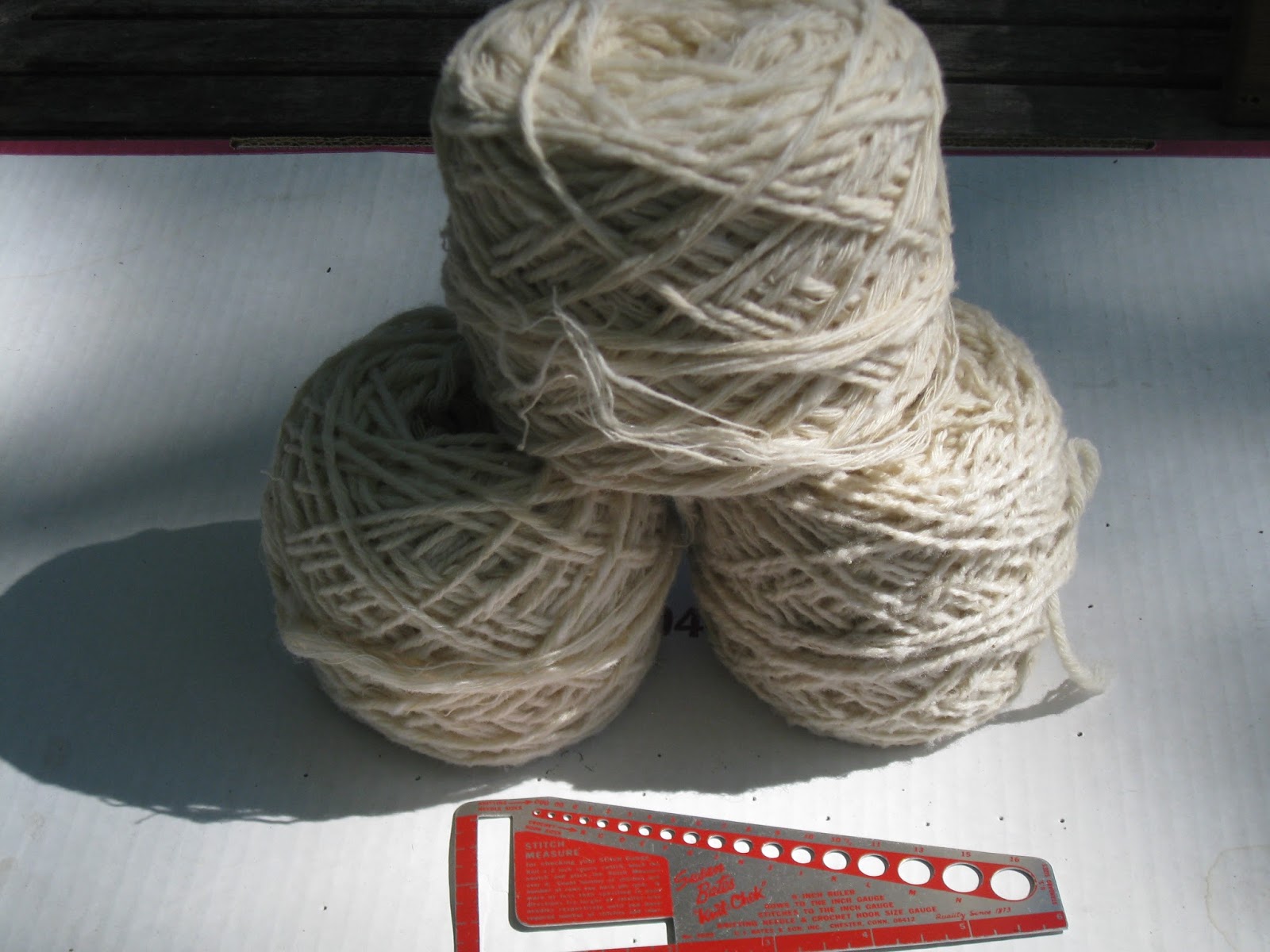
The results from last night, 4 cakes of 10-ply from hand spun singles, and the bobbins emptied to make the cakes:


I like the yarn for warm, comfortable objects. I knit this 10-ply yarn on US3 needles  (3.2 mm) . When I knit commercial (lo-ply) yarns into Aran weight objects, I used 18" steel needles, and it was fearsome work.  Now, I use 14" steel needles.  Between the lighter needles and more flexible yarn, the knitting  effort is much  less.

If you must deal with cold weather for extended lengths of time (e.g. professional need to be outside, all winter long) and one is a good spinner, then I think 10-ply is well worth the effort.  If you are just going to be outside for a few weeks or recreationally, buy cold weather gear.

Certainly, one can knit 2" by 2" swatches from such yarns into weatherproof fabrics with circular needles is a great deal of effort (said by some one that considers making handspun 10-ply, "reasonable").

Wednesday, August 03, 2016

Aran Knitting

Aran yarns were traditionally 10-ply, 500 ypp worsted spun. This was twice as heavy as modern sport weight, and ~ 70% heavier than worsted (e.g., 6-ply).  Aran was more what we would call weight 5,  "Chunky" or "Bulky", or even Super Bulky.  I know, I know, I have bins of  'Pure Wool Aran' from Yorkshire, that is only 772 ypp, but it is also, only 4-ply.  That is not a yarn that can be knit up into a functional seaman's sweater. I have knit it on finer needles, and never found a point where it became weatherproof.  Some of that 'Pure Wool Aran' does serve very well for baby clothes for a family living in San Francisco's Outer Sunset District.  It was knit by the children's grandmother, who was born, and raised in Siberia/ USSR.

Aran sweaters were used for fishing and whaling, even near the Arctic Sea ice.   Key advantages to producing a thick yarn from many  plies is that it can be knit tighter, without becoming stiff and board like. Thick yarns produced with only a few plies,  such as Peace Roving, Lopi, and  MacAusland, are easier to knit into weatherproof fabrics than yarns such as the modern commercial 5-ply, but weatherproof fabrics from yarns with few plies tend to be stiff and have poor hand and drape.  I put up with such fabrics for a long time, because I could knit them, and my LYS did not carry multi-ply yarns with a soft ply twist.  This is why I had to learn to spin, spin fine, spin fast, and produce better multi-ply yarns.   If you need a very warm fabric, then knitting it from a yarn with many plies produces better hand and drape, greater durability, and better warmth.

In contrast, modern, commercial  5-ply sport weight yarns tend to have so much  ply twist that they have poor fill, and tend to be difficult to knit into weatherproof fabrics.  Knitting weatherproof fabrics from high ply twist yarns such as Frangipani is a high effort endeavor. To the best of my knowledge, it requires a knitting sheath.   It is not always worth the effort.  In fact, for some applications, the stiff fabric can be protective.  Many of the fishermen wearing Arans would have been handlining 100 lb cod from the deck of the boat.  They braced against the rail and as the ship tossed, they would have been tossed against the rail, with great force. The net/ cable pattern typical on a Aran sweaters provided padding. (Do not even think of disagreeing unless you have handlined 100 lb fish on-board in rough weather.)   A stiff sweater can cushion a blow from a spar when sailing in foul weather, or arrest a slide (yard sale / garage sale) on an icy ski slope and thereby avoid a long climb back up the hill (while sore) to gather gear. It can also protect in rock climbing.

The best path for very warm knit fabrics leads to a yarn with many plies and soft ply twist.  I learned this from the old Lion Brand Fisherman's Wool, which was easier to knit into very warm fabrics than British Breeds,  Wingham's and etc..


The Lazy Kate set up for 10-ply Aran yarn.

The singles are 5,600 ypp semi worsted (dized off of a drum carder) of Anna Harvey's Rambouillet. Knit on 2.38 mm needles at 6 spi by 8 rpi, it has about the same density as the 14 ply, but is knit on 2.38 mm needles rather than the 3.2 mm needles for the 14-ply.  The difference between this and the 14-ply knitting in the last post is the thickness of the fabric.  The 14-ply in the last post is thicker and about 28% warmer. On the other hand, this fabric, is more than twice as warm as anything I have knit from commercial, ~1,000 ypp 5-ply (even LB FW).  Yes! you read that right! I knit 10-ply, 500 ypp on needles that my Susan Bates "Knit-Chek" assures me are US1. Yes, it is an extraordinary measure, but extraordinary measures are how one stays warm in extraordinary cold.


Aran Swatch from
handspun 10-ply
@ ~ 500 ypp  
 and 
 Swatch of 'Pure Wool Aran'
Commercial @ 772 ypp
both  swatches show 21 stitches on top needle, both knit on US1 needles.
'Pure Wool Aran'  has more stitches per inch, but is best
suited for baby clothes in SF
(Yarns with grists that differ by 272 ypp, knit up up differently, but 
patknitter thinks that yarns that differ by 280 ypp are comparable!)  


The top swatch is a fabric that is ~twice as warm as the fabric that kept me comfortable for 4 hours in minus 10F temps with 40 mph winds (wind chill =>  - 40F). That is kind of wind that makes a parka snap and pop.   For the test, the sweater knit from LB FW  5-ply was my primary upper body garment with mittens and hat from same material. Lower body garments were Patagonia guide pants and medium weight poly-pro base layer.  I also wore one pair of hand knit socks under my plastic boots.  Test conducted at ~10,000 ft altitude.  Just me, sitting on a spare pair of socks, watching life unfold in the valley below.

At less than 50 stitches per inch^2, such a 10-ply Aran sweater can be knit ~60 hours.  (For true polar conditions, the 14-ply knits up even faster.)  With another 30 hours (35 hours for 14-ply)  of spinning to make the yarn, total production time is less than the ~100 hours required to knit a (less warm) sweater from commercial 5-ply.  And the objects from 10-ply/14-ply yarns are much more durable and comfortable than objects of similar warmth knit from yarns with fewer plies (e.g., Peace, Lopi, MacAusland).

One of my goals when I started spinning a decade ago was to be able to produce real 10-ply Aran yarns at a resonable pace.  Along the way, I was told, many times by many different people, "It can't be done!".  Well it certainly can be done.  People who did not know, pretended to know, and told me things that simply are not true.  Likewise, people that have not investigated the virtues of knitting sheaths, pretend to know, and say things that are not true.  They are lucky that Bolgia 10 is warm, not cold.

I have singles on hand (both semi worsted and true worsted) so, with a few hours of  plying, I would be ready to knit polar gear.  Then, the knitting can be done in cars, airports, train stations and quays.  I already have Arctic caliber socks, mittens, hats, and etc. And, I already have sweaters that have been tested at wind chills colder than minus 40.  I could gear up, and be ready to go full Arctic with hand knit clothing, PDQ.  I am not bound to California.

The real trick to staying warm is to make sure your mittens do not blow away if you drop them.  That is how my dad froze his hands on the East Wall at Arapahoe.  As he finished strapping an injured and cold skier into the sled, hand he had to grab it and hold it with his bare hands, even as his mitten blew away.   In the few minutes before we could get off the steeps, and dad could put on a pair of mittens from my pack, he had frostbite on both hands. As a member of the National Ski Patrol, dad skied it all, and I skied with him, from Dawn Patrol to Last Sweep, regardless of the weather.  I grew up in the high country of Colorado and Wyoming.   We did all of the 14,000 foot peaks.  All things considered, it was a good place to learn how to play outside and stay warm and safe.  Later, I did forestry research in the Adirondacks, and spent weeks every year outside in the snow in a climate very similar to that of Wisconsin (with more  snow.)  Along the way, I climbed all the Adirondack High Peaks -  most of them solo.  I have been to the Annapurna Sanctuary.   I have walked from Paradise to Muir Camp  (2,000 feet above snow line)  in flip-flops. Most of my ski trips in California included a night or two of snow camping.  And, I have skied over several of the California passes in the winter, when they were closed because of snow.    All in all, my tendency to play outside in all weather, gave me practical experience in how to stay warm.  I test and compare, and choose what works, not what people say works. Today, the knit objects that I make are much, much warmer than any of the knit objects that we had when we skied the high country and backcountry of Colorado,  Wyoming,  Adirondacks, and Idaho.

It is like spinning - I do what works, and the result is hand spinning that many say is impossible.
 (Who else handspins '500 ypp, 10-ply' in practical quantities?  )   In knitting, I do what works and the result is that I do things that many do not accept as possible.  Their lack of understanding is not my problem.   They should have chosen better teachers.


Aran Yarn
The Classic Yarn for Warmest Woolens

Just over a pound of 
hand spun and plied,
 semi-worsted spun, 500 ypp, 10 ply 
(there are ~ 5,600 yd of singles in the 3-cakes/ ply twist takes up ~10%)
Fiber from Anna Harvey's Rambouillet
www.annagotwool.com 

(If I was planning a season of fishing on the Finnish Sea, I would spin it worsted!)

ETA: 


A couple of cakes of Worsted spun 10-ply Aran.
(The two cakes total ~12 oz, and contain ~4,200 yd of singles.)

Aran Knitting

Aran yarns were traditionally 10-ply, 500 ypp worsted spun. This was twice as heavy as modern sport weight, and ~ 70% heavier than worsted (e.g., 6-ply).  Aran was more what we would call weight 5,  "Chunky" or "Bulky", or even Super Bulky.  I know, I know, I have bins of  'Pure Wool Aran' from Yorkshire, that is only 772 ypp, but it is also, only 4-ply.  That is not a yarn that can be knit up into a functional seaman's sweater. I have knit it on finer needles, and never found a point where it became weatherproof.  Some of that 'Pure Wool Aran' does serve very well for baby clothes for a family living in San Francisco's Outer Sunset District.  It was knit by the children's grandmother, who was born, and raised in Siberia/ USSR.

Aran sweaters were used for fishing and whaling, even near the Arctic Sea ice.   Key advantages to producing a thick yarn from many  plies is that it can be knit tighter, without becoming stiff and board like. Thick yarns produced with only a few plies,  such as Peace Roving, Lopi, and  MacAusland, are easier to knit into weatherproof fabrics than yarns such as the modern commercial 5-ply, but weatherproof fabrics from yarns with few plies tend to be stiff and have poor hand and drape.  I put up with such fabrics for a long time, because I could knit them, and my LYS did not carry multi-ply yarns with a soft ply twist.  This is why I had to learn to spin, spin fine, spin fast, and produce better multi-ply yarns.   If you need a very warm fabric, then knitting it from a yarn with many plies produces better hand and drape, greater durability, and better warmth.

In contrast, modern, commercial  5-ply sport weight yarns tend to have so much  ply twist that they have poor fill, and tend to be difficult to knit into weatherproof fabrics.  Knitting weatherproof fabrics from high ply twist yarns such as Frangipani is a high effort endeavor. To the best of my knowledge, it requires a knitting sheath.   It is not always worth the effort.  In fact, for some applications, the stiff fabric can be protective.  Many of the fishermen wearing Arans would have been handlining 100 lb cod from the deck of the boat.  They braced against the rail and as the ship tossed, they would have been tossed against the rail, with great force. The net/ cable pattern typical on a Aran sweaters provided padding. (Do not even think of disagreeing unless you have handlined 100 lb fish on-board in rough weather.)   A stiff sweater can cushion a blow from a spar when sailing in foul weather, or arrest a slide (yard sale / garage sale) on an icy ski slope and thereby avoid a long climb back up the hill (while sore) to gather gear. It can also protect in rock climbing.

The best path for very warm knit fabrics leads to a yarn with many plies and soft ply twist.  I learned this from the old Lion Brand Fisherman's Wool, which was easier to knit into very warm fabrics than British Breeds,  Wingham's and etc..


The Lazy Kate set up for 10-ply Aran yarn.

The singles are 5,600 ypp semi worsted (dized off of a drum carder) of Anna Harvey's Rambouillet. Knit on 2.38 mm needles at 6 spi by 8 rpi, it has about the same density as the 14 ply, but is knit on 2.38 mm needles rather than the 3.2 mm needles for the 14-ply.  The difference between this and the 14-ply knitting in the last post is the thickness of the fabric.  The 14-ply in the last post is thicker and about 28% warmer. On the other hand, this fabric, is more than twice as warm as anything I have knit from commercial, ~1,000 ypp 5-ply (even LB FW).  Yes! you read that right! I knit 10-ply, 500 ypp on needles that my Susan Bates "Knit-Chek" assures me are US1. Yes, it is an extraordinary measure, but extraordinary measures are how one stays warm in extraordinary cold.


Aran Swatch from
handspun 10-ply
@ ~ 500 ypp  
 and 
 Swatch of 'Pure Wool Aran'
Commercial @ 772 ypp
both  swatches show 21 stitches on top needle, both knit on US1 needles.
'Pure Wool Aran'  has more stitches per inch, but is best
suited for baby clothes in SF
(Yarns with grists that differ by 272 ypp, knit up up differently, but 
patknitter thinks that yarns that differ by 280 ypp are comparable!)  


The top swatch is a fabric that is ~twice as warm as the fabric that kept me comfortable for 4 hours in minus 10F temps with 40 mph winds (wind chill =>  - 40F). That is kind of wind that makes a parka snap and pop.   For the test, the sweater knit from LB FW  5-ply was my primary upper body garment with mittens and hat from same material. Lower body garments were Patagonia guide pants and medium weight poly-pro base layer.  I also wore one pair of hand knit socks under my plastic boots.  Test conducted at ~10,000 ft altitude.  Just me, sitting on a spare pair of socks, watching life unfold in the valley below.

At less than 50 stitches per inch^2, such a 10-ply Aran sweater can be knit ~60 hours.  (For true polar conditions, the 14-ply knits up even faster.)  With another 30 hours (35 hours for 14-ply)  of spinning to make the yarn, total production time is less than the ~100 hours required to knit a (less warm) sweater from commercial 5-ply.  And the objects from 10-ply/14-ply yarns are much more durable and comfortable than objects of similar warmth knit from yarns with fewer plies (e.g., Peace, Lopi, MacAusland).

One of my goals when I started spinning a decade ago was to be able to produce real 10-ply Aran yarns at a resonable pace.  Along the way, I was told, many times by many different people, "It can't be done!".  Well it certainly can be done.  People who did not know, pretended to know, and told me things that simply are not true.  Likewise, people that have not investigated the virtues of knitting sheaths, pretend to know, and say things that are not true.  They are lucky that Bolgia 10 is warm, not cold.

I have singles on hand (both semi worsted and true worsted) so, with a few hours of  plying, I would be ready to knit polar gear.  Then, the knitting can be done in cars, airports, train stations and quays.  I already have Arctic caliber socks, mittens, hats, and etc. And, I already have sweaters that have been tested at wind chills colder than minus 40.  I could gear up, and be ready to go full Arctic with hand knit clothing, PDQ.  I am not bound to California.

The real trick to staying warm is to make sure your mittens do not blow away if you drop them.  That is how my dad froze his hands on the East Wall at Arapahoe.  As he finished strapping an injured and cold skier into the sled, hand he had to grab it and hold it with his bare hands, even as his mitten blew away.   In the few minutes before we could get off the steeps, and dad could put on a pair of mittens from my pack, he had frostbite on both hands. As a member of the National Ski Patrol, dad skied it all, and I skied with him, from Dawn Patrol to Last Sweep, regardless of the weather.  I grew up in the high country of Colorado and Wyoming.   We did all of the 14,000 foot peaks.  All things considered, it was a good place to learn how to play outside and stay warm and safe.  Later, I did forestry research in the Adirondacks, and spent weeks every year outside in the snow in a climate very similar to that of Wisconsin (with more  snow.)  Along the way, I climbed all the Adirondack High Peaks -  most of them solo.  I have been to the Annapurna Sanctuary.   I have walked from Paradise to Muir Camp  (2,000 feet above snow line)  in flip-flops. Most of my ski trips in California included a night or two of snow camping.  And, I have skied over several of the California passes in the winter, when they were closed because of snow.    All in all, my tendency to play outside in all weather, gave me practical experience in how to stay warm.  I test and compare, and choose what works, not what people say works. Today, the knit objects that I make are much, much warmer than any of the knit objects that we had when we skied the high country and backcountry of Colorado,  Wyoming,  Adirondacks, and Idaho.

It is like spinning - I do what works, and the result is hand spinning that many say is impossible.
 (Who else handspins '500 ypp, 10-ply' in practical quantities?  )   In knitting, I do what works and the result is that I do things that many do not accept as possible.  Their lack of understanding is not my problem.   They should have chosen better teachers.


Aran Yarn
The Classic Yarn for Warmest Woolens

Just over a pound of 
hand spun and plied,
 semi-worsted spun, 500 ypp, 10 ply 
(there are ~ 5,600 yd of singles in the 3-cakes/ ply twist takes up ~10%)
Fiber from Anna Harvey's Rambouillet
www.annagotwool.com 

(If I was planning a season of fishing on the Finnish Sea, I would spin it worsted!)

Monday, January 26, 2015

Warmth, again and again

If you want real warmth in clothing, it needs to block air flow like a fine bed sheet.

With knit wool that means lots of twist in the yarn, and yarns knit tightly together.

Lots of twist means very fine plies. For most things, I like singles of ~5,600 ypp.

Then I do not ply yarn very tightly, so that as yarn is knit, the yarn deforms and "fills" all gaps.

The commercial yarn that this concept is built on is the old Lions Brand Fisherman's Wool.  This yarn is no longer made. Production was moved to China, and the new  Lions Brand Fisherman's Wool is different.  The new Fisherman's Wool is much more pleasant to knit, but the resulting fabric is not as warm or durable.

To block air flow through the yarn, the wool fibers must be between 20 and 40 microns apart.  Closer and they tend to conduct heat. Farther apart and air flows between the fibers carrying heat.  Keeping fibers that close together takes a lot of twist.

For wet weather, I like long wool, spun worsted at 5,600 ypp.  Twist is about 9 tpi. These singles get loosely plied up into a sport weight (1,000 ypp) yarn.

Once you get below freezing, things can get really cold.  There, I like fine wool, spun woolen at 5,600 ypp and 12 tpi. These get plied up into 5-ply at 1,000 ypp or Aran weight at 500 ypp for Arctic  (or Antarctic) conditions.

Ok, these yarns are a bit of extra work, but they are warm, and nothing is worse that being really cold.

The the yarn needs to be knit so tightly with fine needles, so there are no gaps in the fabric.

If you knit with 2 or 3-ply yarns there will not be enough twist to hold the individual wool fibers close together and the wind will blow right through the yarn.

If you use a 5-ply with enough ply twist to hold the yarn round, then there will be gaps between the yarn and the wind will blow through the fabric carrying heat away from the body.

Hand spun, hand knit fabrics can be so warm that they feel like magic.  Most do not make the cut.

Friday, February 07, 2014

Real, hand spun, 10-ply Aran yarn


Plied up from worsted singles that I spun over the last 4 years. It is it 211 yards of hand spun 10-ply weighing 196 grams (504 yards per pound.)  It can be done.

Plying was done on an Ashford Jumbo flier running about 300 - 400 rpm, so plying took a couple of hours.

The singles were on bobbins held by a new Lazy Kate:

In use, it was clamped to a foot stool.

Most of the effort in this project was adjusting the LK. The concept was designed for 5-ply and 10 ply required some thought so the yarn paths did not cross and interfere.  And the original design was for smaller bobbins. Thus, a second set of taller dowels had to be made and finished.  And, I had to compensate for the differing twist in the various singles being used.  This is done by putting in 2 or 3 dowels, and weaving the single between them to provide tension. All in all, these were all lessons that would have be learned sometime.

Over all there are ~4 hanks of 10s in the project, so hence forth the time from fiber to finished 10-ply is about 12 hours of spinning and 2 hours of plying per 200 yard skein.  Time to spin/ply the 1500 yards of  full worsted, 10-ply yarn for an Aran sweater would be ~100 hours.  This time can be dramatically reduced by not producing true worsted singles.  Some of these singles were spun before I got the Alden Amos fliers, and thus they took longer to spin.

Fibers in the various plies include Cotswold, Romney, Suffolk, Merino, and Rambouillet. There are 2-plies of navy blue, 2 plies of light blue and 6-plies of natural white. This was as we say, "A stash buster."

I can get a full hank of  5-ply on the Jumbo Bobbin, so a lot of my 10s are on larger bobbins that will hold a full hand of single.  However, since the Jumbo Bobbin will only hold ~ 1/2 hank of Aran, in an 10-ply project, I would just work with smaller bobbins.


It is now a cake ready to knit.