Showing posts with label DIY fine spinning tools. Show all posts

Wednesday, August 11, 2021

Open Your Big Blue Book to Page 385!

Yarn gauge.  It works!! It works best with worsted spun firm. Oh, Yes! And you MUST pack to refusal. 

This is not some promotional craft council standard for selling yarn, this is a practical way to estimate grist while the yarn is still on the spinning bobbin. This is the nitty-gritty of converting fiber to useful yarn.

Alden's table just goes up to about 10,000 ypp, but if you count carefully, have a good yarn gauge, and pack to refusal, the technique works right on up to 60s (34,000 ypp). For finer grist, metal gauges work better than wooden.) 

The day we talked about this, Alden said, "pack to refusal", perhaps 20 times in 4 hours. Pack to refusal is important, and it is different from the "yarn wraps" of the organizations, that just want to sell yarn to retail consumers.

You need a yarn gauge - just wrapping yarn around a pencil, knitting needle or ruler, will not allow you to pack to refusal. I make my yarn gauges out of rosewood.  The form factor changes depending on what grist I am spinning.  I made another one this morning - it has a 0.25" gap, and a bit of a handle so I can hold it firmly as I wrap the 27 or 28 wraps of yarn, while packing the yarn with my thumb and forefinger. (I want a grist of ~11,500 ypp on average.)

With care and practice a yarn gauge will give a better estimate of the grist of a fine single than a "yarn balance". The only thing better is an accurate scale /accurate length. However, the yarn gauge is not as affected spinning oil or fiber moisture as an accurate scale weight/length. 

Wednesday, July 01, 2015

Pure Wisdom

He, that I call "Pure Wisdom" is a member of my most extended family.  He was one of the brightest stars at one of the world's most technical companies, and now is one of its most senior managers. He is no longer concerned with technical issues because he says, "Old must be BOLD!"

We are, after all, are writing our Epitaph. We are writing our grave stone.  Writing in stone takes great force.  Yes, we need to be very bold.

There are many manuals for writing resumes, but there are few guides to writing good Epitaphs.

One was laid out by Ina Corina Brown in the course she taught as a Peabody Scholar.  Sometimes it was offered as a set of things to do on a regular basis, and sometimes it was offered as a personal performance test.  Here is one of the test versions.

1.     Do I seek to to achieve personal growth and development by means of some plan whereby I can enlarge my horizons as well as fill gaps in my knowledge an experience?
2.     Do I subscribe to or regularly access:
2.1.  Some reliable news media? 
2.2.  Some quality magazines dealing with current thought?
2.3.  Some magazines devoted at least in part to book reviews and literary criticism?
2.4.   First rate professional journals?
3.     Do I read at least 2 dozen serious books in the field of biography, history, current affairs, and literature (including classics read and reread)?
4.     Do I make some serious effort in increase my understanding and appreciation of art, literature, and music through the use of pictures, lectures, concerts, records, plays, books and the selective use of radio, TV, and Utube ?
5.     Do I follow some consistent plan for building a library, including dictionaries, atlases, encyclopedias, religious texts, and reference books such as Bartlett's Quotations, Fowler's English Usage, and more modern texts on the topic?
6.     Do I have some consistent plan for professional reading, and for professional growth and development?
7.     Do I have an interest in, and an awareness of, the world of nature so that I can identify and enjoy birds, flowers, trees, stars, and landscapes?
8.     Do I have some enriching and relaxing hobby or interest such as weaving, wood or leather working, cabinet making, book binding or gardening?
9.     Do I belong to and actively participate in at least 3 of the following:
9.1.  A religious body?
9.2.  A civic group?
9.3.  A political group?
9.4.  A literary, art or music group?
9.5.  A scientific group?
9.6.  A social action group?
9.7.  A professional society?
10.  Do I have some consistent and orderly plan for budgeting and handling my income so that:
10.1.  I am able to meet my obligations promptly?
10.2.   Get the greatest possible benefit form my income?
10.3.     Make reasonable provision for the future?
11.   Do I have some consistent can orderly plan for budgeting my time so that I can:
11.1.   Meet my personal and professional obligations?
11.2.    Render service to my fellowmen?
11.3.     Have time for enriching leisure?
12.  Do I take care of my health through habits of eating and sleeping, judicious use of exercise and rest, and regular physical examinations including eyes and teeth?
13.  Am I particular in habits of personal cleanliness and grooming, and in selection, care and repair of clothing?
14.  Do I fulfill my obligation as a citizen by:
14.1.   Voting regularly and as intelligently as possible?
14.2.    Civic participation (serving on boards and committees, aiding in Red Cross and other drives and etc.?
14.3.  Some regular volunteer service to an organization engaged in community betterment?
15.  Am I careful in my oral and written speech habits including enunciation, pronunciation, vocabulary and sentence structure, and do I attempt to correct known deficiencies?
16.  Do I practice the kind of good manners that come of a thoughtful awareness and  consideration of others?
17.  Have I honestly attempted to achieve those qualities of character that I most genuinely admire such as integrity, fortitude, compassion, tolerance?
18.  Do I make a persistent effort to rub off the rough edges of my personality and to become a friendly,  likable person who brings out the best in others?
19.  Am I continuously enlarging the horizons of my knowledge, interest and concern so as to become in the best sense of the word, a citizen of the world?
20.  Am I honestly trying to develop what Overstreet calls “The Mature Mind”, so that I may grow up before I grow old?
See for example http://scholar.lib.vt.edu/theses/available/etd-41198-154456/unrestricted/chap6.pdf

I transcribed the above from a hard copy, and I know there are some typos in it, but in accordance with "make it work, then make it pretty"  I offer it up in its current state.

The other thing that I would add is that there is a lot of sloppy thinking out there.  Sometimes details matter. And, when details matter, generalities fail. When someone tells you that woolen spun is warmer than worsted because woolen is looser and holds more air, ask yourself if they have the details correct. 

Spinning, knitting, and waving are all technologies where details matter - a lot.  And, yet I find that many modern hobby spinners, knitters, and weavers tend to gloss technical details.  They pretend to want to spin or knit or weave fast, but avoid the tools that would allow them to work faster.

Thus, the  4 additional questions that I would add to ICB's exam are:

21. Am I honest with myself about my goals?
22. Do I test statements asserted by others as facts?
23. Do I keep my math sharp?
24. Do expand and deepen my knowledge of physical science? 

Testing statements is not looking them up at some citation. It is either calculations from first principles, or going into the lab or studio, making the test equipment or preparing the test material and testing it. If you want to know whether I am telling the truth about what kind of fabrics are warmer, knit up some fabric swatches and test their insulation values.  If you want to know if I am correct about knitting sheaths, make one and try it.  Try it with pointy needles, then try it with blunt needles.  I did.   

By reading the classics, we learn, "Trust, but verify!"


Tuesday, April 14, 2015

Spinning at more than 210 wpi

I recently mentioned that 56 count wool spun at its spin count is a bundle of 20 fibers. Such a bundle  is just over 125 microns in diameter. The best parts of the Rambouillet fleece that I get from Anna Harvey are 80 count or ~18 microns in diameter, so a bundle of 20 of those fibers will be just over ~90 microns in diameter -- easily much less than 1/210 of an inch, so we can expect wraps per inch of 210 or more from a bundle of 20 fibers.

Drafting 20 fibers from 80 count wool is not that different from drafting 20 fibers from 56 count wool. Making yarn from those drafted fibers just takes some 22-24 tpi, fingers sensitive enough to control the flow of twist up into the drafting triangle, experience to know what the single you want looks like, and the courage to spin that fine.  Oh!, and very well prepared fiber that drafts easily.

The path to spinning 80s (210 wpi) is:

  1. Knowing it can be done.
  2. Wanting to do it.
  3. Having the tools.
  4. Building the skills.
Today the main problems are that most spinners do not know it can be done and the tools are not widely available.  However, any wood turner with the skill to make a functional wine barrel spigot has the turning skills to make the appropriate bobbin and whorls.  You can find somebody like that at any wood working club, and there are wood working clubs everywhere.   Alden Amos's Big Blue Book will give YOU a path to the calculations for the necessary whorl diameters.

ANYONE who says singles of 210 wpi cannot be spun is ignorant of both science and history.

I will say that double drive, with  differential rotation speed is far, far, and away the easiest way to spin 80s. Then, a spindle of ~15 grams - I use a drop spindle with a removable whorl so as the copp builds, I can take the whorl off and use the copp as the whorl.  Then, comes Scotch tension.  And this afternoon, I just cannot seem to be able to tweak my IT enough to spin 80s on a practical basis.

The steps from 10s at 75 wpi to 56s at 175 wpi are easier than the step from mediums at 175 wpi to fines at 210 wpi.  Thus, I suggest that anyone planning to spin 80s make up the whorls required for 10s, 20s, 40s, and 60s, and the build the skills required for spinning each of these threads in a step wise fashion.

=> I use flyers where the flyer whorls are threaded to fit onto the threaded end of flyer shaft.  Then I use threaded inserts in the center of the flyer whorl.  The threaded insert is placed in the whorl blank, and then the whorl is turned on a bolt screwed into the insert, and held in the jaws of the lathe. Required precision for turning flyer whorls for spinning 80s is about 1%, so a 50 mm whorl needs to be turned within 0.5 mm or 1/50" of the design dimension.  Lower count singles require much less precision in their whorls.

Tuesday, April 07, 2015

Baby Talk


I have been accused of talking to my readers like children.The following sites talk to spinners as if the the spinners are babies and not a spinner complains! 


  • http://www.spindizzy.net/Howto/dd_flyer.html
  • http://joyofhandspinning.com/how-the-spinning-wheel-works/
  • http://kromskina.com/single-drive-vs-double-drive-wheels/


In contrast, I give examples with actual measurements.  And, I tell you how to get better results.  Try asking Kromski how to spin fines! 

Spindizzy invokes the the same differential rotation speed (DRS) that Alden and I talk about.  We  do the math, and CAJ does it qualitatively.  The thing is: DRS is a clockwork mechanism, and  to make good clock work mechanisms, one needs to do the math, and get it correct. Then, one needs to fabricate the correct clockwork mechanism.  When spinning fines, a difference of 1 mm (1/25 ") in whorl diameters is important. DRS is simply not something that can be done qualitatively.

Joy of Hand spinning extols a high degree of twisting efficiency in DD,  just like I do.   Except, I use a tachometer and do the math. I tell you how much twist efficiency you can actually expect, and how you can improve your twist efficiency. These details are learned by doing.

Kromskina notes that DD generally spins the finest yarn.  I say, "DD will allow spinning fine yarns, much faster, but to use DD to spin the fine yarn quickly, the spinner needs the correct DRS."  The DRS that comes standard on Kromski is ~1.6, which is very good for spinning 1,600 ypp singles. Note that Kromski does not  supply the DRS for its whorls. By having the correct diameter of whorls to provided the needed DRS, I avoid slippage.  
 It is terrible for trying to spin 5,600 ypp lace singles. It will do it, but it is no faster or easier than Scotch Tension. The 5,600 ypp lace singles want a DRS of ~1.04, which is very different from a DRS of 1.6.  And, the flyer whorl that provides a DRS of 1.04, will NOT allow you to spin the singles for worsted weight 2-ply. As expressed, the Kromski statement is nonsense baby talk, but nobody complains.

If my wheel is set up at a DRS of 1.04, AND I need to spin worsted weight, I either change flier whorls or I run it single drive.  

I assure you that one can spin 45,000 ypp singles running single drive, but that you can spin such singles, twice as fast using DD with the correct DRS. And, 3 times as fast using DRS and an accelerator wheel.  That is the magic of DRS.

The continuous and limited take up of yarn as controlled by DRS allows the self assembly of the yarn. It is not discussed in the Big Blue Book, but it is this the self assembly of  yarn that makes DRS so productive. It is similar to the formation  of  yarn in the old flyer frames circa 1820. This self assembly of worsted yarn is rather similar to the formation of woolen yarn from a long draw draft. It means that the difference between true worsted and true woolen is simply the fiber preparation.  It means that one can spin worsted yarn much, much faster than one can inch worm draft such yarn.  I am sure it is why Alden gave the topic so much space in his Big Book of Handspinning.

The single drive setups are like pliers or adjustable wrenches.  DD is more like a mechanic's socket drive set. The socket drive set is fast, powerful, protects the nuts and bolt heads, but you need the full set.  The pliers and adjustable wrenches are handy, but they will not get into places that a socket drive set will get into, and adjustable wrenches are not as powerful or as fast as a good socket set.

Good mechanics have pliers and adjustable wrenches, but their socket wrench set(s)  let them work quickly and do high quality work.  I have a socket set for working on machines, and I have a set of DD whorls to provide the proper DRS for working on fiber. They allow me to work quickly and do high quality work.

These days every good mechanic uses a power screw driver/ nut and bolt driver.  It improves productivity.   Likewise, I use an accelerator wheel to improve my productivity.  Just as power bolt drivers work better with sockets than with adjustable devices, the accelerator wheel works much better with DRS than with single drive flyer bobbin assemblies.  Spinning worsted with single drive systems requires drafting techniques that cannot be sustained at those speeds, while with DRS and properly prepared fiber, worsted yarn of the correct grist/twist will self assemble a the end of the drafting triangle. A typical commercial spinning wheel can insert twist at about 1,000 rpm. With DRS and an accelerator wheel, spinning at ~3,000 rpm is easy, and spinning at 4,000 rpm is sustainable, and 4.500 rpm is possible when highly motivated.  The drafting process for woolen is very similar, but carded rolags are used instead of combed pencil roving.

Some readers have noted that some of my 10s are "twitted", (the term of art for thick and thin yarns resulting from small variations in roving density as a result of storage or transport). It is easily avoided by re-combing (or by spinning ever so slowly and inch worming the draft) .  On the other hand, when my hanks are within 5% of the correct grist and the twitting does not affect the final objects, I do worry about it.  Sometimes it is nice to be able to use roving out of the bag.  

I judge my final objects, not my yarn. I simply make sure that my yarn is within specification to make a good final object. And always I ask, " Did I get value?".  Or, Did I go over budget? Or, was my level of effort too high?  An object that goes over budget is just as bad as an object that is not functional.  In fact, I would say that a small amount of twitting is desirable, as it adds 'home spun" character without detracting from warmth, durability, drape, or hand. 


Saturday, November 22, 2014

Distance from drafting triangle to bobbin.

I am going to blandly assert that it takes some time for a drafted stream of fibers to "level" and "settle" into a competent yarn.

If one spinning slowly, this time is small enough to be ignored. However, as one spins faster, it becomes a consideration.

Then, one advantage of long draw spinning is that it gives time for this leveling and settling process to occur.  However, in a DRS system, one does not wave the yarn around, to give it time to level and settle. When spinning fast with a DRS system, one simply has to allow more distance between the drafting triangle and the orifice.

One can estimate the required time, by scaling off of Victorian texts on  (power) spinning and doing basic calculations.  At some point, the cap spinning technique of using a "balloon" becomes useful.  Balloons require a clear volume of space to operate.

Wednesday, November 12, 2014

SIP, KIP, lanolin, and baby oil

Lots of folk get all riled up about baby oil, and they call me names.

However, do you notice how few of them offer to meet me a public place and prove that they can knit faster, or tighter?  Do you notice how few of them offer to meet me in a public space to prove that they can spin faster or finer?

I spin and knit in public on a regular basis, and am perfectly willing to make a point of being at a particular Stitches or fiber fair on a particular day.  We can meet up, and knit or spin face to face.

I would love to have somebody show me how to spin 5-ply gansey yarn faster.  I would love to have somebody show me how to knit ganseys better.  If you do not like the way I spin or knit, then show me a better way! And, how many of the folks who got all wound up about baby oil actually do oil and reoil their woolens with lanolin?  They do not.  Wool fat stains an uneven, ugly pee yellow, and they want pretty.

Show me better tools and I will upgrade in a flash. Think about it.  Somebody brings ups "skate boards" and the next day, I have incorporated skateboard bearings into my wheel. When somebody gives me graphite impregnated Delrin, the next day I have bearings from graphite impregnated Delrin. I am always willing to upgrade my tools.  Show me better skills and I will undertake to learn them as soon as possible.  I always expect my students to surpass me, so that I can learn from them.

 I believe that each generation should stand on the last generation's shoulders to see farther, and to reach higher. And, I believe that teachers are entitled to stand on their students shoulders to see farther, and to reach higher.

I spin because I want better yarn. People tell me, "Oh, I make prettier yarn!"  OK, but the folks who do make prettier yarn, do not make useful quantities of it.  And, I want useful quantities of better yarn. I want to make 8 pounds of prettier yarn as a project, not a career.  And, I always want better yarn, not just prettier yarn.

Mostly, I find that making better yarn involves inserting more twist into the yarn - that mostly means spinning finer, and finer. Spinning useful amounts of finer yarn mean inserting twist faster.  

Monday, September 22, 2014

Back to slippage

Once you have a flier/bobbin set with whorls designed for spinning 60s (30,000+ ypp) then a very small amount of slippage will let one spin 80s (45,000 ypp) on the same rig.  For worsted, that is only a slippage of 3 tpi. This small amount of slippage does not seem to significantly affect rpm.

For over-all effort (making flyer bobbin assembly and spinning) this may be the easiest path to 80s.  It also means that a 3/4" thick, gang of 3 flyer whorls can cover a range of grists.  At this point, one flyer whorl gang for spinning 10s and 4-run woolens (6,400 ypp) accurately; and,  a second gang for spinning worsted 40s, 60s, and 80s are at the wheel. Mostly, these two whorls get me through the day. If there is a problem, I have a drawer full of flyer whorls with slightly different DRS.

At this point, I can make several sets in a morning. The other day, I started spinning some woolen weft and discovered that I needed some additional ratios, so with a whole drawer full  of whorls, I made some more.

Making such whorls is no different than a wood worker making a jig so s/he can repetitively cut or drill pieces faster and more accurately.  Look for example at the jigs that Peter Teal used to make combs.

Sunday, July 27, 2014

Perfection

I was a member of the ASQC and ASTM. And, I helped draft important technical standards for both groups.

I set standards of performance for my objects.  Successful objects meet their performance standards.  "Perfection" may well be the enemy of successful.  All "made" objects are a compromise of schedule, budget, and functionality.  A sweater that is not ready when one must go out in the cold is a schedule failure.  A sweater that is too expensive to buy or sell is is a failure for both the maker (not sold resulting in no income) and the potential user (not bought resulting in being cold).  A sweater produced on time, and on budget, but which is not warm enough is also a failure.

As I plan my yarns, I begin with the end in mind.  I plan my yarns so that the final object has the appropriate functionality and aesthetics.   That is "art" supported by craft.  Art does not happen without craft.

I plan my yarns so that the final object has the correct cost structure. If the yarn is not finished in time to knit the object, then the object fails, and the yarn fails.  (e.g., Xmas gifts must be finished on time and gifts to myself must be finished before they are needed.) For every craftsmen, speed of production is always an issue.

As a craftsman, I like multi-ply yarns.  In particular, I like 5-ply yarns.  They are warmer and more durable than 2-ply yarns of the same grist.  They have more drape and elasticity than 2-ply yarns of the same grist knit into fabric of the same gauge.  The problem is that they require about four times more twist per inch of finished yarn.

If I am a craftsman, can I afford to design yarns with the higher twist requirements?  If I run my spinning wheel 4 or 5 times faster, YES! In fact, there is no cost or schedule impact.  Yes, I do use more skills, but as a craftsman, I have those skills.   The the additional benefit of veggy material dropping out as fine singles are drafted is free.  Also, a spinning wheel running faster makes many kinds of spinning much easier.

Spinning short fibers such as cotton is MUCH easier with a high speed wheel.  Spinning fine singles is much easier with a high speed wheel.  And, there is a group of commercial wools that sometimes finds its way into the hand spinning supply stream that is much, much easier with faster wheel.

A couple of years ago, I got a big bin of commercial Jacob.  The fiber looked beautiful, but it was a pain to spin.  As my wheel got faster, this Jacob got easier and easier to spin.  At 700 rpm, it is still very difficult to spin.  However at 3,500 rpm, it was spinning so fast and easy that last week, I went out and made a bunch more plying bobbins to hold all the singles I was generating.

A high speed wheel makes a wide variety of yarns possible that simple are not practical with a slower wheel.

Monday, March 03, 2014

Accelerators and the Miner's head

If we look, we see a significant number of old flyer/bobbin spinning wheels with accelerators.  When there were large numbers of professional spinners and hand spinning was a competitive industry, they knew about accelerators to allow them to spin faster.  They did not put them on great wheels.

With some care, one can design a flyer/bobbin spinning wheel to run at 3,000 to 4,000 rpm in either single drive bobbin lead or single drive flyer lead.  What is hard, is fabricating a DD/DRS  flyer/bobbin spinning wheel to run at  3,000 to 4,000 rpm.

Designing and building an accelerator for a spinning wheel is a large effort, so there must have been a serious reason for putting accelerator wheels on flyer/bobbin spinning wheel..  The only serious purpose seems to have been a fast DD/DRS system to produce fine, consistent,  smooth warp at grists less than the spun count at high speed.

The Traddy Hot Rod now has a 1:2 accelerator wheel, and the AA Competition flier has no problem running at 4,500 rpm; Scotch Tension, Irish Tension, or DD/DRS.  It does not do DD w/ slippage.  First make it work, then make it pretty.  It needs to be a little prettier for its pix.

And, as I have already disclosed, spinning at speeds over 3,000 rpm produces superior quality warp.  DD/DRS provides consistency.  DD/DRS with an accelerator provides consistency at high speed. (For that speed and consistency, DRS demands great effort..  The whorls must have the precisely correct DRS for the intended grist. Draft too thick and you break off;  draft too thin, and you break off; draft too slow, and you break off. )  When you must spin a great deal of fine worsted, it is the tool of choice. If you much spin a lot of worsted, it is worth the effort.

Thus, in the last 3 months, I have moved from thinking that warp could be spun at 400 yards per hour to knowing that warp can be spun much faster and the process of spinning faster, produces much better warp. The same line of inquiry convinces me that trying to spin woolen too fast, reduces the quality of the yarn.

There is no reason why a high quality, very small flyer/bobbin assembly cannot be run at a sustained pace of 3,500 to 4,000 rpm. (with an accelerator wheel.)  This will allow the spinning of a hank of  fine (10s) worsted warp per hour (e.g., 48 minutes). Shirting and hosiery singles (40s) require twice the twist, so you will only get about 320 yards per hour.

The issue of yarn blowing out of the heck array, is not so much aerodynamic as centripetal force.  Clever placement of a extra heck or two resolves the issue.

Great wheels were the Medieval technology of choice. The Renascence tool was the flyer, and the flyer was faster and more compact. Certainly great wheels were cheaper and deeply bedding in myth and romance, but as a tool for a professional spinner was the tool of choice. No great wheel can keep up with a flyer/bobbin wheel properly designed for the grist; not spinning worsted or woolen. Moreover, a flyer allow spinning finer and more consistent yarns. True a spindle (driven or supported will spin very soft yarns that cannot be spun with single drive flyer system because take up will pull the the yarn apart. Spinning such soft yarns with DD/slippage systems is theoretically feasible, but not practical. However, very soft yarns can be spin with DD/DRS systems. It is a matter of doing math, and making up the right bobbins and flyer whorls. With the right tools in hand, spinning such yarns is quick and easy.

Expertise in the flyer has been lost. A flyer will do a lot more than most spinners are aware.

Friday, April 05, 2013

gangs of whorls for fliers


Some would say that the last post was very unfair, as both Alden Amos and Henry Clems HAVE made DRS spinning wheels and had to take them back when the wheel would not produce the yarn desired by the spinner.  Alden in particular has colorful language about the difficulties of  designing a DRS system to produce a specified yarn and the potential for any DRS system to stop functioning for no obvious reason.  (Every DRS system will result in pools of tears/ sweat at some time. )

DRS controlled spinning requires spinning techniques that are not taught in modern spinning classes.  And, if you are limited to the techniques taught in modern spinning classes, you will have poor results with DRS controlled equipment.  For example, "long draw" spinning does not work. At this time, DRS gear would not be my first choice for spinning woolen yarn. On the other hand, one reason for spinning woolen is that spinning woolen can be fast, but DRS allows me to spin worsted much faster than most flier wheels can spin woolen.

Henry Clems says the pages on DRS in AA have caused him a lot of problems.  People read AA, and ask Henry for a DRS wheel, then they can't produce the yarn that they want, and  they make him take the wheel back.

Thus, we have the chicken and egg problem.  Spinning classes do not teach the techniques because nobody has the equipment. And, nobody has the equipment because there was no class on how to use it. There is also the problem that not many wheel mechanics understand the equipment and can find those not obvious mechanical issues.

However, this does not absolve the high status, expert spinners. If they were really interested in moving the craft to finer, and faster, worsted spinning, they would talk about DRS and tell beginning spinners about the equipment and the additional required skills.


A gang of flier whorls of slightly different diameters (steps of 1/32") allows changing inserted twist by simply moving the drive band.  Thus, inserted twist can be held relatively constant as the effective diameter of the bobbin changes as single is wound on.

I intend to make a full set of these so I can spin any grist (twist) on bobbins with any effective diameter.  And, now I intend to start making bigger bobbins.  I did not need bigger bobbins when I was winding off frequently to prevent the effective diameter of the bobbin from changing.

Now, I can spin a full hank of a medium single without winding off.

Yippee!

Wednesday, May 09, 2012

The new spinning workstation

A few months ago, Stephenie Gaustad told me that if I really wanted to spin fast, I should go to an e-spinner or motor spinner.  I had a bunch of reasons why I did not want to start motor spinning.

However, last month I helped my sister move her gold smith shop.  At the end of the day there was a 1/4 hp, 18,000 rpm industrial motor left, over and my sister suggested that I take it home with me ( Across country.)

It sat in the corner of the shop for a few days, then a rebuild kit arrived from Grizzly, and in a couple of hours,  it was a good as new.

Then, it wanted a purpose in life.  It wanted to spin.  There were a dozen prototypes, including one with a Ashford Jumbo ST flier that actually did several hundred yards of ~9,000 ypp single before being disassembled.

However,  one cannot keep nice little motor like that in a drawer.  It wants to spin.


The new spinning workstation.  

Much, much faster for high twist singles.  This is a prototype but as a workstation, it works so well that I am not in a hurry to build the Mark II version.

Speed is controlled by a "router speed controller" with a foot pedal (like a sewing machine) for a soft start. (This approach works on "universal wound" motors with brushes.) The flier is a #1 double drive by Alden Amos.  I turned the bobbins to have correct DRS and core diameters to insert the correct twist for the singles that I spin.  The MOA is standard Ashford.

I would not have bothered if I was spinning low twist (less than 5,600 ypp) yarns, and I think that yarns thinner than  ~ 30,000 ypp are too fragile for this machine, but for garment weight singles, it is wonderful.


Sunday, April 08, 2012

Understand the Spindle! Part III

The next set of questions has to do with how the spindle is spun-up, and how much energy is in the "flick".

There are several "finger flick" motions that can be used to spin up a spindle.  These can give a spindle with a 2 inch whorl some 400 rpm.  That means they can give a spindle with a 1 inch whorl as much as 3,000 rpm depending on how the flick is delivered.  However, a smaller whorl diameter is likely to have a smaller diameter blade (the chopstick like stick in a spindle system).  A smaller diameter blade has a smaller circumfrance, which must rotate more times during the flick, so that a smaller diameter blade can produce much higher spindle speeds.  On the other hand, large whorls will need larger blade diameters to provide the torque to get  larger whorl rotating.  Thus, if you want to spin fine yarns fast, smaller whorls allow smaller diameter blades, which allow spinning the spindle faster during the flick.

In short, it is a system, and by changing the diameter of the whorl and the blade, we can make spinning one kind of yarn easier (and spinning another kind of yarn more difficult.)

The amount of energy that can be delievered to the spindle in one flick is limited.  As the weight of the copp grows, that weight and the weight of the spindle must be both be spun up.  Since some of the energy goes into accelerating the copp, there is less energy to accelerate the spindle.   Thus, as the size of the copp grows the spindle speed is reduced.  This effect can be reduced by using a removalbe  whorl.  Then the whorl is removed when the copp reaches a critical size and spinning continues using the copp as the "whorl".  This allow faster spinning and bigger copps to be built.

The total weight of the system is limited by the tensile strength of the yarn being spun. Fine, soft yarns can not suport as heavy a spindle system as a hard spun cord.  Wool cannot support as heavy a spindle system as linen, cotton, or hemp, and so forth.

On the other hand, spinning hard spun cords require heaver spindles and whorls with longer lever arms to insert twist into yarns with more spin rigidity.Thicker yarns require heavier spindles to hold the fibers in alignment as twist is inserted. (Even with woolen yarns, some parts of some fibers have to be held in alignment so that they can be wrapped around each othe to generate the friction to hold the yarn together.)

Thus, we can design or select a spindle to facilitate the kind of spinning that we want to do.

For strong/ heavy cords/heavy plying : A heavy spindle with a large diameter whorl such as a Navajo or dare I say it?  (I dare!) the old Ashford spindles.

For singles for 2-ply worsted yarn:  This is where the common modern designs excel with ~3" whorls and total spindle running weights ~2 oz.  Cupped or weghted whorl rims allow slow, carefull drafting for spinning very pretty yarns.

Lace singles (6,000 - 12,000 ypp) :  Here modern spindle designs get schizophrenic, with light weight but long lever arms.  I like a removeable whorl bead (sometimes a metal nut) with a total spindle weight near 0.7 oz. Whorl diameter varies from 0.5 to 1" depending on the desired yarn texture. As the copp grows, I take the whorl off and allow the copp to act as the whorl, so that the final weight of blade and copp of 560 yards is only a few grams heavier than the original blade and whorl weight.

Fine Singles (grist greater than 12,000 ypp): Supported spindles (Russian & Tahkli ) work very well, but drop spindles can be much faster.  The trick is to use thin blades and small whorl beads.  In particular, top spindles spun up with thigh rolls can allow rapid production of fine singles.

Monday, February 20, 2012

Spindle vs. wheels


I say, " wheels can be faster than spindles." That is not a value judgment, that is a demonstrable fact. Spinning slowly may be a meditative activity, like yoga, and I do not say that meditation is bad.  I only say that, "I want the most thread in the least time."

Humans use toys to learn skills. Toys are an essential good. Children use dolls to learn child care skills without endangering an actual baby. I used spinning toys to learn basic skills. The Traddy as it come out of the box was a toy.  As tweaked and fixed, it is a very fast wheel.  Playing with that wheel, taught me how to "fix" a wheel. That was good.  I used spindles with a wooden whorls to lean basic spindle skills.  That was good.  However, basic physics told me that there where ways of getting a (drop) spindle to go faster, and to spin finer.  I looked, and did not see such spindles on the market, so I made faster spindles myself.   (http://gansey.blogspot.com/2011/10/spindles-and-spindle-whorls.html )  Playing with wooden spindles taught me to make faster spindles that spin finer.  And, I will say that such spindles spin disconcertingly fast and are not suitable for beginners. I do not say they are better, I only say that they are faster and allow spinning finer.

How can anyone dismiss this technology without trying it?  I cannot patent it, this technology is at least 3,000 years old.  It was in use in the Highlands of  Scotland within living memory. And, it is in use in South America today.  Anyone that talks about South American spinning tools and does not mention removable metal whorls is not telling the whole story.

Spindle advocates say, that if I would just practice, then my spinning with a spindle would be as fast as my spinning with a wheel. OK!, let's assume that I practice until I have perfect spindle technique and my wind-on operations require zero time.

With respect to supported spindles, if one is spinning 6,000 ypp, then 5 yards per minute requires ~180 revolutions per minute. If one is spinning 12,000 ypp (110 wpi) at 5 yards per minute than one needs about 400 rpm on a sustained basis. That approaches the upper limit of hand spindling. Yes, you can get instantaneous speeds in excess of 2,000 rpm, but that is not the sustained average speed over a work day or work week. (Of course, the flier on a stock Ashford wheel cannot sustain such speeds either.)

However, I have fliers for my wheel that will sustain average speeds of more than 2,500 rpm. My wheel has produced more than 2,000 yards of worsted 12,000 ypp singles in an 10 hour day. No spinner with a spindle can do that. When we get to serious lace at 35,000 to 40,000 ypp (200 wpi), then a spindle will produce twist for a maximum of about 2 yards of single per minute, while spinning at my wheel,  I am still limited by my drafting ability to about 5 yards per minute.

The the numbers above dramatically understate how much faster a wheel spins compared to a spindle. If we look at reality, even the best spindle spinner must take some time to wind-on. Thus, in reality a hand driven spindle is very much slower than a properly setup wheel. Anybody that says differently, likely does not understand how to select and setup a wheel to achieve good spinning speed. Anybody that says differently should be ready, willing, and able to show that they can use their spindle to produce more than 2,000 yards of worsted 12,000 ypp singles in an 10 hour day. I am perfectly willing to show anyone how to hand spin 2,000 yards per day of 12,000 ypp worsted singles in 10 hours on a wheel. Let me use a Studio Gaustad Motor Spinner, and I can go much faster. The numbers above prove that no amount of practice will make any hand driven spindle as fast as a properly setup wheel (or driven spindle). This is not about me or you, this is physics.

People say that I do not like spindles and that is just not true. After I had a good, fast wheel, I put a lot of effort into finding a spindle design that allowed me to spin much faster than I could on the stock/standard wheels at a LYS. Given my choice of of those strictly stock wheels or a spindle of with a removable metal whorl, I would take the spindle because it is faster. However. let me put new bobbins on those wheels and do a couple of other tweaks, and suddenly the “fixed” wheels will be much faster than the spindle. Anybody that says a spindle is faster than a wheel does not know how to set up a wheel for faster spinning.

If we look at garment weight, worsted thread (9,000 ypp to 15,000 ypp) and consider ergonomic factors for a full time spinner over a period of years, then the wheel will spin a great deal more thread. In the 18th century, when all spinning was done by hand and there were huge numbers of full time professional spinners, it was a common rule of thumb that a spinner with a wheel could produce 7 times as much thread as a spinner with only a spindle – and that was a spindle with a removable metal whorl. To me, that number seem a little high, but it could be correct because professional spinning wheels in those days had two fliers allowing spinners to spin a thread with each hand. See for example http://gansey.blogspot.com/2011/10/double-flier-spinning-wheels.html .

I am old, and my wrists are weak. I must consider ergonomic factors. If I want as much thread as possible over my remaining years, a wheel is my best choice, but that is just me.

Wednesday, January 04, 2012

First new tools of 2012


I started off the year by making some new bobbins:

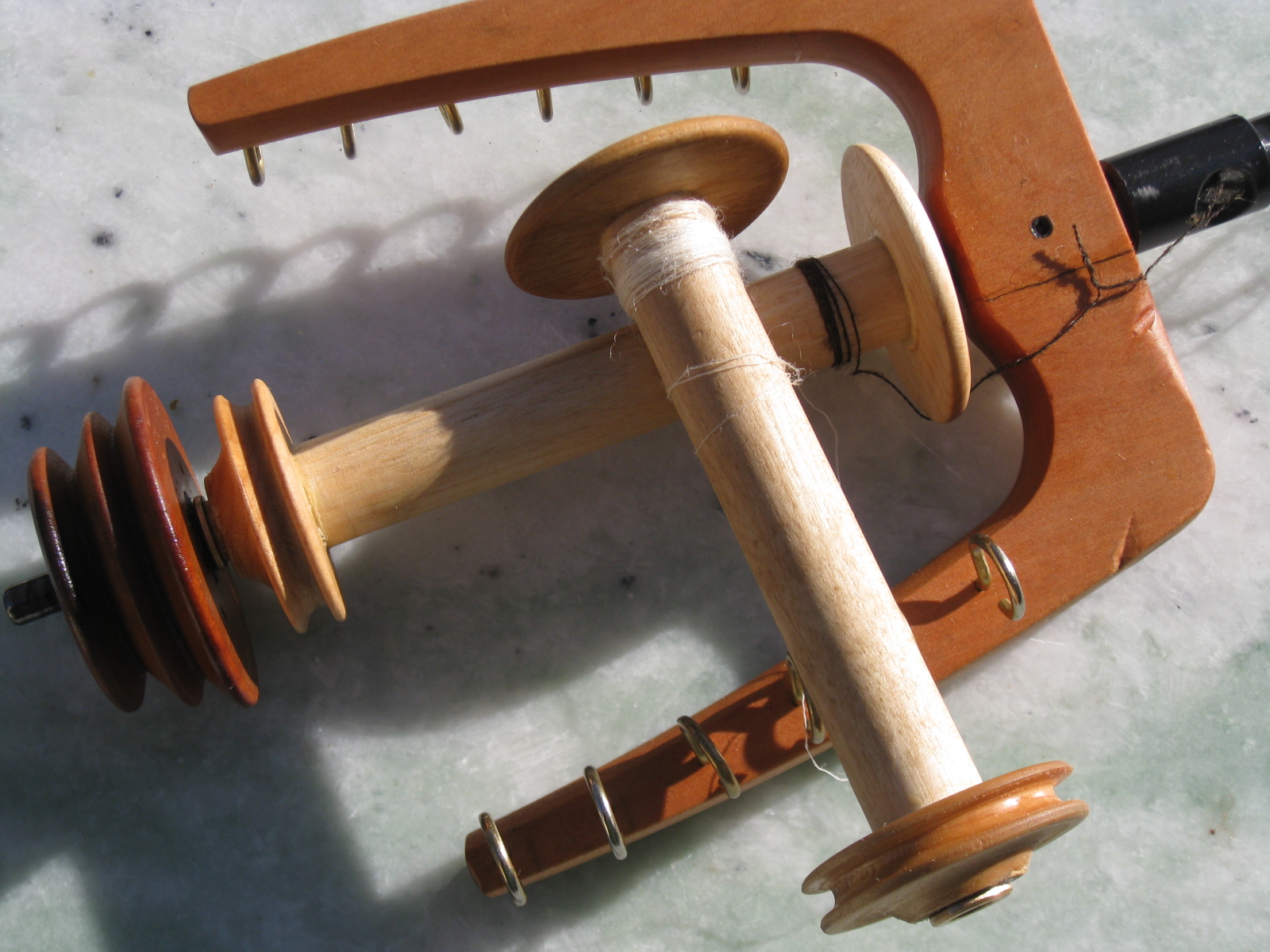
The one in the flier is for singles in the range of 11,000 ypp (20s) and the one on top is for finer singles (20,000 + ypp, 40s; these numbers have changed as I use different fibers, different fiber prep, and made better measurements).  These bobbins are a little lighter and the wider whorls allowing slippage for spinning finer yarns than the DRS would suggest.  On the other hand, that slippage slows everything down, particularly as speed increases and the aerodynamics of the flier start to consume significant power.  I do need a more aerodynamic flier.  (The oil finish is drying on one right now!)

They look small, but they will both hold a little over an ounce of  singles.  An ounce of 20s is 700 yards.  An ounce of 40s is 1,400 yards. Thus, I have no problem winding off full hanks of 560 yards from these bobbins.

The physical flier ratio is 22:1.

They took about half a day to make.  I bored 5/8" maple dowel with a 9/16" hole on their axis by holding them in the wood lathe.  I enlarged the axis boring at each end by 3/8" x 7/16" to hold the brass bushing bearings.  For the ends, I cut a 2" square piece of 3/4" maple stock, trimed the corners to ease the start of turning, and on the drill press, bored a 5/8" hole through the center. On the band saw, I cut the ends apart, one ~ 1/4" thick and the other ~1/2" thick.  I glued the ends on the core.  A couple of hours later, on the wool lathe, I rough turned the thin end, and then the thick end.  Then I finish turned the thin end, making sure it cleared the flier. Then I finish turned the whorl using the scrapers that I made last year and posted below.
The bushing bearings were inserted, and held in place with a dab of silicon adhesive.  A bit of sanding, some Danish oil, and they got left on the rack to dry while I made dinner for my wife.

Normally, I would let the core/ends-blank glue-up dry overnight, but this time, I got away with only ~ 2 hour set time.