Showing posts with label spinning history. Show all posts

Tuesday, October 27, 2015

A History of Fine Spinning in America

Consider how modern mill spun/ mill woven wool shirting and suiting weight wool fabrics drape.

Alden Amos instructs on how to estimate the grist of the yarns used to weave a fabric.  Once one knows how a fabric woven from a particular grist of yarn drapes, then grist of the yarns used to weave the fabric can be estimated from the drape of a fabric. This is not as precise as Alden's methods, but with practice, it is reasonable.

Look at how modern mill spun/mill woven fabrics were photographed and painted by the modern portraiture artists. This can easily be done at the Getty.

In the Huntington Library, one can see portraits  by folks like G. Romney showing the rich and famous wearing fine hand spun/ hand woven fabrics - and they look as fine as the modern mill spun/mill.  This tells us that hand spun/hand woven fabrics were in fact very fine.

Back to the Getty Villa, and we look at the the copies of Classic Greek sculpture, and allowing for the iconic, symbolic, and attributive nature of the sculpted drapery (and allowing for Victorian restoration) we see that the Classic Greeks knew about fabrics that draped very similarly to the drapes in G. Romney's paintings.  Except that these sculpture were copies, and the fabric was iconic, symbolic, and attributive meaning that such fabrics had been around for a long time and EVERYONE, from the estate owners that wore such fabrics and who ordered copies the of sculpture, to the slaves that only peered into the temple from a distance knew about such fabrics.

If A=B, and B=C, then A=C.

From this we can conclude that the best fabrics of the Classical Greeks were rather fine.  Thus, we have three lines of evidence telling us that the classical Greeks had fine spinning and weaving.  We have the archaeology of the textile fragments.  We have contemporary Classical Greek accounts. And, we have the fine fabrics recorded in Greek and Roman copies of Greek sculpture.

One may poke holes in each of the lines of evidence, but together they offer more consistency than pointing to iconic and attributive images on early Classical Greek pottery.  Inspection of the image of Penelope's loom tell us none of the clothing in the image was woven on it. 

In the case of  Penelope's loom, the loom is attributive -- it tells us who the woman is, just as a lion skin would tell us that it was an image of Hercules, and much bare skin would tell us that it was Venus.  Of course it is an old loom, it is meant to tell us the woman lived in an earlier time when the gods and heroes walked waked among us, and took an active role in the lives of men and women.


Tuesday, October 13, 2015

Celtic spinning

See Celtic Clothing (with Greek and Roman Influence) form the Iron Age - a Realistic View Based on What We Know by Heather Smith  ( https://www.academia.edu/1488040/Celtic_Clothing_During_the_Iron_Age-_A_Very_Broad_and_Generic_Approach )

They were spinning fine, and weaving at 18 to 25 threads per cm.

Not what we think of when we think of the  European barbarians (before and after the Roman Empire) from the Middle Danube to the Atlantic (including the British Isles).

When the Romans left, the Brits and the folks in Flanders were already spinning very fine - much finer than the Victorians could believe. And, MUCH, MUCH, MUCH FINER THAN MODERN SPINNERS BELIEVE!!

Oh my oh my! I do want a picture of a one-beam, vertical, weighted loom weaving useful quantities of cloth from hand-spun yarn at 20 threads per cm!!

https://www.youtube.com/watch?v=7FDTDIVUmk4
https://www.youtube.com/watch?v=6PD-FASC6ZQ

Not quite! This technology is never going to weave 50 ends per inch. 

One point is that if you read broadly, and deeply, there is lots of material out there, saying that the tradition of spinning fine is broad and deep --  Very deep.  We should not discard it without fully understanding it. 

The first truth from 5,000 years of spinning is is that fine singles make fine fabrics, and most people prefer fine fabrics.  The second truth is that if you are going to make fine fabrics, you are going to need a lot of yarn -  as a practical matter, you must spin fast, or you will never finish.

Homespun and Professional Textile Workers in Classical Greece

Stella Spantidaki writing in arachne, volume 3, 2009 tells of Specialization in textiles in Classical Athens. (https://www.academia.edu/3984979/Specialization_in_textiles_in_Classical_Attica_Arachne_3_2009_p._80-83)

tells us that women were producing textiles in the home.  However, there were also freed women producing various textile products for pay.

Then there were also men producing textiles on a commercial basis.  The key point is that men producing textiles are not shown in any of the art and iconography, e.g., the vases.  Thus, it is clear that art images do not tell the full story of textiles, and highly symbolic iconography does not tell the truth about spinning technology.  This is consistent with modern spinning iconography, were the same icons are used for 400 years, while the actual spinning technology moves from hand spinning to mill spun.

People who just look at the pictures, get spinning and weaving technology, economics and social structure wrong.  Here we have a class of professional (male) spinners in Classical Athens.  This also sets a commercial factory system where workers are specialized and work on particular tasks, rather than working on the entire production process as is more common in home production.

See related http://www.academia.edu/4217546/The_Fabric_of_the_City_Imaging_Textile_Production_in_Classical_Athens


Wednesday, October 07, 2015

Early Midevial Spinning.

Early Medieval textile finds at South Moravia, Czech Republic show that they had fine spinning and weaving.

Early Medieval textiles, locally produced, in 59 different varieties, and woven to 16 to 20 threads per 10 mm (e.g., 50 threads per inch) were found. These were fine textiles.  Thus, many of the 244 samples reviewed were NOT the crude or coarse textiles that we associate with early the medieval period. Granted that 2,500 ypp is not what I would call fine spinning, but it was central Europe before central heating. It was cold, and they needed warm clothes.  And at 50 threads per inch, the fabrics are finer spun/ finer woven than any of the modern handspun/hand woven wool textiles that I see around.

That is, early medieval spinners spun weaving yarns finer than we see modern hand spinners spinning.

See Finds of Textile Fragments and Evidence of Textile Production at a Major Excavation Site of Great Moravia in Mokcice by Helena Brezinovo in NWSAT XI, The North European Symposium for Archaeological Textiles XI, May 2011, Esslingen am Neckar.

Sunday, October 04, 2015

Spinning as a cultural heritage

The European craft of hand spinning is a cultural heritage just like art, literature, music, and architecture.  It was passed down to us and it is our responsibility to pass it on as good or better than we got it.

A group of modern spinners have taken a small part of  the craft of hand spinning, pronounced themselves "experts on the craft of spinning" and then gone on to say that their small part of hand spinning is all there is. 

They deny that that there is a larger craft of spinning.  They deny that within the larger craft of hand spinning, it is possible to spin finer than they do.  They deny that within the larger craft of hand spinning, it is impossible to spin faster than they do.

Are they really experts?  In 1600, school for spinning ran 2 years of full time instruction -- a total of more than 4,000 class room hours.  That would get an entry level spinner into an apprentice program.    How many of the exert spinners have 4,000 hours of classroom instruction and an apprenticeship program?

I do not claim to be an expert spinner.  I claim that I came to spinning and was told spinning faster and finer was not feasible. 

Ultimately, I found the Big Book of Handspinning, and the math that allowed me to design a spinning wheel that would spin finer and faster.  Now, I spin much finer and faster than the author of Big Book of Handspinning considered possible.  He never told me I could not spin finer and faster, he merely told me that he did not know how to do it with a manual spinning wheel.  However,  many other "expert" spinners told me it was impossible.   One of them told me so yesterday, after I had spent 6 hours sitting in the sun and wind, spinning more and  finer than she had ever spun in any 6 continuous hours in her life.   (I had switched from fine stuff to ordinary weft, and she told me it was a fine as what she could spin.  Except that it was 15,000 ypp coarser that what I had been spinning.  And she thought that in 6 hours she could spin as much as I had spun in 15 minutes.)  She was abusive, inarticulate, and got her dates wrong. Such is typical of a small class of spinners.  However, at one time I worked for a fellow who had been the US Marine Corp's Color Sargent; and, let us say that his articulate abuse puts any spinner I know to shame.  Nevertheless, my wife did take offense at her language.

However, in proclaiming themselves "experts" and denying the glories of European hand spinning, the experts are destroying an important body of world cultural heritage.  Over and over, they say it cannot be done. This lie has come to dominate the internet, and any search brings up the lie over and over, until the truth is buried deep.  By hiding the knowledge that there is such spinning and how it can be done, they are destroying the craft of spinning.  They want everyone to forget that such spinning can be done, and how it is done.

In destroying a world cultural heritage, these spinners are no better than the narrow minded fanatics that blow up statues of the Buddha in Afghanistan. In destroying a world cultural heritage, these spinners are no better than the imperialists that looted Greek Classical sculptures.  In destroying a world cultural heritage, these spinners are no better than the Nazi's that looted the are of Europe.

I do not care what little part of spinning, any particular spinner uses or does not use.  However, no spinner should call themselves expert, unless they are expert.  I consider myself  a "competent" spinner using a narrow definition from the British Wool Board. 

I am still very angry over the lies that many "expert" spinners have told - right up to and including yesterday.


Wednesday, May 06, 2015

Numbers 3

See :

http://upload.wikimedia.org/wikipedia/commons/e/e9/Century_Mag_-_The_spinner_-_Millet.png

Note that there is no treadle, but the drive wheel is driven by a crank in the right hand.  Note that the date on this painting is 1894 - long after mill spun had put professional spinners out of business.

Compare the above wheel to:

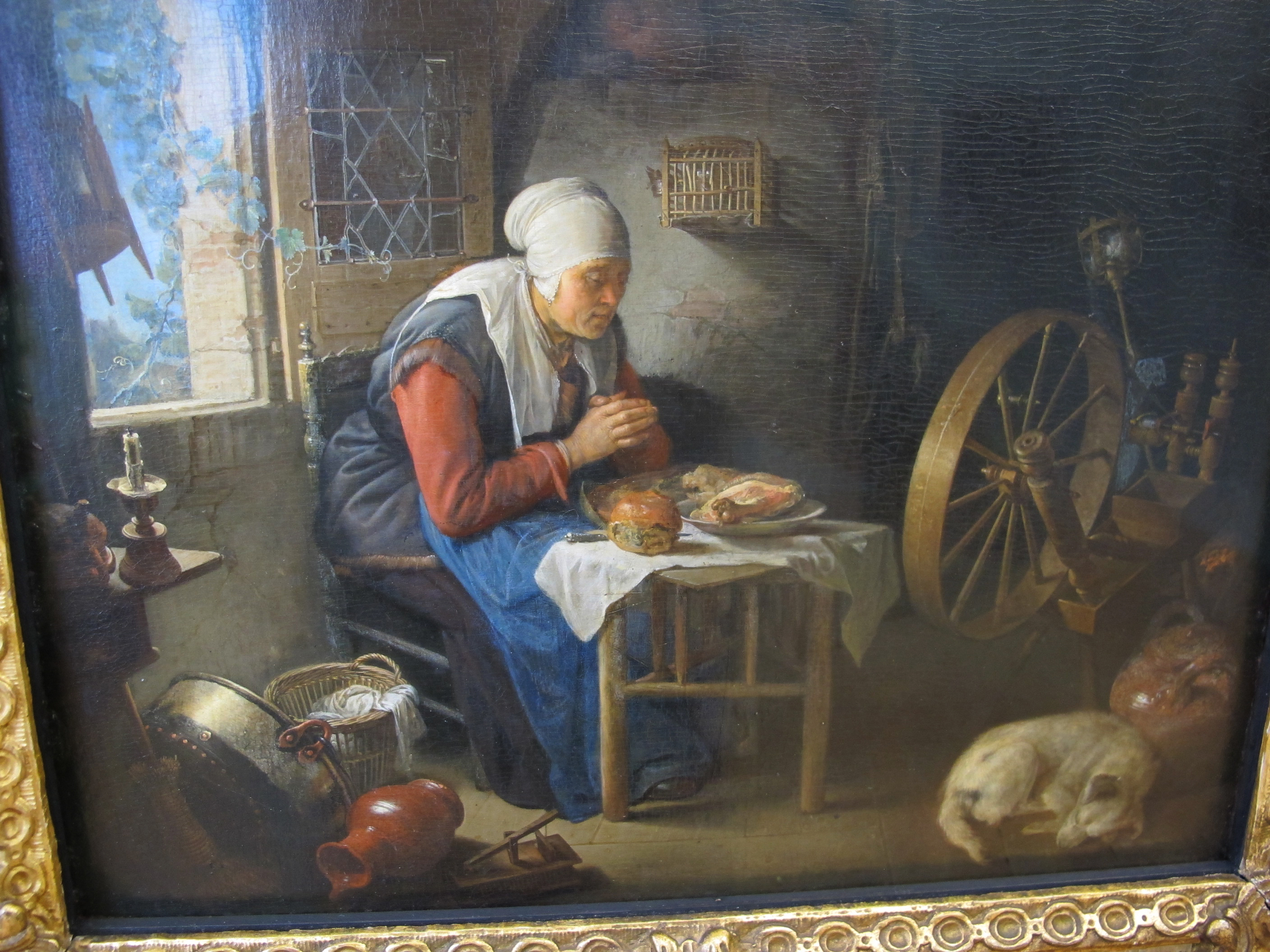
 http://uploads6.wikiart.org/images/gerrit-dou/the-prayer-of-the-spinner.jpg

Note that the date on this painting is the second half of 17th century. If you look carefully you can see the crank on spinning wheel just like that in the Millet painting.  Thus, we have two paintings separated by 230+ years that show the same spinning technology even when it is clear that professional spinners had dramatically changed their technology from hand spinning to spinning frames. From the sequence of paintings we have no confidence that the design of the wheel in Dou's painting is not 250 years old and thus, the design of the wheel in Millet's painting some 500 years old.  In fact, we do know that foot treadle wheels were available in Flanders in the mid 1500s, and thus Dou's wheel is at least a hundred years out of date.

Either wheel would be an almost exact miniaturization of room sized silk throwing equipment in use in Italy at the end of the 13th century. And, either wheel would be somewhat faster than a drop spindle for spinning worsted warp. 

Let us allow 7 yards of fabric for all of Dou's spinner's clothing, a yard for the cloth on the table and 2 yards for the cloth in the basket, for a total of 10 yd^2 of rather coarse cloth woven from  ~5,600 ypp singles. That comes to about 800 hours of spinning with that wheel. Then, we have what appears to be a few yards of a much finer blue cloth in her lap.  Let's assume that it is a couple of yards of shirting weight.  That is another 800 hours to spin the required yarn with the visible wheel.  Thus, the yarn for the cloth in the picture would require almost a year to spin with the spinning wheel depicted.  Add in weaving, and the cloth depicted represents more than a year's work with the technology of that wheel.

We can assume that most (all?) of the yarn for the cloth depicted in the Dou's painting was woven from yarn spun else where by others - using different equipment.  Given the cloth depicted, we can deduce that the spinning wheel is a prop, just like the spinning wheel as a prop in the Millet painting above and the photo below:


Princess Louise,
Daughter of Queen Victoria and a Spinster.

How many years would it take her to spin the yarn for the clothing she is wearing?

Consider:
http://upload.wikimedia.org/wikipedia/commons/5/5f/Vel%C3%A1zquez_-_La_F%C3%A1bula_de_Aracne_o_Las_Hilanderas_(Museo_del_Prado,_1657-58).jpg

Note the tapestry in the background, and that spinning studio is not set up to prepare gold, silver and silk wrapped tapestry yarns. The spinning for the cloth in the picture is again being done elsewhere.

Consider 
http://c300221.r21.cf1.rackcdn.com/jean-franois-millet-french-painter-18141875-standing-spinner-1353478227_org.jpg


Here we see the same artist (Millet) present different spinning technologies in the same time period. Art is not a reliable indicator of the spinning technology in use by professional spinners at the time of the painting.

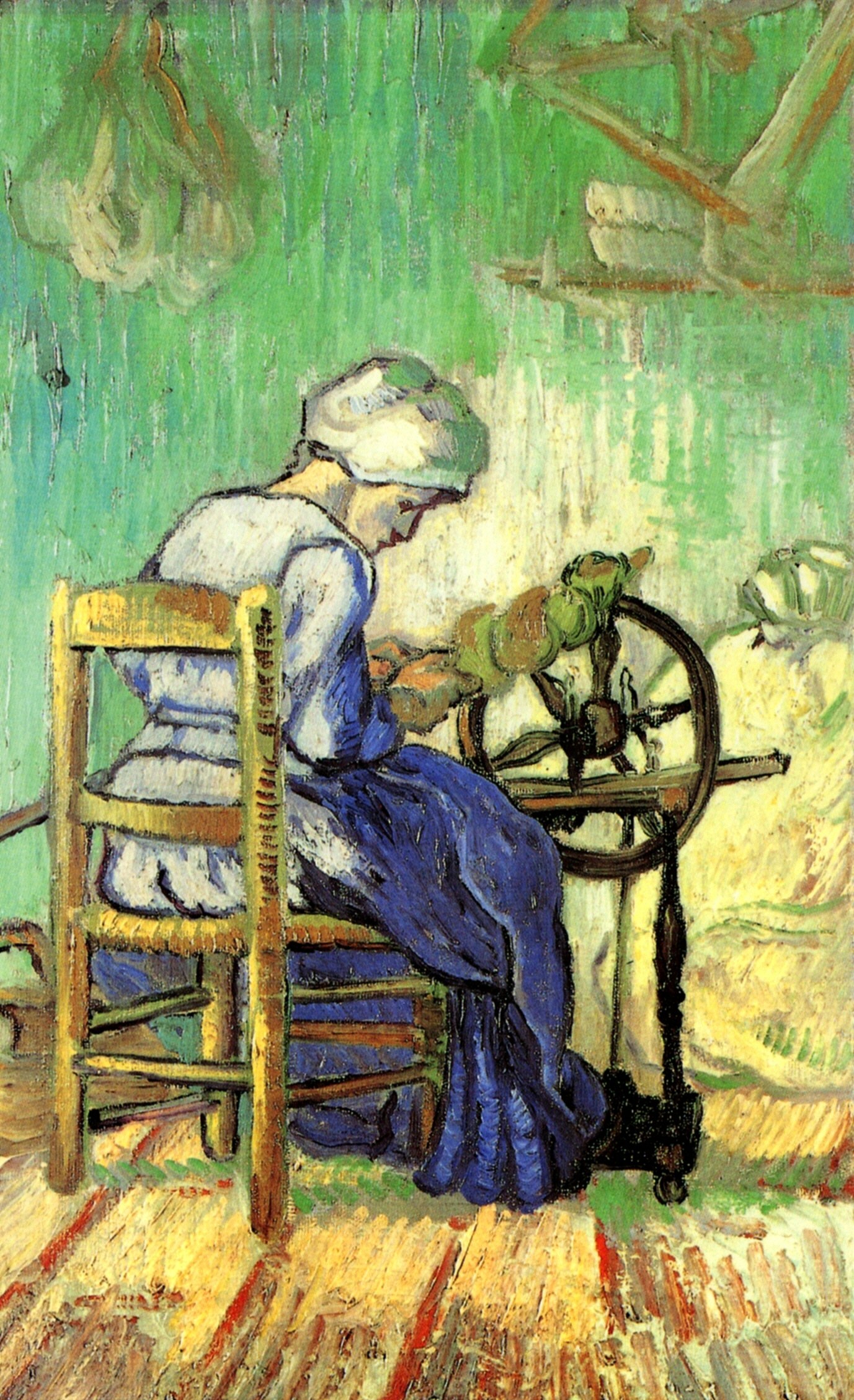
http://uploads7.wikiart.org/images/vincent-van-gogh/the-spinner-after-millet-1889.jpg

Not even multiple images of the same spinning technology by different artists is an accurate indication that the technology is being used by professional spinners.

Here we have a lady in silk dress spinning linen at a time when linen was actually hand spun:
http://ichef.bbci.co.uk/arts/yourpaintings/images/paintings/mhh/624x544/lsw_mhh_88029415_624x544.jpg

At that time and region, professional linen spinners used 2- thread wheels. We know this because 150 years earlier parliament past a law requiring spinning schools to teach spinning on 2-thread wheels  Again, the spinning wheel in the painting is not an indicator of the technology then used by professional spinners.

Depictions in art are very poor indicators of the then current professional spinning technology!

Friday, May 01, 2015

The drop spindle as a baseline.

By the early medieval period, it was common for spinsters (professional spinners) to rent spinning wheels.  Spinsters were paid by the length of yarn they produced, and a spinning wheel allowed them to produce more yarn, so even after paying the rent on the spinning wheel, the spinner could have a higher net income.  (The large number of spinsters kept wagers down, so many spinsters did not have the capital to own their own wheel.)

I can spin yarns in the range of 3,000 to 8,000 ypp about a third faster (e.g., 1,300 rpm) with a spindle than I can with a typical modern wheel (1,000 rpm).  Since I am not terribly proficient with a drop spindle, I assume that professional spinners could spin with a drop spindle much faster than I can (e.g., more than 2,000 rpm for some grists.) Therefor, I assume that the spinning wheels of the early medieval period were much, much faster than the typical modern wheel.  My spinning wheel spins 2 or 3 times faster than I can spin with a spindle.  I think that spinning wheels circa 1400 likely inserted twist at ~2,500 rpm or more.   This is faster than contemplated by Alden Amos.

Just prior to 1,400 ce, there were just under 400,000 textile workers in Florence, but Flanders was actually a larger producer of woolen textiles, and there were significant textile production centers in France, and England. Thus, there was a significant market for spinning wheels.  This would have justified shops where groups of craftsmen specialized in making and repairing spinning wheels. These were spinning wheels for full time professional spinners.  Some of these spinners supported tapestry weavers. These wheels were not for hobby spinners or part-time subsistence spinners or cottage craft spinners.  Regardless of their skill, cottage craft spinners did not produce the tons of  gold, silver, and silk wrapped yarns that the better tapestry weavers demanded.  A cottage cannot provide the security required for handling large amounts of precious metals on a regular basis..

And time was money.  Professional spinners were paid by the yard of yarn produced, and wanted the fastest possible equipment.  This was not a matter of bragging rights for hobbyists, but of income to support the family.

All in all, I have no doubt that Florentine spinning wheels, and even more likely, wheels made in Flanders, could run at 2,500 rpm by about 1380. Metal workers and wood workers of the time could have make all the elements of my wheel that can spin at 4,000 rpm. As a one off object it would have been very expensive, but a shop that produced dozens of wheels per year could reduce costs. Yes, they would use boxwood where I use Delrin, but with plenty of lard oil, the boxwood bearing works -- it just splatters oil, and needs to be replaced after every 2,000 or 3,000 hours of use.

Such wheels do not show up in paintings of time.  The wheels in the paintings are more symbolic, than functional. Add up how long it would take for the depicted wheel to spin the yarn required to weave all the cloth painting. Even in paintings of "spinners", someone else is doing the bulk of the spinning to produce all the cloth shown in the painting.  The culmination of this symbolism:
 Vicky wearing clothing woven from 
finer yarns than what she is spinning!

The clothing worn by Queen Victoria was mill spun, but she shown with a replica of an old technology. I expect that the same thing also happened in earlier times.

Today, we have photographs of  people spinning, and they still have not spun the yarn for all the cloth in photograph.  Even people who claim that they can spin and weave all the clothing needed by their family.

https://www.youtube.com/user/afranquemont

The best you are likely to find is somebody that spins and uses that yarn for knitting their own socks and sweaters.  

Why was the art of earlier times so different? The simple answer is that human nature has not changed.  Old spinning technology symbolizes traditional values.  What would people have thought if QV was shown in the mill where the yarn for her dress was actually spun? As a setting for a portrait, a spinning factory in 1480 would have been just as jarring as photographing Q.V. in a spinning mill in 1880. And yet, such a mill would have been a better place, and a better way for Q. V. and her ladies to develop an understanding of the tasks and roles of the common women of England, than spinning a few yards of yarn at Buckingham, Osborne, or Balmoral


Certainly any yarn can be spun with a spindle.  Finer yarns are more easily spun with a supported spindle than with a drop spindle, but it is very possible to spin wool, at it's spin count, with a drop spindle. However, it is much, much easier if the spindle has a hook, rather then trying to use a half - hitch.  Some teachers have made fun of me of me when I first made this assertion, but I note when they spin yarns finer than about 11,000 ypp they tend to use a spindle with a (metal) hook,  I have yet to see them spin wool at it's spin count using a half-hitch.  In fact, I have yet to see them demonstrating spinning wool at its spin count with a spindle.


Monday, October 13, 2014

Better accelerator bearings

Spinning has been a series of sacrifices to the gods of speed.

I settled into double drive and differential rotation speed (DRS) controlled flyer/bobbin assemblies in the pursuit of speed.  I went to smaller fliers from Alden Amos in pursuit of speed. I went to an accelerator in the pursuit of speed.  By the time I had spun my first fine warp (5 lb of lace weight worsted singles) I expect that my wheel was one of the very fastest in the world. Production of 5,600 ypp worsted at sustained rates of more than 8 yards per minute with peak production rates of more than 10 yd/min is easy.

Nevertheless, I spent a good part of today making better bearings for the accelerator from graphite/Delrin provided by Henry Clemes.  The result is another 800 rpm in the flyer/bobbin assemblies.  And the wheel runs quieter, with less vibration.

This raises the production rate of higher twist yarns. Every time, I thought that my wheel was going as fast as possible, I have found rather straightforward ways to it make go faster. I cannot believe that I am the only one.  Between the invention of DRS by silk throwers in Italy during the 12th century and the advent of  powered spinning frames circa 1780, millions people had a strong financial incentive to improve the spinning wheel in various ways.  It was a very large, very competitive industry, with huge incentives for very small increases in spinner productivity.  The competitive nature of the industry ensured that useful improvements were kept very secret, until they were obsolete. Thus, textiles were generally unique to a locality, because other localities did not know the details of how those fabrics were produced.

The way to determine what tools and technologies were used, is to become expert in textile production technology and reverse engineer the technology from found textile samples.  Proof is in my spinning wheel.  No historian viewing history through the prism of modern commercially produced and sold hand spinning wheels could conceive that a 16 th century hand spinner could have a production rate of  8 yards per hour. And, yet this afternoon as I tested the the new bearings, anything less is silly.  It shakes and rattles, but it spins faster than any wheel you have ever seen or heard. I have no doubt that wheel makers in Flanders were making faster wheels by the end of the 15th century. There is nothing in my wheel that they could not do with the tools and materials that they had.  Yes, the materials they had might have resulted in a bit more lard-oil splatter, but in a commercial spinning factory, that does not matter. Any historian who says that 16th century professional spinners that did not spin that fast, simply does not not know the craft of spinning.

As Ed Deming told us over and over, "You get what you measure.  If you do not measure it, you do not get it".  Professional spinners measured production - it was called income.  Modern spinners do not measure it, and do not get it. Modern historians do not have a clue about the productivity of traditional hand spinners. Since spinning  was the base of textiles, and textiles was major item of trade and a base of the economy,  modern historians do not have a clue about the economy of the period.

And it solves that great question: Why 5-ply? A) Because they had DRS wheels set for 10s, and 5 plies of 10s knit into a fabric that was warm enough to keep a sailor from going hypothermic.

Now that I am spinning a lot of warp, hand spun 5-ply has become my go to yarn.  I always have pounds of 10s around and plying up some 5-ply is just natural.  It is a way of using up left overs.  It is a stash buster.


Monday, August 18, 2014

Overview of Spinning at the Spin Count


  1. Select the desired grist and nature of the single.
  2. Select a wool with a spin count that is the desired grist, and which has a nature that will produce the desired single.
  3. Use differential rotation speed to set the flyer/bobbin assembly to insert the correct twist for that grist.
  4. Prepare the wool as combed top, dressed onto a distaff. Combing with 5 pitch combs is how they did it for years and years, and it works.
  5. Use a high bobbin/flyer rpm -- 2000 is good, 3,000 is better. Accelerator wheels work.
  6. The hands will be a good distance apart and a good distance from the orifice.  Hand motions are very small, and limited to advancing wool into the drafting triangle and bringing stray staples to the area when the single is forming.
  7. Yarn is wound off as when the effective circumference of the bobbin (and hence the inserted twist) changes. If you are spinning 60s, you can likely get 500 yards (8 grams) on a 3.5" bobbin before the twist changes more than 10%, and that is close enough for hand spinning.
The key to the whole process is that one needs to use DRS to insert the correct amount of twist for the takeup. Then, one needs to use a fiber with a spin count appropriate to the grist being inserted.   These two factors must work together.

Modern spinners find spinning these grists (20,000 ypp - 45,000 ypp, 140 to 200 wpi) difficult. This is because they either use spinning wheels with too much take-up or spindles which are slow. Then, modern spinners try to make the spinning easier by using the finest possible fibers.  In fact, the use of finer fibers changes the dynamics of the twisting process, and increases the requirements for drafting.  This is not noticed because these systems already require significant drafting effort.  In contrast, I set up my system to require minimal drafting effort.

I can spin 22,400 ypp single from Romney faster and easier than I can from Merino, and much, much easier than I can from that mix of silk, alpaca, and Merino that I was spinning over the weekend. All those fine fibers disrupt the system's ability to self-assemble the single. 

There is 60 count long wool on the distaff right now and I have been spinning it into 22,400 ypp singles. Spinning it at 30,000 ypp/60 count is just a matter of changing the flyer whorl, and Bingo, I am spinning at the spin count and everything is copesthetic.  The 22,400 ypp requires some drafting, The single at the wool's spin count just sort of self assembles with less attention. This is about small increments of faster and easier.

Get it all correct, and one can spin worsted grists of 20,000 ypp - 45,000 ypp at 350 to 200 yards per hour.  And the uniformity will be unbelievable in the context of modern hand spun.  A rather small investment in learning the physics of spinning brings huge rewards in easier spinning.  This has been my refrain for several years now.  The book that gets the physics of spinning correct is Alden Amos's, Big Book of Hand Spinning. Read it.  I know of two famous spinners that recommend it and still make mistakes about the content.  Learn it.  cf  Alden's analysis of spinning garment weight singles on the great wheel.  Flyer/bobbin systems are much easier, and much faster.

One can make much faster spindles that work very well for this technology, but I do not see many of them around.  

I have seen the larger spinning community deny that this is possible, and I see waves of anger.  No adult should ever get angry over a bobbin of lace  yarn.  A bobbin of lace is nothing, it a few grams of fiber and a couple hours of spinning. However, if you have a quarter of a million yards of 22,000 ypp singles, then you can weave a bolt of shirting. In the middle ages,  hundreds of bolts of shirting were being traded around Europe. That means that hand spinners were spinning tens of millions of yards of 22,000 ypp singles every year.  It was an industry that made families rich, and cities powerful.  And, that was in addition to what was being spun for other weaving.   That kind of money and power is something to get excited about.


Tuesday, August 12, 2014

commerical rates

One old definition said that a competent (hand) spinner could spin (wool)  at its spin count at a commercial rate. Of course, spin count is the measure of the fineness of the wool in hanks per pound, but what was "a commercial spin rate"?

I have spun 500 yd (a hank) of 5-ply gansey yarn in a day, even hanks on consecutive days, but that about did me in.  For 10s,16,000 yards per week is about as fast as I can spin (on th AA # 1 flier) On the other hand, I am a fat old man, who has not run a marathon since the summer of 1980.

I suspect that "commercial rate" for 10s by professional hand spinners was in the range of 16,000 to 20,000 yards per week.   (the AA# 0 flier is faster, and I expect, it is the kind of tool that a pro would use.).  In short, there were likely active hand spinners that spun a million yards of lace-weight singles in a year.

And, there were likely active spinners that spun half a million yards of 40s/shirting/hosiery singles in a year.

Conventional wisdom is that spinning finer requires slower spinning. However, I think quite the reverse.  And at this point, I do not know anyone that is researching the topic as aggressively as myself.


Monday, August 04, 2014

A Failure of Tapestries

Looking at Great Tapestries edited by J. Jobe (1965) and the section in the back by the professional tapestry weavers Francois Tabard and Jacques Brachet, entitled, The Weaver's Art, we see that Tabard (and Aubusson by extension) do not feel that handspun has sufficient uniformity to be suitable for tapestries.  That is silly.  Many of our finest tapestries were woven before mill spun. Their existence is proof that a  competent spinner can produce yarn suitable for a fine tapestry.

What Tabard meant is, "Contemporary hand spinners do not generally produce high quality yarn." In particular, he is talking about uniformity.  This is in contrast to Verlet's and Florissone's themes that in the Gothic and Classical periods,  hand spun yarns produced fine tapestries.

Tabard tells us that 2/20 yarns (2-ply at ~5,000 ypp) is fine enough for almost any tapestry.  (One must stand back to see all of a big tapestry, and at a few steps back, 2/20 yarns provide a higher resolution than the human eye can see.)  That is about the grist of the commercial mill spun warp that I buy.  The French, Italian and English tapestries that I enjoyed in Paris were woven (and restored) with yarns of about that grist.  However, the 16th century Flanders tapestries were woven from finer yarns.  They even look good when you get so close that the guard is running toward you, shouting for you to get away from the tapestry.  I was not touching it! Really!!

I suggest to you that if you having trouble with uniformity, spin finer - and use coarser wool. The advantage of spinning wool at the wool's spin count is that the single, and hence the yarn will be very uniform. Let me say that again: spinning wool at its spin count ensures a uniform yarn. I'm pretty sure that (some) of those very fine tapestries from Flanders in the first half of the 16th century were woven from 2/40 (2 ply at ~10,000 ypp/ e.g., singles of 40 meters/gram) which was plied from a standard grist of single that spinners in Flanders were producing for shirting.  They used DRS spinning wheels set to insert 15 tpi which results in worsted singles of about 18,000 ypp.  (Right now, my spinning wheel is set to insert 17 tpi resulting in worsted single that is very close to  22,400 ypp. I assure you that such singles can be spun at a rate of 2,500 yards per day on a sustained basis.)

Those singles were in the range of 32s to 40s (e.g., 40 hanks of 560 yards each per pound).  Spun from coarse long wool such as Cotswold, the thread is very lustrous, strong, and durable.  40s are more lustrous than 20s spun from the same wool. However, spinning these long wools finer, (e.g.,44s) is more effort.  And, in a time when rooms were lit only by fire, more lustrous wall hangings were much more valuable.  That is, my thoughts about grist are driven by a compromise between spinning effort and the need for luster.  (Mill spun does NOT provide that luster. See http://awordfromclaudia.mirrixlooms.com/2011/01/tapestry-yarn.html, http://finefiberpress.blogspot.com/  ,  https://www.etsy.com/shop/FineFiberPress ,  http://members.peak.org/~spark/FineFiberPressTapestryYarns.html  OK,! it is worsted spun from combed fiber, but different breeds have different luster, and higher grist shows the luster off better. The AVL from Fine Fiber is ~3,200 ypp.) 

Francois Tabard and Jacques Brachet simple got it wrong.  I find this funny as the Apocalypse Tapestry  (http://en.wikipedia.org/wiki/Apocalypse_Tapestry) is genneraly considered to have been a major artistic influence on both Tabard and Lucrat (another great weaver) in the 1930s. In the old days, hand spinners did spin yarns for high quality tapestries, because mill spun did not exist.  Was the warp as uniform as modern mill spun? NO! However, the long wool was stronger and more durable.  And, the hand spun weft was adequately uniform considering the acuity of the human eye.   Using mill spun, modern weavers never get the full luster of worsted spun long wool.  

Tabard and  Brachet were correct in that contemporary (1965) spinners using typical modern hand spinning tools are not likely to produce useful amounts of 2/20 worsted yarns with the necessary consistency. Tabard and  Brachet had never worked with high luster yarns, so luster was not something that they 
expected pr thought about in their yarns.

Hand spinning can produce better yarns for tapestries than mill spun, and can produce those yarns in useful quantities.  Standing back a few feet means that a small lack of uniformity in the yarn does not diminish the over-all effect for the human eye.    It is the same issue that says 2/20 is a fine enough yarn.   And, the hand spinner can work with lustrous long wool, or silk, or rayon, or nylon, or silver /gold/ aluminized mylar fibers, or even polyester.  You can even make transparent yarns. However, use of DRS controlled flyer/bobbins allows hand spinning of more consistent singles at rates 3 to 8 times faster than is possible using typical modern hand spinning tools (spindles, or single drive wheels, or double drive wheels not using DRS ).  That 3 to 8 times faster is worth while because it allows more interesting projects to be completed.  

For something like the Apocalypse Tapestry, the weaver would be working at something like 13 or 14 epi using a final yarn of about 800 ypp. For ease of producing a highly uniform weft yarn, I would use 6 strands of 2-ply 5,000 ypp yarn. (e.g., singles would be 10,000 ypp, e.g., ~20 hanks per pound)  The 6 strands would be wound together on the bobbin but would have very little cable twist so the 6 strands of 2-ply weft (12 strands total) would lie flat on the warp and give perfect fill.  I expect that about just under half a million yards of of warp and just over half a million yards of weft would be needed.  It comes out to just under over 7,000,000 yards of singles.


This is a luxury project, and the use of finer singles vastly improves the look and luster of the fabric, but the additional effort to spin the finer singles is not significant.  (Compared to 72 man-years of weaving!) So, while I have not seen the tapestry in person and have not seen a discussion of the yarn construction details, I very much suspect that they used what most modern hand spinners would consider ridiculously fine singles. 


Weaving time for the Apocalypse Tapestry has been estimated at between 50 and 85 man-years, but it was completed in only 5 calendar years, so there were about a dozen weavers. 


However, using DRS, a team of 4 spinners could easily have spun  all the needed yarn (including 12-strand weft) in about 3 years.  If the spinners start a few weeks before the weavers, they can have warp for 3 looms and a small stock of weft ready for the weavers. Using DRS spinning technology, a team of 30 workers could have produced the Apocalypse Tapestry in about the 5 years history says it took to make the object.  The core team would have been a dozen  weavers,  4 spinners, a wool comber, a dyer, assistants for handling yarn and setting up/adjusting the looms, an artist doing the cartoons and setting color palettes, a manager, and a book keeper.  In the last 2 years of the project, finishing tasks would have replaced spinning tasks.


Spinning effort with spindles would have been 2 or 3 times greater. (e.g., 12 spinners) Certainly not much in the greater scheme of things, but I think that the consistency of the weft argues for it having been spun by a smaller group of spinners working with DRS wheels.  

  
The dealer that arranged the Apocalypse Tapestry commission arranged commissions for 254 other tapestries. And, there was routine textile weaving going on nearby. Thus, there would have been continuous work for spinners, weavers, and finishers.  This was weaving on an industrial scale. These were not women spinning for the needs of their family.  These were not even folks spinning under the direction of their lady for local needs. These were folks in Paris making tapestries for a castle that was 200 miles away. The tapestry for the choir stalls in Tournais was woven in Arras, 40 miles away. It was 8 feet high and 65 feet long.  We know there were other larger and more famous tapestry weavers closer.  Thus, we can infer that textiles was a large and competitive industry. This does not fit into any of the modern mythology of hand spinning. 

These were folks that knew how to get textiles DONE!  Full time, professional textile workers in the time of Chaucer. You can pick at my 
estimates on the number and amount of singles produced, but first you need to look at the Apocalypse Tapestry and think about how you would produce that volume of yarn, of that quality, in that time frame. 

The bottom line is that if you want beautiful tapestry yarn, get some Cotswold, and spin it fine.


Sunday, July 06, 2014

DRS and History

Alden Amos and I are not on Henry Clem most favored list.  We write about DRS, so people want to buy differential rotation speed (DRS) spinning wheels from Henry.  However the spinners do not have to skills to make the wheel work well so they are not happy and want to return the wheel.  This is real problem for Henry because he wants to sell what people want, and he wants people to love his products.

The problem is that the modern spinning community does not have the skills to operate a DRS wheel.  DRS is a taboo subject.  Alden Amos talks about the math, but does not go into the care and feeding of such a machine.  And, if you try to treat such a machine like your ST wheel, the result will be nothing but tears.

What could Henry do?  Demand that every customer take a long workshop on how to use a DRS wheel?  He would have to charge a couple of thousand dollars for that, and "experienced", spinners think that they they know how to spin on any wheel, and are not going to go to a long workshop on the basics of using a wheel.  In short, extended customer training is not a way to sell spinning wheels.

Even Alden had this problem as some of the DRS controlled wheels that he sold were returned.

Thus, we have a chicken and egg situation.  There are few DRS controlled wheels around for spinners to learn on, and therefor few spinners know how to use DRS.  There are few spinners that know how to use a DRS wheel, so few wheels are sold.  Even hand spinners doing restoration work do not understand DRS.

I strongly believe that flyer/bobbin assembly technology developed in the very profitable and secret Italian silk industry starting as early as the 12th century. In the beginning, it was the miniaturization of  room sized silk throwing equipment.   It was valuable industrial equipment used by operators that were extensively trained. It likely followed the same cycle as modern industrial equipment. An operator is trained, gains experience on equipment, makes some improvements on his equipment, and trains the next generation of operators. I think the silk throwers had DD/DRS controlled industrial winding equipment in the 14th century and  the technology was transferred to the aslo secretive and very profitable wool industry not much later.  In short, flyer//bobbin assemblies were likely common in the wool industry long before they show up in drawings.

Don't believe me?  Learn the difference between yarn spun on  DRS wheel equipment and  that spun on an ST wheels and various spindles.  Then, go look at old textiles.  1500 is a good place to start.  Compare threads spun in Italy, Flanders, France, and England.  They are different.  They were produced by different technologies. Ask yourself, how were the threads from Flanders spun?  Ask yourself, " How would I replicate that thread?"  If you understand DRS, you know.

Understanding DRS is part of the craft of spinning.  When you understand the craft of spinning, and you look at old textiles then you realize the entire timeline of  spinning technology as presented by modern historians is wrong, because they are not considering DRS. A Ph.D in history from a major university does not ensure that one is a master spinner.  The very best spinners that I know do not have  Ph.Ds in history from major universities.  I think it takes a good bit of spinning to become a good spinner, and getting a Ph.D in history from a major university takes away from one's spinning time.

(Am I a good spinner?  Not by 16th century Flemish standards!!)

If you want to replicate 16th century textiles as worn by the great and powerful, go DRS.  It has a long steep learning curve, but it is the way to produce high end, luxury thread.  It is how to spin a loom web for a bolt of cloth and get it done before you die of old age.

Friday, November 15, 2013

More on Twisty Sticks

A twisty stick is a piece of wire 8-12" long with a hook at one end.  The Scandinavians make, big, tapered, wooden ones, but I am interested in the British tradition.

They were used for grading wool in the time of Chaucer, and it makes sense to me that a spinning tool was used to determine how fine a wool can be spun.  Anyway, Chaucer was hundreds of years after great wheels had been introduced for the fast spinning of woolen yarn, so twisty sticks are likely an old and deep tradition.

Alden Amos uses 1/8" wire and gives directions with drawings for making them in his Big Book of Handspinning. He likes them, and considers them an essential tool - the kind of thing that spinning guilds should make for every member as guild projects.  I like 2 mm steel wire and make them a bit longer (10.5" over all).  Mine weigh about 5 grams, and I use them for yarn grists that I would use a 5 gram spindle with whorl, e.g. ~30,000 ypp.  An iron hook from cheap, soft iron wire bound into the split end of a dogwood twig with a bit of linen thread and some glue makes a 2 gram twisty stick.  It works. With  half an inch of iron wire, linen thread, hide glue, and a sharp flake of chert, an iron age spinner could make one in a few minutes. It has about the same size shaft as AA's twisty sticks so it will be about as fast, but it only uses half an inch of thin iron wire. This gives us an idea as to why they are called "sticks".  A twisty stick is a drop spindle with a hook, but no whorl, and is often made entirely of metal.

I find that I can do a thigh roll with the twisty stick with one hand do a long draw draft with the other hand and quickly have a good make of yarn. The draft and the thigh roll can occur at the same time.  Then, I can drop the drafting hand, and the return thigh roll will wind on the yarn. The wind on is backwards.  There is almost no wasted motion.  Where a little more twist is required,  the twisty stick can be given an extra shove and released for a moment at the end of the forward thigh roll. Then the twisty stick will deliver a surge of twist to the yarn. The process is very fast. It is not something I have seen any other modern spinner do. It is not in the literature.  This is very odd.  The copp is built to wind off as an end feed package.

However, I do not know how to spin worsted with a twisty stick. So what I produce on twisty sticks are "weaving quality" woolen yarns. The quality would improve if I would practice. The problem is that even the best twisty stick is not as fast as my AA modified wheel, so my tendency is to spin any yarn on my wheel.   Thus, I am not likely to put the required practice time into twisty stick spinning, and I will not achieve and maintain professional competency with the tool.

Still, I have no doubt that Iron Age Brits used this method to produce woolen cloth for export.  I would not be surprised to discover that this was the "rolling on the thigh" method described for Bronze Age Greeks.  It is a concept that would allow a textile professional to produce less expensive woolen cloth.

The wire gets brittle and breaks. What the archaeologist would find a few hundred years later is a small piece of wire.  Any archaeologist ever see anything like that in a Bronze Age or Iron Age site?  Any chance that such an artifact has been found and incorrectly identified?

We have not really thought about hand spinning with a spindle on an industrial scale (e.g., ship-loads of cloth) for a long time.  Linen and hemp need a spindle with whorl because the long fibers and low twist per inch require slow insertion of twist. Thus, we see the spindles with whorls in the Egyptian drawings. Silk also has very low tpi, and want slow insertion of twist. Spinning worsted wool requires a whorl because both hands need to be free to draft, and therefore spindles for worsted spinning need whorls to store momentum and gradually transfer the twist to the yarn over a period of time . This is what we see depicted on Greek urns. Weaving wants worsted warp, so wool cloth production always set a demand for worsted thread, and we find  lots of whorls in every hand spinning culture.

However, woolen and cotton spinning just want lots of twist insertion. Woolen and cotton can absorb twist very rapidly. Drafting can be with one hand, so one hand can keep the spindle turning at a very high speed. If one hand is devoted to tending the spindle, there is no need to store momentum.  One can get the highest rotation speeds and therefore the fastest yarn production from a spindle with no whorl.  The spindle can be spun up very fast, and  all the twist energy transferred to the yarn almost instantly, rather than momentum stored in the whorl.  Over all, the process can be much  faster than modern spindle spinners using whorls think is possible.

This can be seen by the fact that the basic unit of woolen production was a hank of 1,600 yards, while the basic unit of worsted production was a hank of only 560 yards.  Yes, I think that in a world where all spinning was done by hand with a spindle, a yard of worsted was worth 3 yards of woolen. Wool yield, wool preparation, and spinning effort are all factors, but I would also say that in a given time, a woolen spinner would be expected to spin ~3 times the yardage of a worsted spinner.  We do not see this today because both woolen and worsted spinners use spindles with whorls that all rotate at the same slow speed.  Thus, woolen spinners spin at the speed of worsted spinners.   And the goal is better yarn, rather than  faster yarn.

Victorian ladies looked at the depiction of Egyptian linen spinners, Greek and Roman worsted spinners, and decided that all spindles need whorls.  Modern spinners (after 1960) took this as the wisdom of the ages. They felt that spindles needed whorls - everybody knows that, why would they stop and test this bit of folk wisdom? They did not think about spinning faster by using a spindle without a whorl.  They were spinning for a hobby, they did not care how fast they could spin.  In fact, showing off how fine and fast one can spin is considered rude.  When hobby spinners want to spin woolen faster they use a great wheel or charkha.   

I think spindles for worsted spinning need much higher moments of inertia than spindles for woolen spinning.  I find it amusing that this difference does not show up in the spindle market place.  It does not matter to me because I make my own spindles, and mostly I spin with my wheel.  

The above will raise some hackles  Any hand spinner that can sit down and spin wool at its spin count (http://en.wikipedia.org/wiki/Spinning_count) is very welcome to tell me that I am full of shit.  Any person that cannot hand spin wool at its spin count should be polite.  

Thursday, February 07, 2013

Why Seaman's Sweaters?

Or, Why didn't they just change their clothes and put on rain gear as required?

Back in school, I had a  professor that said, "One must make a thousand pots of tea, before one is ready to make one tea pot".  He meant that one must understand how the product will be used, before one can make a truly excellent product. One must remember that Russian tea is served differently than Japanese tea.  In this vein, one must understand the life of that sailor before one can understand the clothes of that sailor.


On sailing ships (pre-1830), top men were stationed in the top of the ship’s rigging because with every change of weather or course, there was ship’s work that had to be done promptly.  There was not time to climb down, change clothes, and climb back up.  And there was no way to store clothes in the top, and in a squall, there was no way to change clothes in the top.  (Yes, oil skins could be lashed to the mast, but one is not going to be able to don oil skins in the top of a ship during a squall. Modern skippers do not even allow crew in the rigging in such conditions.) The clothes that a top man wore as he climbed into the top, were all that he had for his 4 hour watch, regardless of what squalls should blow up (or blow away).

Their rigging and sails were natural fiber, when it got wet, the fiber swelled and the lines shortened and had to be slacked – rather promptly.  When the weather cleared, the lines and sails dried, and had to be trimmed – rather promptly.  The times when a land lubber would have the sailors changing their clothes, are in fact the exact times the sailors had the real work of a sailor to do.

If a weather event required "all hand"s, they came on deck in whatever clothes they wore while sleeping.  A modern racing crew can sleep in their rain gear for the duration of a race, but a seaman did not sleep in his oil skins every night for years on end.  He slept in his sweater, and trusted that to keep him warm during all hands calls. 

Real seamen could do real work, on real ships, because they had real sweaters.  Sweaters that shed rain, but vented under warmer conditions.  The technology to knit such sweaters includes long needles and a knitting sheath.  The technology can be used to knit other things, but it did make  good seaman’s sweaters.  It is a technology that most modern knitters have forgotten and  product that few modern knitters can imagine.

How much clothing and gear did a seaman have?  Space on board a ship was very limited. An officer or midshipman could have a sea chest, but a seaman kept his things in a sail cloth bag, perhaps a foot in diameter and 2' long. He would have the clothes that he wore and slept in; including a neck cloth, leather belt, belt knife, and marlin spike. He could swing out of his hammock, and go on deck ready to work. He would have a change of clothes for shore wear. He would have a couple of pairs of mittens, a couple of pairs of socks, a knit helmet, a cap, an oil skin & rain hat, an extra sweater, perhaps some knit drawers, and a pair of sea boots.  There would be his sailor's palm and needle, thread, beeswax, a razor, and a bible if he could read.   There might be a pipe and some tobacco.  In some fleets, there would be a cup, spoon and bowl.  A fisherman would have a pair of  knit nippers.  Sail cloth could be purchased from ship's stores to make other items.

 I estimate that it would take on the close order of  500 hours to knit all the knit wear.  I estimate that it would take a thousand hours to hand spin 5-ply for that much knit wear.  Thus, a young sailor's kit was a large investment.  

 In the Navy, the entire seaman's bag would be lashed to the railing inside the seaman's hammock and blanket while the seaman was on watch or at battle stations.  The sun and air killed the lice. It made theft more difficult.  And, during battle it reduced the number of splinters from the railings - Splinters from the railing were actually the most common cause of injury during naval battles. It is no surprise that we do not find seaman's gear in ship wreaks.

Typical water rations on board sailing ships was 3 liters per day for cooking, drinking, and washing.  There was no fresh water for washing clothes. (Except when it rained, and a rain squall was not likely a good time for sailors to stop work and wash.)  Woolens were "washed' by dipping them in stale urine and letting them dry in the sun.  It does a better job of cleaning wool than trying to wash it in sea water. Soap will not lather in sea water, and tightly knit wool tends to strain little critters out of sea water.  Then, the little critters die and rot, making the fabric smell like rotting sea life.  Stale urine was the best dirt extractor that they had.

Oops, that may be a bit more than you wanted to know.  : )


Monday, February 20, 2012

Spindle vs. wheels


I say, " wheels can be faster than spindles." That is not a value judgment, that is a demonstrable fact. Spinning slowly may be a meditative activity, like yoga, and I do not say that meditation is bad.  I only say that, "I want the most thread in the least time."

Humans use toys to learn skills. Toys are an essential good. Children use dolls to learn child care skills without endangering an actual baby. I used spinning toys to learn basic skills. The Traddy as it come out of the box was a toy.  As tweaked and fixed, it is a very fast wheel.  Playing with that wheel, taught me how to "fix" a wheel. That was good.  I used spindles with a wooden whorls to lean basic spindle skills.  That was good.  However, basic physics told me that there where ways of getting a (drop) spindle to go faster, and to spin finer.  I looked, and did not see such spindles on the market, so I made faster spindles myself.   (http://gansey.blogspot.com/2011/10/spindles-and-spindle-whorls.html )  Playing with wooden spindles taught me to make faster spindles that spin finer.  And, I will say that such spindles spin disconcertingly fast and are not suitable for beginners. I do not say they are better, I only say that they are faster and allow spinning finer.

How can anyone dismiss this technology without trying it?  I cannot patent it, this technology is at least 3,000 years old.  It was in use in the Highlands of  Scotland within living memory. And, it is in use in South America today.  Anyone that talks about South American spinning tools and does not mention removable metal whorls is not telling the whole story.

Spindle advocates say, that if I would just practice, then my spinning with a spindle would be as fast as my spinning with a wheel. OK!, let's assume that I practice until I have perfect spindle technique and my wind-on operations require zero time.

With respect to supported spindles, if one is spinning 6,000 ypp, then 5 yards per minute requires ~180 revolutions per minute. If one is spinning 12,000 ypp (110 wpi) at 5 yards per minute than one needs about 400 rpm on a sustained basis. That approaches the upper limit of hand spindling. Yes, you can get instantaneous speeds in excess of 2,000 rpm, but that is not the sustained average speed over a work day or work week. (Of course, the flier on a stock Ashford wheel cannot sustain such speeds either.)

However, I have fliers for my wheel that will sustain average speeds of more than 2,500 rpm. My wheel has produced more than 2,000 yards of worsted 12,000 ypp singles in an 10 hour day. No spinner with a spindle can do that. When we get to serious lace at 35,000 to 40,000 ypp (200 wpi), then a spindle will produce twist for a maximum of about 2 yards of single per minute, while spinning at my wheel,  I am still limited by my drafting ability to about 5 yards per minute.

The the numbers above dramatically understate how much faster a wheel spins compared to a spindle. If we look at reality, even the best spindle spinner must take some time to wind-on. Thus, in reality a hand driven spindle is very much slower than a properly setup wheel. Anybody that says differently, likely does not understand how to select and setup a wheel to achieve good spinning speed. Anybody that says differently should be ready, willing, and able to show that they can use their spindle to produce more than 2,000 yards of worsted 12,000 ypp singles in an 10 hour day. I am perfectly willing to show anyone how to hand spin 2,000 yards per day of 12,000 ypp worsted singles in 10 hours on a wheel. Let me use a Studio Gaustad Motor Spinner, and I can go much faster. The numbers above prove that no amount of practice will make any hand driven spindle as fast as a properly setup wheel (or driven spindle). This is not about me or you, this is physics.

People say that I do not like spindles and that is just not true. After I had a good, fast wheel, I put a lot of effort into finding a spindle design that allowed me to spin much faster than I could on the stock/standard wheels at a LYS. Given my choice of of those strictly stock wheels or a spindle of with a removable metal whorl, I would take the spindle because it is faster. However. let me put new bobbins on those wheels and do a couple of other tweaks, and suddenly the “fixed” wheels will be much faster than the spindle. Anybody that says a spindle is faster than a wheel does not know how to set up a wheel for faster spinning.

If we look at garment weight, worsted thread (9,000 ypp to 15,000 ypp) and consider ergonomic factors for a full time spinner over a period of years, then the wheel will spin a great deal more thread. In the 18th century, when all spinning was done by hand and there were huge numbers of full time professional spinners, it was a common rule of thumb that a spinner with a wheel could produce 7 times as much thread as a spinner with only a spindle – and that was a spindle with a removable metal whorl. To me, that number seem a little high, but it could be correct because professional spinning wheels in those days had two fliers allowing spinners to spin a thread with each hand. See for example http://gansey.blogspot.com/2011/10/double-flier-spinning-wheels.html .

I am old, and my wrists are weak. I must consider ergonomic factors. If I want as much thread as possible over my remaining years, a wheel is my best choice, but that is just me.