My first major knitting project was his and hers Icelandic socks as gifts for my parents on their 50th wedding anniversary. Thus, as a knitter, I have always been something of a sock guy.
I make a point of knitting different features into my hiking socks and my ski socks and my gardening socks. I played with different sock constructions, and the one thing that I always liked but could not reasonably produce was socks in Eastern Crossed Stitch. I could do little samples and swatches to test, but I could knot produce the fabric at a practical speed.
Knit Eastern Crossed Stitch was a highly regarded fabric for socks from our earliest knit sock fragments until hand knit socks went out of production -- call it some 1,500 years. Anything that people like for 15 centuries, must be good. I wanted it, but I could not figure out to make it at a reasonable pace. It had be possible, or it would not have been so widely available. It can be knit with hand held needles, but that is slow, and nice sock fabric is hard on the wrists. It is faster and easier on the hands with DPN and a knitting sheath, but that was never quite right. Swaving the fabric is not quire right either. The right tool kit seems to be a knitting belt and DPN.
I make a point of knitting different features into my hiking socks and my ski socks and my gardening socks. I played with different sock constructions, and the one thing that I always liked but could not reasonably produce was socks in Eastern Crossed Stitch. I could do little samples and swatches to test, but I could knot produce the fabric at a practical speed.
Knit Eastern Crossed Stitch was a highly regarded fabric for socks from our earliest knit sock fragments until hand knit socks went out of production -- call it some 1,500 years. Anything that people like for 15 centuries, must be good. I wanted it, but I could not figure out to make it at a reasonable pace. It had be possible, or it would not have been so widely available. It can be knit with hand held needles, but that is slow, and nice sock fabric is hard on the wrists. It is faster and easier on the hands with DPN and a knitting sheath, but that was never quite right. Swaving the fabric is not quire right either. The right tool kit seems to be a knitting belt and DPN.

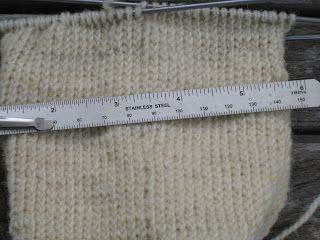
A sock for my gardening sandals knit from MacAusland 2-ply and
knit in Eastern Cross Stitch. The fabric is discolored
because of the polishing compound used as the
needle design evolves. It will wash out,
and they will get worn in the mud anyway.
because of the polishing compound used as the
needle design evolves. It will wash out,
and they will get worn in the mud anyway.
You cannot tell form the picture, but it really is a soft, thick fabric with great cushion. It is NOT as weatherproof as uncrossed knitting, but it is thicker, and has more cushion, and it feels softer. I think the fact that it is not as weatherproof as plain knitting is one of the reasons that I never put the energy into working out a production technique.
I am a bit chagrined to realize that for the first time, I am actually making (pointy) needles for my Shetland knitting belt - previously, I just used what ever needles were available. Now, I am starting to understand the wonderful nuances of the Shetland tool kit. Like all good tool kits, it is not as simple as it looks.
There are hints that before knitters on the Shetland Islands made lace for England, they (illicitly) knit socks for the Dutch. Not Dutch farmers, but fine socks for Dutch traders to sell to the rich and powerful of Europe. It may not be true, but it would help explain their traditions of professional knitting craftsmanship when the market for lace in England opened up. I think, the Shetland knitters were already familiar with high-end knitting for the rich and powerful, when they moved into the lace market. Moving from fine socks to fine lace could be done without changing the tool kit. I read about the Shetland- Dutch sock trade years ago, but had never thought through the implications - e.g., that a knitting belt and making pins are the right tools for very fine socks. That is, socks that is the socks were knit in Eastern Crossed Stitch. I suggest right here and now that knitting the best socks and the best lace take the same level of knitting skill. (I am not talking about socks for farmers and gardeners!)
To misquote a Diva that we all know: Respect the Shetland Knitting belt.


.jpg)