All knit fabrics can be replicated by nalbinding. This is controlled by natural laws as deep and wide as the more commonly known Newton's laws of motion. Therefore nalbinding a replica of an object says nothing about whether the original was made by knitting or nalbinding.
On the other hand, knitting is faster. It may be that an object may be practical to use and wear out when it is quickly knit, but when made by nalbinding the object is too valuable and precious to be subjected to the wear of routine use.
Thus, I "knit" my boot socks. It takes me 20 hours to knit a pair, or 15 hours to swave a
pair. I could produce the same pair of socks by nalbinding, but it would take twice as long, and be less uniform and consistent. As practical objects, subject to wear and abuse, I want to invest an minimum amount of time in each pair of socks, and I knit or swave my socks. Therefore there is a purpose, and a value to knitting.
I like the Eastern Crossed Stitch (ECS) for sock fabric. However, while ECS can in theory be swaved, as a practical matter, this fabric must be knit. Just because a fabric can be knit in theory does not mean that it can be knit with the wrong tools or without specific tools and techniques. One certainly cannot walk into to modern LYS and purchase the tools required to rapidly produce ECS. That does not mean that such tools do not exist and were not not known to professional knitters in the past. It only means that such tools are not common today.
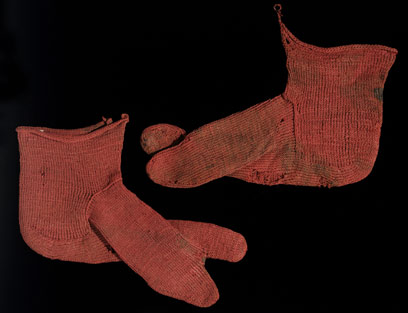
DK Burham replicated objects using nalbinding. Every person familiar with nalbinding knew that could be done, so Burham's work is interesting, but it provides no useful information. Certainly nalbinding is suitable for luxury objects, or objects of ritual or ceremonial use. Economic constraints constraints of whether nalbinding was economically practical for objects subject to wear were not considered, but we know that the socks were subject to practical use and were in need of repair. Thus, we can guess that the socks were not luxury, ritual, or ceremonial; and, economics did play a role in the choice of fabrication method.
Moreover, if the socks were substantially knit from short pieces of loom warm waste, then the Coptic Socks may contain individual stitches that are neither typical knitting or typical nalbinding, but which are simply the result of repair of dropped stitches or darning/weaving in ends at a break in the yarn. Before I started swatching these ECS fabrics, I did think that 3 of these stitches indicated that the fabric was nalbinding. However, as I look back over my knit ECS swatchs, I do see similar stitches in my knit ECS work. This was something that I could only discover by knitting ECS. I did not settle any question, except that ECS makes great socks.
Over all, I am highly amused that so many people are so passionate in favor of a flawed analysis that provides so little information.
On the other hand, knitting is faster. It may be that an object may be practical to use and wear out when it is quickly knit, but when made by nalbinding the object is too valuable and precious to be subjected to the wear of routine use.
Thus, I "knit" my boot socks. It takes me 20 hours to knit a pair, or 15 hours to swave a
pair. I could produce the same pair of socks by nalbinding, but it would take twice as long, and be less uniform and consistent. As practical objects, subject to wear and abuse, I want to invest an minimum amount of time in each pair of socks, and I knit or swave my socks. Therefore there is a purpose, and a value to knitting.
I like the Eastern Crossed Stitch (ECS) for sock fabric. However, while ECS can in theory be swaved, as a practical matter, this fabric must be knit. Just because a fabric can be knit in theory does not mean that it can be knit with the wrong tools or without specific tools and techniques. One certainly cannot walk into to modern LYS and purchase the tools required to rapidly produce ECS. That does not mean that such tools do not exist and were not not known to professional knitters in the past. It only means that such tools are not common today.
DK Burham replicated objects using nalbinding. Every person familiar with nalbinding knew that could be done, so Burham's work is interesting, but it provides no useful information. Certainly nalbinding is suitable for luxury objects, or objects of ritual or ceremonial use. Economic constraints constraints of whether nalbinding was economically practical for objects subject to wear were not considered, but we know that the socks were subject to practical use and were in need of repair. Thus, we can guess that the socks were not luxury, ritual, or ceremonial; and, economics did play a role in the choice of fabrication method.
Moreover, if the socks were substantially knit from short pieces of loom warm waste, then the Coptic Socks may contain individual stitches that are neither typical knitting or typical nalbinding, but which are simply the result of repair of dropped stitches or darning/weaving in ends at a break in the yarn. Before I started swatching these ECS fabrics, I did think that 3 of these stitches indicated that the fabric was nalbinding. However, as I look back over my knit ECS swatchs, I do see similar stitches in my knit ECS work. This was something that I could only discover by knitting ECS. I did not settle any question, except that ECS makes great socks.
Over all, I am highly amused that so many people are so passionate in favor of a flawed analysis that provides so little information.




.jpg)