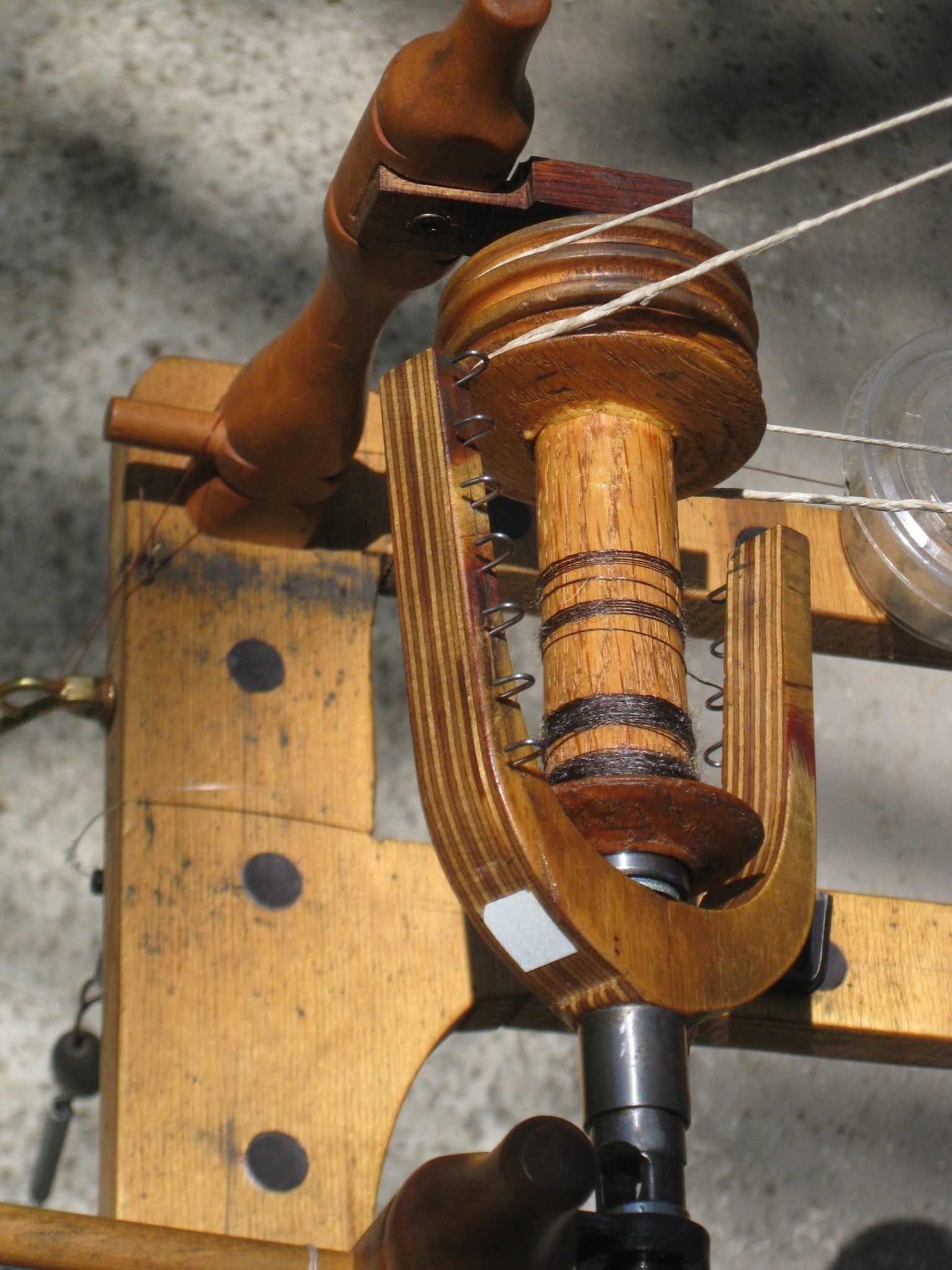
Showing posts with label handspun sock yarn. Show all posts

Thursday, July 29, 2021

Sock fabric!

Elastic, durable, good moisture control, with minimum bulk

Early last spring, I set a goal of learning to knit "sock fabric". I wanted the fabrics of  Gladys Thompson's Sheringham ganseys and  Weldon's various gentleman's socks. These fabrics were knit from 4-ply Scotch Fingering Yarns. Paton's Beehive, was a commercial example, with samples still available. I also had samples of Froelich Wolle Special Blauband, which is also a 4-ply fingering yarn. It was clear to  me that 4-ply fingering was a fairly common kind of yarn - that at one time was commonly handspun.  

The modern Paton's BeeHive is synthetic and the Blauband contains 15% nylon. I like wool yarns, so after looking around, it seemed that I would have to become competent at spinning "sock yarn". I played with various forms of 3-ply (1680 ypp) and even made 6-ply versions, also ~ 1680 ypp, and decided, I wanted good,  4-ply fingering. Such yarns are based on 20s. (singles with 20 hanks of 560 yards /pound)

I could spin worsted 10s (5,600 ypp singles), so I did not fear 20s, but knew they would take some practice to spin on a production basis.

First I needed to do some spinning from the stash.


As excavated from stash. It is a colored (silver-brown, sepia) Cotswold-cross
 with a spin with a spin count under 40s. I bought it for a gansey for myself, but my 
wife tells me it is the wrong color - so it is promoted to socks. It should be a durable as nylon, 
but with all the virtues of wool.
First pass on combing

First bird's nest for this project.
 It needs better planking.

First spinning trial. Grist should be ~11,000 ypp (e.g., 20s). 
At this grist it spins very fast  and easy.  By the
time I write this, I have several bobbins of singles wound off
 and ready  to start plying.
-----------------------
Repeat for every large bin in the stash. No blending - each single is from one fleece. Often the yarns would be marled, plied up from yarns spun from different fleece.  Except for the navy-blue Romney, all fiber was undyed.
--------------------
Also, there was a reality check - did I really hate yarn from this fleece spun as 10s, and plied up in 1,600 ypp 3-ply?  Mostly, I had 10s spun, and it was just a matter of plying and knitting a swatch. Ya, I wanted 4-ply fingering.
----------------
With the exception of a coarse gray Cotswold,  I liked the 4-ply 2,500 ypp better than the 3-ply 1,600 ypp.  The surprise was one of the coarser Rambouillet fleece. It was surprisingly hard to spin as 20s.

I settled on the singles being worsted (Z) spun ~12,00 ypp at 17 tpi. The yarn was S plied at 12 tpi. A hank of 560 yards is ~ 23 grams,  which can easily spun on my DRS system. Length is lost to twist in plying, so a hank of 4-ply is ~500 yards/ 90 grams.  However, I lose good control of twist after ~ 40 grams, so I ply the finished yarn an ounce at a time. Commercial 4-fingering was traditionally sold in 1 ounce balls, so I do not feel too bad. I do feel these yarns are real sock yarn with good abrasion resistance, elasticity, and moisture control when knit on 1.3 mm needles at ~ 12 spi and 20 rpi. I like these fabrics - a lot. I find them worth the effort.

I sampled six fleece, and  spun a worsted 20s from each. These were plied to produce 2 marled and 2 single fleece yarns with grist between 2,000 ypp and 2,500. These were knit into a chain of swatches on 1.3 mm needles. The Cotswold swatch was finished with about 3/4" knit on 1.0 mm needles in deference to Gladys Thompson's description of Sheringham ganseys. In the photograph, a 1.3 mm sock needle is  above the bit knit with finer needles.   When knit on 1 mm needles that  4-ply fingering spun from Cotswold  is weatherproof. Such knitting is a hell of a lot of work.  As plain knitting, it has very limited elasticity, so it needs a stitch  pattern to give it elasticity and wearing ease.   On the other hand, imagine an 8-ounce "gansey" that is weatherproof! That is real magic! Something like that would be worth spending 10 weeks knitting.  (Frankly, I would use a finer wool to spin 23s or 25s, if I was going to knit on 1mm needles, but I have bouts of "crazy"! )


4 samples from different handspun 4-ply finger fingering yarns.
Gauge is about 12 spi by 20 rpi. ( ~240 stitches/ inch^2).
The long needles are 1.0 mm, the short sock needles are 1.3 mm.
These days I hang a small weight from the bottom of the knitting sheath
to provide better balance.


I am not sure why, but the spinning went a lot faster than I expected. Current theory is that when inserting more twist, I spin the wheel faster, so I am drafting about the same speed I would if spinning 10s. I know this project put a lot of wear on the drive bands, and they need to be replaced sooner than I expected.

Sorry about the pix quality-  I was up on Mt. Brionies, slipped in the dust, and came down hard on my phone.


Saturday, July 17, 2021

Spinning and Swatching like a demon

 What I really want  is a "gardening gansey". Something like a "rugby jersey" but in finely knit wool.  The fabric should be like sock fabric - elastic, durable, and able to handle moisture - cotton rugby jerseys fail at the moisture control criteria.

My old ganseys are really too warm for the current climate and resulting garden chores. (We no longer own an apple orchard in Northern Pennsylvania.) One gansey was knit to the criteria of defending me from thorns as I pruned roses in the winter rains.  In these dryer times we gave up roses. 

Anyway, in experimental spinning for weaving, I spun bins of yarn in the ~ 7 thousand ypp range. Some white, some blue. Swatching tells me that those singles as 3-ply yarn (~2,000 ypp)  make a nice sock yarn, which when knit on 1.5 mm needles make nice fabric, that I think would be good for walking socks or a gardening gansey.  In the past, I knit "boot socks" from 5-ply gansey yarn (1,000 ypp). I did not really think about finer sock fabrics - I was focused on the issue of "How warm can knit wool be?"

This is a major change in paradigm. As I get older, I am less likely to go up into the snowy Sierras and more likely to just walk up Mt. Brionies - a pleasant 2-hour walk if I take the short cut.   It is past time to recognize that there is less snow in the Sierras.  On the other hand, wool boot socks do still feel good on the cold tile kitchen floor on a winter's morning, when I come down to make breakfast. I have 75 pair of good wool boot socks - enough to keep my feet warm while I cook thousands of pots of steel cut oats. 

No, that 3-ply yarn will not be a durable as 4-ply from 11,200 ypp singles. However, that 3-ply  yarn by virtue of its coarser fiber will be more durable than commercial yarns such as  Special Blauban or BeeHive.  And I have those singles on hand and I can ply enough yarn for a gansey in a morning. (I knit swatches from the 4 samples the yarn I already made.)  I will not be off at sea - if a part of the gansey gets worn, I can reknit it.  I have more of those fibers, I can always spin more yarn to match.  And, a fabric knit from 2,000 ypp yarn is just right for Mt. Brionies in any season.

To get here, I had to stop thinking in terms of  modern patterns that use commercially available yarns.

I had to swatch until I found a combination of  yarn and needles that produced a fabric that was well suited to the intended purpose. I had to revert to Knitting in the Old Way as in the book by Priscilla Gibson-Roberts and Deborah Robson. (I do not sell anything these days, but I am honest about what works for me.) Knitting in the Old Way was the key that unlocked Gladys Thompson for me.  I think, the process of swatching yarn as spun and the processes in Knitting in the Old Way produce good sweaters. 

Mostly, ganseys are knit to fit. This makes them warmer for their weight, and it means less knitting - faster production.  Knit to fit, these firm fabrics need pattern stitches to provide extra ease for movement. Sure, you can just run vertical ribs from top to bottom, but that is more work, makes a heavier garment, and not as warm as panels of plain knitting. The Sheringham ganseys have moss and chevron patterns across the chest for extra ease. I also like some of the chest patterns in Mary Wright's, Cornish Guernseys & Knit-frocks. Many of Cornish patterns are similar to the Yorkshire patterns in Gladys Thompson. I expect they were knit for men doing the same kind of jobs in the same climates. 

I have said it before,  "A sweater is only a sweater, but a sweater with matching gloves, socks, hat and muffler is an outfit."  And, gloves, socks, hats and mufflers make very good swatches.  I tend to use Mary Thomas's Knitting Book as guidance on these objects, particularly gloves. Except for gloves, I tend to knit on longer needles.   For glove fingers, I often use shorter "sock needles".  There was a time when I had special very short glove needles, but now I knit everything with a knitting sheath, and all needles are at least 5" long, and mostly steel.  If I must knit soft gloves on big needles (e.g., US2) I use 6" wooden needles because they lighter, less slippery, and less likely to fall out when held by only a few stitches on one side of a finger. 

Like a good little demon, I did recently knit Froehlich Wolle Blauband and Paton's Beehive on the recommended US2 needles. I still hate that fabric. 3-ply,  2,100 ypp yarn knit on US2, is enough firmer to make a reasonable glove fabric - better than those damned, old worthless knit  Army mitten liners!

It is time for me to transition from spinning and knitting objects that prove how warm knit wool can be to spinning and knitting objects better suited to the modern climate. Yes, the finer 20s (11,200 ypp singles) are 40% slower to spin than the warmer 10s, (5,600 ypp singles) but I can still spin them at over 300 yards per hour.  I can still spin/ply a hank (500 yards) of 4-ply sock yarn in a day. 

There is a couple hundred pounds of fiber stash in the house, ranging from Lincoln to Rambouillet, with a lot of Cotswold and Romney in between. At some point, I have spun hanks from each of those bins as 20s, 30s, & 40s. I have spun 40s (22,400 ypp) from the Romney. There is a bunch of  Heinz 57 from the Woolery, and I have spun 54s (30,240 ypp) from that  (sorry, it is not a 57s grade fiber) and there is the Rambouillet from Anna Harvey (https://www.annagotwool.com/) from which I have spun hanks of 560 yards that weighed less than 6 grams e.g., ~ 45,000 ypp). (A small part of a large fleece. Other sections of the fleece spun at closer to 40,000 ypp.)  The real lesson of that evolution was that hanks of fine singles must be tied very carefully, or they will tangle. Alden never worked with such fine threads, so his advice on tying skeins of fine singles is - understated. Some of those skeins tangled, and I called them, "My little shits". From that, many spinners assumed that I could not spin fine. No, I could spin fine, but I had a learning curve on tying hanks of 45,000 ypp singles so they could be handled.

The fiber you have on hand can likely be spun in to 22,400 ypp singles or any lower grist. Finer fibers like Shetland can be spun into 30,000 ypp singles. Merino and Rambouillet can be spun into 40,000 ypp singles.  Mostly, the fiber is not the problem.  Any fiber you buy in a retail store selling spinning supplies can be spun into 22,400 ypp singles.

I think all the books on spinning for knitting, fail to properly discuss plying. Alden fails to talk about using a tension box to facilitate plying.  Great knitting yarns are spun rather fine, then plied to a useful grist. A tension box is essential for smooth, easy, consistent plying.  With a tension box, 5-ply or 10-ply yarns are  easy. Without a tension box, consistent plying is difficult.   With thicker singles (10s) I can ply from center-pull cakes. For sock yarn with finer singles, I ply from bobbins. I think all plied yarns need to be steam blocked.  Steam blocking results in a much better yarn (knitting or weaving). 

And when I buy commercial combed top or roving, I steam it prior to combing. Yes, I comb, diz, and plank and diz commercial combed top. The top is wound into birds nests, then carefully transferred to the distaff for spinning. Fiber that sits as bird nests for a few weeks gets recombed.  And, that is some how I spin finer than most hand spinners.  


Monday, April 26, 2021

Handspun Sock Yarn

 I returned to knitting in 1999. I started working on how to hand knit objects well suited to keeping fisherman warm on a square-rigged ship, wooden ship.  My path included learning to hand spin the kind of yarns used to hand knit objects which could supply the exceptional warmth needed to sail then through storms rather than around storms. I skipped a lot of other basic skills, including socks/sock  yarns for urban environments.

 In pursuit of warmth, I tried all kinds of yarns, and settled on "gansey" yarn as being a very good yarn for activites away from centrally heated environments.  Sailing, snow camping, sheep herding, duck hunting, skiing, and pruning fruit trees in the winter are all activities that can be better enjoyed wearing objects well knit from a good gansey yarn.

The best gansey yarns that I found were the British worsted spun 5-ply, 1,000 ypp yarns made in old mills. By 2004, it was clear that those old mills were disapearing, and I needed to find alternate yarns.  I set about learning to spin. It took me 4 or 5 years before I could produce yarns that experienced knitters and spinners could not tell from the commercial products from Britain. It took me a couple more years before I could produce those yarns fast enough that they could be a useful knitting yarn rather than a spinning tour de force. 

In the period 2011 to 2020, my normal knitting yarn was some hand spun variation of those yarns. My favorite needles were 2.3 mm spring steel. Certainly, there was a lot of experimentation with finer yarns, often toward 6-ply (3x2-ply cable) 1,700 ypp yarns. These competed with various yarns such as   4-ply Lion Brand Beehive and British Breeds Goosewing yarns, various Blauband, and my hand spun replicas of those yarns. Over the last couple of years, my  projects have moved from gansey yarns to finer yarns knit on 1.6 mm needles.   While the winter socks I knit fall in 2020 were still 5 and 6-ply yarns at 1,000 and 840 ypp knit on 2.3 mm needles, today all my knitting projects seem to be 6-ply cabled 1,700 ypp knit on 1.63 mm steel needles. I have fallen in love with this 6-ply cabled sock yarn for everything. However, I still pronounce "swatch" as "sock". 


Stuff related to Sock yarn project; socks, finished and tested, socks in progress with tools, and more yarn in progress.  Sometimes, I need a magnifier for this project. Gauge on the socks is 12-spi x 14-rpi. Needles are all 1.6 mm = ~US 000. 

Lion Brand Beehive and British Breeds Goosewing have more 'fill', so objects knit from my 6-ply sock yarn have very different behavior and performance.  I am struggling with which yarn structures are better for which purposes. I am working this out prior to sampling a lot of 12-ply sock yarn. (e.g., I am knitting my stash  of 6-ply cabled 1,700 ypp yarns, ) The knitting bag now holds 1.5mm  needles and their knitting sheathes, and cakes of 6-ply sock yarn, before I spin a bunch of 22,000 ypp singles. A bunch of  exotic sock and glove yarns have been banished to file drawer with a layer of bay leaves.  That hand-spun Irish glove yarn that seems so fine and sophisticated when I bought it in Scotland circa 2004, now seems coarse and pretentious.  Bobbins of 11,200 ypp singles are queued up on the  tension box - I have some knitting to do.

The grist of  my sock yarn is not really that different from "Jumper yarn" used in Fair Isle knitting so knitting a sweater from "sock yarn" is not that outrageous. I knit ~120 to 140 stitches per square inch.  And speaking of yarn from the Islands, let us remember that in 1790, Shetland wool was [hand] spun and knitted fine enough that both (together) of the knee-high socks hand knit from hand-spun Shetland wool produced as a gift for the English King would pass through a lady's wedding ring. In this context, what I spin is only coarse stuff, but I practice in hope of doing better. I have been to his Castle, and it is a cold and drafty place (even with modern central heat), and I would rather wear my socks - even in summer, and even if they are thicker.


 I find that my handspun yarn produces warmer and more durable fabrics, than  commercial sock yarn sold retail,  or BeeHive, or Goosewing yarns I can buy.   Sock yarns and jumper yarns from commercial mills sold through retail yarn shops ARE likely to produce softer objects than I knit from my hand spun yarns, but I do not find the commercial yarns durable enough to be worth putting the effort into knitting those yarns on fine needles.  I find fine spinning is faster and more rewarding than re-knitting - fine objects.

Twist holds yarn together, and fine plies can take more twist than coarse plies. Twist is expensive. Energy to produce twist is traditionally the largest single cost of a wool yarn mill. Putting less twist into yarn means lower cost of production, and making a yarn that can be sold cheaper. On the other hand, it is faster for me to put more twist into my yarns than to reknit the objects.

I can produce a 2-ply, worsted spun yarn at 2,500 ypp or 3-ply at 1,700 ypp, but by the time they are spun and knit tight enough (on US 000 needles) to be a good durable sock yarn, the fabric is unpleasant.  However, I find that if I spin 11,200 ypp singles, ply into 2-ply, then make 3x2-ply cable, at ~ 1,700 ypp)  I can knit that on those 1.5 mm needles to make dense, cushioning, durable sock yarn. I love it.  I do not say it is fast or easy, I say it is a nice sock yarn. 

Yes, knitting at 12 spi and 14 rpi  may seem a bit tedious, but that is why I put 19-years into learning to use a knitting sheath. And, no, I am not done learning how to use a knitting sheath. In the last few months, I have learned a good bit about the shaping of knitting needle tips for different kinds of knitting. Horses for courses. 

Yes, my current sock yarn takes passing 8 yards of yarn through the wheel for every yard of  finished yarn.   Yes, I block 2 yards of  yarn for every yard of finished yarn. Moving to a 12-ply based on 22,400 ypp singles does not change the final grist. The final texture really depends on the ply configuration, ply twist, and cable twist. Knitting effort should not change. These are things to cogitate on and sample as I knit my current sock yarn. Spinning twice as many singles raises spinning effort by ~40%.  Considering total effort on the object including knitting effort, that does not significantly change the total effort to produce the object.  It is worth while to expend 4% more effort to get 10% ?? more quality.