Friday, September 30, 2011

quick kniddy noddy

Not a love token 

but it works, it fits in the spinning bag,
and it was not much effort.


Note that the ends are different.  If I ever need to make another, I will know which shapes work better.

Wednesday, September 28, 2011

DRS, fineness, and vibration

Vibration in a DD system raises the effective DRS, making it more difficult to spin at the fineness expected from the calculated DRS.

Surprise!  If you want to spin fine, you need a smooth-running spinning wheel.

After a year of use, my Traddy had some wear, and hence more vibration.  And, I swear, I oiled it every 4 hours using good oil.  On the other hand, I ran it long and fast.  Nice thing about a Traddy is that new bearings are inexpensive.  A few new bearings and everything is back to fast and smooth.

Saturday, September 24, 2011

Plying from a center-pull cake

With improvised cake holders, the singles twist.  Better is:


Thursday, September 22, 2011

Lambtown

I will be at Lambtown in Dixon, Ca this year.  I will be helping around the Merdian Jacob booth.

I am in the wood shop this week, so the Traddy will be tricked out. The "F-word" may be heard as in, "That is f^&*hair!!"

Wednesday, September 21, 2011

DRS Revisited

I have been plying yarn for my Shetland gansey.  Some of the singles were spun last winter before I built the Hot Rod and some after. 


Running the singles through my fingers, I am impressed by the consistent fineness of the singles spun using the Ashford high speed whorl and bobbins with whorls that provide the proper DRS (differential rotation speed) for the grist of yarn being spun.  While the Hot Rod certainly allows me to spin faster, singles spun on it tend to drift in thickness.  For example, singles that I intend to be ~9,000 ypp end up with portions being closer to 7,000 ypp or 11,000 ypp.  I think this is because with the small whorls, a small change in anything changes the DRS.  While the standard Ashford high speed whorl is twice as large, so the same change in that system makes only half as much change in its DRS. 


Anyway, I am going to move toward larger whorls so that I have better control of my  DRS.  I have not decided if I am going to do that by putting an accelerator wheel on the Traddy or if I will buy a 30 inch wheel.  


Most of last week, I had the Ashford Lace Flier (ST) on the wheel.  First and foremost, I do not think that there is any question that a good bumpless driveband (per Amos) delivers more power than the Ashford Turbo driveband (clear stretchy plastic).  2)  Fluorocarbon leader material (fishing line) makes very good brake band material for spinning very fine yarns. 


As long as we are talking about spinning fine, see the Bothwell Spining results at http://www.bothwellspinin.com/spinin/files/LongestThreadResults_2011l.pdf   The winners are spinning singles up in the range of 100,000 ypp or 176 hanks/ lb. The winner, Jan Zandbelt, currently uses a Louet Julia, but in 2007, he used a Majacraft Suzie with 1 gram of brake tension and custom made ultra-light weight spinning bobbins.  Of course, that contradicts my thoughts about DD being better for spinning fine.  Or, does it?


I do not spin that fine.  I do not try to spin that fine.  I do not need singles finer than about 27,000 ypp.  I aim to spin my finest singles at ~90% of  their spinning count.  Thus, Polwarth has a spinning count of ~ 62, so I would aim to spin it at ~ 31,000 ypp.  Zandbelt spins it at 88,400 ypp.


Does that invalidate everything that I say?  I want yarns that knit up into fabrics that I like, and I want to produce those yarns with a minimum of effort. Zandbelt wants thin yarn for contests. He says that "Patience"  is important.  We have different goals.   


However, I am arrogant enough to think that if I wanted to spin Polwarth  into a yarn that was too fragile for any practical use, I could.   I would approach the problem by making up a DD spinning bobbin with a DRS of 1.01 and a bobbin core diameter of 0.625".  I think that for that low a DRS, I would use the regular Ashford DD flier whorl, which gives me a bobbin whorl diameter of 1.73". We are talking a bobbin speed of 1,200 RPM.  My bobbin has not gone that slow in ages.  It would take all weekend to spin 10 grams. "Patience" is right. 

Thursday, September 15, 2011

The hot rod spinning wheel revisited

In May, I wrote about how I had upgraded my Ashford Traditional spinning wheel.
Since then I have spun a lot of singles in the 5,600 to 9,000 ypp range on it and I have some thoughts.

The DRS (differential rotation speed) between the flier and the bobbin controls the twist.  The accumulated twist changes as the diameter of the copp wound onto the  bobbin changes.  Thus, when I have accumulated a layer of yarn that is ~ 3/8"  thick on the bobbin, I wind off.  This is a pain in the neck.  I use my wood lathe as a bobbin winder to wind off the bobbin. (It is very fast, and is always handy there in the middle of the workshop.)   Without a good wind off approach (or using very long bobbins) using DRS to control twist is not practical.

There has been more wear on the bearings and axles than I expected.  I oil frequently, but I use a high belt tension, and there is a lot of wear. Thus, the machine is getting noisy.

Over the last few days, I swapped it back to standard Ashford double drive and spun a while.  Currently the Ashford Lace Flier is on the wheel. The Ashford Lace Flier is 30:1 ST, but compared to the 40:1 DD, the ST lace flier is much slower.   Spinning on the Ashford Lace Flier is a very pleasant pastime, but it is SLOW!    

With a larger drive wheel (30"), I could use a lower belt tension and with less noise and wear.  : )

Tuesday, September 13, 2011

Carding and Spinning Oil

I just posted that fleece needs to be clean before it can be processed.  That is true, it needs to be clean so that it drops all of the grit that was on it.

It also needs oil for carding and spinning.  I use olive oil at a rate of between 1% and 2% by weight. That is, if I have 4 ounces (112 gram) of clean wool to card/ spin, I add a couple of grams (~  less than 1/2teaspoon) of olive oil.

I have it in one of those oil misters that are sold in gourmet shops, and clean samples of wool going into the carder for the first time gets a squirt on each side. Everything goes through the carder several times.  Bats that feel dry either get carded together with bats that seem to have extra oil them, or dry bats get an extra squirt.

Big bins of wool get weighted amounts of oil, so that amount is more precise. Then they get mixed, sit in a warm place for a day, and get mixed again.  As the bats get blended the oil is evenly distributed through the wool.

"Vegetable oil" will oxidize, get sticky, and turn your fiber into a spinner's torment. Do not go there. Mineral oil is hard to clean off the yarn.  Either use the right oil, or do not oil.

Clean wool with a tiny amount of olive oil on it is the easy way to card, comb, and spin.

Spinning and knitting in the Grease

One of the great romantic fables of spinning and knitting is that fisherman's sweaters spun and knit in the "grease" are warmer and more weatherproof.

The best fisherman's sweaters were scoured, spun, and knit.  Many were also dyed, which provided several advantages, but for a good dye job, the wool had to be scoured.

Unscoured wool has a film of waxy material on it, that holds grit. The variable amounts of grit held in that waxy material makes consistent spinning difficult.  The grit on the fiber causes wear on the spinning equipment.  Inconsistent spinning, produces a variable yarn, which is impossible to knit into a consistently tight fabric. Clean wool is easier to card.  Grease wool is impossible to comb, and combing is a part of producing the worsted style yarns for high quality fisherman/seaman sweaters.   And, lets put it this way, "The scouring process kills lots of germs."  Besides, "Clean wool smells better when you do get rained on!"

Then, the grit trapped in the yarn as it is spun, is a constant source of wear, reducing the durability of the garment.  Grease wool/yarn/fabrics also attracts moths. Clean wool lasts longer.

Some low lanolin wools such as Shetland and Jacob, can be rinsed, and spun with success but the quality of the yarn, and hence the quality of the knitting is not as high as when clean wool is used. Some talk about spinning the long wools in the grease.  It is possible, but you still have the grit. While it is possible to spin beautiful yarns from grease wool, it is easier to spin better yarn from clean wool.  See Alden Amos Big Book of Hand spinning pg 44 - 45.  Judith MacKenzie  McCuin in the Intentional spinner ( pg 28) first says ". . . wool must be washed or scoured before it can be processed efficiently." Then, she waffles to talk about washing wool without removing its natural oils.  I do not waffle.  As long as that waxy layer is on the fibers, grit will stick to it, and will get trapped in the yarn as it is spun. Thus, if you leave the natural oils on the fibers, grit will be there to spoil your spinning.

Scoured wool can be "reoiled", to be weatherproof.  Jan at Frangipani recommends using a drop of baby oil in the rinse water. This is fast, inexpensive, and effective.  I put one drop of lavender oil into my bottles of baby oil for a little extra moth protection.  Dyed wool can be reoiled to be even more weatherproof.  Perhaps the best way to "oil" a sweater for serious outdoor wear is to fry bacon over a camp fire.  The combination of wood smoke and bacon fat does a very good job of oiling a sweater.

Wool can be scoured by letting it sit in cold water for a few days (fermented suint method), rinsing, and then treating with lye soap (followed by a careful rinse).   Or, the Romans cleaned their wool in aged urine (followed by a careful rinse!)   If you can get to a modern market, then modern soaps and detergents make cleaning wool easy.  (Umm, if you use Simple Green, make sure it is diluted and mixed before the wool goes in.)

The investment of time and effort in scouring wool pays off in faster and better spinning.

The first three rules of fast and easy spinning are:
Fiber preparation!
Fiber preparation!
Fiber preparation!

A day of fiber preparation can save 3 days of spinning (if you are spinning fine.)

If you can heat a cauldron of wool to over 120 F, you can skim the "wool fat" off to reoil the wool, after it is all knit. Then, it will smell all "sheepy" and everybody will think that you spun it in the grease, when in fact you spun it the easy way. (Or, you can just buy a little bit of "wool fat" from iriss http://www.iriss.co.uk/product.php?xProd=309&xSec=27.)


Sunday, September 11, 2011

How it was done

I look at  old knitting sheaths, and I ask, why did they do it like that?

For example look at this photo of  various knitting sheaths (http://knittingsexandgod.blogspot.com/2010/01/more-on-spinning.html) and note that a number of the knitting sheaths on the right hand side were made of two pieces of wood.  One carved, the other one turned and inserted into the carved piece with tenon joint.

Certainly many of the older "love toke" knitting sheaths were carved from single piece of wood.  Many of my early sheaths were carved from a single piece of wood and I went to a lot of effort to turn the needle adapter.

However,  last week, my wife had a new red wood fence put around the back yard and the work men left me a lot of little pieces of red wood.  It is a nice light weight, attractive wood, that is very easy to work. So I made some knitting sheaths.


They are both designed to tuck into the elastic waist band of sweat pants or shorts. They work very well with 7.5 inch #1 DPN.  The soft wood is strong enough when the tenon joint is glued.  If you use a friction joint so that that needle adapters are interchangeable, then the softer wood tends to crack at the joint.

Mostly, I have been using 9" needles with spring action for sock knitting for the year or so,  but these little knitting sheaths do not provide enough resistance to support the spring action, so these little knitting sheaths need a different motion. That is OK, the motion is driven by the shoulder muscles, and there is still no stress on the hand. It is almost as fast as the spring action. Made from red wood, the knitting sheaths are light and handy, and the shorter needles are better for knitting bags and travel. I find it worth while to keep this technique in practice.

When you are making knitting sheaths, this is a concept that you may want to consider as the soft wood makes fabrication fast and easy, and they seem to last.  The needle adapter in the top photo was turned from a bit of ash limb that I had to prune off to make way for the fence.   Turning green wood, can be a very fast and easy process.

The bobbins that I make are not as robust as the plywood bobbins that I get from Ashford.  Mine show a disconcerting attraction to concrete floors. Thus, I have had  several opportunities to think about making bobbins. 


These are DD spinning bobbins, that provide a 40:1 ratio on my Ashford Traditional, with a DRS of ~1.01, and a core diameter of 0.625" they are optimized for spinning 16 hanks per pound. The singles on those bobbins is a Shetland - Jacob blend spun to ~9,000 ypp.


I have moved to making the cores and whorls from one piece of black walnut stock. As you can see, there have been trials along the way.


I make the end disks from cherry. And, I like bronze bearing insets better than the Ashford Delrin bearing insets.  The Delrin is far and away the better bearing material and they are lighter.  However, the Ashford bearing inserts have little spacing collars, and with my small core diameter and small whorls, I just do not have enough clearance for the spacing collars on the Delrin bearings.  

My current process for making a spinning bobbin is to bore a straight hole through the core blank.  I use the ends of that hole center the blank as I turn the core/whorl.  The bobbin core blank needs to be straight and smooth to fit the holes that will be bored in bobbin-end blanks.

I scribe a ~3" circle on some 3/4" cherry stock, drill a 1/16" hole through the center of the circle and cut the blank on the band saw.  I use a spur drive on the wood lathe to turn the blank round and part it into 2 pieces.  Each bobbin end piece goes into the lath chuck and I bore the center of the blank to fit the bobbin core blank.  I glue the bobbin ends on to the core.  I turn the final shape of the bobbin ends and the whorl on the wood lathe. The bronze bearings are held in place with a dab of  E 6000 industrial adhesive.

Thursday, September 08, 2011

Re: anonymice

Scientists ask questions, and then seek the answers.  Time and budget are always a constraint.  One cannot ask all possible questions, and one cannot seek all possible answers.  Some questions require data that provides a high level confidence, while lower quality data is acceptable for other questions. Technology is even more focused.  Good technology must meet the criteria of: faster, better, & cheaper.

In 1999, I asked the question, "How did the fishermen on the banks stay warm"  The bulk of the answer is that they (or their knitter) used DPN and knitting sheaths to knit substantially weatherproof woolen fabrics.  These fabrics were used in single and multiple layers with woven wool and other woven fabrics.  However, the real magic was in hand knit fabrics with stitch patterns that increased the warmth of the fabric.  The question is as much technology as science.  I understood this by early 2007, see http://gansey.blogspot.com/2007/03/real-ganseys-are-real-warm.html  Work since then is just refining the technology,   as in:


An inexpensive, but very functional knitting sheath
 designed to be tucked into an elastic pant waist

And it is not like we are starting from scratch.  We have a lot of information about ships, climate, fishing, physiology, textile performance, textile industry economics and so forth.  It is more like we have a "blue print" of an industrial machine and the blue print has some holes in it.  We need to go back and reverse engineer the missing parts so everything works together.

I have documented that such fabrics are weatherproof (i.e., will support a pool of water on them for an extended period of time.)  I have worn these garments skiing, sailing, climbing, mountaineering, and working in freezing rain.  Such garments are exceptionally warm even when compared with the best from modern sporting goods companies such as Columbia, Patagonia, Marmot, and LL Bean.  If the skeptic does not believe, then the proper thing to do is say, " I want to test those garments."  Yes, we can make arrangements for that.  We can even set up a little workshop where we knit while sailing. (An advanced skill, as most people get sea sick.  A good part of the skill is to watch the horizon, rather than your knitting.)

I knit such fabrics with DPN and knitting sheaths.  There is no question that the process is technically and ergonomically feasible. This is well documented in the literature.  There is no need to post data on a topic that is well documented. (I had to get up an experience curve to understand the technology, and I collected data as I climbed that curve.  Having data does not make that data new or useful.)

The process is slower than knitting looser fabrics, and thus the fabrics are more expensive.  However, even today, warmer garments tend to be more expensive, and thus tight knitting economically feasible.

I have documented on this blog, fabrics can be easily produced with a knitting sheath and DPN. For example I knit a good gansey in 10 days, and I am a fat old man with palsy.  If the skeptic does not believe that I knit that fast, then we can arrange to sit down together for a knitting session.  The skeptic can touch and feel the produced fabric at the same time.  I will even let the skeptic stare at a pool of water sitting on a swatch of fabric.   The skeptic can put on a gansey, lie on the floor, and I will pour water on the gansey, and she can note that she stays dry.  We can do the knitting workshop in a campground near some very cold river and the skeptic can spend the day in the cold river while wearing the gansey (15 minutes with gansey on/ 15 minutes with gansey off).  (If we pick a good cold river or a bathtub full of ice cubes, that activity will last about 17 minutes.)

Such weatherproof fabrics are difficult to produce in large quantity with SPN or circular needles because these do not provide the required leverage for packing the yarns together. Certainly a gansey or two can be done on circs, but if you have 8 brothers and need to produce 9 ganseys (dad) per year, your wrists will get sore. Again the ergonomics were established in the 1930s, so there is really no need for me to dwell on that.

What is left is technical issues of what kind of needles are best and what shapes of knitting sheaths work for different kinds of knitting. There is less of this in the literature. I mean, we have lots of shapes of knitting sheaths, but we do not know if they were different shapes with the same use or different shapes with different uses.   The truth is different shapes for different uses.   There were at least 11 different knitting techniques that used a knitting sheath.  This is a part of what I talk about in class, and if you want to know more - take the class. I have shared photographs of the knitting sheaths and needles that worked, and have written of ones that did not work.  I have provided enough data that anybody with even a passing interest can try the process without a large investment in time or effort.  Anybody with any interest can knit their own swatches and in 4 hours, be pouring water on their own swatches and timing how long it takes for the water to drain through.  The way to test another knitting technique is to try it!  You do not go looking for peer review articles on Russian Knitting, you sit down and try it, to see if it works for you!

I certainly have notebooks of data that I have not shared.  Every good researcher does. (The only exception that I can think of in an EPA directed Human Health Risk Assessment.) However, I am not going to transcribe the data just because somebody wants to look at it.  If they have a specific question, they can ask the question.  If they just want to fish, I have given enough information that they can knit their own outfit(s) and go fish.  I have a great pile of Shetland to spin.

People come to me saying that they are a researcher, and thus that I should give them my data, but they are not bringing me any data. They are what Al Dring calls, "Sponges".  A researcher can find all of the above references.  If they do not have the library skills to find the references, then they are lying about being a researcher. On the other hand, there are many people out there with good information, and they share it.  I am so grateful to those people.  If the helpful people need help finding a particular source, I will help.

I am perfectly willing to answer honest questions.  However, I do not tolerate dishonest questions.  And, when someone asks a question, I am as likely to show them how to find the answer themselves, as I am to just tell them the answer.  

Saturday, September 03, 2011

Venting again

The other thing that cannot be worked out from swatches is venting.

The very tightly knit fabrics produce a garment that is very warm.  If you knit a fabric that is suitable for 30F then as a snug sweater, then it will be too warm at 60F .  However, by providing some ease at the neck, shoulders, cuffs, and hem/welt, there will be a flow of air under the garment and out the neck.  When the body/skin is cooler, the flow is less and the skin warms.   When the skin is warmer, the flow increases  so that the wearer stays comfortable. When the ease is right, the flow of air under the garment is self-regulating, and the wearer stays comfortable over a range of temperatures.  Knit to fit.

We have heard layer, layer, layer for cold weather and have forgotten that there might be other ways of staying comfortable.  For example, layering does not really work in the upper rigging of a sail boat, because where do you stow the clothes you are putting on and taking off? Self -venting sweaters inform us as to how the sailors stayed comfortable without making extra trips down to the deck to change their layers of clothing.

Thus, one can have a ski sweater that is comfortable for skiing the steep chutes at the top of the mountain, and yet, it starts ventilating as one steps into the beer line while everyone else is still taking their layers off.

Likewise, it can be worn below decks, and there is no delay while looking for additional clothing when going on deck. (As in, "All hands on deck to shorten sail")

Looking at Knitting in the Old Way by Gibson-Roberst and Robson, this kind of venting works best with "Boat necklines" but also works with others, particularly including Button-neck closures.  (You will need a much tighter fabric than G-R & R contemplate.)  Turtle necks can actually be made vent by knitting the neck in a thinner yarn or on larger needles to produce a looser fabric that allows more air to pass through it.

With this extra ease, a jersey can be worn under these self venting sweaters.  This stops the venting. Such a layering requires exceptional cold to be comfortable. This combination can make shorts and bare feet comfortable even on rather cool days.   Other sailors stare at me, but what do I care?


Friday, September 02, 2011

The "anonymice" want to chew on the notebooks.

None of this was about science.  It was about technology.  This is the kind of technical development that most companies do, and which they keep private as trade secrets.  Go to your cell phone company, and ask to see the data on how they developed their last model.  Then, see what kind of a reception you get.  I am a nice guy. :  )

Just as the proof of the pudding is in the eating, the proof of the knitting is in the wearing. No pile of numbers can inform you as to just how warm a hand knit garment can be. The only thing that can give you the gut feeling of how warm a hand knit garment can be is to wear an ordinary knit garment in the rain until you are cold, (and I mean the kind of cold that hurts,) then while still in that cold rain, then put on a good tightly knit gansey. In a few minutes, you will understand just how warm hand knit wool can be. Numbers cannot tell you this. However, it is easy to make your own samples to touch and feel.

You can prove the effects with some cheapo metal #1 DPN and some tightly spun gansey yarn or MacAuslands. You whittle/drill a knitting sheath or stick - crude works - directions are in this blog. Total investment less than $10. Videos of the knitting process are in this blog.

Then, you knit some swatches. Do you like the firmer fabric? - that is all that counts.

Early swatches

I started by knitting tiny swatches, from 800 - 1,000 ypp yarns, very tightly on # 1 circs, and blowing air through them.  Yes, they blocked air flow and thus should be warm, but I did not see any practical way to knit such fabrics. Knitting them with circs was too hard on my wrists. The early data was crap because the fabrics were crap. It only told me that tighter was warmer, and that the relationship was not linear.  As I knit tighter and tighter, suddenly the fabric was much warmer.  The curve relating fabric density to warmth has a sharp bend in it.

 I spent months trying various combinations of long DPN to knit tighter fabrics, and mostly just poked holes in my wife's living room furniture. It was months before I figured out how to use a knitting sheath. Then, the fabrics were much better.


Second Generation Swatches

Blowing air through and pouring water on the Second Generation Swatches gave me the courage to knit some sweaters at those gauges and in those patterns.  The interesting thing to come out the second generation was that some stitch patterns were much warmer than other stitch patterns. This caused me to think incorrectly that the cable patterns were somehow connected with additional warmth.  This was clearly one point where I got things wrong.

I knit the first real gansey from the old Lion Brand Fisherman's Wool.  (The production of this yarn has been moved to China, and it is now very different!)  In those days it was 5 finely spun plies, loosely plied to together.  I knit the sweater on gansey needles with a knitting sheath in about 30 days while I was taking time off to rest my wrists from too much computer work.  This is the warmest garment that I have ever knit.  It is good for skiing on cold days and taking naps in the snow.  It was knit in white, worn and tested, then dyed blue to see if blue sweaters were warmer.  They are.  Note that this is an odd yarn.  You are not going to be able to replicate anything like this gansey because this kind of yarn is simply not available.  On the other hand, this is a very important data point for the hand spinner because it tells us that yarn structure is very important in the warmth of the fabric, and that yarn plies can rearrange themselves within the fabric structure to fill in gaps.  Such rearrangement is not possible with more tightly plied yarns.  Thus, there is more than one way to make a very warm fabric.

The second gansey was knit from MacAusland's three ply (Aran weight). It was knit on #3 steel DPN.  This I call my "gardening gansey" and has been worn until it is going thread bare and no longer has as much warmth as it had that first year.  Then it was worn while I pruned my mother's apple orchard in a week of freezing rain and wind.  The only other guys out that week we the power company's emergency linemen repairing the power lines that kept icing up and blowing down.  I still did not understand how special a tightly knit sweater could be.

One cold rainy day, I put a couple of ordinary fisherman's sweaters that we hand purchased in Canada and the two sweaters that I had knit tightly in my backpack and I went went for a long walk.  I would put on one of the commercial sweaters, and in 15 minutes, I was cold, wet, and freezing.  I would put one of my sweaters on, and in 15 minutes, I was warm, dry and comfortable.  This was an Epiphany! Numbers based on swatches did not hint at the warmth of the entire garment.  These inter-garment comparisons have been done over and over, as they are the only way to get a measure of the truth about how warm a particular garment construction is.

Moreover air flow through the fabric is a minor part of the effect.  The critical point is getting the fabric tight enough to block drops of liquid water.  Fabrics that block the movement of liquid water through the fabric are much warmer than fabrics that do not.  This is true even when it is not raining because the body produces a lot of water vapor that tends to condense on the outer surface of  clothing in cold weather.  Convention knit fabrics are so loose that these droplets tend to be redistributed back toward the skin with any motion of the fabric.  Then the droplets wet the skin or under garments (often linen or cotton, which wicks the water against the skin), the water absorbs its heat of vaporization from the skin (cooling the skin), and the water vapor moves outward through the fabric, condenses on the outer surface of the clothing, and is transported back to the skin again.  Thus, the liters of water released by the body each day can transport huge amounts of heat away from the skin because the water recirculates through the clothing system.

Laying a gansey on a table,  pouring a bottle of water on it, and having no water leak through to the table is more dramatic that any notebook full of numbers.  It says, this sweater is different from any sweater you have ever worn.  There are photographs in this blog of sweaters on the patio, with water on them.  Yes, those sweaters are different from anything that you know.  They are weatherproof.  However, seeing that a sweater is weatherproof  still does not convey how warm the garment is.  One problem is that we do not have words for the "warmth of garments" in common English, and most people do not have experience with the technical units (i.e., R value, suits).

It turns out to be very easy to knit stuff that is way too warm for ordinary use. The only people that need gear that warm are professionals - crab fishermen on the Bering Sea, electrical linemen working during an ice storm, guys installing tire chains, and so forth. Most recreational sailors, hikers, skiers, & bikers do not venture out in really bad weather.

This is hand knitting. A dab of hand lotion changes the tension and hence the warmth of the fabric. Different batches of yarn are blended from different kinds of wool and thus generate different insulation values. Nothing is standard. On the other hand the skill of the knitter allows the production of consistently warm objects.

The vagaries of hand knitting are not big deal if you just want to knit a fabric that is warm enough to keep a sailor warm. You simply test your own materials and knitting technique.  If you knit a garment that fits rather snugly, and you knit it tight enough that you can lay the swatch (or the garment) on the floor, pour a bottle of water on it, and 20 minutes later the floor is still dry, then that (swatch) garment is weatherproof and will keep a sailor warm. Another test is to hold a single layer of the fabric right in front of your eyes as you face a bright window. If you cannot see the outline of the window, then that garment is weatherproof and will keep a sailor warm. Two different tests and they both work.


Thursday, August 25, 2011

Is undyed wooI warmer than dyed wool?


Short answer: Most of the time:  No.

On a cloudy day in Ireland, the difference is detectable, with dyed being warmer.  Here in California, the difference is huge. On a cloudy night, there is little difference. On a clear cold night, then white wool is warmer.

I put a lot of effort into looking at the research on the topic a couple of years ago, and I have written about it before e.g., http://gansey.blogspot.com/2008/07/knitting-warm-woolens.html

I knit hundreds of swatches and tested their thermal properties. I started by making a little blower and blowing air through the samples and measuring air flow. I tested the samples for radiation absorption, transmission, and emission. And, I tested for conduction. I made holders (bras) for the fabric samples and compared "skin feeling". I knit entire garments in natural yarn, measured their warmth, then dyed them and remeasured their warmth. I knit similar garments from dyed yarn and undyed yarn. Then, I went walking in the rain changing sweaters every 15 minutes. I went downhill skiing, and changed my sweater after every run.

My results were similar to those developed years earlier by the US 10th Army, US Army Cold Weather Research Lab (at Aberdeen Proving Ground,HTTP://www.army.mil/info/organization/apg/), Gerry Cunningham, and Holubar Mountain Sport.

The primary path of heat loss through fabric is heat advection via air flow and water vapor. Air molecules and water vapor molecules are tiny compared to the distance between wool fibers in an ordinary knit fabric. Thus, most of the air and water vapor molecules moving through the fabric do not directly interact with the wool fibers in any way. Small changes in the surface of the fiber as a result of dying *do not* affect heat advection through the fabric. Larger changes in surface texture as a result of "super-wash" treatments have a small effect (allow increased flow/ reduced warmth of the fabric).

Small changes in the surface of the fibers *do* affect the ability of  liquid water to move from the outside surface of the fabric to the inside surface of the fabric. This is because there are hydrophilic sites on the wool fibers, and many dyes bind to these hydrophilic sites, and then the dye molecule presents a hydrophobic tail to any liquid water that contacts it. The presence of these hydrophobic tails tends to prevent water from wetting the wool fibers. Then, the water under its own surface tension forms a droplet. Motion in the fabric then tends to push these droplets outward, where they are able to drop off the fabric. The practical effect is to make fabric more weatherproof and warmer.

Water vapor passing from the inside to the outside of the knit fabric tends to condense on the outer surface of the garment. A blue fabric will absorb more light energy, which slightly warms the surface of the fabric, thereby reducing condensation. At the latitude of Ireland on a cloudy day, the difference between a natural white wool sweater and a navy blue sweater amounts to 0.3 watt per meter^2 per hour. This does not sound like much but it is enough to keep the outer surface noticeably dryer and warmer. However, on a cold, clear night, the white sweater will emit less radiation, and its surface will be warmer and dryer. If worn under an oil skin, the oil skin controls radiation, and different colored sweaters have the same warmth.

If you can hold a sweater up to the light and see points of light through the sweater, then heat (IR radiation) from your body can travel through those same holes.

Conduction is mostly an issue in socks and the inside of mittens. Even tightly felted wool holds plenty of air to retard heat loss by conduction.

Bottom line: Sailor's "ganseys" were blue, because blue sweaters were a good bit warmer. Arans were not dyed because that was cheaper, and in the rainy areas where they fished, they wore an oil skin, therefore, the color of their sweater did not matter.

Shetlands and other primitives produced colored wools, that reduced the need for dying these wools. The fine fibers with a high scale count of these breeds allowed spinning yarns that trapped air. For example Shetland lace yarn was 3-ply at about the same grist as English 2-ply. Thus, even their lace yarns were warmer. In addition, the stranded knitting produced very warm fabrics.
It is worth noting that the fine wools are better at trapping air, but in modern useage the wool fibers are too far apart to be effective at trapping air. If you want to effectively trap air, the wool fibers should be about 40 microns apart. That is a much tighter fabric than anything modern knitters are accustomed to knitting. On the other hand, such a tightly knit fabric is too warm for modern heated environments.

I was Senior Scientist at the world's largest engineering firm. My physics and chemistry are excellent. I have served on ASTM technical committees developing standard testing procedures. I understand testing procedures.

How do I account for all of the anecdotes that undyed wool is warmer? Skin feel is a very tricky thing. It can be very accurate if one is doing many inter-comparisons over a short period of time (and logging them carefully). However, over periods of a few days, the quality of the comparisons falls off dramatically. And, it there is not diligent contemporaneous logging of results, then the memory is going top play tricks on the results. It would take an extraordinary body of work for me to disbelieve the physics and chemistry of the situation. It would take an extraordinary body of work for me to disbelieve the US Army on this topic. No, my work, the Army's research, Gerry Cunningham's work, and Mrs. Holubar's work all confirm the physics and chemistry of the situation.

I suggest that many samples of undyed wool contain traces of potassium salts of lanolin fatty acids that tend to bond with the hydrophilic sites on the wool fibers and which then present hydrophobic tails to liquid water. This would temporarily give these wools the same water transport properties as dyed wools.  However, lanolin is not a stable molecule.  It will oxidize, and the wool will lose this virtue. see for example http://journal.scconline.org/pdf/cc1966/cc017n03/p00157-p00169.pdf  

Moreover, it does not give them the same radiation absorption characteristics

Thursday, August 18, 2011

Knitting sheath with clew

A very functional knitting sheath with a clew to hold the yarn.


The wide hook of the clew was made to hold the big center pull cakes of yarn from my jumbo winder. Clews to hold other shapes of yarn balls have other shapes.  Clews to hold yarn balls being unwound from the outside need swivels.   

The Spinning News

With my fixed DRS, I have to spin a little (couple hundred yards) and then wind off or my twist changes too much.  Thus, speed of winding off affects my rate of production.  I tend to wind off onto a storage bobbin set into my wood lathe. I use a little wooden jam chuck so the storage bobbin can be easily stopped, while the lathe continues to spin.  Yesterday, I seem to have had the bobbin set a bit tight and it grabbed 2 spinning bobbins off of the holding rack and smashed them to pieces (in different wind off operations).  This is why I do not buy $30 spinning bobbins. Until I turn new bobbins, I am stuck spinning frog hair, and I hope the frog hair is not strong enough to pull that last bobbin off of the wind off rack.  On the other hand, I did not expect the 9,000 ypp to be strong enough to pull a bobbin off the rack either.

Mostly I spin coarse long wool such as Cotswold, Romney, Jacob, and Shetland.  By modern hobby standards (NOT http://www.bothwellspinin.com/spinin/files/LongestThreadResults_2011l.pdf ) I spin fairly fine.  Recently, a LYS owner applied the correct reverse psychology to get me to buy a couple of bags of Cormo. That kind of changes the rules.  Makes me think about an ultra fine bobbin and spinning finer.

Last fall, I made some of Amos's drive band dressing.  It helped at lot. It gave me more speed and my DD drive band has spun at least 30,000 yards of singles and is still going strong.  Anyway, I gave the last of that batch of belt dressing away not too long ago.  Thus, I had to make some more.  I buy blocks of bees wax from bee keepers at the local farmer's market.  I buy the little pouches of powdered rosin that are sold in sporting goods stores for baseball players.  Then, I melt  2 oz of bees wax in a double boiler ( I use an old can  set in a skillet of simmering water.  Paste a 1/4 cup of the rosin with a tablespoon of turpentine, and mix into the melted wax.  I pour the mix into little plastic portion containers, and let cool.  It really works.  I had been spinning at ~2,200 rpm, and with fresh belt dressing, I was back over 3,000 rpm - with less noise and vibration.  And, it had only been a couple of weeks since I had put dressing on that drive belt.  With a cotton belt and no dressing, I am lucky to get up to 1500 rpm.  This is the process from Amos' Big Book of Hand spinning.  He has more detail and some extra cautions.  Basically, the process will make a mess.  Wax that gets above ~212F will start to degrade and become very flammable.  And, making drive band dressing is a good time to recycle (and discard) old cans.


Wednesday, August 17, 2011

Warmer Yarn

Last night I was in Jo-Ann Fabric and Craft store and a 100 gram skein of  Kashmira by Sensations jumped  in my basket.  Sensations is a house brand for Jo-Anns, so I was not too thrilled.  How could something like that appeal to a yarn snob like myself?

It is about gansey weight - 260 meters for 100 grams - nothing special there.

Is is 10-ply!, constructed as 5 x 2-ply.  Ya, it is special.

The fibers are about as fine as those in Frangipanni and Wingham's, but are longer.  Long fibers are good. The wool has some luster - that is good.

The density is high enough that it is a very warm yarn, but not so dense that the fabric is heavy.  This yarn produces the warmest fabric for its weight of any yarn that I have tested. On my #1 needles it produced about 7 spi, and that is how I would knit it.

If you want to knit a garment that is very light weight, but very warm, this is the yarn.  I do not know how fabrics from this yarn will stand up to life, but it is an amazing yarn.

______

Edited to add on 8/29/2011: I have not been observant.  I have been spending too much time spinning and not enough time shopping for yarn.  There are a number of (new??) highly structured yarns (lots of fine plies) that should fun to knit and provide outstanding fabrics.


Thursday, August 11, 2011

More on knitting for fishing

I keep coming back to the question of when seamen and fishermen started wearing knit upper body garments. I open the topic of "Traditions of Commercial Fishing in Great Britain", and folks bring up anecdotes about herring and salmon fishing in the 18th and 19th Centuries. No!, I want to go back to when British fishermen were developing the skills, tools, ships, and systems that allowed them to “fish out” the waters around Britain by 1300 AD. When people talk about “traditional” fishing from the coast of England in the 19th Century, they are talking about fishing in waters that had been fished out for 600 years. They are talking about the last embers of a long dead industry.

Read *Cod* by Mark Kurlansky (ISBN 0-08027-1326-2) very carefully.  Look at the bench ends from St. Nicolas' Chapel near Norfolk, England in the Victoria and Albert Museum  in London that were carved circa 1415. These bench ends depict English ships in the Icelandic Cod Fishery. They went to Iceland because they had fished out home waters. 

Iceland was cold. It was a longer voyage. And, it belonged to the Hansa. A British ship caught fishing in Hansa waters was in trouble. Fishing Icelandic waters was the result of British fishermen being so good that they had taken all the fish closer to home. The St. Nicolas' Chapel bench ends tells us that those British fishermen were good enough to make a great success of the Icelandic Fishery, despite its great difficulty. The bench ends tell us that they had mastered the concept of the square-rigged ship. Thus, by 1415 they had all the tools, skills and systems to make square-rigged ships work in an open ocean environment. That is not when they started developing those systems, that when all of the systems were in such good working order that  they had already made a lot of money.  It likely took generations and generations of seamen and fishermen to develop those skills.

This was consistent with what was going in English maritime trade. From *A history of the administration of the royal navy and of merchant shipping in relation to the navy* by M. Oppenheim (1896) or *The Royal Navy* with Some Notes on the Costume of Sailors by Swinburne (1907).) we discover that the English navy and the English merchant trade developed together, and thus must have shared a large number of ship management skills and tools such as how to feed crews, how to keep crews warm, sleeping arrangements, as well as the obvious sailing and navigation skills and tools. The maritime trade overlapped with the fishing industry and they shared the same management skills and tools.

On page 342 of *The Royal Navy*, I note a reference to G. Chaucer (1343-1400), who spent several years as a special royal envoy to textile merchants in Flanders, and later Italy, prior to writing the referenced passage. Thus, Chaucer knew his fabrics and had spent time on ships, when in latter life, he wrote his great poetry. The term "falding" from which Chaucer's sailor's "sea-gowne" was made included knit fabrics. This is all consistent with the History Chapter in Priestman's (1921) *Principles of Woolen Spinning*.

Considering the trade and fishing record, we look to *A history of Newfoundland from the English, colonial, and foreign records* by Daniel Woodley Prowse (1895) to find discussion of Cabot's voyages derived from -- Spanish Archives. The last paragraph on page 15 and the first paragraph on page 16 are key to understanding the history of English fishing fleets. That is, from *Acts of Parliament* we understand that English fishing fleets actively and continuously fished these (Newfoundland) waters, but there is little mention in other histories. This is not unlike the situation where a history dismisses the discovery of the New World in 3 lines and gives Anne Boleyn a hundred pages. Fishing and knitting do not get much space in popular histories, and even less in academic histories.

*The Royal Navy* establishes that by G. Chaucer's time, English sailors had traditions of knit clothing to keep themselves warm. This is consistent with what we know about knitting on the Channel Islands. The Channel Islanders had been great fishermen, but by the end of the 11th century they had fished out their waters and had turned to spinning and knitting for export as a source of income. By the end of the 12th Century, the Channel Islands had become a knitting production center, in part because of the quality of their spinning. Soon, the Channel Island knitting industry out stripped local wool production and the Channel Islands turned to importing raw English wool. Somebody was buying a lot of "Guernseys" and "Jerseys".

Then, I look at other indications of sea faring. One such is the ceramic pots for transporting goods by sea made in in the7th and 8th centuries in what is now Southern Turkey. A large number of these pots, are found around old Irish monasteries. Thus, it was likely that there was extensive trade by sea between Ireland and the Eastern Mediterranean at that time. Remember that we have very early knitting with knitting needles from just south (Syria) and just East of the place where those those shipping pots were made.) Just east was the path of the Silk road. Just south was the route used by the Arab traders bringing goods from India to Europe. Southren Turkey was where goods from both trade routes were repackaged for transport by sea. Thus, there was a direct trade route by sea from Ireland to a place where we know there was knitting.) Ireland was likely knitting sailor's “sea-gownes” of some type by the 8th century. I have thought for a long time that The Origins of Knitted Fabrics by Braham Norwick made cogent argument that the Irish knew about knitting in the 8th century. He goes on to layout similar evidence for the knowledge of knitting in Scotland in the 8th to 9th century. Ireland as the Western Terminus of a sea trade route to Southern Turkey makes this more plausible.

Have you ever reefed a square rigged sail in a rain squall? ( As the ship rolls, you are bounced against the yard (spar). If the deck is moving a foot as the ship rolls, you are going to move a yard during that roll. Top-men (sailors working highest third of the rigging) get thrown around with 3 times the acceleration that the crew on deck experience. (Fortunately, tall ships tend to roll more slowly than your little motor boat.) And, top-men are up in the wind. If the deck is subject to 15 knot of wind, 90 feet above the deck, a sailor is likely subject to 30 or 45 knots of wind. If you try reefing square rigged sails in squall while wearing a woven garment, you will come away bruised and cold. If you have to reef several sails in a single watch, you will be very bruised and very cold and unable to work for a couple of days. However, if you are wearing a well knit Filey, the cables will have padded your chest and you will be able to go back on deck in 4 hours. And, working in the cold, until exhausted, getting 4 hours of rest, and going back into the cold was the life of a seaman. They did not have weathermen, they had seamen that could work in any weather. And, the seamen had their tightly knit woolen garments.

You cannot understand a seaman's clothing unless you understand his work and environment.

Moreover, life at sea in a ship without an engine is very different from life at sea in a ship with an engine. Don't believe me? Ask Capt Douglas on the Shenandoah, 
(Somehow, in this picture he looks older than he did in 1979)  See also
the only tall ship left without an engine. And, even on the Shenandoah, most sail management can be done from on deck. Crew on the Shenandoah do not have to brave the roll of the ship and wind of the upper rigging for routine sail management.

I knit ganseys, and wore them fishing and sailing to see how they functioned. I was very surprised to discover how differently the various stitch patterns performed. This is most notable when when the fabric is knit very tightly. And yes, some patterns of ganseys are better for some jobs, and other patterns of ganseys are better for other jobs. If the sailor is heaving a capstan, he needs padding (cables) across the chest. If he is carrying his boat and/or spars on his shoulders up and down the beach, then he needs padding on the top of his shoulders. A deck worker hoisting 300 pound dories on and off the rolling, heaving deck, needs as much padding as he can get, because eventually one of those dories is going to swing over and hit him. If the fisherman is going to be rowing, he needs extra ease in the shoulders. One could give ease for rowing by knitting loosely, but then the garment would not be as warm, so one gives ease with moss or seed stitch. Some of the dory fishermen on the Banks survived weeks of being in an open boat, so we know their garments were very warm and tightly knit. Some rowed thousands of miles so we know they had ease. On the other hand a whaler in the Azors or South Pacific does not need such warmth.

Some English ports tended to specialize in particular kinds of fishing. This was reasonable, because good fishing takes a lot of very specialized knowledge that changes fairly rapidly. It takes a good deal of continuous effort to keep track of where fish are being found. The different fisheries were found in different climates – cod in Iceland, whales around the Azores, and herring in the Baltic. Thus, the different kinds of fishermen needed different weights of clothing. Thus, ganseys worn by fishermen doing a particular job in a particular fishery are going to wear similar ganseys, because those fishermen all need a similar level of warmth and padding.

And, skills and jobs were passed from father to son. A port that produced a large number of top-men, would have mothers, wives, and sisters that knew how to knit the kind of garments that would protect and help top-men survive and be successful. With the right kind of gansey, a young seaman was likely to live to marry and have his own son. With a poorly knit gansey, a young seamen was likely to perish of the cold. Thus, good knitting enabled good seamanship.

If the fisherman is standing in a barrel of straw (to stay warm while fishing from deck of the ship) then the stitch pattern does not have to go to the bottom of the sweater. This tells us that some of the sweater traditions go back before ~1500 AD when fishermen moved from fishing from barrels on the deck to fishing from dories.

Ah, but were those fishermen's and sailors garments knit? I keep being told ( by folks that do not fish or sail) that woven fabrics, or felted fabrics was just as good - and cheaper. (And , those folks assert, “They did not have knitting that early!”

Three hundred years later, similar knit garments served the crews of the Endurance and the Star of Alaska. Such garments served the fishermen of Digby fishing out of Nova Scotia. These three groups from around 1900, all had access to woven and felted materials, and yet they all turned to tightly knit wool fabrics. Why? Because tight knit wool solved the problems of cold, wet, and durability better than woven fabrics. Or, rather a combination of tight knit wool and woven fabrics solves the problems. Woven and felted fabrics alone were not enough to solve the problems. The Endurance, the Star of Alaska, and the Digby fishermen all needed to add tightly knit wool – just like the fishermen that fished out the waters around England and the Channel Islands in the 11th Century.


 A boat owned by my friend, Al Dring.  
I cannot seem to find a picture of Al from the days when he was captain of the Alma.
Photo ©2004 Michael Slater    May 29 2004


Tuesday, August 02, 2011

A sailor knits

Knitting while sailing on a wicked cold day on the Bay.
Waves broke over the bow, and soaked my knitting bag. Everything got wet, and the steel needles rusted.  However, a little polishing with a bit of crocus cloth, and they were good as new.


Note the knitting sheath - it has become an absolute favorite for knitting out and about.


The current favorite for knitting in front of the TV.

Tools matter.

Saturday, July 30, 2011

The second generation of hand spun gansey yarn

I have stopped hand spinning 5-ply gansey yarn. (Mostly !)
These days, I spin 6-ply.  Construction is 3 x 2-ply.

I like knitting yarns constructed from 16 hank/pound singles (9,000 ypp).  The fine plies provide warmth, durability and a softer drape than 5-ply gansey yarn.

All of this was discovered by accident when I bought a trove of CHEAP wool yarn to use for stuff I did not want to waste good yarn on.  Then, I started knitting it, and discovered that I liked it.  I really liked it! More investigation showed that it was old stock Robison-Anton, worsted at 900 ypp constructed as 3 x 2-ply with ZSS twist.

Not a yarn construction that I had thought about.  It takes some care to get a balanced yarn, but it is worth the effort.

Friday, July 22, 2011

The trail to 9,000 ypp

Last year, I was making 5-ply gansey yarn from ~5,600 ypp singles.

Why that odd number?  Going back to England in the 15th century, yarn was measured in hanks of 560 yards.  If one spins a pound of fiber in to 10 hanks (10s), then it comes out to 5,600 ypp.  And, a good spinner can spin a hank of 10s every couple of hours. All of which made nice round numbers for professional spinners working in a cottage industry.  In a very long day of spinning, a spinner could produce 500 yards of 5-ply yarn. (Ply 5 hanks of 10s together, and the twist of the ply shortens the length to 500 yd plus something for grandmother.) This would also imply that there were other traditions for the spinning of finer singles from finer wools.

However, the Irish and Scots seem to have (hand) spun to a standard of 16 hanks per pound.  These finer singles were then plied up to produce yarns that were similar in weight to the English yarns, but they would have been warmer and more durable.  This would off set the fact that the more labor was required.  I wanted to investigate the trade off between the extra labor and the increased warmth and durability.

I started spinning such 16 hank /pound singles, but it was slow and hard.  I looked for a faster wheel to buy but ended up building the "hot rod".  That took a while.  However, it was worth it.  Now, I can produce such fine (and finer) yarns at a rapid pace.  I am spinning singles for multi- ply yarns at rates close to a hank per hour.  Singles for lace that must be very nice, smooth, and uniform are much slower.

Some of that speed comes from practice.  However, in spinning, tools matter.  My output using my DD bobbin/ flier assembly with controlled DRS is about twice my best output using the Ashford lace flier (with a similar ratio.  There is more to spinning than just ratios.

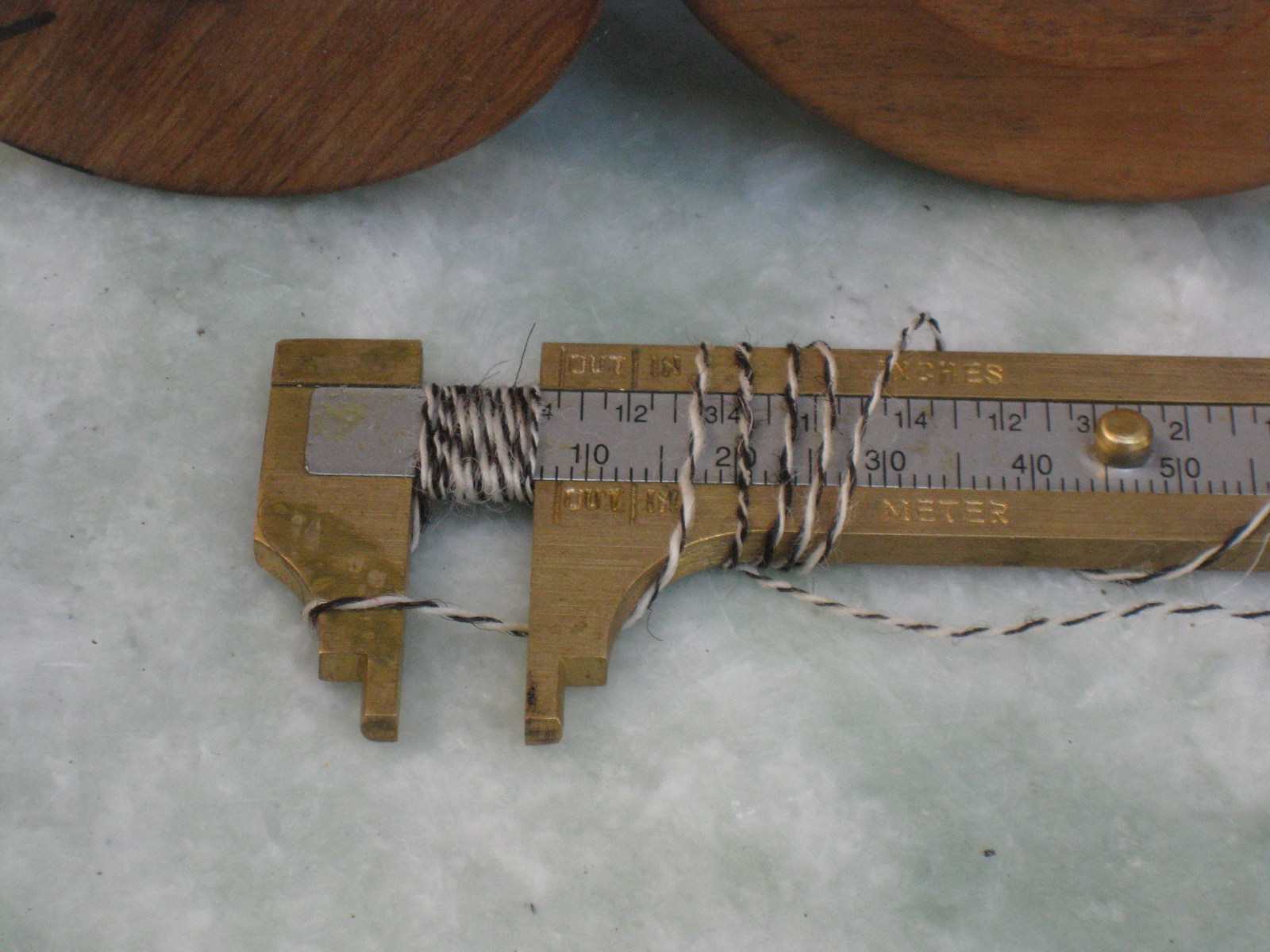
A bit of Jacob and Shetland singles,  plied together and wrapped  around a caliper. 
The two ply is in the 18-20 wpi range.  

Bobbins of singles in the 16 hanks per pound range.  Fibers include (clockwise from dark Jacob) Cotswold, 
Shetland, Romney (blue), grey Romney, blend (~~8,000 ypp), Shetland, Merino (blue) and CVM (10,000 ypp). edited to add:  A hank (560 yd) of the Natural Romney weighed 1.125 oz = 7,964 ypp. The others ran closer to an once per hank or 8,960 ypp. The CVM hank weighed .75 once for 11,947 ypp. I guess something about that bobbin is a little off. 


This was not a post about how fine I can spin, it was a post about learning to spin fast. Recently, I ended up with some nice Romney from Royal Fibers (http://www.royalfibers.com/).  The spinning bobbin at hand was for finer singles. I just wound it off, and in comparison to any of the singles above, it is very fine.


Two spinning bobbins and their flier whorl.  The  different sized whorls on the two bobbins tend to produce different sized singles.  The one  on the right tends to produce singles that run about 16 hanks per pound and the bobbin on the left produces singles that run about 20 hanks per pound. The difference between the two is a few thousandths of an inch. I have another spinning bobbin that tends to spin at 50 hanks per pound.