Saturday, January 30, 2016

Back to leverage

Ultimately, knitting needles are levers for moving loops of yarn. For hand held needles such as circular needles or DPN, the thumb is usually the fulcrum, and total leverage is ~1:3.  With a knitting sheath or knitting stick or knitting pouch as the fulcrum, the leverage is between 1:20 and 1:100.  With the gansey needles/knitting sheath that I am using for sock knitting these days, my leverage is about 1:50.

That means, a knitter with with circular needles must apply about 17 times as much force as I do to move the yarn loops. In fact, it is possible to knit as tight as needed with circular needles.  I wore through the plating on 2 sets of US1  Addi Turbos doing just that.  As an old rock climber, I have reasonably strong hands.  There was a time when I spent 2 hours per day at Indian Rock hanging from my fingers, just to strengthen them.

A very easy training climb on Mt. Tam.
There was a time when I climbed the 2,500 feet of Mt. Tam.
every day.  When they closed Mt. Tam because of the trail-side shootings, 
I climbed it every night.

Some knitters, say that they have very strong hands and can knit as I do using circular needles.  Their hands would have to be 17 times as strong as my hands are.  That is like claiming that if Aaron can lift a hundred pounds, they can lift 1700 pounds, over and over.  They may be that strong, but human hands cannot endure such stress indefinably. Using gansey needles and a knitting sheath, my hands and wrists are subject to only 5% (e.g., 1/17 th)  of the stress of their hands and wrists are subjected to as they knit.  It is a level of stress that my hands can endure indefinably.  I let my steel needles take the stress, and save my hands.

I think that is a smarter way to knit.


Swaving using curved needles with a knitting sheath
provides uses compound leverage, to yield
very high effective leverage.


The crew of one the last wooden cargo 
ships to go around the Horn.  Notice 
the commercially knit Guernseys.


Friday, January 29, 2016

Female knitters bragging like men

I suggest an easier way to knit, and these knitters respond by bragging about how how strong their hands are. That is a silly brag.

One of the great virtues of womanhood is that they often find better, faster, easier, smarter ways of doing work.  In this case, they are bragging about being strong enough to to knit the hard way.

I do not care how strong one is, if one works smart, one can get more done, with less stress to the body.  In short, they are bragging that they are strong enough to be able to work dumb.  That is a man's brag of the worst kind.

Monday, January 25, 2016

Fairy Tales

Phylogenetic analyses suggests fairy tales are much older than thought


Ancient population expansions and dispersals often leave enduring signatures in the cultural traditions of their descendants, as well as in their genes and languages. The international folktale record has long been regarded as a rich context in which to explore these legacies. To date, investigations in this area have been complicated by a lack of historical data and the impact of more recent waves of diffusion. In this study, we introduce new methods for tackling these problems by applying comparative phylogenetic methods and autologistic modelling to analyse the relationships between folktales, population histories and geographical distances in Indo-European-speaking societies. We find strong correlations between the distributions of a number of folktales and phylogenetic, but not spatial, associations among populations that are consistent with vertical processes of cultural inheritance. Moreover, we show that these oral traditions probably originated long before the emergence of the literary record, and find evidence that one tale ('The Smith and the Devil') can be traced back to the Bronze Age. On a broader level, the kinds of stories told in ancestral societies can provide important insights into their culture, furnishing new perspectives on linguistic, genetic and archaeological reconstructions of human prehistory. 

Read more at: http://phys.org/news/2016-01-phylogenetic-analyses-fairy-tales-older.html#jCp


Notably, Wilhelm Grimm, of the famous Grimm brothers who published many fairy tales back in 1812, wrote that he believed the tales were many thousands of years old—that notion was discredited not long after, but now, the researchers suggest, they believe he was right all along.
This dating puts the stories at times when major technologies were being introduced into Europe, and  it point out the confusion between technology and magic.

Thursday, January 21, 2016

Lion Brand Fisherman's Wool

The warmest object that I have ever knit, is from the Old Lions Brand Fisherman's Wool.

Then they moved to production to China, and I tried the new version, and am on record as not liking it.  I owe Lions Brand a deep apology!!

I had swatched the old Fisherman's Wool and settled on US1 needles.  When I tried the new Fisherman's Wool I just went ahead with those US1 needles without swatching it.  That was a big mistake.

Somehow the other day, I ended up knitting the new, produced in China, Fisherman's Wool on US1 (2  mm or AWG 12 needles) and love the fabric for Guernseys.

Gauge in stockinette is just over 9 spi / 11 rpi (close to 100 stitches per square inch).  Today, it is my yarn of choice for knitting sweaters for the temperature range from about  20 F to 45 F.

This has nothing to do with the lanolin in the wool which will washout and be replaced many times in the life of a sweater that does things, and everything to do with the construction, twist, and fiber in the yarn.


Tuesday, January 19, 2016

Dear John,

The modern hand knitting community is dominated by folks who knit for fun. For many years, the fun knitters have rudely pushing aside the folks that want to knit functional objects. (We will get back to functional!)

Fun knitters do not check their work, so many myths have grown up, and now echo around and around the community, with some leaders saying they are experts and the myths are the truth.
Then, intermediate level knitters repeat what they have been told without checking its truth.

Here are my favorite myths:

  1. Myth -hand knitting is warm/ loose is good because air traps heat
    1. no! STILL air traps heat -air can easily move through most hand knit objects
    2. to trap and keep air still to hold heat, the fibers need to be ~40 microns apart - twice the thickness of a Merino staple.  do the physics - http://www.feynmanlectures.caltech.edu/
    3. thus, for max warmth, you want the yarn fibers and the yarns to be about 2x the thickness of a merino fiber apart.
    4. knitting with circular needles does not pack yarns or fibers that tightly together.
  2. Myth- gansey yarn is always warm
    1. not if there are gaps between the yarns where air can flow
    2. gansey knitting can pack the yarns together to produce a warmer fabric.
    3. swaving can pack the yarns together to produce a warmer fabric
    4. woolen yarns are often easier to pack together to produce a very warm fabric if you have the leverage - circular needles are no
  3. Myth - gansey yarns are more durable
    1. most modern commercial gansey yarns are spun from fine fibers that are not particularly durable. woolen spun rug wool may be more durable
  4. Myth- nylon makes yarn more durable
    1. nylon is slippery and lets wool fibers fall out of the yarn while the long nylon stays
    2. yarn makers add nylon because it is cheap
    3. super wash is also less durable then untreated wool
Truths to replace the myths
  1. Gansey knitting and swaving pack yarns together making a fabric that is much warmer than can be knit with hand held needles.
  2. Gansey knitting and swaving can produce fabrics that are much more durable than can be produced from the same yarn with hand held needles.
  3. Gansey knitting and swaving can produce fabrics that are much smoother to the skin that the fabrics produced with hand held needles.
Truths for a knitter to live by:

  1. Finer is better - finer yarns can be knit tighter with less effort - ultimatly warmth is not about thickness, it is about not having holes in the fabric where air can pass through.  For example go look at the best new technologies at Patagonia, Marmot, and North Face.  Thin, light, and no holes.
  2. Finer is better -  yarns with finer plies result in more flexible fabric, with better drape when knit tight.
  3. Finer is better - finer needles leave smaller holes in the fabric for the fibers to fill.
  4. Finer is better - finer fabrics have more warmth for the weight.
Path to the truth
  1. long needles.  12" is good, 14" is better
  2. knitting belt. e.g., http://www.journeyman-leather.co.uk/knittingbelt8.html
  3. making your own knitting sheath is very much like a Jedi Knight making his own light saber. It is its own path and the process is the end.  I have made thousands of knitting sheaths, but the very best one was made just last month.
Functional.  I knit light weight, warm, and often weatherproof objects.  The first took me hundreds of hours to knit.  I could have worked at minimum wage, saved my money and bought objects of similar weight and warmth faster. If we price my time at my full billing rate, then my knit objects are very expensive and not functional for the price.  However, I have to be somewhere, and I can be knitting. We are going to watch the movie anyway and I can be knitting.  We are going to drive some where, so I let someone else drive and I knit.  I can still talk and navigate, while I knit.  Thus, I can value my knitting time at a very low rate and my objects are very cost effective. They are functional in the extreme.


Mostly I use Grizzly tools.  Needle blanks are made on a carbide grinder and are finished on a Sorby-Pro. Knitting sheath blanks are cut on a band saw.  I use threaded inserts to hold the needle adapters to the body of the knitting sheath. The needle adapters are made on a wood lathe.  The blog is full of pix of various designs.  


However, I have made excellent knitting sheaths with just a hand saw or even just a pocket knife, making the hole by heating steel rod or even a nail in a candle and burning the hole.

No one source says very much about gansey knitting and knitting sheaths.  To the best of my knowledge, this blog is the single largest source on gansey knitting and knitting sheaths.


I am likely to go back into making knitting sheaths fairly soon.


AL

Size 12 or 13 needles

The first pattern in Gladys Thompson is A Channel Islands' Guernsey.

The pattern was provided to GT by de Cararte and le Patourel of Guernsey. They owned a very old commercial firm that produced hand knit objects for export for sale to sailors at ports from Gibraltar to Reykjavik and St Petersburg.  De Cararte and le Patourel were only one of several firms in the Channel Islands that exported knitwear for seamen and fishermen.  Shiploads of fine knitwear was produced and shipped from the Channel Islands. Thus, we can be sure that there was a lot of knit wear worn by seamen, all knit to a similar level of fineness.

Some say, they do not find it in the museums.

Where did it all go?  Good husbands/ sons/ brothers, discarded it, and took a bath as soon as they got to shore.  Bad  husbands/ sons/ brothers wore them home, so their wife/mother/sister had to cut it off them, and burn it while the seaman took a bath with lye soap. Real seaman's knit wear was not likely to end up in a museum.

In the Guernsey pattern, 334 stitches are used for a chest size of 38 inches.  That means there were ~8.8 spi or 35 stitches per 4" or 10 cm.  The Guernseys were knit very tight. Since it  was a competitive industry, we can assume that the other firms knitting for seamen knit similarly tightly.  Why?  Because it is a warm, weatherproof fabric.  I know, I have knit a lot of it for myself and my friends. I knit it because it is our favorite fabric for foul weather wear.

A doodle in the round on "A Channel Islands' Guernsey" patterns.
The stockinette has a gauge of just over 9 spi and the
pattern variations are at just under 9 spi.
The needles are size 12. 
The yarn is a commercial 5-ply worsted spun
with a grist of ~950 ypp

However, there is a group that claims such fine tight knitting was never common or useful.  That is because they do not know how to knit such fabrics.  They have not knit such fabrics.  And, they have not tested such fabrics in serious foul weather.

However, knitting such objects is easy - if you know how.  First you use long needles called "gansey" needles. If you have gotten this far, you know I have been working with gansey needles for 10 years. With gansey needles you need a fulcrum so you can apply leverage for fast and powerful knitting.  You can use a knitting belt as your fulcrum, but a real knitting sheath is a more controlled fulcrum and  allows much faster knitting.

On page 7,  GT tells us to use Size 12 or 13 needles for knitting the Guernsey. Because of the group that claims 8 spi is as tight as necessary for gansey yarn, we assume the "Size 12 or 13" refers to the  UK sizes in the range of 2.25 - 2.75 mm. Such needles do produce the 7 to 8 spi the the group likes to think is as tight as such yarn can be knit.

However, The Channel Islands are not the UK. The 12 or 13 does not refer to UK needle sizes. Once one drops the assumption that the 12 or 13 is UK sizing, then one does what one always does, and one swatches until one gets to 8.8 spi.  I have knit a lot of  5-ply gansey yarn at 8.8 spi, so I know that it happens on 1.5 mm gansey needles with a knitting sheath.   I have a great number of such needles, because I like the fabric that results from knitting this yarn at this gauge. If I was knitting objects for sale to seamen, 8.8 spi is the gauge I would choose, because seamen would appreciate the warmth of the fabric.  Remember, this is the gauge that I knit for the guys that have saved my life.

If you flip thorough the various standards for wire sizing, it turns out the the needles I use are in fact Size 13 in AWG.  So, yes I get 8.8 spi from gansey yarn using Size 13 needles, just not UK13!

Sunday, January 17, 2016

How fast?

I getting asked, "How fast can you knit?"

Knit what kind of yarn?  What grist of  yarn?  On what size needles? In what pattern?  At what tension?

It is obvious that both the grist and the construction of a yarn affect how fast it can be knit.

The design, absolute size of  the needles, and the size of the needle relative to the grist of the yarn affect the rate of knitting.

The stitch being knit is critically important to how fast one can knit.  For example, stockinette knit flat is much slower than stockinette knit in the round.

People that want to be speed knitters practice with the yarns and needle types and sizes acceptable in the standard knitting contests.  I practice with the yarns and needles that produce the fabrics that I like rather than what is acceptable under knitting contest rules.

So, a while back I was in a knitting group, knitting along on US1 needles with a knitting sheath  at a good pace.  I had gotten there early and had been knitting for a couple of hours. A lady sat down next to me, and began to knit using US6 needles and  the newly popular Irish Cottage technique. Everyone mentioned on how fast she was knitting, but said nothing about how fast I knit, despite the fact that I was knitting 8 stitches for every 5 stitches she knit. Anyway, she knit for ~3/4 of an hour, put her knitting aside, sat and chatted with the group as a couple of us continued to knit.

Since then, I have doubled my knitting speed, while she still knits with the same technique at about the same speed.  Thus, I now knit at about 16 stitches for every 5 stitches she knits, but if you ask the most of the members of that knitting group, she knits much faster than I do.

But then, I use smaller needles, I use flat ended needles, I use gansey yarn, and I knit stockinette in the round. It is not a level contest.  If I was knitting woolen yarn, flat, with big needles, I would knit slower.

When she knits a sweater, it has about 25 stitches per square inch.  When I knit a sweater for wearing around town, it has about 88 stitches per square inch, so we knit at about the same number of square inches per hour, but with a knitting sheath my knitting is almost effortless, and I can do it all day, while she is lucky to do it for an hour.  The point is that knitting fine does not mean that an object must take longer, because fine stitches can be knit faster because the motions can be smaller.

In the days when I knit with Addi Turbos, I looked at the old stories of  knitters knitting at 200 stitches per minute,  the knitting of Hazel Tindall and Miriam Tegel, and considered the stories implausible.  Today, I consider 200 stitches per minute a reasonable pace for certain kinds of knitting. It is not a pace that can be sustained for very long, but for bursts of stockinette, it is feasible.  

Friday, January 15, 2016

Evidence

If we want medicine to be evidence-based, what should we think when the evidence doesn't agree?

http://medicalxpress.com/news/2016-01-medicine-evidence-based-evidence-doesnt.html

Applies to all fields and activities.


quote:
A meta-analysis is nothing more than just a fancy weighted average of its component studies. We were surprised to find that approximately 63 percent of the included studies were unique to one or the other set of meta-analyses. In other words, despite the fact that the two sets of meta-analyses would presumably look for the same papers, using similar search criteria, over a similar period of time and from similar databases, only about a third of the papers the two sets had included were the same.
It seems likely that most or all of these differences come down to the fact that Cochrane insists on tougher criteria. A meta-analysis is only as good as the studies it includes, and taking the average of poor research can lead to a poor result. As the saying goes, "garbage in, garbage out."
Interestingly, the analyses that reported much higher effect sizes tended to get cited again in other papers at a much higher rate than the analyses reporting the lower effect size. This is a statistical embodiment of the old journalistic saying "If it bleeds, it leads." Big and bold effects get more attention than results showing marginal or equivocal outcomes. The  is, after all, just human.

Why does this matter?At its most basic level, this shows that Archie Cochrane was absolutely correct. Methodological consistency and rigor and transparency are essential. Without that, there's a risk of concluding that something works when it doesn't, or even just overhyping benefits.
But at a higher level this shows us, yet again, how very difficult it is to generate a unified interpretation of the medical literature. Meta-analyses are often used as the final word on a given subject, as the arbiters of ambiguity.
Clearly that role is challenged by the fact that two meta-analyses, ostensibly on the same topic, can reach different conclusions. If we view the meta-analysis as the "gold standard" in our current era of "evidence-based medicine," how is the average doctor or policymaker or even patient to react when two gold standards contradict each other? Caveat emptor. 

Sunday, January 10, 2016

Koolaid

I have been knitting, and had a pile of stuff around my knitting chair.

I put excess stuff away, and there remained 6 WIP. One is a Guernsey from Aran weight yarn on 2.25 mm gansey needles. 3 are sport weight yarns being knit on 1.5 mm needles. And, the other 2 are finer yarns on finer needles.

I have drunk my own Koolaid and like finer needles.


Frangipani  knit on 1.5 mm needles
weatherproof gansey fabric
~ 116 stitches per square inch


The same yarn knit last year at 80 and 90 stitches per square inch.
Note that there is a quantum difference in texture! At
116 stitches the little holes are gone, and
the fabric feels smoother.


a swatch left over from last year!
5x2-ply = 10-strand sport weight
gansy yarn
knit on 1.84 mm needls @ 106 stitches per square inch
weatherproof gansey fabric.
10-strand has better drape than the 5-ply at the
same grist/ tension.

A revised taxonomy of hand knitting

An outline of Hand Knitting to be expanded and extended, this is a post in progress.

Hand knitting is a process where an array of loops of yarn forming a textile are held on one mandrel, and a second mandrel is used to add loops of yarn to extend the textile. In the process, the mandrels act as levers to manipulate the loops of yarn. Hand knitting can be organized by the relative orientation of the levers, the available mechanical advantage, and the diameter of the mandrels.

A higher mechanical advantage means that one can knit faster with less effort.  Less effort allows longer knitting sessions so much more knitting can be accomplished.  Less effort means less stress on the hands and wrists and thus less damage to the hands and wrists during extended knitting  or repeated knitting sessions. In knitting leverage determines the mechanical advantage, and hence speed of knitting, stress on hands and wrists, and type of fabrics that can be produced.

The orientation of the levers determines the nature of the looping process.  The diameter of the mandrels determines the fineness of the resulting textile.  These characteristics do not define the systems, but rather allow ranking them along various different continuum.

Knitting needles in the commercial market place for the last century have mostly tapered to a (rounded) point.  Nevertheless there are several lines of evidence suggesting that in the past, blunt knitting "needles " were used.  Physics/engineering suggest that blunt knitting needles have significant advantages when adequate leverage is is available to open the working stitch.  With hand held needles the wedge of the point being pushed into the working stitch provides additional mechanical advantage to opening the working stitch. On the other hand, holding a fine needle firmly to put it into the stitch is a major problem in the ergonomics of hand held knitting with fine needles. 

In the past, knitters tended to use much finer knitting needles, sometimes referred to as knitting wires or just "wires".  Since I am moving to finer, blunt knitting tools,  I am going to call them wires (W).


Hand knitting with double pointed needles (DPN)
    1. Generally pointed needles (Hand held knitting with blunt needles is perfectly possible, but it requires keeping a correct angle between the needles, which is different for each stitch, so it requires a particular set of skills, which are not commonly taught.  When used, blunt needles can improve speed, but increase effort.)
    2. Both needles supported with hands Working needle must be griped firmly so it can be pushed into stitch, or to resist the left needle pushing the working stitch onto the working needle.  Bracing the needles against the forearm as Mariam Tegels  improves ergonomics.
    3. Yarn feed controlled by right hand, or left hand or looped around neck or with pin on chest
    4. Use of needles longer than 12" is awkward (Trying to hand-hold long gansey needles is an exercise in frustration. (However, with a knitting sheath, gansey needles are the fastest and easiest way that I know to knit large objects.)
    5. Needles generally stiff, or used as if stiff
    6. Either hand may control the yarn, or yarn may be looped around neck or through pin on chest
    7. Poor ergonomics
      1. motions by small muscles of hand/forearm
      2. large motions - must exceed distance of taper on needle tip
      3. available leverage ~ 1:3
      4. ergonomics can be improved by using longer needles and bracing the working needle against the forearm and then using upper arm/shoulder muscles to drive working needle
    8. Least expensive knitting tool kit
    9. Suited for coarse and loose fabrics
    10. Typical needle sizes are larger than 2 mm
    11. Knitting speed is slow
      1. knitting motion must exceed taper on pointed needles
      2. motion is effected by small muscles
      3. Irish Cottage and other flamboyant knitting styles increase required motion range requiring more effort.
      4. limited leverage
    12. Pointy needles are a hazard for small children
Hand knitting with circular needles
    1. Generally pointed needles ((blunt needles not commercially available)
    2. Both needles supported with hands
    3. Yarn feed controlled by right hand, left hand or looped around neck or with pin on chest
    4. Poor ergonomics
      1. motions by small muscles of hand/forearm
      2. large motions - must exceed distance of taper on needle tip
      3. available leverage ~ 1:3
    5. Compact knitting tool kit
    6. Suited for coarse and loose fabrics
    7. Typical needle sizes are larger than 2 mm
    8. Knitting speed is slow
      1. knitting motion must exceed taper on pointed needles
      2. motion is effected by small muscles
      3. Irish Cottage and other flamboyant knitting styles increase required motion range requiring more effort.
      4. limited leverage
    9. Safer than DPN
Hand knitting with single pointed needles (SPN)
    1. Generally pointed needles  (blunt needles not commercially available)
    2. Both needles supported with hands
    3. Yarn feed controlled by right hand, left hand or looped around neck or with pin on chest
    4. Use of needles longer than 12" awkward, Alternatively a flexible cable can be attached to the end of the needle
    5. Needles generally stiff, or used as if stiff, some needles have flexible ends (e.g., cords)
    6. Poor ergonomics
      1. motions by small muscles of hand/forearm
      2. large motions - must exceed distance of taper on needle tip
      3. available leverage ~ 1:3
      4. suited for coarse and loose fabrics
      5. typical needle sizes are larger than 2 mm
    7. Knitting speed is slow
      1. knitting motion must exceed taper on pointed needles (more distance to travel results in slower knitting)
      2. motion is effected by small muscles
      3. Irish Cottage and other flamboyant knitting styles increase required motion range requiring more effort.
      4. limited leverage
    8. SPN may be safer than DPN?
Hand knitting with wires and knitting stick (Knitting sheaths, knitting pouches, and gansey knitting represent a continuum of more than a dozen knitting techniques. These techniques allow production of fabrics that cannot be reasonably knit with the above hand -held knitting techniques. Effort is delivered by the whole hand pushing against a lever, so the ergonomics are good and the potential effort can be very large.

Frankly, as I first worked out the details of using a knitting sheath/knitting stick, my response was: "This is wonderful, why didn't anyone tell me about knitting sheaths?" My second response was, "WTF, WHY DID NOT ANYONE TELL ME THAT THERE WAS AN EASIER WAY TO KNIT!!"  Consider for example the picture on pg 18 of Nancy Bush's Folk Socks (1994).  The subject is a woman using a knitting sheath to knit socks, but Nancy Bush does not mention the knitting sheath; she simply captions the photo, "Girl knitting on West Pier, Whitby".

Mary Thomas's Knitting book discusses and dismisses Knitting sheaths and knitting belts as artifacts of history.  The only modern book to discuss knitting sticks as important to knitting is Mary Wright's Cornish Guernseys and Knit-frocks.  And, Wright does not address how the various techniques are/were performed.  Rutt mentions the techniques with photos, but does not recognize that use of a knitting sheath/knitting belt allows production of  fabrics that cannot be reasonably produced with hand held needles, or that such improved the ergonomics and speed makes commercial knitting feasible.
A fine, skin soft fabric,
with excellent warmth and minimum weight and bulk.
Produced with knitting sheath and wires
3-ply fingering weight (1650 ypp) 
knit on 1.5 mm wires 
gauge is ~150 stitches per square inch
    1. Wires generally short and stiff (however can be used for wires as fine as 0.5 mm that are very flexible)
    2. Wires may be either blunt or pointed
    3. Knitting stick supports working wire
    4. Knitting stick may damage fragile needles
      1. fine needles should be solid metal
      2. larger needles may be wood, bone, or tubular metal
    5. Works best when needle/wire fits needle hole closely, however a skilled knitter can work with a very loosely fit wire
    6. Knitting stick moves with needle (e.g., goose wing pivots on hip)
    7. Excellent for small objects such as hats, socks, mittens and gloves
    8. Good ergonomics
      1. motions by large muscles of upper arm/shoulder and transmitted to hand by large tendons/ wrist may be kept straight
      2. available leverage is between 1:20 to 1:50
      3. versatile tool kit for knitting
    9. Knitting speed is good
      1. blunt wires used to reduce required motion
      2. good leverage is available for rapid motion
      3.  suited for all needle sizes 
    10. Can produce weatherproof fabric from a single worsted spun yarn (or can greatly facilitate Fair Isle and other 2-yarn techniques)
    11. Steel needles can be used to knit metal wire 
    12. Various kinds of knitting sticks can be improvised or bundles of straw or feathers tied with yarn can be tucked in to a belt.
    13. Needles fixed in knitting stick can be a hazard if small children are around
    14. Perhaps hardest part of learning, is learning how to properly place and hold the knitting stick in place.  Knitting stick is at waist on right side of body or over the point of the right hip depending on the length of needles used.  Work area should be directly in front of knitter.
Shetland knitting  
Again the use of knitting pouches is ignored in modern books on knitting.  In the photo, on pg 45, of Poem in Color, knitting in the Bohus tradition, by Wendy Keele, the knitting pouches of several knitters can be clearly seen. In the photo of Annika on pg 34, she is likely using a knitting pouch, and yet Keele does not mention knitting belts despite extensive details about the work.

Use of a knitting pouch or knitting sheath makes Fair Isle and twining techniques much, much easier.
    1. Uses leather knitting pouch usually stuffed with horse hair is used, however other cultures use woven mats and the physics is the same.
    2. Needles may be either blunt or pointed, but must be "double pointed"
    3. Knitting pouch is used to support the working wire
      1. leather belt is gentler on needles than a knitting sheath, better for use with wooden, plastic, and tubular needles.
      2. needles may be either short or long
    4. Wires may be either stiff or flexible
    5. Good ergonomics
      1. motions by large muscles of upper arm/shoulder and transmitted to hand by large tendons/ wrist may be kept straight
      2. available leverage is between 1:20 to 1:100 depending on needle length
    6. Most versatile tool kit for knitting 
    7. Knitting speed is excellent
      1. blunt wires may be used to reduce required motion /increase speed
      2. good leverage is available for rapid motion
    8. Excellent for Fair Isle and lace 
    9. Can produce weatherproof fabrics via Fair Isle or "weaving" or twining/ twisting
    10. Suited for wire sizes smaller than 4 mm
    11. Excellent for knitting in a car or on an airplane
    12. Needles in pouch can be a hazard if small children are around
Spindrift (~2,100 ypp)
knit on 1.75 mm (pointy) needles into
 a light weight, low bulk, elastic, warm fabric.
The yarn band recommends 60 stitches per square inch,
that feels loose to me,
 I like it at 192 stitches per square inch. as shown above. 
Last night at Alpine Meadows, it was snowing hard, with 96 mph gusts of wind.  
Welcome to El Nino 2015.

Gansey knitting  is a powerful form of hand knitting.  For example, commercial 5-ply gansey yarn can be reasonably knit using hand held needles at stitch densities of 80 stitches per square inch. but with gansey knitting techniques, such yarns can be reasonably knit at 120 stitches per inch. Such high density fabrics are unbelievable warm (without bulk or weight) to anybody that only knows the fabrics knit with hand held needles or frame knit, or store bought. Such fabrics work best when "knit to fit".   Small details in fit hugely affect the warmth of such objects, thus bespoken objects can be much warmer than ready to wear objects, and this is likely the origin of the myth that hand knit is warmer than store bought.  The truth is that densely knit objects that are knit to fit are warmer than store bought. Gansey  knitting was used for industrial scale knitting of objects for export. Today, commercial hand knit objects are knit at a looser gauge using knitting pouches.

I would call, all objects knit with long needles that provide great mechanical advantage  "traditional gansey knit".

Nevertheless, I can knit fabrics with a  knitting sheath that I cannot knit with a leather knitting pouch. Knit from fine woolen yarns they seem magically warm.  Knit from fine worsted yarns they are silken smooth.  Knit from coarse worsted yarns, they are extraordinarily durable. Quickly knit from coarse semi-worsted yarns, they are cheap.  As garments, they can be too warm for centrally heated environments such as modern transportation, homes, shops, or churches. Or, fine (fingering or 0 lace) yarns can be gansey knit with fine wires (0.8 mm into very thin fabrics that are light weight, cool and so delicate as to be trnaslucent. Gansey knitting can reasonably produce all of these diverse fabrics.
    1. Wires may be either blunt or pointed, but must be DPN
    2. Wires are flexible and part of knitting process is driven by the spring return of the needle (steel springs are faster than muscles) (required flex less then 5%)
    3. Wires are long
    4. Wires are held in the knitting sheath by friction caused by the needle being flexed out of the axis of the needle hole in the knitting sheath/ when flex is relaxed, needle slides in and out freely/ less need for needle to fit needle hole
    5. Knitting sheath may damage fragile needles 
      1.  steel needles may be bent 
      2. fine wooden needles will likely break
    6. Suited for fine, tight knitting 
    7. Can produce weatherproof fabric from even worsted spun yarn.
    8. Fastest way to knit large objects
    9. Excellent ergonomics
      1. motions by large muscles of upper arm/shoulder and transmitted to hand by large tendons/ wrist may be kept straight
      2. available leverage is between 1:20 to 1:100
      3. some motions produced by return spring action of spring loaded needle
      4. Knitting sheath is placed over right buttock, and working needle arches forward under right armpit into the work zone.  Right arm rests on needle, and larger needles help support right arm.( place holder for motions/ different motions for pointy and blunt ganesy needles)
    10. Can be used with any size needle (fine needles are metal/ large needles are wood or other)
    11. With an Aran weight or Lopi yarn, and 2.25 mm blunt gansey needles, one can knit a weatherproof fisherman's sweater in a week. For example; my old gardening gansey of  MacAusland heavy 3-ply Aran weight was weatherproof at 63 stitches per square inch and  the Lopi below forms a weatherproof fabric at only ~60 stitches per inch.   This is  between 2 and 4 times as many stitches per square inch as many Aran/bulky/Lopi yarns recommend.
    12. Knitting weatherproof fabrics is ferocious work, but no other hand knitting technology can produce such warm fabrics so fast.  These fabrics are more stable and stronger than felt and more flexible with better drape than felted knitting.
    13. Long needles are not suited for knitting in cars/aircraft.
    14. Possible hazard with small children around
      1. Weatherproof gansey fabric 
        ~120 stitches per square inch
        knit from 5 x 2-ply =  10-strand, 1,000 ypp worsted spun yarn
        gansey knit on 1.5 mm wires with knitting  sheath
      I made a lot of that black 6-strand/ 1650 ypp sock yarn,
      This sock is being knit on 1.5 mm gansey wires with sheath
      at a gauge of 192 stitches per square inch.
Swaving
    1. short needles (called "pricks")
    2. stiff needles
    3. curved needles
    4. needles rotate in knitting sheath (needle holes are often lined with metal or entire knitting sheath is often made of ceramic or metal, needle hole often needs lubrication)
    5. needle must fit the needle hole very closely, and lubricant often needed
    6. very good ergonomics
      1. motions by large muscles of upper arm/shoulder and transmitted to hand by large tendons/ wrist may be kept straight
      2. compound leverage results in very high total leverage
      3. stitch finished by return spring action from stretched fabric (produced fabric must be tight enough to be very elastic)
    7. fastest way to knit small objects
    8. can produce very fine fabrics
    9. suited to needles smaller than 3 mm
    10. tools can be used like a knitting stick; However,  best speed is achieved with both hands making a very small, but powerful simultaneous motions down and together that pops the working prick into the working stitch, AND loops yarn over the working needle. Alignment and range of motion of pricks is controlled by rotation of the right prick in its knitting sheath. When the stroke is finished, the tension in the fabric pops the prick out of the stitch as the side of the right hand hits the bend in the working needle, sliding the finished stitch off holding needle.
It was swaving the moved me toward knitting with blunt wires.  It took me about 7 years to work out the details of swaving.  For example neither the bent needles in Rutt, or the bent needle in the Victoria and Albert collection works well for swaving.  The bend that does work is:

Swaved sock in  progress
from 6-strand, 1650 ypp yarn
on 2.0 mm pricks
knitting sheath with swaving adapter shown
needle adapter has brass bearings to allow easy rotation of the working prick


Perhaps, what I should say is that I see many knitters using "make do" tools, and one may be able to swave with the tools in Rutt or the V.and A. but those tools are not likely good enough to be the primary production tools of a commerciall operation.  It is worth noting that one can one can knit the legs of hose on long gansey needles and swave the ankles/feet with no change in gauge.  

Anyway, it took me ~7 years to work out swaving, then I had to swave for a couple of years, before I had the idea that I could "pop" blunt gansey wires into stitches. My first response was "This is wonderful, why didn't anyone tell me about blunt needles!"  At this point, I have been using blunt gansy needles for about 2.5 years.  For, the last few months, I have been grinding the points off of my finer needles. Thus, as of now, I have been working with various kinds of blunt knitting tools for more than 10 years.  A  couple of days ago, I ground the points off of my 0.8 mm wires. Subsequent swatches tell me that this opens up a whole new class of fabrics to reasonable hand knitting.  As I knit more and more with finer and finer blunt  wires, my first response is "This is wonderful, knitting fine fabrics can be easier!"  My second response is, "Whiskey Tango Foxtrot, Why does everyone use pointed  knitting needles?" Because they do not use knitting sheaths. 

Rutt's worst mistake was regarding pointed knitting needles. If you are going the knit replicas of the best objects in Rutt, then you will need fine knitting wires - and a good knitting sheath.

I suggest that the core of better knitting is making better fabric.  I suggest the better finishing techniques are better done on better fabrics, otherwise one is "just putting lipstick on a pig".  I suggest that knitting fast enough to get the project done is important.

Whiskey Tango Foxtrot


Knitting heart
    1. small knitting sheath sewn or pined to clothing to hold fine needles for knitting lace.
    2. fine, pointed needles
    3. medium length needles
Basque Knitting
    1. uses two or more needles with hooks in one end
    2. good for knitting while walking.
    3. good for coarse, loose fabrics
    4. good ergonomics
Pit knitting and "crease knitting"
    1. holding a knitting needle in the arm pit or tucked into the crease of the thigh (normally SPN) 
    2. Various kinds of pads and needle holders may be used
    3. needles may be either SPN or DPN
    4. mechanical advantage is greater then hand held needles, but less than knitting stick/knitting belt/knitting sheath
    5. Grip on working needle can be less, so is more ergonomic than hand held knitting
    6. needle placement is not as precise as knitting belts/knitting sheaths or knitting sticks


Saturday, January 09, 2016

Thinner needles

When I started using long steel needles some 12 years ago, I thought they would last forever.

When new, my US1 needles were 2.38 mm in diameter.  Now, having been buffed to a shine every few months,  I notice that some of the needles are down in the range of 2.2 to 2.25 mm. (And in the last couple of years, most have had their pointy tips ground off and are now blunt.)


A swatch being knit from Romney handspun 5-ply gansey yarn on 1.95 mm needles.
Gauge is ~ 90 stitches per square inch.

As you can see, they are blunt and there is plenty of wiggle room in the US 0
needle size hole


.  


Nevertheless, I like them in their new slimmer format and I keep on using them. (However, now that I have discovered blunt needles, I tend to use needles in the US 0 to US 000 range.)

If they were commercial plated needles they would be long, long gone.

One truth is that knitting needles wear out, and are recycled.  This would be particularly true for copper, brass and bronze needles.  (Brass needles are wonderful to knit with, but most brass alloys leave toxic residue on both the hands and the wool.)

A corollary is that most archaeologists think that knitting needles are pointy. This is not necessarily true.  Today, I do not think that most archaeologists would recognize the objects that I do my best knitting on, as knitting tools. And yet, we have historical descriptions of such objects used for knitting. As metal objects, as they wore out or broke, and the pieces would be recycled.  As pieces of rod with rounded ends, archaeologists would not recognize them as knitting needles.  Old wooden knitting needles would become kindling. No, I am not at all surprised that archaeologists have not found knitting needles.

In particular, how many archaeologists would recognize pricks as knitting tools?  And, yet they are the tool of choice for fine socks and gloves, just as gansey needles are the tool of choice for large objects. However, over the last year,  my idea of  best gansey needles has changed from long pointy 2.38 mm needles to long, blunt 1.95 mm (and thinner) needles.


Some of the current generation of "gansey needles".


Monday, January 04, 2016

Seam Stitches

There are old stories of knitting in the round using only 3 needles.

This is not done much any more.  Mary Thomas brings it up but does discuss any details.  It does not work very well using pointy needles and the "Weldon's" knitting techniques that become popular in the late Victorian period.  For real speed it requires a knitting sheath and blunt tipped needles.

However, it works very well, and has real advantages when working with blunt DPN.  First it is faster because there are only 2 needle changes per round of knitting. And, the needles are not flailing around like a pile of amorous porcupines.  

My desire to learn to knit on 2+1 needles was in part driven by curiosity about seam stitches - why did the old sweaters have them?  The reasons put forth by modern knitting instructors did not ring true.

I suggest that the old seam stitches were a way of preventing possible laddering when changing needles.  It is possible to knit stockinette on 2+1 needles without laddering and without seam stitches, but it is easier and faster to avoid ladders if the last stitch a needle is a purl and the first stitch on the next needle is a knit.  Or, even better, use a crossed purl stitch.

Knitting in the round on 2+1 needles is not for every project or even every phase of the projects where it is appropriate.  Nevertheless is another technique for getting a lot of knitting done, and it gives us a real reason for "seam stitches".

Tuesday, December 29, 2015

Craftsmen

I use the term "craftsmen" and "craftsman" as gender neutral nouns denoting a person that has spent years learning and perfecting their craft, and who practice their craft in an ongoing professional basis.

Professionals have professional tools, both in quantity and quality.  While many modern hand spinners have "flocks" of spinning wheels, how many of them have  the drying reels, skeiners, steamers, and space to produce a commercial order?

If a person is highly trained as a spinner then the most valuable use of their time is as a spinner, and putting time into cooking and child care produces less value.  On the other hand if a person is highly trained as a cook and childcare specialist, then spinning is a lower valued use of their time, and the quality of their spinning is that of general labor, rather than that of a  highly trained professional spinner.

Thus, a married couple seeking to support the family with spinning can optimize their economics by having one partner trained in spinning and pursuing a profession of spinning, and one partner trained in running a household, cooking, and rearing the children.  This has likely been true since India was exporting fine cotton cloth to the Egyptian Old Kingdom, some 5,000 years ago.

In a time without birth control, the occasional woman might forgo sex (to avoid pregnancy) to become a master craftsman.  However, the great textile centers of Europe were among the most densely populated places on Earth over a period of many generations, so we can deduce that the primary work force was not celibate. And, from the quality of their work, we can deduce that they did not take substantial time off for child bearing.

Thus, pure economic analysis without a hint of sexism tells us that the textile craftsman class was dominated by men.  From this we can extrapolate to other crafts, including hunting and farming. The economics of division of labor and specialization has likely been at work long enough to have affected genetic sexual traits. Men and women likely carry genetic traits that suit the sexes to traditional economic roles.

Thus, we have proven that women likely have genetically enabled traits that facilitate running a household, and therefore they belong in the House; and, by extension the Senate, Parliament, Bundestag, State Council, Grand National Assembly, . . . . . 

Men have traits that make them good hunters and warriors.  In the past, we have associated kingship with being a good warrior.  We associated presidential  capacity with George Washington's personal strength and stamina in winning of the Revolutionary War.  However, modern wars  involve weapons of mass destruction and cyber warfare, and these are wars that must be avoided.  Leading a government no longer requires physically leading an army into battle.  On the other hand, things like global warming are very much a threat to our security.  Today, leading a government is more about planning and organizing cooperation - traits that women have.  Traits that women have demonstrated by running households for thousands of years.

Elizabeth R did more for England than most of England's kings. Margaret Thatcher was certainly  among the best of  a long line of English Prime ministers.  Golda Meir did better than most of most of the men that have held the post. Angela Merkel has done well for Germany.

I was born in Cheyenne, and grew up on stories of Governor Ross.  From this, I believe that our selection process for national leaders discriminates against the traits that make good  leaders in the modern age.  We give too much credit to self promotion and aggressive behavior.  That is, we should NOT choose the person who WINS the debates, but the person that can bring the group to a reasonable consensus.  We should not choose the person that solves problems, but rather the person that prevents problems.  That would be someone like the Mom that told you to do your homework.

Monday, December 28, 2015

Professional spinners

14 Incredible Archaeological Discoveries Made In 2015
see http://www.huffingtonpost.com/entry/archaeological-finds-2015_5678360be4b0b958f6574ff4?utm_hp_ref=science


The more we look, the more we find ancient artifacts that demonstrate a professional craftsmanship that cannot be acquired by subsistence workers (e.g., women spinning in the home). This does not mean that women were not spinning in the home, just as a brewery does not mean that women were not making beer in homes. However, the presence of fine gold, breweries, and fine mosaics means that there were classes of full time professional craftsmen. If there professional goldsmiths, brewers and builders, then there were also classes of professional spinners and weavers.

From Anglo-Saxon times, textile centers in Europe imported English wool, and had factories making cloth. That does not mean that home spinners and weavers in England did not make textiles, Rather it means that at the time there were classes of full time professional spinners and weavers that produced high-end textiles.

You know that the above was not worn with  "homespun" clothing.
The clothing was a fine as the gold work,
it just did not survive as well.


Wednesday, December 23, 2015

The Gansey World

Sir Walter Raleigh used the term "gansey knit" in a letter to a Polish Princess to refer to finely knit hose. Gladys Thompson used it to refer to an object knit from ~2,500 ypp yarn, knit at a gauge of 12 spi and 20 rpi, which she also refers to as "Jersey".  Thus, we know the term is old, and the modern knitting of 80 stitches per square inch barely scratches the surface of what traditional knitters could knit.

These two references have been rattling around in my brain since I first started experimenting with "gansey needles" (and knitting sheaths).  However, then, I was never able to knit such fabric at a reasonable pace.  Now, that I have been using blunt gansey needles, such fabrics and objects have become more practical.  

For example, when I first came across Jamiesons  2-ply Shetland Spindrift yarns (2,200 ypp), I was rather disdainful of the fabrics produced according to the gauge on the yarn band.  However, when knit on 1.5 mm needles, the fabric is lovely.  Gauge runs ~ 160 stitches per square inch.  Not "weatherproof" mind you, but a warm, elastic fabric that is perfect for wearing in cool damp conditions. .Spindrift knit on 1.5 mm needles is warmer than worsted weight yarn (e.g.,  "4") knit on 5 mm or  US 8 needles. The Paton's 4-ply Beehive was just a bit denser than the Spindrift with a slightly lower grist, and when knit on similar needles, produces a denser,  warmer, and more durable fabric at 12 spi and 20 rpi,  

These days I have taken to knitting  yarns with  grists of ~1,650 ypp/ 3.3 Nm  (e.g. 3-ply or 6-ply sock yarns) on needles in the 1.75 mm range. This is finer than previous posts, and results in a gauge of 12 spi by 15 rpi.   (As I said, I am falling down the Rabbit Hole and in the last few weeks, I have ground the sharp points off of 6 or 8 sets of fine, pointy "gansey  needles"!)   I use these fabrics for socks, mittens, and where ever a warm, light weight fabric is required. The more plies, the better the drape and elasticity of the fabric.

Then, 4-ply yarns in the 1,260 ypp range are knit on 2.0 mm needles.  A month ago, I was knitting 1650 ypp yarns on 2 mm needles.

5-ply (gansey) yarns in the 1,000 ypp (sport weight) are still knit on 2.38 mm needles.  It is a nice fabric.  If I need a more weatherproof fabric, I reduce the ply twist to give more fill and knit on smaller needles.  If I need a much warmer fabric, I use a lower grist yarn.

All of the above fabrics are firm, warm fabrics with good drape and excellent durability. For all of the above fabrics, I use long steel DPN with a knitting sheath.  as described above, none of the fabrics are particularly weatherproof. Production rates on the finer needles are much better using blunt needles and working in the round.  Purl stitches are easier on pointed needles. Pointed needles are required for picking up stitches.  A fine crochet hook makes repair of mistakes easier. A cable needle is required for cable stitches.

So the question is,"Do I want an object that will be warm and stay looking beautiful for years and years, or do I want an object that will never be very warm, and will quickly fall apart?" 

I work in yards per pound (ypp), because the math is easy. The square of the wpi (packed to refusal) is the grist in ypp, always.  I know that when 10 hanks of 560 yards weigh a pound, I have spun 10s or 5,600 ypp, and it will measure 75 wpi.   Then, if I make 5-ply, it will have a grist of 1,000 ypp and measure 32 wpi. I know that if I spin a single that measures 105 wpi, and I make 6-ply, then the resulting sock yarn will measure 40 wpi.  I know that if I spin 40s that measure 150 wpi, and I ply it into a 6-ply yarn, it will have a grist of 3,360 ypp and measure 58 wpi.

Thus, I must update my gansey yarn chart.
(Note the differences with http://www.craftyarncouncil.com/weight.html , and https://en.wikipedia.org/wiki/Yarn_weight.  Also note the failure of http://www.knitting-naturally.com/yarn-comparison-chart.html, http://www.spinderellas.com/Yarn%20Weights%20and%20Measures.pdf , and  http://paternoster.orpheusweb.co.uk/lace/knittingyarns.htm , to use a wraps per inch technique that provides consistent and useful results.)  The knitting community's to failure to "pack to refusal" when measuring wpi results in nonsense.


wpi       grist (ypp)   spin count           notes

 22         484                                        Aran Yarn (traditionally was 10-ply of 10 count singles)
 24                             1
 26         676
 28         840                                        Worsted Yarn (traditionally was 6-ply of 10 count singles)
 30         900
 32         1,000                                     Gansey  Yarn ( 5-ply of 10 count singles) 
 33         1,100                                     DK weight yarns
 34         1,120           2                        
 38         1,443                                    Common grist for commercial sock yarns e.g., Wooly West
 40         1,650           3                      Various 3-ply  and 6-strand yarns knit on 1.75 mm gansey needles.
 42         1,800                                   Single cut woolen singles         
 44         1935                                    Fingering Yarn
 48         2,303                                   Jumper Weight/ Spindrift weight 2-ply  (1.5 mm needles)
 50         2,520                                   4-ply Beehive yarn ( 20 count singles) (1.65 mm needles)
 53         2,800          5 
 58         3,360                                    Traditional 6-ply sock yarn from 40 count singles             
 60         3,600                                    2-cut woolen singles @ 9 tpi                     
 64         4,100                                     Modern lace weight
 70         4,800                                     Woolen single at same tpi as 10s warp
 75         5,600          10s                    Singles for warp/ 9-10 tpi ; woolen singles for weft @ 12 tpi
 82         6,700          13                      Traditional 3-ply Shetland lace plied up from 40 count singles
 85         7,200                                     High-end Shetland lace weight yarn/ 2/14.5 Nm
 105       11,200        20s                    Worsted singles that I use for my sock yarn @ 14 tpi
 120       14,400                                   8- cut woolen singles / 18 tpi
 130       16,800        30s                     Worsted singles @ 17 tpi
 136       18,000                                   10-cut woolen singles / 20 tpi
 142       20,200                                  2-ply from 80s  e.g.,  ~2/40 Nm
 150       22,400       40s                     Singles used for best sock yarn/ 17 -22 tpi /~ 45 Nm /Shirting
 182       33,600       60s                     Traditional commercial  "fines" / 22- 24 tpi
 210       44,800       80s                     Traditional best commercial "fines"  /24 - 27 tpi  / 90 Nm

So, when I measure the wpi of  2/40 Nm yarn I get  ~135 wpi which converts to ~ 18,000 ypp, which is about what I get when I simply convert from metric units.  Wraps per inch works when one packs to refusal. For somebody to say a 2/40 Nm yarn measures 42 wpi is silly.  If any of  the sites referenced above had a competent spinner in residence, they would know this.  

Note that 2/40 Nm can be easily hand spun  from 70 count wool at a commercial rate by a competent hand spinner.

Saturday, December 19, 2015

I am the Boss.

I do not let the fuzz from a a sheep tell me how to spin.  However, a number of spinners say that they sit down to a pile of fiber and let it tell them what to spin.  That is like a painter letting the color in one tube of paint tell him/her what to to paint.  No, the artist uses a palette to make the color that the artist wants.

When I sit down to spin, I have a vision of what I want to spin. Before I sit down, I think what the function of the object will be, and I decide on a yarn structure. I decide on the grist of the singles, whether the singles should be spun woolen or worsted, and what textures of fibers are appropriate.

Over time, and as I developed more skill, I have moved to finer yarns. My first goal when started spinning was 5-ply, sport weight,  gansey yarn. Now, I find myself spinning mostly fingering yarns yarns of 3 to 6 plies with the occasional 6-ply lace weight sock yarn.

Often, I get it wrong. Something about the yarn is wrong. Then, as I sit there knitting or weaving, I consider the how to make a better yarn.  Usually, I decide on a different grist or yarn structure. Yesterday as I was knitting my replica Patton's Beehive 4-ply, I decided that I wanted such a yarn from a slightly coarser fiber.  Thus, the next batch will be spun from the flock run long wool that I get from the Woolery.  I think up the structure of my next yarn as I knit the last yarn.

For any given texture of fiber, there are several breeds or hybrids that can produce fleece that are appropriate.  I do not really care which I use.  In many breeds, the differences within a fleece or the differences between different fleeces in the breed, or the differences between the fleeces of the same animal in different years are greater than the differences between breeds.  I would say, that the great appeal of Merino, is not so much its fineness, but its uniformity.

I am not a big fan of fiber blends.  I think that having a blend of different kinds of fibers in the drafting triangle, interferes with the draft and the ratchet of the yarn.  Even the flock-run medium long wool that I get from the Woolery, has been sorted and graded to provide reasonable uniformity within the fiber.

I am not a fan of adding nylon to yarn - not even to sock yarn.  Just spin the sock yarn from a more suitable wool than Merino.

Many spinners spend a lot of time studying the details of the various breeds spinning little bits of fleece. Except, unless the fleece has been well sorted and graded (rare in the US) little bits of fleece say little about the all of the grades of wool that one can expect from a flock of that breed. However, many modern spinners seem not spend a lot of time learning the techniques needed to produce the various yarn structures or the virtues of the different yarn structures.

Every 2 or 3 years, the local spinning guild devotes its programs to breeds of  sheep and their fleece, with everybody spinning little bits of different kinds of  fleece. However, they seem not to have any interest in being able to sit down and spin fine.  Being able to spin fine would open up new yarn structures, that would allow them to knit and weave new kinds of objects.  Others in the guild would consider spinning the replica Beehive that I spun the other day to be a challange in fine spinning.

Knowing the virtues and vices of the various yarn structures is more important than knowing the nuances of  breed fleece characteristics.  Knowing yarn structures is harder than knowing the details of fleece characteristics.  To know yarn structures, one must be able to spin the yarn strucrures consistently, and then work with that yarn.  One does not learn about a yarn when it is sitting in the stash or even on your desk.  One learns about yarn by making objects, and living with the objects.

Moreover the required yarn characteristics depend on how the fabric will be constructed.  Thus, there must be a vision for the object that flows down to fabric construction, then to yarn structure, and finally to the required fiber.  However, if I know how to spin, then all I really need to know about the fiber is the reburied spin count and staple length.  Does that mean the the spiral crimp that makes Suffolk so wonderful for socks does not matter?  No, it means that the spiral crimp will enhance a well spun sock yarn, but first one needs to know how to spin an excellent sock yarn structure. Suffolk has a spin count of between 48 and 58, so it is very reasonable to spin it fine enough to make wonderful sock yarn.

The bottom line is that if you are a good spinner and a good knitter than an hour's worth of spinning will take 5 hours to knit.  Thus, you might as well spin the very best yarn to make that 5 hours of  knitting worthwhile.


Are you holy?

Some holy orders live in white wool.
Others dye.

Thursday, December 17, 2015

Rooting around at the bottom of the Rabbit Hole

At the end of the last episode, I was left wanting 4-ply, worsted spun, 2,500 ypp gansey yarn.

This morning, I rooted around in the stash for some fine long wool, oiled it, and carded a batt.

I put the 20s whorl on the wheel, and spun a bit, then did a wpi test - it came out to 26 wraps in 1/4 inch packed to refusal - which is ~104 wpi =>a grist of  ~11,000.  then I spent a couple of 90 minutes spinning a thousand yards of  11,000 ypp single winding off on to 4 bobbins.

I put the bobbins on the tension box and plied a few feet, and did a wpi test of the 4-ply - it came up 13 wraps in 1/4 inch or close to  50 wraps /inch => grist of  2,500 for the finished yarn. I plied about 200 yards of the yarn.

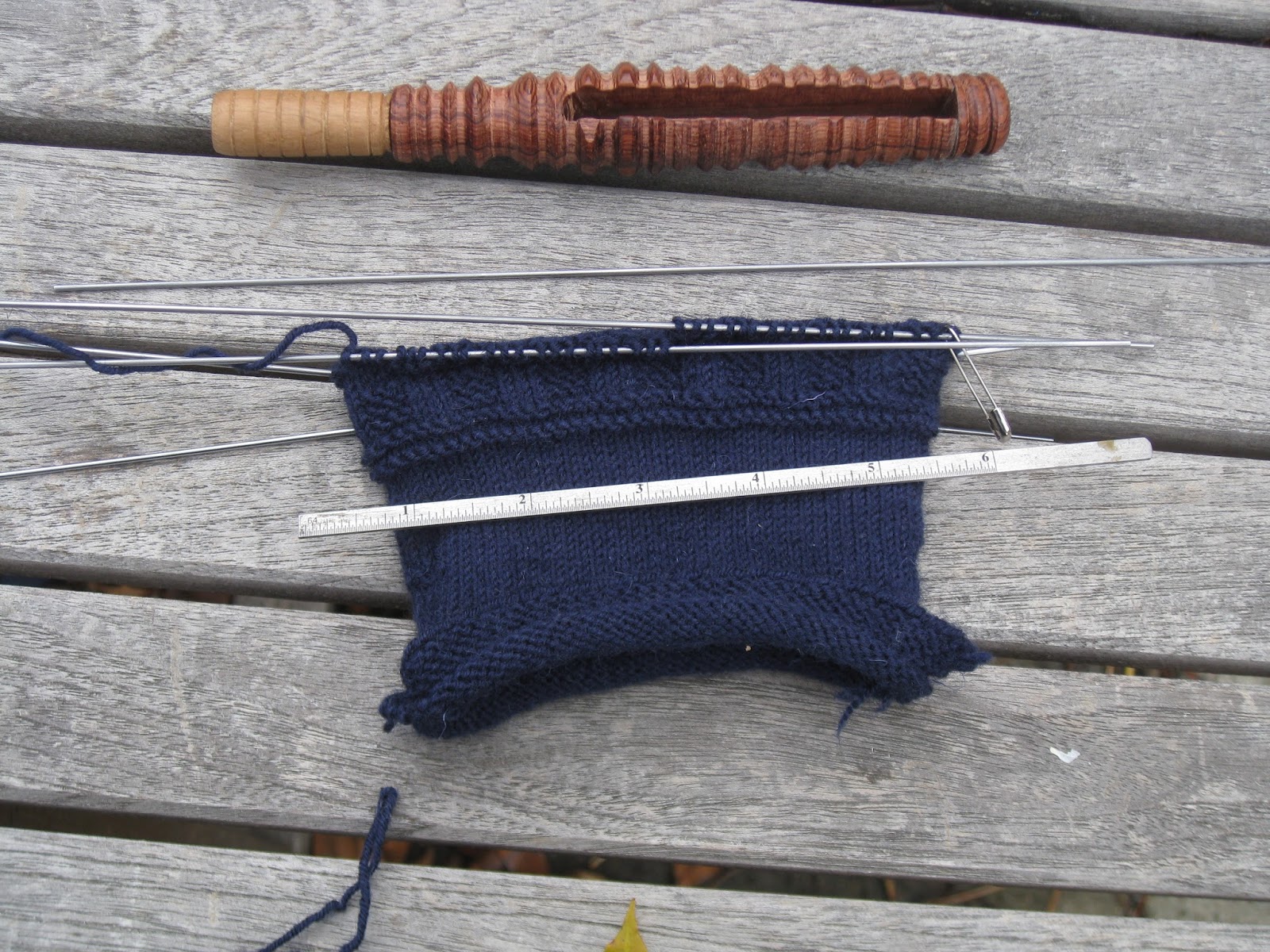
By lunch time, I was knitting my handspun replacement for Paton's 4-ply Beehive  on 1.25 mm  DPN.  Actually, the primary difference between it and the other worsted 20s that I have spun to make 6-strand 1650 ypp sock yarn is the fineness of  the wool.

For a "gansey", I think I would use the coarser 55 count wool, rather then the finer 60 count wool. The real question is whether the fabric from a 2,500 ypp yarn is worth the extra knitting effort.  I need to test some swatches.