Monday, March 05, 2012

Spinning Stash

Spinners brag about how big their fiber stash is.  Sometimes, they will even say that their fiber stash is so big that they have raw fleece that has been in their stash for months without being washed.

That is proof that they have not bothered to learn the basics of their craft.  It does not matter how they talk and brag, if a spinner stores dirty fleece for more than a couple of weeks, they do not know their craft.

If you are going to store wool for more than a couple of weeks, it should be clean.  Do not buy fleece that has sat dirty. Fleece that has soap or scouring compound residues on it is dirty.  Soap or what ever must be rinsed out of the fleece. Once the fiber is clean, it is easy to store for years. Yes, it will settle and pack and may need to be re-carded or re-combed, but it will keep well.

Wool that is being combed, carded or spun should be oiled (actually a gell of oil and soap).

After being combed, carded, or spun, the fiber prep should be scoured before extended storage

Good professional spinning practice for a thousand years has been to work with clean fleece.  Spinning in the grease does not produce as consistent or as good a yarn as can be spun from clean fiber.

Sunday, March 04, 2012

More on how I spin


Fiber gets combed, and then I diz off using a diz with a 3/32" or 1/16" hole.  


The sliver goes into a bin, and I wind it tail first on to my distaff. The sliver takes on 1 twist per wrap of the distaff, which holds it together.

I take the fiber off the distaff over its end, so it loses its twist and is ready to draft.


The sliver going into my drafting hand is much thicker than the tip of the sliver being drafted.  Tension on the sliver between my drafting hand and the distaff holds the fibers in alignment.

With the fiber approaching the drafting zone in close alignment, no "inch worm" drafting is required.  Fibers simply draft in what is very like a continuous attenuated long draw.  I use a very long drafting zone. Where there is a problem with the fiber prep, I may need to "back draft" a bit to maintain consistent grist. However, with good fiber prep, neither hand needs to move much, and the process is as fast as twist can be inserted, and the yarn wound on.  Since the maximum speed of  fliers on a treadled wheel is about 3,600 rpm, the limit for spinning 6,000 ypp  is ~ 12.5 yards per minute, and the limit for 12,000 ypp is just over 6 y/hr.  That means a good days spinning (on a flier) is about 5,000 yards per day for 6,000 ypp and 2,500 yards per day for 12,000 ypp worsted single. ( Actually, my rule of thumb is a hank (560 yards) every 2 hours regardless of grist.) If I want to go faster, I will get a motor spinner or a driven spindle.

All of this depends on having a bobbin flier assembly with the correct effective bobbin core diameter and differential rotation speed to insert the correct twist per inch of take up.

The flier/bobbin assemblies as they came from Amos had a differential rotation speed (DRS) of ~ 1.15 for spinning long draw woolen.  I made new bobbins with DRS in the range of 1.07 to 1.01 for spinning fine worsted singles.

This approach results in a very high quality worsted yarn, and it is very fast.  With well prepped fiber, 2,000 yards per day of 12,000 ypp worsted singles is easy.

The technique is easy, but you need to plan your tools to make it work.  

Oh, and I have moved to using grease rather than oil on my flier/bobbin assemblies. Grease stands up to the speeds I am spinning at better than oil.   I still use oil on the drive wheel and crank.

Thursday, March 01, 2012

A finer flyer

Last night Stephene Gaustad delivered a new #0 flier from Alden Amos.


The bobbin has this morning's play on it.  Note where the single crosses the dime.  I think not bad for ordinary fiber with an ordinary prep.

This is a flier that takes Romney fleece and turns it into frog hair.  I swore that I would never use that term, but there it is.  I guess I have "cobweb" on the brain today.

Will this flier spin finer than the Alden Amos  #1 production flier?  Stephenie tests both by spinning 40,000 ypp singles on them before they get packed for shipment, so Alden will not promise that either flier will spin finer than 40,000 ypp, but yes, this flier will spin finer.

However, for  spinning a lot of 11,000 ypp singles in a day, the #1 production flier is the tool of choice.  For situations where I need to spin very fine, this is the tool of choice.

Sunday, February 26, 2012

Bobbin Winder

I spin on a little spinning bobbin, and then I suck the spun yarn off  (technical term meaning wind off  : ) with a bobbin winder that is a bobbin stuck on a tapered dowel that is chucked into a cordless electric drill.  It is fast and it works.

At Stitches, somebody wanted a bobbin winder to wind off (Suck yarn off of) her little wheel.  I told her my solution and she said, "But I do not have a tapered dowel !"  So I went home and turned her a nice tapered dowel.

 However, This morning at the Chinese market a chopstick would work.  And they do!


Here I show use of wooden takeout chopsticks, but the cheap plastic re-usable are even better.

Monday, February 20, 2012

Spindle vs. wheels


I say, " wheels can be faster than spindles." That is not a value judgment, that is a demonstrable fact. Spinning slowly may be a meditative activity, like yoga, and I do not say that meditation is bad.  I only say that, "I want the most thread in the least time."

Humans use toys to learn skills. Toys are an essential good. Children use dolls to learn child care skills without endangering an actual baby. I used spinning toys to learn basic skills. The Traddy as it come out of the box was a toy.  As tweaked and fixed, it is a very fast wheel.  Playing with that wheel, taught me how to "fix" a wheel. That was good.  I used spindles with a wooden whorls to lean basic spindle skills.  That was good.  However, basic physics told me that there where ways of getting a (drop) spindle to go faster, and to spin finer.  I looked, and did not see such spindles on the market, so I made faster spindles myself.   (http://gansey.blogspot.com/2011/10/spindles-and-spindle-whorls.html )  Playing with wooden spindles taught me to make faster spindles that spin finer.  And, I will say that such spindles spin disconcertingly fast and are not suitable for beginners. I do not say they are better, I only say that they are faster and allow spinning finer.

How can anyone dismiss this technology without trying it?  I cannot patent it, this technology is at least 3,000 years old.  It was in use in the Highlands of  Scotland within living memory. And, it is in use in South America today.  Anyone that talks about South American spinning tools and does not mention removable metal whorls is not telling the whole story.

Spindle advocates say, that if I would just practice, then my spinning with a spindle would be as fast as my spinning with a wheel. OK!, let's assume that I practice until I have perfect spindle technique and my wind-on operations require zero time.

With respect to supported spindles, if one is spinning 6,000 ypp, then 5 yards per minute requires ~180 revolutions per minute. If one is spinning 12,000 ypp (110 wpi) at 5 yards per minute than one needs about 400 rpm on a sustained basis. That approaches the upper limit of hand spindling. Yes, you can get instantaneous speeds in excess of 2,000 rpm, but that is not the sustained average speed over a work day or work week. (Of course, the flier on a stock Ashford wheel cannot sustain such speeds either.)

However, I have fliers for my wheel that will sustain average speeds of more than 2,500 rpm. My wheel has produced more than 2,000 yards of worsted 12,000 ypp singles in an 10 hour day. No spinner with a spindle can do that. When we get to serious lace at 35,000 to 40,000 ypp (200 wpi), then a spindle will produce twist for a maximum of about 2 yards of single per minute, while spinning at my wheel,  I am still limited by my drafting ability to about 5 yards per minute.

The the numbers above dramatically understate how much faster a wheel spins compared to a spindle. If we look at reality, even the best spindle spinner must take some time to wind-on. Thus, in reality a hand driven spindle is very much slower than a properly setup wheel. Anybody that says differently, likely does not understand how to select and setup a wheel to achieve good spinning speed. Anybody that says differently should be ready, willing, and able to show that they can use their spindle to produce more than 2,000 yards of worsted 12,000 ypp singles in an 10 hour day. I am perfectly willing to show anyone how to hand spin 2,000 yards per day of 12,000 ypp worsted singles in 10 hours on a wheel. Let me use a Studio Gaustad Motor Spinner, and I can go much faster. The numbers above prove that no amount of practice will make any hand driven spindle as fast as a properly setup wheel (or driven spindle). This is not about me or you, this is physics.

People say that I do not like spindles and that is just not true. After I had a good, fast wheel, I put a lot of effort into finding a spindle design that allowed me to spin much faster than I could on the stock/standard wheels at a LYS. Given my choice of of those strictly stock wheels or a spindle of with a removable metal whorl, I would take the spindle because it is faster. However. let me put new bobbins on those wheels and do a couple of other tweaks, and suddenly the “fixed” wheels will be much faster than the spindle. Anybody that says a spindle is faster than a wheel does not know how to set up a wheel for faster spinning.

If we look at garment weight, worsted thread (9,000 ypp to 15,000 ypp) and consider ergonomic factors for a full time spinner over a period of years, then the wheel will spin a great deal more thread. In the 18th century, when all spinning was done by hand and there were huge numbers of full time professional spinners, it was a common rule of thumb that a spinner with a wheel could produce 7 times as much thread as a spinner with only a spindle – and that was a spindle with a removable metal whorl. To me, that number seem a little high, but it could be correct because professional spinning wheels in those days had two fliers allowing spinners to spin a thread with each hand. See for example http://gansey.blogspot.com/2011/10/double-flier-spinning-wheels.html .

I am old, and my wrists are weak. I must consider ergonomic factors. If I want as much thread as possible over my remaining years, a wheel is my best choice, but that is just me.

Saturday, February 18, 2012

Science, spinning, and illusion

For a long time, one of my jobs was to evaluate technologies, first for Bechtel and its clients, and later for the US Department of Energy.  Large capital investments and the health and safety of large numbers of people were on the line, so the reports had to be correct.

As I started spinning, I looked at the technology technology of spindle spinning with all of the rigor that years before I had applied to technologies related to disposal of hazardous oil refinery wastes and zinc refineries.

One of my conclusions was that the use of a half hitch as taught by Abby Franquenmont (and as she learned as a child in South America) limited the fineness of the yarn that could be spun with such spindles and/or limited the the size of the copp that could be managed.  I reported my conclusions below and somebody asked on a thread on Ravelry, if those conclusions were correct.  There was a lot of back and forth.

Abby had to defend her long held style of  spinning, so she set up an illusion, purportedly to test the physics, in the same way that 19th century snake oil salesmen purported to test the laws of medicine.

Her little test did prove two things.  Unless one takes special care, hand spun yarn is not uniform.  She should have taken Amos's class on spinning to a standard back in the days when it was offered.  The second is that when loosely spun wool singles are subjected to tensile stress to the point of failure, first the single stretches, then the fibers drift apart.  Every spinner that looks at what they are doing knows this.  Abby used this to present an illusion that pretended to be science.

Physics says that a half hitch will reduce the strength of a half hitch by about 40% in an  axial load, and this is based on the difference in load on the inside and the outside of the radius as the yarn wraps around itself  in the knot.  Abby choose a load direction that minimized the difference between the inside and the outside radius.  However, this is not the direction of the load that occurs during spinning.  This is physics, and in physics, the direction of the forces matters.  That is why we learn to use force vectors. Abby should  have paid more attention in physics and calculus.

If you have a fairly uniform wool yarn, tie an overhand knot in if and pull on both sides, the yarn will break at the knot.  However, with a half hitch the force on the spindle side of the line is reduced by friction as the yarn spirals down to the copp.  In the case of the half hitch  the failure starts at the knot and runs between fibers away from the spindle (and half hitch.)  The actual break occurs a few fiber lengths away from the knot.  Thus, the failure of the yarn appears to be 1-6 inches away from the knot depending on the twist, ratchet, and  staple length. This is indeed what Abby found.

I would say that Abby's little illusion absolutely demonstrates that a half hitch reduces the strength of  a woolen yarn, despite her attempt to minimize the effect by changing the geometry of the stress to minimize the knot effect.


Tuesday, February 14, 2012

Large needles

I like the fabrics produced by fine needles, and thus I have not been making the needles/adapters for large needles.  I have suggested that users of large needles can reduce the stress on their hands by simply dropping  down a needle size.  I was wrong, and I am sorry.

I do not do commissions, however my SIL's 60th birthday is coming up and she wants a cowl.  She has been asking for this for a couple of years, now she is saying that I must do it for her big birthday.  The pattern calls for large needles.  I got out my old cables and swatched. It did not look very good. I was up until midnight making adapters to use those big old  DPN in the bottom of the stash needles with a knitting sheath.

Next morning, sure enough, it looks my knitting again.

I will make adapters to use large needles with knitting sheaths. 

Thursday, February 09, 2012

Esty

I have stopped obsessing over spinning, and am again making knitting sheaths and needles that are listed on Esty.

There are some new tools in the shop and I have learned to do some things faster meaning that prices are down. 

Monday, January 16, 2012

First conceptual project

The start of the first conceptual project:  A Jersey

The yarn is 6-ply sport weight. The construction is cabled 3 X 2-ply.  Two plies are always gray Cotswold.  This gives a "silver sheen" to fabric. Then, two plies are white and two plies are brown. The brown accentuates the silver sheen.  Two plies are fine wool and two plies are "Shetland".  When the Shetland is white, then the brown is Rambouillet.  When the white is Cormo  then the brown is Jacob (very like Shetland). Thus, there are always 4 plies of  high luster wool in the yarn and 2 plies of finer, lower luster wool to contrast. Each yarn ball is ~ 2 oz. All plies are spun worsted.  About half of the plies are already spun.

The sweater will be knit in round, on 2.38 mm gansey needles. The fabric is smooth and dense but elastic. Garment will be a basic blouse, Plan 1 from Knitting in the Old Way. 

Wednesday, January 11, 2012

Thunder and lighting

Alden Amos has "FIXED" my wheel.  Now it is 10 to 15% faster, with measured flier speed in the range of 2,500 rpm, the disagreeable vibration at 1,600 rpm is gone, and it is like WOW! This flier reduces the effort to spin 250 yards of  11,000 ypp worsted single per hour from "moderate" to "easy".  Treadle effort is less. All from a new flyer/bobbin assembly.  Production of threads in the 40,000 - 50,000 ypp range is 4 or 5 times faster than I could mange with the stock Ashford DD flier.

We did not even touch the Mother of All. We are still using standard Ashford flier bearnings.  Alden made three bobbins for this flier, with DRS set for grists of 6,000, 11,000 and 50,000 ypp.  The price and wait was reasonable for such custom work.


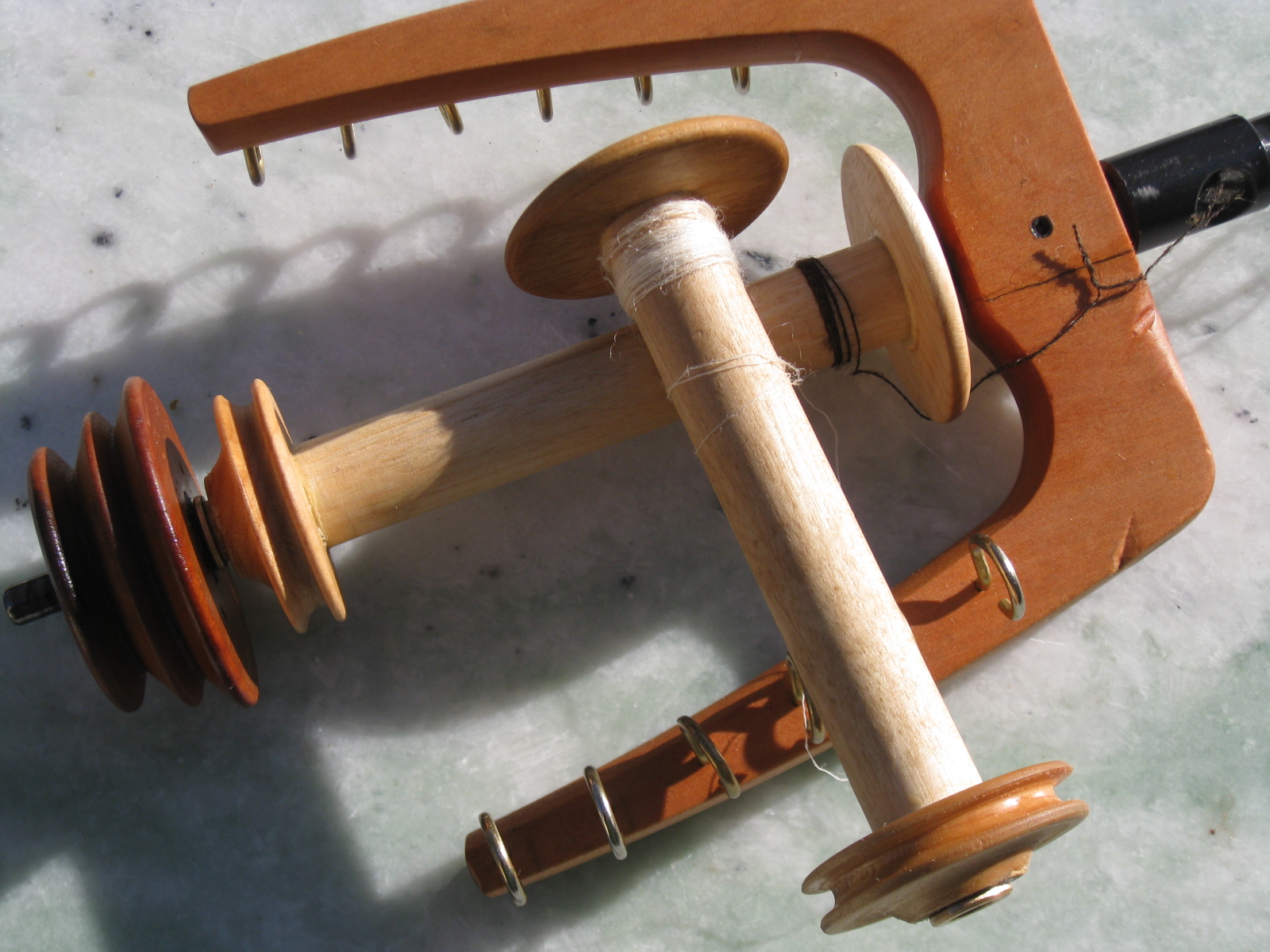
Flier/bobbin as made by Alden.
If I had this flier early on, I would not have spent so much time messing with drive bands.   Note that it was not the bearings that were the problem, it was the aerodynamics of the flier.  If you are going to spin at 1,000 rpm, you do not need to mess with all of this stuff (e.g., aerodynamics & drivebands), but it will take you all morning to spin 560 yards of  11,000 ypp worsted single.


 Single wound off  of a bobbin I made this morning.  
It is something of a pain in the neck,
 because it is a bit finer than the rest of the singles for this project.
The tachometer tells me the flier hit speed of 3,800 rpm while spinning this.

I out sourced the flier, because I cannot do dynamic balancing.  I can make a flier that will run at 1,000 rpm.  I cannot make a flier that runs this smooth, at these speeds. Flier/bobbin assemblies made by other wheel makers may be prettier and have fancier bearings, but they do not have the specific differential rotation speed (DRS) that I wanted. Alden Amos is the only wheel maker that I know, who really understands DRS.

Every design has compromises, and every designer weights those compromises differently.  Out of long experience with what people do to their spinning equipment, Alden's designs are conservative. Alden's designs always work, and they endure.  

Monday, January 09, 2012

Another video of spinning

Spinning a thicker, thread that can be seen more easily by the camera:

This is a Merdian Jacob fiber from a fleece I got in 2010.  I did a bunch of 2-ply jumper weight, and I am just spinning a bit more of what was on the bobbin, because it is thick enough to show on the camera.

The flier looks like it is going slowly, but that is a strobe effect from the camera shutter speed.  Actual flier speed is in the range of 400 to 500 rpm.

 DRS is 1.05 with a 5/8" bobbin core.

Again, this is spinning slowly for the camera.  Normally, I would be running the flier at more than 1,600 rpm

Wednesday, January 04, 2012

How I spin; A video

Here is a better video of how I spin. From over my left shoulder:

And from over my right shoulder:


The fiber is an indifferent prep of Shetland that somebody gave me, and I fixed.  The grist is in the 11,000 ypp range, and the flier rpm is ~500. Twist is in the range of 12 tpi. Twist and to a lesser extent, grist  is set by the DRS (~1.017 with a bobbin core of  ~5/8") of the flier/bobbin assembly.  Thus, I can switch bobbins, and bingo, I have right twist for 14,000 or 25,000, or 50,000 ypp.  All I have to do is make sure the grist is right for the twist. If I need other grists, I make other bobbins as in the last post.

The main thing is that this is a continuous process that produces a true worsted single. Note the use of a distaff.  The distaff is necessary to keep the fibers just behind the drafting zone aligned and parallel.  The fibers are fully aligned as the twist enters them. Of course, these video sequences are much slower than I normally spin, but you can see there is minimal hand motion, so that my hands can keep up when spinning much faster. This technique is a very fast way to produce a true worsted yarn.

These singles will get cabled up  into 8-ply (fingering) for a sweater.  I insert some slubs so you can see the progress of the single.  In the second video, the twisted single is invisible at this resolution. Sorry about that.

First new tools of 2012


I started off the year by making some new bobbins:

The one in the flier is for singles in the range of 11,000 ypp (20s) and the one on top is for finer singles (20,000 + ypp, 40s; these numbers have changed as I use different fibers, different fiber prep, and made better measurements).  These bobbins are a little lighter and the wider whorls allowing slippage for spinning finer yarns than the DRS would suggest.  On the other hand, that slippage slows everything down, particularly as speed increases and the aerodynamics of the flier start to consume significant power.  I do need a more aerodynamic flier.  (The oil finish is drying on one right now!)

They look small, but they will both hold a little over an ounce of  singles.  An ounce of 20s is 700 yards.  An ounce of 40s is 1,400 yards. Thus, I have no problem winding off full hanks of 560 yards from these bobbins.

The physical flier ratio is 22:1.

They took about half a day to make.  I bored 5/8" maple dowel with a 9/16" hole on their axis by holding them in the wood lathe.  I enlarged the axis boring at each end by 3/8" x 7/16" to hold the brass bushing bearings.  For the ends, I cut a 2" square piece of 3/4" maple stock, trimed the corners to ease the start of turning, and on the drill press, bored a 5/8" hole through the center. On the band saw, I cut the ends apart, one ~ 1/4" thick and the other ~1/2" thick.  I glued the ends on the core.  A couple of hours later, on the wool lathe, I rough turned the thin end, and then the thick end.  Then I finish turned the thin end, making sure it cleared the flier. Then I finish turned the whorl using the scrapers that I made last year and posted below.
The bushing bearings were inserted, and held in place with a dab of silicon adhesive.  A bit of sanding, some Danish oil, and they got left on the rack to dry while I made dinner for my wife.

Normally, I would let the core/ends-blank glue-up dry overnight, but this time, I got away with only ~ 2 hour set time.  

Sunday, January 01, 2012

Favorite tools of 2011

We went to Yellowstone last summer and saw everything.  There was a lot of walking to the geyser basins and waiting, waiting, and waiting for the geysers to erupt. I was knitting boot socks from hand spun Romney.  I had the whole knitting bag with me but one knitting sheath became the choice :


As I look at pictures of sailing this fall, there it is, always with 9" long, 2.38 mm steel DPN.  I will say that on some of those sailing trips, the needles got doused with sea water, and rusted. Everything was wet for a couple of days.  Still a bit of crocus cloth brought the needles back to perfect conditions in minutes.

There was a lot of sampling of series of yarns.  Many of these were done on a very light weight knitting sheaths tucked into an elastic pant waist band:


This one was made from redwood.  The redwood is much too soft to support the small steel needles, and hence needs a hardwood adapter, maple in this case.  Moreover, the redwood is too weak to hold interchangeable adapters tightly, and thus the adapter must be glued, and it is not interchangeable.  Just the tool to knit yarn hot off the plying bobbin.

And the winner:
My Ashford flier with standard high speed whorl (22:1) and a bobbin with a 5/8" core and DRS of 1.017  for spinning singles in the range of  10,000 ypp.  This has been a good setup for spinning singles in the 9,000 to 15,000 ypp range.  It is simple, inexpensive, and it works!  This rig will spin 11,200 ypp singles, faster, easier, and more consistently than any of the mass produced spinning assemblies.  Only Alden Amos' flier assemblies are faster.

Saturday, December 31, 2011

How Fast Can Someone Comb Wool?

These days, I comb Jacob at around a half a pound per hour. It is slower than Cotswold, but is similar to Shetland that many people comb these days.  Even a pound per hour is much slower than professional wool combers prior to 1850, but it is about as fast as I can go at this time. I could make myself bigger combs and work faster, but for the small amount of wool that I handle, it is not worth it.

My method is to start with clean oiled fleece, and give it a pass through the drum carder to make sure everything has been opened up and the oil distributed.


Then, I lash 3 or 4 ounces onto a large, single-pitch comb mounted on my combing bench, and use a 6” wide 2-pitch to comb off. Then, I mount the 2-pitch (with the wool on it) on the pad, and comb off onto a pair of 4” wide 5-pitch combs. Then, each 5-pitch gets combed off onto another 5-pitch, which, when full, is mounted on the comb pad, and combed onto another 5-pitch. Then, those combs are mounted on the comb pad, and their beards drawn off into short planks. If I work quickly, it only takes 6 or 7 minutes to get from carded fiber to 2 planks of an ounce (sometimes closer to 2 oz) each. (~3 hours hours to plank a sweater's worth of wool). The planks are arranged in a large bin.
When the bin is full, it is turned out on a table and the planks arranged for uniformity of fiber. The planks can be stored for a while
The planks get lashed onto 5-pitch combs, combed off, and then combed back (two complete transfers). This takes 3 or 4 minutes for between 1 and 2 oz. (22.5 oz /hr).
Then the beard is drafted off using a diz, and wound on the distaff. Total time to comb a sweater's worth, right on the close order of 6 hours. 
However, I suggest that the final combed and drafted fiber be used within a couple of weeks. That is, every few days, I take a few planks out of their bin, and final comb/draft them into slivers for the next few days of spinning.
For long wool, I skip the carding. The Romeny that I did last spring went faster, while the Rambouillet, Jacob and Shetland goes slower.
To achieve a reasonable rate, I had to make myself larger combs. On cold days, I warm the combs. I also use a spray bottle of water. See Peter Teal’s book for instructions. 
To get here, I had to time myself, and look for ways to speed up the process.
So, this lady said,"I've been wool combing for 5 years, I have five sets of combs, but I do not know if I have ever combed enough wool for a sweater."  My reply was, "If you have been wool combing for 5 years, then you should have combed about 5 tons of wool.  Me? I spent more than a hundred hours learning to card, and maybe 20 hours of making better tools and less than 20  hours of real wool combing.   I have big bins of wool to show for that effort.  In my book, just having combs in the closet does not count as time spent wool combing.  Nor, does having a spinning wheel sit in the living room count as spinning time.  


Sampling Cable plied yarn

This post is so important to me that I am going to Shout!


If you are spinning fine singles, it is worth doing a  series of exercises in plying/cabling.  If you have the singles on hand, it is easy to run up samples of  6, 8, 9, and 12-ply cabled yarns, and knit them into fabric to find the fabrics that you like.


I like my 2.38 mm needles.  These days, I make the yarns that I like to knit on that size needles. Knit on them, 6-ply cabled from 10,000 ypp singles makes a nice, skin-soft fabric.  It is warm, and elastic.  8-ply (1,200 ypp) makes a nice outer wear sweater. It is a thin yarn, it knits into a thin fabric - that is remarkably warm, and has wonderful drape.  This is not for sweaters that hang like bags.  It is for sweater designs that are worth all the work.


You are going to say, "Nothing is worth that much work to knit".  Look at your favorite knit wear (tee shirts, underwear, polo shirts, rugby shirts, and even sweat shirts), they are all knit from yarns with very fine plies.  If people wanted  fabrics from yarns with coarser plies, then  textile makers would use coarser yarns, (it would be much cheaper for them!) But no!, as a rule, for actually wearing, people like fabrics made from yarns with fine plies.  


I like quick and easy as much as the next fellow.  However, I find fine plies for the clothes I wear, worth the effort.


It is not very impressive, but here is  a photo of the first swatch that I did from 6-ply fingering Rambouillet (1,300 ypp):


 #1 needles on a swatch from hand spun 6-ply, 1,500 ypp yarn.


That bit of "nothing" was the confirmation of year's work. It was a proof of concept; fine plies work.  On the other hand it was the beginning of more work.  Fine plies ARE more work. Fine plies make good worsted worthwhile - that means I do enough worsted combing to get good (and fast) at the combing process.  However, the fabrics are wonderful.


When I started all this it took forever to comb a pound of wool.  However, I made some combs that help me  comb faster, and now, it takes me an hour to comb a pound of wool.  Anybody that cannot comb a pound of wool in an hour, is not trying.


I have said that it is not worth while for me to have fancy socks because I wear them out, and it is not worth while for me to have nice mittens because I lose them.  Well, it is worth while for me to have socks and mittens knit from yarns with fine plies because such fabrics are worth the extra effort.


Such fine ply yarns have become my standard yarn construction.  Here you see 2-ply Cotswold, Rambouillet, and Jacob waiting their turn to be cabled up into 6 and 8-ply knitting yarns. The needle is 2.38 mm.


Sunday, December 04, 2011

A Milestone: Competence in Spinning

In the early going, I read that "spin count" was the fineness that a competent spinner could spin a particular wool.  I then set my definition of a competent spinner to "being able to spin wool at its spin count."

Today, I can spin the common fleece at their spin count with reasonable confidence and ease.  In short, now I am a spinner.

 Learning to spin has been an obsession over the last year.  Learning to spin disrupted my life.  It was worse than learning calculus.  With calculus, there were very good texts and very good teachers to show the way.  Every physics, chemistry, and math grad student could do calculus, and were happy to parade their expertise in their role as teaching assistants.  However, try finding a spinning course where the objectives of the course include spinning singles at 50,000 ypp.  I do not know how many hand spinners can spin fine wool at its spin count, but it is not something that gets mentioned in course descriptions at fiber shows.

Everyone who reads this blog knows that I like yarns plied up out of 10,000 ypp singles.  What I have not talked about it that 30,000 ypp (Shetland) singles are remarkably strong and elastic.  Unless you have handled such singles, they are like nothing you have handled.  As 2-ply they (@15,000 ypp) they are as strong as the cashmere plied with silk yarns used for Russian lace, but they are more elastic.  If you want drape and flow, go with 2 plies of wool. The elasticity of the fine wool singles makes such lace wonderful.  It is not something that we understand anymore.  It is not a property that can be seen when the lace is mounted in a museum case.  It is something that you feel when you wear the lace. These hand spun yarns are much thinner, stronger, and more elastic than the commercial lace yarns.  However Shetland is not as soft and does not have the softness of the cashmere/silk lace yarn.  If you want just soft, go with the cashmere plied with silk.

Other wools can run a bit softer than Shetland, including  Rambouillet and Cormo.  These can be spun fine and plied into nice soft lace yarns. The finest Shetland is about as soft as very good Merino.  However, the Shetland is easier to spin very fine.  I think any competent spinner can spin the yarn for a nice wedding ring shawl.  Since you only need a couple of ounces of fiber, so you can buy the best fiber and still have an inexpensive project.

The idea of lace is all very interesting, but the real point of learning to spin fine was to be able to spin thicker yarns better.  For that alone, it was worth learning to spin fine.

It has also give me a very different view of how wonderful wool yarn can be.

Thursday, November 17, 2011

Seduced by the Soft Side

Now that I can spin finer and faster, softer wools are more attractive.  I acquired a couple of Rambouillet fleece.  Spun semi-worsted at just over 16 hanks per  pound (~9,000 ypp) and cabled into a 6-ply fingering (1,300 ypp @ 40 wpi), it is is perhaps the nicest knitting yarn I have ever worked with.

The fine plies give it strength and durability despite the fine, skin-soft fiber.  Knit on #1 needles at 9.5 spi, the fabric is thin, light in weight, but very elastic, and very warm. The elasticity was something of surprise. It is far, and away, the nicest fabric that I have ever knit.

Relaxed, the fabric is nearly weatherproof.  Stretched, it opens up and ventilates, making it very good for active winter sports.  It is like Helio, only more so.

Estimated time for me to spin/ply enough for a Jersey is ~50 hours, which does not count fiber prep.   You can buy nice Rambouillet roving for half the price of Jacob or Shetland.  Rambouillet is finer than Shetland and much longer than Merino, so it is nice to spin. And, there is a lot of it around.  Rambouillet is similar in fineness and length to Cormo, but this season Cormo is in fashion, so Rambouillet is a bargain. The thin yarn means that you need less wool. ( Less than 1.5 lb compared to ~ 2.5  lb for sweater designs using commercial worsted weight wool,  but this sweater will be warmer.) Well, yes thin yarn means there is more spinning and knitting - but is that really so bad?  I mean we like spinning and knitting soft fibers - right?  My estimated total time for a Jersey is on the order of  150 hours.

And, it is just in time, as I hear that Wingham's has stopped producing gansey yarn due to equipment failure.  It was one of the best yarns on the market and it will be missed.


Friday, November 11, 2011

WPI

There is a long standing convention in the textile industry on wraps per inch (wpi). Pack to refusal!  They wind the thread into a slot or gap and they pack to refusal.  (It is a gentle and careful packing that does not  deform the yarn.)  This results in an accurate and precise number that can be related to yards per pound (ypp).

Knitters on the other hand, when making wpi measurements wind their "wpi" loosely, (well not too loosely),  and they get a number that is "fuzzy".  See for example http://www.yarnfwd.com/tension.html  or http://www.hatchtown.com/tools/misc-tools/wpi-wraps-per-inch. It is a more modern method, but it will not give a precise and accurate number. And, it does not differentiate between worsted, woolen, and cotton/silk  It is a different culture. Then, they call the textile guys, "wrong" for using the old, precise method.  The only thing the fuzzy method is good for is putting the yarn in a Craft Yarn Council category.  And, that does not provide a lot of useful information. Particularly for somebody like me who is likely to be spinning fine yarns.  Trying to wrap 20,000 ypp singles (35s) loosely, but not too loosely, is an exercise in futility.   However, with the right gauge one can pack to refusal, and get a precise number.

So here is a solution. Use a gap gauge, wrap the yarn around it, and pack to refusal.  Then, for worsted add 10% and take the square of the number.  That will be a good estimate of the yards per pound.  For Woolens, add 16% and take the square of the number and you will have a good estimate for the ypp.  For silk and cotton add 7%, take the square of the number and you will have a good estimate for the ypp.  That is useful information.

Divide the number of wraps per inch packed to refusal by 2, and you will have a good estimate of the number that is defined as "wpi" by the Craft Yarn Council  and used by American knitters as "wpi.

If you have the yards per pound, take the square root and divide by 2, and you will have the knitters' wpi. Or, you can take the square root of  yards per pound, subtract 10 percent (16% for woolen, 7% for silk and cotton) and you will have the wraps per inch, which is the reciprocal of the thickness of the yarn. This gives the diameter of the yarn. This tells you something useful about the your yarn or thread.

In Judith MacKenzie 's the intentional spinner, she does not tell how to do wpi, but when we look at her projects we see that she says a  semi woolen yarn at 2475 ypp has 27 to 30 wpi; 1460 ypp has 18-20 wpi ; 300 ypp has 5 - 6  wpi.  She does not even try to get a number more precise than a range of 10%.  Shannon Okey's Spin to Knit,  on page 57 says that if  want to know more about grist, see Alden Amos's Big Book of Hand Spinning.  Well, Alden says, "Pack to refusal!"  Then Okey contradicts Alden on page on her page 126 by saying one can just wrap the yarn around a ruler.  No, that is not "pack to refusal".

This having two different measures in related fields, with the same name causes some confusion.  For example, yarn, that I say is 100 wpi, most knitters would call 50 wpi, and then they would say I do not know what I am taking about.  Well that is yarn spun at 22 hanks per pound or 12,000+ ypp.  I work with those kinds of threads every day.  Do they?  Measuring the yarn as 100 wpi tells me something useful about the yarn.  Measuring it as 50 wpi tell me that it is "lace weight", and I knew that without picking up a ruler.

Alden Amos gets it correct in his Big Book of Handspinning. I just wish that Alden had put in corrections for yarn construction and yarn fiber.  Then the wrap per inch  number in the table on his page 383 would be 7% to 16% less.    Peter Teal in Hand Woolcombing and Spinning gets it correct, and his Appendix III is the best conversion table. (However, he only addresses worsted yarns, and grist is stated in spin count.)  Better is scanned at http://www.cs.arizona.edu/patterns/weaving/books/pea_fa_2.pdf.


Wednesday, November 09, 2011

Oil it!

Few people,(including myself), oil their spinning wheel often enough.

It does not have to be much - a fraction of a drop is enough, but it needs to often.