Showing posts with label gansey yarn handspun knitting history. Show all posts

Monday, November 03, 2014

lanolin

Many, many modern knitters attribute the warmth of the old knit woolens to lanolin.  However, lanolin oxidizes, and then when it gets wet it has a nasty sheepy smell.  Lanolin also attracts moths.

Thus, modern mills remove lanolin from their yarns (mostly), and modern knitters use this as an excuse for not knitting warm garments.

The truth is that there are 2 aspects of knitting warm garments.  One is knitting tight, and the other is oiled yarn.  Except that there are many ways to get oiled yarn, baby oil works as well as lanolin but baby oil does not smell sheepy or attract moths.

That is, modern knitters use a lack of lanolin as an excuse to knit loosely.  And, they do not substitute other oils for lanolin. The result is that modern hand knit objects are not very warm.

Friday, November 01, 2013

Halloween

The tool of choice for spinning the weft is the AA#1 fast flier with the big bobbin Alden supplied and the 1.05 DRS flier whorl that I made.  That whorl works best with a 2-handed drafting technique.  However, last night I wanted one hand free, so I used the stock flier whorl that Alden Amos supplied.  It has a DRS of 1.2. This DRS  (with drive band slip), works much, much better for one-handed long draw.

That flier/bobbin setup and long draw is a more pleasant way to spin than my normal rig. I admit it.   If I was just spinning as a pastime, I would use the flier/bobbin set as it come out of the box from Alden Amos. My whorl turns hand spinning into real work.

However, I spin because I want the yarn.   I am willing to work so that I get yarn faster.

With the AA stock rig,  my no-load bobbin speed was the same as always.  However, under load, the speed dropped to about half of the speed that I get with my DRS flier whorl. Both have ~ 20:1 drive-wheel to bobbin ratio. It turns out that the advertised drive-wheel to flier ratio means very little, because these ratios say nothing about how much drive band slip occurs.  What counts is actual flier/bobbin assembly speed. Actual flier/bobbin assembly speed can be easily determined with an inexpensive tachometer.  If you do not have a tachometer, you will not understand why you cannot spin as fine and as fast as I do.

If it takes me 70 hours to spin my weft with my DRS whorl,  it would take me ~140 hours to spin it with the stock Alden Amos High Speed  (#1) DD  Flyer. It would be a pleasant 140 hours, but I want my yarn faster. Then the AA HSF is ~15% faster than my Ashford  (ST) lace flyer, so it would take me 160 hours to spin this project on the  Ashford lace flyer, more than 200 hours to spin it on the stock Ashford DD flyer/bobbin, and on the close order of 250 hours to spin it on my standard Ashford Scotch Tension flyer. This is not to say anything against Ashford, because I do not know of another wheel that would have been as easy to modify to increase its speed. (And, I did spin 5# of 5,600 ypp worsted singles on the stock Ashford DD flyer/bobbin Assembly.  That was 28,000 yd.  Then, I spun  a lot more as I started modifying the whorls.)

This little weaving project only  requires 25,000 yd of  (warp+weft).  Thus, on this one project alone, the modifications to my Traddy stand to save me ~ 130 hours.  A faster wheel allows me to do 3 projects in the time it would have taken me just to spin one project.  Tools matter.   Today, I see that if I am starting with a stock Ashford Traddy,  it will save me time in the long run to have a good fast wheel.  I understand that it is worth putting in a hundred hours to make my wheel run faster because I will make it up in one project.  I understand that it is worth the effort to make a faster drop spindle is worth while because I will make it up in one project.  On the other hand, I never let "perfect" be the enemy of good.  I seek better tools, not perfect tools.

If I had started with an Louet or Majacraft  wheel, I would not have the kind of speed that I have today because they are harder to modify and customize.  This is not "sour grapes, this is understanding the engineering and performance compromises inherent in such power transfer systems.

I have done these kinds of  studies before, but every time I calculate drive belt slip on typical modern spinning configurations, it is a little scary.

We made it past Halloween, so Happy All Souls Day!


Sunday, February 27, 2011

How long did it take to make a Seaman's sweater?

When I first asserted that knit "sweaters" were a regular part of a seaman's regular wear, I was told that they took too long to knit to be practical.  However, I have shown that using gansey needles and a knitting sheath such a weatherproof garment can be knit in well under a hundred hours.

Then, I was told that such garments could only have been made after the advent of mill spun because it would have taken too long to spin the appropriate yarn by hand. So, I got a spinning wheel and learned to spin.  In my tests, it is quite possible to hand spin worsted 5-ply (gansey) yarn, and it takes well under a hundred hours to prepare the yarn for one good seaman's sweater.  Thus, the total time from sheep to sweater for a hand-spun, hand-knit seaman's sweater is well under 200 hours.

Assuming uncoated long wool such as Kent, this includes, a day to wash the wool, a day to dye the wool, 16 hours to comb the wool, 50 hours of spinning and plying, and 20 hours of  "yarn management".  I am confident that the spinning could be done in this time on either a flier type spinning wheel or drop spindles.  Yarn management tools in my calculation are limited to niddy-noddies and hand wound balls.  Groups working together (i.e., neighbors) could reduce the required time substantially.  For example, 4 house holds working to together could easily dye 4 lots of wool in one day, reducing that time requirement by 6 hours.  Professional textile workers or well to do households would have had other tools to  improve productivity.

Never the less, it might well have taken 800 hours of hand labor (spinning & knitting) to produce the knit contents of a 15th century seaman's bag including: 2 knit frocks, socks, mittens, hood, and neck warmer. Some of these items would have to be renewed each year, and some would last for several seasons.  Some items such as fisherman's nipper's would have been cut from old socks. And, there would have been pants made of woven wool.  Seaman required specialized clothing to pursue their trade. This clothing was the seaman's tools of the trade,  like a blacksmith's forge and tools or a carpenter's tools.

In addition, the bag would contain clothes to wear ashore, as the clothes worn on-board would have become  highly soiled.


Thursday, July 22, 2010

Handspun gansey yarn

I have not posted for a bit, because I was learning to spin my own gansey yarn.

I had been told that NOBODY ever spun gansey yarn by hand because it was impossible.  The required plies were so fine that they could not be spun by hand and that it was impossible to ply 5 singles together by hand.

Well, lots of pre-mill spun woven cloth had very fine singles - that were spun by hand.  Plying 5 singles together is not that hard.

Thus, after a 3-month learning curve with my little Ashford Traditional, I am turning out my own handspun gansey yarn, and I am very impressed with its competence.

It is stronger and more durable than any of the modern commercial gansey yarns.  I spin it softer, so it is more friendly. It is warmer than modern commercial gansey  yarns.  I like it.

Why in the world would somebody bother to make a 5-ply yarn when it would be easier to spin 3 thicker plies? Well, 5-ply is warmer and more durable.  It is the compromise that provides the most warmth for the least amount of wool.  Given all the effort to prepare the fiber and knit, it is also the compromise that provides the most warmth for the least amount of effort.

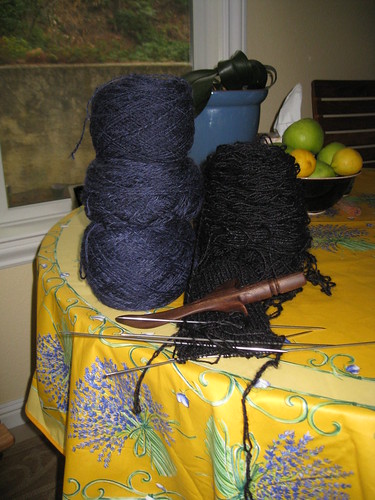
Here is the pix taken in November.  The blue on the left is hand combed, hand spun 5-ply at 16 wpi, and the darker yarn on the right is is 5-ply at 14 wpi being knit up as boot socks.

hand spun gansey yarn