Showing posts with label knitting needles. Show all posts

Saturday, April 21, 2018

Gansey Needles Revisited


I went to 18”, pointy gansey needles because that was the conventional wisdom on what was used to  knit fine ganseys, and I wanted very fine ganseys. It took me a long time to learn to make them really useful. Folks sold “gansey kits” of yarn and needles, but the long pointy needles are not useful without a knitting sheath that can be fastened over the right buttock.  The physics are strongly against hand held “gansey” needles.  And, long steel pointy needles have issues - I had to get bigger knitting bags to hold 18” knitting needles.  I had to make point guards to keep them from sliding right through the fabric of my knitting bags. And, pointy needles cause more wear on knitting sheaths.  On the other hand, the spring action of these needles driven in a vertical motion by the weight of my right hand, was the very fastest and easiest way I knew how to knit.

However, for the last few years, I have been making better knitting sheaths that can attach to a strong belt below the right elbow.  These sheaths can comfortably take the stress of flexing the 3/32” spring steel that I like for knitting cold weather gear.

Now that I am using blunt needles, less needle motion is required, and I can get the required motion from 12” needles.  The motion is still driven by the weight of my hand, so it is a very fast, low effort way of knitting.  I use 6+1 needles for a gansey to fit my ample girth, so the weight of a set of needles remains the same, but they fit in a much smaller bag, and because they are blunt, I do not have to worry about them going through the bag.  Overall, 18” needles are faster because there are fewer needle changes.  With long needles, if you have some space to spread out without poking someone with your needles, you can use vertical or horizontal motions that change the working muscle, without changing the fabric (with practice).  And, 18” US3 needles is the only way I know how to do good tight weatherproof Aran (10-ply/500 ypp) fabrics.
 
(If you are doing brioche stitch or lots of bobbles, stick with pointy needles and a not too splitty yarn.)

These days, I often use finer sock needles, so I can get almost the same motion from 9” needles, but the needles are soft enough to flex sideways (or vertically) with just the effort from the base of my thumb, opening up additional styles of knitting small objects. Since, I now use the same needle adapters for straight needles and swaving pricks, in a small knitting bag, I have the tools for a good variety of knitting styles that quickly produce good uniform knitting, for when I need to get a knit object finished quickly without over working one set of muscles/joints. If you are going to knit seriously, you need different knitting techniques that use different muscles, but which produce identical fabric. The shorter needles also allow knitting in the car or plane or boat.  Long gansy needles (even blunt needles) are not well suited to knitting on public transportation.

One can make a good pair of fine, warm socks in a couple of days. If you can get someone else to drive, you can get much of the work done on the ride up to camp.  And yes, I still think the motion of the longer needles is smoother. But swaving works very well even on rather rough roads.

In the old days, I often knit while walking and hiking – I saw the old pictures of people knitting as they walked and thought it was “cool”. After I discovered knitting sheaths and knitting belts, I found that knitting sheaths were not very good while walking, and I decided that hand-held needles could not produce the quality of knitting that I could make with knitting sheaths/knitting belts.  Thus, I gave up on knitting-while-walking. If I am going to knit, I sit or stand in one place. Knitting with a knitting sheath while standing does work fairly well.  In Jane Austin’s time (and before), women often had knitting sheaths in the form of jewelry stitched to the gowns they wore to social assemblies, so they could knit lace while they stood together and talked. The first time I went to the V&A, such knitting sheaths were only labeled as “jewelry”.  It is worth noting that Jane Austin did not knit.

Tuesday, April 17, 2018

Summary of knitting sheath technique as I understand it today

 Time to upgrade socks

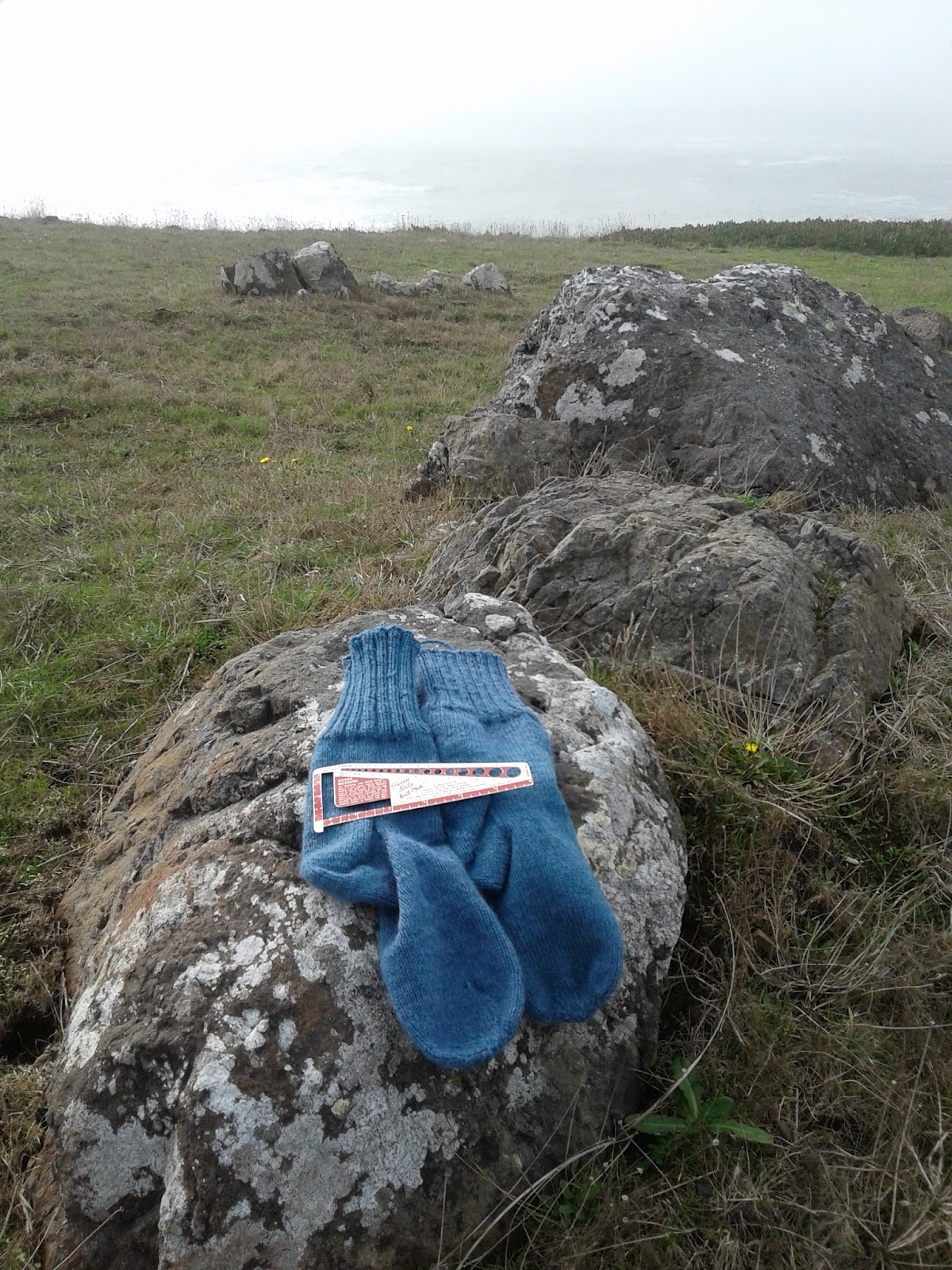
The right socks for the coming storm.

Blunt 9" US1 needles using commercial worsted weight yarn.

Anything that can be made, can be made better!  Anything that can be done, can be done better!

I believe in those two principles. I also believe that everything is a compromise. Doing something better, or making something better may not be worth the resources. "Good enough" may  be good enough! Knitting is a prime example.  Knitting is a group of compromises that I have not addressed in this blog since September 2016.

If I knit a fine weatherproof fisherman's sweater from a 5-ply "gansey"  yarn that I spin from raw fleece; scouring the fleece and spinning the yarn is only perhaps 3 days work, while the knitting takes 3 or 4 times as long as making the yarn. If want my sweater faster, I should focus on faster knitting.  I did.

The paths to faster knitting are thicker yarns, looser fabric, and - knitting faster. I like fine, firmly knit fabrics. If I want a cooler garment, I will knit it (firmly) from a thinner yarn. Thus, I focus on faster knitting.

To reprise, a long time ago, I learned to knit "American", on SPN; then friends said I could knit faster if I learned to knit "continental"; and, faster still if I moved on to circular needles. I wore out several sets of circular needles. I read about how fast the old professional knitters knit, and moved on to knitting belts and knitting sheaths. These were faster than circular needles, and allowed making fabrics that cannot be knit on hand-held needles - and specifically cannot be knit on circular needles.

Knitting belts remain as part of older knitting traditions that have survived to the present day, and we have a good understanding of the technology.  We know that knitting belts are best used with DPN.

Knitting sheaths did not survive as an active knitting tradition, so I had to reinvent the whole technology. At first, I thought that knitting sheaths were just an wooden (or metal or ivory or ceramic . . .) analogue of knitting belts. My early tries told me that knitting sheaths had real advantages.  They allow knitting very fast, producing very tight fabrics, and knitting with a minimum of effort in a very ergonomic manner.  These advantages were very apparent in my early, crude attempts.

Since knitting belts use DPN, I assumed that knitting sheaths also used DPN, and all of my early trials used DPN with various pointy ends.  I put a lot of effort into making pointy needles, and  making the pointy needles work with knitting sheaths was a lot more effort.  For years, the idea that knitting required pointy needles was fixed in my head.  Years after I started working with knitting sheaths, I started considering "swaving", where a curved needle is rotated into the working stitch. I thought, "Wow, this is something else!", and went into it with fewer preconceived notions.

I made curved, pointy, needles and they did not work. I made a lot of different shapes of bent pointy needles and none of them worked.  After much trial, and many errors, it became clear that blunt or even flat ended swaving needles worked very well.  Then, my knitting sheaths had to be redesigned to work with flat tipped needles.  None of this came fast. It was years of benchmarking and validating.

Swaving involves "popping" the working needle into the working stitch. Could I do the same thing with long straight needles? Yes!, but the knitting needle  needs to be blunt or flat ended. It turns out to be easier and faster than poking pointy needles into the working stitch. Are flat ended needles authentic?  Everybody that has acquired many old steel needles has come up with flat ended needles. Were they  were just old pieces of wire that had found their way into the knitting basket?  Now, I think that some (or many) of those flat ended needles survived from the days of knitting sheaths.  And, we have an account of  a professional knitter in the 1840s where in he makes a new knitting "needle" from a piece of wire in a few minutes by grinding it against a stone in the garden path.  I can tell you that it takes hours to grind a pointy DPN like that, but flat ended needles can be ground like that in a few minutes. No, it is pretty clear that those old knitting pins had flat ends.

The bottom line is that having made and used thousands of different needles and hundreds of different knitting sheaths, I have settled on knitting/swaving with blunt or flat ended needles.
Fisherman's sweater on blunt 12" US#1 needles from
handspun 4-ply (~1,000 ypp) with knitting sheath/needle adapter
(the curved needles are for swaving)

Sock on blunt 12" by 1.5mm blunt needles from
6-ply cabled worsted wool yarn (3x2) at ~ 1,700 ypp

Sock on blunt 9" US#0 needles from 
Paton's Classic Wool (204 meters/100 gr.)

"Needle" tips typical of what I have been making and using for knitting and swaving for the last few few years.


Friday, February 05, 2016

Old Needles

I was flipping through Weldon's Practical Knitter, First Series and got to looking at the drawings in the Details of Knitting. I noticed (with the aid of my linen tester) that the ends of the needles looked very much like the ends of the needles in sets of antique needles that I have.  Some are flat, some are pointy, some are blunt, and some seem to have just been cut with a wire cutter, leaving a sharp wedge at the end of the wire.

This suggests that artist doing illustrations for Weldon's used whatever needles were available as the illustrations were being drawn. Likely, the available needles were those owned and used by the knitters that knit the examples in the illustrations.

Since many of the cuts show needles with rounded or blunt or flat ends, and flat or rounded ends do not work nearly as well when hand-held as when used with a knitting sheath,  and blunt needles work better then pointy needles with a knitting sheath,  I  deduce that many of the fabric samples were knit using a knitting sheath. Then, the fabric and needles were held in the Weldon fashion as a model for the illustrations.  After all, knitting sheaths were tools of professional knitters, and the artist was likely to hire professional knitters to make the knitting samples and then use the same knitter as the hand model.  Oh, yes, objects like the Ladies Knitted Under-vest, Child's Shetland Sleeveless Vest were clearly drawn from real models, and it would have taken a professional knitter or group of professional knitters to produce the examples of the various articles to meet the publishing schedule.

Thus, I conclude that the various knit objects illustrated in Weldon's were in fact knit using knitting sheath(s) and were not knit using hand-held needles as shown in the illustration. In comparison, I would say that the examples in Mary Thomas were knit with hand held needles and those in Gladys Thompson were knit with a knitting sheath.

Sunday, January 10, 2016

A revised taxonomy of hand knitting

An outline of Hand Knitting to be expanded and extended, this is a post in progress.

Hand knitting is a process where an array of loops of yarn forming a textile are held on one mandrel, and a second mandrel is used to add loops of yarn to extend the textile. In the process, the mandrels act as levers to manipulate the loops of yarn. Hand knitting can be organized by the relative orientation of the levers, the available mechanical advantage, and the diameter of the mandrels.

A higher mechanical advantage means that one can knit faster with less effort.  Less effort allows longer knitting sessions so much more knitting can be accomplished.  Less effort means less stress on the hands and wrists and thus less damage to the hands and wrists during extended knitting  or repeated knitting sessions. In knitting leverage determines the mechanical advantage, and hence speed of knitting, stress on hands and wrists, and type of fabrics that can be produced.

The orientation of the levers determines the nature of the looping process.  The diameter of the mandrels determines the fineness of the resulting textile.  These characteristics do not define the systems, but rather allow ranking them along various different continuum.

Knitting needles in the commercial market place for the last century have mostly tapered to a (rounded) point.  Nevertheless there are several lines of evidence suggesting that in the past, blunt knitting "needles " were used.  Physics/engineering suggest that blunt knitting needles have significant advantages when adequate leverage is is available to open the working stitch.  With hand held needles the wedge of the point being pushed into the working stitch provides additional mechanical advantage to opening the working stitch. On the other hand, holding a fine needle firmly to put it into the stitch is a major problem in the ergonomics of hand held knitting with fine needles. 

In the past, knitters tended to use much finer knitting needles, sometimes referred to as knitting wires or just "wires".  Since I am moving to finer, blunt knitting tools,  I am going to call them wires (W).


Hand knitting with double pointed needles (DPN)
    1. Generally pointed needles (Hand held knitting with blunt needles is perfectly possible, but it requires keeping a correct angle between the needles, which is different for each stitch, so it requires a particular set of skills, which are not commonly taught.  When used, blunt needles can improve speed, but increase effort.)
    2. Both needles supported with hands Working needle must be griped firmly so it can be pushed into stitch, or to resist the left needle pushing the working stitch onto the working needle.  Bracing the needles against the forearm as Mariam Tegels  improves ergonomics.
    3. Yarn feed controlled by right hand, or left hand or looped around neck or with pin on chest
    4. Use of needles longer than 12" is awkward (Trying to hand-hold long gansey needles is an exercise in frustration. (However, with a knitting sheath, gansey needles are the fastest and easiest way that I know to knit large objects.)
    5. Needles generally stiff, or used as if stiff
    6. Either hand may control the yarn, or yarn may be looped around neck or through pin on chest
    7. Poor ergonomics
      1. motions by small muscles of hand/forearm
      2. large motions - must exceed distance of taper on needle tip
      3. available leverage ~ 1:3
      4. ergonomics can be improved by using longer needles and bracing the working needle against the forearm and then using upper arm/shoulder muscles to drive working needle
    8. Least expensive knitting tool kit
    9. Suited for coarse and loose fabrics
    10. Typical needle sizes are larger than 2 mm
    11. Knitting speed is slow
      1. knitting motion must exceed taper on pointed needles
      2. motion is effected by small muscles
      3. Irish Cottage and other flamboyant knitting styles increase required motion range requiring more effort.
      4. limited leverage
    12. Pointy needles are a hazard for small children
Hand knitting with circular needles
    1. Generally pointed needles ((blunt needles not commercially available)
    2. Both needles supported with hands
    3. Yarn feed controlled by right hand, left hand or looped around neck or with pin on chest
    4. Poor ergonomics
      1. motions by small muscles of hand/forearm
      2. large motions - must exceed distance of taper on needle tip
      3. available leverage ~ 1:3
    5. Compact knitting tool kit
    6. Suited for coarse and loose fabrics
    7. Typical needle sizes are larger than 2 mm
    8. Knitting speed is slow
      1. knitting motion must exceed taper on pointed needles
      2. motion is effected by small muscles
      3. Irish Cottage and other flamboyant knitting styles increase required motion range requiring more effort.
      4. limited leverage
    9. Safer than DPN
Hand knitting with single pointed needles (SPN)
    1. Generally pointed needles  (blunt needles not commercially available)
    2. Both needles supported with hands
    3. Yarn feed controlled by right hand, left hand or looped around neck or with pin on chest
    4. Use of needles longer than 12" awkward, Alternatively a flexible cable can be attached to the end of the needle
    5. Needles generally stiff, or used as if stiff, some needles have flexible ends (e.g., cords)
    6. Poor ergonomics
      1. motions by small muscles of hand/forearm
      2. large motions - must exceed distance of taper on needle tip
      3. available leverage ~ 1:3
      4. suited for coarse and loose fabrics
      5. typical needle sizes are larger than 2 mm
    7. Knitting speed is slow
      1. knitting motion must exceed taper on pointed needles (more distance to travel results in slower knitting)
      2. motion is effected by small muscles
      3. Irish Cottage and other flamboyant knitting styles increase required motion range requiring more effort.
      4. limited leverage
    8. SPN may be safer than DPN?
Hand knitting with wires and knitting stick (Knitting sheaths, knitting pouches, and gansey knitting represent a continuum of more than a dozen knitting techniques. These techniques allow production of fabrics that cannot be reasonably knit with the above hand -held knitting techniques. Effort is delivered by the whole hand pushing against a lever, so the ergonomics are good and the potential effort can be very large.

Frankly, as I first worked out the details of using a knitting sheath/knitting stick, my response was: "This is wonderful, why didn't anyone tell me about knitting sheaths?" My second response was, "WTF, WHY DID NOT ANYONE TELL ME THAT THERE WAS AN EASIER WAY TO KNIT!!"  Consider for example the picture on pg 18 of Nancy Bush's Folk Socks (1994).  The subject is a woman using a knitting sheath to knit socks, but Nancy Bush does not mention the knitting sheath; she simply captions the photo, "Girl knitting on West Pier, Whitby".

Mary Thomas's Knitting book discusses and dismisses Knitting sheaths and knitting belts as artifacts of history.  The only modern book to discuss knitting sticks as important to knitting is Mary Wright's Cornish Guernseys and Knit-frocks.  And, Wright does not address how the various techniques are/were performed.  Rutt mentions the techniques with photos, but does not recognize that use of a knitting sheath/knitting belt allows production of  fabrics that cannot be reasonably produced with hand held needles, or that such improved the ergonomics and speed makes commercial knitting feasible.
A fine, skin soft fabric,
with excellent warmth and minimum weight and bulk.
Produced with knitting sheath and wires
3-ply fingering weight (1650 ypp) 
knit on 1.5 mm wires 
gauge is ~150 stitches per square inch
    1. Wires generally short and stiff (however can be used for wires as fine as 0.5 mm that are very flexible)
    2. Wires may be either blunt or pointed
    3. Knitting stick supports working wire
    4. Knitting stick may damage fragile needles
      1. fine needles should be solid metal
      2. larger needles may be wood, bone, or tubular metal
    5. Works best when needle/wire fits needle hole closely, however a skilled knitter can work with a very loosely fit wire
    6. Knitting stick moves with needle (e.g., goose wing pivots on hip)
    7. Excellent for small objects such as hats, socks, mittens and gloves
    8. Good ergonomics
      1. motions by large muscles of upper arm/shoulder and transmitted to hand by large tendons/ wrist may be kept straight
      2. available leverage is between 1:20 to 1:50
      3. versatile tool kit for knitting
    9. Knitting speed is good
      1. blunt wires used to reduce required motion
      2. good leverage is available for rapid motion
      3.  suited for all needle sizes 
    10. Can produce weatherproof fabric from a single worsted spun yarn (or can greatly facilitate Fair Isle and other 2-yarn techniques)
    11. Steel needles can be used to knit metal wire 
    12. Various kinds of knitting sticks can be improvised or bundles of straw or feathers tied with yarn can be tucked in to a belt.
    13. Needles fixed in knitting stick can be a hazard if small children are around
    14. Perhaps hardest part of learning, is learning how to properly place and hold the knitting stick in place.  Knitting stick is at waist on right side of body or over the point of the right hip depending on the length of needles used.  Work area should be directly in front of knitter.
Shetland knitting  
Again the use of knitting pouches is ignored in modern books on knitting.  In the photo, on pg 45, of Poem in Color, knitting in the Bohus tradition, by Wendy Keele, the knitting pouches of several knitters can be clearly seen. In the photo of Annika on pg 34, she is likely using a knitting pouch, and yet Keele does not mention knitting belts despite extensive details about the work.

Use of a knitting pouch or knitting sheath makes Fair Isle and twining techniques much, much easier.
    1. Uses leather knitting pouch usually stuffed with horse hair is used, however other cultures use woven mats and the physics is the same.
    2. Needles may be either blunt or pointed, but must be "double pointed"
    3. Knitting pouch is used to support the working wire
      1. leather belt is gentler on needles than a knitting sheath, better for use with wooden, plastic, and tubular needles.
      2. needles may be either short or long
    4. Wires may be either stiff or flexible
    5. Good ergonomics
      1. motions by large muscles of upper arm/shoulder and transmitted to hand by large tendons/ wrist may be kept straight
      2. available leverage is between 1:20 to 1:100 depending on needle length
    6. Most versatile tool kit for knitting 
    7. Knitting speed is excellent
      1. blunt wires may be used to reduce required motion /increase speed
      2. good leverage is available for rapid motion
    8. Excellent for Fair Isle and lace 
    9. Can produce weatherproof fabrics via Fair Isle or "weaving" or twining/ twisting
    10. Suited for wire sizes smaller than 4 mm
    11. Excellent for knitting in a car or on an airplane
    12. Needles in pouch can be a hazard if small children are around
Spindrift (~2,100 ypp)
knit on 1.75 mm (pointy) needles into
 a light weight, low bulk, elastic, warm fabric.
The yarn band recommends 60 stitches per square inch,
that feels loose to me,
 I like it at 192 stitches per square inch. as shown above. 
Last night at Alpine Meadows, it was snowing hard, with 96 mph gusts of wind.  
Welcome to El Nino 2015.

Gansey knitting  is a powerful form of hand knitting.  For example, commercial 5-ply gansey yarn can be reasonably knit using hand held needles at stitch densities of 80 stitches per square inch. but with gansey knitting techniques, such yarns can be reasonably knit at 120 stitches per inch. Such high density fabrics are unbelievable warm (without bulk or weight) to anybody that only knows the fabrics knit with hand held needles or frame knit, or store bought. Such fabrics work best when "knit to fit".   Small details in fit hugely affect the warmth of such objects, thus bespoken objects can be much warmer than ready to wear objects, and this is likely the origin of the myth that hand knit is warmer than store bought.  The truth is that densely knit objects that are knit to fit are warmer than store bought. Gansey  knitting was used for industrial scale knitting of objects for export. Today, commercial hand knit objects are knit at a looser gauge using knitting pouches.

I would call, all objects knit with long needles that provide great mechanical advantage  "traditional gansey knit".

Nevertheless, I can knit fabrics with a  knitting sheath that I cannot knit with a leather knitting pouch. Knit from fine woolen yarns they seem magically warm.  Knit from fine worsted yarns they are silken smooth.  Knit from coarse worsted yarns, they are extraordinarily durable. Quickly knit from coarse semi-worsted yarns, they are cheap.  As garments, they can be too warm for centrally heated environments such as modern transportation, homes, shops, or churches. Or, fine (fingering or 0 lace) yarns can be gansey knit with fine wires (0.8 mm into very thin fabrics that are light weight, cool and so delicate as to be trnaslucent. Gansey knitting can reasonably produce all of these diverse fabrics.
    1. Wires may be either blunt or pointed, but must be DPN
    2. Wires are flexible and part of knitting process is driven by the spring return of the needle (steel springs are faster than muscles) (required flex less then 5%)
    3. Wires are long
    4. Wires are held in the knitting sheath by friction caused by the needle being flexed out of the axis of the needle hole in the knitting sheath/ when flex is relaxed, needle slides in and out freely/ less need for needle to fit needle hole
    5. Knitting sheath may damage fragile needles 
      1.  steel needles may be bent 
      2. fine wooden needles will likely break
    6. Suited for fine, tight knitting 
    7. Can produce weatherproof fabric from even worsted spun yarn.
    8. Fastest way to knit large objects
    9. Excellent ergonomics
      1. motions by large muscles of upper arm/shoulder and transmitted to hand by large tendons/ wrist may be kept straight
      2. available leverage is between 1:20 to 1:100
      3. some motions produced by return spring action of spring loaded needle
      4. Knitting sheath is placed over right buttock, and working needle arches forward under right armpit into the work zone.  Right arm rests on needle, and larger needles help support right arm.( place holder for motions/ different motions for pointy and blunt ganesy needles)
    10. Can be used with any size needle (fine needles are metal/ large needles are wood or other)
    11. With an Aran weight or Lopi yarn, and 2.25 mm blunt gansey needles, one can knit a weatherproof fisherman's sweater in a week. For example; my old gardening gansey of  MacAusland heavy 3-ply Aran weight was weatherproof at 63 stitches per square inch and  the Lopi below forms a weatherproof fabric at only ~60 stitches per inch.   This is  between 2 and 4 times as many stitches per square inch as many Aran/bulky/Lopi yarns recommend.
    12. Knitting weatherproof fabrics is ferocious work, but no other hand knitting technology can produce such warm fabrics so fast.  These fabrics are more stable and stronger than felt and more flexible with better drape than felted knitting.
    13. Long needles are not suited for knitting in cars/aircraft.
    14. Possible hazard with small children around
      1. Weatherproof gansey fabric 
        ~120 stitches per square inch
        knit from 5 x 2-ply =  10-strand, 1,000 ypp worsted spun yarn
        gansey knit on 1.5 mm wires with knitting  sheath
      I made a lot of that black 6-strand/ 1650 ypp sock yarn,
      This sock is being knit on 1.5 mm gansey wires with sheath
      at a gauge of 192 stitches per square inch.
Swaving
    1. short needles (called "pricks")
    2. stiff needles
    3. curved needles
    4. needles rotate in knitting sheath (needle holes are often lined with metal or entire knitting sheath is often made of ceramic or metal, needle hole often needs lubrication)
    5. needle must fit the needle hole very closely, and lubricant often needed
    6. very good ergonomics
      1. motions by large muscles of upper arm/shoulder and transmitted to hand by large tendons/ wrist may be kept straight
      2. compound leverage results in very high total leverage
      3. stitch finished by return spring action from stretched fabric (produced fabric must be tight enough to be very elastic)
    7. fastest way to knit small objects
    8. can produce very fine fabrics
    9. suited to needles smaller than 3 mm
    10. tools can be used like a knitting stick; However,  best speed is achieved with both hands making a very small, but powerful simultaneous motions down and together that pops the working prick into the working stitch, AND loops yarn over the working needle. Alignment and range of motion of pricks is controlled by rotation of the right prick in its knitting sheath. When the stroke is finished, the tension in the fabric pops the prick out of the stitch as the side of the right hand hits the bend in the working needle, sliding the finished stitch off holding needle.
It was swaving the moved me toward knitting with blunt wires.  It took me about 7 years to work out the details of swaving.  For example neither the bent needles in Rutt, or the bent needle in the Victoria and Albert collection works well for swaving.  The bend that does work is:

Swaved sock in  progress
from 6-strand, 1650 ypp yarn
on 2.0 mm pricks
knitting sheath with swaving adapter shown
needle adapter has brass bearings to allow easy rotation of the working prick


Perhaps, what I should say is that I see many knitters using "make do" tools, and one may be able to swave with the tools in Rutt or the V.and A. but those tools are not likely good enough to be the primary production tools of a commerciall operation.  It is worth noting that one can one can knit the legs of hose on long gansey needles and swave the ankles/feet with no change in gauge.  

Anyway, it took me ~7 years to work out swaving, then I had to swave for a couple of years, before I had the idea that I could "pop" blunt gansey wires into stitches. My first response was "This is wonderful, why didn't anyone tell me about blunt needles!"  At this point, I have been using blunt gansy needles for about 2.5 years.  For, the last few months, I have been grinding the points off of my finer needles. Thus, as of now, I have been working with various kinds of blunt knitting tools for more than 10 years.  A  couple of days ago, I ground the points off of my 0.8 mm wires. Subsequent swatches tell me that this opens up a whole new class of fabrics to reasonable hand knitting.  As I knit more and more with finer and finer blunt  wires, my first response is "This is wonderful, knitting fine fabrics can be easier!"  My second response is, "Whiskey Tango Foxtrot, Why does everyone use pointed  knitting needles?" Because they do not use knitting sheaths. 

Rutt's worst mistake was regarding pointed knitting needles. If you are going the knit replicas of the best objects in Rutt, then you will need fine knitting wires - and a good knitting sheath.

I suggest that the core of better knitting is making better fabric.  I suggest the better finishing techniques are better done on better fabrics, otherwise one is "just putting lipstick on a pig".  I suggest that knitting fast enough to get the project done is important.

Whiskey Tango Foxtrot


Knitting heart
    1. small knitting sheath sewn or pined to clothing to hold fine needles for knitting lace.
    2. fine, pointed needles
    3. medium length needles
Basque Knitting
    1. uses two or more needles with hooks in one end
    2. good for knitting while walking.
    3. good for coarse, loose fabrics
    4. good ergonomics
Pit knitting and "crease knitting"
    1. holding a knitting needle in the arm pit or tucked into the crease of the thigh (normally SPN) 
    2. Various kinds of pads and needle holders may be used
    3. needles may be either SPN or DPN
    4. mechanical advantage is greater then hand held needles, but less than knitting stick/knitting belt/knitting sheath
    5. Grip on working needle can be less, so is more ergonomic than hand held knitting
    6. needle placement is not as precise as knitting belts/knitting sheaths or knitting sticks


Friday, June 13, 2014

Knitting Pins

These days, my default knitting needles are ~1.6 mm in diameter.  I have them in 10", 12", 14" and 18" lengths. I have them in stainless steel and spring steel.  I think they are a tool form worth studying.

These days, I am spinning worsted 5-ply @ 1,000 ypp. The yarn and needles go together like bread and butter at tea time.

I always use them with a knitting sheath or Shetland knitting belt.  Without the support of a knitting sheath or knitting belt, they are slow and awkward -- not worth the effort.

The knitting method(s) are not so straightforward for somebody accustomed to stiff sock needles.  The tip of the working needle is slid into the working stitch, and the yarn looped, the tip popped out of  stitch, and the stitch popped off the end of the needle.  Of course, that much is obvious.  What is not obvious is that the needle motions are made by flexing and bowing the working needle.   The knitting sheath and leg of the working stitch are fulcrums, and the needle flex is driven by either pressing the needle with the upper wrist or the ball of the thumb.

Why no video?  The flex is small and does not really show up in a video without super imposed graphics. However, the flex changes the angle of the tip and seems to be important in keeping the looped yarn from coming off the needle tip. It might be that more carefully crafted needle tips would also help., I do  regrind the the commercial needle tips.  As supplied, the commercial needle tips worked, but the reground needle tips are better and result in faster knitting with fewer dropped/split stitches. And in these fabrics, dropped/split stitches are a pain in the neck to fix.

The motions are very small, very gentile, and very easy on the hands.  It allows knitting a very tight fabric with minimum stress on the hands.  Over all, I do not think the process is a fast as gansey (long spring steel needles rigidly fixed in a knitting sheath)  knitting because it requires 2 hand motions rather than the single motion of gansey knitting, but it is very easy on the hands and reasonably fast.

I had to spend some time working with the more flexible tubular stainless steel needles to work out this technique. Once I understood the motions, I could do it with the spring steel needles, and in fact it is faster with the spring steel needles. However, with the spring steel needles there was more of a tendency to treat them as rigid needles.  Certainly, I can knit with rigid needles, but that is not always the fastest way from yarn to finished object.

If, when I made my first knitting pins, somebody had told me, "Oh, there is a faster and easier way to use them", I would have put in the effort to work out these techniques years ago.  However, nobody said, "Use a knitting sheath or knitting belt and a whole range of knitting techniques using needle flex open up."

Oh, and the techniques works for 1.3 mm needles on sock yarn. And, using 1.6 mm needles on sock yarn produces lovely fabrics suited to summer evenings.   If I were knitting a gansey for my wife, I might use 1.9 mm needles with 5-ply to produce a softer, more elastic fabric. (She does not sail in foul weather.)

I like the tubular stainless steel needles because they are light weight. they are less likely to slide out of the knitting and they are less likely to leave a ladder.  The spring steel needles are likely a bit faster and more durable.

Thus, today, I would not bother to use my 2 mm to 2.5 mm  long spring steel needles to produce weatherproof fabric. I still think that the spring action of long steel needles is the very fastest way to knit large objects. I  used those needles to make weatherproof fabrics because I hand not figured out how to make such tight fabrics using thinner, more flexible needles. Now, I know, and now you know it can be done and  have the clues to reverse engineer the process.

My current list of different knitting techniques includes:

1a) short, stiff needles held in the hands used with  pitch / yaw motions with yarn in either right or left hand (include conventional sock needles, cable needles, Weldon, Irish Cottage, lever, and all the common modern knitting techniques)
1b) short, stiff needles used with knitting stick
2) hooked needles used with an accordion motion (Portuguese)
3) long spring steel needles fixed in a knitting sheath and flexed into the stitch (gansey knitting)
4) long stiff needles used with Shetland knitting belt
4b) long,  needles tucked in a skin crease or under the arm
5) curved needles that rotate in the end of the knitting sheath and roll/are popped into the stitch, and the spring of the fabric pops the needle out of the stitch  and then the stitch off the end of the needle. (swaving)
6) fine, flexible needles held in a knitting sheath or knitting belt that are bowed/flexed in and out of the stitch

notes

  • technique 2 is good for knitting while walking
  • technique 3 is almost certainly the fastest for knitting large objects; finer needles can be used with finer yarns to produce  fine, soft fabrics at a reasonable pace
  • techniques 3 and 4 differ by the source of the spring action.
  •  technique 5 has no peer for knitting fine gloves

  • technique 6 differs from 3 in that  3 uses a single fulcrum, while with T6 both the leg of the working stitch and the knitting sheath/belt act as fulcrums so that there is a compound lever/spring action
  • technique 6 allow production of fine, dense fabrics  at a reasonable pace


Thursday, June 12, 2014

Average Yarn

Mostly, I spin average yarn.

The knit fabrics that I like are warm, durable, and elastic. My path to such fabrics is mostly via hand spun yarns with 5 or 6 plies or strands.  Yarn grist runs from fingering weight to sport weight. I knit these yarns firm enough  that they drape rather than hang,   These days,  I am pretty much spinning the yarns that I wanted when I bought my wheel and started spinning. And, I am spinning them at what I consider a reasonable rate.

Worsted spun, sport weight,  5-ply requires in the neighborhood of 54 twists per inch of finished yarn (9 tpi in 5 singles + 9 ply tpi).  In contrast, woolen spun, worsted weight,  2-ply requires perhaps 15 or 20 tpi of finished yarn.  Thus, my average sweater weight yarn requires more than 3 times the twist of the average sweater weight yarn of many hand spinners.

To make such high twist yarns practical, I have to spin faster. On average, I can spin a hank of 5-ply gansey yarn in an easy day.  That is; on average, I can spin 5 hanks of 10s, and ply them into 500 yards of  knitting yarn in a day.  Anybody that can do two hanks of 5-ply in a day is a "terrible" spinner.

My process is to use the AA #1 flier with an accelerator to spin worsted singles.  I wind off onto plying bobbins about  every 100 yards /15 minutes.  If I am plying at 9 tpi, then I also use the #1 flier for plying and make small (1.5 oz) skeins of yarn. If  I using a lower ply twist, then I use the jumbo flyer so I can make knot free hanks of 500 yards.   Perhaps the nicest complement that I ever got was from a local spinning teacher. She saw the hand spun gansey yarn I was knitting, and said, "That looks just like the mill spun gansey yarn I get from England."  And, there can be nothing more average than mill spun.

(When making yarn from singles finer than 10s, I block the singles prior to plying.)

These days for gansey fabric, I am knitting these (5-ply) yarns on needles in the size range of  1.6 mm.  I find  the smaller needles less effort than using the 2.38 mm steel needles that I used in the past. Gauge runs only about 7 spi by 11 rpi.  This fabric is weatherproof.  Knit more gently on 2 or 2.25 mm needles, the fabric is softer and more elastic,.  However,  the stitch count per inch is similar.  The softer, more elastic fabric,  is not really weatherproof.   Spi does not tell everything about the density of the fabric,  Two fabrics can be made of the same yarn and have similar of stitches per inch , but on one fabric the stitches are tighter and flatter, while in the other fabric the stitches are looser and arrayed orthogonal to the surface of the fabric resulting in a thicker, but looser fabric. The 3-dimensional structure of knit fabric matters - a lot. These two fabrics will have very differing amounts of elasticity, warmth, and weatherproofness.

Again, those traditional knitters of old knew what they were doing when they knit 5-ply on fine pins.  

Hand spun is (or can be) more responsive to small variations in needle diameter, and thus in the context of hand-spun, the tiny differences in needle size in the old UK needle or old US steel needle or the even more intricate Chinese knitting needle sizing systems make sense .

Mill spun 5-ply allowed me to knit more elastic fabrics with better drape than I could knit from yarns with fewer plies. And, hand spun 5-ply allows me to knit more elastic fabrics with better drape than I could knit from any mill spun that I have tried - including some  mill spun 10-ply, 10-strand, and dozens of 6-strand cabled yarns.  The most elastic fabrics that I have knit have been from hand spun, worsted spun, 10-ply with a grist of 500 ypp.

The most available needle size gauges in this range are those by Lacis.  However, they do not provide discrimination for the Chinese needle sizes.  (And, you know how those Chinese DPN all look a like.  : )  Thus, when I am working with a Shetland knitting belt, I use an electronic size gauge made for wood shop use and sold by Harbor Freight for less than $10.  When using a knitting sheath, I use the needle adapters to indicate the size of the needle.

Thursday, May 29, 2014

Tips again

For a few months, I have been using commercial stainless steel knitting needles. Mostly they are fast and easy, but some decreases and fancy stitches were a problem.  Ordinarily such stitches are only 1% of the total number of stitches, so I seek needles to do the bulk of the stitches easily and suffer the fancy stitches.

Then, the other evening, it hit me, I had  been here before.  There was a solution.  Just use a bit of emory cloth to break the polish on a 1 mm annular area around the tip. Yes, it works. And those little annular areas are not so large or so rough that they interfere with knitting the 99 %.

Actually breaking the polish on the tips significantly speeded up my knitting with those needles. I am back to the position that commercial needles are just too polished for fast knitting.

Friday, March 15, 2013

Getting to swaving

Some seem to feel that what I do is either an arrogant lie or an accident.

No it a matter of taking some clue out of history and working on it until I come up with something useful.

Perhaps the Holy Grail was "swaving".  (After," How did the old fishermen on the banks stay warm?)  My grandmother told stories of very fine, hand knit, camel, ladies gloves.  And. we had limited information on the Terrible Knitters of the Dales swaving fine gloves.  The hints were tantalizing, but,  "What was the truth?" What was the technique?

Clearly the needle rotated in the knitting sheath.  This makes swaving dramatically different from any other modern hand knitting technique. Lever knitting was based on needle pitch / yaw motions. In contrast, swaving was based on  needle rotation.

So I bent some DPNs and tried it. The fabric was wonderful, but the process was so high effort that a 2" by 2" swatch knit in an evening would leave my hands stiff and sore for days.  For several years, I could not find a needle configuration that reduced the effort. I could produce wonderful fabric, but the effort was impossible.  I came to believe that swaving was inherently, a high effort activity, and that the high effort required was why it disappeared.  I was wrong.

Then, I saw a glover's needle in a museum collection that was obviously used for swaving and I made a set of replicas.  They worked - for glove fingers. All of a sudden, swaving (glove fingers) was an easy and low effort way to knit. Scaling that needle/sheath geometry to longer needles suitable for socks and glove cuffs and palms was matter of many generations of needles over a period of 3 years. So, when I say that I can "swave" it is not the result of  one trial or a few trials, it is the result of many trials, and taking many little baggies of swatches to many guild show and tells.

 Everyone is so accustomed to knitting being a pitch/yaw motion, that their eyes are fooled, and nobody sees the rotation of the needle in  swaving.  No wonder Rutt did not see it. It is an optical illusion, and I must apologize to Rutt.

 Here is a pictorial history of the tools I have tried and abandoned, to the tools that I currently use:

Note that the needles that work well have their bend about 2" from the end of the needle.


The needles that I currently use are about as blunt as possible. This goes against current thinking that one needs sharp needles to knit fast. Needles that work very well have just enough bend to fit snugly in 3/4" pipe, regardless of the length of the needle.  Needles that work best are less then 8" long.  My glove needles are 4" long with the bend in the middle.  Thus, the glover's needles have a sharper bend.

Today, swaving is my preferred way to knit. It produces a very nice fabric (with ridges when knitting back and forth). It is very fast.  It is very easy on the hands  It is very low effort.  The needles are compact and blunt (read as "safe in a knitting bag").  The bent needles (pricks) tend not to leave ladders, even in sock fingers.  And, it is very easy to  knit firm (weatherproof)  fabrics from even very fine yarns. Thus, the technique is ideal for gloves and socks. Today, I have, and use swaving needles down to 1.2 mm.

In contrast, gansey knitting with long straight needles and a knitting sheath is a fast and easy way to knit large objects such as sweaters.  Gansey knitting is for objects involving cabling, bobbles, and lace. Gansey needles  are long, and sharp enough to slide right through most knitting bags and poke holes in anything that might be precious or valuable.  On the other hand, when you must knit a very warm sweater, very fast, gansey needles with a knitting sheath are tool of choice.  And one can knit back and forth without ridges.  :  )


A sock and glove kit that is going to a friend next week. 
(I am moving from storing needles in irrigation pipe to storing needles in acrylic tubing.)  


Thursday, March 07, 2013

Beginners or Experts?

Who should I make tools for?

I have always made the tools that I like. Some of my first needles were polished like jewels. They were slippery and I found them unpleasant to use. So early on I found that annular striations around the tip facilitated a gansey needle pulling a loop of yarn through a stitch. This made it easy for me to learn to use gansey needles with a knitting sheath.

Over the last few years I have become a better knitter. I can now use gansey needles with highly polished tips.

Last night, I picked up a set of the old gansey needles with the annular striations around the tip. I happily used those needles to knit a gansey in 9 days a few years ago, but now I find that I can knit faster without the   annular striations. This morning, those needle tips are smooth and polished. A beginner would find them hard or impossible to use. If I had been presented with those polished needle tips when I was beginning, I would have given up in despair  However, now I want something faster.

When one is making specialized tools, how does one compromise the needs of the beginner with the needs of the expert?

Makers of wood turning tools have a similar dilemma.  Wood is abrasive, and even the best wood turning tools have to be resharpened frequently.  Does one tell one's (new) customers how to get the best professional edge, or do you tell them they can do a "good enough" job of sharpening with a bench grinder?

Robert Sorby stands up and says, "This is how we recommend that our tools be sharpened."  It is an approach that requires a large capital investment, but results in a very high quality edge, saves tool material, and saves time.  Hamlet on the other hand, declines to make a definitive statement about how to sharpen Hamlet tools, and mumbles something about bench grinders being "good enough", fast, and inexpensive.  I feel sorry for owners of Hamlet tools that are not informed as to the best practice for sharpening HSS.

In wood turning, the burr raised by a bench grinder is ephemeral and will quickly be worn away by the wood it is cutting.

Any burr that can be raised  on a HSS scraper edge with a manual burnisher is ephemeral and will quickly be worn away by the wood it is cutting.  The cutting edge of a HSS scraper edge with a burr raised by a manual burnisher is not as sharp as a HSS scraper cutting edge honed with a diamond card.  This is a combination of tool engineering, metallurgy, and physics. I am amazed that people that would rather work with dull(er) tools than admit that I am correct.

Yes, it takes longer to sharpen a wood turning tool with a fine, slow speed, wet grinder, but the cutting edge lasts much longer than the cutting edge produced with a bench grinder.  So the slower sharpening system actually saves time in the course of a full day of high end wood turning. And since less tool material is removed, the very expensive turning tools last longer.  Thus, over all the system is less expensive.  The even more capital intensive Sorby system removes even less of the wood turning tool, and thus for somebody doing a lot of wood turning, the Sorby approach is even less expensive, because the big cost in wood turning is the cost of the wood turning tools that are ground away in sharpening.

Wood turning tools do not need to be hollow ground.  In fact, flat ground bevels are less likely to catch, and stronger. And, flat wood turning chisels with flat bevels last longer.

On the other hand, a bench grinder will very quickly produce a reasonable edge. And just as quickly, it will grind that expensive HSS into a pile of worthless gray powder.  Then, Hamlet can sell another set of  expensive HSS tools.