Here is one of my old rusted iron squares with 6 wraps of Rambouilett at Spin count:
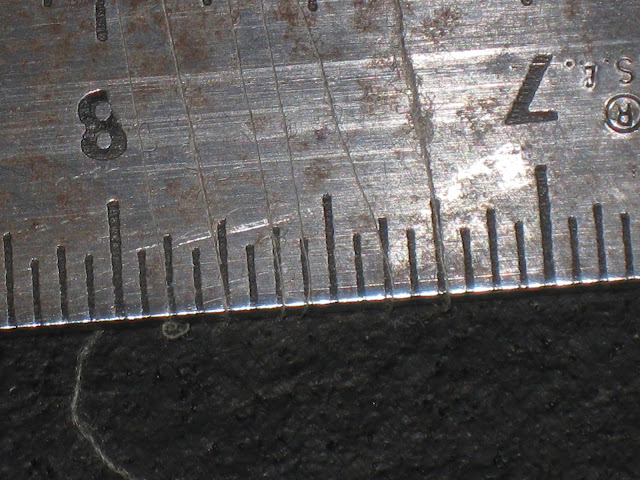 Note the slub on the left-most wrap to help you find the thread. Otherwise, it just looks like little scratches on the ruler. Contrast on this ruler is better than on my newer stainless steel rulers. On my screen, it shows at 5.5 times actual size.

Another ruler with scales marked in 1/16" on top and mm on the bottom. On my screen it is about 5 times actual size.
Here is a greater close up of the untwisted end of the thread, so fibers can be counted:

Those are ~ 18 to 20 micron fibers, and you can see that there are only about 20 of them in the thread. On my screen it shows at about 10x actual size.
I can spin this grist as worsted at ~130 yards per hour and a third slower for woolen and semi-worsted.
If Holin wants to complain, then she should post a photo of how this grist should be spun! And, I want to see all those folk who say that one can accurately measure wpi with a ruler send me a photo of them getting correct wpi of yarns spun at spin count.


Another ruler with scales marked in 1/16" on top and mm on the bottom. On my screen it is about 5 times actual size.
Here is a greater close up of the untwisted end of the thread, so fibers can be counted:
Those are ~ 18 to 20 micron fibers, and you can see that there are only about 20 of them in the thread. On my screen it shows at about 10x actual size.
I can spin this grist as worsted at ~130 yards per hour and a third slower for woolen and semi-worsted.
If Holin wants to complain, then she should post a photo of how this grist should be spun! And, I want to see all those folk who say that one can accurately measure wpi with a ruler send me a photo of them getting correct wpi of yarns spun at spin count.


.jpg)