Showing posts with label warm woolens. Show all posts

Wednesday, August 03, 2016

Aran Knitting

Aran yarns were traditionally 10-ply, 500 ypp worsted spun. This was twice as heavy as modern sport weight, and ~ 70% heavier than worsted (e.g., 6-ply).  Aran was more what we would call weight 5,  "Chunky" or "Bulky", or even Super Bulky.  I know, I know, I have bins of  'Pure Wool Aran' from Yorkshire, that is only 772 ypp, but it is also, only 4-ply.  That is not a yarn that can be knit up into a functional seaman's sweater. I have knit it on finer needles, and never found a point where it became weatherproof.  Some of that 'Pure Wool Aran' does serve very well for baby clothes for a family living in San Francisco's Outer Sunset District.  It was knit by the children's grandmother, who was born, and raised in Siberia/ USSR.

Aran sweaters were used for fishing and whaling, even near the Arctic Sea ice.   Key advantages to producing a thick yarn from many  plies is that it can be knit tighter, without becoming stiff and board like. Thick yarns produced with only a few plies,  such as Peace Roving, Lopi, and  MacAusland, are easier to knit into weatherproof fabrics than yarns such as the modern commercial 5-ply, but weatherproof fabrics from yarns with few plies tend to be stiff and have poor hand and drape.  I put up with such fabrics for a long time, because I could knit them, and my LYS did not carry multi-ply yarns with a soft ply twist.  This is why I had to learn to spin, spin fine, spin fast, and produce better multi-ply yarns.   If you need a very warm fabric, then knitting it from a yarn with many plies produces better hand and drape, greater durability, and better warmth.

In contrast, modern, commercial  5-ply sport weight yarns tend to have so much  ply twist that they have poor fill, and tend to be difficult to knit into weatherproof fabrics.  Knitting weatherproof fabrics from high ply twist yarns such as Frangipani is a high effort endeavor. To the best of my knowledge, it requires a knitting sheath.   It is not always worth the effort.  In fact, for some applications, the stiff fabric can be protective.  Many of the fishermen wearing Arans would have been handlining 100 lb cod from the deck of the boat.  They braced against the rail and as the ship tossed, they would have been tossed against the rail, with great force. The net/ cable pattern typical on a Aran sweaters provided padding. (Do not even think of disagreeing unless you have handlined 100 lb fish on-board in rough weather.)   A stiff sweater can cushion a blow from a spar when sailing in foul weather, or arrest a slide (yard sale / garage sale) on an icy ski slope and thereby avoid a long climb back up the hill (while sore) to gather gear. It can also protect in rock climbing.

The best path for very warm knit fabrics leads to a yarn with many plies and soft ply twist.  I learned this from the old Lion Brand Fisherman's Wool, which was easier to knit into very warm fabrics than British Breeds,  Wingham's and etc..


The Lazy Kate set up for 10-ply Aran yarn.

The singles are 5,600 ypp semi worsted (dized off of a drum carder) of Anna Harvey's Rambouillet. Knit on 2.38 mm needles at 6 spi by 8 rpi, it has about the same density as the 14 ply, but is knit on 2.38 mm needles rather than the 3.2 mm needles for the 14-ply.  The difference between this and the 14-ply knitting in the last post is the thickness of the fabric.  The 14-ply in the last post is thicker and about 28% warmer. On the other hand, this fabric, is more than twice as warm as anything I have knit from commercial, ~1,000 ypp 5-ply (even LB FW).  Yes! you read that right! I knit 10-ply, 500 ypp on needles that my Susan Bates "Knit-Chek" assures me are US1. Yes, it is an extraordinary measure, but extraordinary measures are how one stays warm in extraordinary cold.


Aran Swatch from
handspun 10-ply
@ ~ 500 ypp  
 and 
 Swatch of 'Pure Wool Aran'
Commercial @ 772 ypp
both  swatches show 21 stitches on top needle, both knit on US1 needles.
'Pure Wool Aran'  has more stitches per inch, but is best
suited for baby clothes in SF
(Yarns with grists that differ by 272 ypp, knit up up differently, but 
patknitter thinks that yarns that differ by 280 ypp are comparable!)  


The top swatch is a fabric that is ~twice as warm as the fabric that kept me comfortable for 4 hours in minus 10F temps with 40 mph winds (wind chill =>  - 40F). That is kind of wind that makes a parka snap and pop.   For the test, the sweater knit from LB FW  5-ply was my primary upper body garment with mittens and hat from same material. Lower body garments were Patagonia guide pants and medium weight poly-pro base layer.  I also wore one pair of hand knit socks under my plastic boots.  Test conducted at ~10,000 ft altitude.  Just me, sitting on a spare pair of socks, watching life unfold in the valley below.

At less than 50 stitches per inch^2, such a 10-ply Aran sweater can be knit ~60 hours.  (For true polar conditions, the 14-ply knits up even faster.)  With another 30 hours (35 hours for 14-ply)  of spinning to make the yarn, total production time is less than the ~100 hours required to knit a (less warm) sweater from commercial 5-ply.  And the objects from 10-ply/14-ply yarns are much more durable and comfortable than objects of similar warmth knit from yarns with fewer plies (e.g., Peace, Lopi, MacAusland).

One of my goals when I started spinning a decade ago was to be able to produce real 10-ply Aran yarns at a resonable pace.  Along the way, I was told, many times by many different people, "It can't be done!".  Well it certainly can be done.  People who did not know, pretended to know, and told me things that simply are not true.  Likewise, people that have not investigated the virtues of knitting sheaths, pretend to know, and say things that are not true.  They are lucky that Bolgia 10 is warm, not cold.

I have singles on hand (both semi worsted and true worsted) so, with a few hours of  plying, I would be ready to knit polar gear.  Then, the knitting can be done in cars, airports, train stations and quays.  I already have Arctic caliber socks, mittens, hats, and etc. And, I already have sweaters that have been tested at wind chills colder than minus 40.  I could gear up, and be ready to go full Arctic with hand knit clothing, PDQ.  I am not bound to California.

The real trick to staying warm is to make sure your mittens do not blow away if you drop them.  That is how my dad froze his hands on the East Wall at Arapahoe.  As he finished strapping an injured and cold skier into the sled, hand he had to grab it and hold it with his bare hands, even as his mitten blew away.   In the few minutes before we could get off the steeps, and dad could put on a pair of mittens from my pack, he had frostbite on both hands. As a member of the National Ski Patrol, dad skied it all, and I skied with him, from Dawn Patrol to Last Sweep, regardless of the weather.  I grew up in the high country of Colorado and Wyoming.   We did all of the 14,000 foot peaks.  All things considered, it was a good place to learn how to play outside and stay warm and safe.  Later, I did forestry research in the Adirondacks, and spent weeks every year outside in the snow in a climate very similar to that of Wisconsin (with more  snow.)  Along the way, I climbed all the Adirondack High Peaks -  most of them solo.  I have been to the Annapurna Sanctuary.   I have walked from Paradise to Muir Camp  (2,000 feet above snow line)  in flip-flops. Most of my ski trips in California included a night or two of snow camping.  And, I have skied over several of the California passes in the winter, when they were closed because of snow.    All in all, my tendency to play outside in all weather, gave me practical experience in how to stay warm.  I test and compare, and choose what works, not what people say works. Today, the knit objects that I make are much, much warmer than any of the knit objects that we had when we skied the high country and backcountry of Colorado,  Wyoming,  Adirondacks, and Idaho.

It is like spinning - I do what works, and the result is hand spinning that many say is impossible.
 (Who else handspins '500 ypp, 10-ply' in practical quantities?  )   In knitting, I do what works and the result is that I do things that many do not accept as possible.  Their lack of understanding is not my problem.   They should have chosen better teachers.


Aran Yarn
The Classic Yarn for Warmest Woolens

Just over a pound of 
hand spun and plied,
 semi-worsted spun, 500 ypp, 10 ply 
(there are ~ 5,600 yd of singles in the 3-cakes/ ply twist takes up ~10%)
Fiber from Anna Harvey's Rambouillet
www.annagotwool.com 

(If I was planning a season of fishing on the Finnish Sea, I would spin it worsted!)

ETA: 


A couple of cakes of Worsted spun 10-ply Aran.
(The two cakes total ~12 oz, and contain ~4,200 yd of singles.)

Aran Knitting

Aran yarns were traditionally 10-ply, 500 ypp worsted spun. This was twice as heavy as modern sport weight, and ~ 70% heavier than worsted (e.g., 6-ply).  Aran was more what we would call weight 5,  "Chunky" or "Bulky", or even Super Bulky.  I know, I know, I have bins of  'Pure Wool Aran' from Yorkshire, that is only 772 ypp, but it is also, only 4-ply.  That is not a yarn that can be knit up into a functional seaman's sweater. I have knit it on finer needles, and never found a point where it became weatherproof.  Some of that 'Pure Wool Aran' does serve very well for baby clothes for a family living in San Francisco's Outer Sunset District.  It was knit by the children's grandmother, who was born, and raised in Siberia/ USSR.

Aran sweaters were used for fishing and whaling, even near the Arctic Sea ice.   Key advantages to producing a thick yarn from many  plies is that it can be knit tighter, without becoming stiff and board like. Thick yarns produced with only a few plies,  such as Peace Roving, Lopi, and  MacAusland, are easier to knit into weatherproof fabrics than yarns such as the modern commercial 5-ply, but weatherproof fabrics from yarns with few plies tend to be stiff and have poor hand and drape.  I put up with such fabrics for a long time, because I could knit them, and my LYS did not carry multi-ply yarns with a soft ply twist.  This is why I had to learn to spin, spin fine, spin fast, and produce better multi-ply yarns.   If you need a very warm fabric, then knitting it from a yarn with many plies produces better hand and drape, greater durability, and better warmth.

In contrast, modern, commercial  5-ply sport weight yarns tend to have so much  ply twist that they have poor fill, and tend to be difficult to knit into weatherproof fabrics.  Knitting weatherproof fabrics from high ply twist yarns such as Frangipani is a high effort endeavor. To the best of my knowledge, it requires a knitting sheath.   It is not always worth the effort.  In fact, for some applications, the stiff fabric can be protective.  Many of the fishermen wearing Arans would have been handlining 100 lb cod from the deck of the boat.  They braced against the rail and as the ship tossed, they would have been tossed against the rail, with great force. The net/ cable pattern typical on a Aran sweaters provided padding. (Do not even think of disagreeing unless you have handlined 100 lb fish on-board in rough weather.)   A stiff sweater can cushion a blow from a spar when sailing in foul weather, or arrest a slide (yard sale / garage sale) on an icy ski slope and thereby avoid a long climb back up the hill (while sore) to gather gear. It can also protect in rock climbing.

The best path for very warm knit fabrics leads to a yarn with many plies and soft ply twist.  I learned this from the old Lion Brand Fisherman's Wool, which was easier to knit into very warm fabrics than British Breeds,  Wingham's and etc..


The Lazy Kate set up for 10-ply Aran yarn.

The singles are 5,600 ypp semi worsted (dized off of a drum carder) of Anna Harvey's Rambouillet. Knit on 2.38 mm needles at 6 spi by 8 rpi, it has about the same density as the 14 ply, but is knit on 2.38 mm needles rather than the 3.2 mm needles for the 14-ply.  The difference between this and the 14-ply knitting in the last post is the thickness of the fabric.  The 14-ply in the last post is thicker and about 28% warmer. On the other hand, this fabric, is more than twice as warm as anything I have knit from commercial, ~1,000 ypp 5-ply (even LB FW).  Yes! you read that right! I knit 10-ply, 500 ypp on needles that my Susan Bates "Knit-Chek" assures me are US1. Yes, it is an extraordinary measure, but extraordinary measures are how one stays warm in extraordinary cold.


Aran Swatch from
handspun 10-ply
@ ~ 500 ypp  
 and 
 Swatch of 'Pure Wool Aran'
Commercial @ 772 ypp
both  swatches show 21 stitches on top needle, both knit on US1 needles.
'Pure Wool Aran'  has more stitches per inch, but is best
suited for baby clothes in SF
(Yarns with grists that differ by 272 ypp, knit up up differently, but 
patknitter thinks that yarns that differ by 280 ypp are comparable!)  


The top swatch is a fabric that is ~twice as warm as the fabric that kept me comfortable for 4 hours in minus 10F temps with 40 mph winds (wind chill =>  - 40F). That is kind of wind that makes a parka snap and pop.   For the test, the sweater knit from LB FW  5-ply was my primary upper body garment with mittens and hat from same material. Lower body garments were Patagonia guide pants and medium weight poly-pro base layer.  I also wore one pair of hand knit socks under my plastic boots.  Test conducted at ~10,000 ft altitude.  Just me, sitting on a spare pair of socks, watching life unfold in the valley below.

At less than 50 stitches per inch^2, such a 10-ply Aran sweater can be knit ~60 hours.  (For true polar conditions, the 14-ply knits up even faster.)  With another 30 hours (35 hours for 14-ply)  of spinning to make the yarn, total production time is less than the ~100 hours required to knit a (less warm) sweater from commercial 5-ply.  And the objects from 10-ply/14-ply yarns are much more durable and comfortable than objects of similar warmth knit from yarns with fewer plies (e.g., Peace, Lopi, MacAusland).

One of my goals when I started spinning a decade ago was to be able to produce real 10-ply Aran yarns at a resonable pace.  Along the way, I was told, many times by many different people, "It can't be done!".  Well it certainly can be done.  People who did not know, pretended to know, and told me things that simply are not true.  Likewise, people that have not investigated the virtues of knitting sheaths, pretend to know, and say things that are not true.  They are lucky that Bolgia 10 is warm, not cold.

I have singles on hand (both semi worsted and true worsted) so, with a few hours of  plying, I would be ready to knit polar gear.  Then, the knitting can be done in cars, airports, train stations and quays.  I already have Arctic caliber socks, mittens, hats, and etc. And, I already have sweaters that have been tested at wind chills colder than minus 40.  I could gear up, and be ready to go full Arctic with hand knit clothing, PDQ.  I am not bound to California.

The real trick to staying warm is to make sure your mittens do not blow away if you drop them.  That is how my dad froze his hands on the East Wall at Arapahoe.  As he finished strapping an injured and cold skier into the sled, hand he had to grab it and hold it with his bare hands, even as his mitten blew away.   In the few minutes before we could get off the steeps, and dad could put on a pair of mittens from my pack, he had frostbite on both hands. As a member of the National Ski Patrol, dad skied it all, and I skied with him, from Dawn Patrol to Last Sweep, regardless of the weather.  I grew up in the high country of Colorado and Wyoming.   We did all of the 14,000 foot peaks.  All things considered, it was a good place to learn how to play outside and stay warm and safe.  Later, I did forestry research in the Adirondacks, and spent weeks every year outside in the snow in a climate very similar to that of Wisconsin (with more  snow.)  Along the way, I climbed all the Adirondack High Peaks -  most of them solo.  I have been to the Annapurna Sanctuary.   I have walked from Paradise to Muir Camp  (2,000 feet above snow line)  in flip-flops. Most of my ski trips in California included a night or two of snow camping.  And, I have skied over several of the California passes in the winter, when they were closed because of snow.    All in all, my tendency to play outside in all weather, gave me practical experience in how to stay warm.  I test and compare, and choose what works, not what people say works. Today, the knit objects that I make are much, much warmer than any of the knit objects that we had when we skied the high country and backcountry of Colorado,  Wyoming,  Adirondacks, and Idaho.

It is like spinning - I do what works, and the result is hand spinning that many say is impossible.
 (Who else handspins '500 ypp, 10-ply' in practical quantities?  )   In knitting, I do what works and the result is that I do things that many do not accept as possible.  Their lack of understanding is not my problem.   They should have chosen better teachers.
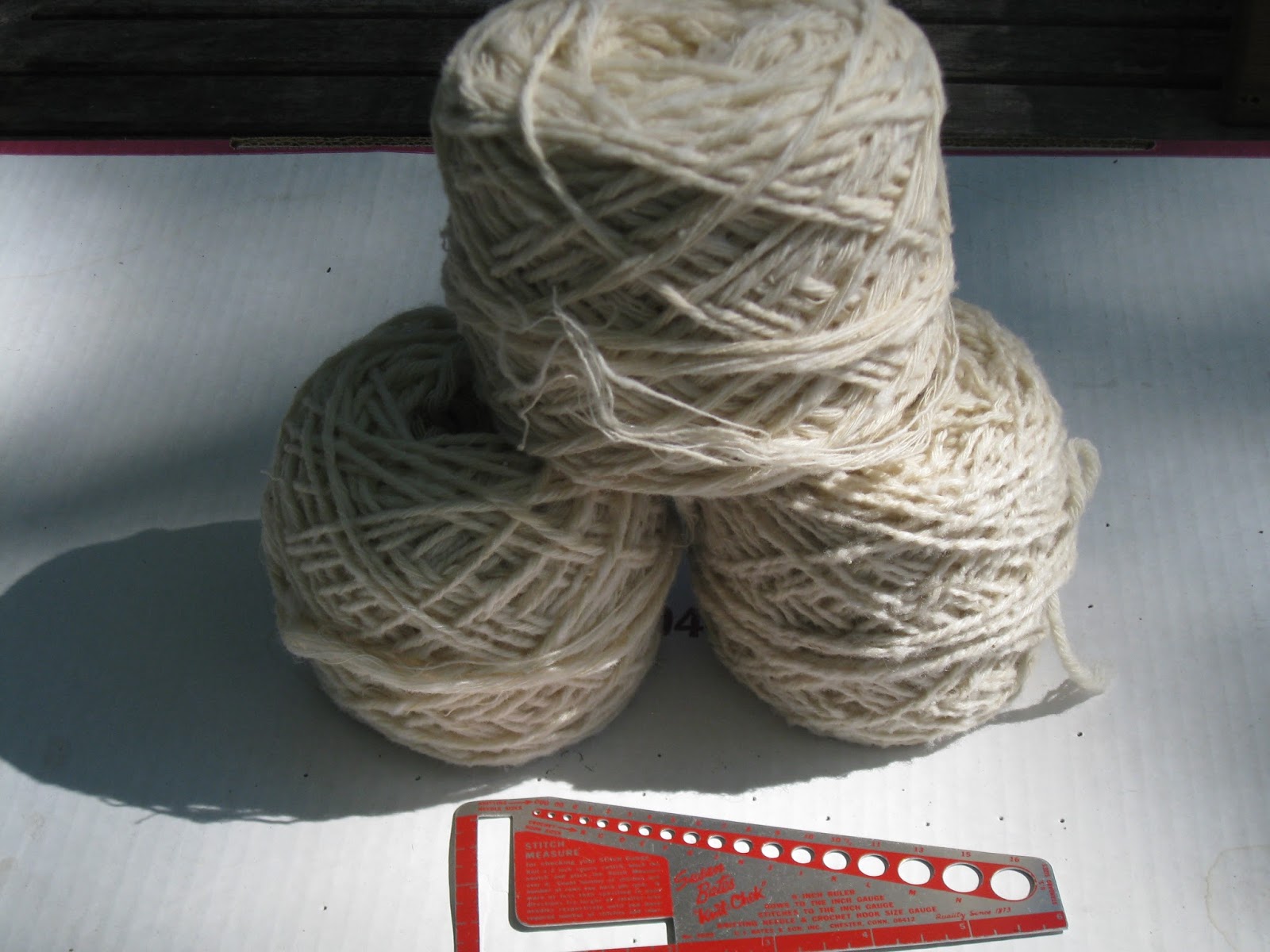


Aran Yarn
The Classic Yarn for Warmest Woolens

Just over a pound of 
hand spun and plied,
 semi-worsted spun, 500 ypp, 10 ply 
(there are ~ 5,600 yd of singles in the 3-cakes/ ply twist takes up ~10%)
Fiber from Anna Harvey's Rambouillet
www.annagotwool.com 

(If I was planning a season of fishing on the Finnish Sea, I would spin it worsted!)

Tuesday, January 19, 2016

Size 12 or 13 needles

The first pattern in Gladys Thompson is A Channel Islands' Guernsey.

The pattern was provided to GT by de Cararte and le Patourel of Guernsey. They owned a very old commercial firm that produced hand knit objects for export for sale to sailors at ports from Gibraltar to Reykjavik and St Petersburg.  De Cararte and le Patourel were only one of several firms in the Channel Islands that exported knitwear for seamen and fishermen.  Shiploads of fine knitwear was produced and shipped from the Channel Islands. Thus, we can be sure that there was a lot of knit wear worn by seamen, all knit to a similar level of fineness.

Some say, they do not find it in the museums.

Where did it all go?  Good husbands/ sons/ brothers, discarded it, and took a bath as soon as they got to shore.  Bad  husbands/ sons/ brothers wore them home, so their wife/mother/sister had to cut it off them, and burn it while the seaman took a bath with lye soap. Real seaman's knit wear was not likely to end up in a museum.

In the Guernsey pattern, 334 stitches are used for a chest size of 38 inches.  That means there were ~8.8 spi or 35 stitches per 4" or 10 cm.  The Guernseys were knit very tight. Since it  was a competitive industry, we can assume that the other firms knitting for seamen knit similarly tightly.  Why?  Because it is a warm, weatherproof fabric.  I know, I have knit a lot of it for myself and my friends. I knit it because it is our favorite fabric for foul weather wear.

A doodle in the round on "A Channel Islands' Guernsey" patterns.
The stockinette has a gauge of just over 9 spi and the
pattern variations are at just under 9 spi.
The needles are size 12. 
The yarn is a commercial 5-ply worsted spun
with a grist of ~950 ypp

However, there is a group that claims such fine tight knitting was never common or useful.  That is because they do not know how to knit such fabrics.  They have not knit such fabrics.  And, they have not tested such fabrics in serious foul weather.

However, knitting such objects is easy - if you know how.  First you use long needles called "gansey" needles. If you have gotten this far, you know I have been working with gansey needles for 10 years. With gansey needles you need a fulcrum so you can apply leverage for fast and powerful knitting.  You can use a knitting belt as your fulcrum, but a real knitting sheath is a more controlled fulcrum and  allows much faster knitting.

On page 7,  GT tells us to use Size 12 or 13 needles for knitting the Guernsey. Because of the group that claims 8 spi is as tight as necessary for gansey yarn, we assume the "Size 12 or 13" refers to the  UK sizes in the range of 2.25 - 2.75 mm. Such needles do produce the 7 to 8 spi the the group likes to think is as tight as such yarn can be knit.

However, The Channel Islands are not the UK. The 12 or 13 does not refer to UK needle sizes. Once one drops the assumption that the 12 or 13 is UK sizing, then one does what one always does, and one swatches until one gets to 8.8 spi.  I have knit a lot of  5-ply gansey yarn at 8.8 spi, so I know that it happens on 1.5 mm gansey needles with a knitting sheath.   I have a great number of such needles, because I like the fabric that results from knitting this yarn at this gauge. If I was knitting objects for sale to seamen, 8.8 spi is the gauge I would choose, because seamen would appreciate the warmth of the fabric.  Remember, this is the gauge that I knit for the guys that have saved my life.

If you flip thorough the various standards for wire sizing, it turns out the the needles I use are in fact Size 13 in AWG.  So, yes I get 8.8 spi from gansey yarn using Size 13 needles, just not UK13!

Saturday, March 07, 2015

Right under my nose

In seeking warmer wool garments, I went to the extremes of modern knitting mythology.  I knit a lot of harsh fabrics where the primary virtue was warmth and durability.  I do not regret this, as those fabrics have kept me warm in real cold, and saved my skin when I fell and skidded down steep rock faces. (Nylon is slippery and it lets one slide faster and faster down the rock or ice, until the nylon wears through and bare skin at high speed hits rock or ice and is turned into hamburger.)

Still most women wrinkle their faces as they touch these fabrics -- for good reason. So the question is: Can one produce such warm fabrics that are soft and friendly?

The answer is yes, and the how was right under our noses all the time. There are actually 3 parts to the how:


  1. Use more plies as you construct the yarn.
  2. Use reasonable fine wool.
  3. Knit reasonably firmly.
Traditional "worsted" weight  knitting yarn was constructed of 6 plies of 5,600 ypp singles. Now, most mill spun yarns of that weight (grist) are only 2-ply. Two-ply yarns are not nearly as warm as yarns constructed from more plies.  This is not my rule, it is Mother Nature's rule; see http://www.feynmanlectures.caltech.edu/ for details.  I merely recite it.

Reasonable fine wool keeps the yarn from being too harsh.  I may want "rug wool" between me and the rock, but most do not need that kind of durability.

The finer wool and softer yarns have more fill, so the yarn does not have to be nearly as tightly knit to ensure that air cannot easily advect heat through the gaps between the yarns.

I have been testing some commercial Shetland 2-ply jumper weight yarns that run 1800 ypp.  My 3-ply semi-worsted Rambouillet at 1870 ypp is softer, more durable, and much much warmer when knit at the same gauge on the same needles. It is softer, because it is a softer fiber.  It is more durable because there is more twist holding the yarn together.  And, it is warmer because 3-ply yarn has more "fill" than 2-ply yarn.  If you run your thermostat at 72F, you want the Shetland 2-ply jumper weight yarn.  If you run your thermostat at 62F, then you want the 3-ply semi-worsted fine wool yarn.

If I am knitting a fine Fair Isle object from hand spun, then most of the effort goes into the knitting. With a very fast wheel, spinning the singles for a sweater goes from a couple of days spinning for 2-ply jumper weight to ~4 days of spinning for 3-ply jumper weight.  However, an additional 16 hours of spinning is not a big deal compared to the 100 hours of knitting  - if you  consider that the additional spinning time will make the object much warmer and much more durable.  For 20% more effort, one gets 100% more value. The extra effort in spinning, increases the return on the large knitting effort.

On a commercial basis, doubling the required twist  (more and finer plies) would approximately double the price of the yarn, and most knitters would look at the price and decide that the much less expensive 2-ply was warm enough and durable enough.  Thus, the construction of modern commercial yarns is a function of competition and price point, rather then value considering warmth, softness, and  durability. This trade of price point for warmth and durability is a major reason why modern hand knitting is not as warm as the hand knitting in the old days.

Then when winter comes round, modern knitters decide that they need  something warmer and they turn to exotic, expensive, super fine fibers to make warm fabrics.  The problem is that the last few generations of knitters preferred a lower price point over warmth  and  durability, and the mill responded by making 2-ply yarns that are less expensive, but also not as warm or durable.  Likewise, the commercial mills optimized the 5-ply gansey yarns for stitches that "pop" rather than for warmth. The modern commercial 5-ply gansey yarns are much warmer than 2-ply yarns, but they are not nearly as warm as they could be if they were designed to be warm, rather than decorative.

Now, you can take the same semi-worsted, fine wool singles (5,600 ypp) and ply them up as 5-ply and knit the yarn at the same gauge on the same needles as the Shetland 2-ply jumper weight yarns, and you will have soft, dense fabric that is fully 4 times as warm as the fabric from the Shetland yarn.  The fabric is not stiff, it is not harsh, it is just warm.  I have not really run durability tests on it yet, but with all that twist holding the yarn together, it should be much more durable than the 2-ply.  This is a fabric for when your thermostat is set for 52F,

If you can knit the 2-ply at the gauge on the band then you can also knit the 3-ply at the same gauge with the same needles.  By the time you get to knitting 5-ply at that gauge, you are packing the yarn together and will want the leverage of a knitting sheath or at least a leather knitting pouch.

If your thermostat is set at 42F, then move on to real 6-ply, knit on slightly larger needles (3 mm), and enjoy.

If you want to spin your singles from long wool, spun worsted, then the fabric will have less drape, but will be more durable and it will be lustrous.  A stiffer fabric is a small price to pay for warmth that gleams.  Certainly, you can knit it less firmly, but then the fabric will not be as warm.

I would never have gotten here, if I had not been spinning for weaving, and fallen into the habit of plying- up singles spun for weaving as knitting yarns.  I stared spinning semi-worsted 5,600 ypp singles from carded batts to see how they would work as weft, but once I had a few cakes of such singles sitting there, it was very  little effort to ply it up into knitting yarn.


Friday, November 07, 2014

More on Lanolin II

Sheep produce lanolin and suint, and together they keep the sheep's fleece oiled without the grooming required by animals like beaver.  Oiled fleece can repel water, so the fleece can trap the sheep's body heat and keep the sheep warm.

When we shear the fleece, everything changes.  The wool is soaked in cold water to remove the soap-like suint and hot water to remove the lanolin (and grit).

When we treat the wool to felt less, the wool become less water repellent. When we dye wool  (particularly deep blues and reds), the wool fibers become more water repellent. Long wool (e.g., Romney) dyed deep blue is fairly water repellent.  Fine, undyed wools are less water repellent.

Then, in the old days many mills used the lanolin produced in the scouring process as a cheap spinning oil.  It gave the wool water repellency and a certain aroma.  However, lanolin is a waxy material, and if you are wearing wool oiled with lanolin, the lanolin will come off (a little bit at a time) on everything it touches. If you go commando - it will come off on you. Pick up a child and some lanolin comes off on the child and the child's clothes.  Every time you go out in the rain, some small amount of lanolin will be washed out of the fabric.  Over time wool fabrics loose lanolin.

And, lanolin oxidizes, becomes sticky, becomes brittle, and flakes off.  The sticky lanolin attracts and holds dirt, meaning the garment must be washed more often, and the washing takes the lanolin out of the fabric.  And, lanolin attracts moths.  Lanolin is not magic.  It is goopy stuff that helps keep wool dry for a brief period.  Like everything on a sailing ship, it requires constant attention and maintenance.

I wear my woolens places where they get dirty, and I wash my woolens.  If you also wash your lanolin coated woolens, then soon, there will be much less lanolin on the wool.

Sea water contains plankton that is strained out of the water by well knit woolens.  In certain seasons, if you get doused by breaking waves, your sweater will pick up enough plankton that in a few hours it will smell like every dead thing that ever came out of the sea.  I do not care if you live in a sheep barn, sometimes your fisherman's sweater must be washed with soap before it can be taken into the house/barn.  At that time, any and all lanolin in the sweater will be scoured out.

(If it is a real fisherman's sweater, that must be waterproof, the lanolin can be replaced by melting some wool fat (lanolin) in a big pot of 125F water and raising the sweater through the film of lanolin on the surface of the water.  This will work for fisherman's garments (already stained) but is likely to stain other garments.)  And, garments firmly knit from worsted spun, long wools will tolerate this treatment,  but any fine wools, or loosely knit objects, or woolen spun objects, are likely to felt in the worst way. 

As I said, I wash my woolens on a regular basis, and reoil by putting a drop or two of baby oil in the rinse water.  It is not as good as lanolin for water repellency, but it is much less effort, and much better than nothing,   It keeps me from smelling like a wet sheep when I go into the yacht club for a pint.


Thursday, November 06, 2014

More on Lanolin

I was doing forestry research for the American Chestnut project back in the days when it was run by Lou Ismay.  We went out in all weather, and we always seemed to be wet.  The only time it was dry was when everything was frozen.

I found some US Army infantry uniforms that had been made at the end of WWI to protect the troops from gas attacks.  The war ended, and by WWII they had better materials so the gas-tight wool sat in a warehouse.  Anyway, they were fine, thick wool with flaps that buttoned over the openings.  Oh, My!! They sopped up water and got wet.

My mother, who understood such things said, "They have to be oiled with lanolin."   I went to the library and found the old manuals and figured out how to do it. I bought the best quality reagents, and followed the instructions.  Then,  I had oiled wool that kept me warm and dry in any weather.

A few weeks after oiling, the lanolin would start to oxidize, and then when it got wet it would smell like sheep.  This was not bad in the forest with a camp fire, with the smell of the wet forest around us.

Then, I was drafted, and ordered to an inductee meeting one evening. It was a cold, rainy night, an hour's bicycle ride away, so I wore one of my oiled wool shirts. I arrived soaking wet, but comfortable.

The sergeant in charge took exception to my "lamby smell", and said things the way only a sergeant can say them. He used me as an excuse to display his command of the Army vernacular. It did not really bother me. I knew there was no way in the world he could have completed the bike ride I had just already ridden, and I had another longer, colder, uphill bike ride to do after the meeting. Nevertheless, 28 years later, when Jan from Frangipani yarns  (http://www.guernseywool.co.uk/) brought up the topic, I was all ears. She told me about baby oil to oil wool.

I like lanolin.  I make my own hand lotion for knitting and it is mostly beeswax, lanolin, olive oil, and lavender oil.  However, when lanolin is applied to wool, it forms a thin layer on the wool fibers.  That thin layer has a huge surface area allowing oxidation.  (And the oxidation helps the lanolin to bond to polar regions on the wool.)  The oxidation products and water produce the sheepy smell that raised the ire of the sergeant.  When you put lanolin on wool it will oxidize, and when the oxidized lanolin gets gets wet, it will have a sheepy smell. I do not mind the sheepy smell too much.  My wife has several sweaters that have lanolin on them, but when it rains, she always wears a parka over them so they do not get wet. Nevertheless, the last time we were coming back from Pt Reyes, it was her sweater, not mine, that perfumed the car with a sheep smell. I wear my sweaters in the rain and salt spray, and they do not smell of sheep.  They may smell of fish, but they do not smell of sheep.

If you wash or dry clean your wool, and remove all the oils, then in the next rain, the wool will sop up water, and will not keep you dry (or warm). Thus, you need a rain coat or parka or umbrella to keep your wool dry. Or, you can just wear your wool in the house and not take your fine gansey out into the weather.

So, your options in the rain are wet wool, or a silicon product such as Scotchguard, or lanolin and smell like a sheep in the wet, or baby oil and run the risk of stains.

A drop or two of baby oil in the rinse water (after washing with real soap)  will form a film over every fiber, so the change in color is very uniform and there is no visible stain. None! I have been using baby oil on all of my outdoor woolens for about 12 years now.  It keeps me comfortable in the rain.  It lets me wear my ganseys when I am splashing in the water, and  then lets them dry quickly afterwards.   Lanolin also works, but it is properly applied by dissolving the lanolin in enough benzene to submerge the garment.  Benzine is hazardous, toxic, carcinogenic, and any residual is a solvent waste that requires special handling under RCRA (40 CFR 260 et seq.). Other methods of applying lanolin to wool fabrics do run a real risk of staining.   The wool must be re-oiled whenever the wool is washed or cleaned.

Oh! Wet wool is a different color than dry wool. Freshly cleaned woolens shows splashes of water.

Much wool from the commercial  channels will not tolerate washing with soap and water.

Baby oil is easier.  Jan sells good yarn and dispenses very good advice. I like venders that give smart advice on how to use their products.