Thursday, December 10, 2015

Money

Some say that in the study of knitting, the study of fishing and its history is a red herring.

Fishermen and sailors supported many thousands of professional knitters for hundreds of years. And, fishermen and sailors consumed the products of many millions of hours of  knitting by wives, mothers, and sisters.  In return for those millions of hours of knitting by family, the sailors and fishermen contributed to the cash flow of the family. If the knitters knit poorly, then fisherman or sailor died and did not bring home his wages. This put a premium on good knitting, and both the professional knitting and the home knitting was labor of large economic value. The economic value of knitting is very germane to the study knitting and its history.

Fishing was for food and oil.  The products of fishing were essential to medieval civilization.

Hand knitting was essential to industrial fishing from the 13th century until the invention of the knitting frame circa 1590.  We know that sailors did wear knit clothing from various sources including Chaucer.  We know where they were fishing from Kurlansky.  Cross referencing with modern paleoclimatology and the nature of wooden square rigged ships, we can estimate the required warmth of the clothing used.

Unless we can offer a suitable  alternative clothing, then we have to accept knit objects as the clothing of sailors.  Furs pelts, and leather are warmer, but need to be fully dried every few days. Thus furs and pelts were not an option for the longer fishing voyages as on shore fish were fished out in the 12th century. Woven fabrics are denser but not as thick and hence not as warm.  Quilted objects are warm, but are bulky and do not allow the freedom of movement for working the rigging of a square rigged ship. Quilted objects are very well suited to junks where the sails can be handled from deck.  What else is left? -- Well knit wool!

The requirements imposed by realities of the sailing and fishing industries tell us the knitting standards met by generations of  both professional and home knitters.  Those standards were very high indeed.

Mostly, modern knitters do not use knitting technologies that allow the production of very warm knit fabrics required by sailors and fishermen on wooden ships without engines .  The knitting technologies currently in use do not affect or diminish the effectiveness of the old knitting sheath system.

Five years ago, I pointed out that modern yarns do not produce fabrics as warm  and durable as yarns widely used in the past, but which are no longer in fashion.  For example, the old Lion Brand Fisherman's Wool could be easily knit into fabrics that are warmer than modern  5-ply "gansey " yarns. Then production of LB Fisherman's Wool Production was moved to China, and the new  LB Fisherman's Wool is not nearly as suited for knitting warm fabrics.  I have knit objects from MacAusland's wool that are warmer than comparable objects knit from "5-ply gansey yarns."  And, my hand spun can be easily knit into fabrics that are warmer than what I believe can be reasonably   knit from either the old LB Fisherman's Wool or the MacAusland's.

Very warm knit fabrics evolved under the economic stimulus of money and need by the sailing and fishing industries.  Without the influence of the sailing and fishing  industries, recreational knitting has lost the technical skills to produce the very warm fabrics produced in the past by hand knitters for the sailing and fishing industries.

I do not care what knitting technology any particular modern knitter uses.   However a knitter that thinks 5-ply gansey yarn knit on circular needles produces the warmest possible fabric has a very shallow knowledge of their craft. And, in particular, a very shallow knowledge of the needs of the clients that shaped medieval knitting.

I suspect that they do  not like my views because I compare various aspects of modern knitting to the best of  traditional knitting which was supported by huge economic flows from the sailing and fishing industries.  They think, I am saying that they should knit like that.  I am not,  I am only saying that such knitting was done and is possible.

Some days, I think that no amateur can can be as competent as a professional. On these days, I do not think that modern amateurs can ever match the knitting of  long dead, talented and trained professionals.  On the other hand, I know amateur wood turners that produce better bowls than professionals, because the amateurs can lavish more time and resources on the their objects, while the professionals must control costs to meet a sales price point. On such days, I feel that the modern recreational knitters, freed from a need to control costs and limit labor can brilliantly exceed the best knitting of the past.

Tuesday, December 08, 2015

Durability testing

I am sure that many of my readers, and perhaps the great majority of my readers have tested yarns with nylon content for durability, e.g., compared yarns with nylon to yarns without nylon.

A better experimental design is to compare yarns with nylon to yarns without nylon at different gauges.  Do that, and you discover that knitting tighter brings more improvement than adding nylon, and that with the medium long wools, the tightly knit, properly blocked, all wool yarns are the most durable.

Then the questions are how to knit tighter, how to knit ergonomically, and how to avoid stiff fabrics. A knitting sheath will let you knit tighter, without ruining your wrist.  Thinner yarns of more plies will allow softer drape even with the tighter knitting.

Thinner yarns of more plies, knit tightly result in light, durable, warm fabrics with a delicacy that we do not often see today. They seem to be almost magical.

With a good DRS spinning system, even fine yarns of  many plies can be produced much faster than they can be knit.The cost of production is dominated by the labor to knit the object.  A couple of days of spinning will produce the yarn for a couple of weeks of knitting.

WPI

As a spinner, I use wraps per inch (wpi) often. If I do a good job of measuring wpi, then the square of wpi is the grist in yards per pound. And the twist factor times times wpi equals required twist in tpi.

It works.  Mostly it is within 10% of the actual grist, and with corrections for fiber and construction, wpi can measure grist to within 2%, which is better than a yarn balance.

To measure wpi so that it indicates grist, you need a wpi gauge, you need to pack to refusal, and you need to practice.  You need to take various kinds of yarns with known grists, and practice doing wpi, until you get the correct grist, time after time.  It is a skill.

So, when a knitter says a yarn is 18 wpi, I figure the grist is 324 ypp (e.g., 18x18) -- that is like rope. Then, she gives the yarn band info of 175 yard per 2 oz. -- or 1,400 yards per pound. That is sock or fingering yarn. When I measure the wpi of that yarn, I get 37 wpi.  That tells me, and other spinners, the grist.

Packing the yarn to refusal gives a definite measure that can be made anywhere by anyone. Packing the yarn loosely so that a 1,400 ypp yarn so that it yields a wpi of 18 is not a repeatable measure of -- anything.  This approach is as much a measure of twist as of grist.  With this approach, high twist yarns will seem to have much lower grist than yarns with the same grist, but less twist - and vice  versa.

If you pack to refusal, then worsted and woolen yarns of the same grist will have the same wpi.  If you use the loose knitter's wpi, then worsted and woolen yarns of the same grist will have very different wpi.  If you pack to refusal then yarns of the same grist but different twist will have the same wpi. If you use the loose knitter's wpi, then yarns that are the same grist, but which have different twist will have different wpi.  This is silly.  What really counts to a knitter is the length and weight of the yarn.  These should be described by the wpi.  Twist of the yarn is less important.

In my world wpi and grist are related thusly:

wpi       grist (ypp)   spin count           notes

 22         484                                        Aran Yarn (traditionally was 10-ply of 10 count singles)
 24                             1
 26         676
 28         840                                        Worsted Yarn (traditionally was 6-ply of 10 count singles)
 30         900
 32         1,000                                     Gansey  Yarn ( 5-ply of 10 count singles)
 33         1,100                                     DK weight yarns
 34         1,120           2                        
 38         1,443                                    Common grist for commercial sock yarns e.g., Wooly West
 40         1,650           3                      My 6-strand sock yarn
 42         1,800                                   Single cut woolen singles         
 44         1935                                    Fingering Yarn
 48         2,303                                   Jumper Weight/ Spindrift weight 2-ply
 53         2,800          5                        
 60         3,600                                    2-cut woolen singles @ 9 tpi
 60         3,733          7                        Traditional 6-ply sock yarn from 40 count singles
 64         4,100                                     Modern lace weight
 75         5,600          10s                    Singles for warp/ 9-10 tpi  & woolen singles for weft @ 12 tpi
 80         6,700          13                      Traditional 3-ply Shetland lace plied up from 40 count singles
 105       11,200        20s                    Worsted singles that I use for my sock yarn @ 14 tpi
 120       14,400                                   8- cut woolen singles / 18 tpi
 130       16,800        30s                     Worsted singles @ 17 tpi
 136       18,000                                   10-cut woolen singles / 20 tpi
 142       20,200                                  2-ply from 80s  
 150       22,400       40s                     Traditional grist for singles used for best sock yarn/ 17 -20 tpi
 182       33,600       60s                     Traditional commercial  "fines" / 22- 24 tpi
 210       44,800       80s                     Traditional best commercial "fines"  /24 - 27 tpi

A defined ratio between wpi and grist make working with yarn easier.  In fact, I would go so far as to say that the textile industry was likely more important to defining various units of measure than the size of the king's foot or finger.
 
Twist per inch numbers reflect the firmer yarns that I am spinning since starting to spin warp. Before, my 40 count singles were only 17 tpi. These higher tpi were allowed by my move  from 25 mm to  ~50 mm flier/bobbin whorls.

And, it is all hand spinning.  Everything above is plus or minus 10%.  I calculate grist by winding hanks of 560 yards and weighing them on a kitchen scale to the nearest gram.  In the past, I used a jeweler's scale to weigh fine spinning.  Now I just weigh fine hanks 4 at a time and calculate the grist on the basis of  grams per 2,240 yards.

ETA - It is worth noting that plying takes up about 10% of the length of  the starting singles.  Thus, if one starts with 5 hanks of 10s, then one gets just over 500 yards of gansey yarn, and the grist of the 5-ply gansey yarn is is a bit more than the 5 times the grist of the singles.  This small change in grist cannot often be measured by wpi.

Good Socks!

Good socks last long enough to be worth the effort to knit.

Good socks are made from good yarn, and good yarn is made from good fiber.

In my view, the best wool sock yarns are worsted spun from medium to fine long wools with their scales intact, and functioning. I think the best wool  for socks is Suffolk, but any of the long wools with diameters of 25 to 35 microns are very good. Perhaps the best socks I ever knit were from Shetland fiber.

I think the texture of a good sock should be very smooth and silken against the skin rather than soft. Smooth lustrous socks have good durability and maintain their appearance for a long time.  Soft socks tend to deteriorate more rapidly.

The Camilid and Capra fibers do not have scales on the fibers, so exceptional care must be taken in spinning them into sock yarns.  The fine wools (Merino and Rambouillet) are fragile and best reserved for ladies that are careful not to walk or dance in them. There are some very robust commercial Merino socks, but they are exceptional well spun - not the kind of yarn one finds at LYS. The yarns are more tightly knit than most modern knitters have the patience or tools to knit.

Nylon is slippery and it stretches.  Spin any significant amount of nylon into a yarn and  unless the other fibers are carefully locked into the fabric by very tight knitting, the other fibers will come out of the yarn under stress, leaving the nylon fibers thread bare. Nylon is also very cheap.  If you want to pay wool prices for cheap synthetic fibers, the yarn mills are perfectly willing to take your money.

In super wash wools, the scales on the wool are either removed or sealed to the fiber shaft. Thus, adjacent wool fibers cannot lock scales to form a more competent yarn structure.

We are told that worsted yarns should be combed so that they can be spun "butt" first into the yarn.  This does make a more lustrous and silken feeling yarn.  However, yarns spun with the fibers oriented in both directions allow the scales to lock together and form a stronger, more competent, yarn that can be knit into a more durable sock.

I think good socks are finely knit.  I knit 5-ply or  10-strand gansey yarn (1,000 ypp) on 2.35 mm needles to make ski, hiking and fishing socks.  I knit 1650 ypp sock yarn on 2 mm needles to produce a casual sock fabric at 10 spi and 14 rpi. (140 stitches per square inch).

By now, you have all read Nancy Bush's books, including gauge and the fiber content of  the suggested yarns.  She focuses on the knitting.  I focus on the wearing.


Monday, December 07, 2015

Weldon's

Weldon's Practical Knitter was a series of pamphlets in the late Victorian era that taught women to knit like ladies -- not like professional knitters.  It was a guide to "hobby" or recreational knitting.

Weldon's did not discuss the tools or techniques used by professional knitters to produce professional quality objects.  A knitter using the Weldon technique had to invest huge amounts of time to knit the fine objects as presented in the Weldon's patterns.  It was the conspicuous consumption of leisure time.

As Modern knitters felt that they had less leisure time, they went to lower gauges and simpler patterns. Many, many modern knitters say they can knit socks in a few hours (http://www.knittinghelp.com/forum/showthread.php?t=40796 ) ,http://www.mothering.com/forum/66-arts-crafts/536314-how-long-does-take-knit-sock.html , - but these are very soft fabrics that do not endure as socks. The knitters justify their looser gauges as being "softer".    http://glennaknits.com/2013/05/10/the-thing-about-handknit-socks/    Glenna points out that the soft fabrics do not retain their good looks for long.   http://glennaknits.com/2013/05/10/the-thing-about-handknit-socks/  And everybody seems to be looking for ways to make more durable socks.

I observe and record, I do not judge. Being that kind of guy, I would rather put twice as much effort into my socks and have them last 10 times as long.   That way I have hand knit socks to wear with only 20% of the effort compared to the knitters that knit softer fabrics.  Socks that are knit tighter, last longer.

For folks that have limited time, and want the old professional quality hand-knit objects I point out the old tools.  For example,  I point out that using a knitting sheath, the professional knitter of circa 1840 was able to produce 2 pair of socks per week at gauges that are much finer than any of the patterns in Nancy Bush's books (mostly in the 7 spi range, from 1400 ypp sock yarn knit on 2.5 mm needles) .  The truth is that worsted spun, long wools like Suffolk, when spin fine and knit fine are smooth and silken in texture.  Long wool spun worsted retains it good looks for a long, long time.  Long wool is lustrous. Lustrous socks are beautiful. When spin fine and knit fine they feel wonderful against the skin.  And, they are ever-so- durable. (One caveat is that each grade of wool needs to be spun separately, so that each single contains only one grade of wool.)

Now, I did not learn to knit until I was past 50, and it took me another 10 years to work out all the details of  using a knitting sheath.  Much of my study on knitting sheaths was devoted to "weatherproof" fabrics for seamen and cabmen, rather than how to knit socks quickly.  Thus, I cannot call myself a fast sock knitter.

Most knitters and most modern knitting competitions time knitting stitches over a brief period (few minutes) and when knitting rather loosely e.g., DK weight yarn knit on US4 needles. In theory, these folks can knit the 2,500 stitches in a fine sock in an easy couple of hours of  knitting, so 2 pair of socks a week should be very easy.  On the other hand, I do not see many modern knitters that can knit a Nancy Bush Pattern sock in a day, and the Nancy Bush patterns have only half as many stitches in them as the sock fabrics that I like.

The antibiotics have knocked down much of my  Lyme Disease caused palsy, so these days it takes me an easy day's knitting to make a men's boot sock at ~ 6 spi (worsted weight yarn knit on US1 needles) and a couple of days to knit a sock at 10 spi from 6-strand cabled sock yarn at 1650 ypp on 2 mm needles. This are both smooth, firm fabrics that are desirable for many objects.  This is the result of looking back to the professional knitters (1840 and earlier), and using the tools that Weldon's pointedly ignores.

I find it peculiar that Nancy Bush talks about knitting sheaths, gansey needles, and swaving, but does not address the tools' powers to rapidly produce fine knit fabrics in an ergonomic process.

Stonehenge

http://phys.org/news/2015-12-stonehenge-bluestone-quarries-miles-wales.html

5,000 years ago those Britons had clever technology, and the time / resources to do big projects.

Sunday, December 06, 2015

Gauge for Socks

I tend to make notes in books.  This drives my wife crazy, so I do not write in her books, but I still write in mine. I notice that my copies of N. Bush on socks are now full of notes.

First, I encourage everyone to read and reread both of  Bush's books on socks  ( Folk Socks and Knitting Vintage Socks).  And, when I say read, I mean at a minimum knit swatches of the fabrics.  Do you love them?  That is always relative. So knit swatches looser and tighter.  Which fabric(s) do you like more?  NOT, which fabric is easier to knit, but which fabric do you like?  Pick the fabric that you like, THEN figure out how to knit it easily and quickly.

In Vintage Socks, Bush invokes this "not too tight, not too loose" standard.  She says knit too tight, the wool will thin and lose elasticity.  I look at fine old commercial  wool socks that my dad bought a long time ago, the the fabric is much tighter than anything that Bush discusses, and after 40 years the fabric is still in good condition.  I like the fabric in those socks, but I have not yet figured out how to hand  knit socks that fine and tight at a reasonable rate.

The gauge that I have settled on for sport socks is ~1,650 ypp sock yarn, knit at 9 or 10 stitches per inch. That is the yarn that results from 3-ply from the standard singles that I spin for weaving warp.  Or, I spin 20s and make a cabled 6-strand. Or, I cable together, 3 x 2-ply commercial warp.  In any case the grists of the finished yarns are very similar.  The gauge/fabric much tighter than anything in in Bush, but not as tight as the fine needle work in Weldon.  I like the fabric. I like it for socks and for other objects.

That is the gauge that I get when I knit that yarn with ~2 mm (US#0, 5/64") needles. It does not matter much if I use curved needles and swave the object or short straight needles, or long gansey needles.  The fabric is more dependent on the kind of yarn that I use,  than the knitting technique.

That is not to say that knitting technique does not matter.  You are not going to be able to knit that fabric with hand-held needles, e.g., circulars or SPN.  You will need "DPN" and a knitting sheath or knitting belt; or, you will either knit too slow to finish a project (with all due respect for folks that use  knitting as a meditation) or you will ruin your wrists.

The fastest way to make such fabric for small socks and gloves is swaving, where the curved, blunt needles rotate in the knitting sheath. The needle is popped into the working stitch with a very small motion of both arms/hands, the yarn is looped over the working needle, and the tension of the fabric along with the return motion of the hands finishes the stitch and transfers it to the working needle.  The motion is very small and because it is limited by the rotation of the needle in the knitting sheath.  The motion can be very accurate, even when made very fast with the upper arm muscles.  Done correctly there is almost no stress on the hands. Sock toes and fingertips are finished with short pointy DPN.


 2 mm swaving needles or "pricks" and knitting sheath
for a tabi from 6-strand 1650 ypp yarn.
Most of that was knit yesterday as we walked
around an outlet mall,
 so the knitting is not real high quality,
 but it will block out OK.

Medium sized objects,  are best knit on 9" to 12" long blunt "DPN". Note that is what the girl on page 18 of  Folk Socks captioned "Girl knitting on West Pier, Whitby" is using.

Full sized ganseys are best knit on 18"  steel "gansey needles" with a knitting sheath. Here the spring action of the flexed needle is used to finish the stitch and transfer it to the working needle. This it the fastest way that I know how to knit. It is how to knit a fine sweater in a reasonable length of time.

However, the gansey needles do not have the stability of swaving, so I find that for very fine yarns swaving is better. If I wanted the 12 spi of Thomas's Norfolk II, Sheringham I would use a 4-ply or 4-strand yarn based on 11,200 ypp worsted singles, and would knit it on 1.75 mm gansey needles. If I wanted a fabric a little tighter, I would use 5-ply at ~ 2,000 ypp.  This is still well within the range of easy knitting with steel gansey needles.  The time required to hand spin such yarn is nothing compared to the time required to hand knit such an object.

One of my favorite shirts is (frame) knit at 22 spi.  It is a nice fabric, and we are talking about nice fabrics rather than easy to knit fabrics.  Mostly, finer is nicer.

Saturday, December 05, 2015

The climate situation -- understated

https://www.youtube.com/watch?v=rd2uYRJLfpk

Friday, December 04, 2015

Blunt Glover's Needles

Do not work!

I was knitting tabi, and made a set of blunt glover's needles and they are  - well they went back to the shop and got pointed

Wednesday, November 25, 2015

GO!

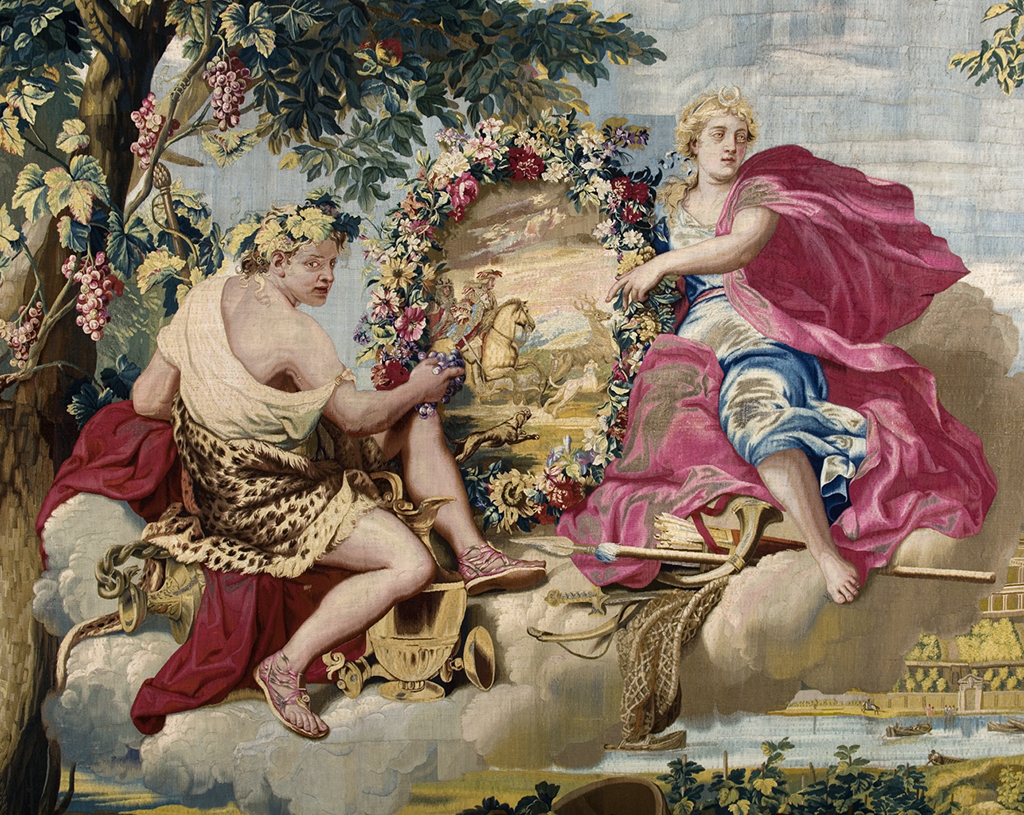
http://www.getty.edu/art/exhibitions/french_tapestries/

Everyone passes through Southern California during the Holiday Season. Give yourself a layover at LAX, pull a fast one on TSA, and run up to the Getty.

Woven Gold: Tapestries of Louis XIV


December 15, 2015–May 1, 2016 | The Getty Center

Fair and balanced

I have been babbling happy sounds over Shetland knitting belts. And, yes, if you are knitting delicate fabrics with light weight and/or wooden needles, then Shetland knitting belts have great virtues.

On the other hand, by simply making a longer needle adapter, knitting sheaths will work very well for pointy needles, and allow additional knitting techniques. The longer needle adapters will also work very well with blunt needles.

My rule of thumb is that if the fabric is firm enough to  support my steel needles, I use the steel needles and a knitting sheath, If the fabric requires lighter needles, then I use my Shetland knitting belt.

The steel needles for fine socks are so light, and the fabric so firm, that it really does not matter if one uses a knitting sheath or a knitting belt.


Knitting sheaths with short needle adapters for blunt needles, long needle adapters for pointy needles, and the knitting belt with the lighter, but more fragile tubular needles that sometimes collapse under the greater stress that can very easily be applied with a knitting sheath.

Fair and balanced says that different fabrics are made with different tool kits.

As for circular needles, I used them for years and years. Any fabric that anyone can knit with any combination of circular needles can be knit faster, and with less stress using "DPN" and either a knitting belt or a knitting sheath.  The class of objects that are more difficult to  knit with a knitting sheath or knitting belt are mobius objects that may require as many as 9 straight needles.  On the other hand, knitting belts/knitting sheath allow knitting a wide variety of fabrics that cannot be practically knit with circular needles.  The poster child for that truth is the lovely, soft fabric known as Eastern Crossed Stitch Knitting.

If you disagree, then post a link to a pair of socks in ECS that you have knit in a time period of less than a month using some combination of circular needles. 

Tuesday, November 24, 2015

Shetland Knitting Belts

My first major knitting project was his and hers Icelandic socks as gifts for my parents on their 50th wedding anniversary. Thus, as a knitter, I have always been something of a sock guy.

I make a point of knitting different features into my hiking socks and my ski socks and my gardening socks. I played with different sock constructions, and the one thing that I always liked but could not reasonably produce was socks in Eastern Crossed Stitch. I could do little samples and swatches to test, but I could knot produce the fabric at a practical speed.

Knit Eastern Crossed Stitch was a highly regarded fabric for socks from our earliest knit sock fragments until hand knit socks went out of production -- call it some 1,500 years.  Anything that people like for 15 centuries, must be good. I wanted it, but I could not figure out to make it at a reasonable pace.  It had be possible, or it would not have been so widely available.  It can be knit with hand held needles, but that is slow, and nice sock fabric is hard on the wrists. It is faster and easier on the hands with DPN and a knitting sheath, but that was never quite right. Swaving the fabric is not quire right either.  The right tool kit seems to be a knitting belt and  DPN.


A sock for my gardening sandals knit from MacAusland 2-ply and
knit in Eastern Cross Stitch. The fabric is discolored
because of the polishing compound used as the
needle design evolves. It will wash out,
and they will get worn in the mud anyway.

You cannot tell form the picture, but it really is a soft, thick fabric with great cushion.  It is NOT as weatherproof as uncrossed knitting, but it is thicker, and has more cushion, and it feels softer. I think the fact that it is not as weatherproof as plain knitting is one of the reasons that I never put the energy into working out a production technique.

I am a bit chagrined to realize that for the first time, I am actually making (pointy) needles for my Shetland knitting belt - previously, I just used what ever needles were available. Now, I am starting to understand the wonderful nuances of  the  Shetland tool kit. Like all good tool kits, it is not as simple as it looks.

There are hints that before knitters on the Shetland Islands made lace for England, they (illicitly) knit socks for the Dutch. Not Dutch farmers, but fine socks for Dutch traders to sell to the rich and powerful of Europe.  It may not be true, but it would help explain their traditions of professional knitting craftsmanship when the market for lace in England opened up.  I think, the Shetland knitters were already familiar with high-end knitting for the rich and powerful, when they moved into the lace market.  Moving from fine socks to fine lace could be done without changing the tool kit.   I read about the Shetland- Dutch sock trade years ago, but had never thought through the implications - e.g., that a knitting belt and making pins are the right tools for very fine socks.  That is, socks that is the socks were knit in Eastern Crossed Stitch. I suggest right here and now that knitting the best socks and the best lace take the same level of knitting skill. (I am not talking about socks for farmers and gardeners!)

To misquote a Diva that we all know:  Respect the Shetland Knitting belt.

Monday, November 23, 2015

Getting under the skin of a medieval mystery

http://phys.org/news/2015-11-skin-medieval-mystery.html
See in particular the last paragraph.

Sunday, November 22, 2015

Eastern Cross Stitch Revisited

I like ECS.  The fabric is thicker, with much more cushion and ventilation than plain knitting.  It has a much softer feel than plain knitting knit at the same gauge.  This makes it ideal for socks.  On the other hand, it can never be as weatherproof as plain knitting so it is not as suited for outer wear, where wind is a factor.

ECS wants to be knit with small motions.  Large motions tend to tighten up the fabric and make the next row difficult to knit.  Thus, ECS is easier to knit with a working needle that is stabilized, and more difficult to knit with say circular needles, where both needles are hand held.

I first tried ECS on circular needles and it too much effort to be practical.  Yes, it could be done,  but it was an effort.  Then, I went to  DPN with a knitting sheath.  That was much better. As I discovered that blunt needles work better with knitting sheaths than DPN,  I used knitting sheaths with blunt needles to knit ECS faster. To be frank, knitting ECS with blunt needles is fast, but tricky.

Now, I know that leather (Shetland style) knitting belts are the  support of choice for DPN, and DPN with a knitting belt is the tool kit of choice for knitting Eastern Cross Stitch.  And it is a stitch that allows knitting very tight fabrics, very durable without the extra leverage that a knitting sheath provides.  And, when knit very tight, ECS is much less stiff then plain knitting knit similarly. Plain knitting is the path to a tight firm fabric. ECS is the path to a tight, soft fabric.

ECS is a very nice fabric for socks and undergarments.  I think it is likely the basis of the traditional "Jersey".  It has taken years for me to come to a technology that made knitting such fabrics a reasonable effort.

Why did I not get here earlier? Conventional wisdom did not tell me that a knitting belt could produce such fabrics.  Today, I see knitting belts with pointy needles as the tool of choice for lace and crossed stitch fabrics.

The  other side of this is that a knitting sheath with blunt needles remains easiest and fastest way that I know do plain knitting, garter stitch or Fair Isle.   

Monday, November 16, 2015

How long do knitting sheaths last?

A while back, I made my "coffin" series of knitting sheaths:

They were fast and easy to make, and I made them in various sizes from various woods. They are very compact, and I like them for both gansey needles and sock needles. I often used them for knitting when I was out and about.

The one on the right above, is from a relatively soft wood (cherry) and is sized for US1 needles. I was sitting out somewhere knitting the other day, and decided that it had worn out, and the needle no longer sat snugly in its hole. (Not necessary for studio knitting, but handy for KIP.)

Certainly, I have other  knitting sheaths that I made for the purpose of KIP:
But somehow, this series does not provide quite as much support to take advantage of needle flex and spring as the coffin series.

Thus, the other day, despite having dozens of knitting sheaths in the house, I found myself making a new knitting sheath.

It works with all my belts, and takes adapters to fit all my needles, it provides enough support for knitting with US1 steel needles of any length, and it does not fall out even when I have run to catch the train.

Counting up, I think the cherry knitting sheath lasted for about 7 or 8 hundred hours of knitting. That is, if a busy knitter made their knitting sheath from a soft wood like cherry, or other other fruit, or nut woods, it would last perhaps 6 months, while a knitting sheath made from yew or maple or tropical hard wood would last a year or more.

From this we know that most of hand carved, wooden knitting sheaths in collections were keepsakes rather than the work-a-day knitting sheath of a busy knitter.

Metal or ceramic knitting sheaths seem to last forever. The knitting sheaths where I lined the needle adapter with brass tubing also seem to last very well.

Saturday, November 07, 2015

Big Fat and Not

I have described myself in this blog as "a fat old man with palsy".

With drugs for the Lyme Disease, the palsy has much reduced, and my hands are much more steady.

And, since being on drugs for the Lyme Disease, I have lost a little over 50 pounds.  Twenty of  that was likely inflammation and just fell off easily, but more than 30 pounds of that was the result of a serious effort to lose weight.  It was a priority, that I planned, and  I executed.  Today, 50 pounds lighter, I feel 20 years younger.  I like it.

However, while the Lyme Disease is stable, it is not gone, and I have another 30 pounds to lose. Losing that extra weight will make it much easier to get rid of the Lyme Disease in a shorter period of time. From here, I am very sure it is worth the effort.

The best system/diet that I know of for losing a lot of weight rapidly is that devised by Dr. Joel Fuhrman.  (http://www.drfuhrman.com/default.aspx ) 

Other systems work, but Fuhrman's program gets more results with much less effort.  And, the weight loss is more likely to be permanent.  

I see a lot of fat spinners. They will die "young", and the un-deserving will acquire their stash! And, if you are fat,  you will be less fit, and less fit spinners spin more slowly, meaning that more of your stash will land in the hands of  the un-deserving.  If you intend to spin all of your stash, then get fit! If you have stash beyond normal life expectancy, then you need to be exceptionally fit so you can live longer than normal.  

Most fat folk will say that Dr. Fuhrman's program required too many sacrifices.  It is not really that bad. My wife really likes her meat and fat, and for years and years, she had bee trying all kinds of diets to lose weight.  With minimal effort, hunger, and discomfort, she has lost 20 pounds since July on the Fuhrman program, and now has a closet full of clothes that must be altered to fit.  That is this afternoon's program - go in for fittings to get things taken in.  On the other hand, the Aran sweater that she bought in Scotland 30 years ago fits better than it has since we got back from that trek across Nepal in 1991.  In those days, she was very fit.  

Folks like Dr. Weil will deny the health advantages that Fuhrman claims for very low BMIs. Fuhrman provides all the citations, and I encourage you to read them with care, and with a copy of a good text on statistics, sampling, and study design at your side.  Many of the studies accepted by Dr. Weil are biased by the loss of weight common in fatal diseases near end of life. People who (get and) stay fit live much longer. Fat people do not live as long as fit people.

Some folks will say that Fuhrman is too much effort to prepare.  I say that as you become accustomed to the program, and plan for it, it is no more effort to prepare than the Standard American Diet (SAD).    When traveling, you can get food compliant with the Fuhrman program at places like Tender Greens and The Cheese  Cake Factory. The "free continental breakfast" offered at many motels takes some picking and choosing.

While I had uncontrolled Lyme Disease, my lipid panel numbers were  as high as one would expect for someone a hundred pounds over weight.  Within 90 days of starting the Fuhrman program, my lipid numbers were at the low end of normal without any medication.  Likewise, my blood pressure has come back down to normal without medication.  Given all the side-effects of prescription medicine, this is a real advantage.

The real advantage is that I like the freedom that being thinner gives.  It lets me move more easily.  That alone is worth the effort.

There are a few errors and in inaccuracies in Fuhrman's books, but the program as described, is scientifically correct and it works for losing significant amounts of body weight.  It has fewer side effects than the surgery often used for  obesity. Unlike the surgery, it is easily reversible.  If you decided that you want to be fat again, you can always go back to SAD.

Thursday, October 29, 2015

Running socks

The most important aspect of any knitting project is choosing the fabric.  I have chosen the fabric for my running socks:

 The yarn is worsted spun, 6-strand, fairly tightly cabled as 3x2-ply. Gauge is ~10 spi.

I knit the sock foot, bringing the ankle up about 4 cm of 2x2 ribbing above the top of the shoe.  Then I knit 12" high leggings that overlap the the ribbing on the sock foot.  I knit to fit, and the fabric has enough body to stay up while running and protect my lower legs, but it can also be rolled down for extra coolness.

This yarn is ~ 1,700 ypp, knit on 1.85 mm needles. I thought about finer yarns and finer needles,   but they are just running socks!!, and not worth the extra effort of finer yarns knit on finer needles, and the thickness is about right for my current running shoes.  Over all, I like the fabric a lot, and it is fast and easy to knit.

Tools used (short needles because we
were traveling)

ETA, those were the needles packed for travel, but on return, I seem to have moved on to 1.5 mm needles, which tightens up the fabric a bit.
(Oh, yes, there is a nice 17th century painting in the Huntington Library showing a girl knitting socks with blunt needles.)


I think it looks pretty good for hand made yarn.  However, as always, I look forward to folks posting images of better hand made yarns that they have made into nicer fabrics.

Tuesday, October 27, 2015

A History of Fine Spinning in America

Consider how modern mill spun/ mill woven wool shirting and suiting weight wool fabrics drape.

Alden Amos instructs on how to estimate the grist of the yarns used to weave a fabric.  Once one knows how a fabric woven from a particular grist of yarn drapes, then grist of the yarns used to weave the fabric can be estimated from the drape of a fabric. This is not as precise as Alden's methods, but with practice, it is reasonable.

Look at how modern mill spun/mill woven fabrics were photographed and painted by the modern portraiture artists. This can easily be done at the Getty.

In the Huntington Library, one can see portraits  by folks like G. Romney showing the rich and famous wearing fine hand spun/ hand woven fabrics - and they look as fine as the modern mill spun/mill.  This tells us that hand spun/hand woven fabrics were in fact very fine.

Back to the Getty Villa, and we look at the the copies of Classic Greek sculpture, and allowing for the iconic, symbolic, and attributive nature of the sculpted drapery (and allowing for Victorian restoration) we see that the Classic Greeks knew about fabrics that draped very similarly to the drapes in G. Romney's paintings.  Except that these sculpture were copies, and the fabric was iconic, symbolic, and attributive meaning that such fabrics had been around for a long time and EVERYONE, from the estate owners that wore such fabrics and who ordered copies the of sculpture, to the slaves that only peered into the temple from a distance knew about such fabrics.

If A=B, and B=C, then A=C.

From this we can conclude that the best fabrics of the Classical Greeks were rather fine.  Thus, we have three lines of evidence telling us that the classical Greeks had fine spinning and weaving.  We have the archaeology of the textile fragments.  We have contemporary Classical Greek accounts. And, we have the fine fabrics recorded in Greek and Roman copies of Greek sculpture.

One may poke holes in each of the lines of evidence, but together they offer more consistency than pointing to iconic and attributive images on early Classical Greek pottery.  Inspection of the image of Penelope's loom tell us none of the clothing in the image was woven on it. 

In the case of  Penelope's loom, the loom is attributive -- it tells us who the woman is, just as a lion skin would tell us that it was an image of Hercules, and much bare skin would tell us that it was Venus.  Of course it is an old loom, it is meant to tell us the woman lived in an earlier time when the gods and heroes walked waked among us, and took an active role in the lives of men and women.


Wednesday, October 14, 2015

The Nazi

I have been called a Nazi.  Pretty mild compared to some of the things spinners have called me in the last couple of weeks -- and people wonder why I am not more respectful of spinners. When I use words like "silly" and "boss cow", it is instead of the really foul language tossed at me.

Many make personal attacks rather than disputing the concepts, technologies, and skills.  I admit, that when something works very well, it is hard to demonstrate that it does not work.  Thus, disputing the concepts, technologies, and skills would be more difficult than proving that 6, and only 6 angels, can dance on the head of a pin.  That is, the dispute fails in the real world.  All that is left is personal attacks.

I am to the point where I have to treat every personal attack as a blatant admission that I am correct, and my attacker simply cannot think of anything intelligent to say. 

I do not expect modern hobby spinners to spin like a traditional trained professional spinners, because only a trained professional could do all those things. However, I think it is worthwhile to think what useful things the old spinners did, and how I can do those things.  Yes, we do not have the tools and skills that they had, but with some thought, we can replicate some of their products.

The truth is that in the Old Kingdom of Egypt, the pyramids were built by professional builders, who were fed by professional bakers and brewers.  The Pharaoh's shrouds (and likely other clothes) were made by professional textile workers.  Spinning was a specialized task performed by professionals. Producing professional quality yarn products has a long history, just like baking and brewing.

In Classical Greece, some textiles were produced in the home or on estates by the women of the house, and some of those products were sold on a commercial basis.  However, there was also an industry that was devoted to the full time and exclusive production of textiles by specialized professional textile workers -  textile factories.  There was enough trade between Greece, Asia Minor, Italy, Egypt and the Fertile Crescent that we can assume that the concept of such textile factories was widely known.  Now, we know enough about industrial organization to know that specialized professionals can produce higher quality products than general labor including prison labor.  Yes, specialized professionals in ancient Greece and Rome were producing superior quality textiles for the rich and powerful.

We know that Roman textile production methods were imposed on local producers as the Empire expanded, thus, the concept of specialized professional textile workers was known in Flanders in Roman times.  When Romans left, Flanders become famous and wealthy by converting English wool into great textiles.  England had the stable currency that was the envy of Europe, but Flanders became the most industrialized and densely populated region in the world as a result of its textile exports.  We can assume that they remembered the Roman textile production system that included specialized professionals.

Now we know the Celts were spinning and weaving fine, but folks in Flanders were spinning and weaving finer. In the Medieval period, they were turning out great tapestries including threads intricately formed of gold and silver.  Considering the silk, gold, and silver in the tapestries, we know that there were large scale textile factories producing fine textiles that were well beyond the resources of a spinster working by herself.  These were large coordinated enterprises, that utilized specialized professional textile workers.  This is a continuity with Greek, Roman, and later professional spinners.  The technologies and skills to make the great tapestries did not pop out of nowhere, they evolved over centuries.   This is not the common idea of the Medieval spinner.  The myth is that the dark ages were dark, and everything exploded in the Renascence.  Everything did explode in the  Renascence, but the dark ages were not as dark as the myopic Victorians would have you believe. Were there women spinning in the home? Certainly.  If you opened a bale of textiles as it was unloaded off of a ship in 1400, was the yarn spun in a home?  Not likely, as the stuff spun in  homes was for local consumption.  Textiles that were worth exporting were spun in large, coordinated enterprises, by talented professional spinners. 

If you think not, then post an image showing where you have plied a gold ribbon ( e.g., start with something like https://www.hooverandstrong.com/small-diameter-round-wire-specifications  and planish flat ) around a yarn to give it more luster as was commonly done in tapestries.   I do not know many hand spinners these days that can do that.  


Tuesday, October 13, 2015

Whorls

See https://www.academia.edu/11841581/Efficiency_and_technique_Experiments_with_original_spindle_whorls

A good spindle is faster than most modern spinning wheels!!

The factors are the moment of inertia of the whorl, the total weight of the whorl, the diameter of the spindle, and the weight of the spindle.  (http://www.feynmanlectures.info/ )

Moment of inertia determines how long the spindle will rotate.  The moment of inertia also controls how fast the spindle can be spun. 

The total weight of the whorl and spindle determines how thin a single can be spun.  Removable whorls, allows longer and finer threads to be spun.

A light weight, high moment of inertia spindle is good for fine worsted warp that with high twist.  The required inch worm drafting limits the total yarn production. The high moment of rotation gives time for drafting a good draw.

A light weight, low moment of inertia spindle is good for fine woolen threads, particularly with small diameter spindles to deliver very high spindle rpm. Fine spindles with low moments of inertia spun with a thigh roll can achieve speed of more than 3,000 rpm, allowing very fast production of  woolen yarns, where one hand controls the spindle, and the other hand drafts. It is wicked fast, and Karina Gomer  misses just how fast it can be. It is much faster than any portable wheel. For this, I like a metal blade.  Or, I like a very thin wood blade with a small (removable) brass whorl.

In either, case, a whorl that can be removed so the copp can act as the whorl, keeps the process fast  as the moment of inertia of the copp increases

Heavier whorls are good for heavier yarns.  Heavier yarns need higher moments of inertia to overcome the higher torsional rigidity of thicker yarns, and the thicker yarns can support greater spindle/whorl weights.  Thicker yarns require much less twist, and thus less rpm.

A good spinner will choose the right spindle for the task.  In the old days, spinners had a great many tasks. And spinners had a wide selection of spindles, and they know which spindle to use on a particular task.

Respect the spindle!  Know your tools!  Use the right tool for the job.

Karina Gomer misses the physics of spindle. She gets the generalities correct such as heavy whorls working for thicker yarns, but she misses things like diameter of the spindle as affecting total spinning performance.