Wednesday, August 11, 2021

Open Your Big Blue Book to Page 385!

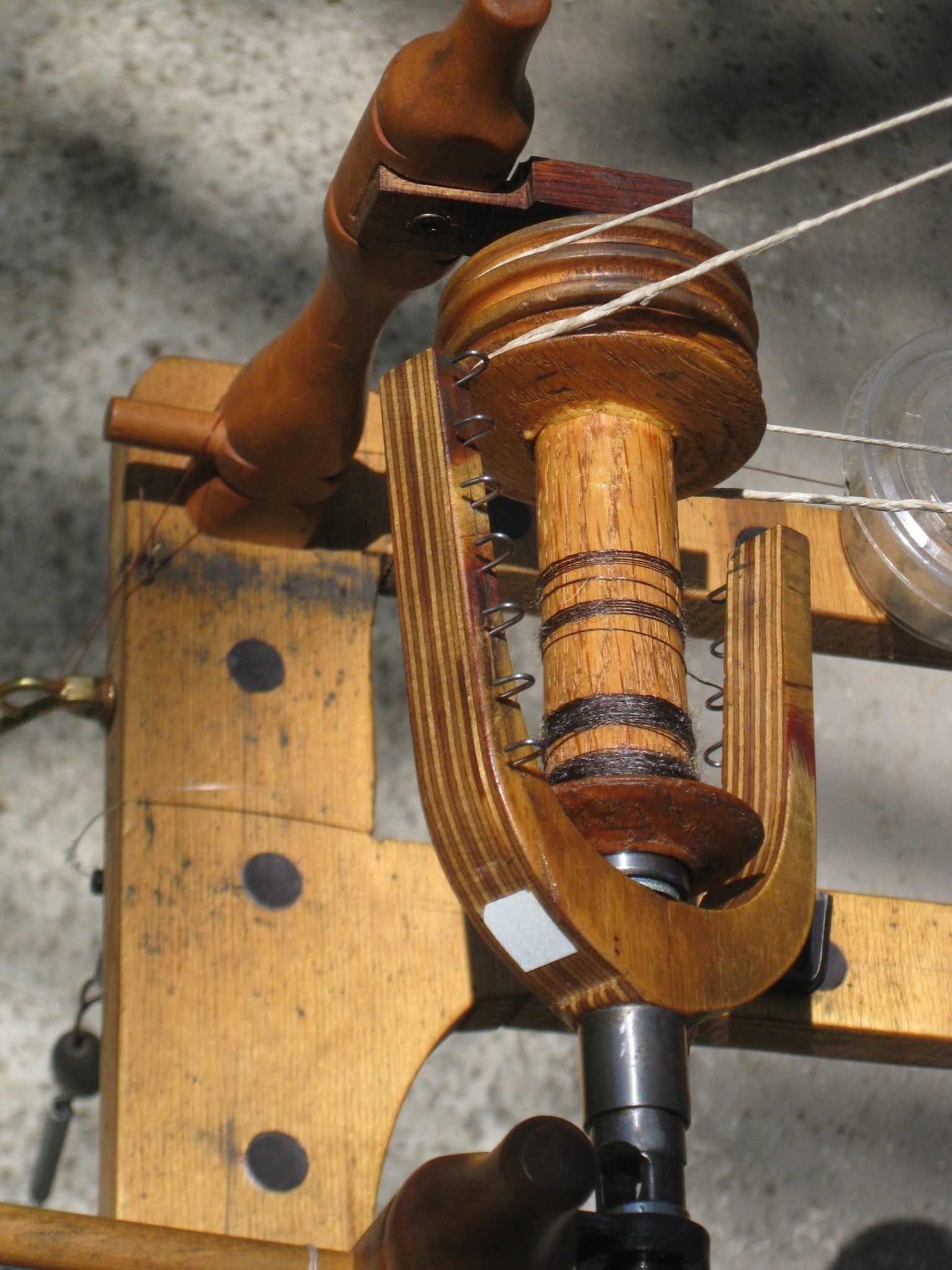
Yarn gauge.  It works!! It works best with worsted spun firm. Oh, Yes! And you MUST pack to refusal. 

This is not some promotional craft council standard for selling yarn, this is a practical way to estimate grist while the yarn is still on the spinning bobbin. This is the nitty-gritty of converting fiber to useful yarn.

Alden's table just goes up to about 10,000 ypp, but if you count carefully, have a good yarn gauge, and pack to refusal, the technique works right on up to 60s (34,000 ypp). For finer grist, metal gauges work better than wooden.) 

The day we talked about this, Alden said, "pack to refusal", perhaps 20 times in 4 hours. Pack to refusal is important, and it is different from the "yarn wraps" of the organizations, that just want to sell yarn to retail consumers.

You need a yarn gauge - just wrapping yarn around a pencil, knitting needle or ruler, will not allow you to pack to refusal. I make my yarn gauges out of rosewood.  The form factor changes depending on what grist I am spinning.  I made another one this morning - it has a 0.25" gap, and a bit of a handle so I can hold it firmly as I wrap the 27 or 28 wraps of yarn, while packing the yarn with my thumb and forefinger. (I want a grist of ~11,500 ypp on average.)

With care and practice a yarn gauge will give a better estimate of the grist of a fine single than a "yarn balance". The only thing better is an accurate scale /accurate length. However, the yarn gauge is not as affected spinning oil or fiber moisture as an accurate scale weight/length. 

Sunday, August 08, 2021

A hank of 4-ply fingering

 I do not mark spinners by their entry into contests, such as The Longest Thread, but by what they can sit down and spin, today.

I think a competent spinner can spin a hank of worsted 4-ply fingering in a day.

There was nothing in the process that I had not done before, but doing it all on one day, required: a new drive band, new accelerator bearings, fresh spinning oil, some new wool combing protocols, fitness from combing and spinning for hours every day, and cooler weather (without strong breezes) all of which took weeks.   A good chunk of that is stuff a competent spinner would do as a matter of routine, but I had been thinking about other things

And it can be done with crap fiber. I thought it was a practice/exercise day, so I used some old worthless fiber. About all I have done with it is knit "nippers", as I learned about at Maritime Museum of the Atlantic | (novascotia.ca), and on that day, with those exhibits, I started to wonder, "How did those old seamen stay warm?"

Actually, a few days later, we went to MacAusland Woolen Mills (https://www.macauslandswoollenmills.com/  ). I started knitting socks, and within few weeks, it was apparent that nippers were not knit, rather they knit socks,  wore them until felted and they had holes, then they cut the worn socks into nippers.  Nevertheless, such a shape makes a good swatch.)

Tuesday, August 03, 2021

Fresh Wool

 I have said several times that I like freshly prepped wool. Spinning 12,000 ypp singles outside on the patio, has pushed this to an extreme. In the morning, I set up my spinning on the patio, and prepare enough wool for one hank.  Each hank weighs about 24 grams, and takes a little over an hour to spin. I spin a hank and walk the 30 yards to my combing bench, and prep another 24 grams.  In the course of an hour, the consistency of the wool on the distaff changes, so the first 10 grams is easier to spin than the last 10 grams.

I think it is a matter that my combing/spinning oil mix (per Alden's Big Blue Book) has water in it that evaporites as the wool sits on the distaff. I think if I kept the prepped wool at high humidity, it might be OK, or it might compress a bit.

On the other hand, I like breaks every hour or so for a few minutes of combing.

I think when I was spinning singles at twice the weight, they had more moisture with less surface area and did not dry as fast.  I know these dry a lot faster after steam blocking.

Friday, July 30, 2021

Sheringham

 I have known this day was coming since I bought Gladys Thompson's book on Patterns. (and I spilled red wine on page 82.)

I have cleaned the white fluff off the combing bench, and moved a kilo of that Romney that I dyed navy blue years ago to the bench. It has been languishing in the stash.

I am going to knit a Sheringham - from handspun 4-ply fingering. Not the "tight one" knit on 1mm needles, but the fluffy one knit on 1.3 mm needles. (I like the motion of the stiffer needles. I intend to knit it on 5- 12" needles using a knitting sheath that hangs below my belt.)  All needles except 1.3 mm have been banished to the needle chest. 

Here in sunny California, I like to spin on the patio in the cool of the morning. I figure 2 or 3 weeks to get the spinning done. (Actual spinning/ply time under 55 hours.) (There is a real chance that with a new drive band, actual spin time will be closer to 30 hours.  I come from a world where we plan increment, baseline, and decrement budgets. )  

Then, 10 or 12 weeks of knitting - not all the time but 4 to 6 hours per day.  (Actual knitting time, 200 to 300 hours.)


Thursday, July 29, 2021

Sock fabric!

Elastic, durable, good moisture control, with minimum bulk

Early last spring, I set a goal of learning to knit "sock fabric". I wanted the fabrics of  Gladys Thompson's Sheringham ganseys and  Weldon's various gentleman's socks. These fabrics were knit from 4-ply Scotch Fingering Yarns. Paton's Beehive, was a commercial example, with samples still available. I also had samples of Froelich Wolle Special Blauband, which is also a 4-ply fingering yarn. It was clear to  me that 4-ply fingering was a fairly common kind of yarn - that at one time was commonly handspun.  

The modern Paton's BeeHive is synthetic and the Blauband contains 15% nylon. I like wool yarns, so after looking around, it seemed that I would have to become competent at spinning "sock yarn". I played with various forms of 3-ply (1680 ypp) and even made 6-ply versions, also ~ 1680 ypp, and decided, I wanted good,  4-ply fingering. Such yarns are based on 20s. (singles with 20 hanks of 560 yards /pound)

I could spin worsted 10s (5,600 ypp singles), so I did not fear 20s, but knew they would take some practice to spin on a production basis.

First I needed to do some spinning from the stash.


As excavated from stash. It is a colored (silver-brown, sepia) Cotswold-cross
 with a spin with a spin count under 40s. I bought it for a gansey for myself, but my 
wife tells me it is the wrong color - so it is promoted to socks. It should be a durable as nylon, 
but with all the virtues of wool.
First pass on combing

First bird's nest for this project.
 It needs better planking.

First spinning trial. Grist should be ~11,000 ypp (e.g., 20s). 
At this grist it spins very fast  and easy.  By the
time I write this, I have several bobbins of singles wound off
 and ready  to start plying.
-----------------------
Repeat for every large bin in the stash. No blending - each single is from one fleece. Often the yarns would be marled, plied up from yarns spun from different fleece.  Except for the navy-blue Romney, all fiber was undyed.
--------------------
Also, there was a reality check - did I really hate yarn from this fleece spun as 10s, and plied up in 1,600 ypp 3-ply?  Mostly, I had 10s spun, and it was just a matter of plying and knitting a swatch. Ya, I wanted 4-ply fingering.
----------------
With the exception of a coarse gray Cotswold,  I liked the 4-ply 2,500 ypp better than the 3-ply 1,600 ypp.  The surprise was one of the coarser Rambouillet fleece. It was surprisingly hard to spin as 20s.

I settled on the singles being worsted (Z) spun ~12,00 ypp at 17 tpi. The yarn was S plied at 12 tpi. A hank of 560 yards is ~ 23 grams,  which can easily spun on my DRS system. Length is lost to twist in plying, so a hank of 4-ply is ~500 yards/ 90 grams.  However, I lose good control of twist after ~ 40 grams, so I ply the finished yarn an ounce at a time. Commercial 4-fingering was traditionally sold in 1 ounce balls, so I do not feel too bad. I do feel these yarns are real sock yarn with good abrasion resistance, elasticity, and moisture control when knit on 1.3 mm needles at ~ 12 spi and 20 rpi. I like these fabrics - a lot. I find them worth the effort.

I sampled six fleece, and  spun a worsted 20s from each. These were plied to produce 2 marled and 2 single fleece yarns with grist between 2,000 ypp and 2,500. These were knit into a chain of swatches on 1.3 mm needles. The Cotswold swatch was finished with about 3/4" knit on 1.0 mm needles in deference to Gladys Thompson's description of Sheringham ganseys. In the photograph, a 1.3 mm sock needle is  above the bit knit with finer needles.   When knit on 1 mm needles that  4-ply fingering spun from Cotswold  is weatherproof. Such knitting is a hell of a lot of work.  As plain knitting, it has very limited elasticity, so it needs a stitch  pattern to give it elasticity and wearing ease.   On the other hand, imagine an 8-ounce "gansey" that is weatherproof! That is real magic! Something like that would be worth spending 10 weeks knitting.  (Frankly, I would use a finer wool to spin 23s or 25s, if I was going to knit on 1mm needles, but I have bouts of "crazy"! )


4 samples from different handspun 4-ply finger fingering yarns.
Gauge is about 12 spi by 20 rpi. ( ~240 stitches/ inch^2).
The long needles are 1.0 mm, the short sock needles are 1.3 mm.
These days I hang a small weight from the bottom of the knitting sheath
to provide better balance.


I am not sure why, but the spinning went a lot faster than I expected. Current theory is that when inserting more twist, I spin the wheel faster, so I am drafting about the same speed I would if spinning 10s. I know this project put a lot of wear on the drive bands, and they need to be replaced sooner than I expected.

Sorry about the pix quality-  I was up on Mt. Brionies, slipped in the dust, and came down hard on my phone.


Monday, July 19, 2021

Fresh Fiber

 I am sure, that by now, you are sick unto death, of my saying "Fresh fiber is good".

Here in California, we have been having some "fine dry weather" that produced some natural experiments on why fresh fiber is good.

1) I use Alden's recipe for spinning oil. It is great for spinning very fine, but it is mostly water. Put it on fiber and let it day and it does not work when dry. 

2) Wool can absorb moisture, and wool holding some moisture is easier to spin fine.  

3) If combed wool dries so much that it is hard to spin fine, it is better to spray it with water and recomb and diz, rather than just spritzing with water. Just spritzing does not evenly moisten all fibers. Combing spreads the moisture through the wool mass and along the fibers. In our fine weather, if I just spritzed the mass, it would dry, before the moisture diffused to all parts of all fibers.

These factors may not be so prominent for commercially produced combed top. I will accept that argument if you can take that commercially produced combed top and spin it at its "spin count" as it comes out of the package. I an spin wool at its spin count as it comes off  the combs. When I have commercially produced combed top I prepare it just like I prepare raw fleece.

I once complained about the warm weather in California one spring, and my boss said, "I will do something about that right now!" And, he handed me a one way ticket to Saudi Arabia and I spent a long warm summer fighting oil well fires and disposing to the resulting hazardous waste. Since 1991, I have not complained about the weather in California. At worst, our weather is an opportunity to learn and improve one's moral fiber. The truth is: Wool grease melts at 120F, so it is easier to scour wool in our fine climate.

Saturday, July 17, 2021

Spinning and Swatching like a demon

 What I really want  is a "gardening gansey". Something like a "rugby jersey" but in finely knit wool.  The fabric should be like sock fabric - elastic, durable, and able to handle moisture - cotton rugby jerseys fail at the moisture control criteria.

My old ganseys are really too warm for the current climate and resulting garden chores. (We no longer own an apple orchard in Northern Pennsylvania.) One gansey was knit to the criteria of defending me from thorns as I pruned roses in the winter rains.  In these dryer times we gave up roses. 

Anyway, in experimental spinning for weaving, I spun bins of yarn in the ~ 7 thousand ypp range. Some white, some blue. Swatching tells me that those singles as 3-ply yarn (~2,000 ypp)  make a nice sock yarn, which when knit on 1.5 mm needles make nice fabric, that I think would be good for walking socks or a gardening gansey.  In the past, I knit "boot socks" from 5-ply gansey yarn (1,000 ypp). I did not really think about finer sock fabrics - I was focused on the issue of "How warm can knit wool be?"

This is a major change in paradigm. As I get older, I am less likely to go up into the snowy Sierras and more likely to just walk up Mt. Brionies - a pleasant 2-hour walk if I take the short cut.   It is past time to recognize that there is less snow in the Sierras.  On the other hand, wool boot socks do still feel good on the cold tile kitchen floor on a winter's morning, when I come down to make breakfast. I have 75 pair of good wool boot socks - enough to keep my feet warm while I cook thousands of pots of steel cut oats. 

No, that 3-ply yarn will not be a durable as 4-ply from 11,200 ypp singles. However, that 3-ply  yarn by virtue of its coarser fiber will be more durable than commercial yarns such as  Special Blauban or BeeHive.  And I have those singles on hand and I can ply enough yarn for a gansey in a morning. (I knit swatches from the 4 samples the yarn I already made.)  I will not be off at sea - if a part of the gansey gets worn, I can reknit it.  I have more of those fibers, I can always spin more yarn to match.  And, a fabric knit from 2,000 ypp yarn is just right for Mt. Brionies in any season.

To get here, I had to stop thinking in terms of  modern patterns that use commercially available yarns.

I had to swatch until I found a combination of  yarn and needles that produced a fabric that was well suited to the intended purpose. I had to revert to Knitting in the Old Way as in the book by Priscilla Gibson-Roberts and Deborah Robson. (I do not sell anything these days, but I am honest about what works for me.) Knitting in the Old Way was the key that unlocked Gladys Thompson for me.  I think, the process of swatching yarn as spun and the processes in Knitting in the Old Way produce good sweaters. 

Mostly, ganseys are knit to fit. This makes them warmer for their weight, and it means less knitting - faster production.  Knit to fit, these firm fabrics need pattern stitches to provide extra ease for movement. Sure, you can just run vertical ribs from top to bottom, but that is more work, makes a heavier garment, and not as warm as panels of plain knitting. The Sheringham ganseys have moss and chevron patterns across the chest for extra ease. I also like some of the chest patterns in Mary Wright's, Cornish Guernseys & Knit-frocks. Many of Cornish patterns are similar to the Yorkshire patterns in Gladys Thompson. I expect they were knit for men doing the same kind of jobs in the same climates. 

I have said it before,  "A sweater is only a sweater, but a sweater with matching gloves, socks, hat and muffler is an outfit."  And, gloves, socks, hats and mufflers make very good swatches.  I tend to use Mary Thomas's Knitting Book as guidance on these objects, particularly gloves. Except for gloves, I tend to knit on longer needles.   For glove fingers, I often use shorter "sock needles".  There was a time when I had special very short glove needles, but now I knit everything with a knitting sheath, and all needles are at least 5" long, and mostly steel.  If I must knit soft gloves on big needles (e.g., US2) I use 6" wooden needles because they lighter, less slippery, and less likely to fall out when held by only a few stitches on one side of a finger. 

Like a good little demon, I did recently knit Froehlich Wolle Blauband and Paton's Beehive on the recommended US2 needles. I still hate that fabric. 3-ply,  2,100 ypp yarn knit on US2, is enough firmer to make a reasonable glove fabric - better than those damned, old worthless knit  Army mitten liners!

It is time for me to transition from spinning and knitting objects that prove how warm knit wool can be to spinning and knitting objects better suited to the modern climate. Yes, the finer 20s (11,200 ypp singles) are 40% slower to spin than the warmer 10s, (5,600 ypp singles) but I can still spin them at over 300 yards per hour.  I can still spin/ply a hank (500 yards) of 4-ply sock yarn in a day. 

There is a couple hundred pounds of fiber stash in the house, ranging from Lincoln to Rambouillet, with a lot of Cotswold and Romney in between. At some point, I have spun hanks from each of those bins as 20s, 30s, & 40s. I have spun 40s (22,400 ypp) from the Romney. There is a bunch of  Heinz 57 from the Woolery, and I have spun 54s (30,240 ypp) from that  (sorry, it is not a 57s grade fiber) and there is the Rambouillet from Anna Harvey (https://www.annagotwool.com/) from which I have spun hanks of 560 yards that weighed less than 6 grams e.g., ~ 45,000 ypp). (A small part of a large fleece. Other sections of the fleece spun at closer to 40,000 ypp.)  The real lesson of that evolution was that hanks of fine singles must be tied very carefully, or they will tangle. Alden never worked with such fine threads, so his advice on tying skeins of fine singles is - understated. Some of those skeins tangled, and I called them, "My little shits". From that, many spinners assumed that I could not spin fine. No, I could spin fine, but I had a learning curve on tying hanks of 45,000 ypp singles so they could be handled.

The fiber you have on hand can likely be spun in to 22,400 ypp singles or any lower grist. Finer fibers like Shetland can be spun into 30,000 ypp singles. Merino and Rambouillet can be spun into 40,000 ypp singles.  Mostly, the fiber is not the problem.  Any fiber you buy in a retail store selling spinning supplies can be spun into 22,400 ypp singles.

I think all the books on spinning for knitting, fail to properly discuss plying. Alden fails to talk about using a tension box to facilitate plying.  Great knitting yarns are spun rather fine, then plied to a useful grist. A tension box is essential for smooth, easy, consistent plying.  With a tension box, 5-ply or 10-ply yarns are  easy. Without a tension box, consistent plying is difficult.   With thicker singles (10s) I can ply from center-pull cakes. For sock yarn with finer singles, I ply from bobbins. I think all plied yarns need to be steam blocked.  Steam blocking results in a much better yarn (knitting or weaving). 

And when I buy commercial combed top or roving, I steam it prior to combing. Yes, I comb, diz, and plank and diz commercial combed top. The top is wound into birds nests, then carefully transferred to the distaff for spinning. Fiber that sits as bird nests for a few weeks gets recombed.  And, that is some how I spin finer than most hand spinners.  


Friday, July 16, 2021

Old dog learns new tricks

I have been sampling/swatching/ playing with old yarns like Paton’s Beehive, Froehlich Wolle Blauband yarns, and Jamieson’s of Shetland 4-ply yarns with a grist of  ~2,500 ypp. I have knit them on 1.5 mm and 1.3 mm needles, and like the 1.3 mm needles.

(Some of these yarn labels recommend US2 needles. I first swatched these yarns on the recommended needles. I did not like the fabric, which is I have these nice old yarns in the stash - for an older and wiser knitter to revisit.)

I like the 4-ply construction much better than the 6-ply cable construction that I have been using. The cables are cooler and more durable, but do not have as nice skin feel.  

The Paton’s Beehive, Froehlich Wolle Blauband yarns, and Jamieson’s of Shetland 4-ply yarns with a grist of  ~2,500 ypp seem to be disapearing. There are small lots on Esty, and EBay, but it is hard to find yarn for a sweater. 

These yarns are based on worsted spun singles of 11,200 ypp (20s). Almost any long wool fleece can be spun to that grist.  It takes me a day (after fiber prep)  to spin 4 hanks of singles and ply them together into 500 yards/ 90 grams of good sock yarn. On 1.3 mm needles, 90 grams is a wicked lot of knitting. These 4-ply yarns are easier to produce (fewer steps) than the 6-ply cabled that I have been playing with and knitting on 1.5 mm needles.

Today, this is the kind of yarn I like to knit, but it is very hard to buy such yarns these days. I will tell you about it, but I am not going to spin it for you.

(Yes, with a slower wheel, it will take you longer to spin this kind of yarn. That is not my fault! It is something you should take up with people like Henry Clemes or Robert Ashford.)


Monday, July 12, 2021

A Rabbit Hole

As I started knitting,  yarns seemed to be based on singles of 5,600 ypp.  Gansey yarn was 5-ply (1,000 ypp, allowing for contraction as a result of twist).  The "worsted weight" of  Paton's and Lion Brand was 840 ypp  (e.g., 6-ply grist produced as a 3 or 4 ply yarn requiring  much less  twist and much cheaper to produce).

Paton also produced BeeHive  wool  which has a grist equivalent of  2 singles of 5,600 ypp, but was produced as a 4-ply yarn. It was based on singles of  11,200 ypp. Such singles have a lot of twist and are durable. One must pay for that extra twist and durability, but it was worth it. 

"Jumper yarn" was traditionally a 4-ply yarn with a grist of ~ 2,500 ypp. It was very good stuff. It was/is the basis of the sock fabric I want to knit. Most of the commercial lines of this yarn have been discontinued. Some of it is on ESTY. Over the years, I have bought samples of it from discount bins, but I never learned the technical knitting skills to use it to its highest use, and I did not understand how wonderful fabrics knit from these yarns could be. Now, these brands of wool seem to have been replaced with synthetics.  I still like campfires, so I am not looking for synthetics.

Few hand spinners spin 5-ply gansey yarn because it requires a lot of twist and is thus slow to produce.  The 4-ply, 2,500 ypp needs more than twice as much twist as gansey yarn.  It takes me 3 days to spin yarn for a gansey that takes me 9 days to knit so I should not feel too bad if it takes me more than a week to spin yarn for a sweater that takes me more than a month to knit.  

Spinning yarns based on finer singles is a real rabbit hole. If singles of 11,200 ypp are better, perhaps singles of  33,600 ypp would be much better? That is not a very deep rabbit hole - I spun some 10,000 ypp, 3-ply lace yarn a while back and decided I did not like knitting lace. For now, I am focused on "sock fabric".

As I study sock fabric, I am learning some technical skills - but mostly it is about the value of knitting good stuff. I thought I learned some of that knitting weatherproof ganseys.  No, I just scratched the surface.  The more we have cheap synthetic mass produced clothing, the more precious good clothing becomes. 

Good knit objects are some effort to produce, but if they are really good then you realize that they are worth much more than the effort put into producing them.   I want real value from my textile efforts.

My wife's mother was a very good, fast knitter - and her needles clicked. As I said, there are other reports of knitting needles clicking. As I have gotten more proficient with 1.3 mm needles, they have stopped clicking.  If my needles are clicking, that means that energy is being transferred to the other needle, instead of to the yarn. The needles are levers for moving loops of yarn. Energy that does not go into the yarn is wasted. And, clicking needles mean that one hand is transmitting stress and trauma to the other hand via the needles.  Why should I let one hand bang-up the other hand?


Sunday, July 11, 2021

Irish Cottage or Lever Knitting

 It can be fast! It  can reduce stress on the wrist and hand. It can be done with tools bought at any knitting store. For some knitters these are overwhelming advantages.  I wish them well!

On the other hand, it is not particularly good for fine needles, and hence is not particularly good for fabrics that must be weatherproof. Irish Cottage Knitting is not particularly good for fine socks.

Starting in 1999, I set out to knit weatherproof fabrics. It was soon apparent that Irish Cottage Knitting was not a good option for my needs 

Knitting sheaths have similar motions, so  techniques using a knitting sheath are just as fast or faster! Using a knitting sheath, I can work with very fine needles of any length. 

Yes, I had to make the knitting sheaths. The first few knitting sheaths I made were crude, functional, and the time invested was less than the time saved by knitting (the first project) faster. I put a lot more effort into later knitting sheaths, but they have been used on hundreds of knitting projects, and have saved me a lot of knitting time. And, they allow me to knit fabrics that I could not otherwise knit.

This summer, I am learning to knit "sock fabric". I am knitting worsted spun, high twist yarns in the 2,500 ypp to 1,200 ypp class. The fabrics are knit at  between 9 and 15 spi, and include fabrics in the 12 spi by 20 rpi as reported by GT for Sheringham ganseys.  I am not real thrilled by modern sock knitting yarns. I find myself making/spinning my own yarns.  Wool fibers have scales and crimp, that with twist hold the yarn together and give it durability.  Super wash wool does not have the scales, so it has less durability. If I am going to put the effort into knitting, I want durable. Still there is a difference between knitting a sock at that gauge and knitting a sweater at that gauge.  In particular, worsted spinning 6-ply "sock yarn" 17 tpi singles is an easy week's work for a pair of socks, but a sweater's worth of that yarn takes longer. 

Wool is less flammable than synthetics, and for a sweater that I am going to wear out and about, I want less flammable. 

Nylon goes into sock yarns because it is cheaper than wool; it is a filler. For various reasons the wool wears away from the nylon; people see the residual nylon and think nylon makes a durable sock. No, it just helps the wool wear out faster. If I am going to put the effort into knitting, I want durable. That goes double for a fine sweater.

The effort to spin good yarn is less than the effort of buying most commercial yarns, them knitting more socks (or sweaters) because that yarn was designed not to be durable. Some, like Frangipani are very durable, but have a high ply twist, so the yarn has less fill and even when knit firmly produces a fabric that is well suited to modern centrally heated conditions.  Sweaters knit from Frangipani are not well suited to -- taking a nap in the snow. The lesson is : If you wear your beautiful Frangipani sweater to the pub on a cold night, call a taxi, rather than trying to walk home in the snow! ( : 

Irish Cottage Knitting is fast, but it is not suited to producing dense, durable fabrics. Rather the assumption is that the objects will go threadbare or sag, and you will have to knit new objects.  

My points are:

  • Spinning is faster than knitting yarn designed to fail.
  • Good knitting is faster than knitting twice. 
  • If you just like knitting, there are always people that need well knit objects.

Saturday, July 10, 2021

Knitting needle tips

 I have been moving toward blunter/flatter knitting needle/ knitting pins/knitting pricks for several years now. For a long while, I thought flat tips were better for knitting and domed or rounded tips were better for ribbing.

Today, I recognize that as a lack of skill.  Now, I like flat tips for knitting and purling. I like flat tips for ribbing. With skill from real practice, they are faster.  Perhaps, if I sit down and practice, I will be able to knit bobbles with flat tipped needles. (There might be 10 cakes of real 10-ply Aran yarn, in the stash.) However, from here I think pointy needles/ knitting pouch is a better toolkit for panels of brioche stitch.

Flat tipped (needles) do not  work well as hand held needles - they really do need a knitting sheath.  

And, knitting  sheaths work better with flat ended needles/pins/pricks. 

If  I need pointy needles for a substantial bit of knitting,  I likely use a knitting pouch. If it is just a few stitches, I will use them in a knitting sheath, or just hand hold them.

If you are going to FINISH a good stream of  fine socks (30,000 stitches per sock) per year, a knitting sheath and flat tipped needles are the easy path.

Friday, July 09, 2021

The Click of Knitting Needles

 In the book Heidi by Spryri, her blind grandmother's knitting needles clicked as she knit by the fire. And, there are other literary references to the clicking of knitting needles.

From this I assumed that a good knitter's needles clicked as they knit. However, I did not hear modern knitter's needles click, and I did not click as I knit.  This was good as it allowed me to do a lot of knitting as my wife and I watched movies.  

However, recently, my needles have started clicking as I knit. The currents culprits are 1.3 mm steel sock needles with a Durham style knitting sheath when knitting firmly spun sock yarn.  It is not a big deal - it is not something you would hear over the Star Wars sound track.  

But yes, Spyri was correct that some knitter's knitting needles click as they knit.


Wednesday, July 07, 2021

Sock Fabric

 I was going to spin the yarn, and knit a fine gansey this summer. 

Then, I realized that the fabric I wanted was actually "sock fabric".  

Thus, when I was out sailing with guys that had gotten many pairs of handknit ski and hiking socks from from me over the years, and I told them that my plans for the summer was to learn to knit socks, they were surprised.  However, there are socks and there are "socks"!

I cabled up some 6-ply, 1,680 worsted yarn, and started looking for needles to knit it. I was not impressed by 2 mm, 1.9 mm, 1.8 mm, 1.5 mm, . . .  . but ahh! the yarn comes alive with 1.3 mm needles. Stitches are easier to  knit and easier to see than with the thicker needles that I had tried.  Actually the 1.3 mm needle got mixed in to a set of 1.5 mm needles Iwas working with, an the difference was such an epiphany, that I frogged the 20,000 stitches that I had already knit with the 1.5 mm needles, and am reknitting it with 1.3 mm needles. (I have not frogged the first sock of the pair, and I may keep it because it is a good sock, just not a great sock. ) 

That yarn, knit with 1.3 mm needles is a lovely fabric, and just as importantly, it is as fast to knit as coarser fabrics knit on thicker needles. The stitches pop and are easy to see, and it is easy to feel when the stitch is correct. And, it is suddenly a smooth fabric, that will not chafe.  It is the same explosion of understanding as when I first knit 1,000 ypp gansey yarn with "gansey needles".  It convinces me that the magic of  gansey knitting is the ratio of the yarn grist to the diameter of the knitting needle. Now, I believe there are other such wonderful convergences between grist and needle size, with spinning factors such as twist per inch also important.

I also think "that magic" only appears when using a knitting sheath.  Now, I am using blunt tipped knitting "pins" or knitting "pricks", which do not work well with a leather knitting pouch.  More and more, I am convinced that knitting tools were rather specialized. A leather knitting pouch with pointy needles is a much better tool kit for lace, Fair Isle, and perhaps Aran sweaters with bobbles.  I no longer use my knitting pouch for socks.  If I needed a pair of lace socks, I would be buckling that  leather knitting pouch around my waist as I read the pattern.  More likely,  I would knit a fine pair of socks and then use the pouch to knit lace cuffs to stitch onto the socks. 

For a fine sock fabric, I want a knitting sheath, and fine needles. 

I do not care how long the needles are - I use whichever knitting sheath that brings the knitting into an ergonomic knitting zone.  The knitting bag now has 3 lengths of fine sock needles in it - and a different knitting sheath for each needle length. If I was a professional - knitting a ship cargos of one kind of sock, I would need only one set of needles and one knitting sheath. My personal knitting would just be done with that one tool kit. I have the 3 tool kits not because I do so much knitting, but because I want to know how those different tool kits work, and I do not have a teacher to ask.

Yes, this summer, I am learning how to knit a sweater of fine sock fabric. It may be blue or white or dyed, but my wife tells me it will not be any of the natural browns in the fiber stash. Oh Well! That frees up those brown fleece to be fine socks.

Saturday, June 19, 2021

Lifelines

 I certainly used them when I started knitting ganseys. 

Now, I knit finer, more intricate objects, always from wool yarns, and I do not use lifelines. I do use a knitting sheath, and blunt spring steel needles. I have been seriously knitting for 20 years. The first 4 years with hand held needles (circular, and DPN). Then there was 11 years of learning how to use a knitting sheath with pointy needles. The last 7 years have been a gradual transition to knitting sheaths with blunt needles. There was a period of learning that with knitting sheaths, blunt needles are better, and then development of better techniques for blunt needles, and learning  to make better blunt needles. The transition to blunt needles has allowed productive use of finer needles on finer wool yarns to produce finer fabrics. 

I assert: Lifelines can be replaced with 3 skills;

  • Learn to feel the stitches as they are made, and use that feel to be sure the correct stitch was properly formed as you knit. The best solution to a knitting error is be able to fix the last stitch.
  • Learn to feel/read the stitches you are knitting into, and use fine pointy needles and a crochet hook to fix any errors before making the error more onerous by knitting over the error and pushing it deep into what should be good knitting.
  • If you have missed the error and pushed it deep into your knitting, you can use a fabric steamer to block the row that you have to frog back to; and make that row more stable and easier to pickup.
If you are knitting loosely, you can go back, deep into the fabric to repair errors without frogging. If you are knitting weatherproof, or very fine fabrics, or lace, then frogging and reknitting is likely the better fix.

A good knitter, can feel all the stitches in the fabric around the working stitch, and know when the working needle is near a stitch that is "wrong".  As soon as you feel the "wrong", fix it!  With practice, this can be even done with fine dark blue thread by by the light of a candle or the gloom in a movie theater.

There was a time, when English knitting cooperatives, worked in their gardens in the mornings and knit in the afternoon and evening producing objects to sale for cash . Candles were expensive, so there was very limited light, and yet they produced professional quality knit products.   We know it can be done!  It is just a matter of learning the skills and doing it ourselves. We develop the skills by - practice. We visualize what we want to do, and plan evolutions to become better.

They sang knitting songs to remember the pattern and count rows and stitches as they knit. I use a piece of wood that has grooves and slots that define the size of the objects I am knitting. For socks, it is the exact length of the foot I am knitting for.  I find such a measure gives a more accurate length of the sole of the sock. I can compare my knitting to the slots and grooves on the wood "story board" (by feel) and know when to move on to the next part of the pattern.  This allows me to knit socks for different purposes from different yarns at different gauges, and still have the socks fit. The slots and grooves for socks to fit me are also on a favorite knitting sheath that works with either 9" or  6 " needles, when used with a belt in my jeans. This allows me to knit socks for myself using my knitting sheath as a measure.  The knitting sheath, needles and yarn for 3 days of knitting fit into a knitting bag only 7" x 10" x 2".  My firmly spun yarns take less space than a similar weight of commercial sock yarn, and make socks that are just as comfortable, but more durable.  The 12" needles and their sheath remain by my knitting chair.

My epiphany came when I was knitting hard spun 6-ply / 1680 ypp yarn on 10" long blunt steel 1.5 mm steel needles. I knit a couple of pair of  these socks. It is not my favorite fabric with this yarn, but is is where I learned to feel the fabric. The light was good, and I had magnifying glasses handy.   I think the firm yarn and long needles conducted and amplified (?) vibration. Once I knew there was a sensation, it was a matter of detecting fainter vibrations in other (stiffer) knitting needles and (softer) yarns, and learning what the vibrations meant.  

I am knitting a few pairs of  fine socks to practice this skill.  This detection of  errors is best learned when knitting fine, firm fabrics -  e.g., garters, socks, mittens, gloves.  I find detection of errors by feel harder when knitting soft fabrics and soft [commercial] yarns. Also, I find it much harder to feel knitting errors when using pointy needles. This may just be me, but it may also be that the  angle from the shaft of the needle to the point makes it harder to feel small variations in spacing and tension. Also, I find that grippy needles are less sensitive. I like POLISHED steel. 

In a time of Covid, we learned how to binge watch movies and TV series. Leverage that, and learn how to knit in the gloom of watching Heartland or Madame Secretary or Gunsmoke!  I cheated and knit a few pair of white ski socks during Heartland . During the current binge of Madame Secretary, I expect to knit 3 pair of socks from purple, firm spun1,680 ypp sock yarn.  In part, this is a test of which gauge/needles/knitting sheath I like best for this yarn. The yarn is cabled up from commercial 2-ply wool weaving yarn. 

I also often knit objects that are intended to be functional rather than fashion statements. I fix errors that diminish the functionality of an object, but I may leave other kinds errors in the object -  to remind the close observer that it is HANDMADE.  I do not care if the socks in a pair differ by 0.07".  It is a gift, and I tell him that the bigger sock is for his his right foot, because we both know that his right foot is bigger. 

It has taken me 20 years, but I think I am starting to understand why master knitters expected apprentices to do knit stitches for years, before allowing them to knit other kinds of stitches.  Working intently with one kind of stitch allows a better understanding of the fabric.  Knitting fine socks is very different from knitting weatherproof ganseys -- each fabric has its own "Zen".  I consider it took me 12 years to understand gansey fabric, and after a few more years, I am just starting to understand sock fabric.

Tuesday, June 15, 2021

How fast can a hand spinner spin - part 2

 Twist allows short fibers to become yarn or thread. Twist organizes "fibers" and holds them together. Thin yarns and thread need more twist per inch. Very thin thread require a lot of  twist.

Traditionally, twist was the greatest expense in making textiles. For the hand spinner, inserting twist consumes time, and time is valuable. Fine yarns and threads need more twist, and thus are more expensive.

Thick yarns (low grist) can be made with less twist, but low twist yarns are less durable, not as warm, and do not have the drape and hand of higher twist yarns and thread.

How much twist is required for a yarn of a particular grist can be estimated from the table of Twist Factors  on page 383 of  The Big Book of Handspinning by Alden Amos and a simple calculation.

Alden discovered that some popular designs of spinning wheel fliers tended to self-destruct at speeds just over 2,000 rpm. (revolutions per minute) This exposes the truth that most modern spinning wheels are not made to insert twist faster than about 1,500 rpm. Now, there are some e-spinners that will insert twist at over 2,000 rpm, but they are single drive mechanisms, that alternate between a drafting/twist insertion mode and a wind-on mode, with the spinner controlling which mode is in operation by the tension of the yarn being spun. At twist insertion speeds of over 1,500 rpm, a human spinner's reflexes are not adequate switch between these modes to produce a uniform yarn.

Alden made my #1 flyer out of  aircraft plywood, and I have run it at 5,000 rpm. I use DRS, so there is a (crude but effective) clockwork synchronizing drafting/twist insertion and wind-on. DRS has  only one mode.  DRS is different! Spinning 17,000 ypp singles at 17 twists per inch, at 5,000 rpm produces ~ about 8 yards of thread per minute. No hand spinner can draft, control twist insertion, and wind-on that fast.  My distaff loaded with the combed top for that yarn only holds about 4 grams which spins into 140 yards of single. However, the smallest fault in fiber prep makes a mess. I actually have higher overall productivity running the flyer at about 3,000 rpm for all grist under  30,000 ypp. Spinning 10s, I produce about 10 yards of single per minute or a hank of 560 yards in less than a hour. Finer singles want more twist, and are produced more slowly.

The clockwork of DRS allows true worsted yarn or thread to be spun at these speeds. With a different fiber prep, the clockwork of DRS allows true woolen yarn or thread to be spun at these speeds. With DRS, fiber preparation is critical.

Most of my spinning is 10s (worsted, 5,600 ypp). For knitting I insert 9 tpi, and for weaving I insert 12 tpi.  This allows me to spin a hank of the knitting single in an hour.  I can spin/ply a 500 yards (8 oz) of 5-py gansey knitting yarn in an easy day.

Singles of 10s were the traditional building block of wool yarns for good reasons. They have enough twist to be durable and have good drape. They can be spun from almost any fleece.  As 2-ply they make good sock and jumper yarns. A good "gansey" (knit from 5-ply) is warm enough to sleep in snow or work in the top of a square rigged ship.  As 6-ply yarns, they can be knit into objects for cold weather wear. As 10-ply, (Aran yarns) they are ridiculously warm and durable.

Singles of lower grist, can be formed with less twist (faster on a single drive wheel) but with less twist they have less durability, and less warmth. Their great virtue is low cost because they require less twist.  Low grist singles with enough twist to be durable and warm, tend to feel like barbed wire.  

10s make a good compromise for a good yarn with reasonable effort. If I want good yarn fast, I spin worsted 10s.  If I want a thicker yarn, I ply or cable as thick a yarn as I need. Woolen yarns need more twist to be as competent, and thus with DRS, woolen spun takes more time and effort. 

If you have the resources, then finer yarns with more twist have virtues.  A 3-ply worsted spun  yarn plied up from 10s at 12 tpi is a nice sock yarn for walking, but a 6-ply from 20s is a smoother with about 3 times the twist for greater durability. (All are ~1,680 ypp).  Four 20s makes a 2,580 ypp yarn well suited to city socks. Finer yarns based on 30s spun at 17 tpi were the traditional yarn for  good hose for gentlemen. My net production of the finished yarns is about a 60 yards /hour. I budget a day to spin the yarn for a good pair of socks. (Longer for knee high.)  The finer plies take a lot more twist, and with a single drive wheel, that higher twist would take MUCH longer to spin.  With DRS, I can just change whorls, and the spinning time remains less than the time needed to knit nice socks.  That is why I use DRS.  For patterns see the original Weldon's Practical Knitter.


Sunday, June 13, 2021

How fast can a hand spinner spin?

This is a question that has several answers.

For woolen, even a simple drop spindle will insert twist faster than most treadle spinning wheels. If you are looking to spin woolen yarn at 5,600 ypp, and willing to work very hard, a drop spindle with a very thin shaft and removable whorl is fast.  Most people do not spin that fine, and lower grist yarns need less twist and more ability to handle the produced yarns.  If you are spinning a 2,000 ypp woolen yarn, a wheel or e-spinner works well, and will be faster than a drop spindle.

The big deal is worsted. I have no idea how fast most modern spinning wheels  (single drive, flyer or bobbin lead) will produce worsted. Most modern "double drive" wheel are really single drive wheels with a complicated belt tension adjustment.    

Most modern treadle wheels have large amounts of slippage at the flyer/bobbin assembly whorl, and thus the ratio between the drive wheel and assembly whorl is not a good estimate of the actual rate of twist insertion.  However at high rates of twist insertion (greater than 2,000 rpm), without true DRS, it is essentially impossible to produce a high quality thread with uniform twist.

Great wheels are faster than most modern treadle wheels for woolen thread. They will produce woolen thread as fast as a drop spindle at less effort. They will produce worsted thread faster than a drop spindle but it is a difficult, high skill activity.

I have a true differential rotation speed (DRS) double drive wheel. For what I spin, it is far and away the fastest method of hand spinning yarn that I know.  It will spin 5,600 ypp worsted singles at at rate of 560 ypp, or about 400 yards of 5,600 ypp woolen singles per hour because I put more twist into my woolen yarns. I can spin 8 hanks of 10s per day. It will also produce worsted 11,200 ypp singles at ~ 400 yards per hour. 560 yards of 11,200 ypp single weighs half an ounce and takes me about 90 minutes to spin. That starts to be real work, I would not plan on more spinning more than 4 hanks of 20s per day. My wheel will produce 24,000 ypp worsted singles at about 350 yard per hour. It will produce 43,000 ypp worsted singles at about 100 yards per hour. A hank of "fines" weighing 6 grams will take me most of a day to spin.

 I never spin more than about 2 ounces of yarn onto my spinning bobbin, because with a higher effective diameter bobbin, my DRS system become less effective and yarn quality goes down. Regardless of the grist, I spin a hank (560 yards) and wind off.    

Your mileage may vary.


Learning to knit again

 The fastest that I have ever knit a good weatherproof gansey is about 2-weeks. Two hundred years ago, a good professional knitter could knit a "good gansey" in a couple of days.  From a young age they learned skills that had been developed over generations, and honed by a long professional training. Some master knitters thought it required years of practice to learn the plain knit stitch, and that an apprentice knitter should move on to other stitches only after the "knit stitch" had been perfected. 

Those generations of skills have been lost, and I do not have the advantage of long professional training.  Fussing around with only pointy needles for 15 years, and then taking 5 years work to out how to use blunt needles (pins, pricks) to knit better and faster has been a bitter dose of humility. I was always a quick study.  I was the guy that could sit down with a technical paper and in a few days, find the errors in it. And, yet it took me years to understand the virtues of blunt needles slid or "popped" in and out of stitches, compared to pointy  needles.

I fully believe that everything I have learned about knitting could be improved by a few generations of bright-eyed, nimble fingered knitters, working like demons, to knit silk hose for nobles and ganseys for  loved sailors. None of this is likely to happen. Nobles no longer wear handknit silk hose and sailors no longer go aloft in foul weather - even in square rigged ships.

And, I knit to make good objects. Victorian ladies knit to demonstrate disposable leisure time, that they  had beautiful hands, and to remind (rich) suitors of the virtue of  their "busy fingers". Whenever I think about teaching knitting, I remember these reasons for some knitting. Demonstrating leisure, beauty, and busy fingers may be good reasons to knit - who am I to dispute Queen Victoria?  

Queen Victoria did not approve of knitting sheaths in public.  In fact, she did not approve of manual labor within her sight. Fireplaces were cleaned daily and silver was polished out of her sight. Her rich ladies in waiting did not work at their knitting, they knit slowly (Weldon Style is slow!) to prove they were at leisure, and used large, slow, elegant movements to show their beautiful hands and associated rings and other jewelry.  Those were hands without the wear and tear of manual labor.

Fifty years ago, I learned a technique of knitting that was very similar to the technique of knitting described in Weldon's Practical Knitter, First Series. Weldon's praises German and Shetland knitting but does not discuss the faster continental style of knitting. Weldon's does not discuss the Shetland's use of knitting pouches.  Weldon's does not discuss hundreds of  years of use of knitting sheaths by professional knitters in Europe, or Great Britain including India and the factory run by the British Admiralty in China.  Weldon's is a lie. The patterns in Weldon's are mostly good traditional knitting patterns as used by good professional knitters. Knitting was a common profession, and every community had people with good knitting skills that were willing to share those skills. Every community had people that could make good knitting needles. Every community had members that could make good knitting sheaths.  Knitters with good skills and good tools could knit the patterns in Weldon's. A knitter using the techniques and tools illustrated and advocated in Weldon's would be utterly frustrated.  Weldon's was a lie.

Nancy Bush's book, Knitting Vintage Socks, takes sock patterns from Weldon's and dumbs them down so they are much easier to knit. Then, she devotes much space on how to knit those much easier to knit patterns.  Nancy Bush's patterns have 3 important advantages for the modern knitter: 1) they are easier and faster to knit; 2) the yarns are available in retail channels; and 3) the tools are readily available (even if Weldon did, not mention "Oh, by the way, you will need a knitting sheath for this pattern!"

The downside of Knitting Vintage Socks is that resulting objects are not as fine or durable as objects knit to the patterns in Weldon's.  I think real, professional quality knit objects are worth substantial effort.

Knitting sheaths support many techniques. I have found several techniques, and become proficient in a few. The techniques I have become proficient in are somewhat specialized for gansey yarns and sock yarns. These objects tend to be too warm for modern centrally heated structures, including places like homes, shops, churches, automobiles, trains, and airplanes. The objects I make tend to be durable - they are not fashion - with such durability, they are worth some effort. 

That brings us to back to Gladys Thompson's Sheringham ganseys. (I am somewhat obsessed with them these days and return to the topic frequently.)  I have been knitting socks [swatches] from yarns that I think might be appropriate.. They are firm, worsted spun yarns. (Unlike anything I see in the retail market these days.)  I am trying to make the perfect sock fabric that would make the perfect sweater fabric. 

Knitting socks from these yarns is one thing - that is very doable.  However, knitting a sweater is a larger project. Many modern knit sweater patterns call for about 40 stitches per square inch. The "ganseys" I knit have ~80 stitches  per square inch. The various fabrics I am knitting from sock yarns have ~150 stitches per square inch. So, knitting a Sheringham gansey is like knitting 4 other sweaters - I know lots of people that knit more than 4 sweaters per year.  My dentist was doing some work on an old fellow, and he felt so much better that his wife knit my dentist a sweater in a week as a thankyou gift.

Nevertheless, I am rethinking my knitting technique to facilitate fine knitting. The motions are smaller, and thus may be faster. The forces required in each stitch are smaller, again making it possible to knit faster. I am using less splitty yarns, making them easier to handle, and again allowing faster knitting. I do not find such yarns in retail channels. (This post is for spinners willing to spin firm, fine, worsted with high ply twist.)

I had always thought that the rules of the the various speed knitting competitions allowed knitting as fast as possible. Now, I think not. The results of  modern speed knitting contests make the reports of the knitting speed achieved by the Terrible Knitters of the Dales seem like pure myth. Terrible Knitters of the Dales were knitting gloves from fine worsted spun yarns on fine needles using knitting sheaths. They worked outside modern speed knitting competition rules. Few modern knitters use knitting sheaths, and the speed knitting competition rules specify big needles and splitty yarns.  Dear Hazel showed us the virtues of a supported working needle. 

After 20 years of knitting including 15 years of using a knitting sheath, I finally understand why a knitting master would require his apprentices to spend years perfecting their "knit stitch" before allowing them to move on to work involving purl stitch. Knitting fast and fine is a matter of feel - the needle moves faster than you can see, and you can feel if the stitch was properly finished sooner than you can see if the stitch was well formed. And, when knitting fast, it is important know as soon as possible if there is fault in the knitting, so you can go back and fix it quickly. Unknitting fine knitting is a slow and tedious process.  Knitting was perfected to go forward, not backward.

The fastest way I know to knit fine, firm, yarns is with blunt 1.5 mm spring steel needles and a knitting sheath. (Hand held blunt needles are worthless!)   Knitting a block of  knit stitches with blunt needles saves hours and hours. However, blunt needles are not useful in fixing knitting faults. I use fine pointed needles and a fine crochet hook to fix faults. Generally, I can feel a fault as it happens, then with a pointy needle and a crochet hook, the fault can be fixed in a few seconds.  If I was using pointy needles, there would be more knitting faults, but I could fix each knitting fault in several seconds with the pointy knitting needles in my hands. Between the slower knitting of the pointy needles and the longer time to fix faults, the blunt needles allow a panel of fine knit stitches to be finished much faster. The downside to my approach is that I need to keep a 4" pointy, 1 mm needle and  fine crochet hook handy - either on the window sill a few inches from my right hand or outside my breast pocket hanging from a magnet inside my breast pocket. 

These days, my knitting costume often includes either bib overalls or my leather welding apron. They both have good breast pockets, and help support the leather belt that holds the knitting sheath at what ever height it is needed considering the length of the needles and style of knitting sheath. 

I guess only old guys wear bib overalls. As an old guy, I have gotten pedantic.  I use 12" by 1.5mm needles for socks, but for the fingers of gloves and thumbs of mittens I regress to 6" by 1.5 mm needles. As a pedantic, I now consider them 2 different knitting techniques using different needles and different knitting sheaths.  That is, if we had a knitting co-operative with one person knitting the wrists and hands of the gloves and  another knitting the fingers/thumb, I would consider them to be using different tools and techniques.

Visualize what you want to do, then conceptualize a set of training exercises to acquire the needed skills, and acquire tools needed. There will be an iteration of improving skills and the tools. This is speeded up by making your own tools.  Some of the tools I make may be better than what I need, but I use the best tools available - anyway. My AddiTurbos have languished in storage for years and years, only coming out for the occasional test swatch - not even one full sock.


Friday, June 11, 2021

Polished wool

 A textile professional that frequently makes reproductions of old textiles for museums was asked to make reproductions of knit hats from the Tudor period.

The hats had a "polished surface, and that she was unable to reproduce.

The surface of the hats in question, looks just like the bottoms of some of the socks that I knit (from yarn that I made) and have worn several times. There are patches of such polished surfaces on some parts of my old ganseys that I have worn many times. It does not occur on objects that I have knit (even with knitting sheaths) from  commercial yarn that I have purchased in the last 15 years. 

That polished wool surface is produced with firmly worsted spun wool is tightly knit - knit using a knitting sheath that allows knitting more tightly than can be achieved with hand-held knitting needles, and that is then worn.

Think of a knitting sheath as a lever for moving loops of yarn. A knitting sheath provides more leverage so the loops can be moved more forcefully without damaging the hands and wrists. Yes, you can knit that tight with circular needles, but if you knit that tightly for more than a few minutes per day, you will ruin your wrists. And a knitting sheath allows knitting faster. If I are knitting fine fabrics, I need to knit faster to actually finish an object.  If I make slow progress, I give it up, and it becomes a WIP. 

These days, I knit and finish socks using 1,700 ypp worsted spun yarn on 1.5 mm needles at 12 spi &14 rpi. When I was young and foolish, I tried such knitting, and that resulted in a bin of WIP. From small swatches, it was clear that I did not like the fabric from the Nancy Bush solution (7 spi). 

Yes, it took me several years to work out how to use knitting sheaths. Now, much of what I know is in the videos in this blog. 

I often go back and review the basics as I know them on to use knitting sheaths, and I often find new things. 

For a long time, I thought it was much faster and easier on the hands to knit sock ribbing with dome tipped needles - So I would sit down to knit socks with 2 sets of needles. In the last few weeks, I have figured out how to do purl stitches in fine yarns quickly and easily with flat tipped needles. Yesterday, I took the dome tipped needles out of my sock knitting bag. Now, the knitting needles (pricks) in my sock knitting bag are 6- flat tipped, spring steel, 12" by 1.5 mm. 

Also in the bag are a thin slab of wood (the exact length of the foot that I am knitting for!), a leather apron, knitting sheath, yarn, magnifying glasses, yarn needle, a fine crochet hook,  and a couple of short-fine-pointy needles for aid in picking up or recovering dropped stitches.  (A knitter's dreams should exceed their grasp, and if you are knitting your dreams, some days you will drop stiches.) 

Knit to fit.


Friday, June 04, 2021

Needles and knitting sheaths for sock yarn

 I have knit dozens of pairs of socks from "sock yarn" on 6" - sock needles.  I wore out Addi Turbos knitting socks. I broke lots of little 6" wooden and bamboo needles. I listened to the conventional wisdom in the Social Media, and I tried diligently to implement it. 

However, most of the socks I knit were boot socks on 8" or 9" steel  US1 needles supported by 10" knitting sheaths. This brought the tip of the working needle up, into a space where I could see the knitting without hunching over, and without getting a sore neck.  Good posture is essential for sustained knitting.

Recently, as I have been seriously exploring serious knitting of sock yarns (worsted spun, high twist, 1,600 - 2,000 ypp).  I went back to making small swatches, on 6" - US 000 needles - pointy sock needles.  (I did not bother to test circular needles.)  This is not technology or technique that would ever get me to fine sweaters knit with such yarns -- e.g., Gladys Thompson's Sheringhams.  This tack was to eliminate the "impossible".

As a baseline, I am working with the 6-ply (3 x 2-ply cable) that I make up from commercial mill ends.  The commercial 2-ply has consistent grist, and I can cable it at consistent twist, to give me a uniform test yarn with minimum cost and labor. The labor (and cost) is in knitting the experimental swatches, otherwise called "socks". The faster the knitting, the lower the cost for the socks made!

My boot socks from gansey yarns have about 15,000 stitches in them. My sock-yarn-socks of the same size and height have about 32,000 stitches in them.  Ummm! Many of my test socks are only ankle high ~ 20,000 stitches  -  I think that is enough to test technology and technique. Compare that the number of stitches in a 4" swatch.

With all due respect to "sock needles",  I am back to knitting my standard 1,680 ypp sock yarn at a gauge of  12 spi x 14 rpi on 12" long needles made from AWG 14 music wire (spring steel, ~1.5 mm, 0.059 in.). The needles have blunt ends, which are almost flat, but are very slightly domed. I keep another 2 very fine, pointy needles handy for picking up stitches and a very fine crochet hook for fixing stuff.  The blunt needles are not good for picking up stitches or fixing dropped stitches, but they make up for those lacks with knitting speed and consistency.  I optimize my tools for their routine job, and make plans for - user errors. This allows knitting an object faster;  a couple of extra fine pointy knitting needles and a fine crochet hook do not take up much space in a knitting bag. The down side to this kit is that it needs a knitting bag that will hold 12" needles.    (I really do like the the compactness of  sock projects on sock needles, but the 12" needles let me knit much faster and much better.)  (Rutt also has descriptions and pictures of a "Terrible Knitter" swaving with short needles and Yorkshire Goosewing sheath. With fine sock yarn that technique leads to poor ergonomics. I believe that the purpose of knitting sheaths was and is, sustained knitting; e.g., good ergonomics.)

I think, the last couple of months recapitulating knitting tools and techniques for use with sock yarns and fine knit fabrics has been very worth while.  The best techniques that I found were remarkably similar to the best techniques I had found for gansey knitting, but had never made the effort convert to sock yarns. Thus, with sock yarns, I am back to 10" knitting sheaths, but because the forces are less, the sheaths can be finer, more delicate, and be held in place with more comfortable cloth tapes.  For sock yarns, I put the sheath under my right elbow, a few inches forward of where I place sheaths for 18" gansey needles.  The 12" by 1.5 mm needle arches forward under my right arm, and I rest my right wrist on it.  The knitting is in front of me, in easy view, while maintaining good posture.

This answers one of the questions left hanging by Brears in The Knitting Sheath published in Folk Life Volume 20.  Different knitting sheaths are of different sizes depending on the forces generated in producing specific kinds of fabric. Knitting weatherproof gansey require stronger (and larger ) knitting sheaths than knitting finer Sheringham style ganseys.

A knit stitch is comprised of 3 motions. 1) Pushing both needles forward and down with both hands. This also pushes stitches along the left needle toward the working tip with the next stitch(s) to be worked released by the left index finger.. 2) The right hand continues down so the right index finger can loop yarn over the tip of the working needle. 3) Pressure is released on the right needle and it springs up and toward the body, while the right hand moves stitches away from the tip of the needle. The motion of the right needle allow it to pop out of the last worked stitch leaving the just formed stitch on the right needle. Both needles continue their motion (mm). The working needle is ready to be popped into the next stich to be worked. Needle motions are small and can be wicked fast.

This provides feasible tools and technique for knitting Sheringham style objects. Such objects were knit and can be knit again. My fiber bins are overflowing, while my mill spun bins are near empty. Any large object I knit will be - hand spun. 

I start off with 4+1 needles, and switch to 3+1 needles as soon as I am past the heel. If I was knitting hose, I would likely knit the legs on 3+1 needles for greater speed.  I admit to still using 6" sock needles and 9" tubular needles on the fingers of gloves, thumbs of mittens, and such.

Both purl and knit stitches can be quickly made with blunt tipped needles supported in a knitting sheath. The direction of motion reverses, and the angle between the needles changes but in both cases making the stich is faster than with hand-held (pointy) needles including circular needles. Decreases and increases can be knit with blunt needles, but it is slower than with pointy needles. If most stitches in a project are increases or decreases than the project should be knit with pointy needles. My US 000 needle case contains both pointy and blunt needles. I switch back and forth depending on what I expect to knit the next half inch faster.  

One way or another, pointy needles require larger knitting motions. The flat tipped knitting pins or "pricks" can work with small motions, which can be much faster.  And the pricks can be easily made from a bit of music wire - one does not need to carefully grind points. And, it is easier to make knitting sheaths for blunt needles.


Wednesday, May 19, 2021

Sock yarn is not like gansey yarn!

 Alden told me to over spin singles and under ply. For gansey yarn that worked brilliantly. The firm singles endured, and the yarn spread in the stitch to produce weatherproof fabrics.

However, as I scaled down to sock yarns, I found the knitting time for splitty, under plied "sock yarns" going to infinity. This is not much of a problem if  you are just knitting a few pair of socks, but if you want to knit a lot of sock yarn, you need a yarn that can be knit at a reasonable rate.

I love the traditional firm spun hose singles, but and I counter them with appropriate ply and cable twist to produce a sock yarn that is NOT splitty. I do this with full knowledge that all that twist will require steam blocking. Good yarn for good knitting and desirable objects is worth the effort. We can make objects that cannot be made with the yarns in commercial retail channels.

At one time, it broke my heart to steam block Suffolk and other wools traditionally used for hose, but ultimately I decided that the steam blocking was useful in producing better "sock yarns". I waned good yarn, not some romantic dream of how yarn might have been produced in the past.

Sock yarn is not like gansey yarn! Sock yarn needs relatively more ply and cable twist to allow knitting at a reasonable pace.  Splitty gansey yarn can be knit fast. Splitty sock yarn must be knit carefully.  Well plied sock yarn results in beautiful finished objects. Splitty sock yarn results in ugly works in progress.