Showing posts with label hand spinning. Show all posts

Wednesday, October 05, 2016

Fiber from the mill

Some experimentation tells me that much of my objections to fiber prepared in commercial mills is substantially caused by the use tension with steam to straighten the fibers for commercial spinning frames

For warp singles that must be very strong, I relax mill-prepped fiber with a gentle breath of steam. I lay the commercial top or roving on a wire rack and use a garment steamer to gently steam top and bottom. Then, I spin my threads, and block the threads with steam.  The steam blocking of threads  is easy - I wind off onto a reel, steam with my garment steamer, then wind the thread onto bobbins that fit onto my bobbin rack. I find the double steaming to be faster and easier than sizing or massively increasing inserted twist.    Thus, my final threads only have a firm twist factor.

Looking again at AA, BBB, pg 240, we see that he talks about spinning 5,400 ypp at between 12 and 16 tpi on a great wheel.  Since the great wheels with the spinning technique AA discusses for GW's use, produce woolen yarn, and  12 to 16 tpi is way more twist than is needed for knitting yarns; we have to assume this is for weaving.  And in fact, woolen yarn spun at 5,400 ypp and 15 tpi, then steam blocked works very well for warp.  It is very possible to produce "woolen" cloth using woolen singles for both warp and weft.  The woolen singles "bed" to form a unique fabric. Then, when when the cloth is milled or waulked (see for example https://en.wikipedia.org/wiki/Waulking_song) one has a very warm, durable fabric.

Some may assert that the commercial top, straight from the "bump", produces a more perfect worsted thread.  I am not ready to argue this.  However, folks were spinning true worsted threads of very high quality, long before mills were straightening fiber with steam. Then, those handspun threads were hand woven in to fine cloth.  I think commercial top relaxed with a breath of steam  is more like the traditional  fiber prep, and for hand spinning, the relaxed (crimpy) fiber produces a stronger, more elastic thread.  That is my story until someone shows me different (or, buys me another beer.)

AA suggests on pg 241, that a traditional great wheel (without an accelerator can produce 255 yards of 5.3 tpi woolen thread per hour.   On the other hand, the AA flier/ with DRS and an accelerator will easily produce 600 yards per hour at 9 tpi of either worsted or woolen singles.  In fact, one can easily spin 600 yards per hour of good 5,200 ypp woolen singles with a single drive bobbin lead  flyer/bobbin assembly (German Tension/ Irish Tension).  If you want to weave without the hassle of  spinning a worsted warp, weave woolen cloth.  If you want to spin a fine worsted warp at a reasonable pace, use differential rotation speed (DRS).

It is Spinzilla!  Spin at "warp" speed.

Wednesday, August 24, 2016

Good stuff

 Hand spun, worsted 10-ply Aran


The yarn is not designed to be easy to knit.  The yarn is designed to have very high fill, so as to produce a fabric that is exceptionally warm,  durable, and very comfortable to wear.  Knitting this yarn into the desired fabric is a ferocious effort!  On the other hand, the yarns that are easier to knit do not produce the same fabric!  Do I want "easy to knit" or "warm,  durable, and very comfortable"?

What do you want?

I had to spend days reworking the needle tips to find a shape that allowed knitting this fabric at a good pace.  I had to modify my knitting technique. I had to put padding on the knitting sheaths.  The fabric is worth all these efforts.

The shape of needle points is important, and different yarns require differently shaped needle points.  And some projects are much better knit with blunt, curved needles, that are rotated into the fabric.
  
"Bombproof" fisherman's socks being  swaved from
 worsted 5-ply, sport-weight, high-ply twist (non-splitty)  handspun from Romney fleece.
Such needles (pricks) require a knitting sheath optimized for this technique.

Good products may take more effort!  I would rather put in more effort and get a better product than just do it the easy way for a lesser product.  How about you: Do you want easy?; Or, better?

I have been spinning, and knitting 4, 5, 6, 7, 8, 9, 10, 12, and 14 ply yarns for some years now; and, knitting swatches (socks, etc,) to figure out how the various yarns behave.  I have plied yarns firmly and softly, and cabled them as 2x2, 2x3, 3x3, 3x2, 4x2, 5x2, and etc to see how each of these yarns behave as fabrics.  I have compared my-spun with mill spun.  I know how to spin/ply yarns that are not splitty; and, I know how to produce yarns that are easy to knit.  Been there. Done that!

Mills need to sell "easy to knit yarns" because not all of their customers are superior knitters. Consider for example how many modern knitters are so dedicated to their craft, that they make their own needles.    Likewise, not all hand spinners, are superior hand knitters. And, being more members of a social club, than craftsmen seeking mastery, they are not willing to make the effort to spend  YEARS of working out how to spin and knit a particular, exceptional fabric.  They do not follow paths to fabrics that require special tools and special skills to produce. Special fabrics also require the insight to predict even the existence of the fabric. 

One gets to special fabrics by beginning with the end in mind.  One does not just stumble onto special fabrics,  rather, one must visualize the tools and skills that will be required for the fabric, before the combination of  tools and skills required for a particular fabric can be developed.  If you are buying your tools, materials, and skills at "Stitches", then you are not going to get to "exceptional fabrics".

Most modern spinners use commercially available spindles and spinning wheels, so they are not going to spin yarns that are difficult to spin on modern commercial spinning wheels (e.g., worsted spun, 5,600 ypp singles).   Most modern knitters use commercial needles, so they are not going to knit fabrics that are difficult to knit on such commercial needles. In contrast, I spend years making the spinning tools that I need to spin exceptional yarns that are difficult to spin on modern commercial wheels. AND,  I spend years making the knitting tools that I need to knit fabrics that are difficult to knit with commercially available knitting needles.

Exceptional yarns and fabrics are outside of the social boundaries of modern spinning groups (e.g local guilds and Ravelry).  Mostly, modern spinning and knitting is about being a member of the social group, rather than of producing exceptional textiles.

Those that cannot do, criticise.


How many of  you have actually worn objects of hand spun worsted 10-ply Aran yarn so that you have a basis of comparison?  How many of you have seen cakes of handspun worsted 10-ply Aran yarn so that you have a basis of comparison?  How many of you have made objects of 10-ply Aran yarn, (and worn them in a good, long, hard, cold rain?)  The truth about seaman's sweaters is only found in  a good, long, hard, cold rain!   If I was knitting objects for Siberia, then in 5 of the plies, I would have used a finer wool, spun woolen.  That fabric is not as durable, but it is softer, and warmer for the weight.  It is also harder to knit, and more likely to felt/shrink when abused.

Going to all woolen, produces a yarn that is much easier to knit, but not nearly as durable and  the high country (and Siberia) have long winters.


I had to sit in the snow, and watch the whole parade.
(long lens on tripod, easy peasy photography in the dawn's early light)


It is a wild mountain goat, near the top of  a wild mountain, in wild Montana. 
I took this with a handheld Nikon F4 with a 50 mm lens.  
There was some sitting in the snow, waiting.
All things considered, this ledge is about as warm as
the Northern Tree Line in Siberia.

Let us know when you have spent enough time sitting in the snow
to get such pix.


Monday, August 22, 2016

Spinner Creed, cont.

A spinner gets stuff spun.

Yarn for another 10-ply "Aran" Sweater:


If stuff is good, you will need more than one.

Those 10 cakes have about 20,000 yards of singles in them.

Saturday, August 20, 2016

Alden Amos, revisited

Alden Amos', Big Book of Handspinning (2001) (aka Big Blue Book, BBB) is the best book on hand spinning wool.

At one time, I thought there were as many as 9 glosses in it, but no actual errors.  this puts it far ahead of every other book on hand spinning, which all that contain actual errors.  For somebody wanting to learn to spin ordinary yarns, BBB is the best book,  and every hand spinner should have a copy.

Glosses that I recognize today include:


  • It does not discuss practical mechanisms for differential rotation speed (DRS) flyer/bobbin assemblies.  In truth, 3- gang whorls work very well with 4" bobbins/ 500 m skeins at grists down to 10 m/g,; and, gang whorls are not required for spinning skeins of 500 m weighing 10 grams or less.
  • It dismisses the value of high-ply yarns (e.g., 5-ply, 6-ply, 10-ply).  In contrast to what the BBB says, high-ply yarns have virtues for knitting very warm and/or very durable fabrics with a pleasant hand, drape, and touch.  High-ply yarns knit up faster, and spinning is faster than knitting.  While BBB gives the best directions for basic plying, it does not address producing 5-ply and higher yarns.
  • Double treadle/ fast spinning is more healthy than spinning at a lower level of activity. 
  • It does not discuss how to spin fine threads. I believe that any spinner with a good teacher should be able  spin super-fine threads of 40,000 m/g (44,000 ypp) within a few months of starting spinning.  The elements of learning to spin fine, are knowing it can be done and  having good tools that are properly set-up.  DRS makes fine spinning much easier, starting to spin fine on a ST wheel is an exercise in frustration. that become perfectly easy after some practice on a DRS wheel.  Why?! Because fine singles can be plied into fine yarns with both puns intended.
  • There is limited discussion on the handling/management of very fine singles.
  • It understates how fast a motivated spinner can actually spin. 
  • Limited discussion of accurate use of, and correction factors for, wraps per inch (WPI).
  • Limited discussion of accelerators.

All the glosses are only of interest to advanced spinners, and do not detract from BBB's value for beginning and intermediate spinners.  

Spades

When I came to knitting for warmth, I was told loudly, and firmly by "experienced knitters" that commercial yarns knit on circular needles were the correct program for knitting warm objects. I thought not. (Read as: "Thousands of swatches knit from commercial yarn using circular needles, and tested".)

At first, I thought commercial yarns knit with long needles (per EZ's note in GT ) were THE answer!! Then it was clear the knitting sheaths were very much a part of the solution; and,  I had to make knitting sheaths. Then it was clear that there were multiple distinct knitting skills that had to be learned - - Better to practice on cheaper, mill spun.

Yes, much of my skill is making tools!

However, those tools (or any tools) are worthless without the skills to use them! 

Thus, another part of my expertise is to visualize, develop and refine the skills required to obtain significant benefit from a tool kit.  Without skills, tools are just a pile of junk!!  A tool is not a tool, until one has the skill to use it.  With skill, a simple piece of wire becomes a knitting needle!

I tested commercial yarns for a while for a while, and after a few years, decided that handspun was likely just as warm , and I should test handspun. It took a while to learn to spin. It took a lot of intercomparisons between handspun and commercial to show the various virtues of handspun.  However, my spinning was still slow, and commercial yarns were still the practical approach for knitting the stuff that I wanted.  Yes, I knit a lot of commercial yarns because I did not have a teacher and commercial yarns were a very good practice material.

Working out the mechanics of DRS (spinning) took a long while, which produced better handspun, and it convinced me that high-ply yarns had GREAT advantages, but spinning fine singles was still slow.  So, for my functional gear, I was still knitting mill spun (with long needles and knitting sheaths!)  Then, I had to work out the details of accelerator wheels to sped up my spinning.  (It took 5 generations of prototypes to get it up to current speed.)  Prior to a well working accelerator, high-ply hand spun did not seem very practical.

In fact, today, I can run my Ashford Lace Flyer at over 3,000 rpm - something I did not think was possible even only 5 years ago.  However,  one of my DRS flyers running at the same speed is enormously more productive for ordinary fine plies.  On the other hand, I would be delighted if someone would please show me how to use an ordinary Ashford Lace Flyer to produce worsted spun, 5,600 ypp singles at a hank per hour.  I would love to learn how to do that!

While I was spinning 5-ply sport weight, by the fall of  2006, much of my handspun production went to testing to be sure that it really was as good as commercial for various uses.  And, there was that economic issue of: "Can handspun be reasonably priced?"

The first part of this blog is about knitting sheaths, and their power!  The first posts were about long needles and knitting sheaths, and I still consider knitting sheaths to be the most powerful tool in hand knitting.  Knitting sheaths work just as well with mill spun just as well as with hand spun.  Since I did not have a teacher, and was working everything out as I went, it was cheaper and easier to work with commercial yarn. I have a great deal of very good outdoor gear that I knit from commercial yarn.  It is gear that I would trust to keep me warm in Arctic/polar conditions for weeks or months at a time.  I do not find it durable enough to trust to keep me warm for years under Arctic/polar conditions -- commercial yarns are not durable enough, so that maintenance and upkeep on the objects would be too great.  That is what can make HANDSPUN cost effective! High-ply, handspun yarns can be so much more durable that over the long run, hand spun can be about the some price as mill spun, because as produced today, mill spun is not as durable or as warm for the weight.   And the big cost on outdoor wear is knitting and repair /maintenance.  More durable yarn up front is cheaper than reknitting.   (I am still doing economic analysis from the viewpoint of a 15th century fisherman.)

 Who else is testing sweaters that contain 20,000 yards (18,000 m) of singles?  Such objects have virtues, but you cannot see those virtues, unless you can produce such objects in a practical manner. .  I see those virtues through the window of the tools and skills that I have developed over the last 18 years.

Tuesday, August 09, 2016

My world of knitting yarn

Long wool comes in, and often gets spun  worsted with a firm twist at about 5,600 ypp ( 10s, 11.3 m/g).  Such singles were commonly used for weaving and everybody was accustomed to spinning them. Then, there was loom waste, which could be plied up into various grists of knitting yarn. Standard "10s" were a standard base for knitting yarns.

Then;
(These are not the standard names for these grists)

2-ply is knitting yarn at ~ 2,500 ypp ( 5. m/g) .
3-ply is fingering yarn at ~ 1,700 ypp (3.4 m/g)
4-ply is double knitting yarn at ~ 1260 ypp or ( 2.2 m/g)
5-ply is sport weight at ~1,000 ypp  (e.g., (gansey weight")
6-ply is worsted weight  or triple knitting yarn at ~ 840 ypp  or 1.7 g/m  (heavier than what is normally sold as "Aran" weight yarn.)
8-ply is "8-ply" at ~ 630 ypp or 1.3 m/g
10-ply is Traditional Aran  or 10-ply at ~ 500 ypp or 1 m/gram!

And, I ply heavier yarns as needed. However, my 6-ply yarn is warmer than any commercial knitting yarn on the market today.  That is why I have the kind of lazy kate that I do, and why I learned to use it.   If you want to knit objects as warm or warmer than I do, you will have to spin your own multi-ply yarns.

Medium fine wools 50 -60 count ( 25 micron) are spun worsted, sometimes at 11,200 ypp (25 m/g)

3-ply makes a quicky lace yarn at 3,360 ypp

Then a 6-ply yarn from those singles is the preferred sock yarn at ~ 1,700 ypp or 3.4 m/g


Medium fine wools 40 -60 count ( 25 micron) are spun worsted, sometimes at 30,000 ypp or ~60 m/g
3-ply from this makes a nice lace yarn at ~ 8,000 ypp
6-ply makes a better sock yarn at ~ 4,000 ypp

Fine wools (finer than 60 count) may get spun at their spin count ~ 40,000 ypp or 100 m/g, which can be plied as needed. Or, they may be prepared into woolen spun versions of any of the above.

Note, The post above covers grists that vary by a factor of  8.   In truth, I have no problem spinning thicker yarns, because like a musician, I do my scales on a regular basis and practice spinning different grists of yarn.   On the other hand, I rarely do spin  singles thicker than 1-cut woolen (1,640 ypp).  As 2-ply that yields a yarn about the same grist as my worsted weight, and the worsted weight is much warmer and more durable.  Why waste my knitting time on yarn that produces an inferior product?  I certainly have in the past, and I do not regret any part of it.  However, improvements in my tools and skills over the last few years, allow me to make better yarns at a reasonable investment of resources, so I do.  


Use of AA's spinning oil is highly recommended.I suggest the addition of a few drops of lavender oil.  Also, many olive oils are adulterated with soybean oil.  These will get sticky in storage, and MUST be avoided.  The US and Italy have good, enforced rules on olive oil.  I suggest buying an oil from one of these countries.  You do not need EV or cold pressed. You just need pure olive oil.

Note: After spinning all singles are measured for length, blocked with steam, and weighed.  They may also be dyed. For dying, they must be washed to remove the spinning oil.

All plied yarns must be blocked again.

None of this is any more difficult than turning bobbins from green wood. People tell you it cannot be done, but it is simply a matter of learning the skills and having the tools.

Monday, August 08, 2016

Science

The irreproducibility crisis – an opportunity to make science better

August 8, 2016 by Megan Yu, Plos Blogs


Among the 1,576  surveyed in this news feature, 52% noted that reproducibility is a significant crisis in . Physicists and chemists had the greatest confidence in their respective fields while medical professionals and biologists had the least. In addition, the survey found that 24% and 13% of respondents had published successful and unsuccessful replications, respectively, compared to only 12% and 10% of those whose findings were rejected. These findings are similar to previous studies that found that only 16 of 83 articles recommending the effectiveness of various psychiatric treatments were successfully replicated and that only 36% of replication studies among 100 experimental and correlational studies published in three psychology journals were

Read more at: http://phys.org/news/2016-08-irreproducibility-crisis-opportunity-science.html#jCp

Science is what always works.  If it is not reproducible, it is not science.  Any researcher that publishes things that are not reproducible, should be punished according to the list of crimes in the Mikado,( https://www.youtube.com/watch?v=1NLV24qTnlg ) or (http://wonderingminstrels.blogspot.com/1999/06/i-got-little-list-w-s-gilbert.html )

I often pursue small advances in technology, and sometimes it is hard to tell just what small change in the new prototype is responsible for the change.  Thus, sometimes, I have to go back and retest various aspects of the current technology, to see if I missed something along the way.

Circa 1999, I started researching how to knit warmer objects. It was and is a systematic collection and organization of information about how to knit warmer objects  (aka "science".  I systematically tested the conventional wisdom in the knitting community on how to knit warmly, and found that much of it was/is myth.  I consider this to be no different from published research. I mean, knitters have had centuries to work out how to knit warmly, and to get it wrong is unforgivable.  At the very least, they should be required to sing "Koko" every evening,

Some deny that is is possible to knit "weatherproof" fabrics. That is merely a lack of technique on their part.  I knit weatherproof fabrics.   I have been knitting swatches of weatherproof fabric for about 13 years.  As I learned to use knitting sheaths, I was able to knit entire weatherproof objects.

Part of  the denier's  lack of technique is a failure to use yarns that make the process easy.  Weatherproof fabrics can be knit from a variety of yarns, but knitters are bound up in the mythology of using commercial 1,000 ypp "5-ply gansey" yarns, and these are, in fact, very difficult to knit into weatherproof fabrics.

By, 2006  I was very disappointed in the quality of  the commercial yarns available. and began to spin my own.  However, from the early going, I  found hand spinning also bound up in myth and fairy tails.  Spinners denied the virtues of  differential rotation speed (DRS) and accelerators.  There was nobody around to teach me to spin fine and fast. Sure, there were people like Northernlace, but her approach to spinning fine was arduous. Again the folks using supported spindles  for spinning various fibers into lace, seemed to prefer the slower, supported spindles to the wheel technology.  I understand this because, at those grists, supported spindles are easier than Scotch Tension.  On the other hand, DRS is much more productive than Scotch Tension.

DRS makes spinning fine singles much easier than either of the single drive technologies, and yes, I can use single drive, bobbin lead to spin 56 count wool (~25 micron) at its spin count of 31,000 ypp
( 63 m/g) on AA fliers w/ my bobbins.  So, what? I can also spin that fiber to that grist with a stock Ashford Jumbo Flyer using Scotch Tension! (Using a couple of machine screw washers as tension.) It can be done.   And, I can spin the same singles on the Ashford Lace Flyer.  That is a little faster than the Jumbo.  The point is: I can spin.  My love of DRS is because it is more productive.  Only with DRS can I spin 560 yard/hour of 5,600 ypp and have the hanks come out within 5% of the desired weight (45.4 g)

Today, I have to give more credit to my efforts to damp vibration.   It turns out that with the better vibration damping, I could have run the stock Ashford flyer/bobbin assembly a few hundred rpm faster (e.g., ~2,000 rpm).  However, the extra rpm does not really seem to be useful, so on a practical basis, it was/is the DRS (and AA's little fliers) that boost/ed productivity, and allow/ed use of the higher speed that I get with the accelerator.  And, better vibration damping allowed the higher speeds.  This is particularly true for the Ashford Lace Flyer.  Today, I can run my Ashford Lace Flyer (as a result of better vibration damping)  at 3,000 rpm, but it is still not a practical technology for spinning fine singles in the quantities needed for weaving, or making knitting yarns such as 5-ply sport weight or higher numbers of plies for warmer fabrics.

When you understand spinning, then spinning is faster than knitting.

The first thing that I learned is that "weatherproof" fabric, requires knitting denser fabric.  Knitting denser fabric requires using finer needles and it requires more force to form the stitches.  To retain stretch and elasticity of the fabric, the bars between the stitches are not tighter, but each stitch must be more firmly formed.  Using a knitting pouch is a good first step, but the densest fabrics for the  coldest climates require the use of knitting sheaths and double ended needles.

Warmer yarns tend to be thicker. Warmer yarns tend to have more plies but less ply twist.  Thus, at 1,000 ypp, the 5-ply will be warmer than the 2-ply and the 5-ply with less ply twist will be warmer than the high-ply-twist commercial 'gansey ' that produces a "drafty" fabric.

For very cold climates, yarns in the range of 500 ypp with 10-plies  produce the warmest fabrics with reasonable hand and drape.  Any knit objects intended for the coldest climates will likely have to be knit from such yarns. However, such yarns are not common in the modern commercial market place at this time.  In the current market most, yarns called 10-ply are actually only 750 to 800 ypp, which makes them a 50% less warm than the true 500 ypp 10-ply.

Anyone that says otherwise is trying to publish myth, old wives tales, and commercial nonsese as fact.

If there was a single great failure in this blog, it was thinking in terms of numbers and blurting it out on the blog.  These days most spinners and knitters, do not think in terms of ypp, and thereby much of the content goes right past them.  I use ypp because it makes the math easy.  Wraps per inch (packed to refusal) squared is ypp. The problem here is that the method of taking WPI has changed so that WPI as measured today has no relation to ypp.  I consider the lack of grist, twist, and ply information on yarn bands to make buying yarn like buying a pig in a poke. Likewise the yarn categories are no use to me.  I need to know the number of plies and whether they are woolen or worsted.  This is important if you are designing for a particular climate.  The appropriate yarn differs between SF, Berkeley and  Orinda.  And,  heading to the Matterhorn or Thunderbolt Peak requires an entirely different basis of engineering textiles and objects.  And, that is just in California.  Parts of Vancouver get 12 or 14 feet  (4+ m)  of rain per year.  Then, in places like Fraser, CO it starts to get cold, and we need to apply our our skill to objects intended to be used there.

If we divide ypp by 560 yards in the hank then we have the spin count of the grist.  Then we can buy wool with that spin count, and we can estimate how many yards per pound that wool will spin into. Then we know the total number of yards came be spun from that lot of wool

Anywool can be spun in to 10s (10 worsted hanks per pound, 5,600 ypp, 12.3 g/m) , and it was a standard grist for weaving inexpensive cloth. 10s were ubiquitous and fungible. Everyone knew how to spin them.  At one time 10s were the basis of a good grade of knitting yarn.  It was ubiquitous and fungible. Mostly it was warm enough for a world without central heating, and durable enough to be worn  all the time.  I like such yarns better than what I see at LYS.


Saturday, July 30, 2016

Aaron Knits

First make some nice 14-ply, worsted spun, wool yarn.  It is easy with a tension box type Lazy Kate:


 to get:

Craftsmen need to deeply understand their materials.

 It's grist is about 360 ypp, which means that it is ~ 25% lighter than the Super Bulky LB Wool Ease  (LB WE, 288 ypp). The 14-ply yarn is much denser than the SB LB WE, and thus is easier to knit into very warm fabrics.  Another advantage is that it is more elastic, allowing skin tight garments to move with the body, and still be perfectly comfortable.  In addition, skin tight garments are inherent warmer. Thus, this is an excellent yarn for gear used for extreme conditions. (Sometimes, California has wickedly extreme weather,)

Thus high-ply yarns can be used to knit warmer fabrics that can be thinner and more flattering than objects of similar warmth knit from 2 and 3 ply yarns.  This is a serious advantage for for the fashion conscious in cold climates  Multi-ply yarns are also enormously more durable.  Over the years, not having to reknit/repair objects, saves much knitting,  If your knit objects last more than a few years without repair, then you are not active enough.  I have hand spun, hand knit objects from Nepal that are pristine.  They are pristine, because they are crap! They sit in a drawer. They were made for foreign climbers that only spent a few weeks in Nepal, and then left.  Hand spun, hand knit is NO guarantee of quality or warmth.  My  aunt got a bunch of my early  hand knit objects.   One those hats I know was worn almost every day for 7 years.  When she died, it was almost pristine. She was very frail, and treated it very gently.  I put that much wear on a hat in  one winter of sailing, skiing, and etc, - even when I have Lyme Disease with coinfections.

With such a multi-ply yarn, it is trivial to knit a fabric that is lighter, thinner, more weatherproof, and more durable than what can be knit with from a yarn with only 2 or 3 plies, or from a 5-ply yarn constructed with high ply-twist.

Modern  commercial 1,000 ypp 5-ply and 1,120 ypp 5-ply yarns are designed and spun to produce fabrics that are not weatherproof! "Experienced" knitters recited the myth that commercial 5-ply yarns produced the warmest fabrics to me, and  I believed it -- until I did my own testing. Weatherproof fabrics can be produced from such yarns, but it is a significant effort. I had to learn to knit such fabrics so I could measure the effort.  Those "Experienced" knitters were telling me the harder way to knit such fabrics, not the easy way.

The seed of truth in that myth is that the older multi-ply yarns with less ply twist, were the best path to warm weatherproof fabrics.  Modern 5-ply,  high-ply twist yarns are designed to so that decorative stitches "pop".   Yarns, that can be more easily knit into very warm fabrics can be hand spun using less ply twist.  Experienced knitters had not understood that there was a real difference between high-ply twist and low ply twist yarns.  Lower ply twist gives the yarn more "fill", which is the easy route to warmer fabrics.  Likewise yarns with cable construction tend to be stiff, and difficult to knit into weatherproof fabrics.  Such cables yarns are good for summer socks that must be durable and cool.  Again, knitting cables yarns into weatherproof fabrics can be done using  long gansey needles and a knitting sheath, but it is slow, hard work.   I know this by testing and comparing yarns, and the fabrics knit from them.  The bottom line here is that the best handspun 1,000, ypp 5-ply can produce yarns that knit into warmer fabrics than modern commercial 1,000, ypp 5-ply tend to produce.  And yes, 1,000, ypp 5-ply can produce warmer fabrics than 1,120 ypp, 5-ply,  When both are knit on the same needles, the difference in warmth will be on the order of 25%, but if the finer yarn is knit on finer needles, then the difference is likely only  11%.  (You cannot get there using US3 needles! Alert knitters keep a journal, and know this.)  Using fine needles, hand spun 1,120 ypp, 5-ply with  low ply twist can easily be knit into fabrics that are much warmer than fabrics commonly knit from commercial 1,000 ypp, 5-ply yarns with high ply twist.

Thus, as we consider the warmth of  fabrics knit from the above 360 ypp, 14 ply, it needs to be compared to modern commercial 1,000 ypp, 5-ply, and best handspun 1,000 ypp, 5-ply.  The 360 ypp 14 ply above knits into fabrics that are about 50% warmer than best handspun 1,000 ypp 5-ply spun for warmth, and about 3 times warmer than the fabric produced by knitting 1,000 ypp, 5-ply, (commercial Guernsey yarns)  on the typical modern  2.25 mm (circular) needles.

Fabrics knit from the above 360 ypp, 14 ply are only very slightly warmer than fabrics knit from LB WE, (or MacAusland's heavy 3-ply) but the fabrics knit form 360 ypp, 14 ply, will be much lighter in weight, have much better hand and drape, have more stretch and elasticity, and be more durable.  In total, they are altogether more comfortable to wear in cold conditions.

  Swatch from best 360 ypp, 14 ply worsted spun yarn
knit on US 3 long needles


In short, factors that affect the warmth of knit fabrics include:

  • fiber - fine or coarse
  • spin - woolen or worsted
  • grist of singles
  • twist per inch of  singles
  • number of plies/ total grist of yarn
  • ply twist
  • needle size
  • how needle is used, e.g., hand held, knitting belt, or knitting sheath
  • tension of yarn as it is knit
  • stitch used in the knitting
Factors affecting warmth of objects include:
  • yarn used
  • stitch used
  • needle size
  • how needle is used
  • fit/ wearing ease 
  • waist opening 
  • size and shape of neck opening
  • sleeve construction
  • total area of body covered (e.g., a hoodie is warmer than a  sweater and hat, but a sweater, comforter, and balaclava is likely to be warmer still) 
Factors affecting over-all body warmth include:
  • weather/ wind, cold, wet, and etc.
  • base layers
  • over layers
  • warmth of knit objects
Much heat is lost through the feet, hands, and head! If your sweater is not keeping you warm, the fast and easy way to knit what will keep you warm is likely to knit socks, gloves, hats (balaclava),   and such. My wife laughs at me because most of my knitting is socks, gloves/mittens, and such. However, having such objects is essential to staying warm and being comfortable in cold, and very cold conditions.  And, gloves/mittens and socks are subject to a lot of wear.  They need to be regularly repaired/replaced.  I expect a sweater to outlast a couple of hats, several pairs of gloves/mittens and many pairs of socks.  


Yes, I spin such yarns, and knit such fabrics right here in Warm Sunny California, because these days, this is where the technical skills are. Remember, the knit objects that protected Shackleton's men on the Antarctic ice were knit in Balmy England, because that is where the technical skills were. When I was a kid, the best technical skills for down clothing were in Boulder, Colorado - a place where Native Americas had wintered, because it had pleasant winter weather.  North Face clothing was founded in San Francisco and grew based on experience gained by going to places with wicked weather.  Patagonia came out of Southern California, by way of experience gained in other places.    Even REI was founded in a place with fabulous year-round weather (Kent, Washington).  And, the great knit objects that allowed British seamen to navigate the cold and stormy Southern Ocean, were knit in tropical Hong Kong circa  1790 1830.


Thursday, June 23, 2016

Why don't I just leave Ravelry?

Because there is a stream of new folk coming into Ravelry, and Mother Nature does not post there.  Somebody needs to make sure that there is some echo of the truth in Ravelry for new seekers to find.

Truths:


  • Yarn matters!  Regardless of what patknitter asserts, both grist and yarn structure matter to the quality and ease of knitting a fabric.  Yarn density affects the drap and hand of the fabric. 
  • Knitting affects the warmth, durability, drape, hand.  Using finer needles can cause knit wool fabrics to be "smooth" and even "slick", without being stiff and losing drape. Most people do not see such fabrics these days because few knitters do fine knitting. And hand is something that needs to be felt. Seeing a picture or looking through glass is not the same.
  • Wool yarn can be spun so there are only 20 staples in the cross section.  This can be down with a supported spindle, or a Scotch Tension wheel or a DRS controlled double drive wheel. Working with fine wool the grist of a single can be on the close order of 100 m/gram (45,000 ypp). The fine long wools such as Shetland yield  yarns  of ~ 30,000 ypp ( 70 m/gram). As 3-ply, these were the base for the great Peacock lace yarns of the Victoriana.  Long wools spun at 17 tpi (22,400 ypp, 50 m/gram) were the base for the great hosiery yarns.
  • Yarns can be hand spun at a reasonable pace.  With a good wheel 45,000 ypp singles can be hand spun at more than 100 yards per hour.  Singles with a grist of 5,600 ypp which make an excellent base for ordinary knitting yarns can be spun at more than 500 yards per hour.  It is very reasonable to spin enough worsted spun, 5-ply sport weight yarn for a sweater in a day and a half.  Enough 2-ply yarn for a sweater can be spun in a morning.
  • Knitting yarns with several plies are warmer, more durable, and produce fabrics with better drape and hand. Fabrics knit from multi-ply yarns can yield astonishing warmth with minimal bulk.  (e.g., figure flattering)  Finely knit, these yarns produce figure flattering fabrics.
  • Knitting sheaths are the knitting tool of choice to produce fine fabrics at a reasonable rate.  Knitting sheaths are the tool of  choice for knitting very fine fabrics (couture) , or fabrics which must be very warm ( objects for cabmen or seamen) or very durable (socks and objects for men working in an industrial environment) are best knit with a knitting sheath.
  • Knitting sheaths have a wide variety of form factors and  support several very different knitting techniques.  These techniques produce fabrics that cannot be practically knit with circular needles or handheld DPN
  • Knitting belts are an excellent tool to produce fine, soft fabrics that do not need the higher density  that can be delivered by a knitting sheath.  Knitting belts are the tool of choice for decorative Fair Isle objects.
All of the above are easily demonstrated to anybody with an open mind. These are not subtle effects that require statistics to tease out. These are bold effects.  When seen in person, they are as startling as getting hit in the face by a large, live salmon.  

Fine hand spinning and knitting are traditional skills that we should preserve for the future.  Certainly the concept of DRS spinning is in Alden Amos, but a more practical and concrete example does not hurt.

Traditional use of knitting sheaths by full professional knitters is in the literature. I merely point out what a diverse, powerful, and practical set of technologies they are.

Mother Nature always has the last word.


Monday, June 20, 2016

Ravelry

At one point, my grandfather was a carpenter for the Union Pacific Railroad in Oklahoma. They built whole towns of  buildings using wood and nails. 

Now the quiz:

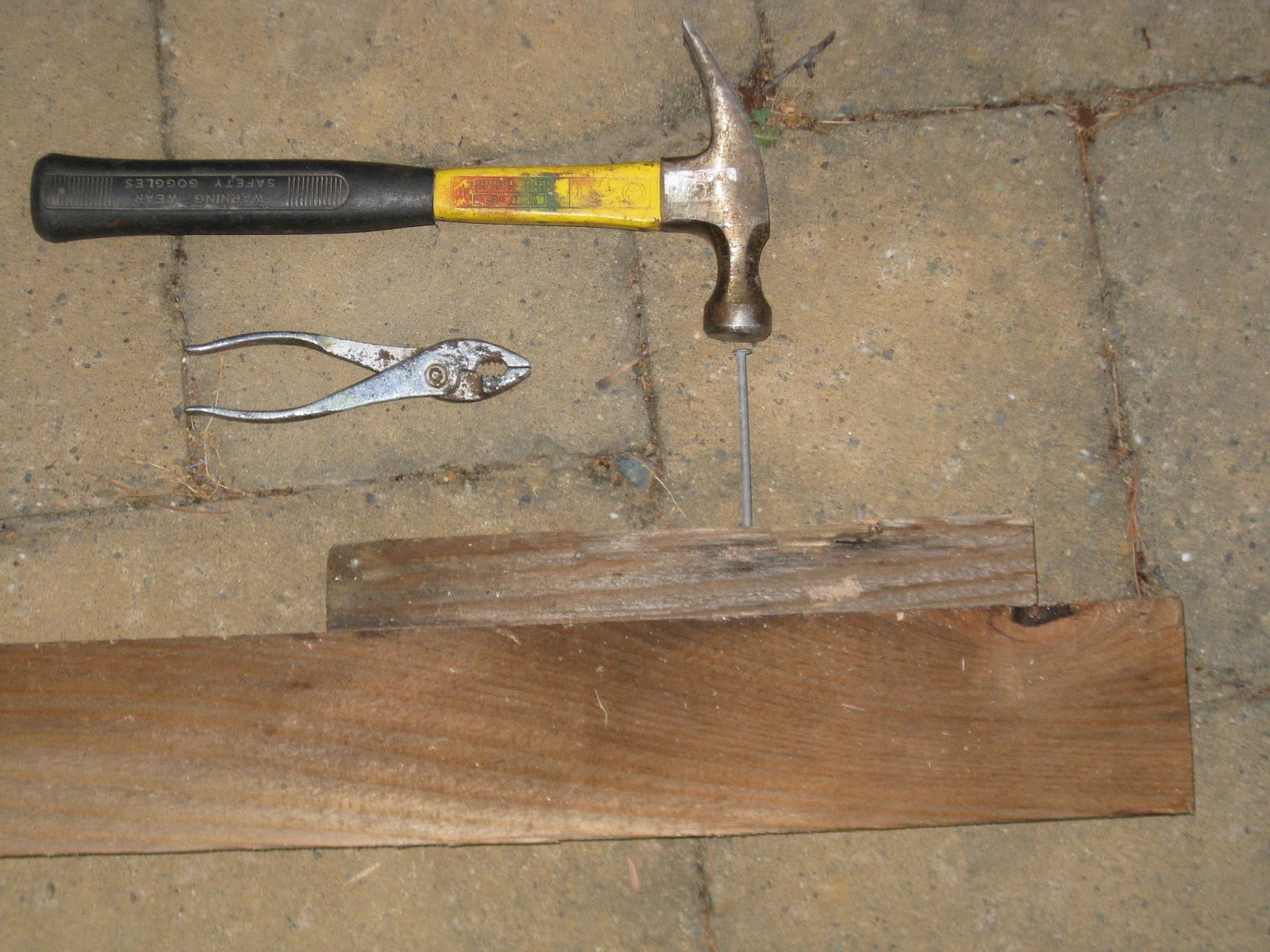
Which tool in the picture below is the correct tool for driving nails into wood?

Both the hammer and the pliers are applications of  levers

Of course it is the hammer!; because it provides the useful leverage for the job.  It allows professional grade nail driving. 


Which tool below it the correct tool for knitting "gansey" yarn into weatherproof objects?

Shown above are 3mm circular needles and 2 mm DPN with 
a good knitting sheath

The DPN with knitting sheath provides much more leverage putting much less stress on the hands and the circular needles are just too big. And, those big needles leave big needle holes in the fabric; you are never going to get to "weatherproof" leaving such big holes in the fabric.  Use 2mm circs, and there still is too much stress on the hands.

What tools are needed  for the knit objects that  GT calls "ganseys" knit from 2,700 ypp yarns at 12 spi and 20 rpi?

A good knitting sheath with 1.3 mm needles.  It makes a lovely soft, warm, durable fabric that I also use for gloves and socks,  as in this very well tested (worn) sock knit from 6-ply, 1680 ypp wool yarn, knit at 12 spi and 16 rpi:

This is actually a heavier yarn than the old  Patons Beehive,
 thus this is a denser fabric - more like the Dunraven.

You are not going to get there with circular needles!  I know, I tried very hard for years. and years.  My grandfather could not have built cities of wood by pounding in all of those nails with a pair of pliers (although he always carried a pair of pliers in his pocket.)  No, he used the right tool - he used a hammer to drive those nails home.  Likewise, to knit the kind of fabrics that I like, I have to use DPN and a knitting sheath.


Raverly's take on tools;

Some groups have been taken over by populist bullies (e.g., boss cows) that tell us that  3.25 mm needles will produce the same fabrics as 2.4 mm needles. (If we slice that salami, they imply that any fabric can be knit on any sized needle.) Then, they get agrees and loves on such nonsense. Some, or even most, groups on Ravelry have become a popularity contest among folks with limited technical skill, that negates Ravelry's ability to be a clearinghouse of useful textile knowledge and skills. There is more speculation from ignorance than knowledge from actual compartive testing of  tools, materials, and techniques.  People who say this technique is better, are considered to "discriminate" against the folks who use that technique.  

Some will call this "sour grapes" on my part.  Not at all.   I make my rounds of the textile crafts world, and see what suits my needs.  I adopt any tool or technique that is better than what I have.

One thing that I see is that the boss cows at Ravelry spend so much time protecting their turf, and keeping the herd in line  that they have no time to improve their spinning and knitting.

I see the folks who told me ten years ago that it was not possible to hand spin 5-ply -gansey yarn, still spin as they did 10 years ago.  It took me months and months to spin that first kilo of 5-ply gansey yarn.  Since then, I have learned skills and made tools that allow me to hand spin the worsted spun 5-ply yarn for a good gansey or Guernsey in about 12 hours. I did not learn those new skills on Ravelry.  What I heard on Ravelry, was "Cannot be done."

I do not care how experienced spinners spin!

 I do care about what options they offer to beginning spinners.  Beginning spinners need to know that there are ways to spin fast. Beginning spinners need to know that there are ways to spin fine, both woolen and worsted.

Many folks that disparage my knitting sheaths, still knit the way they did when I started using knitting sheaths.

I do not care how anybody knits.  

I do care when experienced knitters make an effort to hide or wrongly  depreciate other knitting techniques. Beginning knitters need to know that there are ways of knitting warmer objects.  Beginning knitters need to know that there are ways to knit more durable objects.

Current tools and skills allow me to knit fabrics that cannot be hand knit without a knitting sheath - not even with a leather knitting belt - which is a wonderfully powerful tool.  The power of a knitting sheath is infinite. It allows me to hand knit fabrics that cannot be reasonably knit with any other knitting technique.  It transforms the impossible into  the possible. Beginning knitters and spinners need to know what is possible, so they can choose their tools, and what skills to learn.

On Ravelry, advanced spinning and knitting techniques are hidden behind what is popular. 

Gansey Nation is proud to knit commercial 1,200 ypp, 5-ply "gansey yarn" on 2.25 mm circular needles at 9 spi and 11 rpi, (99 stitches per inch^2) working half an hour per day 
 ( see http://www.ganseys.com/knitting-ganseys/preparation/stitch-gauges-and-sizing/ ). He does not think that ganseys can be knit "weatherproof''.    This is  the conventional wisdom among folks that never learned to use a knitting sheath, and which specifically includes Bishop Rutt.  It is the doctrine, and cannon, on Ravelry. They believe.  They are a community of Believers.   They are not a comunity of  testers looking for the best way to make textiles.

In contrast, I knit such yarns at 120 and 140 stitches per inch^2 respectively.  I got there by testing, testing, testing! These fabrics are absolutely weatherproof, but Gansey Nation/ Ravelry consider these impossible fabrics.   Impossible - because they never bothered to learn to use a knitting sheath. I agree, using circular needles, such fabrics are not practical to knit.  Gansey Nation considers the very concept of  a weatherproof gansey to be a myth.   This is well accepted at Ravelry.  I see it as simply a failure to learn the required knitting technique. Ravelry is not not a comunity of  testers looking for the best way to make textiles. Rather it is a community of Believers that  proselytize. 

However, if they had some intellectual curiosity, they would have done some testing.  Testing would have told them that the fast way to knit a weatherproof seaman's sweater is to use MacAusland 3-ply (or similar) yarns  ( http://www.macauslandswoollenmills.com/), and long 3 mm DPNs with a knitting sheath. HELL YES!, I knit  weatherproof seaman's sweaters from Patons Classic Wool Yarn!!  At 108 stitches per inch^2 it is as much knitting effort as knitting worsted 5-ply, and it is not as durable, so I would rather put the effort into more durable objects knit from worsted 5-ply.  Still, sometimes I need to prove the concept.

Paton Classic Wool
knit at 9 spi by 12 rpi
Weatherproof! (when oiled)
  And skin soft.
This is a nice fabric to live in when it is cold!.
(No, it cannot be knit with circular needles.) 

The truth is that it is more difficult to knit a weatherproof object from high-twist, worsted spun, 5-ply than from a woolen yarn. Woolen yarn can be a 40 hour path to a seaman's sweater that is weatherproof! It is a lot of work, but it is fast. By the modern knitting terminology, it is not a "gansey" but it is a seaman's sweater that is functional, very functional.  Ravelry has forgotten about functional!   Such a sweater at its best, will not be as warm (for it's weight) or as durable as one knit from high twist worsted yarn.  In the long run (years), a series of the more difficult to knit worsted sweaters takes less wool and less total knitting time than a series of  woolen spun sweaters. It was the dual virtues of great warmth from light weight and durability that made the British seaman's sweater, the Masterpiece of Hand Knitting.

I have never gotten good advice on Ravelry on how to knit really functional objects.  I have never seen anyone else post really good advice on how to knit warm objects.  The standard Ravelry advice is to knit loosely to produce "air space" as an insulator.  Nobody seems to like it when I point out that the right sized air space for warmth is 40 microns - twice the thickness of a Merino staple.  The other side of that 40 micron air space is that the fabric is very durable, by being firmly knit, and not bulky considering its great warmth. Great warmth with minimum bulk and weight is a great attribute in a textile for some uses.

I have never seen good advice on Ravelry on knitting durable objects - notably socks. My 3 principles are; 1) knit to fit (e.g., no stress points), 2) knit firmly, and 3) use worsted spun wool yarns with many fine plies. These points work, but they do not generate many "agree"s on Ravelry, quite the opposite

Many of the "experts" on Ravelry have or had close ties to the modern commercial yarn industry, e.g., they own or work for LYS.  They recommend what is commercially available.  LYS sell what is popular - not what produces great fabrics.  Yarns that produce great fabrics tend to have higher production costs and hence higher price points.  Go down to the designer botiques at a Needless Markup Department Store, and see which of the great fashion designers are using yarns like the yarns you can get at your local yarn store. Last dozen times I looked - zero.  Even the yarns used to make the knit goods at Textures in Santa Monica are not available at LYS.  I would not depend on Ravelry for a understanding of the universe of yarn. When was the last time you saw the 6-strand worsted that I like in the Ravelry database?  When was the last time you saw a 6-strand all wool, 1,680 ypp sock yarn (as above) in the  Ravelry database ? 

 Ravelry is a terrible place to be a beginning spinner or knitter because it tends to hide the paths to excellent textiles. Ravelry is dominated by "pretty textiles". However, "pretty" changes with fashion. Good textiles are both attractive and functional.  Excellent textiles, are very functional, very durable, very attractive, and have a timeless style and beauty that is immune to fashion.  I like excellent textiles. 

Thursday, June 16, 2016

Comprehensive revision

I have Lyme Disease.  It crept up on me, starting circa 2005, and I did not realize how very disabled I was.

It dramatically affected my strength, endurance, vision, balance, and coordination.

Thus, circa 2011, as I set out to discover just how fast a professional hand spinner could spin in the era 1550 to 1750, I was significantly disabled.

 Now! after more than a year of intensive antibiotic treatment, I am better.   I am not well yet, but I am better. Today, I have more strength, endurance, and coordination than I had in 2011 and a great deal more than I had in say 2014.  Thus, today I do spin spin faster. Therefore, all of the timed spinning in previous posts is conservative.

One could expect a healthy, professional hand spinner with moderately good equipment to spin faster.

My current considered judgment is:

  •  That a DRS controlled flyer/bobbin assembly with an accelerator wheel operated by a professional hand spinner should be able to produce 560 yards of worsted spun 5,600 ypp commercial grade warp yarn (10s) per hour, even if the spinner has substantial health issues.  Woolen spun yarns of about the same twist ( 9 TPI) can be spun faster. 
  • That a a DRS controlled flyer/bobbin assembly with an accelerator wheel operated by a competent hand spinner can spin woolen or worsted yarns with ~ 20 wool staples in cross-section at a good commercial pace. Romney is easy to spin at more than 20,000 yards per pound, Shetland can be spun at more than 30,000 ypp, and  fine wools such as Merino or Rambouillet can be spun at more than 40,000 ypp.  Fine worsted singles can be reasonably spun at rates of more than 3 yards per minute. Thus, 20,000 ypp 2-ply worsted yarn can be prepared at an over-all rate of 60 yards per minute.
  •  20,000 ypp 2-ply is finer than any American entry in the last longest thread competition.  A reasonable time budget to spin, and ply, 10 grams of 20,000 ypp 2-ply using  a DRS controlled flyer/bobbin assembly with an accelerator wheel is on the close order of  25 hours.
  • Wool yarns of less than 20 fibers are either fragile or require excessive twist resulting in a unpleasant yarn. I stopped producing wool singles finer than ~ 50,000 ypp.  My goal is to spin better yarns, not finer yarns.
I thought that I needed to make a new spinning bobbin for the Aldan Amos #0 flyer that I was using for fine singles. Along the way, I was going to photograph and describe the DRS spinning bobbin production process. With my revived coordination, I find that a new bobbin is not necessary, so I am just going to post pictures of the spinning bobbins that currently fit the AA flyers.

The AA #0 flyer/bobbin as delivered :
 Single on bobbin is the test single spun by SG.


  AA bobbin detail (ends bored out, brass flange bearings inserted, wood rings glued in to cover brass bearings)

Detail of AA whorl


Flyer with the (2d generation) DRS bobbin/whorl by me:
Bobbin and whorl of  tropical hardwood with Delrin bearings (thanks to Henry Clemes).  The wood was a scrap picked up inexpensively at a Rockler promotion.


Flyer/bobbin disassembled


Ends of bobbin bored out to receive bearings

AA #1 Flyer bobbin with 3d generation - DRS bobbin and whorls

These 11 whorl diameters provide ability to spin woolen and worsted singles from ~3,000 ypp to more than 45,000 ypp. Note the difference between whorl diameters is small.

Bearings for this flyer/bobbin assembly are replacement bearings for skate boards.  Bearing wise, this is over kill as differential rotation is only ~50 rpm.  However, the center of the bearing fits AA's flyer shaft, and this saves me some effort. The skate board bearings are much better than what my local hardware store sells, and much cheaper than what the local bearing specialist charges.


Detail of borings to receive bearings


Detail of bobbin shaft inserted into board cut bobbin end/whorl

All in all, not particularly pretty, but wickedly effective. The oak in the #1 bobbin is recycled from our kitchen remodel. Since then, I have moved to turning ALL whorls from maple to get a more even texture around the whorl, and avoid belt dressing build up at the cross grain.


Storage bobbins to fit 0.25" spindle:


 Front,  Right to Left; board cut redwood ends on redwood barrel, 2x redwood turned from solid blank, blank
Back, Right to Left;  reels for blocking singles, 2x board cut maple ends/whorl on maple barrel, blank for maple barrel. 

Turning tools:


For 5,600 ypp singles, and 50 mm whorls, required accuracy of whorl diameter is about 0.5 mm.
For 40,000 ypp singles, required accuracy of whorl diameter is higher.  Thus, turn a little larger than needed and sand down to final required diameter.  (If your tools are really sharp, no sanding is required for appearance.)

Use HSS tools and keep them very sharp.  A good procedure is to grind to shape, and then hone.  For honing, I use 400 grit emery belts on the Sorby Pro, or a diamond hone.  Do not try to burnish HSS turning tools.


My OLD Bedan  is carbon steel, and it can be BURNISHED and is sometimes used to clean up where the ends meet the barrel. (But was not used on the current generation of spinning bobbins  : )

Burnished tool steel is sharp, but does not hold an edge 
as well as honed HSS.  

If you use a good hone, and get the angles correct, then HSS is as sharp as the very best burnished tool steel edge, but a HSS edge lasts 10 times longer.  Finishing whorls, I figure the edge on my HSS tools lasts 10 minutes, thus a burnished tool steel edge lasts for ~ one cut.  Turning redwood bobbins from solid blanks, I can do a dozen bobbins in a hour without honing the HSS skew chisel I use.  Using tool steel tools, I have to stop and sharpen frequently, and only get half as many bobbins made in an hour.

Saturday, December 19, 2015

I am the Boss.

I do not let the fuzz from a a sheep tell me how to spin.  However, a number of spinners say that they sit down to a pile of fiber and let it tell them what to spin.  That is like a painter letting the color in one tube of paint tell him/her what to to paint.  No, the artist uses a palette to make the color that the artist wants.

When I sit down to spin, I have a vision of what I want to spin. Before I sit down, I think what the function of the object will be, and I decide on a yarn structure. I decide on the grist of the singles, whether the singles should be spun woolen or worsted, and what textures of fibers are appropriate.

Over time, and as I developed more skill, I have moved to finer yarns. My first goal when started spinning was 5-ply, sport weight,  gansey yarn. Now, I find myself spinning mostly fingering yarns yarns of 3 to 6 plies with the occasional 6-ply lace weight sock yarn.

Often, I get it wrong. Something about the yarn is wrong. Then, as I sit there knitting or weaving, I consider the how to make a better yarn.  Usually, I decide on a different grist or yarn structure. Yesterday as I was knitting my replica Patton's Beehive 4-ply, I decided that I wanted such a yarn from a slightly coarser fiber.  Thus, the next batch will be spun from the flock run long wool that I get from the Woolery.  I think up the structure of my next yarn as I knit the last yarn.

For any given texture of fiber, there are several breeds or hybrids that can produce fleece that are appropriate.  I do not really care which I use.  In many breeds, the differences within a fleece or the differences between different fleeces in the breed, or the differences between the fleeces of the same animal in different years are greater than the differences between breeds.  I would say, that the great appeal of Merino, is not so much its fineness, but its uniformity.

I am not a big fan of fiber blends.  I think that having a blend of different kinds of fibers in the drafting triangle, interferes with the draft and the ratchet of the yarn.  Even the flock-run medium long wool that I get from the Woolery, has been sorted and graded to provide reasonable uniformity within the fiber.

I am not a fan of adding nylon to yarn - not even to sock yarn.  Just spin the sock yarn from a more suitable wool than Merino.

Many spinners spend a lot of time studying the details of the various breeds spinning little bits of fleece. Except, unless the fleece has been well sorted and graded (rare in the US) little bits of fleece say little about the all of the grades of wool that one can expect from a flock of that breed. However, many modern spinners seem not spend a lot of time learning the techniques needed to produce the various yarn structures or the virtues of the different yarn structures.

Every 2 or 3 years, the local spinning guild devotes its programs to breeds of  sheep and their fleece, with everybody spinning little bits of different kinds of  fleece. However, they seem not to have any interest in being able to sit down and spin fine.  Being able to spin fine would open up new yarn structures, that would allow them to knit and weave new kinds of objects.  Others in the guild would consider spinning the replica Beehive that I spun the other day to be a challange in fine spinning.

Knowing the virtues and vices of the various yarn structures is more important than knowing the nuances of  breed fleece characteristics.  Knowing yarn structures is harder than knowing the details of fleece characteristics.  To know yarn structures, one must be able to spin the yarn strucrures consistently, and then work with that yarn.  One does not learn about a yarn when it is sitting in the stash or even on your desk.  One learns about yarn by making objects, and living with the objects.

Moreover the required yarn characteristics depend on how the fabric will be constructed.  Thus, there must be a vision for the object that flows down to fabric construction, then to yarn structure, and finally to the required fiber.  However, if I know how to spin, then all I really need to know about the fiber is the reburied spin count and staple length.  Does that mean the the spiral crimp that makes Suffolk so wonderful for socks does not matter?  No, it means that the spiral crimp will enhance a well spun sock yarn, but first one needs to know how to spin an excellent sock yarn structure. Suffolk has a spin count of between 48 and 58, so it is very reasonable to spin it fine enough to make wonderful sock yarn.

The bottom line is that if you are a good spinner and a good knitter than an hour's worth of spinning will take 5 hours to knit.  Thus, you might as well spin the very best yarn to make that 5 hours of  knitting worthwhile.


Wednesday, April 08, 2015

DRS, Accelerator Wheels, and Low Grist Yarns

Many of the commercial double drive wheels come with a differential rotation speed of ~1.6. this would seem to make them ideal for making singles for worsted weight 2-ply yarns.

However, such thick yarns rapidly change the effective diameter of the bobbin as they accumulate on the bobbin.  Changes in the effective diameter of the bobbin change the DRS,  To keep grist/twist within ~10%, DRS need to be kept within  ~10%.  When you accumulate 1/4" of yarn on the bobbin, the diameter changes by 1/2" and the DRS changes by a lot and one needs to either change flyer whorls or wind off or allow slippage.  Slippage is the easiest, but why go to the effort of having a DD system, if you are just going to let the drive band slip?  I mean, at these grists we do not have to worry about breaking fine singles.

My first choice for spinning a single with grist of less than 2,500 ypp is single drive, bobbin lead (Irish tension).  These yarns do not require at lot of twist, so one does not need the very high rpm that requires 2 drive bands.  With these yarns, two thousand rpm will produce 10 yards per minute, which is about as fast as you can draft quality yarn.  With 90 rpm as a comfortable treadling cadence, that means a good ratio is ~1:24.

Whorls less than 2" (50 mm) in diameter tend to slip, so if you really want 2,000 rpm, then you need a whorl of 2" and a drive wheel of  48"!!  Forty-eight inch drive wheels are a big pain.

Enter the accelerator wheel.

When I first went looking for more speed for fine singles, I went to higher ratios by decreasing the size of my whorls. It was more an education than a success.

Today, I use the Ashford Jumbo flyer in Scotch Tension mode with the accelerator wheel for plying, and I routinely ply at more than 2,000 rpm.  I could just as well be spinning singles at (more than)  9 yards per minute. I have done samples and tests but no production spinning with that plying setup. Since with Scotch tension, worsted yarn does not self assemble as it does with DRS, it is all long draw woolen, rather than worsted. The speed is limited by my drafting, rather than the speed of the equipment.

Since low grist worsted tends to be harsh, when I want thick worsted yarns, I ply them up from fine worsted singles and have no interest in trying to figure out how to use DRS to spin low grist yarns.  On the other hand, this means that I have a great desire for fine singles.

Bottom line -- DRS for low grist yarns is a waste of effort.  DD without DRS is a waste of effort.  The only reason that people do it is that they have heard myths about the power of  double drive wheels  And, DD does have power.

DD with DRS can do things that SD simply cannot.  DD with DRS is a very powerful tool for spinning singles in the range of 2,500 to 45,000 ypp (5 m/gram to 90 m/gram). With DRS, true worsted and true woolen can be spun with almost the same drafting technique - what differs is the fiber preparation. Woolen is spun from a pile of carded rolags and worsted is spun from a distaff of combed sliver.  In particular, DRS allows spinning true worsted singles faster than long draw woolen singles of the same grist can be spun. (Woolen requires more twist than worsted of the same grist.) With DD/DRS, true worsted 5,600 ypp singles (10s) can be hand spun at 10 yd/minute on a sustained basis.  However, this puts very high demands on fiber preparation to avoid "twittering", which is variation in thickness of a single as a result of variation in the density of the sliver being spun.  Even with minor twittering, DRS allows spinning 560 yard hanks that are consistently within 5% of the desired weight.

And now you know why I have such respect for Clemes and Clemes.  Better fiber preparation is at the core of better and faster spinning.

On the other hand, minor twittering will not affect the final quality of 5-ply sport weight yarn.  The folks who say it does do not make enough of such yarn to make many objects from it.