At one point, my grandfather was a carpenter for the Union Pacific Railroad in Oklahoma. They built whole towns of buildings using wood and nails.
Now the quiz:
Which tool in the picture below is the correct tool for driving nails into wood?


You are not going to get there with circular needles! I know, I tried very hard for years. and years. My grandfather could not have built cities of wood by pounding in all of those nails with a pair of pliers (although he always carried a pair of pliers in his pocket.) No, he used the right tool - he used a hammer to drive those nails home. Likewise, to knit the kind of fabrics that I like, I have to use DPN and a knitting sheath.
Raverly's take on tools;
Some groups have been taken over by populist bullies (e.g., boss cows) that tell us that 3.25 mm needles will produce the same fabrics as 2.4 mm needles. (If we slice that salami, they imply that any fabric can be knit on any sized needle.) Then, they get agrees and loves on such nonsense. Some, or even most, groups on Ravelry have become a popularity contest among folks with limited technical skill, that negates Ravelry's ability to be a clearinghouse of useful textile knowledge and skills. There is more speculation from ignorance than knowledge from actual compartive testing of tools, materials, and techniques. People who say this technique is better, are considered to "discriminate" against the folks who use that technique.
Some will call this "sour grapes" on my part. Not at all. I make my rounds of the textile crafts world, and see what suits my needs. I adopt any tool or technique that is better than what I have.
One thing that I see is that the boss cows at Ravelry spend so much time protecting their turf, and keeping the herd in line that they have no time to improve their spinning and knitting.
I see the folks who told me ten years ago that it was not possible to hand spin 5-ply -gansey yarn, still spin as they did 10 years ago. It took me months and months to spin that first kilo of 5-ply gansey yarn. Since then, I have learned skills and made tools that allow me to hand spin the worsted spun 5-ply yarn for a good gansey or Guernsey in about 12 hours. I did not learn those new skills on Ravelry. What I heard on Ravelry, was "Cannot be done."
I do not care how experienced spinners spin!
I do care about what options they offer to beginning spinners. Beginning spinners need to know that there are ways to spin fast. Beginning spinners need to know that there are ways to spin fine, both woolen and worsted.
Many folks that disparage my knitting sheaths, still knit the way they did when I started using knitting sheaths.
I do not care how anybody knits.
I do care when experienced knitters make an effort to hide or wrongly depreciate other knitting techniques. Beginning knitters need to know that there are ways of knitting warmer objects. Beginning knitters need to know that there are ways to knit more durable objects.
Current tools and skills allow me to knit fabrics that cannot be hand knit without a knitting sheath - not even with a leather knitting belt - which is a wonderfully powerful tool. The power of a knitting sheath is infinite. It allows me to hand knit fabrics that cannot be reasonably knit with any other knitting technique. It transforms the impossible into the possible. Beginning knitters and spinners need to know what is possible, so they can choose their tools, and what skills to learn.
On Ravelry, advanced spinning and knitting techniques are hidden behind what is popular.
Gansey Nation is proud to knit commercial 1,200 ypp, 5-ply "gansey yarn" on 2.25 mm circular needles at 9 spi and 11 rpi, (99 stitches per inch^2) working half an hour per day
( see http://www.ganseys.com/knitting-ganseys/preparation/stitch-gauges-and-sizing/ ). He does not think that ganseys can be knit "weatherproof''. This is the conventional wisdom among folks that never learned to use a knitting sheath, and which specifically includes Bishop Rutt. It is the doctrine, and cannon, on Ravelry. They believe. They are a community of Believers. They are not a comunity of testers looking for the best way to make textiles.
In contrast, I knit such yarns at 120 and 140 stitches per inch^2 respectively. I got there by testing, testing, testing! These fabrics are absolutely weatherproof, but Gansey Nation/ Ravelry consider these impossible fabrics. Impossible - because they never bothered to learn to use a knitting sheath. I agree, using circular needles, such fabrics are not practical to knit. Gansey Nation considers the very concept of a weatherproof gansey to be a myth. This is well accepted at Ravelry. I see it as simply a failure to learn the required knitting technique. Ravelry is not not a comunity of testers looking for the best way to make textiles. Rather it is a community of Believers that proselytize.
However, if they had some intellectual curiosity, they would have done some testing. Testing would have told them that the fast way to knit a weatherproof seaman's sweater is to use MacAusland 3-ply (or similar) yarns ( http://www.macauslandswoollenmills.com/), and long 3 mm DPNs with a knitting sheath. HELL YES!, I knit weatherproof seaman's sweaters from Patons Classic Wool Yarn!! At 108 stitches per inch^2 it is as much knitting effort as knitting worsted 5-ply, and it is not as durable, so I would rather put the effort into more durable objects knit from worsted 5-ply. Still, sometimes I need to prove the concept.

The truth is that it is more difficult to knit a weatherproof object from high-twist, worsted spun, 5-ply than from a woolen yarn. Woolen yarn can be a 40 hour path to a seaman's sweater that is weatherproof! It is a lot of work, but it is fast. By the modern knitting terminology, it is not a "gansey" but it is a seaman's sweater that is functional, very functional. Ravelry has forgotten about functional! Such a sweater at its best, will not be as warm (for it's weight) or as durable as one knit from high twist worsted yarn. In the long run (years), a series of the more difficult to knit worsted sweaters takes less wool and less total knitting time than a series of woolen spun sweaters. It was the dual virtues of great warmth from light weight and durability that made the British seaman's sweater, the Masterpiece of Hand Knitting.
I have never gotten good advice on Ravelry on how to knit really functional objects. I have never seen anyone else post really good advice on how to knit warm objects. The standard Ravelry advice is to knit loosely to produce "air space" as an insulator. Nobody seems to like it when I point out that the right sized air space for warmth is 40 microns - twice the thickness of a Merino staple. The other side of that 40 micron air space is that the fabric is very durable, by being firmly knit, and not bulky considering its great warmth. Great warmth with minimum bulk and weight is a great attribute in a textile for some uses.
I have never seen good advice on Ravelry on knitting durable objects - notably socks. My 3 principles are; 1) knit to fit (e.g., no stress points), 2) knit firmly, and 3) use worsted spun wool yarns with many fine plies. These points work, but they do not generate many "agree"s on Ravelry, quite the opposite
Many of the "experts" on Ravelry have or had close ties to the modern commercial yarn industry, e.g., they own or work for LYS. They recommend what is commercially available. LYS sell what is popular - not what produces great fabrics. Yarns that produce great fabrics tend to have higher production costs and hence higher price points. Go down to the designer botiques at a Needless Markup Department Store, and see which of the great fashion designers are using yarns like the yarns you can get at your local yarn store. Last dozen times I looked - zero. Even the yarns used to make the knit goods at Textures in Santa Monica are not available at LYS. I would not depend on Ravelry for a understanding of the universe of yarn. When was the last time you saw the 6-strand worsted that I like in the Ravelry database? When was the last time you saw a 6-strand all wool, 1,680 ypp sock yarn (as above) in the Ravelry database ?
Ravelry is a terrible place to be a beginning spinner or knitter because it tends to hide the paths to excellent textiles. Ravelry is dominated by "pretty textiles". However, "pretty" changes with fashion. Good textiles are both attractive and functional. Excellent textiles, are very functional, very durable, very attractive, and have a timeless style and beauty that is immune to fashion. I like excellent textiles.
Now the quiz:
Which tool in the picture below is the correct tool for driving nails into wood?
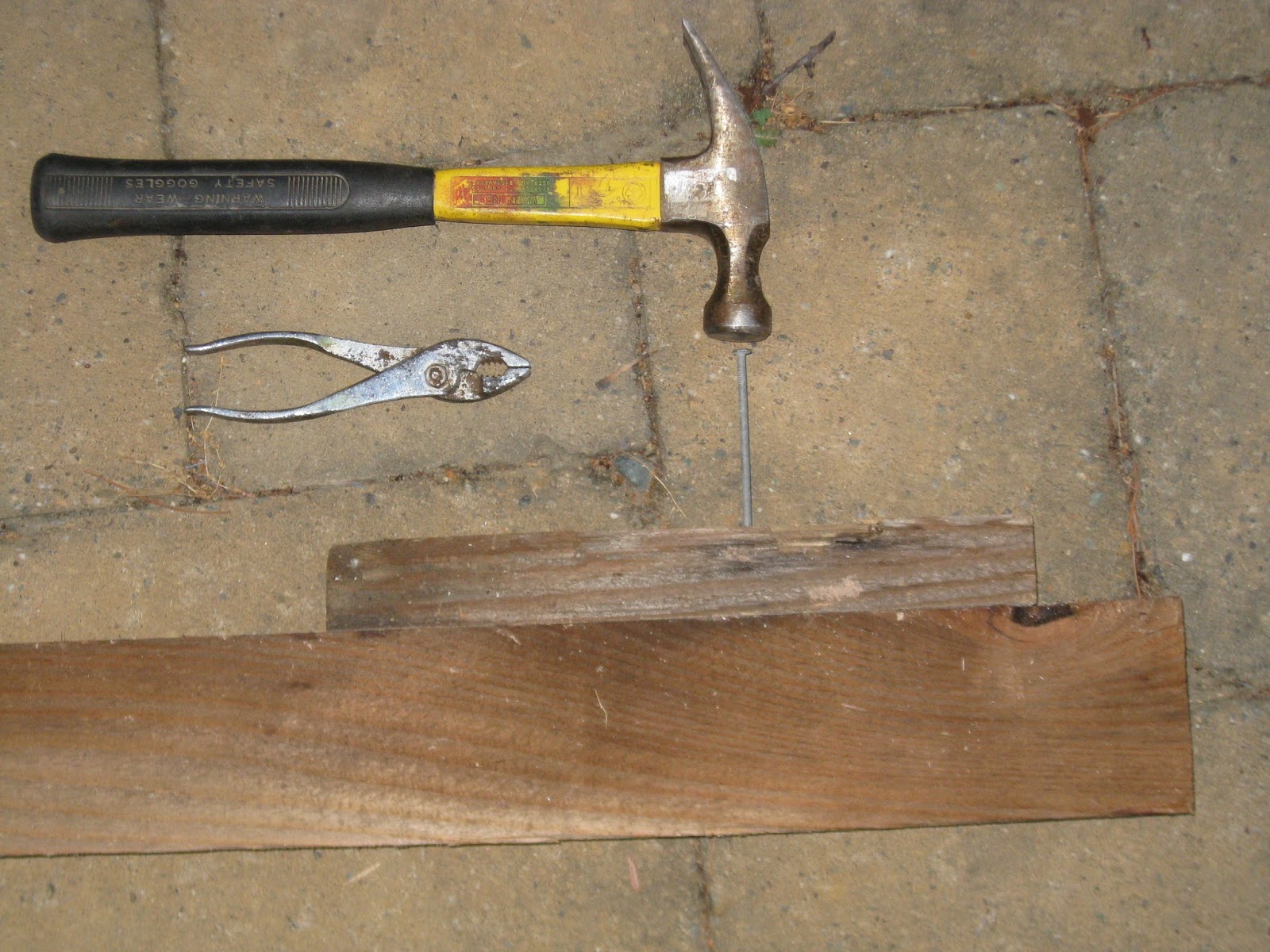
Both the hammer and the pliers are applications of levers
Of course it is the hammer!; because it provides the useful leverage for the job. It allows professional grade nail driving.
Which tool below it the correct tool for knitting "gansey" yarn into weatherproof objects?

Shown above are 3mm circular needles and 2 mm DPN with
a good knitting sheath
The DPN with knitting sheath provides much more leverage putting much less stress on the hands and the circular needles are just too big. And, those big needles leave big needle holes in the fabric; you are never going to get to "weatherproof" leaving such big holes in the fabric. Use 2mm circs, and there still is too much stress on the hands.
What tools are needed for the knit objects that GT calls "ganseys" knit from 2,700 ypp yarns at 12 spi and 20 rpi?

A good knitting sheath with 1.3 mm needles. It makes a lovely soft, warm, durable fabric that I also use for gloves and socks, as in this very well tested (worn) sock knit from 6-ply, 1680 ypp wool yarn, knit at 12 spi and 16 rpi:

This is actually a heavier yarn than the old Patons Beehive,
thus this is a denser fabric - more like the Dunraven.
Raverly's take on tools;
Some groups have been taken over by populist bullies (e.g., boss cows) that tell us that 3.25 mm needles will produce the same fabrics as 2.4 mm needles. (If we slice that salami, they imply that any fabric can be knit on any sized needle.) Then, they get agrees and loves on such nonsense. Some, or even most, groups on Ravelry have become a popularity contest among folks with limited technical skill, that negates Ravelry's ability to be a clearinghouse of useful textile knowledge and skills. There is more speculation from ignorance than knowledge from actual compartive testing of tools, materials, and techniques. People who say this technique is better, are considered to "discriminate" against the folks who use that technique.
Some will call this "sour grapes" on my part. Not at all. I make my rounds of the textile crafts world, and see what suits my needs. I adopt any tool or technique that is better than what I have.
One thing that I see is that the boss cows at Ravelry spend so much time protecting their turf, and keeping the herd in line that they have no time to improve their spinning and knitting.
I see the folks who told me ten years ago that it was not possible to hand spin 5-ply -gansey yarn, still spin as they did 10 years ago. It took me months and months to spin that first kilo of 5-ply gansey yarn. Since then, I have learned skills and made tools that allow me to hand spin the worsted spun 5-ply yarn for a good gansey or Guernsey in about 12 hours. I did not learn those new skills on Ravelry. What I heard on Ravelry, was "Cannot be done."
I do not care how experienced spinners spin!
I do care about what options they offer to beginning spinners. Beginning spinners need to know that there are ways to spin fast. Beginning spinners need to know that there are ways to spin fine, both woolen and worsted.
Many folks that disparage my knitting sheaths, still knit the way they did when I started using knitting sheaths.
I do not care how anybody knits.
I do care when experienced knitters make an effort to hide or wrongly depreciate other knitting techniques. Beginning knitters need to know that there are ways of knitting warmer objects. Beginning knitters need to know that there are ways to knit more durable objects.
Current tools and skills allow me to knit fabrics that cannot be hand knit without a knitting sheath - not even with a leather knitting belt - which is a wonderfully powerful tool. The power of a knitting sheath is infinite. It allows me to hand knit fabrics that cannot be reasonably knit with any other knitting technique. It transforms the impossible into the possible. Beginning knitters and spinners need to know what is possible, so they can choose their tools, and what skills to learn.
On Ravelry, advanced spinning and knitting techniques are hidden behind what is popular.
Gansey Nation is proud to knit commercial 1,200 ypp, 5-ply "gansey yarn" on 2.25 mm circular needles at 9 spi and 11 rpi, (99 stitches per inch^2) working half an hour per day
( see http://www.ganseys.com/knitting-ganseys/preparation/stitch-gauges-and-sizing/ ). He does not think that ganseys can be knit "weatherproof''. This is the conventional wisdom among folks that never learned to use a knitting sheath, and which specifically includes Bishop Rutt. It is the doctrine, and cannon, on Ravelry. They believe. They are a community of Believers. They are not a comunity of testers looking for the best way to make textiles.
In contrast, I knit such yarns at 120 and 140 stitches per inch^2 respectively. I got there by testing, testing, testing! These fabrics are absolutely weatherproof, but Gansey Nation/ Ravelry consider these impossible fabrics. Impossible - because they never bothered to learn to use a knitting sheath. I agree, using circular needles, such fabrics are not practical to knit. Gansey Nation considers the very concept of a weatherproof gansey to be a myth. This is well accepted at Ravelry. I see it as simply a failure to learn the required knitting technique. Ravelry is not not a comunity of testers looking for the best way to make textiles. Rather it is a community of Believers that proselytize.
However, if they had some intellectual curiosity, they would have done some testing. Testing would have told them that the fast way to knit a weatherproof seaman's sweater is to use MacAusland 3-ply (or similar) yarns ( http://www.macauslandswoollenmills.com/), and long 3 mm DPNs with a knitting sheath. HELL YES!, I knit weatherproof seaman's sweaters from Patons Classic Wool Yarn!! At 108 stitches per inch^2 it is as much knitting effort as knitting worsted 5-ply, and it is not as durable, so I would rather put the effort into more durable objects knit from worsted 5-ply. Still, sometimes I need to prove the concept.

Paton Classic Wool
knit at 9 spi by 12 rpi
Weatherproof! (when oiled)
And skin soft.
This is a nice fabric to live in when it is cold!.
(No, it cannot be knit with circular needles.)
The truth is that it is more difficult to knit a weatherproof object from high-twist, worsted spun, 5-ply than from a woolen yarn. Woolen yarn can be a 40 hour path to a seaman's sweater that is weatherproof! It is a lot of work, but it is fast. By the modern knitting terminology, it is not a "gansey" but it is a seaman's sweater that is functional, very functional. Ravelry has forgotten about functional! Such a sweater at its best, will not be as warm (for it's weight) or as durable as one knit from high twist worsted yarn. In the long run (years), a series of the more difficult to knit worsted sweaters takes less wool and less total knitting time than a series of woolen spun sweaters. It was the dual virtues of great warmth from light weight and durability that made the British seaman's sweater, the Masterpiece of Hand Knitting.
I have never gotten good advice on Ravelry on how to knit really functional objects. I have never seen anyone else post really good advice on how to knit warm objects. The standard Ravelry advice is to knit loosely to produce "air space" as an insulator. Nobody seems to like it when I point out that the right sized air space for warmth is 40 microns - twice the thickness of a Merino staple. The other side of that 40 micron air space is that the fabric is very durable, by being firmly knit, and not bulky considering its great warmth. Great warmth with minimum bulk and weight is a great attribute in a textile for some uses.
I have never seen good advice on Ravelry on knitting durable objects - notably socks. My 3 principles are; 1) knit to fit (e.g., no stress points), 2) knit firmly, and 3) use worsted spun wool yarns with many fine plies. These points work, but they do not generate many "agree"s on Ravelry, quite the opposite
Many of the "experts" on Ravelry have or had close ties to the modern commercial yarn industry, e.g., they own or work for LYS. They recommend what is commercially available. LYS sell what is popular - not what produces great fabrics. Yarns that produce great fabrics tend to have higher production costs and hence higher price points. Go down to the designer botiques at a Needless Markup Department Store, and see which of the great fashion designers are using yarns like the yarns you can get at your local yarn store. Last dozen times I looked - zero. Even the yarns used to make the knit goods at Textures in Santa Monica are not available at LYS. I would not depend on Ravelry for a understanding of the universe of yarn. When was the last time you saw the 6-strand worsted that I like in the Ravelry database? When was the last time you saw a 6-strand all wool, 1,680 ypp sock yarn (as above) in the Ravelry database ?
Ravelry is a terrible place to be a beginning spinner or knitter because it tends to hide the paths to excellent textiles. Ravelry is dominated by "pretty textiles". However, "pretty" changes with fashion. Good textiles are both attractive and functional. Excellent textiles, are very functional, very durable, very attractive, and have a timeless style and beauty that is immune to fashion. I like excellent textiles.


.jpg)