Showing posts with label spinning lace. Show all posts

Friday, July 08, 2016

mea culapa

Once again, I have gotten things wrong.

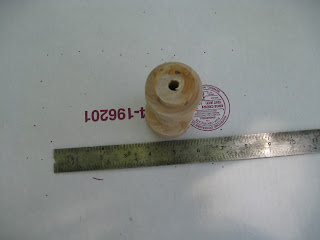
The long story is that after picking plums, I went to prune the plum tree and noticed that the olive needed pruning.  Then, one of the olive  branches looked just the correct size to make bobbins - and I always need bobbins.

I turned some blanks:


Green, the wood is soft and can be turned very fast - such a blank can be made in a couple of minutes.  (There are a lot of wet sticky shavings.  Sweep up will take longer than the turning!)

I let them dry a couple of days:
and turned spinning bobbins:

Boring the ends for 22 mm bearings was accomplished using  a mandrel of sacrificial 
3/8" wooden dowel.

The  still slightly soft olive wood allowed turning the bobbin to size very quickly.  The wood was free, so turning spinning bobbins from block of "green" olive was faster and cheaper than glueing up blanks. With the 3/8" hole down the center, the olive seems to dry fairly quickly without much cracking, warping or distortion.  

The spindle turned (not board cut) whorls seem to work just fine,  but we will see how they wear.


The new flyer/bobbin assembly in service.

Now, I had told people that because of the relatively small difference in rpm between the bobbin and the flyer, the bobbin bearings did not matter that much.  However, with the same whorl sizes, this bobbin with ball bearings seems to allow the flyer/bobbin assembly to spin faster.  A couple cups of coffee, and it will turn well over 4,000 rpm on a sustained basis.  Of course, that is way too fast for fat, low twist yarns, but for hoisery singles wanting 17 tpi , that is only ~6.5 yards/ minute, and with well prepped worsted fiber, 6.5 yards per minute is easy enough to draft.  It is hard on a ST wheel because the constant tension on the single from the ST flyer/bobbin assembly pulls the single apart before enough twist is inserted to hold the single together. (Same problem with a DD wheel set up for low twist yarns!)   However, this DRS  flyer/bobbin assembly only winds-on the single after it has inserted the right amount of twist to hold the single together.  Thus, I do not have to worry about twist, I just focus on drafting.  

On the other hand, drafting 5 to 10 yards per minute of 30,000 ypp to 20,000 ypp  (66 m/g to 44 m/g) singles is enough to keep me focused on the job at hand.  Finer, but not as high twist as sock yarn.


Yep,  a ball bearing at the whorl end of the shaft, 
is worth another couple of hundred rpm. e.g., 5% faster

As modified, AA's competition flyer will easily do 5,000 rpm with the bobbin running about 3% faster.  I know I have said that before, but now the differential rotation speed is better controlled, and everything is smoother.


This flyer/bobbin/ assembly is now my choice for high twist sock yarns.  It looks like it is worth while to put ball bearings everywhere.   I apologize for saying that brass bushings were adequate for spinning bobbin bearings. I was following AA's lead, as he used brass bushings for spinning bobbin bearings.


Saturday, July 05, 2014

Spinning productively

Why, Oh Why, comb top, and then knock the fibers out of alignment before spinning?  It is doing the work twice.  No professional does the same job twice, unless they did a poor job the first time.  No the comb/diz did their job, but the spinner destroyed the alignment when held the fiber to keep the flyer/bobbin assemble from pulling the whole top into the orifice all at once, like a hungry grizzly bear eating a Big Mac.


Silly!! The spinner that knows their craft simply keeps the fibers straight, and aligned parallel all the way through the process. The combs /diz can align the fibers better than fingers hurriedly inch-worm drafting.  More, better, faster drafting to realign the fibers is not the answer. The Answer is: Do not mess the fiber up!

The answer is use differential rotation speed (DRS) so that fiber is drawn into the orifice only as fast as twist is added..When, I am spinning 10s at 9 tpi, my flier/bobbin assembly draws in 1/9" of fiber stream and inserts 1 twist.  I do not have to pull back on the fiber stream to retard its entry into the orifice, because it is only going to take in as much fiber as is needed for the twist that is being inserted.

Alden Amos and others have tried selling such wheels but there was no market.  Modern spinners do not have the skills to operate such wheels.  That is stupid because the concepts and math are fully explained in the spinning manuals from the beginning of the 20th century.  And, Alden Amos in his Big Book of Handspinning walks us through the math and concepts.

Still modern spinners insist on messing up their top by using Scotch Tension wheels, and in the discussion of what kind of wheel to buy there is no discussion of  DRS.Even Alden does not discuss the advantages of DRS in his big blue book.

When, I started using DRS, I thought that it was faster because there were 2 drive band contact areas, and hence more friction to drive the flyer/bobbin assembly faster.  And, that is certainly part of the story, but it does no explain the full increase on productivity.  The other side of the story is that DRS speeds spinning by making fiber in take much more efficient.  And, instead of a fiber drafting process there is a very efficient top/roving attenuation process.

So here is the deal. A DRS wheel is inherently faster than single drive wheel - and that includes e-spinners.
A double drive wheel that does not use DRS is somewhat faster than a single drive wheel, but not nearly as fast as a true DRS wheel.  And the difference between a not DRS DD wheel and a true DRS wheel is only millimeters - you cannot tell without measuring unless you work with DRS all the time.

My take is that any spinner that wants to spin productively, will put the effort into learning DRS; the concepts, the math, the tools, and the technique.  How productive is DRS?  Well, it will let me spin 560 yards of lace weight worsted spun single in ~70 minutes.  How long does it take you?  Yesterday, I was tuning my whorls, and running back and forth between the wheel and the lathe.  In the process, I spun a couple of thousand yards of lace weight singles.  How much did you spin yesterday?


Thursday, January 09, 2014

Cross-lacing flyers

There is a school of spinning that thinks spinning fine is facilitated by cross lacing the flyer.

No!, If there is so much take-up that it is difficult to spin fine, then there is a problem with the setup or maintenance of the wheel. First clean and oil the wheel and make sure everything is set up correctly.  Cross-lacing will always slow down a well setup and well maintained wheel.

As proof, I can easily spin singles of 22,400 ypp (very fine lace weight) at rates of a couple hundred yards per hour without cross-lacing my flyer.  I can spin 5,600 ypp  ( heavy lace weight) woolen singles at rates of 500 yards per hour.  I spin miles and miles of "lace weight" yarn per month. (I like knitting yarns plied up from "lace weight" singles.  The yarn for a gansey contains 6 miles of lace weight singles.) And, in the last 3 months, I spun 36,000 yards of 2,800 ypp singles for the loom.

I do not get out much, but I assure you that there are not many people that can spin that fine, that fast.  I can not spin that fast with my flyer cross laced.  Cross-lacing slows me way down. If your teacher says cross-lacing is better, ask for a demonstration.  I can give you a demonstration, I will charge you, but setting up a flyers is one of those things that is worth knowing how to do correctly