Showing posts with label spinning wheels. Show all posts

Friday, July 16, 2021

Old dog learns new tricks

I have been sampling/swatching/ playing with old yarns like Paton’s Beehive, Froehlich Wolle Blauband yarns, and Jamieson’s of Shetland 4-ply yarns with a grist of  ~2,500 ypp. I have knit them on 1.5 mm and 1.3 mm needles, and like the 1.3 mm needles.

(Some of these yarn labels recommend US2 needles. I first swatched these yarns on the recommended needles. I did not like the fabric, which is I have these nice old yarns in the stash - for an older and wiser knitter to revisit.)

I like the 4-ply construction much better than the 6-ply cable construction that I have been using. The cables are cooler and more durable, but do not have as nice skin feel.  

The Paton’s Beehive, Froehlich Wolle Blauband yarns, and Jamieson’s of Shetland 4-ply yarns with a grist of  ~2,500 ypp seem to be disapearing. There are small lots on Esty, and EBay, but it is hard to find yarn for a sweater. 

These yarns are based on worsted spun singles of 11,200 ypp (20s). Almost any long wool fleece can be spun to that grist.  It takes me a day (after fiber prep)  to spin 4 hanks of singles and ply them together into 500 yards/ 90 grams of good sock yarn. On 1.3 mm needles, 90 grams is a wicked lot of knitting. These 4-ply yarns are easier to produce (fewer steps) than the 6-ply cabled that I have been playing with and knitting on 1.5 mm needles.

Today, this is the kind of yarn I like to knit, but it is very hard to buy such yarns these days. I will tell you about it, but I am not going to spin it for you.

(Yes, with a slower wheel, it will take you longer to spin this kind of yarn. That is not my fault! It is something you should take up with people like Henry Clemes or Robert Ashford.)


Tuesday, July 21, 2015

Great Wheels

Making yarn is about inserting twist into fiber.  Twist is energy. The essence of making yarn is using energy to organize fiber.  And, energy for twist  has traditionally been the largest single cost for a mill making natural fiber yarns.

With a great wheel, if the spinner wishes to work very efficiently, the  spinner will turn the wheel rather slowly so that most of the energy goes into twisting the yarn, and very little braking is required. However, this produces yarn slowly.  A motivated spinner spins the wheel rapidly so twist is inserted quickly, but then the wheel must be braked and stopped before the yarn over twists.

Braking and stopping the wheel wastes the energy already added to the wheel, and the braking/stopping process requires additional energy from the spinner.

Spinning yarn on a great wheel is energetically very inefficient.

A great wheel is like an old Ferrari - it goes very fast, but it uses a lot gas.

In contrast, a  flyer /bobbin assembly does not have to be stopped and CAN be  energetically  more efficient.  Note, the single drive flier-lead assemblies do require continuous braking, which wastes energy.. With flier-lead there is an adjustable brake band device (Scotch Tension) and with bobbin lead, the braking usually comes from the aerodynamic drag of the flyer (Irish Tension, sometimes with an additional brake band on the flyer).

A double drive flyer /bobbin assembly designed to insert twist as required for the desired grist does not require any braking. These are the energetically, the most efficient spinning wheels. 


In a double drive flyer /bobbin assembly not designed to insert twist as required for the desired grist, one loop of the drive band will act as a brake. Because such systems require drive belt slip, their energetic efficiency is noticeably LESS than a single drive  flyer /bobbin assembly. Thus, a few  millimeters difference in a whorl diameter can dramatically change the energetic efficiency of a double drive flyer/bobbin assembly for the production of a particular grist.

That said, if great quantities of thick woolen singles are wanted in continuous lengths, then a great wheel may well be the tool of choice because it offers the leverage to spin those big copps.  If  I want to produce an 1,800 yd cuts  of 3,000 ypp singles on my wheel, I have to splice short ones into long ones.   On the other hand,  if we are spinning 23,000 ypp, then 1,800 yards is only a little over an ounce, and I do not have to splice at all.  On my wheel, spinning fresh rolags, (from the drum carder), 1,800 yd of  woolen 23,000 ypp is about 6 hours work.

Folks with great wheels should let us know how fast they spin  23,000 ypp singles on their great wheel.  I do not seem to have any GW production numbers for that grist.  In theory , it should depend on the motivation and fitness of the spinner, and a spinner willing to put in a lot of  energy should be able to do it very fast indeed.

Tuesday, August 19, 2014

Spinning

I do not care if you are buying Italian designer suits or underwear at Target, the bulk of nice textiles are produced from thin yarns.  If you want to claim to be a spinner, you need to be able to produce thin yarns. And, if you want to be able to claim to be a spinner, you need to be able to produce a useful quantity of those yarns.

When I came to spinning 6 years ago the offered tools were various spindles, single drive wheels, and double drive wheels.  However, the whorl profile on the (commercially produced) DD  whorls had been corrupted, so that the DD wheels were actually single drive wheels in disguise.

There was a residual mythology about DD wheels being "better".  This was supported by the DD wheels with the corrupted whorl profiles being a few percent faster than single drive spinning wheels.  I was spinning 5-ply sport weight gansey yarn and the DD system was better.  Soon I was spinning those "lace weight" / 75 wpi singles at 150 yards per hour.

However, spinning finer was still difficult, and I went back to a Scotch Tension "Lace Flyer" to learn to spin 80s / 45,000 ypp / 200 wpi. Spinning those fine singles was slow and difficult.  Everything about it was hard.  Fiber preparation had to be perfect. Great care was required to prevent the single from burying itself. Mostly, it was slow - less than 100 yards per hour.

For the last couple of years, I have used double drive with differential rotation speed (DRS) exclusively.  DRS is the source of the myth that DD wheels are better. They are faster and allow spinning finer.

Now using DRS, I routinely spin the singles for gansey yarn at more than 500 yards per hour. A 500 yard hank of 5-ply is an easy day's task.  Last night while watching Pride and Prejudice, I spun an ounce/ 1,600 yards of shirting warp (22,000 ypp) from 60 count long wool.  And, I can spin 80s / 45,000 ypp / 200 wpi using fiber with only ordinary preparation. And, I do not have to worry about the single getting buried because, it is spun under much less tension. And it is faster.  My production rate with the Scotch Tension "Lace Flyer" is still less than 100 yards per hour, and my production rate with the DRS DD is about twice that.

DRS DD wheels are better for producing useful quantities of fine singles for high quality textiles.  Why DRS DD wheels are not sold is a mystery.  Why people do not learn to use such tools is a mystery.


Monday, February 20, 2012

Spindle vs. wheels


I say, " wheels can be faster than spindles." That is not a value judgment, that is a demonstrable fact. Spinning slowly may be a meditative activity, like yoga, and I do not say that meditation is bad.  I only say that, "I want the most thread in the least time."

Humans use toys to learn skills. Toys are an essential good. Children use dolls to learn child care skills without endangering an actual baby. I used spinning toys to learn basic skills. The Traddy as it come out of the box was a toy.  As tweaked and fixed, it is a very fast wheel.  Playing with that wheel, taught me how to "fix" a wheel. That was good.  I used spindles with a wooden whorls to lean basic spindle skills.  That was good.  However, basic physics told me that there where ways of getting a (drop) spindle to go faster, and to spin finer.  I looked, and did not see such spindles on the market, so I made faster spindles myself.   (http://gansey.blogspot.com/2011/10/spindles-and-spindle-whorls.html )  Playing with wooden spindles taught me to make faster spindles that spin finer.  And, I will say that such spindles spin disconcertingly fast and are not suitable for beginners. I do not say they are better, I only say that they are faster and allow spinning finer.

How can anyone dismiss this technology without trying it?  I cannot patent it, this technology is at least 3,000 years old.  It was in use in the Highlands of  Scotland within living memory. And, it is in use in South America today.  Anyone that talks about South American spinning tools and does not mention removable metal whorls is not telling the whole story.

Spindle advocates say, that if I would just practice, then my spinning with a spindle would be as fast as my spinning with a wheel. OK!, let's assume that I practice until I have perfect spindle technique and my wind-on operations require zero time.

With respect to supported spindles, if one is spinning 6,000 ypp, then 5 yards per minute requires ~180 revolutions per minute. If one is spinning 12,000 ypp (110 wpi) at 5 yards per minute than one needs about 400 rpm on a sustained basis. That approaches the upper limit of hand spindling. Yes, you can get instantaneous speeds in excess of 2,000 rpm, but that is not the sustained average speed over a work day or work week. (Of course, the flier on a stock Ashford wheel cannot sustain such speeds either.)

However, I have fliers for my wheel that will sustain average speeds of more than 2,500 rpm. My wheel has produced more than 2,000 yards of worsted 12,000 ypp singles in an 10 hour day. No spinner with a spindle can do that. When we get to serious lace at 35,000 to 40,000 ypp (200 wpi), then a spindle will produce twist for a maximum of about 2 yards of single per minute, while spinning at my wheel,  I am still limited by my drafting ability to about 5 yards per minute.

The the numbers above dramatically understate how much faster a wheel spins compared to a spindle. If we look at reality, even the best spindle spinner must take some time to wind-on. Thus, in reality a hand driven spindle is very much slower than a properly setup wheel. Anybody that says differently, likely does not understand how to select and setup a wheel to achieve good spinning speed. Anybody that says differently should be ready, willing, and able to show that they can use their spindle to produce more than 2,000 yards of worsted 12,000 ypp singles in an 10 hour day. I am perfectly willing to show anyone how to hand spin 2,000 yards per day of 12,000 ypp worsted singles in 10 hours on a wheel. Let me use a Studio Gaustad Motor Spinner, and I can go much faster. The numbers above prove that no amount of practice will make any hand driven spindle as fast as a properly setup wheel (or driven spindle). This is not about me or you, this is physics.

People say that I do not like spindles and that is just not true. After I had a good, fast wheel, I put a lot of effort into finding a spindle design that allowed me to spin much faster than I could on the stock/standard wheels at a LYS. Given my choice of of those strictly stock wheels or a spindle of with a removable metal whorl, I would take the spindle because it is faster. However. let me put new bobbins on those wheels and do a couple of other tweaks, and suddenly the “fixed” wheels will be much faster than the spindle. Anybody that says a spindle is faster than a wheel does not know how to set up a wheel for faster spinning.

If we look at garment weight, worsted thread (9,000 ypp to 15,000 ypp) and consider ergonomic factors for a full time spinner over a period of years, then the wheel will spin a great deal more thread. In the 18th century, when all spinning was done by hand and there were huge numbers of full time professional spinners, it was a common rule of thumb that a spinner with a wheel could produce 7 times as much thread as a spinner with only a spindle – and that was a spindle with a removable metal whorl. To me, that number seem a little high, but it could be correct because professional spinning wheels in those days had two fliers allowing spinners to spin a thread with each hand. See for example http://gansey.blogspot.com/2011/10/double-flier-spinning-wheels.html .

I am old, and my wrists are weak. I must consider ergonomic factors. If I want as much thread as possible over my remaining years, a wheel is my best choice, but that is just me.

Wednesday, November 09, 2011

Oil it!

Few people,(including myself), oil their spinning wheel often enough.

It does not have to be much - a fraction of a drop is enough, but it needs to often.

Friday, January 14, 2011

Virtues of Scotch Tension

Previously, I noted that Double Drive (DD) spinning wheels can go faster because they have two drive bands to transmit that power from the drive wheel to the flier assemble. However, you may not really need to go that fast.

If you do not have a real need for speed, “Do you want a DD spinning wheel?” I suggest, not likely.

With DD wheel, the ratio between differential rotation speed (DRS) strongly affects the kind of yarn that you spin. A set DRS can help you spin a very consistent yarn if you are working with the same kind of wool and want to spin miles and miles of the same kind of yarn (production spinning).

On the other hand, if you to work with different kinds of fibers/wools, or you want to spin a different kind of yarn, with a DD wheel you need to change the DRS. This means changing your bobbin or changing your flier whorl or both. If you want to spin different yarns with a DD wheel you need a whole set of bobbins and flier whorls.

Now, some of this can be done by working with a partially filled bobbin to fine tune DRS, and some can be done by adjusting belt tension. However, these steps only take you so far. If you do not have a bobbin/flier whorl combination to give you the DRS that you need for the yarn that you want to spin, you are going to have to fight your wheel for every inch of that yarn that you produce. This takes away from the joy of spinning. This is one reason that people have different DD wheels. Each has a (set of) different DRS, and thus different yarns that they spin easily.

DD wheels come with a very limited selection of bobbin/flier whorl combinations that allow the easy spinning of a very limited number of different yarns. If you have an Ashford Traddy with a (Fast) DD kit, you will find it easy to spin lace singles at about 5,000 ypp. However, spinning 11,200 ypp singles leads to cuss words that cannot be said in public – until you get the right whorl (custom made), and then it goes like butter on warm toast. (Oh, yes, it can be done, but it is not as easy as it is when you have the bobbin/flier whorl combination to produce the correct DRS for that yarn.) If you want to spin 22,400 ypp singles (easily), then you need a different (custom) bobbin/flier whorl combination. Thus, if I want to spin a new kind of yarn, I start by going into the shop and turning a new spinning bobbin that gives me the correct DRS for the yarn that I want to spin. And, when I am spinning ST, I put a lot of yarn on my spinning bobbin. When I am spinning DD, I stop and wind off frequently, because as the bobbin fills, my DRS changes.

Scotch tension (ST) on the other hand will allow you to produce almost any yarn that you want from almost any wool. Small changes in drafting technique, or treadle rate or brake tension are all that is required to easily produce a wide variety of yarns. Thus, Scotch tension is better for people that want to work with a variety of different wools/fibers to produce a variety of different yarns. The downside of ST is that it has lower limits on speed and it is harder to produce a very consistent yarn.

The virtues of DD are ease of producing a consistent yarn very rapidly. The vices of DD are the extreme difficulty of producing yarns for which you do not have an appropriate bobbin/flier combination to produce the correct DRS, and the difficulty of obtaining appropriate bobbin/flier combinations for specialty or unique yarns (particularly for old wheels.)

Sunday, January 09, 2011

A New Twist on Lace Fliers

I came to spinning not as a spinner, but as a person interested in yarns that I could not get from commercial sources. As a good student, I asked, “What is the best way to spin fine, high twist singles?” The conventional wisdom that I received was to use a “Lace Flier”.

Lace fliers are Scotch tension flier and bobbin assemblies ostensible designed for the rapid production of lace singles. They tend to be “balanced”, and have low friction bearings to allow them to spin at very high speed. They are flier lead and have small whorls resulting in “high ratios” so that they can turn very fast with a limited treadle rate. Or, at least that is the conventional wisdom.

In fact, at lower speeds (400 – 800 rpm) this is how lace fliers work. As a beginning spinner starts wanting to spin faster, a lace flier helps them insert more twist into their fine singles, and for the beginning spinner, it seems like a lace flier is the ultimate answer to rapidly spinning fine singles.

At slightly higher speeds, things start to fall apart. At low speeds, it takes very little power to drive the flier and bobbin. Windage is minimal. Energy to accelerate the flier is minimal. Energy going into twisting the yarn is minimal. And, (if you oiled your wheel) friction is minimal. However, windage is proportional to the cube of the speed and acceleration is proportional to the square of the speed, with the power dissipated as friction and going into twist being directly proportional to the speed. Together these represent a power consumption function. All the power to the flier is supplied to the flier and bobbin by the drive belt.

Thus, if “windage” consumes 1 watt at 400 rpm, it will consume 8 watts at 800 rpm, 27 watts at 1,200 rpm, 64 watts at 1,600 rpm, and 125 watts at 2000 rpm. This power must be delivered by the drive band. A piece of kitchen string tied with a square knot can easily transfer 8 watts, even if it is sweeping a small whorl. To get that kitchen string to transfer 125 watts (i.e., 2,000 rpm) you are going to have to ply it up into a cable and douse it in a high-friction belt compound, otherwise that belt is going to slip or break. You will be treadling like like crazy, and you wheel will be making all the noises that say it is going fast, but drive belt will be slipping against that little lace flier whorl, so that the flier and bobbin are not going as fast as you think they are going.

Wheel wrights have put great effort into reducing the windage of their lace fliers, but that cubed function for windage is against them. And, in a Scotch tension system, the bobbin cannot go any faster than the flier. In fact, the bobbin speed (and hence twist) will be between 10 % and 30 % less than the flier speed.

The truth is that a high-speed double drive system will provide higher bobbin speed and hence insert more twist into the yarn, allowing faster spinning than a lace flier. There are several reasons for this. Double drive wheels have more than twice as much contact surface with the drive band to transfer more than twice as much power. In a double drive system the bobbin goes 10 % to 30 % faster than the flier. Thus, if you have a Scotch tension wheel and a double drive wheel with the fliers going at the same speed, the double drive wheel will be putting 20 % to 60% more twist into the yarn. I did not know this when I looked at the ratios of various fliers as I prepared to buy my first wheel.

Last summer, I spun 10 miles of 5,600 ypp singles with a lace flier on my Ashford Traddy, and I guessed much of the above. In December, I got a Neiko Digital Tachometer (NDT). That confirmed my worst fears. I was wasting effort. I was treadling and my drive belt was slipping like crazy. (Despite that fact that I have long experience with drive belts in the power range of 0.5 to 800 hp, and I know how to minimize belt slip.) The bottom line is that the small swept area of the lace flier whorl is not capable of handling the power required to drive the flier at much over 2,000 rpm.

The NDT tells me that if I treadle diligently, I can insert a lot more twist into my yarn using the high-speed double drive (ratio stated as 17:1) than I can using the lace flier that Ashford tells me has a ratio of 40:1. For example, the NDT tells me that the Ashford Turbo dive band starts slipping at ~2,000 rpm. It does not matter how much tension I put on it, the band does not drive the Ashford Lace Flier faster, no matter how fast I treadle. From my treadle pace, I think my flier is flying, but the NDT is there to keep me honest.

The NDT tells me that much of what is tossed around about speed of spinning is not accurate. And, it tells me that much of the conventional wisdom about spinning is wrong.
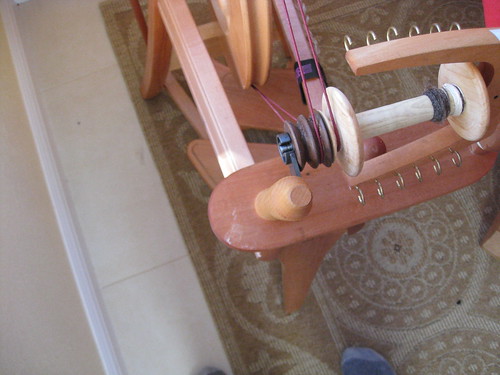
handmade high speed DD set

A faster DD bobbin/whorl set for my Traddy that I made by hand.

Moreover, the industry has a odd way of calculating the ratios for DD spinning wheels.  The actual drive wheel/ bobbin ratio affecting spin insertion for the high-speed Ashford DD bobbin/whorl set is closer to 22:1.  The drive wheel/ flier ratio is ~ the stated 17:1, but in practice the bobbin turns faster than the flier, and thus twist insertion is greater than would be expected by comparing the ratios of the DD kit with the ratios of the lace flier kit.

DD is the smart spinner's way to fast twist insertion.