Tuesday, August 27, 2013

Inventory of knitting methods

Most modern knitters would say that one's method or style of knitting is purely a matter of personal preference.  I add that a knitter's knitting style affects the fabric that they produce.

First, I would divide knitting styles by the tools used:

  1. single point needles (SPN) (including single point cable needles)
  2. double point needles (DPN) (including hand held sock needles)
  3. gansey needles (DPN)  (hand held or pit knitting)
  4. double point cable needles (CN)
  5. nalbinding needle 
  6. sock needles with knitting stick
  7. gansey needles with knitting sheath
  8. Shetland long needles with knitting pouch
  9. swaving pricks with knitting sheath
  10. Portuguese knitting hooks 
  11. other hooking and frame knitting tools
On Ravelry, they take the first 4 of those tool kits and claim to find a couple of hundred different knitting techniques. I am not so sharp eyed, and would say that these are all variations on a few knitting methods, that include, but are not limited to: English, American, continental, Portuguese, Irish Cottage, and Weldon.

For me, the English style produces better gauge, the continental is faster, and Irish Cottage /Weldon are remarkable for showing off a young woman's pretty hands. (With hand held needles, I revert to continental, which I learned because I was told it would allow me to knit faster.) 


Kits 1, 2, 4, and 5 are tools that are easy to carry to a tea, to market, to court, and while traveling.  The downside to these tools is that they do not facilitate knitting very fast, or very tight. Nalbinding can produce Eastern Cross Stitch, but slowly. Portuguese knitting hooks (10) are also portable, and allow production of ECS faster than nalbinding, but slower than knitting with a knitting stick.

Any knit fabric can be done by Nalbinding. It is the most versatile, and the slowest method of producing a knit fabric. It is widely used for repair and restoration, so it is well known to museum curators. Nalbinding can also produce fabrics that cannot be knit. On the other hand, knitting can produce fabrics that are not economically practical to nalbind. 


Over the last 15 years, I have visited archaeology sites and historical museums around the world. By and large, I found archaeologists woefully ignorant of knitting sheath technology. Curators at knitting museums in the UK, knew about knitting sheaths, but had not made replicas and learned to use them.  They could not produce fabric samples that could be handled and tested. And, they did not have working knitting sheaths with appropriate needles to test and identify wear marks that could be used to separate broken DPN from broken  "awls"  at  archaeology sites.  The nature of broken DPN was the first lesson that I learned as I started using knitting sheaths.  This constrained my thinking until Pressfield pushed me to look at metal trade routes in the late Bronze Age.

While any knit fabric can be made by nalbinding, the process is too expensive for some purposes. For example, socks worn with sandals in a sandy environment have a short life span. Socks made by knitting would have half the cost, and be more practical. On the other hand, for a sentimental keepsake, no price is too high, and nalbinding is the perfect production technology. Here, a rare (keepsake) item is more likely to be preserved, while the more common item is likely to be discarded and not preserved.  In such analysis, one must consider not only the cost of the particular object, but also the time invested in the development process to work out construction details. Objects with sophisticated detail are likely to be the result of generations of design. Generations of design suggest a lower cost method of production such as knitting rather than nalbinding.  That is, a room full of knitters, each knitting 3 pair of socks per week is more likely to get all the details correct, than a wife nalbinding one pair of socks per year.  (It is one thing to work from a written pattern, and something very different to just work from memory.)

Tool kits 6 to 9 can be used to produce any fabric produced by tool kits 1 to 4, but they can also be used to produce fabrics that cannot be reasonably produced by kits 1 to 4.

Short DPN with a knitting stick (tool kit 6) is the right tool kit for knitting socks with patterned stitches including Eastern Crossed Stitch, clocks, and Argyle. Knitting sheaths/sticks change the physics of the process, and allow faster and tighter knitting.  


With a knitting sheath, I use an English style of knitting that give me a tighter and more consistent gauge. Knitting English style with a knitting stick, I knit much faster than I can knit continental with hand held needles, so I do not feel that I need the extra speed resulting from knitting continental. And, with a knitting sheath, I do not find continental to be that much faster.

Modern knitters (using hand held needles) dismiss the virtues of Eastern (or Western) Cross Stitch because it is not worth the extra effort. However, it is so much extra effort because they have forgotten how to use knitting sheaths or Portuguese knitting hooks to knit such fabrics rapidly and easily. The right tools and skills make these fabrics feasible. Choice between ECS and WCS for a project depends on direction of ply twist in the yarn. 

Gansey needles with a knitting sheath (tool kit 7) allow faster, tighter, and more ergonomic knitting than any of the above methods. the flex of the long needles give more power than can be achieved with short DPN. While the finger motions of English or continental knitting with Gansey needles with a knitting sheath are somewhat similar to those of knitting with hand held or pit knitting, the physics are different, allowing faster and tighter knitting with much less stress on the hands and wrists. This is very suited to worsted yarns and knitting patterned stitches. Gansey knitting with a sheath has no equal for knitting weatherproof sailor's sweaters from worsted yarns. Thus, the resultant fabric is very different from the techniques above. Jerseys are also knit on gansey needles/ knitting sheath. 

Gansey knit fabric can be replicated with nalbinding, but it is very hard work, and not an economically feasible technology for equipping a shipload of fisherman. 

Shetland knitting (8) is very similar to knitting with gansey needles, but done in a different position.  In shetland knitting some of the effort to drive the working needle comes from the knitting pouch, and part come from the knitter's upper arm. While gansey knitting is driven by the weight of the right arm and the spring of the spring steel needle. Thus, the Shetland needles can be stiffer or less springy than gansey needles. Shetland knitting is also very suited to fast, sustained knitting. I think Shetland knitting has the advantage for knitting woolen spun yarns and Fair Isle knitting.  A Shetland knit fabric can be as warm as any gansey knit fabric, but you may have to use hand spun yarn to get such warmth. Shetland knitting is also suited to knitting large lace objects, however, I do not find it suited to small objects such as lace points for collars and lace cuffs.

I like ~8" DPN and a knitting sheath for fine lace points and lace cuffs. A knitting sheath or knitting heart stabilizes the needle, and makes fine lace much easier and faster. Fine lace is more fun when it can be knit faster. In theory, it can be done, but good luck nalbinding fine lace.

Swaving (9) or knitting by rotating a curved needle, can rapidly produce very fine, tight fabrics. It does not do well with pattern stitches including ECS.  It is not suited for knitting out and about.  It does not work well for Fair Isle.  However, for knitting strips of garter stitch or small objects (socks and especially gloves) in the round, swaving has no equal. Swaving pricks apply compound leverage so the applied force can be small, but produce a large effective force resulting in a very tight fabric.  Needle and hand motion is tiny, and guided by the knitting sheath, and can thereby be very fast. Needle motion feels very different, but looks to an observer to be rather similar to sock needles with a knitting sheath. 


This is an optical illusion as the physics of the motion are very different. The main difference is that needle motion is controlled by the knitting sheath and the tension of the fabric. Since fabric tension controls tension of each stitch, the over all tension can be very uniform. It does feel a bit weird as it is performed.  For gloves, it is a game changer. For fine gloves and fine socks, swaving is far and away the best hand craft method for producing such objects. Swaving pricks work best when less than 8" long, so swaving does work better for small objects. Sheringham Guernseys knit from 3-ply at 12 to 14 spi, are better knit with long knitting pins (1.5 mm) and a knitting sheath. However, if I wanted to knit a shirt of an even finer fabric, with good density, I would swave it, using 2 sets of swaving pricks.  I have not tried swaving yarns finer than lace weight. 

Portuguese knitting hooks (10) provide a reasonably productive way to produce ECS while out and about. I like ECS for socks because it provides great cushion, ventilation, and durability. Even linen stitch and fisherman's rib does not provide the durability of ECS.  Add-in the cushion and ventilation, and the ECS is a great fabric for sock heels and soles -- if you know how to make with with reasonable effort.

ECS on PKH does not require a knitting pin to hold the yarn. 

Thus, hats, I knit with uncrossed stitches, but knit tightly with DPN/knitting sheath. My standard tool kit for large garments is gansey needles with a knitting sheath.  Arans are knit flat with a pair of gansey needles and a knitting sheath.  All Fair Isle goods are knit with a knitting pouch (mostly with long Shetland style needles, but sometimes with sock needles). Worsted gloves are swaved.  The legs/ cuffs of hose and boot socks are either swaved or gansey knit.  The feet of hose and boot socks are knit on steel sock needles with a knitting stick so the sole can be ECS.  Summer socks for sandals are knit on sock needles with a knitting stick. Dress socks are swaved.  Large lace objects are knit Shetland style, while lace points and cuffs are knit on fine (1.2 mm) DPN with a knitting sheath.


I knit scarves, shawls, comforters and other loose fabrics on DPN with knitting sheaths because it is fast.  


Rugs, trivets, and such are knit on gansey needles because I like the fabrics and speed with which they can be produced. 

So that is how I knit from head to toe. I have put a lot of effort into discovering how these fabrics can be produced. If these fabrics could be produced by hand held needles, I would know. Fabric produced by hand held needles looks about the same, but it does not perform as well, and stress on the hands and wrists limits production. For another thing hand held knitting is slow. I have not actually knit an entire object with hand held needles since 2006, and that was only because I was on an airplane, the knitting sheath had been left in the rental car, and the knitting pouch was in checked luggage. If that happened to me today, I would just read. It is better for me to do something else than to waste my time trying to knit without the right tools.

Using a knitting sheath is so much faster and easier, that if I did not have a knitting sheath, I would stop and make myself a knitting sheath.  On any knitting project, with a fabric that can be produced on CN or SPN, a knitting sheath reduces the number of hours required to knit the object by more than the number of hours required to make the knitting sheath. This is true for any non-trivial object.  On other hand, I do put more effort into making better knitting sheaths for larger projects.

When I start a knitting project, I decide what kind of fabric I want.  Then, I choose the tools that allow me to best produce that fabric.  I have actually worn out a couple of sets of US1 Addi Turbo CN. That was a learning experience. I know what CN will do, and what they will not do.  One may succeed in knitting a swatch on CN, but trying to knit these fabrics with hand held needles either results in injury, or the fabric being so loose / uneven that it does not meet specifications. I know that sock needles and a knitting sheath allow me to produce fabrics that I simply cannot knit on CN or SPN. I know that gansey needles with a knitting sheath facilitate the production of other fabrics that cannot be knit on hand held needles.(I consider the different gansey patterns to be different fabrics suitable for jobs.) I know that swaving facilitates the production still different fabrics that also cannot be knit with hand held needles. Somewhere out there is fine lace.  I should likely  have listed a tool kit for fine lace, but nobody NEEDS lace finer than what can be produced with the 1.5 mm gansey needles mentioned above.

I consider the redevelopment and description of knitting tool kits 6 through 9 to be a significant body of work.  It needs to be organized and indexed. Whatever faults the text has, the concepts are the craft of hand knitting, where better is better. The craft of hand knitting is different from the pastime of hand knitting. The pastime of hand knitting is run rather along the rules of Queen Victoria's court. (In Queen Victoria's court, one had to be careful not to knit like a professional.)  

Experts

Feynman said that he did not trust the experts and always did the calculations himself.  That works for me.

Traditional experts learn more and more about an ever narrowing topic until eventually they know everything about nothing. Then, there are generalists that try to learn something about an ever broader span, and they end up knowing nothing about everything.

I am neither of these.  My qualifications for being a senior scientist were that I tended to get the numbers correct. The would give me a problem and I would get a better answer.

I came to knitting in 1999 asking a particular question, "How did the cod fishermen on the North Atlantic Banks stay warm?"

A bunch of expert knitters pretended to answer that question by telling me things  that are impossible according to physics and biology. They said those fishermen were just tough, and that the hand knit fabrics knit with hand held needles were warm enough.  Do those experts actually believe that nonsense?  Do other knitters also accept that nonsense?  (Hypothermia is a physiological condition that results in loss of coordination, loss of judgement, and death.  There is no way to just "tough out" hypothermia.)  

I looked at history, and found ways to knit tighter and faster. This made the knitting experts even more furious.  Modern knitting experts try to ignore the traditional knitting methods used by the master knitters of old.  Modern writers (Rutt) on knitting history wrote without bothering to learn the knitting methods used by professional knitters in the past. Even Mary Wright never learned to use a knitting sheath prior to publishing a book on the topic.  Their unstated, and untested assumption is that the fabrics produced by such methods are substantially similar to the fabrics produced by hand held needles such cable needles.  If they would think about the physics of the process and do the math,  they would know this is nonsense.  It they would learn these techniques and test the produced fabrics.  They would know this is nonsense.

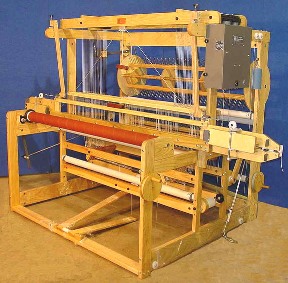
The logical conclusion of the argument that all knit fabrics are equal, is that all woven fabrics are also equal, and that any fabric produced on a floor loom:

 can be produced on a rigid heddle knitter's loom:

No! A floor loom will produce fabrics that a little knitter's loom simply cannot produce. For one thing, a real beater on a floor loom allows the production of denser fabrics.  Likewise, a knitting sheath allows much more force to be applied, allowing the formation of denser fabrics.  Many knitters brag about knitting tight. A  knitting sheath allows knitting much tighter than is possible with hand held needles. The difference in fabric density between a fabric knit with hand held needles and that knit using a knitting sheath is as great as the difference in density between a fabric knit on a table top rigid heddle loom and  fabric woven on a floor loom with a beater. And, for the same reason.  The weaver using a beater on a floor room has more leverage than the weaver using a little knitter's loom.  This allows the floor loom to produce denser cloth.  Likewise, the knitter using a knitting sheath has more leverage.  If knitting tightly is a virtue, then a knitting sheath or knitting pouch is the route to great virtue.  Knitting sheaths allow the production of fabrics that simply cannot be knit with hand-held needles, including cable needles.

The bottom line is that tools matter.  Yes, skill matters. Moreover, the better and more sophisticated the tools, the more skill matters.  Knitting sheaths give more range and scope to the better knitter.

The only way to understand the full range of fabrics that can be produced by the various knitting methods is to make such fabrics and work with them.  Handling museum specimens does not convey how the fabrics perform in everyday use.  Knitting sheaths were used for a very long time because knitting sheaths allowed the production of fabrics that solved problems. To understand the fabrics, one must put the fabrics in the context of those problems. The only way to understand the essence of a "gansey knit" seaman's sweater is to put it on, and wear it while sailing in stormy conditions. The sailors wearing ganseys did not have weather services, their ships endured all weather conditions, and the sailors worked in all weather, including weather conditions that modern ships are able to avoid. the purpose of gansey knit sweaters was to protect sailors from the worst possible weather. The sailors of old, often went aloft under conditions that are avoided by modern sailors. (Grumble you may: but go ye must!) The only way to understand the essence of fine swaved ladies gloves is to put them on, and wear them in an unheated environment. The only way to understand a sock is to wear it under the conditions it was designed to be used.  Museum specimens cannot be subjected to such destructive tests.

By and large, knitting experts are no better than the experts that Feynman did not trust.


Sunday, August 25, 2013

Socks

Good socks allow one to walk farther, faster, and to be less foot sore afterward.

For an army, this means that the army with the better socks gets there firstest, with the mostest.

Not being foot sore as an army goes into battle is a very big deal.

For a marching army, better socks are an enabling technology.  The army with the better socks has an advantage. That was as true 2,000 years ago as it was in General Kitchener's time.

Hesiod talks of lining shoes with "felt".  However, looking at the translator's footnotes, all I can be sure of is that the lining was something made from wool, and that it may not have meant the same thing, all the time.

I never said that Alexander the Great or Hesiod or Darios per se, were spinners or knitters.  I said  that the military men of the time would have arranged the best foot wear possible for their armies on the march.

Read "The Art of War".  Barefoot armies lose and die. Socks and boots are enabling technologies for an army on the march.  Both the Greek and Persian armies marched. Then, the Roman army marched.

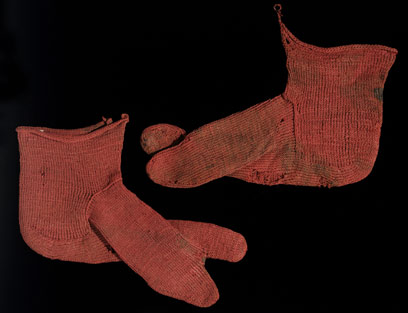
Then there is that Coptic sock. Who here thinks it was a proof of concept prototype to replace the felt in Hesiod's leather foot wear?  No, that sock shows sophisticated details that were likely worked out over generations.    That sock shows long evolution.

Saturday, August 17, 2013

Weatherproof

I claim to knit "weatherproof" garments.  If you claim to knit as tight as I do, your fabrics should do anything that my knitting does - without limit.

A pool of water on a sweater is a nice visual aid, but it is not test for weatherproof. Fog droplets in still air move at almost zero speed - rather like a pool of water beading on the sweater.  Real rain drops fall at ~ 20 mph in still air.  A weatherproof sweater can withstand a lot of water hitting it at 20 mph.  Test for it.  I do. My test uses a high pressure nozzle throwing 12 liters/min at the sample.

To a sailor, "weather' means wind.  I test to be sure my gasneys will keep me warm in a cold gale (35 mph). Test for it.  I do.

Wind will accelerate the rain drops or ocean spray to more than 20 mph. Test for it.  I do.

In the 18th century, cod fishermen in the North Atlantic worked from open boats and hand knit sweaters that would keep them warm and dry in a 48F  gale. ("Frostbite" time for bare skin = 30 minutes.)   When the weather got bad, they put on another gansey, and oil skins.  However, their Jerseys and Guernseys were warm to a degree that you cannot imagine. That is what I test for - Can I knit as warm as they did? And, I always seek better. What is your standard?

I wear my ganseys in the rain and in the wind.   And when conditions get bad, I wear them  2 at a time, under a commercial fisherman's foul weather gear, with proper accessories. I admit it, that combination is warmer than what the old timers had.  They were very tough. In the real world, it does get colder than freezing, the wind does blow harder than a gale, and I have fished in places where 20 feet of rain per year is normal.  I figure that my sweaters are just sort of minimum competence for a working fisherman's shirt.  If you want to say that you knit as tight as I do, then prove that your sweaters have  minimum competence for a working fisherman's shirt.

If you want me to prove things, then turn-about is fair play. We test for  minimum competence.

Friday, August 16, 2013

More on Eastern Cross Stitch (Coptic Socks)

There are at least 2 ways to rapidly and effectively produce ECS. Use of short DPN with a long knitting sheath has already been mentioned.

The other is knitting with hooked needles as done by the shepherds in Southern Europe. See for example, Mary Thomass.  This is also a very powerful technique for producing ECS. It is not as fast as DPN, but it is easier when one is walking, or may be interrupted.  If I was sitting knitting, I would use the DPN.  If I was likely to be interrupted, I would use the hooks. The hooks are more suited to multi-tasking.

The two methods favor different kinds of errors and hence different kinds of anomalous stitches.  In either case, the anomalous stitches are not similar to the errors found in uncrossed kitting as produced by modern knitting techniques.  To the modern knitter,  such  anomalous stitches  are counter intuitive.

The modern knitter assumes that such the anomalous stitches must be the result of nalbinding.   One can nalbind the object without bothering to determine if the original object could in fact be “knit”. And proving that the original can be knit does not prove that it was not produced by nalbinding.  All knitting such a sock proves is that there is a faster way to produce that lovely sock fabric.

I am amused at how many modern knitter reject (without trying) the eastern cross stitch as having "No Advantage".  Amazing that a technology would survive for 1,500 years with no advantage.  I expect that modern knitters reject ECS because it is very functional and requires effort.  

It is worth noting that replicas of the Coptic Socks produced by nalbinding do not contain some of the anomalous stitches seen in the original objects.  To me this suggests that the originals were being produced rapidly, likely as  commercial objects.   And, in the original, some of the anomalous stitches are exactly where I tend to drop stitches when knitting that pattern with short, sharp DPN.  Again consistent with someone sitting &  knitting (a professional knitter) rather than a multi-tasking mother.   Some of the anomalous stitches in the original look exactly like my repair of the dropped stitches. 

I like the pattern for socks. It makes a nice heel and a very neat gusset.  I very much wonder why Nancy Bush did not include it in her book on Folk Socks.  She does mention the Coptic Socks.  I like to wear socks with sandals, and the Coptic sock makers seem to have worked out all the details.  That kind of working out of details only comes from long, long experience.  Not just one life time, but generations of incremental improvements.

Such a long experience with socks is at odds with NB's timeline of knitting.  However, long experience makes sense if "pilos" could also refer to knitting. I do not trust translators to understand all of the possible meanings of a word. In particular, Hesiod comes a time following extraordinary upheavals and trans-humance in Eastern Europe, Asia Minor, Sinai Peninsula and North Africa.  In such times, words acquire and lose meanings. 

Knit socks would have been an enabling technology for Alexander the Great or even Datis.  Come on.  They were good spinners.  They had enough leisure to create art and do science.  They had pointy sticks.  And Hesiod is about the time the Greeks started getting steel needles from Anatolia. 

Many a time, I have looked through inventories of archaeological site artifacts, and what strikes me is that there are a lot objects categorized as  "awls" that look like broken DPN.  I ask, "Did you do a wear mark analysis ?", "Do you have a knitter in the group that has used a knitting sheath?".  The Answer is always, "No.".


Thursday, August 15, 2013

Jersey

I long ago decided that Jersey and Guernsey (in the old days) had both produced fine, dense fabrics suitable for garments worn by sailors and fishermen, but that there there was some subtle, but inherent difference between the fabrics produced on the different Channel Islands (in the period 1100 -> 1485). The different fabrics were likely produced with similar tools (e.g., long metal needles and knitting sheath).

Let's assume that the Guernsey fabric was uncrossed stitches in elaborate patterns knit from 5-ply; a very nice fabric. What is a nice knit fabric for garments worn by sailors and fishermen that is different? It needs to be very warm, durable, and must be fast to knit.  I suggest crossed stitch garter.

I know, I know, it is not knit in the round, and we all know that seaman's "ganseys" were knit in the round because sweaters knit in the round were more durable.  However, one can knit the garment in 3 pieces, then take one of those shepherd's hooked knitting needles and "knit" the pieces together, to make a garment that is as strong as one knit in the round.

It is a fast and easy knit on 2+1 long needles.  Crossed garter stitch up to the neck hole, bind off the neck hole, knit the shoulders, cast on at the other side of the neck hole, and knit down the other side.  Knit the sleeves.  Knit (with hooked needles) the sides together.  Knit (with hooked needles) the sleeves on. Gussets at the arm pit are easy to add.

I have made many of attempts at twisted stitch sweaters, and this is the first one that really seems to make sense.  I am knitting a prototype from 2-ply worsted weight on 2.38 mm steel needles.  It has horizontal stripes of different yarns from different mills.  

This morning I laid the WIP of crossed garter stitch on the kitchen counter, and poured a cup of water on it.  Then, I made breakfast for my wife.  Then, I poured the water off the sweater.  The counter was still dry.   CGS does not provide the padding of crossed cables, but it does provide substantial cushioning for those days when the lee rail is awash and it can be tight enough to be weatherproof.  CGS provides more warmth and cushion than the vertical ribbing of  "Jack Ryan"  submarine sweaters that were popular, and CGS is much faster to knit.  In fact, I would not be surprised if a "terrible knitter" could not knit a weatherproof "gansey" of crossed garter stitch on long needles from worsted weight yarn in a couple of days.   CGS may not flatter the figure like vertical ribbing, but I like it a lot. 

I have been (rudely) asked if I understand at what gauge most knitters knit.  I know that most knitters do not knit "weatherproof" fabrics. (That will support a pool of water.)  And, I do often knit weatherproof fabrics that will support a pool of water.  Yes, my knit fabrics tend to be a little tighter than most.   
   
Will Taylor and his wife have seen more different hand knit fabrics than anyone else that I know, and they tell me that my knit fabrics are unique.  Alden Amos and Stephenie Gaustad have judged more textile competitions than anyone else that I know, and they tell me that in their experience, I  am the only person knitting such fabrics.  Beth Brown-Reinsel touched and felt my gansey and watched me knit, then she told me that she had never seen any fabric like what I knit.   Judith Mackenzie that she had never seen such a gansey actually being worn, and had never seen such fabric actually being hand knit.  I did my home work.  Do I need to go on?

For me, knitting such fabrics is not a big deal.  It is clear that such fabrics could be hand knit on an industrial scale. 

I do not say that such fabrics are for everyone. I say that such fabrics were practical for working sailors and fishermen, and that such fabrics were practical to hand knit on an industrial scale.  I say that sailors on junks had different needs.  I say that sailors on later "steam ships" have very different needs.

It is worth a few cases of brandy to find peers that knit like I do.  Let's see how many people can earn their brandy by knitting a good weatherproof seaman's sweater. The point of this post is that crossed garter stitch can also be knit into a weatherproof fabric.  This give everyone options.

Eastern cross stitch

I am coming to like ECS. Some years ago, I tested samples and decided it was inherently too porous to make a good fabric for fishing and sailing garments. However, it makes a great fabric for socks.  It has some real virtues.

It can be produced with short DPN and a long knitting stick, or using the hooked needles of the shepherds.  Both approaches will  produce an excellent fabric.

Hooked needles work well when standing or walking. The DPN/sheath work when sitting. The DPN are ultimately somewhat faster and more ergonomic.  But, if one is going to be walking and standing, then a bit of knitting is better than no knitting.

Friday, August 02, 2013

Judging textile objects.

The best textile judge that I know always asks, 'What is the PURPOSE of this object?"  The purpose of an object may be to display the skill of the spinner/weaver/knitter. Or, the purpose of the textile object may be purely functional. Or, it may be to display the wealth of the wearer as in the case of haute couture. Or, in my case it is often to test how practical or functional a particular garment construction can be.

I just got back from Salmon Camp. The weather was "fishable".  However, our hosts had told us to bring warm clothing as the weather would be very cold.  And indeed, many in camp were complaining about the conditions. There was 5 or 6 ' of chop on top of a 10' swell,  and the temperature was about 50F.

Our hosts have  a happy, little, bouncy boat, that makes a fair amount of spray in those sea conditions, so oil skins are a must, but by the conditions faced by dory fishermen in the North Atlantic, the conditions were fine.

I wore my thinnest, and almost thread bare gansey, with wool pants under my rain gear.  From the wording on the invatation, I had expected to need  two ganseys, but one was very comfortable. I left my heavier ganseys in the truck.

When I judge that gansey by the needs of a (California) salmon fisherman, it is a great garment. The only way I can judge that garment is to put it on and wear it salmon fishing, trip after trip. Its virtues as a garment for salmon fishing do not show in a picture.  Even touching and feeling it does not warn of its perfect warmth. (And, it is more tightly knit than any sweater that I have ever seen that was not knit with the aid of a knitting sheath.)  Some might look at pictures of it and find faults in the knitting.  For example, the sleeves are loose so that they can be rolled up for when I have to reach into the water to grab a downrigger weight.  And the sleeves are a bit short so they are not fouled when I cut fish. (I wore it baiting crab traps the other day, and afterward it hardly stank at all.)   The stitch pattern is Filey, but the construction is not Filey.  It is not traditional.  The knitting police see it, "see red", and blow their whistles.  : )

Thus, what I consider real virtues of this sweater, would be considered "Faults" by some knitter who never crewed THE boat that went out first, and proved that the conditions were indeed fishable, and that there were fish to be caught, (as the rest of the camp sat by the fire watching the white caps on the water.)  The garments that I make can not be judged by looking at photos on the internet, because they are not like any garments modern knitters have experienced.  They cannot even be judged by touch and feel in a warm room, or even touch and feel sitting by a camp fire.   The only way to judge my ganseys is to put one on and wear during a long day of being drenched by cold salt spray.  The way to judge my socks is to put a pair on, and go use them.  My fishing boot socks are from handspun 5-ply Romney. They suffered a great deal of wear on this last trip.  So, I really am desperate to find a better way to make fishing boot socks.  I am knitting prototypes from MacAusland wool. 

The new salmon gansey will be knit from 10-ply.

I know about fisherman's rib/ linen stitch.  I have made many pairs of boot socks with that stitch. (And worn them to mended rags.)  However, the extra strand of yarn is not anchored to the primary knit stitch, and is free to move and wear.  In Eastern Cross stitch, the crossing of the stitch means that the loop of yarn making the stitch is double weight and as thick as in  fisherman's rib/ linen stitch, however it is anchored by being twisted and cannot move, shift, or wear.  In short, each Eastern Crossed Stitch acts a tiny bit of cabled yarn at half grist, which provides a thick, durable, pad.  For sock heels and soles, it provides a thick, well ventilated cushion.  If you want a warm fabric, go with the  fisherman's rib.  If you want cushion, go with the Eastern Cross Stitch.  Two different fabrics for two different purposes.  Any knitter that dismisses one or the other, has not thought about function in their garments.  

Now, a particular knitter may be knitting purely for status, or the status of the person who will wear the garment, but that should not keep the knitter from thinking.  As I stared at the bobbing rod tip as we bounced up and down on the billowing main, I decided that I am very glad that I have "no credibility on the street". Any spinner/knitter that would try to judge my garments from a internet photo is not somebody that I would ever trust to judge my work in any way.  Such self-appointed judges do not ask, 'What is the purpose of this object/"  They are not as thoughtful as the judges that I do trust.


Sunday, July 28, 2013

A case of brandy


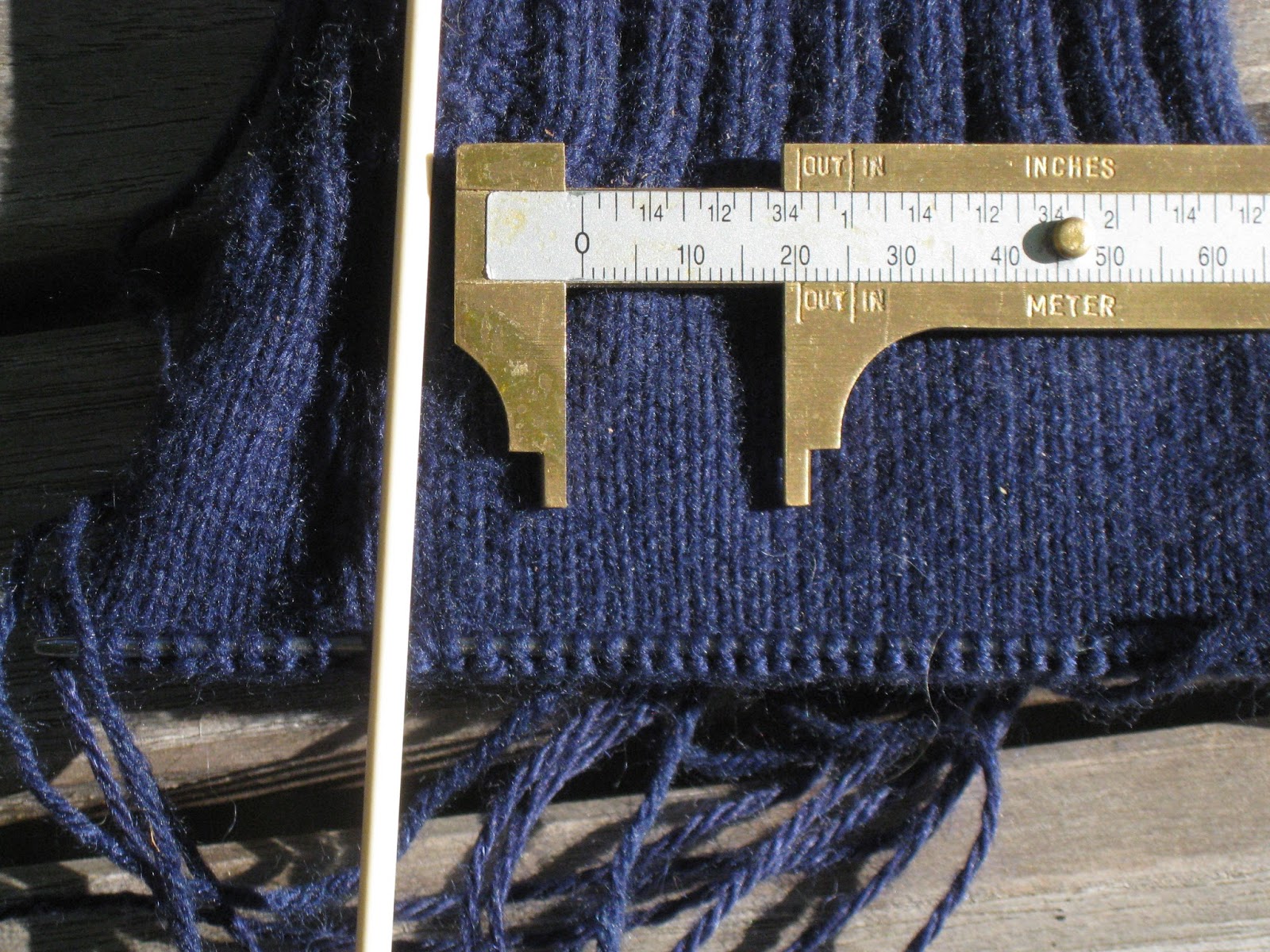
This swatch has shown up in this blog before.  It was swaved with the steel needle (2.38 mm) and commercial wool 6-ply yarn with a grist of 850 ypp. Gauge is 5.5 to 6 spi or 22 stitches/ 4 inches.  It is a firm, but not tight fabric, and certainly not one I would consider tight enough to be weatherproof.  In fact, the purpose of this swatch was to prove that it was possible to swave a normal knit fabric.

One of the anonomice says they can knit such fabric on US3 needles (the white bar above.)

Anyone that can do that will need some refreshment afterwards.  If anyone can knit such fabric on US3 needles, I will buy them a case of good brandy.

Yes, it is not very good knitting.  I was just learning an utterly new technique.

Swatch from last batch of 10-ply

It is cabled, 5x2-ply yarn,  that runs  very close to 1,000 ypp. The swatch is still wet from washing. The base 2-ply was loom warp spun from fine wool.

The fabric slant at the top is the result of a stitch decrease and stitch increase, so the fabric is firm enough that such changes propagate. I have never had a gansey yarn produce such clear, distinct stitch patterns.  I think it is well enough balanced that the stitch rows will not spiral across the belly.

I have been thinking about  such a yarn for more than 2 years.  Everything that I know about fiber and textiles tells me that this is the warmest and most durable fabric that I have ever knit from fine wool.  The current record holder is the gansey knit from (old) LB Fisherman's wool which was tightly spun, loosely plied 5-ply.  The loosely plied structure provided great fill to make a dense fabric. This yarn will not have as much fill, and thus must be to be knit much tighter.  On the other hand, it is less splitty, and easier to knit fast and tight.

Next week I will be salmon fishing up-north, and have been told it will be very cold.  Some of my favorite ganseys are getting a bit thread bare.  Time to knit some new ones. The question is whether 10 ply is worth the extra spinning effort.  Time to do something.

This is not "art yarn".  It does not look like hand spun.  

Saturday, July 27, 2013

Swaving on US 0


Recent swaving on US 0 (2  mm) pricks using 1,200 ypp (4-ply) yarn.  It is a firm, weatherproof fabric, good for a trip around the Horn, on a square rigged ship.

Gauge is 8.5 spi.

In the lower photo, the white rod is a US 3 (3.25 mm)  knitting needle.

Anybody that can knit that gauge on US 3 needles is truly ready for a trip around the Horn.

:  )

Knitting and Nalbinding

All knit fabrics can be replicated by nalbinding. This is controlled by natural laws as deep and wide as the more commonly known Newton's laws of motion. Therefore nalbinding a replica of an object says nothing about whether the original was made by knitting or nalbinding.

On the other hand, knitting is faster. It may be that an object may be practical to use and wear out when it is quickly knit, but when made by nalbinding the object is too valuable and precious to be subjected to the wear of routine use.

Thus, I "knit" my boot socks.  It takes me 20 hours to knit a pair, or 15 hours to swave a
pair.  I could produce the same pair of socks by nalbinding, but it would take twice as long, and be less uniform and consistent.  As practical objects, subject to wear and abuse, I want to invest an minimum amount of time in each pair of socks, and  I knit or swave my socks.  Therefore there is a purpose, and a value to knitting.

I like the Eastern Crossed Stitch (ECS) for sock fabric.  However, while ECS can in theory be swaved, as a practical matter, this fabric must be knit.  Just because a fabric can be knit in theory does not mean that it can be knit with the wrong tools or without specific tools and techniques.  One certainly cannot walk into to modern LYS and purchase the tools required to rapidly produce ECS.  That does not mean that such tools do not exist and were not not known to professional knitters in the past. It only means that such tools are not common today.

DK Burham replicated objects using nalbinding.  Every person familiar with nalbinding knew that could be done, so Burham's work is interesting, but it provides no useful information. Certainly nalbinding is suitable for luxury objects, or objects of ritual or ceremonial use.  Economic constraints constraints of whether nalbinding was economically practical for objects subject to wear were not considered, but we know that the socks were subject to practical use and were in need of repair.  Thus, we can guess that the socks were not luxury, ritual, or ceremonial; and, economics did play a role in the choice of fabrication method.

Moreover, if the socks were substantially knit from short pieces of loom warm waste, then the Coptic Socks may contain individual stitches that are neither typical knitting or typical nalbinding, but which are simply the result of  repair of dropped stitches or darning/weaving in ends at a break in the yarn. Before I started swatching these ECS fabrics, I did think that 3 of these stitches  indicated that the fabric was nalbinding.  However, as I look back over my knit ECS swatchs, I do see similar stitches in my knit ECS work. This was something that I could only discover by knitting ECS. I did not settle any question, except that ECS makes great socks.

Over all, I am highly amused that so many people are so passionate in favor of a flawed analysis that provides so little information.


Sunday, July 21, 2013

More on crossed sitches

Working with the Coptic Stitch, I was reminded of how much I like fabrics made with crossed and plaited stitches.  It is no wonder that at one time such fabrics were held in very high esteem. Fabrics made with crossed stitches can be very thick to provided padding or cushion, and warmth.  However, they tend to be a bit less "weatherproof" than fabrics made with uncrossed stitches. Eastern Crossed stitch has holes in it that allow air to pass freely through the fabric.  As a sock, this allows ventilation.

Thus, we have different kinds of knitting for different uses. Thin stretchy, windproof gloves would be swaved with uncrossed stitches. A under garment (Jersey??) might be constructed of twisted garter stitch because of the stitch's thickness and the rapidity with which it can be knitted (read as lower cost).  The outer gansey would be knit with uncrossed stitches to make it more weatherproof.   Dress socks would be swaved to produce a thin fabric, while an infantryman's socks were constructed of crossed stitch knitting. And, as a heavy duty sock fabric, the Coptic Stitch/Eastern Crossed Knitting has no equal.   As a sandal sock in cotton it provides cool, durable protection.  As a wool boot sock, it is warm, durable, and offers more padding than any other stitch.

So why don't we see crossed stitch work in modern sock patterns? Why do modern authors suggest fisherman's rib or linen stitch for heels and soles, rather than the much better crossed stitch?  Why haven't all the "experienced" knitters pointed out the virtues of Eastern Cross Stitch?  

Well because it takes some skill to produce.  Neither Rutt or Burnham bothered to understand the virtues of (knit) Eastern Crossed Stitch. In fact, over the last few weeks, a large number of knitters have told me that such fabric cannot be knit.  And there is the rub.

Crossed stitch knitting was an early adventure in my discovery of knitting sheaths, and it shaped much of my early knitting sheath and needle designs. Those tools were overkill for knitting uncrossed fabric. And to a certain extent, knitting crossed stitches was an impediment to my development of gansey (long needle) and swaving tools.

How does one knit crossed stitches rapidly?  With rather pointy sock needles and a long knitting stick.  It is very difficult to pop a swaving prick into a crossed stitch, and thus Swaving and Eastern Crossed Knitting require different tools. I would also choose different knitting sheath designs for uncrossed gansey knitting and crossed stitch knitting. Also, the pointy needles and force required to put the needle into the stitch means that knitting needle will be forced through the  back of a leather knitting pouch.  Thus, we can be reasonably sure that fabrics with crossed stitches were knit with short, straight, pointy needles, fixed in knitting sheaths.  

At this point, we know there there was one kind of knitting sheath for swaving, and another kind of knitting sheath for producing Eastern Crossed Knitting, and that knitting pouches are not suitable for either of these styles of knitting. (However, knitting pouches do work well for both twisted garter stitch and plaited fabrics, which are not as tight as Eastern Crossed Knitting.)  Both Rutt and Brear missed these points about the differences in use of different knitting sheath styles as did earlier authors such as Mary Thomass.  At one time, knitting sheaths were like hammers, there were different kinds for different jobs.

The $64 question is did master knitters in Europe during the middle ages know swaving, gansey knitting, and crossed stitch or did each specialize to a single knitting technology? When did swaving and gansey knitting become separate industries?


Wednesday, July 17, 2013

Cites

 Makarieva, A. M., Gorshkov, V. G., Sheil, D., Nobre, A. D., and Li, B.-L.: Where do winds come from? A new theory on how water vapor condensation influences atmospheric pressure and dynamics, Atmos. Chem. Phys., 13, 1039-1056, doi:10.5194/acp-13-1039-2013, 2013.

Above is the only paper that I have read in a long, long time that deserves a citation.

Many of the weathermen who should be most interested in Makarieva et al do not have the math background to follow the arguments.  I have great sympathy and compassion for  Makarieva, A. M., Gorshkov, V. G., Sheil, D., Nobre, A. D., and Li, B.-L.  They are a  bit outside the field of weather, and  weather, atmospheric science, climate science are a bit clannish.

The IPCC used hundreds of correctly cited research to generate their documents.  And yet they hugely understate global warming.  In particular AR4 (http://www.ipcc.ch/publications_and_data/ar4/syr/en/contents.html ) missed the dramatic 2007 Arctic Sea ice melt.  What is worse, AR5 to be published in 2014 will fail to discuss the terrible 2012 Arctic Sea ice melt.  AR5 is already out of date.  The IPCC reports do not reflect the reality of the coming climate change. Correct citation of academic work does not ensure correct conclusions.  Loss of Arctic sea ice and carbon feedback are tipping points that will speed climate change.  They are very important, but are not considered in the IPCC models.  See for example http://www.youtube.com/watch?v=Z_-8u86R3Yc . Richard, Gavin, and Michael are some of the best, but note what they do not not say.

My contempt for the IPCC is absolute. That contempt over flows to other academic fields that do not recognize reality.  Climate change is important. Knitting and spinning are just a a tactile sensation of making order out of chaos.  A way to pretend that I have some control over something. Spinning, knitting, and weaving is just a hobby.  It really does not matter.

This blog is about reality.  It is about how to knit warm fabrics. It is about how to spin faster. "Pretty" is subjective. Cold is a physiological reality. If you are really cold, anything warm is wonderful. I do not do pretty!  I do wonderfully warm.


20 gm, 3-ply, art yarn

aka glove yarn

Looks balanced to me. 

I did not even put leases on it.

Sunday, July 14, 2013

Swatching cotton

The gauge is a bit off, but it is the right stitch and the variations in tension in the fabric are about correct.

This was knit as we were out and about on Saturday shopping chores.

This tells me that this stitch, at about this gauge, can be easily knit with sock needles and a knitting sheath.

Note the similarity in the "row out" on the back side of the fabric.

Thursday, July 11, 2013

One Yarn Project.

About spring thaw, I went  looking to buy a loom, and visited a loom dealer that had put a loom aside for me. We ended up sitting in the back of my truck with her poking through a bin of my knitting swatches. She said, "Dang!, These are unbelievable! We need to take these up to the house. You know he was a great knitter."

He pawed through them, and said, " Kinda grubby!  No hand spun here!"  Thus, was born the hand spun gloves project.

I chose the knitting tools, and sampled hand spun yarns from the stash. No joy. I  made up samples of  other possible yarns from hand spun singles in the stash.


      No Joy.


I then took some Rambouillet :
 washed it with soap flakes and borax,


 and blended it on my Clems carder with some navy blue combed Romney from a gansey yarn project to produce a lavender color way with white neps for accent.  This is my first "art yarn" (neps!). The Rambouillet makes it soft, the Romney gives it good wear at the finger tips.  Over all the blend gives reasonable wear without being too harsh.

The bats are sprayed with spinning oil, torn into lengths, and wound on my distaff to facilitate spinning. I spin singles at 4,800 ypp (9s) using the spinning technique shown in videos on this blog,
( http://gansey.blogspot.com/2012/01/another-video-of-spinning.html )
but with the gang whorls on the flier.  

My typical spinning wheel bobbin rotation speed as measured with a digital tachometer is 2,300 rpm. Compare that to the 800 rpm that a stock Ashord Traddy can do.  Even with a lace flyer, Ashfords do not go much faster than 1,400 rpm. Most espinners are limited to 1,600 rpm.  Twist is DRS controlled to just over  8 tpi.  Net spinning rate is around 300 yards per hour. I note that there is nothing on my wheel that a 15th century spinner in Flanders could not have had. I very much doubt if I spin as fast as the spinners in Bruges, 500 years ago.  Over all,  "spinning" is a tiny part of the project.

I am sure that I do not spin as well as the spinners in Bruges, 500 years ago.   They were trained pros with elan.

Singles are wound off onto reels using an electric drill to drive the reel, washed (with shampoo),  dried (blocked), and then wound onto smaller plying bobbins. Singles with spinning oil on them need to be washed within a month. Last fall when I was working with hanks of fines, I  found wet skeins to be problematic, and moved to washing singles on reels. I made enough reels that I can wash and dry singles faster than I can spin them.
 

Once the yarn is clean (and loosely wound) on a plying bobbin it can be stored.  I have many yarn storage/plying bobbins.

Current plying technique is to put the plying bobbins on a bobbin rack or lazy Kate, feed the singles through my tension box, and ply with the same gang whorl flyer as used to produce the singles.  If I was making gansey yarn, I would use the Ashford jumbo flyer so that I could produce knot free, 8 oz hanks.  However, the (smaller) high speed flier is much faster and  each glove only requires ~2 oz of yarn in 5 pieces, so smaller yarn packages are acceptable.

 
The full plying train of Lazy Kate,          Tension Box,  and                            Wheel with high speed flier.

A tension box used on blocked singles really is an advance on Alden's Four Great Principles of Plying. Tension boxes are simple to make, and worth their weight in hand spun yarn.

The finished yarn is wound off the wheel with  a cake winder, to produce :

3/4 ounce of 1,500 ypp, 3-ply,  glove yarn
(~70 yards)
Knit, the color matches the lavender buds I was putting in the wool bins at the start of the project, and which inspired the color for this yarn. It is warm, durable, and comfortable.

The swaving pricks are the same 1.5 mm used for the cotton sock fabric in the last post. The semi worsted yarn knits easily at 12 to 14 spi. to make an elastic fabric.  Yarn for final objects will likely get a final  blocking with steam. 

Final objects will get washed again.

Wednesday, July 10, 2013

Nalbinding - not

Consider : http://www.knitty.com/ISSUEspring06/FEAThistory101.html and in particular photos

and
identified as 'nalbinding'.

On the other hand there is 


All, the result of a few minutes (time to drink one beer on a warm California afternoon) of my knitting some crochet thread.  Looks like the same stitch to me. This is about 10 spi. ( 450 stitch swatch).  Nalbinding, it would have taken longer than one beer.  If you want finer, I have finer (red) crochet thread and much finer knitting needles.  It would not be hard to run up a much finer fabric. It is a firm, dense fabric, utterly unlike most modern hand knitting. If you knit to fit, it is a nice sock fabric.  On the other hand, with its limited stretch, it must be knit to fit.  I think those old red toe socks are just knit from loom waste (short pieces of yarn).  In particular, the way the heel was turned looks like knitting.  I see the very same lines on the boot socks that I knit.  Someone working nalbinding would have turned the heel differently.  There are many heels that work well with nalbinding, but none of them produce those lines that look like my knit boot socks.

Some rows of the old red socks have a spiral or threaded appearance. Compare that to this well used gansey knit sock:

The difference is that the old red toe sock has crossed stitches, and is cotton 2-ply, rather than wool 5-ply of the gasney sock.  

There are good instructions on the internet on how to do the Coptic Stitch in nalbinding.  However, such instructions will not get you to the gauge used to make the old red toe socks.  Practice will make you better, but the nalbinding technology is not suited to produce the fine evenness and uniformity that we see in the Coptic socks.  However, gansey knitting and swaving easily product that style, gauge, and quality of fabric.  A good knitter could come close to a sock a day. 

 And trying to knit fine, tight, crossed stitches without the leverage of a knitting sheath will put a lot of stress on your wrists. You could knit a pair, but not 2 pair a week as a commercial knitter.

I will keep this opinion until I see modern nalbinding as firm, even, and at the same gauge as the original red toe sock.  Mary Thomas handled the old red toe socks and pronounced them KNIT.  She knew about nalbinding.  She also knew about knitting sheath technologies. Modern textile people tend not to know about knitting sheaths and what kinds of work they enable.


Friday, July 05, 2013

The One True Way to block

My position is that I have been told a lot of different techniques to spin, and most of those techniques are not nearly as fast, as easy, and do not produce as good a product as what is recommended in books like Alden Amos's Big Book of Handspinning.  It is not that I have One True Way, it is that better spinners have better ways.   I am not impressed by what I have been told on the internet (read as Ravelry). The very best advice I have gotten is from Alden Amos, either in person or in his book. Most of what I say, I have gotten from better spinners, and I recite these better techniques to remind people that much of what is repeated over and over on the internet is not best practice.

Blocking yarn was a stone wall for me. First, I had to understand that yarn (singles) needed to be blocked.  It was hard to take the concept of blocking very seriously. However, good blocking of singles is essential to a reasonable process of making 5-ply gansey yarn. The 5-ply that I made before I started blocking singles is not nearly as good as the 5-ply made after I started blocking all singles. And, handling 45,000 ypp (and finer) singles required that they be blocked prior to plying.  Handling wet fines, required a certain set of tools and skills. Nobody would come right out and say that.   I tried everything.

Blocking wet skeins by hanging weights on them is better than nothing.  However, for for the quality of yarn that I want, it is not good enough. It does not work for 560 yard hanks of 80s (45,000 ypp).  Anybody that talks about blocking wet skeins by hanging a weight from the skein is not thinking in terms of full hanks of  worsted "fines" (60s -> 80s).  And the truth of the matter is that for the 12,000 ypp singles for an ongoing knit glove yarn project, blocking wet skeins by hanging a weight on them just does not work as well as blocking on a reel.

Sometimes one does just end up with wet skeins of yarn that need to be blocked.  This may be the result of sizing the yarn for weaving or dying it. In which case, the wet skein needs to be mounted on a squirrel cage swift and wound on to reels. I know sometimes this has to be done, but I still look for better ways to do it.

I know that blocking yarn on reels is not the only way to produce an excellent product, because I also have a very good steam blocker. Steam blocking under tension and wet blocking on reels are different techniques on paths to different yarns.  Every yarn has it own One True Way that will produce the right yarn, faster, better, and cheaper.

I continue to be impressed by the Big Book  Handspinning.  Last week, I was sampling on the loom and after a few inches, I was getting fuzz balls on the warp.  Sure enough, there in the Big Blue Book, are 2 recipes for sizing to protect warp from abrasion.  I had never noticed those recipes before.  They are both being evaluated, along with 3 commercial PVA based sizes.  I may be able to use singles for warp, wind the warp on through the tension box, size the warp on the loom, and then, tension on the warp during sizing would block the yarn?  I have ~ 4 feet of warp path from the sectional beam to the heddles.  The question is will the yarn size together and make a mess?  I will never know until I try it. AVL  is mute on the topic of sizing.


knitting in Europe circa 1280


Paul Lacroix quoting  French historian and archaeologist. Jules Étienne Joseph Quicherat (13 October 1814–8 April 1882) :

"Towards the year 1280," he says, "the dress of a man--not of a man as the word was then used, which meant serf, but of one to whom the exercise of human prerogatives was permitted, that is to say, of an ecclesiastic, a bourgeois, or a noble--was composed of six indispensable portions: thebraies, or breeches, the stockings, the shoes, the coat, the surcoat, or cotte-hardie, and the chaperon, or head-dress. To these articles those who wished to dress more elegantly added, on the body, a shirt; on the shoulders, a mantle; and on the head, a hat, or fronteau.

The braies, or brayes, were a kind of drawers, generally knitted, sometimes made of woollen stuff or silk, and sometimes even of undressed leather. .... Our ancestors derived this part of their dress from the ancient Gauls; only the Gallic braies came down to the ankle, whereas those of the thirteenth century only reached to the calf. They were fastened above the hips by means of a belt called the braier."

By chausses was meant what we now call long stockings or hose. The stockings were of the same colour and material as the braies, and were kept up by the lower part of the braies being pulled over them, and tied with a string."


Lacroix and Quicherat were both experts on the middle ages and anybody that wants to disagree with both of them had better have all their arguments in good order.


Manners, Custom and Dress During the Middle
Ages and During the Renaissance Period has been reprinted by Skyhorse Publishing, in which the quote above starts on page 529. It is also available as a 
Project Gutenberg EBook and the quote is adjacent to fig 417.

Tuesday, June 11, 2013

Twist

Twist is inserted when one end of a string is rotated relative to the other end of the string.

The string is tied to a spindle, the spindle goes round, the spinner holds the other end of the string, and twist is inserted.

String is tied to the spindle on a great wheel, the wheel/spindle goes round, the spinner holds other end, and twist is inserted. A bobbin on the spindle makes no difference.  If the string is tied to the bobbin, the bobbin goes round and twist is inserted when the spinner holds the other end.

On a flyer/ bobbin assembly, the string is tied to the bobbin.  When the spinner holds one end of the string, then twist is inserted when the bobbin goes round.  The flyer is not tied to the string. The flyer cannot insert twist unless the bobbin rotates.  The bobbin and flyer may rotate together, but it is the bobbin that is fixed to the end of the string; and therefor,

it is the bobbin that inserts twist.  

If the flyer rotates, but the bobbin does not, then string is wound onto the bobbin, but no net twist is inserted.

(Some small amount of twist will be inserted, but this is NOT enugh to hold the yarn together, so no actual yarn is formed. If no yarn is formed, then the bobbin is simply rotating in space, and there is no yarn to accept the twist, and "spinning" does not occur.)

If the bobbin rotates but the flier does not, then twist will be inserted, at the rate of one twist per effective circumference of the bobbin.  One twist per per effective circumference of the bobbin is not likely enough twist to make a competent yarn.  It may not be enough to even hold a soft roving together.

Confusion comes when the rotation of the flyer causes the bobbin to rotate (via yarn lock.)  In this case, the flyer drives the rotation of the bobbin, but it is the rotation of the end of the string tied to the bobbin that causes the insertion of the twist. If rather than a mass of fiber, filaments are passed through the flyer, then it can insert some small amount of twist. However, with normal fiber this is not enough twist to form a yarn, so there is no yarn to accept the twist.

One end of the string is held by the spinner, and the other end of the string is tied to the bobbin.   Only rotation of the bobbin or rotation of the spinner (or the counter rotation of both) can insert enough  net twist to form yarn from fiber.

Twist is the essence of spinning.  If one does not understand twist, then one does not understand spinning.

Skeins

Spinners produce skeins so the yarn can be easily judged. In the past, skeins allowed the factors and weavers to judge the quality of the yarn that a spinner was producing.  However, what really matters is the appearance and function of  the fabric(s) produced from the yarn.

Judging a skein of yarn in the skein at a show is like judging a hunting dog or a sheep dog in a show ring.  The only way to really judge such dogs is to watch them hunt or work sheep.  Judged in the ring, you are likely to come up with a "champion" sheep dog that is pretty, but can't work sheep.  And, a sheep dog that cannot work sheep is not a sheep dog, it is just a pet.

Yarn must be judged by how it performs in a fabric, and the intended use of the fabric must be known. Yarn for a sweater is different from yarn for gloves.  And, yarn for matching sweater and gloves is another set of compromises depending on how the outfit will be used.  No! that is the mind set of a knitter using commercial yarn.  A hand spinner can make soft sweater yarn, and durable glove yarns that match.

I have been sampling yarn for gloves.  The soft yarn's do not wear well at the finger tips. The yarns that wear well at the fingertips, tend to feel harsh at the cuff. Certainly it is also an issue with socks, but it is more an issue with gloves.  This brings up the idea of spinning different, but matching yarns for cuffs and  areas of high wear.

Mostly transitions from one fiber type to another are visible where the transition is abrupt.  However, the hand spinner can make such transitions gradual and very much less apparent.  That is, suppose it is desired to put more Romney in the fiber blend over the heel and toes of a sock to increase durability. The hand spinner can change the blend over a length of  the yarn that will result in a inch of knitting, so that in the finished object, the transition from one fiber blend to another is not noticeable.  In a skein, that transition from one fiber blend to another would look like crap.   In the finished object it looks like magic. It is a touch of true craftsmanship.


Saturday, June 08, 2013

The math of spinning for weaving

One of the things that I have been persistently ridiculed over is my search for ways to spin faster.

However, lets think about hand woven cloth form hand spun yarn.  A garment weight cloth is 10 or 12 ounces per yard, and a traditional English bolt of cloth is 12 yards, or 144 oz or 9 pounds. If the yarn is 10s (5,600 ypp) then a bolt cloth will contain 90 hanks or ~50,000 yards.

With a wheel ratio of 1:12, a treadle rate of 90, you can spin about 150 yards (of 10s) per hour that comes to ~334 hours of spinning.    With a faster wheel a spinning rate of 370 yards per hour is reasonable and it is only 135 hours or 3 hours a day for 7 weeks to spin the yarn for a bolt of cloth.

Spinning fast is better.  This is why I want fast spindles. This is why I am willing to work a little harder to spin much faster.

Skeins? It is faster and easier for me to store yarn as cakes, bobbins, and cones. For knitting, I wash and block the yarn on reels, and put it up as center pull  cakes. For weaving, I wash, block, and put the yarn on little bobbins that each hold an ounce of  yarn. With 50 such bobbins, I can wind 2" of warp at a time.  There is just no way in world to juggle 50 skeins of yarn while winding on to the loom.

Tuesday, June 04, 2013

Spinning with a spindle

There is a story going around that I cannot spin with a spindle. It is libel.

I have even taught spinning with a spindle at some of the local spinning guilds "learn to spin" booths, including a couple of years at Stitches West.  Later, a friend who is a very fine spinner wanted a travel wheel for a trip to Southern Europe. Together, we shopped for a wheel, but decided that a set of spindles designed for the kinds of fine yarns that she wanted to spin would actually allow her to spin faster than any of the commercially available travel wheels.  So, I undertook to design suitable spindles for her.  I spent a few hundred hours getting good at spinning with a drop spindle. I used a drop spindle to spin miles of "fines".  I learned to spin fine and fast.   And, I started making spindles for spinning fine and fast. There were at least 4 distinct generations of design as my increasing skill informed my spindle design, and better spindle design allowed better spinning. The last couple of  generations of these spindles are so fast that they require the use of a distaff to permit drafting fast enough to keep up with the spindles.

A set of the Third Generation spindles was stolen and passed around fiber groups in Ohio. I expect that those spinners tried to spin 2,000 ypp singles rather than the 22,000 - 30,000  ypp singles that the spindles were designed to spin. Thus, the spindles did not work well, and the spinners did not like those spindles.  They, decided that anyone that made such spindles must not know how to spin.  And they posted such nonsense.

(I allowed the spindles to be stolen because I already had G4 spindles that were better, and I wanted to see if those spinners were honest.)

Monday, June 03, 2013

The Fall collection

We happened to be in Needless Markup as some of the fall designer collections came in.

It looks like this year there are going to be some very nice, fine wool pants.  We have not seen such fabrics in ages.  A real inspiration for the weavers. Here we can see why in the old days, spinners learned to spin fine.  It was to make the yarn for such fabrics


Ladies and Gentlemen,   Wax Your Fly Shuttles!

Wednesday, May 15, 2013

Back to the basics of plying

Soft and lofty woolen spun yarns present their own difficulties for plying, but the nature of the yarn hides the art of the plying.  If you want to show off your skill at plying, spin worsted.  Sure 4-ply woolen yarn takes skill, but 4-ply worsted  takes more skill.

If you want to know how good someone is at plying, look at one of their yarns plied up from fine, high twist singles.  In particular, 5-ply gansey yarn is a structure that is hard to get uniform, and the worsted singles make any and all faults in the plying clearly visible.  Because of its more stable structure, I feel that 7-ply is easier to ply into a uniform and consistent structure than 5-ply.

Making 5-ply gansey yarn is a evolution that every aspiring spinner should perform.  It is a good place to master Alden Amos's 4 principles of plying. (Tension, Distance, Re-wound bobbins, Constant Motion) With simpler yarns, one can get way with violating one or more of those principles.  However, a kilo of 5-ply will turn the Principles into habits, and thereby improve all of your yarns.  The lesson is worth the price of the fiber.  Sure it is a week of spinning, but we like to spin, right?

A kilo of 5-ply will also force you to acquire the tools (bobbins, lazy Kate, yarn guides or tension box)  for better plying.  These will stand you in good stead, when you want to make very high quality 2-ply woolen spun.

A kilo of 5-ply is enough for you to start thinking about blocking singles prior to plying. (If you go into one of mills producing high-end luxury yarns, you will note that they block the singles prior to plying.)  Alden talks about plying in Chapter 11.  In Chapter 10, he talks about ways to make yarn better.   I think one of the few glosses in the book is that on page 263,  he should have points 5 & 6 about washing and blocking the yarn.

Sometimes the extra effort to wash and block the singles will save a great deal of  time. I use spinning oil, so washing the single after it is spun means that I can store that yarn, and am no longer under pressure to use that yarn.  Thus, washing yarn immediately after spinning reduces my stress levels. Over all, it saves me time because the spinning oil lets me spin much faster. It produces a better yarn because the spinning oil lets me spin more uniform yarn.  Some singles are just much easier to ply after they have been blocked. One example is fine hosiery singles ( 23,000 ypp, 17 tpi).  And, yarns plied up from those singles will be much better when you do take the time to wash and block the singles.

This post was prompted when a spinner on Ravelry, who has never made any gansey yarn, tried to tell me that it is not important to rewind bobbins prior to plying.  It is this group that makes fun of me because I am only a beginner, but I have the "one right way to spin". They have this up-side-down.  I believe in different yarns for different purposes.  I believe in different tools and techniques for different yarns.   And, I believe that any set of  tools and techniques that has been invented, can be improved.  I always look for Better, Faster, Cheaper!  There is no one right way to spin!  Today's best way to spin is not good enough for tomorrow.  When I see a better way to spin, I adopt it. 

Wednesday, May 01, 2013

Plying

With all due respect to core spun yarns, plying is critical to the appearance, strength, warmth, and durability of yarn.  Why then, in modern spinning culture is plying considered a second rate procedure?  Spinners that have many beautiful, expensive spindles, use toilet paper rolls as storage/plying bobbins and a shoe box with knitting needles as a lazy Kate.

Sorry, but singles do not feed smoothly and evenly off of  a toilet paper roll on a knitting needle stuck through a shoe box. The result is less even plying.  A smooth, even flow of each single is required for good plying.  This is not a noticeable issue working with a few skeins of low twist woolen singles for 2-ply worsted weight yarns or even 4-ply DK yarns.  However, if one is making fine sock yarns or warp for a large weaving project it quickly becomes an issue.

Alden Amos is craftsman that knows how to ply, and is honest enough to tell his students and readers the truth.  Alden's Four Great Principles of Plying work.  However, Alden does not want to scare spinners off by telling them that they need a lot of expensive tools for plying.  That is my job.  (On the other hand, he has never been bashful about selling a lot of expensive tools for plying.)

Good plying tools are as essential as good spinning tools.  Instead of buying that third spinning wheel, use the money to get yourself some really good plying tools.  Get or make a good lazy Kate, with bobbins that fit, so that they turn smoothly.  (Along the way, you are likely to discover that you need a good bobbin winder.)

If you are working with fine or high twist singles, then they are much better behaved if they are blocked before plying.  Blocking singles prior to plying can result in much less over all effort, and much better yarns. With high energy singles, Alden's principle of rewound bobbins is an understatement.

Blocking can be accomplished by running the single through a steamer under tension.  Such a device can be made from a "T" of  PVC pipe attached to an inexpensive clothes steamer.  Less energetic singles can simply be wound onto reels, then washed and dried on the reel or the "Shaker Rocket Ship". This will take the combing/spinning oil out of the yarn and allow extended storage.  Here are some currently in use at the Tulip Patch:
The pointy thing, holds reels for winding off.

After washing and drying, singles can be wound into skeins for storage or put on plying bobbins.  I have also started using pirns as cores for winding cones.  More docile singles can simply be wound into center pull cakes for storage.

Now, comes the point of this post. Very fine singles are still a challenge to ply, particularly if you are doing 6 or 10  or more plies.  When working with large numbers of fine plies, consistent and uniform tension can be achieved with a tension box of the type used by weavers for warping sectional beams.  
I  use one made by AVl.  The one above by Leclerc is simpler.  For a spinner to buy, there is some sticker shock, but they are easy to make, once you have the idea - dowels between 2 reeds or raddles.

I have mine about 6' from the spinning orifice, and use DRS controlled twist insertion.  I allow twist to occur  as the singles exit the tension box. The result is fast uniform plying even when working with fine, high energy singles.