Sunday, November 24, 2013

The return of niddy-noddy

Look at the traditional and old designs for niddy-noddys.  They are STRONG, heavy, and clunky.

Why?

Modern designs of light weight PVC pipe or thin dowel, work very well  --- as long as you are working with dry yarn.

So, why are the traditional designs so strong?  I  think they were also used for blocking skeins of yarn.

I think the old spinners, wound off their bobbins onto niddy-noddys, washed the yarn or steamed the yarn on the niddy-noddy, then let the yarn dry on the niddy-noddy, so that the skein of yarn was blocked when it came off the niddy-noddy.  The yarn will try to shrink so the niddy-noddy must be strong to resist the contraction of the yarn.

That gives me a better blocked skein than taking the skeins off the niddy-noddys, washing the yarn, and trying to block the loose skein. I do not find that this works well.  The better alternative taught today is to put the WET skein on the squirrel cage swift and wind it on to a yarn reel for blocking and drying.  That does give a better product, but I am not sure that I need to work that hard.

One should not wet a niddy-noddy that has a varnished, or linseed oil  finish. One will ruin the finish or discolor the wood.

However, niddy-noddys are (or can be) small and inexpensive.  They can be made to disassembled for storage.  A niddy-noddy holds about a #1 bobbin of yarn for washing/drying. If  I am spinning 4 bobbins of yarn per day,  then 16 niddy-noddys will give the skeins 3 days to dry, and 16 niddy-noddys take up less space and cost less than one yarn reel.  The yarn reel is much better for dyed or sized yarn.  However, skeins on niddy noddys can be dried in the microwave, which makes the process wicked fast.

Working with green wood, a wood worker with Iron Age tools could make 16 functional niddy noddys in a day.  A 15th century wood worker with steel tools could make them in a couple of hours.  I can buy PVC pipe and  wood dowel at the hardware store around the corner and do the 16 in less than half an hour for a cost of less than $15.  (the prototypes were made of maple with oak limbs, the limbs can be pushed through to release the skein.  Thus the limbs can be either parallel for easy storage or the traditional orthogonal. )


For fines, I like my little reels.  However, for 3,000 ypp warp and weft, I am going to give the niddy-noddys another chance. I will wind off on to the niddy-noddy, and the wash, rinse, and dry batches of skeins on their niddy-noddys.

If I do not use spinning oil, then I will steam the skein on the niddy noddy with my little electric fabric steamer that was so inexpensive. This sets the twist and the yarn drys quickly.  I can imagine doing this with the steam from the spout of a large metal kettle hung over an open fire.
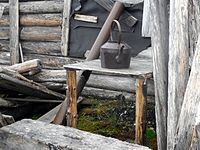
This would give a way for Old Time Spinners to set the twist of their product, and have it ready to pack and sell almost instantly even in damp weather, and to future archaeologists, it would look like a tea kettle. 

 Bronze Age textile workers were producing good cloth by the ship load. That tells me that they were blocking the yarn. They were blocking a lot of yarn.  Any archaeologist that does not address the issue, does not have a clew.  I think they had niddy noddys with a handle at one end ( see Alden Amos, Big Book of  Handspinning, pg 447,343) wound the yarn onto the niddy noddy, and dipped the niddy noddy of yarn into a big kettle of hot or boiling water. Metal kettles would have been another way that the Bronze Age improved textile production. And, to future archaeologists it looks like a soup kettle.  It was, but it may also have helped spinners earn their bread.

The reels are faster to wind onto, and dry faster, but after washing and drying, I have to wind off of the reels.  The skeins on  the niddy-noddys dry slower, but when they are dry, I have  a blocked skein.  I will use a squirrel cage swift to transfer the yarn to bobbins and pirns so that is extra effort.  On the other hand for a weaving project, the skeins are easier to store.  Managing the yarn as I spin the yarn  for a weaving a bolt of cloth is different than managing the yarn to knit a pair of socks. Managing the yarn for a boat load of cloth.

If this does not work as well as I hope, then I must make a bunch of yarn reels that are tapered so that I can slide skeins/ hanks off, or simply sit the reels on their end, and use them as an end delivery yarn package.

In England, there have been laws against using niddy-noddys to measure yarn for sale for 400 years.  In Chaucer's day, it really was a tool of the professional spinner.  However, it is easy to wind yarn onto a niddy noddy so tightly that it stretches, thus, a skeiner gives a better measure of the length of the yarn.  I think of the tons and tons of cloth that passed under Chaucer's nose, and the thousands of spinners that is took to spin the yarn for all that cloth. I think about the weavers being able to demand that the yarn be measured under less tension, and therefor that there be more yarn in a hank.

What I am saying is that textile historians really have not considered and discussed the practical details of how Old Time Textile Workers made boat loads of cloth.  I am not sure they used niddy noddys, but at least I am thinking about the holes in the story.

Finishing Yarn

Many modern spinning "teachers" say that yarn can be finished by winding a skein, wetting it,  and letting the skein dry under various conditions. I do not find that this works, I say so, and spinners bash me.

I like skeins for washing and dyeing.  Yarn in a skein can be washed with less water than yarn on a reel. However, I have never been happy with the quality of finish achieved by allowing yarn in a skein to dry in the skein. with, or without, weighting.

If you are going to wash or dye a skein of yarn then it needs to go onto a squirrel cage swift, and be wound off onto a reel.

Fine yarns need to be washed on a reel.  The old silk reels work well, as do AA's Shaker Rockets.

As an alternative, if the yarn does not need washing, steam works very well to set the twist.   See AA.

I have no doubt that Iron Age weavers routinely worked with blocked yarn.  If the yarn was dyed after spinning, the blocking might have been done by the dye, but I would guess that often the spinner finished the yarn. Truth is that if you have a horse trough or a barrel, you can wash the yarn on the niddy-noddy, then dry it in the sun or hang it in the rafters on a rainy day.  This is better than letting the skein dry loose or weighted.  This works,  and is inexpensive, why don't see this in the modern spinning texts?

Why do spinners bash me for honestly saying what works for me and what does not?  I think this says more about the spinners than about my testing.

Tuesday, November 19, 2013

Center pull balls

I love center pull balls. One of my favorite knitting yarns comes in skeins, so I bought a jumbo cake winder. I love it for knitting yarn, right down to lace weight.

However, last year I was thinking about thinner yarn, and a very experienced textile person said," Try winding it into CPB."  Wrong!! Very fine yarn does not like center pull balls. Wind fine yarn on cones, bobbins, prins, or Styrofoam balls.

I had some luck winding blocked worsted warp singles into center pull balls.

However, unblocked woolen singles are another story.  Trying to store unblocked woolen singles in center pull balls is a path to heartbreak.  Wind woolen singles on cones, bobbins, reels, as hanks, or on prins.

 Anything but center pull cakes.


The truth of the matter is that a spinner producing hand spun warp to go on a sectional beam needs more bobbins.  I do not care how many bobbins you have, you are going to need more.

ETA

I started making bobbin blanks, and then I though about historic spinning and weaving sites.  Did I see bobbins?  No!  Why not??!!

What does one see?

Pirns!!

What is a prin? A recyclable cone core? A cone core that fits in a shuttle?

It takes me 1/6 the time to make a pirn as to make a bobbin.  The pirn will not hold as much as a bobbin of the same size, but there is not THAT much difference.

The logical thing is to spin weft, and wind it off onto the pirn that goes into the shuttle. When I spin warp, I wind off onto a pirn used as a cone core.  Will it work?

The clever readers are already saying, "That fool, pirns supply no drag for plying! And, any yarn that slips off the end can produce a tangle more heart wrenching than watching a shed full of bobbins go up in flames."

Yes, and yes.

There are many good reasons to wash and block yarn right after spinning.  Perhaps there is no alternative.  It maybe that I must wash and block the yarn immediately after spinning.

Those center pull cakes are a mess.

Oh, and by the way, the AVL pirns for their  flyshuttles just hold one of AA' s # 1 bobbin's full of yarn.  What a coincidence!  No, they are both traditional sized.  Spinners have been spinning for weavers for a long time.


Saturday, November 16, 2013

Stone Whorls

My sister is a world class goldsmith.  Since he retired in 1980, my father has been doing lapidary work for my sister.  He does fine, one of  kind, gems for her small sculptures.

Fifteen yeas ago he bought a big lot of fine jade, and for the last couple of years we have talked about him making me some stone whorls from that jade. My sister has superb drawing skills and he is accustomed working from drawings. Along the way, I did a lot of calculations.   I made spindles that accepted interchangeable whorls, and tested various shapes of whorls.  I bought "whorl" beads of various kinds and tested them. At one point, I made a full set of  CAD files for the project.   And, I talked to folks like Stephenie that have collections of  real neolithic spindle whorls.

My conclusions were:

1. Stone spindle whorls are fragile and they tend to get lost. 

As a result, I expected production spinners to use the least expensive whorls available.  This is born out by the large number of crude stone and ceramic whorls that  have been found. My response was to use machine made whorl beads.  Today, a broad variety are available, and can easily be tested.

2.  "Carved" whorl beads tend not to be very well balanced so that substantial amounts of rotational energy goes into gyroscopic stabilization rather than into twist, and spindles with carved whorl beads tend to slow rapidly. The  goal of spinning is to insert twist quickly.   Energy going anywhere but to insert twist is BAD.

3,  Carved whorl beads tend to have more aerodynamic drag and hence tend to slow more rapidly.

4.  Production spinners, seeking to spin as fast as possible are very unlikely to use carved whorl beads  in their production spinning. Carved whorl beads are a store of value, rather than a functional tool for rapid yarn production.

5.  I preferred smaller, higher density whorls made of metal.  For example brass is ~ 2.5 times denser than jade. I quickly discovered that for fast (worsted) spinning, I liked small, well balanced brass whorls much better than even very well balanced jade whorls. And, the metal whorls were cheaper, and less fragile. In any industry, production workers who buy their own tools, like cheap and durable.  I made a lot of brass whorls to test.  I liked the way the worst of the brass whorls spun better than the way the best stone whorls spun.  I came to feel that better spindles and therefore cheaper textiles was one of the major contributions of the bronze age. I told my dad not to bother making those stone whorls for me.

The above was all done when I was mostly spinning and thinking about worsted 5-ply knitting yarn with singles running 5,600 ypp.

This summer, I have been thinking about woolen spun yarns for weaving.  Woolen is a different kind of drafting and it makes different demands on the spindle.  Why should I use the same spindle for woolen and for worsted spinning?  Why does a spindle used for woolen spinning need the large moment of inertia provided by a whorl?  

The way (with a hand spindle) to quickly spin a lot of woolen yarn  with a hand spindle is with a 'twisty stick'.  A whorl just slows things down.  Yes, you need a whorl for worsted spinning (wool or cotton).  Yes, you need a whorl for linen, hemp, and nettles.  Do your physics home work, and calculate the moment of inertia that you require for your current spinning project.  It may be smaller than you think.


Friday, November 15, 2013

More on Twisty Sticks

A twisty stick is a piece of wire 8-12" long with a hook at one end.  The Scandinavians make, big, tapered, wooden ones, but I am interested in the British tradition.

They were used for grading wool in the time of Chaucer, and it makes sense to me that a spinning tool was used to determine how fine a wool can be spun.  Anyway, Chaucer was hundreds of years after great wheels had been introduced for the fast spinning of woolen yarn, so twisty sticks are likely an old and deep tradition.

Alden Amos uses 1/8" wire and gives directions with drawings for making them in his Big Book of Handspinning. He likes them, and considers them an essential tool - the kind of thing that spinning guilds should make for every member as guild projects.  I like 2 mm steel wire and make them a bit longer (10.5" over all).  Mine weigh about 5 grams, and I use them for yarn grists that I would use a 5 gram spindle with whorl, e.g. ~30,000 ypp.  An iron hook from cheap, soft iron wire bound into the split end of a dogwood twig with a bit of linen thread and some glue makes a 2 gram twisty stick.  It works. With  half an inch of iron wire, linen thread, hide glue, and a sharp flake of chert, an iron age spinner could make one in a few minutes. It has about the same size shaft as AA's twisty sticks so it will be about as fast, but it only uses half an inch of thin iron wire. This gives us an idea as to why they are called "sticks".  A twisty stick is a drop spindle with a hook, but no whorl, and is often made entirely of metal.

I find that I can do a thigh roll with the twisty stick with one hand do a long draw draft with the other hand and quickly have a good make of yarn. The draft and the thigh roll can occur at the same time.  Then, I can drop the drafting hand, and the return thigh roll will wind on the yarn. The wind on is backwards.  There is almost no wasted motion.  Where a little more twist is required,  the twisty stick can be given an extra shove and released for a moment at the end of the forward thigh roll. Then the twisty stick will deliver a surge of twist to the yarn. The process is very fast. It is not something I have seen any other modern spinner do. It is not in the literature.  This is very odd.  The copp is built to wind off as an end feed package.

However, I do not know how to spin worsted with a twisty stick. So what I produce on twisty sticks are "weaving quality" woolen yarns. The quality would improve if I would practice. The problem is that even the best twisty stick is not as fast as my AA modified wheel, so my tendency is to spin any yarn on my wheel.   Thus, I am not likely to put the required practice time into twisty stick spinning, and I will not achieve and maintain professional competency with the tool.

Still, I have no doubt that Iron Age Brits used this method to produce woolen cloth for export.  I would not be surprised to discover that this was the "rolling on the thigh" method described for Bronze Age Greeks.  It is a concept that would allow a textile professional to produce less expensive woolen cloth.

The wire gets brittle and breaks. What the archaeologist would find a few hundred years later is a small piece of wire.  Any archaeologist ever see anything like that in a Bronze Age or Iron Age site?  Any chance that such an artifact has been found and incorrectly identified?

We have not really thought about hand spinning with a spindle on an industrial scale (e.g., ship-loads of cloth) for a long time.  Linen and hemp need a spindle with whorl because the long fibers and low twist per inch require slow insertion of twist. Thus, we see the spindles with whorls in the Egyptian drawings. Silk also has very low tpi, and want slow insertion of twist. Spinning worsted wool requires a whorl because both hands need to be free to draft, and therefore spindles for worsted spinning need whorls to store momentum and gradually transfer the twist to the yarn over a period of time . This is what we see depicted on Greek urns. Weaving wants worsted warp, so wool cloth production always set a demand for worsted thread, and we find  lots of whorls in every hand spinning culture.

However, woolen and cotton spinning just want lots of twist insertion. Woolen and cotton can absorb twist very rapidly. Drafting can be with one hand, so one hand can keep the spindle turning at a very high speed. If one hand is devoted to tending the spindle, there is no need to store momentum.  One can get the highest rotation speeds and therefore the fastest yarn production from a spindle with no whorl.  The spindle can be spun up very fast, and  all the twist energy transferred to the yarn almost instantly, rather than momentum stored in the whorl.  Over all, the process can be much  faster than modern spindle spinners using whorls think is possible.

This can be seen by the fact that the basic unit of woolen production was a hank of 1,600 yards, while the basic unit of worsted production was a hank of only 560 yards.  Yes, I think that in a world where all spinning was done by hand with a spindle, a yard of worsted was worth 3 yards of woolen. Wool yield, wool preparation, and spinning effort are all factors, but I would also say that in a given time, a woolen spinner would be expected to spin ~3 times the yardage of a worsted spinner.  We do not see this today because both woolen and worsted spinners use spindles with whorls that all rotate at the same slow speed.  Thus, woolen spinners spin at the speed of worsted spinners.   And the goal is better yarn, rather than  faster yarn.

Victorian ladies looked at the depiction of Egyptian linen spinners, Greek and Roman worsted spinners, and decided that all spindles need whorls.  Modern spinners (after 1960) took this as the wisdom of the ages. They felt that spindles needed whorls - everybody knows that, why would they stop and test this bit of folk wisdom? They did not think about spinning faster by using a spindle without a whorl.  They were spinning for a hobby, they did not care how fast they could spin.  In fact, showing off how fine and fast one can spin is considered rude.  When hobby spinners want to spin woolen faster they use a great wheel or charkha.   

I think spindles for worsted spinning need much higher moments of inertia than spindles for woolen spinning.  I find it amusing that this difference does not show up in the spindle market place.  It does not matter to me because I make my own spindles, and mostly I spin with my wheel.  

The above will raise some hackles  Any hand spinner that can sit down and spin wool at its spin count (http://en.wikipedia.org/wiki/Spinning_count) is very welcome to tell me that I am full of shit.  Any person that cannot hand spin wool at its spin count should be polite.  

Wednesday, November 13, 2013

2 Rules of Thumb

1.) One can expect a talented, careful production worker to make a serious mistake at least once in every million operations. 

Thsi means that a careful production spinner doing 3 operations per minute and working 3,000 hours per year is going to make a serious mistake at least once every 6 years.

If that mistake is dropping the stone spinning whorl onto the stone floor, then we can expect that mistake about 5 times in a 30 year spinning career.  Thus, we can presume that plain stone whorls were used for production spinning because they were very likely to be broken or lost every few years.  From this we can deduce that a spinning whorl found as grave goods was used for production spinning for less than 30,000 hours. This would be only about one-third of a production spinner's career.  A production spinner that has already broken a few stone whorls, knows they might break another whorl. Thus, they use a plain whorl for their production spinning. 

We can also deduce that a rich  lady spinning carefully for 2 hours a day, could use a single stone spindle whorl for all of her life without loss or damage - but that whorl could not be presumed to be the kind of tool used by commercial production spinners.  She could do that valuable whorl because she was less concerned with her production rate and thus could be more careful and protective of her whorl. She was a hobby spinner.

2.) It takes about 5,000 hours to learn a complex manual skill such as playing the piano, surgery, or spinning.

Practice the skill for 10 hours per day and it can be acquired in 1.5 years. Practice for only 2 hours per day and it takes 9 years.

Stretch the learning over 9 years, and old skills will be forgotten as fast as new skills are learned and true mastery will never be achieved.  A musician will practice 4 or 5 hours per day, part of which is learning new skills, and part of which is reviewing and renewing old skills.  A spinner that does not go back and  review and renew old skills on a regular basis will lose them. Two hours of spinning per day is not enough to maintain professional level competency in hand spinning. If you want to be a good spinner, you need to practice 800 or more hours per year.  

From this we can deduce that the spinner carefully using a valuable, highly decorated stone whorl for only a couple of hours per day is not a competent, professional spinner.  Valuable, highly decorated stone whorls were stores of wealth - jewerly - not the working tools of a competent, professional spinner.  They had to be treated with more care than the plain stone whorls of the professional spinner.

Prior to the the use of metal spinning tools we know that production spinners had sets of stone whorls for spinning different grist yarns, and that the typical dimensions/weight of  the various standard stone whorls in a community often remained fairly stable for hundreds of years.  Even in the stone age, professional spinners had professional tools.

And, the professional production spinner was likely to use metal spinning tools after 1,000 BC because they are much faster.  We do not see them for 2 reasons.  1) Metal was valuable and could be resmelted.  Any worn or damaged metal object would be resmelted.  If the valuable metal was going into a grave, it would be resmelted into jewerly.  2). We do not recognize them for what they are.  

I took my hand made knitting sheaths and  needles to some important archaeological sites where I thought knitting sheaths might be found.   None of the staff archaeologists on site recognized them for what they were.  All of these sites had an lot of "broken awl points" that they had not checked for the wear marks of a DPN used with a knitting sheath. A DPN used with a knitting sheath develops a curved wedge shaped point. And, eventually the needle fractures at the point where it is stressed by the knitting sheath. To the naked eye,  the broken piece looks like an awl point.  

I have no doubt that if I took my latest drop spindle to a bunch of staff archaeologists, they would not recognize it as a drop spindle. In fact, it is a "twisty stick". Alden Amos, supplies them with his wheels for testing the quality of fiber.  It is an old and common tool.

However, if you are seated and use your (metal wire)  twisty-stick with a thigh roll, it can insert a lot twist very fast. If you draft long draw with one hand and roll the twisty stick with the other hand, the thigh roll  forward can twist the make into competent yarn, the drafting hand can be dropped, and the thigh roll backwards can wind on the yarn. There is no wasted motion with either hand. This makes me think that some of the historical descriptions (Bronze Age Greece) of  spinning yarn by rolling it on one's knee or thigh may actually have been the high speed production of woolen yarn by use of a twisty stick, while drop spindles with whorls were being used for making worsted yarn.   A supported spindle will produce a finer, more consistent yarn, but the wire twisty-stick with thigh rolls using both the forward and backward motion is faster.  Nobody does this kind of spinning any more. It is very much like patting your head and rubbing your tummy at the same time, but it can be done. 

Monday, November 11, 2013

Clean Wool

Good spinning requires clean wool. This is notice that I change my story, whenever, I find a better way.

I am back to something like what Alden Amos describes in the Big Blue Book.

I grade and sort the fleece, putting each grade in its own plastic bin. (Dirty fleece does not want to sit in a plastic bin for very long.  The lanolin will react with the plastic.) I turn the hot water heater up to 130 F.

Bin by bin, I  lay the grades of wool on a open wire rack and willow them to remove excess grit.

Hot water and "soap" is added to the bins of wool.  Soap may be either real soap or laundry detergent.

The wool is allowed to soak in the hot water/soap with minimum agitation untill the water starts to cool (15 minutes).  Then the bin is drained into a steel mesh strainer. (I use an elfa mesh drawer from the Container store).  The process is repeated a few times depending on how dirty the wool started.  Then the locks of wool are rinsed in tepid water. It is very important that the last rinse get all the soap out of the wool.

The locks go into a mesh bag and into the spin cycle in the washing machine.

The locks are dried in the sun. These "clean" locks are much easier to open and card than dirty locks. On some grades of wool, this means much less fiber breakage.  In any case, this first wash makes the rest of the job more pleasant.

The locks are oiled with a mix of olive oil, soap and water (AA's recipe for carding oil).  The locks are  opened using a wool card braced against the workbench and a "flicker" from the pet store designed for grooming dogs. The dog flicker is softer than a wool card.  I do not bother to maintain orientation of the locks. While retaining orientation of the locks makes the wool much easier to spin, I feel that random fiber orientation produces a much stronger yarn for a given grist/twist in both woolen and worsted preparations.  I am willing to put the extra effort into spinning to achieve a stronger yarn.

The opened locks are run through the drum carder twice.

The carded batts are washed again. (You will be amazed at how much more grit comes out of the wool after carding.)

I turn the hot water heater back down so I do not get scalded as I wash up after working with dirty fleece all day.  With a 40 gallon high-efficiency water heater, I can easily wash an entire Rambouillet fleece in half a day so that is dry by night fall. The next day, the locks are opened, carded, rewashed and dried.  Thus, a fleece takes ~8 hours over 2 days.

The batts are dried in the sun, and ready for storage. (Washing and drying the batts reduces bulk,) There are advantages to living in sunny California.  We have local Rambouillet and we have sun.

For woolen:
At time of use, the batts are oiled,  torn into short lengths and run through the drum carder sideways.  Those batts are torn length wise into thirds and passed through the drum carder a couple more times.  For woolen spinning, I tear the batts into rolags and spin from the rolags.  Each rolag weighs about 3 grams.  As the good fiber is drafted from each rolag, I am left with a small wad of neps, noils, & VM which I discard. I find that working with individual rolags and discarding the ends gives a better quality yarn.

For worsted:
The wool is oiled and passed through the drum carder with the grain. Then, the batts are combed, planked, combed and dized.  The sliver/ combed top  is wound onto my distaff for spinning.

Wool with AA's carding/spinning oil on it should be washed within 30 days.

I do not use long soaks, or any of the fermented processes.  I have in the past, but the above gives me better results.

Sunday, November 10, 2013

The little python

Alden's #1 flier opens its jaws and swallows rolags, batts,  and then full bins of Rambouillet.  It is like a great snake unhinging its jaws and swallowing sheep whole. It is like magic.  It does like olive oil & soap much better then J&J NMT, so now there is a deadline to get everything spun, woven, and washed.  However, with the little python eating bins of fiber for breakfast, it seems feasible. I feared the weft would be boring, but it is rather like feeding bacon strips to a bear - you have to watch what you are doing, and the fingers must move faster than the maw..  It is better than video games.  I use the jumbo cake winder to wind off, so 3 bobbins  full  is a cake of almost 500 yards.  (Of course, this is woolen, so I should switch to hanks of 1,600 yards.)   A niddy-noddy would be a good, and better if the yarn was going to a dyer. There are heaps of VM around my spinning work station.

I have moved to sitting in a teak arm chair as I spin.  It helps support my arms at an SG approved distance apart, and that does seem to work very well. I hold the fiber as if for long draw, but I do not wave my drafting arm.  The process is continuous and fast  As necessary, I use the other hand for double extension.  This is only required where there is a fault in the fiber processing. This whorl is a bit small, so the grist is running a bit high, perhaps 3,200 ypp.

I am using 30 oz of drive band tension weight. This gives good traction for the driveband, and will result in breakoff if drafting is not continuous.  On the other hand, it means that spinning is FAST.  I have a bunch of brown  Rambouillet, so I may do a 24 yard long warp and spin weft for 12 yards of white and 12 yards of brown fabric.

For most of the history of spinning, spinners made sewing thread, tatting thread, twine, and other yarns, but mostly they made the warps and wefts (webs) for weavers. Thus, an experienced spinner was one that had prepared many, many, loom webs. Of course the thing is, that one does not get there unless one spins rather fast, and spends a rather a lot of time spinning. And, one needs a full set of spinning equipment.

Still history sets a bar on what an experienced spinner should have done.  You get the point.  I have always expected "experienced spinners" to spin much faster than I do.  

Sunday, November 03, 2013

Strategies for low grist woolens

In the past, I spun low grist woolens only in sample quantities to demonstrate that I could do it. Now, I find myself spinning pounds of such yarns.

Bobbins fill so fast that there is no time to think through issues.

Suddenly!,  the appeal of the big bobbins in most modern spinning wheels shines like a beacon.

However, while the ratio changes, the rate limiting step does not.  Spinning takes most of the time and effort. Wind-off is relatively fast.  For the loom, I am using J&J No Tangles as my carding oil, so there is less need to wash after spinning, and wind-off can be direct to the ball winder.  A larger flyer/bobbin assembly would slow the spinning process more than it speeds up the wind off process.   Thus, a larger /slower  flyer/bobbin assembly would slow my over-all production of yarn, regardless of the subjunctive feeling that I need a bigger bobbin.  I must steel myself, and impose rational thought over emotion.

That said, I do ply knitting yarns on lager flyer/bobbin assemblies so that I can make 500 yard hanks without knots.  Here, I put up with slower plying because for for knitting, I like half-pound cakes of knot free yarn.

On the other hand warp thread requires lengths only a little more than the length of the weaving project , and my fly-shuttle bobbin are limited to ~1 oz per winding.  Here, I want speed more than I want for knot free, 500 yard hanks.

Friday, November 01, 2013

Am I OK?


The short answer is, "No!"  The longer answer is that nobody is Ok!

Last spring, I made the SSA Master Death List.  Easy enough, but getting off it is harder.  About the same time, I had some thefts from the Etsy site, and I became acutely aware of some problems with the climate models used to calculate the effects and impacts of global warming. The issues with the global warming models affect everyone (7 billion people) as a life and death issue, so the issue of global warming popped to the top of my list.  

Traditionally I did science by walking around the garage waving my arms and shouting.  At Bechtel, I did it in the stairways. Spinning and weaving are sort of automatic activities and are a good substitute for walking around the garage waving my arms and shouting.  So I could see that there were problems with the IPCC models, but finding the errors was harder.  After all, a lot of very smart guys had gone over this work many, many times.  But smart guys do not make mistakes with the complex details, the errors are usually in unstated basic assumptions.  Errors in unstated basic assumption are the hardest to find.

In one case, a group of US DOE computer geeks, tried to express a discontinuous curve as a differential equation.  It was hard to find.  The work was based on a great pile of peer reviewed literature, but nowhere in the literature was there any hint that the curve was discontinuous.  The assumption of continuity is one of the most basic assumptions.  This is a big deal because it means that sea level can rise much faster than climate science community had considered plausible in the last 10 years. The problem is that the ice can undergo progressive structural collapse.  This results in large flows of broken ice into the ocean.  See Chasing Ice minutes 14 and 64 for video of ice already floating to under go progressive structural collapse. If there is as little as a 2% grade, the same thing can happen on land if there is a slightly higher Gibbs Energy.   (The boys at DOE seem not to have been chemistry or math majors, or mine engineers in Alaska.)

In the second case, carbon feedback and methane clathrate from sea floor has still not been included to the climate models used for the IPCC AR5 report.  Sea floor clathrates were deposited over the last 30 million years and more rapidly in the last 5 million years as the Earth tended toward cooling.  Clathrate was in equilibrium at a temperature near the 1800 global temperature with a partial pressure of methane near 700 ppbv. As the Earth warms, the vapor pressure of those clathrates increases and we can expect the partial pressure of methane in the atmosphere to increase.  These sinks and sources are large and likely to overwhlem all other sources and sinks. The bottom line is that as the Earth warms from anthropogenic CO2, very large amounts of methane will be released in a highly non-linear fashion.

Carbon feedback is a huge and imminent issue.

Today, I see the most pessimistic of the climate science community like priests in the middle of a Cholera epidemic telling everyone that they will be OK if they just keep their fast days and pray to God.  No! The priest should be telling them to boil their water, wash their hands, and cook their food.

I think people can survive 410 ppmv of CO2 in the atmosphere, but I expect that level of greenhouse gas in the atmosphere to trigger carbon feedbacks that will destroy modern society and technology.  Within a hundred years, I expect 95% of the textile mill capacity in the world to be flooded by sea level rise.

I say that then people will have to develop supplies of textiles with short supply chains.  And people laugh at me saying that there are lots of extra clothes around.  That is ok for the first hundred years, but CO2 and sea level rise are long term issues.  What are folks going to do for textiles a hundred years after Shanghai floods?  How are you going to rebuild organic chemical and fiber production facilities when the steel mills also flooded?  I have no doubt that we will see large, rapid sea level rise and the climate science community will say, "Wow, we sure did not see that coming!"


Anyway, they have been warned.  I do not think it will help, but I like to be able to say, "I told you so!"

Halloween

The tool of choice for spinning the weft is the AA#1 fast flier with the big bobbin Alden supplied and the 1.05 DRS flier whorl that I made.  That whorl works best with a 2-handed drafting technique.  However, last night I wanted one hand free, so I used the stock flier whorl that Alden Amos supplied.  It has a DRS of 1.2. This DRS  (with drive band slip), works much, much better for one-handed long draw.

That flier/bobbin setup and long draw is a more pleasant way to spin than my normal rig. I admit it.   If I was just spinning as a pastime, I would use the flier/bobbin set as it come out of the box from Alden Amos. My whorl turns hand spinning into real work.

However, I spin because I want the yarn.   I am willing to work so that I get yarn faster.

With the AA stock rig,  my no-load bobbin speed was the same as always.  However, under load, the speed dropped to about half of the speed that I get with my DRS flier whorl. Both have ~ 20:1 drive-wheel to bobbin ratio. It turns out that the advertised drive-wheel to flier ratio means very little, because these ratios say nothing about how much drive band slip occurs.  What counts is actual flier/bobbin assembly speed. Actual flier/bobbin assembly speed can be easily determined with an inexpensive tachometer.  If you do not have a tachometer, you will not understand why you cannot spin as fine and as fast as I do.

If it takes me 70 hours to spin my weft with my DRS whorl,  it would take me ~140 hours to spin it with the stock Alden Amos High Speed  (#1) DD  Flyer. It would be a pleasant 140 hours, but I want my yarn faster. Then the AA HSF is ~15% faster than my Ashford  (ST) lace flyer, so it would take me 160 hours to spin this project on the  Ashford lace flyer, more than 200 hours to spin it on the stock Ashford DD flyer/bobbin, and on the close order of 250 hours to spin it on my standard Ashford Scotch Tension flyer. This is not to say anything against Ashford, because I do not know of another wheel that would have been as easy to modify to increase its speed. (And, I did spin 5# of 5,600 ypp worsted singles on the stock Ashford DD flyer/bobbin Assembly.  That was 28,000 yd.  Then, I spun  a lot more as I started modifying the whorls.)

This little weaving project only  requires 25,000 yd of  (warp+weft).  Thus, on this one project alone, the modifications to my Traddy stand to save me ~ 130 hours.  A faster wheel allows me to do 3 projects in the time it would have taken me just to spin one project.  Tools matter.   Today, I see that if I am starting with a stock Ashford Traddy,  it will save me time in the long run to have a good fast wheel.  I understand that it is worth putting in a hundred hours to make my wheel run faster because I will make it up in one project.  I understand that it is worth the effort to make a faster drop spindle is worth while because I will make it up in one project.  On the other hand, I never let "perfect" be the enemy of good.  I seek better tools, not perfect tools.

If I had started with an Louet or Majacraft  wheel, I would not have the kind of speed that I have today because they are harder to modify and customize.  This is not "sour grapes, this is understanding the engineering and performance compromises inherent in such power transfer systems.

I have done these kinds of  studies before, but every time I calculate drive belt slip on typical modern spinning configurations, it is a little scary.

We made it past Halloween, so Happy All Souls Day!


Thursday, October 31, 2013

The Princess is dead! Long live the Princess!

In the 4,000 years prior to 1750, there was global trade in hand-spun, hand-woven textiles.  The textiles were mostly made from fibers such as wool, flax, hemp, cotton, silk, alpaca, camel, nettles, ramie, goat, and yak.  From this period, we have many stories of the princess that could spin fast and fine.

A tribe that has the tools and skills for better spinning will have a comparative economic advantage in the textile trade, and that tribe will get rich.  Then, the daughters of the leaders of that tribe will be princesses. Thus, the girls with the best tools and skills to spin fast and fine were princesses.  Viewed through the lens of economics, the stories of  princesses that could spin fast and fine make sense, even when such things could not happen in history as written by Victorians. (Take off your Victorian glasses. Family businesses succeed because the family has a passion for the industry. When the family has a passion, everyone in the family becomes involved.)

The next element of these stories is that the princess is captured by an evil king or witch, and forced to spin a room full of straw into gold.  This is fairy tale language for "the captured business executive was forced to disclose her company's trade secrets." "Gold"  is the key word.  It tells everyone (except the Victorians) that the fairy tale  is really about trade and wealth. The princess was spinning for trade with distant (more than an hour's walk?) markets.

This whole line of thought about fairy tale princess started when I was thinking about hand-spun, hand woven fabrics that are planned for a particular garment. Some of these are very clever. Last year at CNCH, I must have spent an hour looking that red silk jacket by Stephenie Gaustad. The other day she was showing a nice little cotton blouse with her trademark invisible hand stitching along the selvage.  That is fine for haute couture, but  for trade, one must produce more generic bolts of cloth that can be used to make garments of various kinds that will fit people of various sizes. Tailors need to be able to make clothes with seam allowances, so the garment can be taken in and let out

So, for 4,000 years princesses hand spun (and supervised/managed the hand spinning of) the yarn for bolts of cloth.  Now, when was the last time you saw a bolt of high quality, hand-spun, hand-woven wool flannel cloth?  

Since I started spinning, several spinners have been telling me about their depth and breadth of spinning experience.  They tell me how they are connected to their historical roots. With all of these experienced spinners around, the countryside should be awash in bolts of hand-spun, hand-woven cloth, just as it was prior to 1750.  It is not. The spinning princess must be dead.

If the experienced spinners will not spin thread  for full bolts of cloth, then some of us newby spinners will have to step up and do it.  My next goal is spinning yarn for a bolt ( 32" wide by 12 yd long) of wool flannel.)  It should weigh about 10 lb. It should require ~25,000 yd of yarn.  And, since the fabric will be wider than my samples, I will spend a lot more time spinning than weaving  That 10:1 ratio of spinning to weaving may be about right, or even a little low.  This is the ultimate stash buster project. The warp will take most of my Cotswold, and for the weft all the Rambouillet  in the house is freshly washed and sitting beside the carder at this very minute.

I am using J&J No More Tangles for my carding/spinning oil so I do not have to wash the weft prior to weaving. I do not like it as well as the AA spinning oil mix for spinning, but since I am not spinning very fine, it works well enough.

We were in Needless Markup the other day, and there was this lovely lady's jacket trimmed with dove gray wool flannel.  Oh my, there are some nice wool fabrics this year, but $4,000!? for that little thing!!  Good thing my wife does not look good in dove gray. Yes, it is time to see if I can actually make flannel from hand spun.

Let's see if any of the experienced spinners turn out a bolt of wool flannel before I do. Let's see who can spin fast and fine.


Monday, October 14, 2013

The best fleece for a gansey.

I see a gansey as the right sweater for the job.

What is the job? Where is the job?  When is the job?

If the job is really cold, then you want a finer fleece, and more plies. If the job involves a lot of abrasion such as furling sails, then you want a coarser fiber. And, I like coarser fibers (eg. Romney) in sustained wet.

I do think that gansey stitches show up much better with worsted spun yarns, and I like the luster and lack of felting that long wool offers. I would not use Merino or any of the short downy wools.

Just make sure that you get a good fleece (Judith tells the truth, and here are good notes from one of her classes;  http://www.isbona.com/vol4no4fall00a.html)  I think it is worth while taking her classes and reading her books.  Alden Amos also has much to say about wool in his Big Book of Handspinning, but he no longer teaches formal classes.

Then, it is a work garment, so the fiber should not be too expensive.

For a very traditional gansey, I like the finer long wools.  That includes Romney to Shetland, and all of the traditional long wools in between.  I have promised myself one from American Jacob, which is very much like Shetland.

However,  if a skier is going to wear it to slide down Gun Barrel, then Cotswold or Lincoln will help avert the hamburger effect as skin slides over ice at 60 mph.  (Romney only lasts for a few slides  : (

Really cold weather demands finer fibers.  If you are going to wear it skiing in Montana , or steelhead fishing in the upper Columbia River, I suggest Rambouillet.  It is about the finest wool with  long enough staples to comb and spin true worsted.

All that said, navy blue really is a bit warmer than white in the fog, but natural "Russet" is almost as warm. Natural colored fleeces will work.

Fiber that has not been acid treated to remove VM is easier to spin.  With a low grease wool like Shetland, the improved spinning speed will save you enough time in spinning, to wash and comb the wool. With Romney, you will need to budget some extra time to scour the wool.

Almost any handspun worsted from long wool will be much better that the best modern mill spin 5-ply.

5-ply gansey yarn at 1,000 ypp requires worsted singles of 5,600 ypp.  That comes out to ~9 tpi for each ply. 5 plies plus plying means a total of about 60 twists per inch of the finished yarn. Such twist provides great durability, but if you are not going to be working as a fisherman on the North Atlantic, you do not need that durability.

3 plies of 2,800 ypp handspun worsted will produce a beautiful round, dense yarn that makes stitches "pop" as well as any mill spun gansey yarn, and it only requires 24 twists per inch of finished yarn.  Energy wise it is less than half the work, and since most people spin 5s much faster than 10s, it takes a whole lot less spinning time.  Then, you will have the spinning budget for matching hat, comforter (scarf), mittens, and socks.  Everyone will be so impressed that they will not ask, " And, how many plies?"

I encourage you to do the first gansey as 3-ply.

On the other hand, a very round, smooth yarn can be produced by spinning 11,200 ypp singles and cabling them as 5x2. This is a lot of work.  Judith also told me that she has seen 3x2 cabled yarns in traditional ganseys, and I find this easier than straight 5-ply without a tension box.

Do it for love, and do it for fun. Use a long wool, spin worsted, and do not worry.

If you are a member of the Re-enacter Police, then ganseys must be spun from the coarse, long wool of the Scotch Blackface.


Sunday, October 13, 2013

DRS Revisited

Differential Rotation Speed (DRS) is a way of setting up a double drive spinning wheel.  I first came across it Alden Amos, Big Book of Handspinning.  It is also discussed in the introductory chapters in several of the books on industrial spinning published early in the 20th century but the technology is given other names.  Some of these are free on Google Books.  There is also some material and pictures from earlier in this blog.

Normally, in modern double drive spinning wheels, there is a 1:1.2 ratio between the flier whorl and the bobbin whorl. The drive band is kept loose enough to allow some slip and whorl profiles facilitate this slip.  "Yarn lock" causes the flyer and bobbin to rotate at the same speed. During yarn lock the drive band slips on the bobbin whorl.  When yarn lock is released, the bobbin speeds up and yarn is rapidly wound on to the bobbin. This set up allows the drive band to transfer power to the flyer/bobbin assembly through two whorls and allows slightly more power transfer, thereby driving the flyer bobbin assembly at speeds significantly higher than Scotch Tension. Thus, this arrangement is favored by lace spinners that need to insert a lot of twist.  However, total power transfer and thus top speed is limited by drive band slip. Moreover, continuous drive band slip causes wear on the drive band and the whorls.

In this arrangement, rapid take-up is always available and the spinners' tension on the yarn determines whether take-up occurs.  The feel of such a wheel is very like that of Scotch Tension or Irish Tension.  And, almost any yarn can be spun with very minor adjustments in the drive belt tension.

With DRS, the ratio of take up to inserted twist it controlled by the ratio between flier whorl and the bobbin whorl. This ratio is selected to produce a particular yarn.  The drive band tension and whorl profiles are selected to limit drive band slip, and the differential rotation speed between the flier whorl, the bobbin whorl with the effective diameter of the bobbin controlling the amount of inserted twist. If the spinner wants to produce a different yarn, then whorls with a different ratio must be selected or the effective diameter of the bobbin changed.  As the bobbin fills up the effective diameter of the bobbin changes, and it tends to wind yarn on faster, thereby reducing inserted twist. (With high grist yarns, this effect is trivial.)  Then, yarn must either be wound off, or a different whorl ratio selected, or a thicker/ lower twist yarn will be produced as the bobbin fills.  When producing low grist yarns, the effective diameter of the bobbin changes rapidly and the DRS approach is not useful.

With DRS, if the spinner drafts too thick for the set whorl ratio, the yarn breaks off.  If the spinner drafts too thin for the set whorl ratio, the yarn drifts apart.  If the yarn winds on, it is good competent yarn of the grist set by the effective diameter and the ratio of the whorls.   The system will not spin anything else, and  the spinner that tries to spin anything else will be frustrated.  No drive band slip is required, so power transfer by the dive band to the flier/bobbin assembly can be much greater and the flier/bobbin assembly can be driven at speeds 2 or 4 times greater than typical modern modern double drive spinning wheel.

The feel of the DRS  wheel is very different. Techniques such as long draw, that use twist accumulation followed by rapid take up do not work.  Both Alden Amos and Henry Clems have made such wheels, and all of those wheels were returned as "non-functional".  I agree that the approach is not useful for a recreational spinner that spins small batches of yarn.  And, here a small batch of yarn is 25,000 yards of the same grist single.

The concepts starts to be useful at grists of  ~ 5,600 ypp (9 tpi). By using a flier whorl with 4 different drive band slots allowing 4 different flier/bobbin differential rotation speeds, and bobbin length of just under 4" (Ashford) a full hank (560 yd/ 1.6 oz) can be spun with a twist/grist variance of  just about 10%, which I am told is not bad.  Spinning 11,200 ypp singles again using a flier whorl with 4 different drive band slots the twist/grist variance can be much less. By the time you get to 40s (22,400 ypp) The change in effective bobbin diameter for a hank (0.4 oz) is so small that a flier whorl with a single drive band slot can be used to produce a full hank with minimum twist/grist variance.

Sustained 2,400 rpm is as about as fast as a great wheel with an accelerator can insert twist.  However, with a flier/bobbin assembly both hands can be used to draft, and thereby produce worsted yarn.  Since, worsted yarn required 5 -10% less twist than woolen the  flier/bobbin assembly can produce  5 -10% more yarn at the same average rate of twist insertion.  Thus, I am no longer seeking a great wheel.  Also, I have made a driven spindle assembly for my Traddy that is very fast (twice as fast as the Ashford spindle).  Peter Teal was correct, one can easily spin worsted on a driven spindle.

That makes DRS seem perfect for spinning fines (60s - 80s).  However, at that point the ratio of the whorls is less than 1:1.01, so with a 1" whorl diameter, we are talking about a difference of  less than 1/100 of an inch between the diameters of the two whorls, and when I make whorls that are only 1/2" in diameter, the difference between the whorl diameters is less than 1/200".  I made some flier/bobbin assemblies for such spinning.  At that point, seasonal changes in humidity can change the diameter of wooden whorls enough to affect performance. For such whorls, details such as the kind of wood and the orientation of the grain of the wood matters a lot.  Or, the build up of a film of drive belt dressing on one whorl can cause the thing not to work, provoking much profanity. This summer I have not been spinning a lot of fines, so I have been using Irish Tension on the #0 flier or conventional DD with a DRS of 1.01 and belt slip when I needed to sample fines.

Tolerances for whorls designed for spinning 5,600 ypp are on the order of 1/32".    This is doable with no profanity. The 9 tpi of these singles needs the speed of a DRS system.  DRS is the only way that a spinner can spin 5,600 ypp singles as fast as they spin 1,800 ypp singles.  A man's sweater from 2-ply worseted requires about a million twists to make the yarn.  A sweater from 5-ply takes about 4 million twists.  If one is spinning gansey yarn, a faster wheel is better.  For singles in the range of 10s to 40s, DRS is worth the effort.  And, I admit that it is a lot of effort.

One other point is that the math for DRS is a bit counter intuitive, so one must do the algebra to select correct whorl diameters.  I made up little tables for different effective bobbin diameters and those tables are in both my shop journal and my spinning journal for reference. I check them frequently.


Saturday, October 12, 2013

VM

When sheep do what sheep do, they get Vegetable Matter in their wool.  It is a fact of life.

If you see commercial wool fiber in the form of  top, or roving, or batts, that does not have any VM in it, then either the sheep were covered, or the wool was lovingly combed, or more likely, the wool was treated with acid (carbonized) to remove the VM.  

Acid treating wool has become the commercial standard.    Most of us have forgotten that acid treated wool is harder to spin, and is not as durable as natural wool. Most of us have forgotten how nice natural (not acid treated) wool is to spin.  Likewise, I do not think most knitters and weavers understand what they are giving up when they buy commercial yarn spun from acid treated fiber.  In particular, I do not think most reenactors understand how different modern fabrics are from fabrics made before 1770 (mill spinning) or even 1880 (acid treatment).  I am not even sure textile historians understand how much acid treating fiber changed the character of woolens.  This effect has been noticed before, see for example http://cdnc.ucr.edu/cgi-bin/cdnc?a=d&d=CF18760928.2.10.1 or Textile World, Volume 59, Issues 14-26 page 29 et seq.

I will get a lot of push back on this, as most of the most pretentious fiber sellers sell acid treated fiber.  Their customers are very picky and do not want any bits of VM in their very expensive fiber. However, every time I spin acid treated fiber, I am reminded how much I hate it.  This is written as I finish spinning 17,000 yards of 5s (2,800 ypp singles) of such fiber for a bolt of cloth.  (An older spinner stopped spinning as a result of health problems, and she sold me some of her stash  to me for a tiny fraction of the price she paid for it.  Spinning 40 hanks of worsted gives one time to think.  Originally it was pricey fiber.  Not great fiber, just very expensive fiber.)

It is medium fine, and it should be very easy to spin at 30,000 ypp, but when I sampled, it is was difficult to spin finer than 22,000 ypp.  Nor does it draft as fast and easily as the fiber I scour and card/comb myself.  I think acid treated wool is one reason that many modern spinners have trouble spinning fast, or spinning wool at its spin count.

In another case, I bought a "lace kit" from one of the pretentious dyers.  It is supposed to be Merino, but it is acid treated, and I have (natural) Jacob that I can spin finer.  Heck, I have natural Romney that I can spin finer.  On the other hand, I have a bunch of commercial, acid treated Jacob, and I have natural Cotswold that I can spin much finer than the acid treated Jacob.   And, somebody gave me some expensive Shetland from the Shetland Islands. It was so pretty,  but it was acid treated and very difficult to spin fine.

Nor do I think that acid treated wool is as durable as natural wool.  Mill woven or frame knit fabric is inexpensive, so its lack of durability as a result of the fiber having been acid treated is less of an issue. And, objects of fashion are discarded as they go out of style.  However, in the context of a hand knit or hand woven object, the lack of durability is more of and issue.  In the context of a hand spun - hand woven fabric, durability becomes important.  If I am going to invest the time to spin and weave, I will make the effort to use good fiber.  Thus, now I am spinning 9,000 yards of warp from 1.5 kg of natural Cotswold/Romney blend that I have in the stash, and I will only use the yarn from the acid treated fiber as weft.  And, this is still my practice exercises on the loom. 

I will never again buy acid treated fiber. 

Never! No matter what kind of a deal I am offered and how cheap the fiber seems to be.  

This also means that I am not going to buy any more knitting or weaving yarn spun from acid treated wool.  You may knit or weave fashion items that will quickly go out of style, but I want my hand knit objects to last.   There are still some wool mills that do not carbonized their fiber. Find them.


As long as I am bitching about milled wool: I am going to bring up wool grading.    While over the last 100 years sheep have been bred to have more uniform fleece, every fleece still contains different grades of wool.  These days, most mills throw whole fleeces into the process.  That means all the different grades of wool are mixed into the top or roving.   Likewise, when you buy a fleece and send it off to be washed, all the different grades of wool in the fleece get mixed together.  This is not ideal.  Better is to buy intact fleeces grade them, and keep the different grades separate.  If you need the best Merino, you should buy several fleeces, and sort out the "A", "B" & "C" wool from each fleece. If you are buying good fleeces, the B and C wool will not be bad, it just will not be as nice as the A wool.  And, over all, more consistent fiber sized in the A, B, & C yarns will result in less itch.  This is because one cause of itch is variance in fiber diameter within a yarn single. Yarns made from  fibers with a narrow range of diameters have less itch. Remember this as you think about doing or buying fiber blends.

Yes there is superfine and extrafine Merino out there, but if it goes into a mill, and all the grades on all the fleeces in that sort are mixed together, you lose the value of the best A grade wool.  If it gets carbonized, it is going to be harder to spin. The bottom line is that you are going to spend  $30 to $60/lb on fiber that will not spin up as nicely as the 19 micron Rambouillet that I buy from Ann Harvey at $10/lb. 

Actually, the $10/lb is for raw wool.  I figure the clean, combed wool costs me more than $26/ lb plus my labor to scour and comb. And, from a fleece, I get only some A grade wool, and some B & C grade wool.  (Of course, there is some byproduct for felting and that sort of stuff.) So my cost for the A grade is more than $26/lb, so my costs for the B & C grade wool can be lower.   I do not buy it because it is cheap.  I buy it because I like the finished products I can make from it.

There are very good reasons for blending wool with silk or the various synthetic blends, but my usual reason for blending wool it that I do not have enough of the right wool for the project, so I blend two or three bins together so I have enough fiber for the project - as in the case of the Cotswold/Romney blend that I am using for the current warp project.  I would say that for every need, there is a correct grade of wool, and for every grade of wool, there are needs.  

So a mill tosses all the fleeces from a flock in together and everything gets milled into one stream of roving or top - that contains 10 different grades of wool.  Then, some fiber dealer takes 3 different kinds of roving and cards them together to produce a proprietary fiber blend - that now contains 20 different grades of wool. (The different rovings likely contain some of the same grades of wool.)  Now, besides extra itch, what do all of those different wool grades add to the fiber blend?  $$$$$$$  The purpose of most of this blending is to sell cheaper wool at a higher price.   Regardless of the artistic bull shit, the purpose of blending commercial fiber is to maximize profit.

 It is better to just select one wool grade that suits the need. 

Most of my spinning over the last year has been either rather fine or that nasty acid treated fiber, and I have gotten accustomed to spinning slowly.  Spinning the warp is going about twice as fast as I expected.  It is nice.  I spin like a demon for 15 or 20 minutes, wind off the hundred or so yards on to a reel, wash it quickly to remove the spinning oil, set it in the sun to dry, dress the distaff again, and repeat a hundred times.

I am still doing tabby samples with commercial yarn as I tune the loom.  However, there is this old rule of thumb that says it takes 10 spinners to spin the yarn for one weaver.  I look at how much yarn I am using and how much yarn I am spinning and my ratio is closer to 1:3.  I want cloth that is obviously hand spun/ hand woven and I am taking advantage of that and spinning rather fast. If I was seeking to make "professional" quality fabric, my spinning rate would be slower, so that I could maintain tighter control.  I may be sorry for trying to spin so fast when I see the results.   In the mean time, I like the idea of spinning 3 hours for every hour of weaving, rather than spinning 10 hours for every hour of weaving.

What to do about VM in a fleece?

First put the fleece on a open rack and "willow" it.  That means beat it (gently) with a stick so dirt and VM fall out of it.  Then, scour the fleece (grade by grade) using lots of water and soap until the fleece is clean.  Willow it again.  If it is long wool, and is going to combed, combing will take out all of the VM!  : )  Problem solved, and this is one reason I like worsted spinning.

For woolen, card the fiber, several times using a vacuum cleaner to pick up all of the VM that will be thrown off.  Then, card again in very small batches and use a pair of forceps to pick the VM out of the carding drum. It goes faster than one would think.

Finally, spinning rather fine will allow most of the remaining VM to drop out at the drafting point. This is another advantage to spinning fine.  Spinning at 2,800 ypp drops out most of the VM.  Spinning at 11,200 ypp drops almost all of the VM, so I just do not see VM as enough of a problem for me to use acid treated fiber. 

Wash the yarn to remove the carding/ spinning oil in less than a month after oiling.

The Rambouillet that I got from Ann Harvey last year had a significant amount of VM in it, but the singles were VM free. I know a number of spinners that would have turned those fleeces down because of the VM.  I knew I was going to spin that wool worsted, and therefore, I was going to comb it.  Since I was going to comb the wool anyway, the VM did not add any extra work or diminish the quality of the yarn. Really!  Could I have done that spinning on acid treated fiber?  No!  And the longer staple length of the Rambouillet give me a much better yield over Merino on the combs.  


Friday, October 04, 2013

Sizing warp

When weaving fine cloth, the warp is subject to a fair amount of abrasion.  With fine wools, the abraded fiber can cause jamming and breakage.

One solution is to spin your warp from Cottswold  : )
 AA recommends gelatin. It works.

Modern professional weavers sometimes use polyvinyl alcohol.  Sekisui makes a good one.  However, preparation and application is a big deal.

Then there is No More Tangles:

http://www.target.com/p/johnson-s-no-more-tangles-detangling-spray-10-0-oz/-/A-11427127


Will Taylor told me about it. It works. I put a big cookie sheet on the floor under the loom, and just spray it on the warp.

It it the best ?  Not sure.  It seems to be good enough  for current projects.

Saturday, September 28, 2013

Long Draw

Long draw with driven spindles was one of the enabling technologies that made wool cloth less expensive, increased warmth for the masses, and made civilization in Europe possible.

Long draw with a great wheel is the traditional way to spin a lot of fine woolen yarn quickly.  See AA, The Big Blue Book, page 240.

However, with all due respect to AA and the big yellow strobe light that indicates the precise speed of all rotations at Dragonfly Farms, 20 years after AA wrote that, he made me flier/bobbin assemblies that do routinely spin at speeds between 2,400 and 3,600 rpm as indicated by my digital tachometer.

The great advantage of long draw is that it allows one handed drafting, while the other hand drives the spindle at great speed.

If I can drive a flier/bobbin assembly at a higher average speed, then my  flier/bobbin assembly can produce more yarn than the driven spindle.  And, since I use both hands to control fiber flow, I have more drafting options.  I can produce a pure worsted yarn.  Or, with a tiny change in hand position, a tiny change in how I pinch the yarn, and a change in fiber preparation,  I can allow twist to run into the fiber mass and produce a pure woolen yarn.  Since my flier/bobbin assembly is inserting twist as fast as a great wheel, I can produce pure woolen yarn as fast as I could using long draw and a great wheel.

On the other hand, long draw produces a more consistent, and higher quality yarn.  Maybe.  Maybe not.  I do not really see a difference in fines or mediums. If there is an advantage, it would be with short fibers such as cotton.

The bottom line is that for a long time, I wanted a great wheel, but over the last year, that desire has gone away as I learned to produce similar threads at similar speeds on a  flier/bobbin assembly.  Since, I have both hands available to draft, the need for long draw has also gone away.

Friday, September 27, 2013

Horses for Courses

Last night, our guild hosted a "free" come one, come all class on spinning cotton, taught by Stephenie Gaustad. There was a huge turn out, but Stephenie really is a master teacher, and a good time was had by all. She can look at a spinner, and instantly tell whether the problem is in the spinner's technique or in how their wheel is is set up.  And, she knows how to explain spinning.  She can instantly adapt to the spinner's needs, whether it is the basics or the fine points of a master class.

Anyway, her book on spinning cotton, flax and hemp is finished and will be out at the end of February, 2014.  Now, she again has some time for teaching. I suggest that everyone take advantage of this, and learn as much from her as possible.

Make up your list of questions, and take a class from her.  Soon.  She is not going to be out there teaching forever.

She had not seen me spin since Alden made the competition flier for me. Last night, her comment to me was, "You spin on a knife edge, with no room for error."  True.

I was spinning Irish tension, but while spinning DRS DD it had become my habit to hold my hands too close together.

The Master Teacher corrected a bad habit that I had acquired. Am I back to long draw on IT?  No, but I keep my hands farther apart and my drafting triangle is longer. There is still almost no visible motion in my hands.  Is this more ergonomic than long draw?  Not sure, but it is much faster.  I let the wheel do the work.  Why do I need to move the drafting triangle away from the wheel? To give me time to even out the yarn as it accumulates twist?  Why not just draft an even thread to start with?  What advantage is there to waving my arms around that I cannot achieve by proper wheel adjustment?

If I draft evenly, then I do not need to be waving my arms around, and keeping my drafting arm still helps me draft more evenly.

Here is what I think.  Long draw allows the storage of 100 to 200 twists to allow the twist to even out over a length of yarn. If you are spinning 1600 ypp singles, it takes 30" to 60"  inches to store that amount of  twist, and that requires long draw.  If you are spinning 40,000 ypp singles, then it only takes a few inches of yarn to store 200 twists, and long draw is not required.  However, these days nobody ever spends all their time spinning fines, and as they spin thicker threads, long draw becomes a habit, that carries over to when they are spinning fines.

If you disagree, meet me at the Lambtown Races.  I will be the guy spinning fines from Ann Harvey's Rambouillet. Buy me a couple of pints, promise to drive me home, and I will change my mind about long draw and twist.


Friday, September 20, 2013

Irish Tension

When I started spinning, I started with an Ashford Traddy because I knew it would be easy to work on and adapt.

As I got to be a better spinner, and was spinning finer, the Traddy was slow with somewhere around 800 usable rpm. If I was doing singles for 2-ply worsted weight yarn, that would be about as fast as any beginner  can draft.  However, my goal was 5-ply and I wanted 5,600 ypp singles.  Producing 5-ply on a stock Traddy was slow going.

I took a long and meandering path to more speed, and a lot people said very rude things and called me every kind of stupid. I went through the whole double drive with differential rotation speed, and everyone called me a bunch of rude names, but the technology works, is fast, and produces beautiful yarn.

Tonight, the Alden Amos competition flier is on the wheel in Irish tension mode. It delivers a full 3,500 rpm and will easily spin 30,000 ypp singles. If those folks calling me names had wanted to be helpful, they could have just said, "Get a smaller flier with less windage!",  so we know they were not trying to be helpful, they were just being boss cows.

So, I am going to say it, fine yarns want smaller fliers with less windage.  (And get high speed dynamically balanced fliers while you are at it.")

Am I sorry I went to the trouble to learn DRS and make all those gang fliers?  No!  DRS controlled spinning really does produce better singles. When, I am sampling, I may not bother with the DRS, but when I need pretty yarn, I get out the DRS gear.

However, for very fine yarns (above spin count), I now use a quill mounted in the Traddy.  I do not like the Ashford quill, so I had to make my own. It is better than a great wheel, or a supported spindle because it is hands free, so both hands can draft. It is better than a spindle because it can give me sustained 3,500 rpm. It is better than Irish tension because twist can be inserted at almost zero tension. And ,  DRS systems for very fine yarns take some effort to make up and get right.

The bottom line is that DRS is a very powerful technology for someone that needs to produce a lot of very uniform singles, but it may not be worth while for everybody.  In particular, spinning wheels with small fliers may not get as much advantage from DD.  And, setting DRS up on many wheels is more difficult than for a Traddy.

Friday, August 30, 2013

Eastern Cross Stitch on hand held needles

The other day, I said that ECS could not be knit with handheld needles.  I can hear the tittering anonomouse saying, he is crazy," I can do it easily".

Last evening, as my wife watched Grey's Anatomy, I knit a swatch with hand held needles:

  ECS
For scale, it is #3 crochet thread on US1 needles.
Those brass needles knit very smoothly, and have long tapered points that are well suited for ECS

Well, there is knitting, and there is KNITTING.  In my world, knitting ECS on hand held needles is slow, ugly, and high effort. It can be done, but it is not worth the effort. I only do it to show that I am not crazy.

Note that even on hand held needles, I knit firm sock fabrics. In a desert environment where sandals are worn, a very tight fabric helps protect the foot from sand. 


.


Wednesday, August 28, 2013

Metal spindles

We are very much a product of our culture and the expectations programmed into us by that culture.

We recognized neolithic spindle whorls that fit on a wooden shaft.  These were made of wood, bone, stone and ceramic. We found/find a lot of them, and they continue up into the bronze and iron ages. See for example http://pinterest.com/habetrot/whorls-spindles/  Subsistence communities still using such spindles to spin coarse yarns. Moreover, bronze and lead whorls on a wooden shaft work very well.  However, in the bronze and iron ages, population exploded and cloth production increased dramatically, and professional spinners associated with industrial scale cloth production needed faster ways to spin.

If I were an Iron Age spinner, and I needed to spin a lot of garment weight (5,000 to 10,000 ypp) yarn quickly for weaving, what would I use?  I would use a piece of iron or bronze wire with a wooden whorl that acts as a yarn spool or pirn.


Certainly many folks use steel wire for the shafts of bead spindles such as http://askthebellwether.blogspot.com/2007/09/what-is-bead-spindle.html .  However, the idea of using a metal blade with a wooden bobbin or pirn as a whorl seems to be rare these days. 

The concept works for both drop spindles and supported spindles. We can look at medieval art, and see nothing what-so-ever that looks anything like this.   See http://pinterest.com/gbertholet/medieval-crafts-spinning-spindles/ for example.  On the other hand, in that art, we also do not see anything that looks like the industrial production of shiploads of cloth for export either. And, we do know that such production was going on.  Art is not the last word on industrial production technology.

It is not pretty, but it is an awesome spindle for spinning. The metal "blade" (shaft) is small enough that the spindle can be spun up to very high speed, which is somewhat limited by the diameter/inertia of the wooden whorl. It is much faster than a spindle with a wooden blade and a whorl. It is faster than a spindle with a steel shaft and  "spindle beads" as the relatively high inertia of the spindle beads tends to slow the spindle.   Drafting is just like drafting for any other spindle, just faster.  Most modern recreational spinners will find it difficult, and thereby assume that I know nothing about spinning with a spindle.  They will object to having to spin the spindle frequently and assume that I know nothing about spinning.  No, it is a matter that I tend to spin garment weight yarns, and I want much higher rates of twist insertion than most modern recreational spinners can accommodate.  I know that the spindle is slowing because it is putting a lot of twist into the yarn and a lot of twist in the yarn is what I want.   Most modern recreational spinners using a drop spindle are not trying to spin as fast as possible. They spin for relaxation.  I spin because I want yarns that are not commercially available.  Thus, I want to spin as fast as possible.

The design has many advantages. It is cheap and durable. This spindle design can withstand being dropped on a stone floor many times. It is easy to fabricate.  And. the wire can be used to toast marsh mellows or cheese over an open fire.  :  )  The wooden whorl/bobbin allows very fast wind-on, and instead of winding off, the  bobbin/whorl/pirn can be slipped off, and handed to the person doing the plying or even to the weaver as a wound shuttle pirn. This can speed the entire textile production process. 

However, such tools are not likely to be found in the archaeological record because when they break the pieces will either get reforged or reused as wire. To anybody that actually makes stuff, such little pieces of metal are very handy.  And, archaeologists are not looking for such a spindle, it is not part of their culture. They are looking for spindle whorls of stone, ceramic, lead, bronze . . . . 

Did any previous culture every use such spindles?  Who knows?, but it is an intermediate step between a neolithic spindle with a metal whorl and a flyer/bobbin assembly.  This suggests that at some point, somebody did work with the concept. (Or, perhaps that intermediate point did not occur until bobbins were put on the spindles of great wheels.)  And, without the wooden bobbin, you have the "twisty stick" that was traditionally  used by wool merchants to grade wool.  Since the grading (and hence price) of wool was based on how fine a thread a competent spinner could spin from the wool, this suggests a relationship between the grading tool and the spinning tool. It may be that at the end of the dark ages, the grading tool was just a metal spindle without its bobbin.