Tuesday, April 14, 2009

The Physics and Theory of Ganseys

Clothing is warm because it stops the flow of heat away from your body.

Heat flows away from your body in 4 ways; radiation, conduction, advection by air, and the heat carried in water vapor. Even a loose shawl will reduce radiation on clear night. To stop conduction you need avoid contact with cold objects. To stop heat loss by advection in air you need to stop the movement of air past your skin. Standard hand knit items (http://www.yarnstandards.com/weight.html) are so loosely knit that air goes through them like race cars go around a race track, and every time any cool air goes past your skin, it picks up another bit of heat and carries it off. When a sweater is given substantial ease, then any movement of the fabric with respect to the skin will actually cause the sweater fabric to pump air under the garment increasing ventilation and heat loss. Even a very heavy sweater, if it is loosely knit or it hangs loosely will not be very warm. It will just be heavy, not warm.

Woven materials excel at being tight enough to stop advection by air. However, most woven materials are so thin that heat can be conducted through them. That is, heat is advected or radiated or conducted to one side of the fabric, the heat is conducted through the woven fabric, and then the heat is advected or radiated or conducted off the outside of the fabric. Knit fabrics are thicker and reduce conduction. Knit fabrics are thicker and need to be considered as a three-dimensional volume, with a “skin-side”, an outside, and distance between the two sides. Knit fabrics with Fair Isle or weaving or double knitting or the other double yarn techniques are even thicker and thus even warmer. In the temperature range of liquid water, knit wool fabrics can be thick enough to do an excellent job of blocking heat conduction.

Thus, if you want a warm fabric, it needs to be tight enough to stop air flow and thick enough to reduce conduction. A fabric knit with 2.25 mm needles and worsted weight yarn or 3.25 mm needles and Aran weight yarn will do this - if you full the fabric after knitting.


I do not just "block", I full and block!

On left "as knit", on right after fulling and blocking. Note the "holes" in the as knit fabric. Compared to air molecules, they are HUGE. Air can rush through those holes. After fulling, the channels through the fabric are smaller.


(On the one hand, it is a lot of work to knit that tightly. On the other hand, you will have an extraordinary garment. These are the kind of socks that mothers, wives, and sisters knit for their sons, husbands, and brothers as they prepared to march off to war. These are socks that ooze love when you put them on. No store bought sock is ever as good as a sock that is "knit to fit".)

Cotton, linen, hemp, and nettles will allow water vapor to migrate from the body to the outside of the fabric and then wick the condensed moisture back to the body, where it will again evaporate and move outwards. This process can carry very large amounts of heat away from the body, very, very rapidly. Wool tends to wick less moisture back toward the body. However, water droplets will move through standard hand knit fabrics resulting in the entire fabric tending to be damp if the outside of the fabric has water droplets on it. On the other hand, wool that very tightly knit results in any condensed water droplets remaining on the outer surface of the garment and prevented from passing into the body of the fabric by surface tension. Thus, a damp or wet tightly knit wool garment tends to dry rapidly from the inside out when it is worn, and feels dry and comfortable on the inside, even while the outside is still quite damp or even covered with water droplets. On the hand, a more loosely knit wool sweater does not feel dry until the entire fabric is dry because the fabric is so loose that any droplets of water on the outer surface (including those produced by the condensation of moisture from the body) can move through the body of the fabric, (re)wetting the inside surface of the fabric.

Thus, I can take two sweaters knit from worsted weight wool; one knit at 5 spi and the other knit at 7 spi. The 7 spi sweater will stop the wind, and keep me warm, while the one knit at 5 spi will allow much more air to flow through it and thus not keep me as warm. When it rains or drizzles, the drops will stay on the outside surface of the 7 spi fabric and not penetrate to the inside surface of the fabric, while with a fabric knit at 5 spi the water droplets will move through the body of the fabric. Thus, in wet weather, the 7 spi fabric will feel warm and dry while the looser fabric feels wet.

Ok, you say, “I want a warm gansey, but how will I avoid sweating to death when I stop in to the pub on the way home from _______”. Easy, you knit it snug, but not skin tight. As you warm up in the pub, (or on deck out of the wind) air convection driven by body heat will develop up under the gansey exiting at the neck. It will feel strange at first, but it works. I can wear a gansey skiing, and be the first in the beer line, because everyone else has to stop and take off their layers. After lunch, I can be the first in the lift line because everyone else is putting their layers back on. (The great virtue of the gansey was that a sailor could wear it in the relative warmth of the hold, and yet it would keep him warm when he rushed on deck to shorten sail.) This ventilation can be enhanced by cables and retarded by stitch patterns such as Lizard Lattice. This ventilation is why the traditionally fisherman’s ganseys had the large neck opening. If you want a turtle neck, either use a looser fabric for the turtle neck or expect the pub to be a bit warm. If you knit a skin tight gansey with a turtle neck, you had better plan on wearing it only in cold conditions.


A quick and easy gansey in MacAusland 2-ply fine natural wool knit on 2.35 mm needles with a turtle neck of knit of looser, softer fabric. The garment is very warm and dry under almost any conditions and allows great freedom of motion. By the by, Edie shown here, is a first rate rock climber.

To get the tight knit without ruining my wrists, the above Brown Gansey was knit using a knitting sheath and gansey needles. See previous posts.

Sunday, December 14, 2008

The Filey

The Filey is done! While I would not say that it is a beautiful as It is knit from Frangipani on (mostly) 2.5 mm needles. Pictures to come.

My wife is having the kitchen redone, so the furnace is off and the windows are wide open to let the dust out.. The temperature is about 55 F (13C) and the Filey is very comfortable as my sole upper body garment.

I was helping the guys place sheetrock on the ceiling. The freedom of upper body movement while maintaining warmth is amazing. With most garments, as you repeatedly raise and lower your arms, the movement of the garment pumps cold air around your torso. (I.e., The other guys on the sheet rock crew got cold, and they were wearing more layers than I was.)

One change that I made was that as originally knit, it was a bit short, so I lengthened the welt by 3.5 inches, and this seems to have pushed the comfort zone down by 5 or 6 degrees F. I was very surprised at how much of a difference this little change made. Now, I am very pleased with the warmth to weight ratio of this sweater. I really consider hand knit wool, THE wonder fiber for producing warm garments.

Rain finally arrived, and while my wife did Christmass shopping, I sat in the plaza and knit. The Filey is not knit tightly enough to be comfortable in a good rain. I got cold. The 2.5 mm needles were too large for Frangipani. It is a very warm comfortable sweater, it is just not warm enough to wear shorting sail in a rain squall. It is not nearly as warm (or rain proof) as my gardening gansey.

Monday, July 21, 2008

More on Pit Knitting

Look at her go! (I have been watching knitting videos—again!) Pit knitters can be wicked fast. And, they can knit tighter without damaging their wrists. So, why do I bother with knitting sheaths?

I have been experimenting with pit knitting. It has its virtues, and its faults.

Fault 1, Pit knitting with fine needles (DPN) for fabrics designed to be worn in cold weather is uncomfortable.

Fault 2, Pit knitting does not let me use the spring of the needles to knit faster and tighter.

That is my story and I am sticking to it.

Knitting Warm Woolens

My rules of thumb. Not yet edited up, but just as a data dump.

"Spinning in the grease" does not make warmer woolens. The old fisherman’s wives knew a lot about keeping sailors warm . They washed the wool so they could dye it, then they added a spinning oil, spun the yarn, knit the object, fulled the object, and then re-oiled the wool. It worked in the days of fishing the Banks in open boats, and it works today. The spinning oil does affect how tightly the yarn can be spun, and that affects the ultimate weatherproofness of the knit object. Oiled wool does stay drier, but it only takes a drop.

As a reference look at some 5-ply gansey yarn. Firmly spun yarns are required for knit items that much have a good warmth to weight ratio. Tightly spun yarns are required for knit items that must shed water or be windproof. (Spinning on wool wheel (spindle) will allow tigher spinning than using a flier.) Very tightly spun plies, loosely plied together (such as Lion Brand Fisherman’s Wool) when very tightly knit also produces a weatherproof fabric. Early in your spinning career, it is worth knitting swatches of these yarns, and thinking about the fabrics produced. Tightness of knitting is critical for weatherproofness and warmth.

Think of a knitting needle as a lever for moving yarn. (Or, even a lever for packing yarn together to form a tighter fabric.) Hand held needles provide a mechanical advantage of 1:3. With a knitting sheath you have a mechanical advantage of 1:30 or 1:50. This additional leverage allows knitting tighter. Hand held needles can not apply enough force on the yarn to pack it tight enough to produce weatherproof garments. My needles for outdoor wear are #1 with Aran weight for downhill ski wear and #1 with worsted weight for general cold weather wear. I knit 10 wpi yarns at 5 spi. Those yarns are packed against each other in the fabric.

Finer wools ( merino, Shetland) are better for dry cold. Coarser wools (Cotswold) are better for shedding water. Woolen spun is better for dry cold, worsted spun is better for blocking wind and water.

Some decorative stitches such as Lizard Lattice dramatically improve the warmth of the fabric. Fair Isle, twining, and weaving dramatically increase the warmth of a fabric. For foul weather wear, woolens need to be completely washed and fulled after knitting. This process will take essentially all of the spinning oil off of the wool! It can be easily replaced by adding a drop of baby oil or a drop of lanolin to the final rinse water. This works as well as spinning in the grease, and is less likely to smell or attract moths, and it allows washing the woolens at the end of the trip or season, or whenever they need to be washed. I repeat myself because this is a common misconception.

In cold damp weather, very tightly knit woolens will become damp on their outer surface as moisture from the body passes through the fabric and condenses on the cold outer surface of the fabric. This can be reduced by dying the wool blue so that the outer surface of the garment absorbs some sunlight.. The sunlight keeps the surface of the wool warmer so that less moisture condenses. Using a naturally dark colored wool is better than a lighter colored wool, but not as good as navy blue. This is a tiny effect, but it works surprisingly well. Note the blue wool will increase surface condensation at night, so it is worth wearing an outer garment (oil skin) at night. If worn under foul weather gear (oil skins) then cables and bobbles allow ventilation between the oil skin and the gansey which tends to keep the outer surface of the gansey drier.

Loose knit wear tends to flap around and pump air through the fabric, dramatically reducing the warmth of the garment. Snuggly fitting knit wear is warmer.


Cold feet one morning in the days before I knit.

Monday, July 14, 2008

Belts v. Sheaths

I keep going back to the question, “Why did knitting belts survive when knitting sheaths died out?”

There are three basic answers that keep coming to me.

The first is that there was more social stigma to using a knitting sheath than to using a knitting belt. As the Fair Isle knitting industry started up in the late Victorian era, the knitters needed to knit as fast as possible. Previously, most professional knitters had used the cheaper knitting sheath, thus knitting belts escaped the social stigma attached to professional knitting. However, for Fair Isle, a knitting belt was as good as a knitting sheath without the social stigma. The knitting belt was more akin to the knitting heart worn by ladies for leisure knitting and thereby socially acceptable.

Second, Fair Isle sweaters started being knit for tourists or for export in late Victorian times. They were knit more loosely than the older sweaters knit for local consumption. The firm support of a wooden knitting sheath was not required for this looser knitting. A knitting belt was a softer, more comfortable device that gave adequate support to the needles for the type of knitting being done.

Finally, even Shetland fishermen were using “steam” vessels by 1900, and did not have the same need for warmth that earlier fishermen on sail boats required. (Working in the rigging in foul weather puts special requirements on the seaman’s clothing.) Thus, in late Victorian times the need for the very warm clothing that could only be produced by fine steel needles was much reduced. (If your boat has an engine, and you do not need to go into the rigging, then a “pea coat” is almost as good as a gansey, and much cheaper to produce. Fishermen are nothing if not thrifty!) Therefore, the need for knitting sheaths to support fine steel needles died out. Over time the knowledge of how to make and use knitting sheaths died out, while knitting belts continued to produce Fair Isle knitting for tourists and export.

If you are going to be knitting Fair Isle sweaters, a knitting belt really is a good tool. It is better than “pit knitting” or trying to hold a #2 DPN in your thigh crease.

On the other hand, if you want to knit fine socks, warm ganseys, or an Aran for your mouse, then a knitting sheath is better. The down side of knitting sheaths is that they must fit the needles. The upside of knitting sheaths is they are the most ergonomic, and you can knit things with them that are very difficult to knit in any other way.

Sunday, July 13, 2008

Pit Knitting

Holding a long DPN under your arm as you knit (“pit knitting”) is a way to control long DPN and to obtain additional mechanical advantage for knitting tighter. Knitting tighter is a good way to produce warmer fabrics for wear out of doors or in structures without central heat.

As with anything in knitting, there are a number of variants to pit knitting that work, and there are tradeoffs between the various styles. The needle can be held higher in the armpit or just above the elbow. The needle can pass under the right thumb or above the thumb in a pencil like grip. Then, there are still all the variations of holding the yarn. Thus, pit knitting encompasses a whole collection of knitting styles. These are documented in various videos on the Internet, and as I look around groups of knitters in California, I usually see a pit knitter or two.

The fact that pit knitters make it to the world speed knitting championships reminds us that pit knitting can be wicked fast, and a quick look at the ergonomics of pit knitting shows that it puts less stress on the hands and wrists than most knitting styles.

Many of the virtues of pit knitting are the same as the virtues of using a knitting sheath. Is there still an advantage to using a knitting sheath? I believe that there are several.

First, pit knitting requires long needles. Short needles are handy for socks, gloves and other small items. The owner of our LYS is a pit knitter for large items, but she knits small items on sock needles or small circular needles. Knitting sheaths work very well for even miniature needles.

Second, pit knitting works better with larger needles, and is more difficult with finer needles. Knitting sheaths can work with any size or length of needle.

Third, pit knitting works better with single point needles. The double pointed needles used to knit seamless garments are less convenient for pit knitting. I like the seamless comfort and durability of sweaters knit in the round without seams. (I just had a sweater come apart along the its seams.)

Fourth, pit knitting does not stabilize a steel needle sufficiently to take advantage of its spring action. It is this spring action that makes long thin steel needles such wonderful tools.

Fifth, once a knitting sheath is put on and adjusted, the needle position is very stable. In pit knitting, the needle tends to move, which can interrupt knitting. Moreover, in tight knitting as the stitches are slid along the working, sometimes the needle can be pushed against the chair back. This changes the work zone and may not be good for the chair.

Sixth, in every pit knitting style that I have seen, or been able to devise, the right wrist does have more stress on it than with good knitting sheath technique. Ultimately, the ergonomics are not as good for pit knitting as for knitting with a knitting sheath with the needle under the thumb, and using the good old English lever throw. Knitting continental style with a knitting sheath can also be very ergonomic, but continental purling often seems to put a torque on the left wrist

Holding the working needle in the thigh crease improves ergonomics over pit knitting, but I do not like to hold fine DPN in my thigh crease and holding a needle in the thigh crease does not allow the use of short sock needles. Nor, can I hold a steel DPN in my thigh crease tight enough to take advantage of the spring of the steel. Moreover, I do not get the kind of consistent needle placement that I get with a knitting sheath, but this may be just a matter of practice.
Over all, I think it would be a waste of effort for me to practice pit knitting or crease knitting. Knitting belts are better, and knitting sheaths are better still

This raises a serious question, "Why do the professional knitters in the Shetlands use knitting belts, rather than knitting sheaths?" Stay tuned for the next post.

Monday, June 02, 2008

Knitting sheath designs that work


I keep being asked for designs of knitting sheaths that work. This post summarizes knitting sheath designs that I like.

First, there is the classic knitting belt. A tool of many virtures. Any knitter that is serious about Fair Isle knitting should have one. Available from J&S (http://www.shetland-wool-brokers.zetnet.co.uk/accs.htm).

Under that are 7 wooden knitting sheaths that I made with only hand tools and was using in the last half of 2007. Note the two made from Brittany Birch crochet hooks. These are show in use in other posts, were fast and easy to make, and work very well.


This is a hand carved knitting sheath that I made for use with shorter needles. It was used to knit that socks that were given to Mamie Diggs. Shown are steel needles, but it works well with wooden or aluminium or bone or plastic DPN.

(The "Z" twist works much better than "S" twist.)


Another view of 6 of my favorite knitting sheaths and their appropriate needles. The one at the top is for #3 needles, the second from the top is for #2 needles and the one at the bottom is for #00 needles. The other 3 are for my favorite 2.3 mm needles.


My last and very favorite knitting sheath. It is small, light weight, and, versital. The first 6 years of studing knitting-for-warmth was a slide toward thinner needles. The last 6 months have been a fall toward longer needles. These days, I find myself knitting socks on 8" long needles.

Sunday, June 01, 2008

Why Don't We See Knitting Sheaths in Old Art?

Historians ask me, “If knitting sheaths were so
common, why don't we see more evidence for them?” Why do we not see them in period Art?

Well, look back at my Feb 10, 2008 posting. There are photos of me knitting with a knitting sheath and you cannot see the knitting sheath. You just have to recognize that the knitting sheath is there from the position of the hands. (And hands get moved while posing for a a painting.) A historian that is not thinking in terms of knitting sheaths is not likely to recognize that position of the hands as signifying the use of a knitting sheath.


This would be a strange view for an artist to paint and yet is the the view that the artist would have to paint in order to show the classic use of a knitting sheath.

The artists knew their business, and painted people's faces rather than their hips.

Friday, May 30, 2008

Current knitting


My current knitting situation in a pile on the patio. The blue socks are the infamous $200 hiking socks after their final fit and before all ends are woven in. These are socks that are precious, not for their beauty, but for their performance in hiking boots on rough trails.

The brown gansey on 16" #1 DPN is for me. It is from MacAuslands 2-ply fine (worsted weight), and at 5+spi and 4X2 rib will be not quite as warm as the gardening gansey. The needles are some of the first that I made and were very sharp, hence the leather welder's apron to protect my legs.

I had been working with somewhat more rounded needle points for the MacAusland's med wools and the Merino 2000. As a result I was careless, and managed to use the sharp needle tips to slice open my left index finger tip and put 4 good puncture wounds in my hands. Learn from my mistakes, and when you move to sharper needles, be careful.


Here are two closer views of the hiking socks.

My LYS owner shudders when she touches them, but then just bringing up the topic of snow camping makes her shiver. She would never deliberately walk (uphill) toward snow.

(Her knitting is much prettier than mine!)


Ugly, but strong as a bag of mustard seed!

When socks are knit this tight, you must get the fit just right. There is not much stretch in this fabric, and any excess fabric is going to be a real problem in the boot.


Finaly, here is the crux of this post, my new knitting sheath. It is my best ever for gansey needles. And it is designed with a thin slot to fit on a belt made of nylon webbing.

Again, it is made to be a functional tool rather than a thing of beauty. It was made with only hand tools in less than half an hour. The wood is from my firewood bin.

Its final dimensions are 3 inches high, ¾ “ thick, and 1 ¼” wide. It has a simple beeswax and lemon oil finish, and it feels like a good tool in the hand. Mostly, on its nylon belt, it provided the right support for gansey needles.

Mostly though, this wonderful little knitting sheath makes me furious at archeologists. Early on in my studies on knitting sheaths, I read an archeologist’s report on an old knitting sheath, and they said that because it was only 6 inches long, it must have been a child’s toy. So, I made all of my early knitting sheaths longer than 6 inches, because I was an adult.

Now, I know that the length of a knitting sheath is a function of the knitting technique. Some techniques work better with long knitting sheaths, and some knitting techniques work much better with shorter knitting sheaths. Now, I know that the archeologists that wrote that report, did not know their business.

Spring is Sprung


It was late season and my buddy was getting a last day of skiing in.

Me? I was just testing hiking socks. The blue gansey kept me warm. Real ganseys are very different from ordinary hand knitting. The gloves were just to protect my hands from the ice if I fell.

The hiking socks are good. They are much warmer than any of the commercial socks, and far superior to samples of socks hand knit by others.

These are "bombproof" socks that you can put on at the trail head and not take off untill you get back to the trail head, even if if the trail is long and hard.

My buddy, was wearing a pair of ski socks that I gave him for Christmans. He liked the hiking socks, and offered me $200 for a pair. (We had a final fitting last night.)


I am standing on a little ledge here, so the photo does not convey how steep it was.

Lets, put it this way. If you fall wearing nylon outer wear, you will slide to the bottom. The result is a "yard sale" and gear recovery is always an issue. If you fall wearing wool, The wool stops the slide, and gear recovery is much easier.

The socks were knit with MacAusland Woolen Mills 2-ply medium natural yarn knit on 2.3 mm steel needles with a knitting sheath. More on this latter.

Wednesday, April 30, 2008

Not to put too fine a point on it.

There has recently been a lot of back and forth about the shape of needle points. This morning I got told about all the reasons why "good knitters" all use finely tipped needles. I bit my tongue and did not tell her that finely tipped needles are a real pain when one is knitting Lopi or alpaca or another "splitty" yarn. Conversely, those ball tipped needles that worked so well for the Lopi are going to slow you down when you try to use them on a firmer yarn. If you try to use these ball tipped needles on some 5-ply gansey yarn, then you are going to be coming around asking for my expanded list of "Swear Words for Serious Knitters."


Very sharp eyed people commented that the tips of the stainless steel 16 inch Inox double pointed needles that I used in the gansey needle video below, were not real pointy. (See right, Second from the top) That comment took me by surprise. I know that when that yarn came in, I really liked knitting it on my hand-made steel needles. (Needles 8-13 from the top in photo) Then, I had moved toward knitting it with the Inox. Well, that batch of yarn had spinning oil on it when it first came in, and then I had washed it. Thus, the yarn had gotten softer and fluffier. Of course, it wanted to be knit with less pointy needles! I was just doing what the yarn wanted. The Inox needles are primarily sold to Shetland knitters who use them with knitting pouches. They want needles that will not go through their leather pouches. Today, I really looked at those needles.


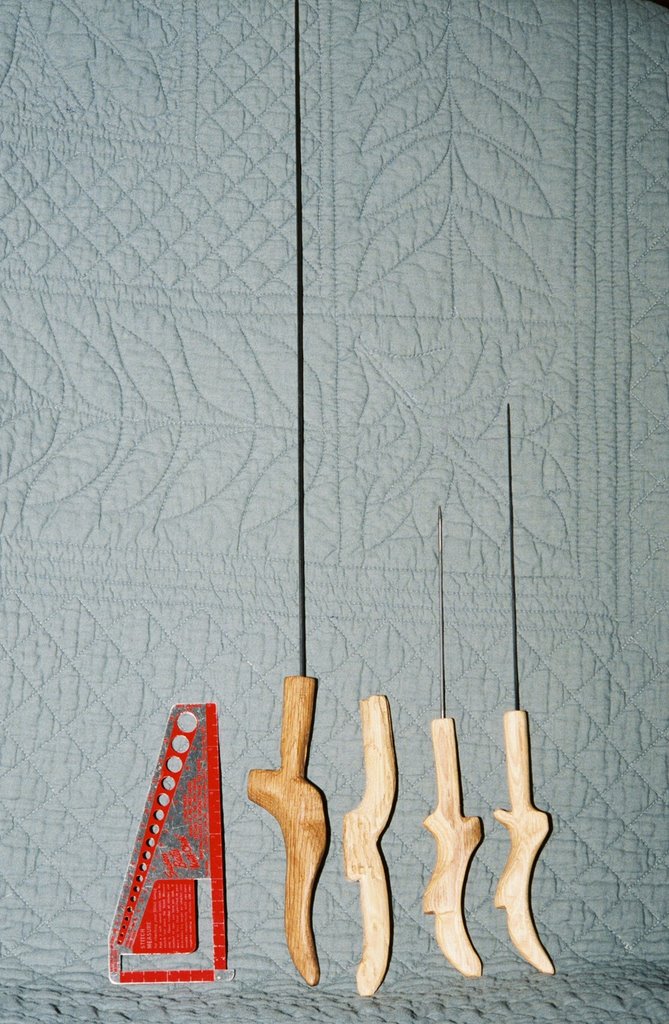
The photo at right is a closeup of the tips of 8 of the needles from above. The top needle a 2.5 mm Addi steel, # 2 is the 2.5 mm Inox used in the gansey needle knitting video, # 3 is a 2mm Susan Bates (the first needles that I bought when I started knitting, and the most hated needle I have ever owned). #4 is a 2mm Boye Aluminium. Needles #5-8 are my handmade 2.3 mm carbon steel. From this is clear that the Inox (http://www.shetland-wool-brokers.zetnet.co.uk/accs.htm) are more finely pointed than the Addis or the Boye.
However, what I like about steel needles is that I can change them to suit my needs, NOW! If I do not like the way they feel, I get up, take them over to the bench grinder, and grind the tip that I want on them! Evolution in action. It is clear that needles numbers 5 and 8 have been used for knitting 5-ply gansey yarn, while 6 and 7 have been used for MacAusland yarns. #7 was used for the oiled yarn and #6 was used for the washed yarn. I think these needle tip shapes are about right for the kind of knitting and the yarns that I use. If I had wanted finer points on these needles, I would have ground finer points on them. Somewhere I have needles with more rounded tips, but all the splitty yarn is put away and the ball tipped needles with it.

Over all, I think the 2.5 mm Inox needle is actually a good compromise, and a good general purpose needle tip shape. One has to be just a little careful about how sharp the tips of a 16" long DPN are, or you will seriously damage the furniture and your thighs. If you go with anything sharper, I suggest a leather knitting apron, e.g.,(http://store.weldingdepot.com/cgi/weldingdepot/4421xx.html?id=soRVWHTx ) I have one, and I use it!

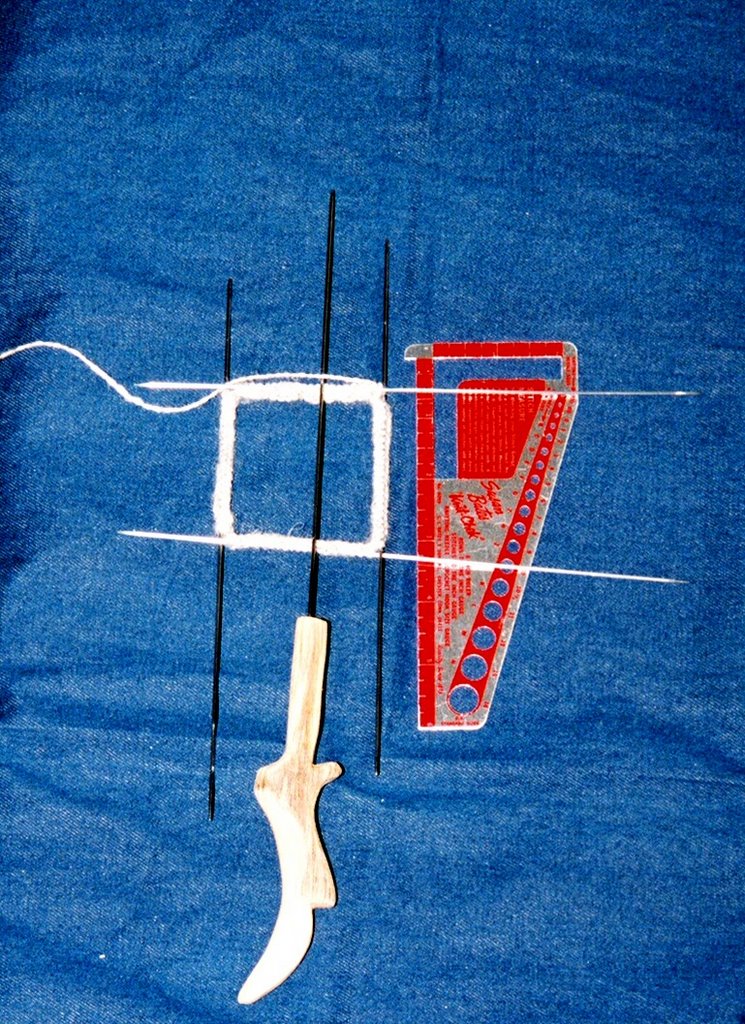
OK, but how big a needle? I really do not care. I knit a swatch, and if I like the fabric, I knit an object. I like the Susan Bates "knit-check" as a photo prop, but not for not as a needle gauge. I work with a limited number of yarn types, and after a while I know what yarns I like to knit with which needles. If I need to know how big this needle is, I go to the shop and "mic" it.

Tuesday, April 01, 2008

Sit up straight!

I have a friend who is a spinner. She was tall, graceful, and athletic. Then, she bought a spinning wheel that causes her to hunch over it. Now, a month later, she is in the kind of pain that causes people to wince as they move.

I kind of laughed and chided her, then the other night, I was working with some thin blue yarn in a dimly lit room, and I hunched over toward the light. (My wife was watching a very good movie.) Now, I am in the kind of pain that causes people to wince as they move. It is not bad during the day, but for the first few minutes in the morning, I wince as I move.

It is just a sore muscle from not sitting up straight for a few hours. Proper exercise, stretching, and it will go away in a few days. Still it is embarrassing.

Tuesday, March 25, 2008

Wassit? Wassit? No clew on the Internet!

Some have been surprised not to find how to use a clew on the Internet.

They would not find much on wassit either. Wassit was the inexpensive, tightly spun, indigo dyed, knitting yarn that was ubiquitous on the shores of the English Channel 500 years ago. It was used for knitting everything from underwear and socks to ganseys for the fishermen. Why doesn’t something that important show up on the Internet?

A clew is simply a hook, hung from the belt, on which a ball of yarn is impaled. Many designs work. I simply bent a spiral of wire so that it clipped on to a leather work belt and held a wire claw (from the same root) upwards to hold my yarn.

Very likely some of the hooks on the lower end of knitting sheaths, that museum curators tell me were to hold the knitting, were actually clews to hold yarn. (Since the museums did not have needles for those sheaths, it is unlikely that the curators had actually tried knitting with such an arrangement.) However, as you knit round and round, hooks attached to the knitting get all tangled up. However, used as clews, the hooks hanging from the bottom of the knitting sheath work just fine. And, even when I am working on the second sleeve, I have not had a problem with the gansey touching the floor. So, I see no need or advantage from a hook to hold the knitting.

Clews work with either center-pull or outside in balls. Every so often you will have to reset the ball, and for center pull balls, rewind them, but it is knitting, not rocket science. They are useful if you are camping or knitting while walking or if your hut has a mud floor.

Friday, March 21, 2008

Get a clew!

Over on Ravelry, there is a discussion on centerpull vs. using yarn from the outside-in. The outside-in school talks about yarn barf and ball collapse resulting in tangle, while the center pull school talks up the virtues of the ball not rolling around.

I think it is a matter of yarn twist. Commercial balls of yarn have the correct twist when pulled from the center, regardless of yarn barf or final collapse and tangle issues. If you are winding your own balls, you should preserve the twist in the yarn. When you wind the ball, you should have a plan for whether you are going to use the ball from the inside or the outside. I always wind center pull.

Then, I suggest getting a clew to hold your yarn. I made mine out of a bit of steel wire. It holds either center pull or outside in balls of yarn at your waist, clean, handy, and out of (most) pets way. I think it is better than a pickel jar or even a ziplok bag with its corner cut off.

I can stand, or walk about while kntting. I can move away from my knitting bag without leaving a trail of yarn behind me. Sure I sometimes wind small balls and keep them in a cargo pocket, but the lets me pull a full sized ball right out of the stash and knit on the run.

Wednesday, March 19, 2008

Needle Case for Steel Needles - Advanced Technology


The flexible plastic risers used for irragation systems make good needle cases for steel needles as they are ligher and can be screwed together to accomodate any length of needls. Again the screw caps are protected with wads of waste yarn.

Monday, March 17, 2008

Come-on! Knit like a Man!

Some gansey yarn came in the other day, and I realized that I wanted to knit ganseys in public (KIP). I have long knitted socks and other small stuff in public, but gansey needles were akward to carry, so I did not take them out in public.

Now, I have knitting bag that lets me easily carry gansey projects:

It is a Craftman 20" tool bag - from the hardware store.

Then, I had to revist needle cases. I made a bunch of cloth needle rolls and needle bags for the last trip back East, but after living with them on the road for 3 weeks, I hated them.

The new program is a mix of bamboo cases (which are light) and sections of plastic pipe with screw caps (which are stong) and wads of waste yarn in the ends to protect the needles.


The gansey needle case very functional. It is two pieces of bamboo, smoothed and slotted, held to gether with a cord. Thus, it can protect the needles (and protect other things from the needles) even with knitting on the needles. The 12" steel needles are in a bamboo case made from a large piece of bamboo and a small piece of bamboo that is slotted to fit into the larger bamboo tube. I strengthen the ends of the bamboo with a bit of epoxy and stuff wads of waste yarn in for extra protection for needle points. Also note that less than fully dry bamboo WILL rust steel needles. DRY IT, Dry It, dry it.

Plastic pipe with screw-on caps protects more delicate needles. Again, the ends are stuffed with waste yarn.

As you can see, I have started a new gansey. My old Cornish Fish is just not up to the stress of a new gansey (even with its new dentures). Thus, this morning, I made another Cornish Fish. It took less than 45 minutes from start to finish. I took a piece of fire wood and split it into a blank. Then, I used a hand saw to cut it to lenth. I used an electric drill to drill a 3/32 hole in one end. I used my hand saw to cut the slot in the other end. Then I used my pocket knife to smooth it and carve the funnel at the needle hole that makes it easy to stick the needle in. I sanded it by hand and smeared some bee's wax finish on it. It is not beautiful. It is not a love token that I have lavished hundreds of hours on. A wood worker with power tools could have made it in 5 minutes. I might have finished it faster if the plums overhead had not been blooming so sweetly. It is a very practical knitting tool that will last for no more than 500 hours of knitting with gansey needles. It does feel good in the hand, and it feels good in the belt. It does not have any sharp edges.


It is about 6" long. Early-on, I had read that such small knitting sheaths must be for children. That was clearly written by somebody that had never made and used their own knitting sheaths. This size works very, very well. I think I will name it, "Albrecht," after the dwarf that forged the Ring from the Rhine gold.

Wednesday, March 12, 2008

A sock kit


Here is a photo of a pretty good sock kit that sat in the bottom of my sock project shoe boxes last fall. It is light, and does not take up as much space as gansy needles.

Sunday, March 09, 2008

Using gansey needles for socks, mittens and sleeves

Here is an advanced technique for knitting sleeves, socks, mittens, and mobius cowels fast and tight. Is this how it really was done? Maybe not, but not many needles have survived and we do not know. This works, it is reasonable, fast, and -- well it takes some pratice, but it is worth it if you are knitting outdoor wear. This file is some 55 megabytes.

By the way, use steel sock needles. Wood needles do not like this technique.
Here is a close up of the finger motion. Note it is very similar to that of the standard gansey technique, but it requires a bit of finess so you do not pull the sock needle out of the socket.

When I get back out to California, I will reshoot all these segments (and few more), put them on a DVD and make the DVDs available.
A Natural Born Knitter with keen eyes has noted that the tips of the commercial steel needles were different. They are. I broke their polish by rubbing them with crocus cloth to make them a bit less slippery.
Some Knitting sheath will work with just about any double pointed knitting. Typically I use longer knitting sheaths with sock needles. Sheaths for gansey needles need to be stronger and made from harder materials than knitting sheaths for wooden, bone, or bamboo. The knitting sheath must fit the intended needles and suit the intended technique.

Edited in Jan 2013 to add, this was a work around.  Today, I swave such items using bent needles. Swaving is faster and easier.  Today, I am sure most gloves,  mittens and socks in the old days were swaved.  This is one case where I wondered down the wrong path.  It worked better than the hand knitting that I was taught, but there are better ways to produce such fabric and objects.

Saturday, March 08, 2008

The Wrong Way to "De-pill" a Sweater

The orchard was pruned. Mom wanted ALL the clippings burned NOW. So, I did. However, twigs, even green twigs burn very hot. At the end of the day, I noticed that the flames had burned the pills and fuzz off of the sleeves of my gardening gansey. The wool protected my arms, and I never even noticed.

However, if I had been wearing a synthetic, my arms would have been toast.


I like wool.

Thursday, March 06, 2008

Video of Gansey Needles with Knitting Sheath

Gansey needles are a very powerful if somewhat specialized knitting tool. However, gansey needles are the tool to knit a gansey without ruining your wrists.

Again, this is just a first try at a video clip. I will do this again and again until I get it right.


Again, my hands are all beat up from pruning all morning. Sorry no pretty models.

Here is a shorter clip showing finger and needle movements.

Video clip of A Better Way to Knit

Here at long last is my first VIDEO of knitting using a traditional knitting sheath with thin steel needles. It is a first cut, this is after all, a research journal. This is 85 megabyte, even at such low resolution.


A better view of the finger action is in the following clip:

Note that this was filmed during prunning season and the my hands are beat up from being out in the orchard.

This basic technique can be used for anything from socks, mittens, hats, and baby clothes to ganseys, rugs, and circus tents. It can be used for knitting in the round or back and forth. You can use more needles to knit larger items. This technique is appropriate for fine lace. and, I like a knitting sheath better than a knitting pouch/belt for Fair Isle.

Wednesday, March 05, 2008

Mamie Diggs Socks


Mamie Diggs is a historian in Williamsport, PA (where I have
been for the last few days.) I was sitting outside her classroom finishing a pair of new boot socks for myself. (My wife acquired the first pair of socks that I knit for myself in this pattern.) The first 3 socks of this pattern that I knit required only one skein each, however, the fourth one required a bit more, so I finished it with a bit of dark gray yarn of the same type that I had in my bag. So, this pair is mismatched from the start! I had just finished weaving in the loose ends when Mamie came out and started admiring the socks.

Mamie had learned knitting as a girl, but had been too much of a “tomboy,” to do much kitting. However, she did tell me about some of the knitting traditions she saw as a girl. Her Grandmother’s favored knitting needles were made of deer antler. They were quite long and were used with a knitting sheath. (Thus, apparently there was a tradition in Williamsport of using knitting sheaths as late as ~1900. ) She also told me of using a “circular needle” made of a single piece of cherry wood for knitting Afghans and bedspreads. With these wood circular needles, as the knitting progressed, the knitter would have two young girls hold and support the needle to prevent it from breaking under the weight of the knitting. I am working with the local historical society to find examples of these knitting tools.

Anyway to make a long story short, Mamie admired the socks to much that I just gave them to her. Thus, the second pair of these boot socks that I have made, that have become “house socks.” Mamie does not walk much anymore, so these socks should last her forever. Did you ever see someone smile so much just because you gave them a pair of socks?
I have ordered more yarn, and someday I will have a pair of socks in this pattern for myself.

Edited to note the Dr. Diggs died this last March, and is much missed.

Monday, February 25, 2008

Video clip of A Better Way to Knit

At long last! Video of using a knitting sheath! It is not Star Wars quality, but this is my first try at VIDEO.

Without any more fuss:


I whittled this knitting sheath with a chip knife, just as a sailor of old might have. The “z” twist rope pattern provides excellent support, and is one of my favorites. The needles, I made from steel rod from the local hardware store. A set of such needles can be made in a few minutes with the tools that most home owners would have in their workshops for a materials and supplies a cost of a couple of dollars per set. Very good needles are also available from J&S (http://www.shetland-wool-brokers.zetnet.co.uk/accs.htm) at a reasonable cost. (No connection)

Note also, the Fair Isle heel. Using a knitting sheath also makes knitting Fair Isle easy, but that video is for another day.

Tuesday, February 12, 2008

Sheep and Goats in the Backcountry


A couple of mountain goatthat I photographed in Montana a while back.
I "used-up" some commercial wool socks on that trip.
Hand knit socks are better.

Good Socks

I like pretty girls. I like pretty socks on a pretty girl. However, I also like to hike, ski, garden, and spend time out of doors. For that, I like socks that are comfortable. There are times when I want socks that will stand up to a good long walk (days). I like to take my pretty wife with me on those walks, and I tell you she is not as pretty if her feet hurt.
My wife and a Sherpa friend on a summit in Nepal at dawn. (You cannot tell how cold it was that morning. The other Sherpa were huddling, shivering, and cropped out of the photo.)

I see a lot of knitters selecting soft, and softer yarns to knit into socks. That is fine if all you want to do is sit around and look pretty. However, if they actually go walking in those socks, those soft luxuary yarns disintegrate into lint and holes. There is a certain functional beauty to a hiking sock (or ski sock) that keeps your feet comfortable so that you can think about the birds and the bees rather thinking about your feet and blisters.

As a boy, I was trained to wear two pair of socks in my boots. By the 1990s, I had settled on a polypropylene liner and a wool-pile boot sock. The sales clerks at the mountain sport shops assured me that was state of the art, but I was never happy with that combination. In the year 2000, I started knitting. Boot socks were an obvious early project. I tried the Briggs and Little yarns. I tried Lopi with more success. The results were good, but not perfect. For example, my wife told me some of the Lopi socks were too scratchy. All in all, last fall, I found myself short of boot socks and determined to knit myself some really good ones. First, how thick? With good wool socks, does one need a liner sock? Results from some of the Lopi yarns convinced me that a good, hand knit wool sock did not need a liner or an outer sock. One good sock was all that was needed. I swatched a bunch of yarns. I Knit one sock of one yarn and another sock of another yarn, put them on and walked up mud ridge and back (15 miles). Then, I looked at the condition of my feet, and the condition of the socks. The soft yarns fell apart. That resulted in blisters. Many of the sock yarns with nylon in them were not much better.

What I ended up liking was MacAusland's 2-ply med yarn for winter socks and 2 ply fine for spring and fall socks. MacAusland's Woolen Mill on Price Edward Island (http://www.peisland.com/wool/ ) is a funky old mill with equipment still powered by leather belts running across the ceiling. The yarn is sold in skeins and it retains a stinky spinning oil. I discovered it by talking to a hooked rug maker on Cape Breton Island. (Yes, she uses it as "rug wool"!) I made a detour to find MacAusland's. It was worth the effort. If you buy from the mill or mail order, you will need to wash the yarn before you knit with it. It is worth the effort. The yarn is not expensive, and for some things, it is the best yarn that I have knit. It comes from real sheep, and it has real veggy matter in it. It is still worth the effort. I have no association with MacAusland.

I ended up developing two patterns, both based on the Dad's Function over Form socks at http://knitting.about.com/library/ndadsocks.htm; except that to get them as tight as I wanted them, I knit them on I had to use #3 steel needles - with sharp points for the med yarn and #1 needles for the fine. The gussets were picked up and the first 2 rows of gusset stitches were knit on # 1 steel needles. I hate holes in my gussets.

Here is what I think good boot socks should look like, tried, washed, and dried. The clerks at the mountain sports shops do not have really good boot socks to sell. I know they like to hike, and I know their feet will not be as comfortable as mine.
The natural color yarn is somewhat softer than the dyed yarns. The yarn gains softness when it is well washed and rinsed in a conditioner. The fabric is firm, but not unpleasantly so. Knitting large and felting down always produced fabric that was too stiff for my comfort. The hiking and gardening sock has a Fair Isle heel to protect my heel from the stiff counter in my hiking and gardening boots and ribbing to the toe for extra ventilation. The ski sock does not have the ribbing for firmer control. I will post a pattern on ravelry real soon now.

Below is the tool set used to produce these socks.
This Flemish style knitting sheath was worn at my right elbow, tucked into a heavy leather belt. The z twist of the pattern, provides extra stability for firm knitting. Yes, z twist is better than s twist in this case. It is not possible to knit this tight without a knitting sheath. And, the firmness of the knitting really improves the quality of the socks. After this project, I have greater respect for this little tool kit.
The red stitch marker was cut from a plastic straw.


My wife in her new hiking socks this afternoon. She liked them so much that she aquired the hiking socks that I had just knit for myself. Oh well! There is more yarn where that came from!

(I have no relationship with MacAusland's, except that I bought some of their yarn.)


Sunday, February 10, 2008

More basics

This is the mouth of my poor old Cornish fish (a knitting sheath that is strong enough to support long steel needles). It had worn until it was oval, and been re-enforced with different glues and epoxy. This morning it got a brass insert. We will see if that helps.


When I started learning about knitting sheaths, I was told that I would need curved gansey needles, which were no longer available. In fact the straight needles gansey needles work just best, but they aquire a curve as they are used over a period of hundreds of hours. Then, I pound them straight again and go back to my knitting. Curved needles were used with knitting sheaths for knitting miniatures, but that is an altogether different technique.

If you see a knitting sheath with brass insert (or a metal knitting sheath or knitting heart) then I know from sad past experience that it was used with metal needles. A knitting sheath with a metal mouth destroys wooden knitting needles.


One can knit socks without a knitting sheath. I could even knit hats, hoods, and scarves without my Goose Wing knitting sheath. I would knit slower, and there would be more stress on the hands and wrists, but I could do it. (Actually, I can make another knitting sheath in an hour with just my pocket knife and a candle.)

Real ganseys are another matter. Real. wind -proof ganseys (sailor's frocks) are another matter altogether. I cannot knit that tight, long enough to finish a gansey without a knitting sheath. Here I am testing the new "brass dentures" of my Cornish Fish, using 18" long US #1 double pointed steel gansey needles. The fish is tucked into my pants waist band over my right hip and the working needle is flexed forward under my right arm.


This is just back and forth swatching rather than real "in the round" knitting.

I am still amazed at how a knitting sheath tames these long needles. Such long needles are unmanageable without a knitting sheath. These gansey needles are even too long to use with a knitting pouch.

However, once you understand the technique, they make knitting a gansey ever so much easier and faster.


Another view showing how the yarn is held in my right hand. It is possible to knit "continental" style using a knitting sheath. Knitting continental style, one can knit even faster, but the fabric is significantly looser, and purling is more difficult.
Since my focus is on warm fabrics, I like to knit tightly, and I like stitches that add texture. Therefore, I usually hold the yarn in my right hand. Still, I knit fairly fast, and I can knit for exteded periods of time without much stress on my hands and wrists.

Back to basics

Here, I am knitting a sock with sock needles and a nice little knitting sheath made out of a Brittany Birch crochet hook.

This little system is light, inexpensive, and is the fast way to knit socks. The knitting sheath allows Me to knit faster than I can knit without it. For Fair Isle and standed knitting I can knit a whole lot faster. Your results may vary.


This is another view of the the knitting sheath shown above. I refer to this style of knitting sheath as "Flemish".


This is a classic "goose wing" shaped knitting sheath that I made from piece of oak. This style was common in Yorkshire. For scale it is shown with 10" long, #3 needles.


This it the goose wing knitting sheath in use. Note the differece in position between this the "Flemish" design in use with the sock needles above. Some Flemish designes work very in this position. Some do not. The most beautiful knitting sheath that I ever carved is Flemish style. It works well with sock needles, but falls out when I try to tuck it at my side in this position. It is just too polished. I was trying too hard to to avoid the "old wooden spoon" look.


Here is a "Cornish fish" style of knitting sheath. This one is carved of California Black Walnut, and is one of the best knitting sheaths I have ever produced. Unfortunatly, it is about worn out and will be tossed in the fire soon.

It is as ugly as an old wooden spoon, but it has served me well.

Saturday, February 09, 2008

Funky


For hundreds of years, most knitters made their own knitting sheaths. Many must have been "funky.” Certainly, we have examples of sailors scrimshaw and sailor carved knitting sheaths that were real art. These became sentimental keepsakes. However, knitting sheaths as tools wore out in a couple of thousand hours, the knitter made themselves another and they tossed the old one into the fire.

Knitting sheaths were tools that wore out. They carved themselves a knitting sheath that was the right size and shape, and had a nice feel, but it was just a tool that would be tossed in the fire in 6 months.

As I started making knitting sheaths, I was looking for, “What would work?” “What was the right size?” I make a bunch of rather “funky” knitting sheaths. Many did not work very well. Some of them worked. Some of them worked very well. One of the very best is in the photo.

It was on the kitchen table this morning. My wife said, “That looks funky!” Nobody would want it. She did admit that it had a lovely feel to it in the hand.

It was carved from California Black Walnut, and it does have a nice feel to it. It feels good in the hand, it feels good in the belt, and it works very well. It is not pretty, but it works very well and it is a pleasure to use. It only cost me a few minutes whittling to make, and when it wears out, I will toss it in the fire. It is not a pretty keepsake, but it is a good functional tool.

Tuesday, January 22, 2008

Knitting Pouches


Toward the end of last year, I purchased a knitting pouch from Jamieson & Smith Shetland Wool Brokers Ltd (http://www.shetland-wool-brokers.zetnet.co.uk/accs.htm). It is now part of my regular knitting stash and I use it regularly.

Why? Because it is my new toy. I tried it with short sock needles. A knitting pouch actually increases the knitting effort with short needles. If you are going to use a knitting pouch, use 30 or 40 cm long DPN. Short needles and a knitting sheaths that supports the needles up into an ergonomic work zone are better for socks, mittens, and gloves.

Where the pouch really stands out is for Fair Isle and Scandinavian stranding on hats and children’s clothes done on rather long DPN in the US # 2 ->3 range (2.5- 3.5 mm) For this kind of knitting, a pouch provides good support and control. Until you have tried it, you would not believe how easy a knitting pouch makes two color knitting. Holding a yarn in each hand turns out not to be so hard when you have the right tools.

I have a gansey for my wife out of Cool Wool 2000 on 10 “, #3 Brittany DPN. That really should be the perfect use for the knitting pouch. I have not decided if I like the pouch for that knitting yet or not.

Monday, March 26, 2007

Real Ganseys are Real Warm

This project of knitting a gansey was started because I wondered how did the fishermen of old, stay warm? The hand knit "fisherman's sweaters" that I knew, simply were not warm enough to keep a fisherman warm on an extended fishing trip.

Thus, I have knit a traditional fisherman's gansey. Is it warm enought to keep a fisherman warm on an extended fishing trip? That would presume extended exposure to temperatures in the 30F to 50F range with winds of greater than 15 mph. I live in California, so skiing would a beginnning test. The air temperature was about right, and I could ski fast to simulate wind.


I wore my "Cornish gansey" for two days of skiing at Sierria Tahoe and Kirkwood. The air temperature was 30F to 50F, the slopes were not crowded, so we were able to ski fast to generate real, sustained wind effects.

The results were very surprising. The garment is perhaps the single best ski garment that I have ever worn. It was warm enough to keep me warm during fast runs early in the morning or in the afternoon shade. It was warm enough that I could wear it while skiing in shorts, while my companions were wearing long ski pants, long underwear, and ski parkas. On the other hand, it was cool enought that I could wear it on the sun deck or indoors. (With jeans, it is comfortable up to about 62F.) Thus, I was first in the beer line as my companions took off their ski gear, and I was first in the lift line as my companions geared up. I can imagine the virtues of sleeping in such a garment when all hands are called on deck to shorten sail.

Since this was a test, I wore the gansey with a variety of other garments including at least two different under garmnents. You can just see the blue collar of a shirt that I wear when running in cold weather sticking up from under the gansey in the picture where I am wearing shorts. However, the gansey proved to be more versital worn by itself, as shown in the picture where I am wearing the black ski pants.

This gansey has loose cuffs and collar. I fully expected that in the event of a fall, snow would get under the gansey. This did not happen. In fact, I took a good fall on the ice on upper
Zachary and expeced to slide all the way down to Home Run, but did not as a result of the greater friction between wool and ice as compared to the friction between nylon and ice. In any case, we skiied pretty much all of the double black dimond runs at Kirkwood, and there was no problem with snow getting into the gansey. The open slope above and behind me as I am seated is the "Wall" and a good example of what we skiied that day. >>Yes, we started above the cornice.

This was the first time that I had ever been perfectly, comfortably, warm skiing in a hand knit sweater. The great downside to this gansey is that it has no pockets. This convinces me that the purpose of the elaborate fishermen's sweaters was to keep the fishermen warm. The decorative stitch patterns provide additional warmth. The tight knitting provided wind proofing and warmth. The loose cuffs and collar provide ventilation as required.

This summer, this gansey will get a real test off the coast of Novia Scotia. I have no fear about it passing test.

This gansey was knit from Lion Brand fisherman's wool on 2.25 mm gansey needles yielding more than 8 stitches per inch. The stitch patten is Lizard Lattice. It was knit in round up to the armholes, then the front and back were knit separately and joined at the shoulder. The neck stitches were picked up and neck knit, then the shoulder stitches were picked up and each sleeve knit.

This is very different paradigm of constructing a warm garment.

Bottom line, if you want warm, knit tight.

Post Script
The success of the first test inspired a second test. A while back, I knit a fishing sweater for myself, so when a cold rain storm came through the area yesterday, I spent an hour walking around in the rain in that sweater. I was warm and toasty, and I stayed dry. Then, I put on a favorite, commercial "fisherman's" sweater that my wife had bought for me in New Brunswick, and which I had used as a standard of knitting excellence for several years. in the New Brunswick sweater, I started out into the rain again. I could feel every drop against my skin, I was wet in minutes. I was cold in 15 minutes. I put the sweater that I knit back on, and in minutes I was warm and dry again. Both sweaters had been washed in the same wool wash with lanolin in it, so they were similarly oiled. Both are knit at 5 spi. What is the difference? The yarn I used was about 25% heavier, thus was more tightly knit. However, because of shorter sleeves and less ease, the sweater I knit weighs 600 g compared to the 800 grams that the commercial sweater weighs. Thus, a lighter, but tighter knit sweater is much warmer.

Wednesday, March 07, 2007

Cornish Fisherman's Gansey

New years Day, I cast on for a Cornish Fisherman's Gansey as described by Mary Wright in book. This gansey was pattern was selected because swatch testing indicated that the "Lizard Lattice" was the warmest stitch pattern, and it was a common stitch pattern for contract knit fishermen's ganseys.

My Cornish Gansey was finished last week. It is shown here modeled by my climbing buddy, Bob Williams.

Of course, it was filthy after some 130 hours of knitting and frogging. It was knit on steel needles. Half way through, I gave the needles I was working with away, and the replacement needles that I pulled out of the stash had to be polished. I guess I did not get those needles real clean after polishing, and that contributed to the filth on the sweater. Anyway it needed a full wash before blocking.


The gansey is quantitatively different from any other garment that I have ever worn. It is a very clever design. It is comfortable in a temperature range between 40 F and 60F. At higher temperatures, or when I am more active it automatically vents and remains comfortable. It is basically windproof up to about 20 knots. At 990 g it is twice as heavy as most of my medium weight synthetic technical pull overs and in the weight class of my heavier multilayer garments which run about 770 g. I have scheduled a head to head test in the snow.
The body of the gansey was knit using traditional steel gansey needles. These needles are 18 inches long and are 2.3 mm in diameter (US size 1). Five needles are used in the knitting. Below is a photograph of me knitting 16 inch needles, showing how the held and flexed during use. with longer needles, the knitting sheath is slid a couple of inches back on the belt.


Wednesday, July 12, 2006

Knitting sheaths

The gansey in Fisherman's Wool is at some 40,000 stitches. Considering that a typical fisherman's sweater knit with worsted weight at 4.5 spi is only 25,000 stitches, mine is getting along. Considering that this garment will have more than 150,000 stitches in it when it is finished, I've got a ways to go.

But, I am going up the leaning curve on knitting sticks. I have made a dozen prototypes so far, some of which are quite effective. That is what this note is about.

I saw pictures of continental style knitting sheaths or sticks, so that is what I started making. I did not like them.

Then I saw http://www.daelnet.co.uk/features/knitting/ksticks.htm and I started working along those lines. I find these shapes more comfortable and more effective. Here are two views of four knitting sheaths that I have made along these lines. The light colored wood is hickory, and the darker wood is red oak. The oak is more of the classic shape. That classic shape is really a good design. With an over all length of 6 3/4 inches, it has enough leverage to stabilized long gansey needles, but it fits comfortably under your belt, and does not poke holes in your easy chair. Turned upside down, it tucks nicely into apron strings.


These are two views of the same needles. The needls are polished steel and their dark color is artifact of the camera flash. Note that 3 of the sheaths have "notches" that catch on a belt loop on my jeans which gives the knitting sheath extra stability without additional length or bulk. The extra stability is useful with long, heavy (2mm) needles, but is really not needed with 1.5 mm and smaller needles.


This is another photo of one of the knitting sheaths shown above with 5 - 11 inch 1.5 mm steel needles. The 2 horizontal needles show their true polished steel color. The yarn in this photo is Bartlett's sport and the guage comes to about 10 spi, which you will find to be warmer than worsted weight yarn knit at 4.5 spi.

So, what does 40 K stitches look like? Here is a shot of my favorite knitting sheath with the gansey in progress.

Wednesday, February 08, 2006

A Yarn Snob Recants

Sometimes a wonderful yarn is right under your nose, it is just mislabeled. In the past, I had tried Lion Brand “Fisherman’s Wool.” And, I did not like it at all. The yarn band recommended big needles, i.e., US # 9. When Lion Fisherman’s Wool was on sale, I would buy some, and start something using the recommended # 9s, and I was never happy with the product. For example, I have one knee sock that I knitted from this yarn in a fancy Scottish pattern on # 6 needles, and despite the fancy pattern, it looks - Well, home made. I could never bring myself to knit its mate.

But the other day I was looking for a portable project, and I hit upon taking little balls of left over yarn from my stash and knitting the same little pattern swatch on US # 1 needles from each of the different yarns. You guessed it! One of the balls of yarn was left over Lion Brand Fisherman’s Wool.

I got back, and had a bunch of 3-inch square swatches in my bag. After blocking, the swatch that I liked best was from the Lion Fisherman’s Wool. Knit continental style, at 7.4 spi (over moss stitch), it is a firm, flat fabric with excellent stitch definition. With a knitting stick, I can easily knit it at 8 spi and the effect is even better. Forget the fancy wool I bought in Scotland last year, my next gansey is going to use Lion Brand Fisherman’s Wool. I am very excited! Because it is a firm fabric, a gansey knit from this yarn will require real attention to tailoring. It requires knitting a garment that fits and is carefully blocked. And, it is a warm fabric – maybe too warm to wear in modern centrally heated buildings. But, it is a glorious fabric. Unfortunately, it only comes in the natural cream color, but it is less itchy that the wonderfully colored Cottage Craft yarn that I love. So get ready to dye. (I have no connection to either company.)

One funny thing is that Lion sells a wide variety of knitting stuff including needles, but the finest needles that they now sell is #2. Go figure.

Thursday, February 02, 2006

Experience revised, and methods compared!

Surprise surprise!

This gansey is a mess. 10,000 stitches knitted on 4 different systems: Old circular (#1), new circular (#1), continental and English with knitting stick on US # 1 tight and US # 0 loose, so there are some variations in tension. What a weaver would call, "Lazy Lines." But, the average is about 7spi with a yarn weight of 1,100 yd/lb.

With the circular needles and continental knitting method, the effort to push the stitches around the needle was substantial. I never had this problem before when knitting looser fabric with GOOD circ. needles. Perhaps I would have done better to have knitted more loosely with #0 needles, but that would have taken more effort just to form such small stitches with this thick yarn. As it was, the effort to consistently form tight stitches was substantial. Nevertheless, circular needles/ continental method were the clear winner for travel and safety.

With the DPN, knitting stick, and yarn controlled with right index finder; the effort to move the stitches on the needles is much less, and the effort to maintain consistently tight stitches is less, while the actual speed of stitch formation is similar or better than continental method. I have some trouble with the first 10 stitches on a needle, so I just knit the first 10 stitches on each DPN in continental style before putting the needle in the knitting stick and switching the yarn to my left hand. All things considered, the time to move the yarn back and forth between my right and left hands is much less than the time to move stitches around the circ. needles. Over all, I am getting more knitting done with less effort. This fast and easy production is offset by the real issues of long sharp steel DPN.

Some old texts say that it is important to keep the tips of the knitting needles smooth and polished to avoid fraying the yarn. SHEEP POOP! It is important to keep the needle tips smooth to protect your fingers. I was in a hurry to test some new needle designs and did not polish the reground tips carefully. I ended up ripping my right index finger tip to bloody shreds!

While this gansey is clearly a beginner's practice piece, I am beginning to really see the potential of what I am calling high definition knitting. I think it is worth the effort.