See :
 http://upload.wikimedia.org/wikipedia/commons/e/e9/Century_Mag_-_The_spinner_-_Millet.png
Note that there is no treadle, but the drive wheel is driven by a crank in the right hand. Note that the date on this painting is 1894 - long after mill spun had put professional spinners out of business.
Compare the above wheel to:
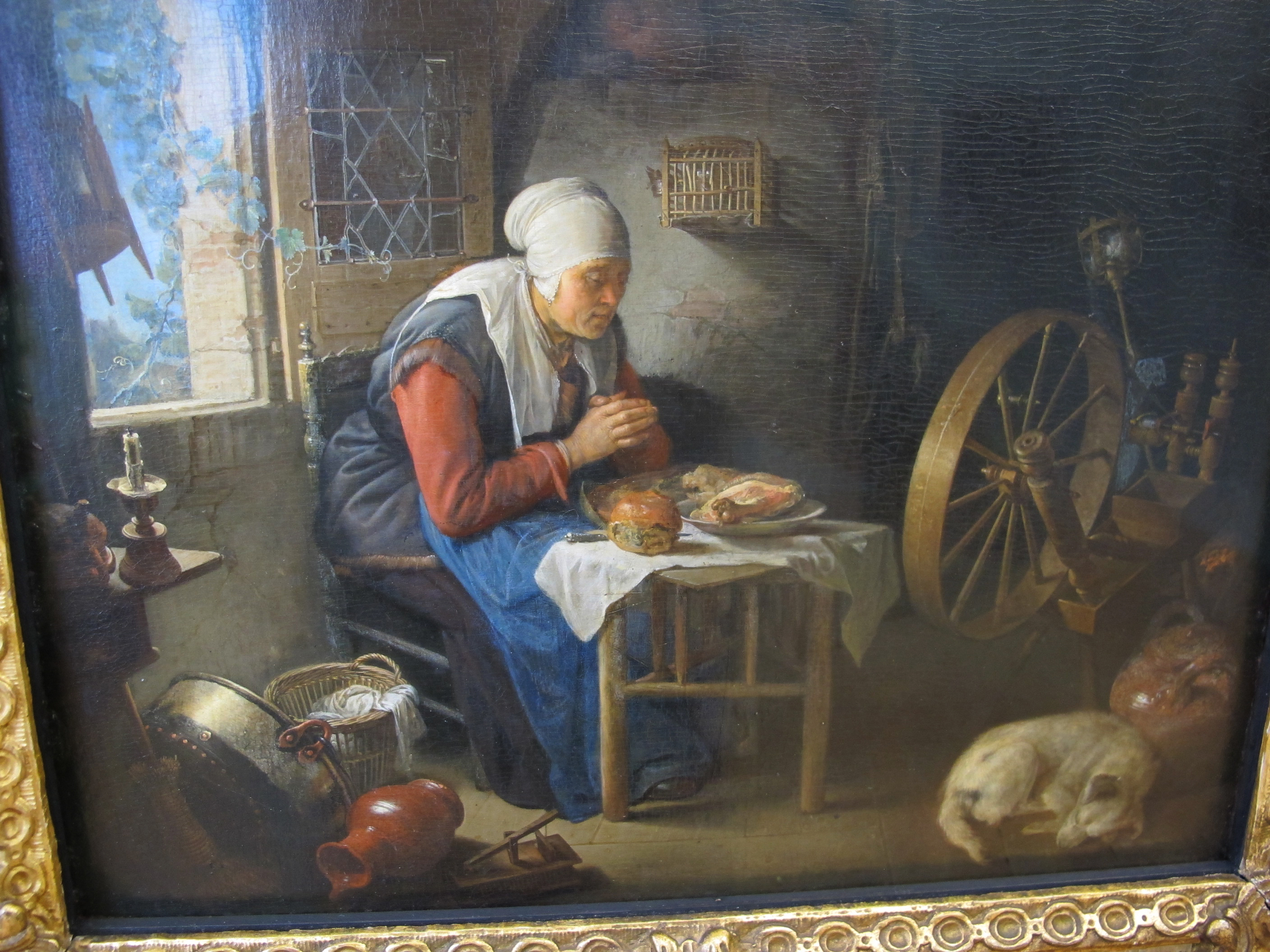 http://uploads6.wikiart.org/images/gerrit-dou/the-prayer-of-the-spinner.jpg
Note that the date on this painting is the second half of 17th century. If you look carefully you can see the crank on spinning wheel just like that in the Millet painting. Thus, we have two paintings separated by 230+ years that show the same spinning technology even when it is clear that professional spinners had dramatically changed their technology from hand spinning to spinning frames. From the sequence of paintings we have no confidence that the design of the wheel in Dou's painting is not 250 years old and thus, the design of the wheel in Millet's painting some 500 years old. In fact, we do know that foot treadle wheels were available in Flanders in the mid 1500s, and thus Dou's wheel is at least a hundred years out of date.
Either wheel would be an almost exact miniaturization of room sized silk throwing equipment in use in Italy at the end of the 13th century. And, either wheel would be somewhat faster than a drop spindle for spinning worsted warp.
Let us allow 7 yards of fabric for all of Dou's spinner's clothing, a yard for the cloth on the table and 2 yards for the cloth in the basket, for a total of 10 yd^2 of rather coarse cloth woven from ~5,600 ypp singles. That comes to about 800 hours of spinning with that wheel. Then, we have what appears to be a few yards of a much finer blue cloth in her lap. Let's assume that it is a couple of yards of shirting weight. That is another 800 hours to spin the required yarn with the visible wheel. Thus, the yarn for the cloth in the picture would require almost a year to spin with the spinning wheel depicted. Add in weaving, and the cloth depicted represents more than a year's work with the technology of that wheel.
We can assume that most (all?) of the yarn for the cloth depicted in the Dou's painting was woven from yarn spun else where by others - using different equipment. Given the cloth depicted, we can deduce that the spinning wheel is a prop, just like the spinning wheel as a prop in the Millet painting above and the photo below:

Note that there is no treadle, but the drive wheel is driven by a crank in the right hand. Note that the date on this painting is 1894 - long after mill spun had put professional spinners out of business.
Compare the above wheel to:
Note that the date on this painting is the second half of 17th century. If you look carefully you can see the crank on spinning wheel just like that in the Millet painting. Thus, we have two paintings separated by 230+ years that show the same spinning technology even when it is clear that professional spinners had dramatically changed their technology from hand spinning to spinning frames. From the sequence of paintings we have no confidence that the design of the wheel in Dou's painting is not 250 years old and thus, the design of the wheel in Millet's painting some 500 years old. In fact, we do know that foot treadle wheels were available in Flanders in the mid 1500s, and thus Dou's wheel is at least a hundred years out of date.
Either wheel would be an almost exact miniaturization of room sized silk throwing equipment in use in Italy at the end of the 13th century. And, either wheel would be somewhat faster than a drop spindle for spinning worsted warp.
Let us allow 7 yards of fabric for all of Dou's spinner's clothing, a yard for the cloth on the table and 2 yards for the cloth in the basket, for a total of 10 yd^2 of rather coarse cloth woven from ~5,600 ypp singles. That comes to about 800 hours of spinning with that wheel. Then, we have what appears to be a few yards of a much finer blue cloth in her lap. Let's assume that it is a couple of yards of shirting weight. That is another 800 hours to spin the required yarn with the visible wheel. Thus, the yarn for the cloth in the picture would require almost a year to spin with the spinning wheel depicted. Add in weaving, and the cloth depicted represents more than a year's work with the technology of that wheel.
We can assume that most (all?) of the yarn for the cloth depicted in the Dou's painting was woven from yarn spun else where by others - using different equipment. Given the cloth depicted, we can deduce that the spinning wheel is a prop, just like the spinning wheel as a prop in the Millet painting above and the photo below:
Princess Louise,
Daughter of Queen Victoria and a Spinster.
How many years would it take her to spin the yarn for the clothing she is wearing?
Consider:
.jpg)
Note the tapestry in the background, and that spinning studio is not set up to prepare gold, silver and silk wrapped tapestry yarns. The spinning for the cloth in the picture is again being done elsewhere.
Consider

Consider:
http://upload.wikimedia.org/wikipedia/commons/5/5f/Vel%C3%A1zquez_-_La_F%C3%A1bula_de_Aracne_o_Las_Hilanderas_(Museo_del_Prado,_1657-58).jpg
Consider
http://c300221.r21.cf1.rackcdn.com/jean-franois-millet-french-painter-18141875-standing-spinner-1353478227_org.jpg
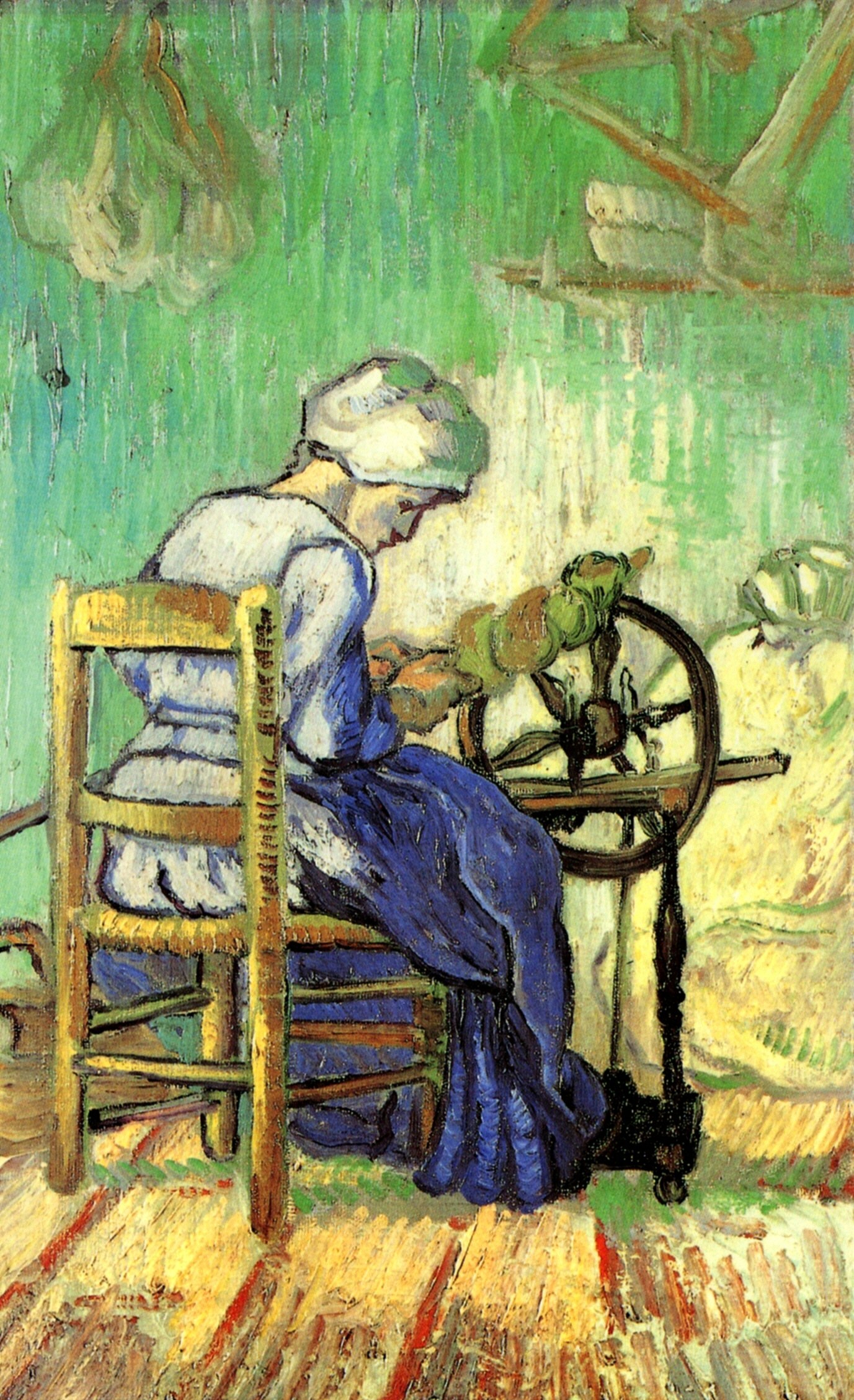

Here we see the same artist (Millet) present different spinning technologies in the same time period. Art is not a reliable indicator of the spinning technology in use by professional spinners at the time of the painting.
http://uploads7.wikiart.org/images/vincent-van-gogh/the-spinner-after-millet-1889.jpg
Not even multiple images of the same spinning technology by different artists is an accurate indication that the technology is being used by professional spinners.
Here we have a lady in silk dress spinning linen at a time when linen was actually hand spun:
http://ichef.bbci.co.uk/arts/yourpaintings/images/paintings/mhh/624x544/lsw_mhh_88029415_624x544.jpg
At that time and region, professional linen spinners used 2- thread wheels. We know this because 150 years earlier parliament past a law requiring spinning schools to teach spinning on 2-thread wheels Again, the spinning wheel in the painting is not an indicator of the technology then used by professional spinners.
Depictions in art are very poor indicators of the then current professional spinning technology!




.jpg)