Monday, August 08, 2016

Science

The irreproducibility crisis – an opportunity to make science better

August 8, 2016 by Megan Yu, Plos Blogs


Among the 1,576  surveyed in this news feature, 52% noted that reproducibility is a significant crisis in . Physicists and chemists had the greatest confidence in their respective fields while medical professionals and biologists had the least. In addition, the survey found that 24% and 13% of respondents had published successful and unsuccessful replications, respectively, compared to only 12% and 10% of those whose findings were rejected. These findings are similar to previous studies that found that only 16 of 83 articles recommending the effectiveness of various psychiatric treatments were successfully replicated and that only 36% of replication studies among 100 experimental and correlational studies published in three psychology journals were

Read more at: http://phys.org/news/2016-08-irreproducibility-crisis-opportunity-science.html#jCp

Science is what always works.  If it is not reproducible, it is not science.  Any researcher that publishes things that are not reproducible, should be punished according to the list of crimes in the Mikado,( https://www.youtube.com/watch?v=1NLV24qTnlg ) or (http://wonderingminstrels.blogspot.com/1999/06/i-got-little-list-w-s-gilbert.html )

I often pursue small advances in technology, and sometimes it is hard to tell just what small change in the new prototype is responsible for the change.  Thus, sometimes, I have to go back and retest various aspects of the current technology, to see if I missed something along the way.

Circa 1999, I started researching how to knit warmer objects. It was and is a systematic collection and organization of information about how to knit warmer objects  (aka "science".  I systematically tested the conventional wisdom in the knitting community on how to knit warmly, and found that much of it was/is myth.  I consider this to be no different from published research. I mean, knitters have had centuries to work out how to knit warmly, and to get it wrong is unforgivable.  At the very least, they should be required to sing "Koko" every evening,

Some deny that is is possible to knit "weatherproof" fabrics. That is merely a lack of technique on their part.  I knit weatherproof fabrics.   I have been knitting swatches of weatherproof fabric for about 13 years.  As I learned to use knitting sheaths, I was able to knit entire weatherproof objects.

Part of  the denier's  lack of technique is a failure to use yarns that make the process easy.  Weatherproof fabrics can be knit from a variety of yarns, but knitters are bound up in the mythology of using commercial 1,000 ypp "5-ply gansey" yarns, and these are, in fact, very difficult to knit into weatherproof fabrics.

By, 2006  I was very disappointed in the quality of  the commercial yarns available. and began to spin my own.  However, from the early going, I  found hand spinning also bound up in myth and fairy tails.  Spinners denied the virtues of  differential rotation speed (DRS) and accelerators.  There was nobody around to teach me to spin fine and fast. Sure, there were people like Northernlace, but her approach to spinning fine was arduous. Again the folks using supported spindles  for spinning various fibers into lace, seemed to prefer the slower, supported spindles to the wheel technology.  I understand this because, at those grists, supported spindles are easier than Scotch Tension.  On the other hand, DRS is much more productive than Scotch Tension.

DRS makes spinning fine singles much easier than either of the single drive technologies, and yes, I can use single drive, bobbin lead to spin 56 count wool (~25 micron) at its spin count of 31,000 ypp
( 63 m/g) on AA fliers w/ my bobbins.  So, what? I can also spin that fiber to that grist with a stock Ashford Jumbo Flyer using Scotch Tension! (Using a couple of machine screw washers as tension.) It can be done.   And, I can spin the same singles on the Ashford Lace Flyer.  That is a little faster than the Jumbo.  The point is: I can spin.  My love of DRS is because it is more productive.  Only with DRS can I spin 560 yard/hour of 5,600 ypp and have the hanks come out within 5% of the desired weight (45.4 g)

Today, I have to give more credit to my efforts to damp vibration.   It turns out that with the better vibration damping, I could have run the stock Ashford flyer/bobbin assembly a few hundred rpm faster (e.g., ~2,000 rpm).  However, the extra rpm does not really seem to be useful, so on a practical basis, it was/is the DRS (and AA's little fliers) that boost/ed productivity, and allow/ed use of the higher speed that I get with the accelerator.  And, better vibration damping allowed the higher speeds.  This is particularly true for the Ashford Lace Flyer.  Today, I can run my Ashford Lace Flyer (as a result of better vibration damping)  at 3,000 rpm, but it is still not a practical technology for spinning fine singles in the quantities needed for weaving, or making knitting yarns such as 5-ply sport weight or higher numbers of plies for warmer fabrics.

When you understand spinning, then spinning is faster than knitting.

The first thing that I learned is that "weatherproof" fabric, requires knitting denser fabric.  Knitting denser fabric requires using finer needles and it requires more force to form the stitches.  To retain stretch and elasticity of the fabric, the bars between the stitches are not tighter, but each stitch must be more firmly formed.  Using a knitting pouch is a good first step, but the densest fabrics for the  coldest climates require the use of knitting sheaths and double ended needles.

Warmer yarns tend to be thicker. Warmer yarns tend to have more plies but less ply twist.  Thus, at 1,000 ypp, the 5-ply will be warmer than the 2-ply and the 5-ply with less ply twist will be warmer than the high-ply-twist commercial 'gansey ' that produces a "drafty" fabric.

For very cold climates, yarns in the range of 500 ypp with 10-plies  produce the warmest fabrics with reasonable hand and drape.  Any knit objects intended for the coldest climates will likely have to be knit from such yarns. However, such yarns are not common in the modern commercial market place at this time.  In the current market most, yarns called 10-ply are actually only 750 to 800 ypp, which makes them a 50% less warm than the true 500 ypp 10-ply.

Anyone that says otherwise is trying to publish myth, old wives tales, and commercial nonsese as fact.

If there was a single great failure in this blog, it was thinking in terms of numbers and blurting it out on the blog.  These days most spinners and knitters, do not think in terms of ypp, and thereby much of the content goes right past them.  I use ypp because it makes the math easy.  Wraps per inch (packed to refusal) squared is ypp. The problem here is that the method of taking WPI has changed so that WPI as measured today has no relation to ypp.  I consider the lack of grist, twist, and ply information on yarn bands to make buying yarn like buying a pig in a poke. Likewise the yarn categories are no use to me.  I need to know the number of plies and whether they are woolen or worsted.  This is important if you are designing for a particular climate.  The appropriate yarn differs between SF, Berkeley and  Orinda.  And,  heading to the Matterhorn or Thunderbolt Peak requires an entirely different basis of engineering textiles and objects.  And, that is just in California.  Parts of Vancouver get 12 or 14 feet  (4+ m)  of rain per year.  Then, in places like Fraser, CO it starts to get cold, and we need to apply our our skill to objects intended to be used there.

If we divide ypp by 560 yards in the hank then we have the spin count of the grist.  Then we can buy wool with that spin count, and we can estimate how many yards per pound that wool will spin into. Then we know the total number of yards came be spun from that lot of wool

Anywool can be spun in to 10s (10 worsted hanks per pound, 5,600 ypp, 12.3 g/m) , and it was a standard grist for weaving inexpensive cloth. 10s were ubiquitous and fungible. Everyone knew how to spin them.  At one time 10s were the basis of a good grade of knitting yarn.  It was ubiquitous and fungible. Mostly it was warm enough for a world without central heating, and durable enough to be worn  all the time.  I like such yarns better than what I see at LYS.


Wednesday, August 03, 2016

Aran Knitting

Aran yarns were traditionally 10-ply, 500 ypp worsted spun. This was twice as heavy as modern sport weight, and ~ 70% heavier than worsted (e.g., 6-ply).  Aran was more what we would call weight 5,  "Chunky" or "Bulky", or even Super Bulky.  I know, I know, I have bins of  'Pure Wool Aran' from Yorkshire, that is only 772 ypp, but it is also, only 4-ply.  That is not a yarn that can be knit up into a functional seaman's sweater. I have knit it on finer needles, and never found a point where it became weatherproof.  Some of that 'Pure Wool Aran' does serve very well for baby clothes for a family living in San Francisco's Outer Sunset District.  It was knit by the children's grandmother, who was born, and raised in Siberia/ USSR.

Aran sweaters were used for fishing and whaling, even near the Arctic Sea ice.   Key advantages to producing a thick yarn from many  plies is that it can be knit tighter, without becoming stiff and board like. Thick yarns produced with only a few plies,  such as Peace Roving, Lopi, and  MacAusland, are easier to knit into weatherproof fabrics than yarns such as the modern commercial 5-ply, but weatherproof fabrics from yarns with few plies tend to be stiff and have poor hand and drape.  I put up with such fabrics for a long time, because I could knit them, and my LYS did not carry multi-ply yarns with a soft ply twist.  This is why I had to learn to spin, spin fine, spin fast, and produce better multi-ply yarns.   If you need a very warm fabric, then knitting it from a yarn with many plies produces better hand and drape, greater durability, and better warmth.

In contrast, modern, commercial  5-ply sport weight yarns tend to have so much  ply twist that they have poor fill, and tend to be difficult to knit into weatherproof fabrics.  Knitting weatherproof fabrics from high ply twist yarns such as Frangipani is a high effort endeavor. To the best of my knowledge, it requires a knitting sheath.   It is not always worth the effort.  In fact, for some applications, the stiff fabric can be protective.  Many of the fishermen wearing Arans would have been handlining 100 lb cod from the deck of the boat.  They braced against the rail and as the ship tossed, they would have been tossed against the rail, with great force. The net/ cable pattern typical on a Aran sweaters provided padding. (Do not even think of disagreeing unless you have handlined 100 lb fish on-board in rough weather.)   A stiff sweater can cushion a blow from a spar when sailing in foul weather, or arrest a slide (yard sale / garage sale) on an icy ski slope and thereby avoid a long climb back up the hill (while sore) to gather gear. It can also protect in rock climbing.

The best path for very warm knit fabrics leads to a yarn with many plies and soft ply twist.  I learned this from the old Lion Brand Fisherman's Wool, which was easier to knit into very warm fabrics than British Breeds,  Wingham's and etc..


The Lazy Kate set up for 10-ply Aran yarn.

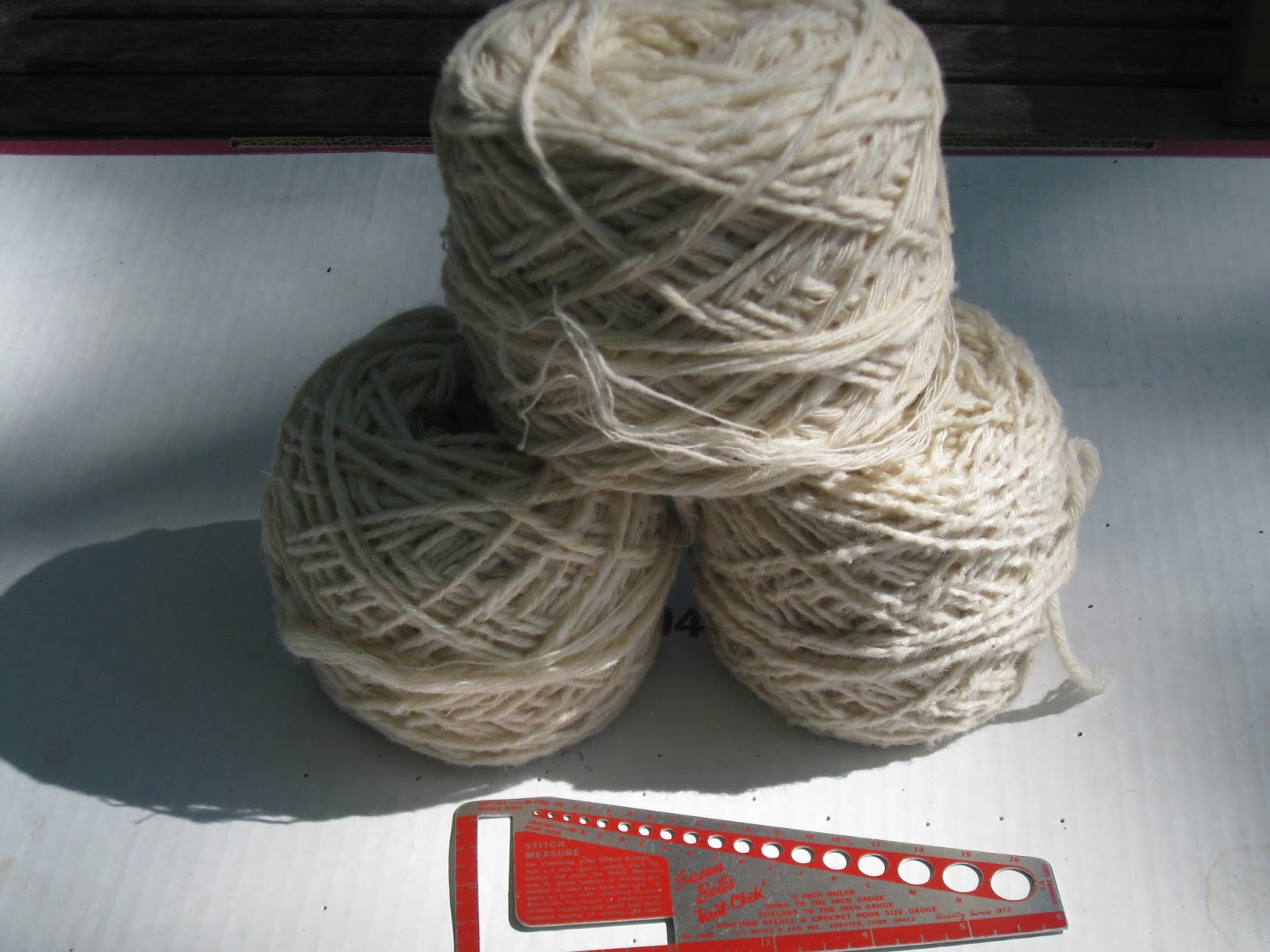
The singles are 5,600 ypp semi worsted (dized off of a drum carder) of Anna Harvey's Rambouillet. Knit on 2.38 mm needles at 6 spi by 8 rpi, it has about the same density as the 14 ply, but is knit on 2.38 mm needles rather than the 3.2 mm needles for the 14-ply.  The difference between this and the 14-ply knitting in the last post is the thickness of the fabric.  The 14-ply in the last post is thicker and about 28% warmer. On the other hand, this fabric, is more than twice as warm as anything I have knit from commercial, ~1,000 ypp 5-ply (even LB FW).  Yes! you read that right! I knit 10-ply, 500 ypp on needles that my Susan Bates "Knit-Chek" assures me are US1. Yes, it is an extraordinary measure, but extraordinary measures are how one stays warm in extraordinary cold.


Aran Swatch from
handspun 10-ply
@ ~ 500 ypp  
 and 
 Swatch of 'Pure Wool Aran'
Commercial @ 772 ypp
both  swatches show 21 stitches on top needle, both knit on US1 needles.
'Pure Wool Aran'  has more stitches per inch, but is best
suited for baby clothes in SF
(Yarns with grists that differ by 272 ypp, knit up up differently, but 
patknitter thinks that yarns that differ by 280 ypp are comparable!)  


The top swatch is a fabric that is ~twice as warm as the fabric that kept me comfortable for 4 hours in minus 10F temps with 40 mph winds (wind chill =>  - 40F). That is kind of wind that makes a parka snap and pop.   For the test, the sweater knit from LB FW  5-ply was my primary upper body garment with mittens and hat from same material. Lower body garments were Patagonia guide pants and medium weight poly-pro base layer.  I also wore one pair of hand knit socks under my plastic boots.  Test conducted at ~10,000 ft altitude.  Just me, sitting on a spare pair of socks, watching life unfold in the valley below.

At less than 50 stitches per inch^2, such a 10-ply Aran sweater can be knit ~60 hours.  (For true polar conditions, the 14-ply knits up even faster.)  With another 30 hours (35 hours for 14-ply)  of spinning to make the yarn, total production time is less than the ~100 hours required to knit a (less warm) sweater from commercial 5-ply.  And the objects from 10-ply/14-ply yarns are much more durable and comfortable than objects of similar warmth knit from yarns with fewer plies (e.g., Peace, Lopi, MacAusland).

One of my goals when I started spinning a decade ago was to be able to produce real 10-ply Aran yarns at a resonable pace.  Along the way, I was told, many times by many different people, "It can't be done!".  Well it certainly can be done.  People who did not know, pretended to know, and told me things that simply are not true.  Likewise, people that have not investigated the virtues of knitting sheaths, pretend to know, and say things that are not true.  They are lucky that Bolgia 10 is warm, not cold.

I have singles on hand (both semi worsted and true worsted) so, with a few hours of  plying, I would be ready to knit polar gear.  Then, the knitting can be done in cars, airports, train stations and quays.  I already have Arctic caliber socks, mittens, hats, and etc. And, I already have sweaters that have been tested at wind chills colder than minus 40.  I could gear up, and be ready to go full Arctic with hand knit clothing, PDQ.  I am not bound to California.

The real trick to staying warm is to make sure your mittens do not blow away if you drop them.  That is how my dad froze his hands on the East Wall at Arapahoe.  As he finished strapping an injured and cold skier into the sled, hand he had to grab it and hold it with his bare hands, even as his mitten blew away.   In the few minutes before we could get off the steeps, and dad could put on a pair of mittens from my pack, he had frostbite on both hands. As a member of the National Ski Patrol, dad skied it all, and I skied with him, from Dawn Patrol to Last Sweep, regardless of the weather.  I grew up in the high country of Colorado and Wyoming.   We did all of the 14,000 foot peaks.  All things considered, it was a good place to learn how to play outside and stay warm and safe.  Later, I did forestry research in the Adirondacks, and spent weeks every year outside in the snow in a climate very similar to that of Wisconsin (with more  snow.)  Along the way, I climbed all the Adirondack High Peaks -  most of them solo.  I have been to the Annapurna Sanctuary.   I have walked from Paradise to Muir Camp  (2,000 feet above snow line)  in flip-flops. Most of my ski trips in California included a night or two of snow camping.  And, I have skied over several of the California passes in the winter, when they were closed because of snow.    All in all, my tendency to play outside in all weather, gave me practical experience in how to stay warm.  I test and compare, and choose what works, not what people say works. Today, the knit objects that I make are much, much warmer than any of the knit objects that we had when we skied the high country and backcountry of Colorado,  Wyoming,  Adirondacks, and Idaho.

It is like spinning - I do what works, and the result is hand spinning that many say is impossible.
 (Who else handspins '500 ypp, 10-ply' in practical quantities?  )   In knitting, I do what works and the result is that I do things that many do not accept as possible.  Their lack of understanding is not my problem.   They should have chosen better teachers.


Aran Yarn
The Classic Yarn for Warmest Woolens

Just over a pound of 
hand spun and plied,
 semi-worsted spun, 500 ypp, 10 ply 
(there are ~ 5,600 yd of singles in the 3-cakes/ ply twist takes up ~10%)
Fiber from Anna Harvey's Rambouillet
www.annagotwool.com 

(If I was planning a season of fishing on the Finnish Sea, I would spin it worsted!)

ETA: 


A couple of cakes of Worsted spun 10-ply Aran.
(The two cakes total ~12 oz, and contain ~4,200 yd of singles.)

Aran Knitting

Aran yarns were traditionally 10-ply, 500 ypp worsted spun. This was twice as heavy as modern sport weight, and ~ 70% heavier than worsted (e.g., 6-ply).  Aran was more what we would call weight 5,  "Chunky" or "Bulky", or even Super Bulky.  I know, I know, I have bins of  'Pure Wool Aran' from Yorkshire, that is only 772 ypp, but it is also, only 4-ply.  That is not a yarn that can be knit up into a functional seaman's sweater. I have knit it on finer needles, and never found a point where it became weatherproof.  Some of that 'Pure Wool Aran' does serve very well for baby clothes for a family living in San Francisco's Outer Sunset District.  It was knit by the children's grandmother, who was born, and raised in Siberia/ USSR.

Aran sweaters were used for fishing and whaling, even near the Arctic Sea ice.   Key advantages to producing a thick yarn from many  plies is that it can be knit tighter, without becoming stiff and board like. Thick yarns produced with only a few plies,  such as Peace Roving, Lopi, and  MacAusland, are easier to knit into weatherproof fabrics than yarns such as the modern commercial 5-ply, but weatherproof fabrics from yarns with few plies tend to be stiff and have poor hand and drape.  I put up with such fabrics for a long time, because I could knit them, and my LYS did not carry multi-ply yarns with a soft ply twist.  This is why I had to learn to spin, spin fine, spin fast, and produce better multi-ply yarns.   If you need a very warm fabric, then knitting it from a yarn with many plies produces better hand and drape, greater durability, and better warmth.

In contrast, modern, commercial  5-ply sport weight yarns tend to have so much  ply twist that they have poor fill, and tend to be difficult to knit into weatherproof fabrics.  Knitting weatherproof fabrics from high ply twist yarns such as Frangipani is a high effort endeavor. To the best of my knowledge, it requires a knitting sheath.   It is not always worth the effort.  In fact, for some applications, the stiff fabric can be protective.  Many of the fishermen wearing Arans would have been handlining 100 lb cod from the deck of the boat.  They braced against the rail and as the ship tossed, they would have been tossed against the rail, with great force. The net/ cable pattern typical on a Aran sweaters provided padding. (Do not even think of disagreeing unless you have handlined 100 lb fish on-board in rough weather.)   A stiff sweater can cushion a blow from a spar when sailing in foul weather, or arrest a slide (yard sale / garage sale) on an icy ski slope and thereby avoid a long climb back up the hill (while sore) to gather gear. It can also protect in rock climbing.

The best path for very warm knit fabrics leads to a yarn with many plies and soft ply twist.  I learned this from the old Lion Brand Fisherman's Wool, which was easier to knit into very warm fabrics than British Breeds,  Wingham's and etc..


The Lazy Kate set up for 10-ply Aran yarn.

The singles are 5,600 ypp semi worsted (dized off of a drum carder) of Anna Harvey's Rambouillet. Knit on 2.38 mm needles at 6 spi by 8 rpi, it has about the same density as the 14 ply, but is knit on 2.38 mm needles rather than the 3.2 mm needles for the 14-ply.  The difference between this and the 14-ply knitting in the last post is the thickness of the fabric.  The 14-ply in the last post is thicker and about 28% warmer. On the other hand, this fabric, is more than twice as warm as anything I have knit from commercial, ~1,000 ypp 5-ply (even LB FW).  Yes! you read that right! I knit 10-ply, 500 ypp on needles that my Susan Bates "Knit-Chek" assures me are US1. Yes, it is an extraordinary measure, but extraordinary measures are how one stays warm in extraordinary cold.


Aran Swatch from
handspun 10-ply
@ ~ 500 ypp  
 and 
 Swatch of 'Pure Wool Aran'
Commercial @ 772 ypp
both  swatches show 21 stitches on top needle, both knit on US1 needles.
'Pure Wool Aran'  has more stitches per inch, but is best
suited for baby clothes in SF
(Yarns with grists that differ by 272 ypp, knit up up differently, but 
patknitter thinks that yarns that differ by 280 ypp are comparable!)  


The top swatch is a fabric that is ~twice as warm as the fabric that kept me comfortable for 4 hours in minus 10F temps with 40 mph winds (wind chill =>  - 40F). That is kind of wind that makes a parka snap and pop.   For the test, the sweater knit from LB FW  5-ply was my primary upper body garment with mittens and hat from same material. Lower body garments were Patagonia guide pants and medium weight poly-pro base layer.  I also wore one pair of hand knit socks under my plastic boots.  Test conducted at ~10,000 ft altitude.  Just me, sitting on a spare pair of socks, watching life unfold in the valley below.

At less than 50 stitches per inch^2, such a 10-ply Aran sweater can be knit ~60 hours.  (For true polar conditions, the 14-ply knits up even faster.)  With another 30 hours (35 hours for 14-ply)  of spinning to make the yarn, total production time is less than the ~100 hours required to knit a (less warm) sweater from commercial 5-ply.  And the objects from 10-ply/14-ply yarns are much more durable and comfortable than objects of similar warmth knit from yarns with fewer plies (e.g., Peace, Lopi, MacAusland).

One of my goals when I started spinning a decade ago was to be able to produce real 10-ply Aran yarns at a resonable pace.  Along the way, I was told, many times by many different people, "It can't be done!".  Well it certainly can be done.  People who did not know, pretended to know, and told me things that simply are not true.  Likewise, people that have not investigated the virtues of knitting sheaths, pretend to know, and say things that are not true.  They are lucky that Bolgia 10 is warm, not cold.

I have singles on hand (both semi worsted and true worsted) so, with a few hours of  plying, I would be ready to knit polar gear.  Then, the knitting can be done in cars, airports, train stations and quays.  I already have Arctic caliber socks, mittens, hats, and etc. And, I already have sweaters that have been tested at wind chills colder than minus 40.  I could gear up, and be ready to go full Arctic with hand knit clothing, PDQ.  I am not bound to California.

The real trick to staying warm is to make sure your mittens do not blow away if you drop them.  That is how my dad froze his hands on the East Wall at Arapahoe.  As he finished strapping an injured and cold skier into the sled, hand he had to grab it and hold it with his bare hands, even as his mitten blew away.   In the few minutes before we could get off the steeps, and dad could put on a pair of mittens from my pack, he had frostbite on both hands. As a member of the National Ski Patrol, dad skied it all, and I skied with him, from Dawn Patrol to Last Sweep, regardless of the weather.  I grew up in the high country of Colorado and Wyoming.   We did all of the 14,000 foot peaks.  All things considered, it was a good place to learn how to play outside and stay warm and safe.  Later, I did forestry research in the Adirondacks, and spent weeks every year outside in the snow in a climate very similar to that of Wisconsin (with more  snow.)  Along the way, I climbed all the Adirondack High Peaks -  most of them solo.  I have been to the Annapurna Sanctuary.   I have walked from Paradise to Muir Camp  (2,000 feet above snow line)  in flip-flops. Most of my ski trips in California included a night or two of snow camping.  And, I have skied over several of the California passes in the winter, when they were closed because of snow.    All in all, my tendency to play outside in all weather, gave me practical experience in how to stay warm.  I test and compare, and choose what works, not what people say works. Today, the knit objects that I make are much, much warmer than any of the knit objects that we had when we skied the high country and backcountry of Colorado,  Wyoming,  Adirondacks, and Idaho.

It is like spinning - I do what works, and the result is hand spinning that many say is impossible.
 (Who else handspins '500 ypp, 10-ply' in practical quantities?  )   In knitting, I do what works and the result is that I do things that many do not accept as possible.  Their lack of understanding is not my problem.   They should have chosen better teachers.


Aran Yarn
The Classic Yarn for Warmest Woolens

Just over a pound of 
hand spun and plied,
 semi-worsted spun, 500 ypp, 10 ply 
(there are ~ 5,600 yd of singles in the 3-cakes/ ply twist takes up ~10%)
Fiber from Anna Harvey's Rambouillet
www.annagotwool.com 

(If I was planning a season of fishing on the Finnish Sea, I would spin it worsted!)

Saturday, July 30, 2016

Aaron Knits

First make some nice 14-ply, worsted spun, wool yarn.  It is easy with a tension box type Lazy Kate:


 to get:

Craftsmen need to deeply understand their materials.

 It's grist is about 360 ypp, which means that it is ~ 25% lighter than the Super Bulky LB Wool Ease  (LB WE, 288 ypp). The 14-ply yarn is much denser than the SB LB WE, and thus is easier to knit into very warm fabrics.  Another advantage is that it is more elastic, allowing skin tight garments to move with the body, and still be perfectly comfortable.  In addition, skin tight garments are inherent warmer. Thus, this is an excellent yarn for gear used for extreme conditions. (Sometimes, California has wickedly extreme weather,)

Thus high-ply yarns can be used to knit warmer fabrics that can be thinner and more flattering than objects of similar warmth knit from 2 and 3 ply yarns.  This is a serious advantage for for the fashion conscious in cold climates  Multi-ply yarns are also enormously more durable.  Over the years, not having to reknit/repair objects, saves much knitting,  If your knit objects last more than a few years without repair, then you are not active enough.  I have hand spun, hand knit objects from Nepal that are pristine.  They are pristine, because they are crap! They sit in a drawer. They were made for foreign climbers that only spent a few weeks in Nepal, and then left.  Hand spun, hand knit is NO guarantee of quality or warmth.  My  aunt got a bunch of my early  hand knit objects.   One those hats I know was worn almost every day for 7 years.  When she died, it was almost pristine. She was very frail, and treated it very gently.  I put that much wear on a hat in  one winter of sailing, skiing, and etc, - even when I have Lyme Disease with coinfections.

With such a multi-ply yarn, it is trivial to knit a fabric that is lighter, thinner, more weatherproof, and more durable than what can be knit with from a yarn with only 2 or 3 plies, or from a 5-ply yarn constructed with high ply-twist.

Modern  commercial 1,000 ypp 5-ply and 1,120 ypp 5-ply yarns are designed and spun to produce fabrics that are not weatherproof! "Experienced" knitters recited the myth that commercial 5-ply yarns produced the warmest fabrics to me, and  I believed it -- until I did my own testing. Weatherproof fabrics can be produced from such yarns, but it is a significant effort. I had to learn to knit such fabrics so I could measure the effort.  Those "Experienced" knitters were telling me the harder way to knit such fabrics, not the easy way.

The seed of truth in that myth is that the older multi-ply yarns with less ply twist, were the best path to warm weatherproof fabrics.  Modern 5-ply,  high-ply twist yarns are designed to so that decorative stitches "pop".   Yarns, that can be more easily knit into very warm fabrics can be hand spun using less ply twist.  Experienced knitters had not understood that there was a real difference between high-ply twist and low ply twist yarns.  Lower ply twist gives the yarn more "fill", which is the easy route to warmer fabrics.  Likewise yarns with cable construction tend to be stiff, and difficult to knit into weatherproof fabrics.  Such cables yarns are good for summer socks that must be durable and cool.  Again, knitting cables yarns into weatherproof fabrics can be done using  long gansey needles and a knitting sheath, but it is slow, hard work.   I know this by testing and comparing yarns, and the fabrics knit from them.  The bottom line here is that the best handspun 1,000, ypp 5-ply can produce yarns that knit into warmer fabrics than modern commercial 1,000, ypp 5-ply tend to produce.  And yes, 1,000, ypp 5-ply can produce warmer fabrics than 1,120 ypp, 5-ply,  When both are knit on the same needles, the difference in warmth will be on the order of 25%, but if the finer yarn is knit on finer needles, then the difference is likely only  11%.  (You cannot get there using US3 needles! Alert knitters keep a journal, and know this.)  Using fine needles, hand spun 1,120 ypp, 5-ply with  low ply twist can easily be knit into fabrics that are much warmer than fabrics commonly knit from commercial 1,000 ypp, 5-ply yarns with high ply twist.

Thus, as we consider the warmth of  fabrics knit from the above 360 ypp, 14 ply, it needs to be compared to modern commercial 1,000 ypp, 5-ply, and best handspun 1,000 ypp, 5-ply.  The 360 ypp 14 ply above knits into fabrics that are about 50% warmer than best handspun 1,000 ypp 5-ply spun for warmth, and about 3 times warmer than the fabric produced by knitting 1,000 ypp, 5-ply, (commercial Guernsey yarns)  on the typical modern  2.25 mm (circular) needles.

Fabrics knit from the above 360 ypp, 14 ply are only very slightly warmer than fabrics knit from LB WE, (or MacAusland's heavy 3-ply) but the fabrics knit form 360 ypp, 14 ply, will be much lighter in weight, have much better hand and drape, have more stretch and elasticity, and be more durable.  In total, they are altogether more comfortable to wear in cold conditions.

  Swatch from best 360 ypp, 14 ply worsted spun yarn
knit on US 3 long needles


In short, factors that affect the warmth of knit fabrics include:

  • fiber - fine or coarse
  • spin - woolen or worsted
  • grist of singles
  • twist per inch of  singles
  • number of plies/ total grist of yarn
  • ply twist
  • needle size
  • how needle is used, e.g., hand held, knitting belt, or knitting sheath
  • tension of yarn as it is knit
  • stitch used in the knitting
Factors affecting warmth of objects include:
  • yarn used
  • stitch used
  • needle size
  • how needle is used
  • fit/ wearing ease 
  • waist opening 
  • size and shape of neck opening
  • sleeve construction
  • total area of body covered (e.g., a hoodie is warmer than a  sweater and hat, but a sweater, comforter, and balaclava is likely to be warmer still) 
Factors affecting over-all body warmth include:
  • weather/ wind, cold, wet, and etc.
  • base layers
  • over layers
  • warmth of knit objects
Much heat is lost through the feet, hands, and head! If your sweater is not keeping you warm, the fast and easy way to knit what will keep you warm is likely to knit socks, gloves, hats (balaclava),   and such. My wife laughs at me because most of my knitting is socks, gloves/mittens, and such. However, having such objects is essential to staying warm and being comfortable in cold, and very cold conditions.  And, gloves/mittens and socks are subject to a lot of wear.  They need to be regularly repaired/replaced.  I expect a sweater to outlast a couple of hats, several pairs of gloves/mittens and many pairs of socks.  


Yes, I spin such yarns, and knit such fabrics right here in Warm Sunny California, because these days, this is where the technical skills are. Remember, the knit objects that protected Shackleton's men on the Antarctic ice were knit in Balmy England, because that is where the technical skills were. When I was a kid, the best technical skills for down clothing were in Boulder, Colorado - a place where Native Americas had wintered, because it had pleasant winter weather.  North Face clothing was founded in San Francisco and grew based on experience gained by going to places with wicked weather.  Patagonia came out of Southern California, by way of experience gained in other places.    Even REI was founded in a place with fabulous year-round weather (Kent, Washington).  And, the great knit objects that allowed British seamen to navigate the cold and stormy Southern Ocean, were knit in tropical Hong Kong circa  1790 1830.


Thursday, July 28, 2016

Rushen Knitting

There has been some discussion here about how to knit for cold weather.  : )

Here is my "Rushen" solution.

For patknitter, it is done with US 3 knitting needles.
For purplespirit1, it is warm enough for snow camping in the Gulag.


 The yarn is Wool-Ease thick and quick by Lion brand. Suggested gauge is 9 stitches per 4 inches and 12 rows, using 9 mm needles. My gauge using US 3 (3 mm)   is 18 s per 4 inch by 26 r per 4 inches.

It weatherproof, and it is fast to knit.  An object knit from this yarn and at this gauge is well suited for a movie set, as it is warm enough for Siberia.  However, it is not durable enough for a serious tour of the Gulag.  In the long term, knitting real 10-ply saves knitting time.  Aside from swatches such as above, I do not knit objects from such yarns, because it is too fragile.  On the other hand I think you will find that purplespirit1 and patknitter have trouble knitting even such little swatches.  They do not have the right tools.

Monday, July 25, 2016

Exceptional points

'Exceptional points' give rise to counterintuitive physical effects


No matter whether it is acoustic waves, quantum matter waves or optical waves of a laser—all kinds of waves can be in different states of oscillation, corresponding to different frequencies. Calculating these frequencies is part of the tools of the trade in theoretical physics. Recently, however, a special class of systems has caught the attention of the scientific community, forcing physicists to abandon well-established rules.

When waves are able to absorb or release energy, so-called "exceptional points" occur, around which the waves show quite peculiar behaviour: lasers switch on, even though energy is taken away from them, light is being emitted only in one particular direction, and waves which are strongly jumbled emerge from the muddle in an orderly, well-defined state. Rather than just approaching such an exceptional point, a team of researchers at TU Wien (Vienna, Austria) together with colleagues in Brazil, France, and Israel now managed to steer a system around this point, with remarkable results that have now been published in the journal Nature.


Read more at: http://phys.org/news/2016-07-exceptional-counterintuitive-physical-effects.html#jCp

Spinning wheel drive bands (and other drive belts) absorb and release energy, and thus can be expected to have exceptional points, which goes far in explaining issues in drive belt design problems.

Sunday, July 24, 2016

da Vinci's DNA

Leonardo da Vinci's DNA: Experts unite to shine modern light on a Renaissance genius


A team of eminent specialists from a variety of academic disciplines has coalesced around a goal of creating new insight into the life and genius of Leonardo da Vinci by means of authoritative new research and modern detective technologies, including DNA science.

Read more at: http://phys.org/news/2016-05-leonardo-da-vinci-dna-experts.html#jCp

I am less interested in his DNA and the location of his remains, than in a smart translation and intelligent description of his work. 

Failure of Art Historians

Study reveals Leonardo da Vinci's 'irrelevant' scribbles mark the spot where he first recorded the laws of friction

Read more at: http://phys.org/news/2016-07-reveals-leonardo-da-vinci-irrelevant.html#jCp


Study reveals Leonardo da Vinci’s 'irrelevant' scribbles mark the spot where he first recorded the laws of friction


A new detailed study of notes and sketches by Leonardo da Vinci has identified a page of scribbles in a tiny notebook as the place where Leonardo first recorded the laws of friction. The research also shows that he went on to apply this knowledge repeatedly to mechanical problems for more than 20 years.
Scribbled notes and sketches on a page in a notebook by Leonardo da Vinci, previously dismissed as irrelevant by an art historian, have been identified as the place where he first recorded his understanding of the laws of .
It is widely known that Leonardo conducted the first systematic study of friction, which underpins the modern science of "tribology", but exactly when and how he developed these ideas has been uncertain until now.


 More evidence of the tendency of art historians to misunderstand  the important issues. LdV did important work on textile machinery. Anybody that knows textiles, knows that friction is critical in textile manufacture, and the Medicis made their money in textiles.

Thus, this page is important to the history of science, the history of engineering, the history of textile art in all of its glory and commercial importance, and the history of how one of the greatest families of art patrons made their money.

For an art historian to dismiss this as "irrelevant", is to display the failures of art historians write large.

Over the last few months, I have seen how small changes in friction can dramatically change the performance of a flyer - bobbin assembly.  One needs practical spinning experience on a variety of spinning devices to understand the textiles depicted in art.  

"Irrelevant" demonstrates a deep, broad, and profound ignorance of textile production.  


Saturday, July 23, 2016

Old Rope


Researchers discover how rope was made 40,000 years ago


Prof. Nicholas Conard and members of his team, present the discovery of a tool used to make rope in today's edition of the journal: Archäologische Ausgrabungen Baden-Württemberg.


Rope and twine are critical components in the technology of mobile hunters and gatherers. In exceptional cases impressions of string have been found in fired clay and on rare occasions string was depicted in the contexts of Ice Age art, but on the whole almost nothing is known about string, rope and textiles form the Paleolithic.
A key discovery by Conard's team in Hohle Fels Cave in southwestern Germany and experimental research and testing by Dr. Veerle Rots and her team form the University of Liège is rewriting the history of rope.
The find is a carefully carved and beautifully preserved piece of mammoth ivory 20.4 cm in length with four holes between 7 and 9 mm in diameter. Each of the holes is lined with deep, and precisely cut spiral incisions. The new find demonstrates that these elaborate carvings are technological features of rope-making equipment rather than just decoration.


Read more at: http://phys.org/news/2016-07-rope-years.html#jCp


Friday, July 22, 2016

Trump and Coal

Coal is declining because "Drill Baby Drill" produced a lot of cheap natural gas that pushed the price of coal down - that is the market - and the GOP supposedly likes the market.
Trump Digs Coal means that Trump supports the losing industry - coal. Trump Digs Coal invokes the Federal Government trying to pick winners and losers in the market place, and supporting the loser. The market has chosen renewable power because it is cheaper than coal. Add in external costs from the health of miners and environmental costs, and renewable energy is massively cheaper than coal.
Presidents are supposed to consider all costs and benefits. Guys with degrees from Wharton are suppose to be able to estimate the cost of energy from various industries. Trump seems not seem able to do a correct economic analysis. Trump has lost his Wharton skills. A real Wharton graduate would have gotten the "fact" in his speech correct. Trump is a loser.
Then, how did he make his money? He did deals where he lied and was a bully. How could he get to be president? He could lie and bully - he is good at that. Maybe he crossed the line and just stole his money. Several criminal schemes have yielded as much money as Trump seems to have. After all, he will not show his tax returns.
Would America tolerate a real criminal for president? Maybe - almost every town has a used car salesman that makes a living despite not being trusted or liked - America is tolerant of fraud and intimidation.
All in all, I would rather vote for "Bernie" Madoff" for president than D. J. Trump. If we are going to have a thief for a president, then let's get the best thief we can. Bernie stole a lot more money than DJ.
Now, that brings us to the $64 question. Would I throw away my vote by writing in "Bernie" for president? No, if not Madoff, and not Trump, then that leaves Clinton.
On the other hand, I think it is very clear that DJT, has stolen money. It is in a thief's nature to assume that everyone steals. In law school, HC learned about the full range of crimes in the world, but I do not get the sense that she is inherently criminal. Is she 'secretive" ? Yes, every good attorney that I know puts a high priority on attorney- client confidentiality, and that tends tends to rub off on their personal life, so yes, most high profile attorneys are very secretive. Over all, HC's accumulation of wealth was by more innocent means than DJT's. This puts HC in a different class - one where she was able to "make good" without stealing or extortion. I would rather have someone like that, than even the best thief.
Now, she might be a 3d term to Obama or a 3d term to Bill's administration - the 2 best economic records since Eisenhower. Would her speeches be as much fun as Trump's? Hell, no!, but she would get her facts correct. Would she promise as much as Trump? Hell, no!, but she might actually deliver a good chunk of what she does promise. She is smart enough to let someone that remembers their economics do the research on the cost of various sources of energy. She knows how to delegate and manage a large organization. Trump does deals, he does not manage large organizations.
We need to remember that Trump has a long history of not keeping his promises, e.g., not paying vendors, dumping projects into bankruptcy, and firing workers on short notice. All of these hurt the kind of people and families that he promised to protect in his acceptance speech. He lied! He got his facts wrong, and he lied. The man is no better than the most ruthless used car salesman in the US, and some people want to let him be POTUS?

Tuesday, July 19, 2016

We need to talk about the bad science being funded

Bad science
http://phys.org/news/2016-07-bad-science-funded.html

A  on the issue, published in Nature this May, found that about 90% of some 1,576 researchers surveyed now believe there is a reproducibility crisis in science.
While this rightly tarnishes the public belief in science, it also has serious consequences for governments and philanthropic agencies that fund research, as well as the pharmaceutical and biotechnology sectors. It means they could be wasting billions of dollars on research each year.
One contributing factor is easily identified. It is the high rate of so-called false discoveries in the literature. They are false-positive findings and lead to the erroneous perception that a definitive scientific discovery has been made.
This high rate occurs because the studies that are published often have low statistical power to identify a genuine discovery when it is there, and the effects being sought are often small.


Read more at: http://phys.org/news/2016-07-bad-science-funded.html#jCp

I know a guy, who teaches statistics to users of  one of the high-end statistics programs.  He says, the program is excellent, but that he does not trust any of the results produced by his students (mostly scientists and statisticians working for large research organizations.)   My friend would add poor sampling protocols to the issues identified by Simon Gandevia.  However, my friends job is to teach the mechanics of using the program, rather than the theory of statistics and sampling.

My view is that any significant result can be identified with rather simple statistics - if sampling was unbiased and adequate samples were collected.

If different appropriate statistical protocols can yield different results, then sampling was inadequate or there is no effect.   If there is a real effect then all the appropriate statistical protocols when used correctly will yield the same answer.

Monday, July 18, 2016

Let's be honest

The great advantages of wool are its warmth when wet, and its resistance to fire.  The warmth when wet made/makes wool ideal for wet climates.

In cold continental climates or polar climates, where the winter temperatures are far below freezing, everything is very, very dry.  At those temperatures, a campfire is little help in staying warm, and there may be little fuel for a fire. In the morning you have the choice of breaking through (feet?) of  ice or melting snow for your morning tea. Water in the desert is easier to come by, you do not have to melt the water bottle to brush your teeth.  Thus, in cold continental climates or polar climates, the virtues of wool are less important.

In those conditions, if you must knit yourself a suit of clothing to stay warm at -10C to -40C, one starts out by knitting a set of drawers (see Weldon 46th series), and a long sleeved undervest (see Welden 12th series).  Knit from worsted spun  5-ply (1,000 ypp, NOT the 1,120 ypp of Wendy's or 1,089 ypp of  Frangipani) at a gauge of  8 spi by 12 rpi, that is ~ 400 hours of knitting.  Then, you will need socks, gloves, hat ( balaclava helmet, or hat and scarf) at the same gauge from the 5-ply.  That is another 110 hours of knitting.   If it must be handspun, that is another 80 hours of spinning.

Over that you need tightly woven wool shirt and tightly woven wool pants. The LL Bean Guide shirt and pants work.  If you need hand spun/hand woven, that is another 80 hours of spinning and 40 hours of weaving plus 40 hours of fabric finishing and tailoring.

Then, one needs over-socks, mittens, over-hat, and an Aran sweater, all  knit from worsted spun 10-ply  500 ypp wool knit on 3.1 mm needles at 5 spi by 8 rpi. This is a softer, but thicker yarn than the 6-stand cable that was previously discussed with patknitter, and it has better fill and knits to a denser fabric. This is another 250 hours of knitting.  Such yarn is not commercially available these days, so there is another 80 hours of spinning.

Thus, labor for a hand made outfit for cold continental  or Arctic climates is about  6 months work (~1,000 hr).  Once made, it can be replaced/ repaired/refurbished as worn by knitting an hour or 2 per day.  I would need a couple hundred hours of knitting to refurbish my all hand knit kit for full on Arctic winter usage. I have the handspun singles on hand, so all I need to do is ply and knit.  I could have all the yarn ready to travel in a few hours, and  it will be 4 months before the Arctic gets really cold, on a sustained basis. There is time.

Dealing with Antarctic cold is whole other program.  Nevertheless, very finely knit objects knit by Burberry (contractors using knitting sheaths) were a part of the outfits used by Shackleton's crew during their year on the Antarctic ice, during which no men were lost. 

Most modern knitters cannot knit 3 major objects plus associated socks, gloves and hat from 1,000 ypp 5-ply at 8spi in 6-months without ruining their wrists. And, that does not even count the Aran weight outer sweater, socks, mittens and hat, which requires even more knitting effort, and more stress on the wrists -- unless you are using a knitting sheath.

On the other hand, you can buy an outfit at LL Bean that will keep you warm in those conditions for $600. That means the functional value of your knitting is $0.60/ hour (less if you pay for yarn), and anything over that is just for pretty, or because the knitter is a good salesperson.  Less attractive, but just as warm outfits can be had from other outlets for less than $250.

The best are Carhartt, add hat, gloves, socks, googles, and you will be far warmer and more comfortable than with anything that can be knit on circular needles.

Fancy outfits from Spyder and others are more than $2,000, good for guys with too much ego.

No list of cold weather clothing would be complete without Patagonia.

At their best, nothing from Carhartt, L.L.  Bean, or Patagonia can match the warmth for weight and ease of movement of  wool, finely knit to fit.  On the other hand, in performance per dollar,  hand knit objects fail miserably.

The value of hand knit sweaters on a cold movie set lies in their fashion value, not their warmth.

Sunday, July 17, 2016

Gensis

Men who like playing outside, start out as boys who like playing outside.
I was born in Cheyenne Wyo.  My Dad was an excellent skier, and leader of a Boy Scout  Explorer post that specialized in first aid and skiing.

Dad was Senior National Ski Patrol.  We skied every weekend, all day, regardless of the weather.  Dad had a beautiful, erect wedeln, and I often skied with him as he patrolled, in all weather.

Dad and Gerry Cunningham (Gerry Mountain Sport) had worked together during the Blizzard of  '48, and were good friends.  We tested prototypes of Gerry's gear, and used his cabin in Left hand Canyon as a base for back country skiing.  I still love, respect and understand the limits of that storm cloth that Gerry used in those days.

In Boulder, Mrs. Holubar ( Holubar Mountain Sport) had her down stuffing facility under Dad's office. I would help  Mrs. Holubar stuff sleeping bags, and in return, on Wednesdays, she took me up into foothills above Boulder, and gave me rock and ice climbing lessons. I still love, respect and understand the limits of down gear.

We had a Austrian Exchange teacher living with us, and she like to climb.  By the time I was 12,  I had "done" most of the major peaks and routes in Colorado.  Like all kids, when it snowed, I make igloos/ snow caves and camped in them. Then, I used a wool sleeping bag.

At the University in Albany, NY,  I was involved in forestry research that involved field studies in Quebec, the Adirondacks, the Berkshires, and the Catskills, that had to be carried out on schedule, regardless of the weather.   e.g., canoeing in foul weather, and snow camping. Because we were known to be able to get in and out in any weather, we were invited by various agencies to participate in rescue work.

In the late '70s, my parents were living up on the Saranac River.  I could come up from NYC, step out the back door and ski for 90 miles without crossing a plowed road.  There was always good snow, so I did not even bother to carry a tent.

Circa 1980, I was in California, and able to play in the Sierrias and on the Bay.  There were times when I was warm and comfortable, when others were cold, blue and "pinched" because I understood the limitations of down.  Sometimes synthetic is much better than - down. In those days, we still did not understand the wool could be knit tight for warmth.

Circa 1991, we trekked across Nepal.  I saw the local hand knit goods being sold to climbers. I still have some of  it.  It is durable, but not warm.  I never actually saw any of the Sherpas wear socks, or any knit gear for that matter.   In those days, you could sometimes find me at Muir Camp in flip-flops. And yet Dev Shukla, who grew up in the Himal, told me that his mother used a knitting sheath to knit very warm clothing for her children.  We did not see the use of a knitting sheath or knitting belt in India/Nepal.

Circa 2000, I asked the question, " How did the old seamen in the time of square rigged ships stay warm?

Boundaries:

  • Down is good for dry cold such as Siberia, but not for wet cold.
  • They did not have synthetics.
  • They had wool and knitting, but modern hand knitting is not warm enough!
Conclusions"
  • The old timers used knitting sheaths and finely spun wool to knit very light, but very warm fabrics.  Such fabrics were durable, light  and appropriate for the cold, wet conditions at sea in a wooden ship.
Corollaries:


  • Down is much better for the dry polar and continental cold. Down is light and good for mountaineering. Sweaters were used by Hudson Bay Traders, but they swapped them for furs as soon as they could get a squaw.
  • Snow caves are warm (0C)  and damp, thus suited to wool or synthetic.  Down in a snow cave is a disaster. 
  • Wool sweaters are not appropriate for dry polar, or dry continental, or high altitude cold (below -20 F.) .  Note, we are starting to see thunderstorms/rain in the Arctic, so parts of the Arctic are becoming damper and less suitable for down and more suitable for synthetic/wool sweaters.
  • Chinese quilted fabrics were well suited for junk rigged ships, where the sails could be managed from deck.
Bottom line:

If you are knitting sweaters for -40 cold, it will be the other things you wear, and not the sweater that keeps you warm.   It only takes being a few degrees too cold to kill you.  When you get cold, you get confused and lose coordination. In cold weather, that is death.

In real polar and continental cold, one needs a lot of fluids - the air is as dry as a desert.  If you tell me that you are in such conditions, and nobody is supplying (hot) fluids, then you are a liar.  If someone is supplying hot fluids, then there is a wind break and a place to get warm.  


Saturday, July 16, 2016

Alternative design for ST and IT

I did learn to spin at the spin count using Ashford's ST setup, so I know that can be used to spin at the spin count.  However, shortly thereafter I went on to DRS.  Yes, there might have been some minor experiments with better ST brakes, but I did not pursue them.  I was too busy spinning.

The other day, I was spinning on The Competitor, and just flipped the drive bands over onto the bobbin, and it worked very well.  At that grist, (~20, 000 ypp) it worked much better than the Ashford system.  I played with that for a day or two,  spinning various fine wools in the stash at their spin count.  It was kinda nostalgic.

OK, what about ST, could I rig the The Competitor with a better ST (single drive/ flyer lead) system than that clumsy Ashford system?  I had already heard of the European Longest Thread competitors using a weighted system.


  Fishing line around the mother of all with a slider T. From the T, a piece of  leader goes over the bobbin, to a hook holding weights (nuts).  It is simpler than the Ashford system and  works very well for the grists that I have tried over the last few days (e.g., 10,000- 40,000 ypp).

OK, it also works very well for an advanced IT system.

Note the weights (nuts) handy on the magnets set into the MOA.

Kit to convert DRS to either IT or ST

The IT and ST systems are nice for spinning samples where the twist model does not seem to work as in superwash wools.

Nevertheless,

DRS remains the production mode, because it is 3 or 4 times faster.

ETS, this works well for both IT and ST because the whorls that I made for DRS are the same shape.  Often flyer whorls and bobbin whorls have different profiles.

Friday, July 15, 2016

ST

I like to retest and re-compare the various technologies every so often to see if I still come to the same conclusions.

This morning, I set up  The Competitor flyer/bobbin assembly with the accelerator wheel and Scotch Tension (single drive/ flyer lead).

I originally went to DRS because in trials, DRS (double drive) delivered a lot more rpm from the flyer/bobbin assembly, and I wanted more speed for spinning the singles for 5-ply.  While it was chosen for speed, DRS opened up another set of  drafting techniques that I did not expect.

With the accelerator wheel,  I can easily run The Competitor (flyer) as fast as with a single drive  (either IT or ST) as I can drive the flyer/bobbin assembly with DRS.

Nevertheless, DRS produces singles faster. The difference is wicked.

DRS changes the nature of the drafting process.  With DRS, I can draft much faster than I can with either IT or ST.  DRS can take full advantage of the speed possible with an accelerator wheel.

Accelerator wheels can deliver a lot more rpm than can be taken advantage of with conventional drafting such as "long draw" (with fine singles),  and accelerator wheels are a bother.  Therefore, I deduce that spinning wheels with accelerator wheels used DRS.

As we look in the Big Blue Book, pages 183 - 190, AA / SG provide drawings of 11 wheels, 3 of which have accelerator wheels.  Despite, the modern accelerator wheels with ST, I trust that the 3 wheels in TBBB, belonged to trained professional spinners that knew how to do spinning math and use DRS.  I mean Aristotle, knew and used the math.  Anyone who had access to any copy of books by Aristotle  or his students, had access to the math; and, spinning was a very competitive  industry.

ETA I have been mostly spinning worsted and semi-worsted, and had not tested the just the accelerator wheel with single drive against DRS for true woolen spun from rolags, via long draw. Perhaps this was a case where single drive could keep up with DRS.  Well, as of this morning,  I cannot spin 40,000 ypp woolen long draw, and I can spin it with DRS so I will do the numbers for which is faster when I get a rate for somebody actually spinning 40,000 ypp via long draw.

Thursday, July 14, 2016

How Producers Keep Actors Warm

First there the starwaggon - if for no other reason than to protect camera and lighting equipment.

Where there is lighting, there is a generator, and generators are always warm  : )    Where there is a catering truck, there is a circle of warmth.

http://www.starwaggons.com/

under costume:


http://www.patagonia.com/product/mens-long-sleeved-capilene-daily-graphic-t-shirt/45280.html?dwvar_45280_color=TLFW&cgid=mens-baselayers

http://www.patagonia.com/product/mens-capilene-thermal-weight-boot-length-bottoms/43680.html?dwvar_43680_color=FGX&cgid=mens-baselayers#start=1

http://www.patagonia.com/product/mens-merino-thermal-weight-zip-neck/37122.html?dwvar_37122_color=CAN&cgid=mens-baselayers#start=1

http://www.patagonia.com/product/mens-capilene-thermal-weight-one-piece-suit/43701.html?dwvar_43701_color=CABX&cgid=mens-baselayers#start=1

Actor's sweaters are need not be any more functional than a "ski sweater" worn on the lodge's sun balcony.

Over Costume:

http://www.patagonia.com/product/mens-dual-aspect-hoody/83200.html?dwvar_83200_color=FGE&cgid=mens-fleece#start=1

http://www.patagonia.com/product/mens-stretch-nano-storm-jacket/84330.html?dwvar_84330_color=CUSO&cgid=mens-jackets-vests#start=1

http://www.patagonia.com/product/mens-triolet-pants-for-alpine-climbing/83215.html?dwvar_83215_color=BLK&cgid=mens-snow-pants#start=1

The sweaters that the actors wear may or may not be important to the actor's warmth!

Durability: With a couple of exceptions, all movie shoot schedules have been shorter than the typical 3 year cruize of  of a whaling vessel - and actors do not have to reef sails, which tends to wear a seaman's sweater. I find that falls and slides on ice and rock when skiing and climbing tend to be good tests of durability.  On set, most falls/slides are done by stunt men, thereby saving the star's costume/ sweater.

I do not see knitting for actors as setting a high bar for sweater's functionality, warmth, or durability.  A better test is to pass them out to farm workers pruning apple trees in the winter.  Real knowledge comes from actually wearing your objects as you perform jobs like pruning apple trees in a storm.  Or wearing one of your sweaters as your upper body garment when sailing in a cold gale.  If everyone wearing Patagonia sailing gear is looking cold, with blue lips, and fumbling from hypothermia, when you are happy and warm, then it is likely a good sweater.  Another good test of a sweater is a long night of steel head fishing on the Columbia, when it is cold enough that the lines freeze instantly in the reels.  Again, if everyone else is pinched with cold and you are still warm, happy, and relaxed, (without a base layer) then it is a good sweater.

The truth is that today, folks do not need really warm sweaters. People are never more than a few miles from a vehicle with a heater.  Warmth from Patagonia ( or similar ) clothing is much cheaper.