Monday, April 13, 2015

The Best

One of my sculpture professors was friends with a world class silversmith/artist. The silversmith would come up and visit several times a year, and we would gather to hear his wisdom.

Once, he told us about how lonely it was being the best. He said, that when you are the best, there is no teacher.  The best must develop their own skills and likely design/make their own tools.  He said if you want to stay the best, one needs to spend 20% of one's time developing new techniques, learning new skills, and making new tools.

In the past, craftsman spinners spun for craftsman weavers. Most of the spinner's products were threads in the 5,600 ypp to the 45,000 ypp range. (This s the range of the Bradford system of  fiber/yarn measure.)  Such threads were used (or plied into yarns) for garments, upholstery, and even tapestries and sails.  Look at the old master paintings and (and tapestries) remember that every bit of cloth in them was woven from hand spun yarn.  Spinning for weaving is an old tradition.
There was a lot of spinning in a senator's toga.

Today, most hand spinners do not produce singles in that range of grists, and many who do are focused on entries into spinning competitions such as Longest Thread.  Thus, very few hand spinners are producing such threads primarily to be used in making other objects.  And, in fact, when I set about to make my first 5-ply sport-weight gansey yarn, I was told by "experienced" hand spinning historical enactors that it had not been done and could not be done.  Such advice conflicted with both history and science.  I find that many spinners have a poor grasp of history / science.  This is not to say that they will not try to floor you with dates.

Thus, spinning singles suited to weaving (and plying into very high quality knitting yarn) is a lonely place.  However, the yarns constructed from fine plies are nice - better than what the pack of spinners are spinning. While we have become accustomed to the fragility of knitwear made up of loosely knit 2-ply, many retailers offer knitwear of rather firmly knit 4-ply yarns that are much better. And, when I say better, I mean warmer for the weight, more durable, better drape, and nicer hand. Why would any spinner/knitter allow LL Bean and Costco to sell better sweaters than what the spinner/knitter is producing? NO!  If it worth making by hand, it is worth making as good or better - that is the craftsman's way.  And, like it or not, that means more and finer plies.  (If you wanted your toga to drape properly, you had it woven from fine, multi-ply yarns. Look at the Roman spindles! Many were highly optimized for spinning rather fine singles.  Those spindles will produce fine singles faster than most modern spinners can produce such singles on their wheels.

And, higher grist yarns are thinner and have a smaller tolerance for errors and defects.  Thinner yarns must be made to higher quality standards.When 560 yards of yarn weighs only 20 grams, there is not much room for slubs.  And a thin yarn without enough twist is more likely to drift apart.  A thin single must be more consistent. Again, thinner yarns are better.

This morning, I dug out the 20 tpi whorl and am spinning ~30,000 ypp (67 meters/ gram) singles from 56 count (25 micron) medium wool. The wool is lustrous, and strong. The single is a bundle of ~20 wool fibers. The hand-dandy electronic micrometer says the single is 0.005" in diameter - about 1/200"; that makes them a comfortable 175 wpi. The tachometer says the flyer is running at 2,400 rpm, so the bobbin is running at ~2,500 rpm, and the single is being spun at 124 inches per minute or ~ 160 yards per hour (145 m/h).  Not bad for someone that has not spun that grist since before Christmas.  I will spin 10 grams/ 670 yards and stop. (Then I must spade the tomato bed, and that will spoil my hands for such spinning for a few days.) These are soft singles, suited to a senator's toga or a lady's robe.  I do not need such singles just now. It is practice to maintain skills.  It must be measured as a test of my current skills.  I did not bother to re-comb and diz the roving I am using to spin 10s (worsted 5,600 ypp singles) that I do want now.  10s, I can spin after gardening.)

The trick is to spin such high  grist singles fast enough to make them useful.  Frankly, I do not know of any other hand spinners that spin garment weight yarns as fast as I do.   I do not even know of any hand spinners that come close to my speed.  And yet, I am certain that 300 years ago many spinners in Bruges could spin much, much faster than I do.  If all those spinners that claim to have the wisdom of ages actually had that wisdom, they would spin much faster than I do.  

Because fine singles do produce better fabrics and objects, I do expect other spinners to eventually follow me. I do believe in merit of product. By then I will have developed new techniques, new skills, new tools, and I will have moved forward.

What I am saying is that I am an Autodidact, and snide remarks and insults from the pack do not affect my spinning.  If you are a craftsman spinner, I am happy to exchange hints with you so that we both may become better spinners. And just as many folks play football, but there are not many NFL quarterbacks around, we should not expect that there are too many craftsman spinners around.  
---
Edited to add that the grist of the first 625 yd was only 52 m/g or (24,000 ypp, 150 wpi).  I guess that is what happens when I do not spin mediums for 4 months.

-----
Edited to add: after soaking my hands in hand lotion all night, removing the film of belt dressing from the bobbin whorl, and  combing/dizing the fiber,this morning I was spinning 30,000+ ypp/  8 grams per hank.  It takes competence, but spinning wool at its spin count is not that difficult.  Wool fiber can be spun much thinner - 9 fibers in the single can be spun. For 56 count wool that would produce a single on the order of 60,000 ypp (250 wpi), but that is a very fragile yarn - OK for contests, but not for commercial weaving. Spinners spin a few feet of that, take a pix, and say, "Look how fine I am spinning!" 

People compare my singles to those pix and say, "You are not spinning as fine as XYZ!"  No, I am not, I am spinning miles of usable yarn.  On the other hand, my usable yarn can be spun from 56 count wool spun at 175 wpi. Part of its usability is that it is well measured.  If I have not been doing it on a regular basis, sometimes it takes some warm up to get back in the groove.  However, once I am  back in groove, it is every so easy.  I guess, I need to go get back in the fines groove.  Where is that that 24 tpi flier whorl?  (The oil finish that I put on them before storage last fall took the labels off
  :  ( 

The 20 fiber bundle was a grist that could be spun at a commercial rate (quickly) and it made a yarn that was robust enough to be handled in commercial weaving operations and when woven, made a good fabric.  


Saturday, April 11, 2015

Pix

There is a group that says,"If there is no picture, it did not happen!"

They want me to take pictures of what I do, or they do not believe that I did it.

They do not pay me for my work, or even say, "Thank you!"  They do not come up with new ideas or technologies or even improvements on the old technologies. The just like  to look at pictures.

In the distant past, I often obliged.  Then, I was taking a video of  finer spinning, and at internet resolution, it looked like  pantomime.  The fine thread just disappeared!   I could put more effort into doing the photography, but taking pix of threads that are 0.005" in diameter does take a lot more effort.

I have stopped pandering to people that just want to look at pix.  Their belief or disbelief does not affect my spinning.  However taking good photographs does suck up time when I could be spinning.


I hear a new Star Wars movie is coming out.  All of the folks that just want pix, can BUY a copy.  It is time they paid for pix.

Some things are true, whether or not there are pix, and sometimes pix do not prove that something is true.  

Wednesday, April 08, 2015

Household Economy

I can spin 2,500 ypp woolen singles and make 2-ply sport weight yarn in 3 passes (each ply + plying) through the wheel, meaning that it takes me ~ 2 days to spin the yarn for a jumper. Or, I can spin 5,500 ypp worsted singles and make sport weight yarn in 6 passes through the wheel, so 5-ply worsted yarn for a jumper takes me about 4 days to spin.

Then, it takes me about 10 days to knit a good sport weight sweater (on US #1 needles.).

The 5-ply worsted is warmer, and much more durable, and if I am working with long wool, it has more luster.  On the other hand, by saving 2 days of spinning I get a softer sweater that is not as warm and not as durable.

The knitting wins. It is thriftier for me to spin better yarn and spend less time knitting.  This analysis makes spinning 5-ply worsted well worth the effort.  A similar analysis applies to hose and sock yarns, plied up from even finer singles.

 Or, it is better for me to buy the best available yarn and save the effort of knitting more frequently.

Of course, I could spin (or buy) worsted weight yarn and knit it on big (US 7) circular needles in couple of days. That would give me a decorative garment in only 4 days  that gives the appearance of warmth, but which is cool enough that it can be worn in a centrally heated environment - and if I need to go OUTSIDE, I can always put on my cold weather gear from Marmot, NorthFace, LL Bean, Patagonia, or Needless Markup.

I am not a snob.  The last time I was sailing on the Bay, I wore a sweater from LL Bean.  As backup, I had one of mine in my bag, but the LL Bean was enough for the day.  That works on sunny warm days, but when it is murky overhead,  and the wind begins to blow, I like hand knit. And, hand spun because that is how one gets the long wool that endures.

DRS, Accelerator Wheels, and Low Grist Yarns

Many of the commercial double drive wheels come with a differential rotation speed of ~1.6. this would seem to make them ideal for making singles for worsted weight 2-ply yarns.

However, such thick yarns rapidly change the effective diameter of the bobbin as they accumulate on the bobbin.  Changes in the effective diameter of the bobbin change the DRS,  To keep grist/twist within ~10%, DRS need to be kept within  ~10%.  When you accumulate 1/4" of yarn on the bobbin, the diameter changes by 1/2" and the DRS changes by a lot and one needs to either change flyer whorls or wind off or allow slippage.  Slippage is the easiest, but why go to the effort of having a DD system, if you are just going to let the drive band slip?  I mean, at these grists we do not have to worry about breaking fine singles.

My first choice for spinning a single with grist of less than 2,500 ypp is single drive, bobbin lead (Irish tension).  These yarns do not require at lot of twist, so one does not need the very high rpm that requires 2 drive bands.  With these yarns, two thousand rpm will produce 10 yards per minute, which is about as fast as you can draft quality yarn.  With 90 rpm as a comfortable treadling cadence, that means a good ratio is ~1:24.

Whorls less than 2" (50 mm) in diameter tend to slip, so if you really want 2,000 rpm, then you need a whorl of 2" and a drive wheel of  48"!!  Forty-eight inch drive wheels are a big pain.

Enter the accelerator wheel.

When I first went looking for more speed for fine singles, I went to higher ratios by decreasing the size of my whorls. It was more an education than a success.

Today, I use the Ashford Jumbo flyer in Scotch Tension mode with the accelerator wheel for plying, and I routinely ply at more than 2,000 rpm.  I could just as well be spinning singles at (more than)  9 yards per minute. I have done samples and tests but no production spinning with that plying setup. Since with Scotch tension, worsted yarn does not self assemble as it does with DRS, it is all long draw woolen, rather than worsted. The speed is limited by my drafting, rather than the speed of the equipment.

Since low grist worsted tends to be harsh, when I want thick worsted yarns, I ply them up from fine worsted singles and have no interest in trying to figure out how to use DRS to spin low grist yarns.  On the other hand, this means that I have a great desire for fine singles.

Bottom line -- DRS for low grist yarns is a waste of effort.  DD without DRS is a waste of effort.  The only reason that people do it is that they have heard myths about the power of  double drive wheels  And, DD does have power.

DD with DRS can do things that SD simply cannot.  DD with DRS is a very powerful tool for spinning singles in the range of 2,500 to 45,000 ypp (5 m/gram to 90 m/gram). With DRS, true worsted and true woolen can be spun with almost the same drafting technique - what differs is the fiber preparation. Woolen is spun from a pile of carded rolags and worsted is spun from a distaff of combed sliver.  In particular, DRS allows spinning true worsted singles faster than long draw woolen singles of the same grist can be spun. (Woolen requires more twist than worsted of the same grist.) With DD/DRS, true worsted 5,600 ypp singles (10s) can be hand spun at 10 yd/minute on a sustained basis.  However, this puts very high demands on fiber preparation to avoid "twittering", which is variation in thickness of a single as a result of variation in the density of the sliver being spun.  Even with minor twittering, DRS allows spinning 560 yard hanks that are consistently within 5% of the desired weight.

And now you know why I have such respect for Clemes and Clemes.  Better fiber preparation is at the core of better and faster spinning.

On the other hand, minor twittering will not affect the final quality of 5-ply sport weight yarn.  The folks who say it does do not make enough of such yarn to make many objects from it.

Tuesday, April 07, 2015

Baby Talk


I have been accused of talking to my readers like children.The following sites talk to spinners as if the the spinners are babies and not a spinner complains! 


  • http://www.spindizzy.net/Howto/dd_flyer.html
  • http://joyofhandspinning.com/how-the-spinning-wheel-works/
  • http://kromskina.com/single-drive-vs-double-drive-wheels/


In contrast, I give examples with actual measurements.  And, I tell you how to get better results.  Try asking Kromski how to spin fines! 

Spindizzy invokes the the same differential rotation speed (DRS) that Alden and I talk about.  We  do the math, and CAJ does it qualitatively.  The thing is: DRS is a clockwork mechanism, and  to make good clock work mechanisms, one needs to do the math, and get it correct. Then, one needs to fabricate the correct clockwork mechanism.  When spinning fines, a difference of 1 mm (1/25 ") in whorl diameters is important. DRS is simply not something that can be done qualitatively.

Joy of Hand spinning extols a high degree of twisting efficiency in DD,  just like I do.   Except, I use a tachometer and do the math. I tell you how much twist efficiency you can actually expect, and how you can improve your twist efficiency. These details are learned by doing.

Kromskina notes that DD generally spins the finest yarn.  I say, "DD will allow spinning fine yarns, much faster, but to use DD to spin the fine yarn quickly, the spinner needs the correct DRS."  The DRS that comes standard on Kromski is ~1.6, which is very good for spinning 1,600 ypp singles. Note that Kromski does not  supply the DRS for its whorls. By having the correct diameter of whorls to provided the needed DRS, I avoid slippage.  
 It is terrible for trying to spin 5,600 ypp lace singles. It will do it, but it is no faster or easier than Scotch Tension. The 5,600 ypp lace singles want a DRS of ~1.04, which is very different from a DRS of 1.6.  And, the flyer whorl that provides a DRS of 1.04, will NOT allow you to spin the singles for worsted weight 2-ply. As expressed, the Kromski statement is nonsense baby talk, but nobody complains.

If my wheel is set up at a DRS of 1.04, AND I need to spin worsted weight, I either change flier whorls or I run it single drive.  

I assure you that one can spin 45,000 ypp singles running single drive, but that you can spin such singles, twice as fast using DD with the correct DRS. And, 3 times as fast using DRS and an accelerator wheel.  That is the magic of DRS.

The continuous and limited take up of yarn as controlled by DRS allows the self assembly of the yarn. It is not discussed in the Big Blue Book, but it is this the self assembly of  yarn that makes DRS so productive. It is similar to the formation  of  yarn in the old flyer frames circa 1820. This self assembly of worsted yarn is rather similar to the formation of woolen yarn from a long draw draft. It means that the difference between true worsted and true woolen is simply the fiber preparation.  It means that one can spin worsted yarn much, much faster than one can inch worm draft such yarn.  I am sure it is why Alden gave the topic so much space in his Big Book of Handspinning.

The single drive setups are like pliers or adjustable wrenches.  DD is more like a mechanic's socket drive set. The socket drive set is fast, powerful, protects the nuts and bolt heads, but you need the full set.  The pliers and adjustable wrenches are handy, but they will not get into places that a socket drive set will get into, and adjustable wrenches are not as powerful or as fast as a good socket set.

Good mechanics have pliers and adjustable wrenches, but their socket wrench set(s)  let them work quickly and do high quality work.  I have a socket set for working on machines, and I have a set of DD whorls to provide the proper DRS for working on fiber. They allow me to work quickly and do high quality work.

These days every good mechanic uses a power screw driver/ nut and bolt driver.  It improves productivity.   Likewise, I use an accelerator wheel to improve my productivity.  Just as power bolt drivers work better with sockets than with adjustable devices, the accelerator wheel works much better with DRS than with single drive flyer bobbin assemblies.  Spinning worsted with single drive systems requires drafting techniques that cannot be sustained at those speeds, while with DRS and properly prepared fiber, worsted yarn of the correct grist/twist will self assemble a the end of the drafting triangle. A typical commercial spinning wheel can insert twist at about 1,000 rpm. With DRS and an accelerator wheel, spinning at ~3,000 rpm is easy, and spinning at 4,000 rpm is sustainable, and 4.500 rpm is possible when highly motivated.  The drafting process for woolen is very similar, but carded rolags are used instead of combed pencil roving.

Some readers have noted that some of my 10s are "twitted", (the term of art for thick and thin yarns resulting from small variations in roving density as a result of storage or transport). It is easily avoided by re-combing (or by spinning ever so slowly and inch worming the draft) .  On the other hand, when my hanks are within 5% of the correct grist and the twitting does not affect the final objects, I do worry about it.  Sometimes it is nice to be able to use roving out of the bag.  

I judge my final objects, not my yarn. I simply make sure that my yarn is within specification to make a good final object. And always I ask, " Did I get value?".  Or, Did I go over budget? Or, was my level of effort too high?  An object that goes over budget is just as bad as an object that is not functional.  In fact, I would say that a small amount of twitting is desirable, as it adds 'home spun" character without detracting from warmth, durability, drape, or hand. 


Wednesday, April 01, 2015

The Gaurdian

The Guardian has become one of a very few voices of reason in the circus tent called mass media:

Climate change: at last a breakthrough to our catastrophic political impasse?


http://www.theguardian.com/commentisfree/2015/mar/30/climate-change-paris-talks-oslo-principles-legal-obligations


We are in a spot of trouble.  It is time to work together to get out of trouble.  IF we survive, there will be time to point fingers.  

Children II

Twenty or 30 years ago, several wheel makers did try making wheels using DRS and accelerator concepts. They did not gain market acceptance. And those wheel makers found they could make more money selling slower wheels  -- and teaching.  For teaching they used the kind of wheels their students liked, and the high speed wheels disappeared, almost without a trace.

Yes, spinners as a culture are responsible for the absence of DRS and accelerator wheels that will spin faster than a child.  That culture is still out there, and you wonder why I am not respectful of the old spinners.   As a group, I blame them for not conserving the more productive technologies of old hand spinning.  I blame them for the extra work I had to put in to reconstruct these old technologies.

There are folks out there that want me to respect those old spinners that chose to spin low grist yarns slowly.  If they had done that out of an informed aesthetic, that is, after they had explored the possibilities of finely spun yarns, I might grant them great respect. However, if they spin low grist yarns because they never bothered to learn to spin fines, then I give them no respect - they are like  children that did not do their homework. Why do I talk to most highly experienced spinners the way I do?  It is because I think that they never did their homework to learn to spin fine (and learning to spin very fast to make high grist/high twist spinning practical.)

Now, I assure you that Stephenie Gaustad used DRS and accelerator concepts back in the days when Alden Amos made such wheels. She can sit down at my wheel, and spin wicked fast. However, mostly she teaches theses days, and as a good teacher, she teaches what the students want to learn. So, she brings her wheel that is like the wheels the students have, and she teaches spinning slowly, even when the name of the class is ,"Production Spinning".   Being nice person, she does not mention  that there are wheels that spin faster.

Now, you may not believe that I can spin as fast as I say I do, but that is the nice thing about technology - it works whether you believe in it or not. I really do not care what you think or do not think.  I spin yarns that produce textiles that I like. I judge my yarn by the finished objects that it produces.  And, I treat people that deny the virtues of DRS and accelerator concepts as children that have not done their homework.

Some spinning projects are better done without DRS and accelerator concepts, so I do not use them for every project, but they are tools that I use when I need them.  They let me get high grist/high twist
 spinning done in a reasonable time frame.

Children

Typical of the way modern spinners are taught is the Northern Lace Fine Spinning Workbook by Lovrick.  I certainly bought a copy and studied it. It was right there on the work bench, the first time I spun 30,000 ypp singles (60s, 65 m/gram) from Shetland wool.

However, it makes spinning such singles into a lot of work.

First, it assumes a Scotch tension wheel - and it assumes the wheel is slow - the wheels Lovrick uses are slow Scotch tension wheels.  Such wheels insert twist slowly and such fine yarn require a lot of twist, so it takes a long time for the yarn to become competent - and all the while, that Scotch tension is pulling on the yarn.  Even after the yarn is competent, the Scotch tension pulls, and likely buries the yarn so yarn management on the bobbin, and tricks to prevent the yarn from burying are required.

And, the slow twist insertion requires that fiber prep be perfect.

This approach is almost required because the assumption is that nobody has a DRS wheel, and certainly not a very fast DRS wheel.  This is a very good assumption because spinners tend not to be very good at math, and therefore wheel makers do not make DRS wheels.

With a DRS wheel there need be no tension on the fiber as it is drafted and twist inserted - thus the proto-yarn does not get pulled apart.  This makes such spinning infinitely easier.  In the Big Blue Book pg 215, Alden talks about spinning 56 count fiber on a bobbin lead system to produce 19,000 ypp woolen singles.  I have spun similar wool on similar bobbin lead flyers.  However with DRS spinning that fiber at 30,000 ypp is much easier. There is less tension on the yarn as it is wound on the bobbin so it is much less likely to bury - this makes yarn management much easier and all the special tricks to avoid burying the yarn go away.  Then too, DRS wheels can be run much faster, allowing much greater productivity.

I can put the Ashford ST Lace flyer on my wheel and spin 60s at about 400 yards per long day, if I hustle. In contrast, with my DRS system, 1,200 yards of 60s is an easy 6 hours work.

In addition, with the DRS system, I can easily work with a lower grade of fiber preparation.

How would I teach a spinner to spin fine? I would teach them the math for DRS. Then, I would tech them how to use the DRS.  Then, and only then, I would teach them to spin fine. The result would be spinners that spin much faster and can spin finer.

The truth is that despite her many more years of spinning experience, Lovrick on her Bliss spinning wheel cannot keep up with me when I use my  DRS wheel. At any given grist, my wheel can form yarn 3-times as fast as her Bliss. Likewise, my wheel forms yarn much faster than any of the wheels Stephenie Gaustad  uses these days. Lovrick and Gaustad have more experience, but my wheel is just so much faster. At the same grist, I produce yarn much faster. It seems very reasonable to me that if a beginning spinner is going to be spinning for 30 years, it is worth spending a few hours teaching them the math and function of DRS, so they can spin 3-times faster, but this is NOT the way spinning is taught.  Rather, students are taught the slow and difficult way to spin. And, DRS is not discussed.  

I am still very pissed-off that when I started spinning,  NOBODY was willing to teach me the easy way to spin fine and fast.  I had dig out the clues and develop a workable implementation of DRS.  Then, I had to dig out the clues and develop a workable implementation of an accelerator wheel.  In both cases, concluding that there was an easy solution was the hard part.  There, I have saved my readers a lot of work.

A competent spinner (with a DRS wheel with an accelerator) can spin any wool at its spin count, at a "commercial rate".  A reasonable standard for commercial rate is a hank /hr for 10s (5.600 ypp, 11 m/gram), a hank/2 hr for 40s, and a hank/4 hr for 80s. Spinning soft 5s from well prepped wool should allow spinning ~50,000 yards in a 56 hour work week.  Anything less is for amateurs and children. If one is spinning at the wool's spin count, the grist should be spot on.  With DRS, it is reasonable to spin fine wool as 10s, 20s, or 40s and keep the grist within 5% of desired.  Many of my 10s are within 2% of the desired 45.4 gram weight.  Those standards are for an old man that has only been spinning for 7 years.  A nimble fingered young person with bright eyes should be able to do much better.

On the other hand, if I have not been spinning for a while, it always takes me a while to get back in the "competent" groove.

I spin these singles because they are good for weaving, and I have come to like yarns that are plied up from fine singles for knitting. Being able to spin fast, makes using such yarns for knitting feasible. Fabrics knit from such yarns have better drape and hand.

The advantage of not being a child is that I do not have to do what the teacher says.

Saturday, March 21, 2015

Competence

I was a pretty good knitter, then I started spinning because I wanted better yarn for the knitting that I was doing.  However, the time I spent spinning took away from the time I spent knitting, and the quality of my knitting has declined.  I would say that to remain a competent knitter one needs to spend 30 hours per week knitting at a very high level.  Likewise, I would say that to remain a competent spinner, one needs to spend at least 30 hours per week spinning at a very high level.

Thus, if one wants to spin better yarn for better knitting, one must invest 60 hours per week in textile work.  That does not leave much time for weaving or -- teaching.

Professional spinners and knitters were/are very competent because they were able to turn every commission, every job into an opportunity to hone and refine their skills.  Pros practice everyday, all day.  Amateurs have other things to do, and cannot spend as much time honing and refining their skills.

Teaching has its own work, that distracts from high-end craft work.  Even master's classes require prep work that distracts from high end practice. Teaching basic skills takes more time out of practice.  A teacher that maintains a full teaching schedule for an extended period of time is not going to have to have retained the same level of technical skills as a talented professional working at their craft full time.

And, if you are on Ravelry, you are not practicing.  If somebody spins and knits and has a lot of posts on Ravelry, we know they are not highly competent knitters or spinners.

That said, maximum productivity in human muscles only lasts about 6 hours, but can be stretched to about 8.  Human productivity starts to decline after 8 hours of work.  You really cannot do your best work for more than about 8 hours per day. And muscles need rest.  You cannot do your best work, working more than about 40 hours per week. So, in fact one could do 8 hours of knitting and 4 hours of Ravelry on a daily basis.

I have to admit  to spending a lot of time on Ravelry as I started knitting and again when I started spinning.  Each time, I picked up a lot of conventional wisdom suited to hobby quality production. To move on to better quality production, I had to abandon that conventional wisdom,  and adopt tools  and skills not discussed on Ravelry.  Today, I see this attitude as one of the great impediments of my moving to better tools and the skills needed to use those tools.

Mention of the other tools and other skills on Ravelry invoked huge amounts of antagonism from groups of knitters and spinners on Ravelry. I do not know if they were a majority or a very vocal minority.  I do not care, they were unpleasant towards me. The knitting and spinning community should be more tolerant of  alternative approaches to knitting and spinning.  I find the  knitting and spinning community to be bigoted against the tools used by professional textile workers for hundreds of years.

I point down another path.  I do  not tell anyone that they must follow that path, I only say that the path exists.  From their reaction, one would have thought that I scream heresy from the steps of the cathedral, everyday 24/7.  I see my position as rather like telling a group of Latin scholars, that studying Greek or Hebrew also has its use. And yes, I do see scholars that can work in Latin or Greek or Hebrew as more advanced than scholars that work only in Latin.  On the other hand it is better to do good work in Latin then poor work in Latin AND Greek. I did not invent the Greek, I only remind folks that it exists.


Ravelry Rubbernecker Group and there "mods"

A person that claims to be science literate and then asserts that a member of the genus Homo is in the genus  Equus has made two errors.  First, they do not understand biology (science), and that error throws great doubt on their claim of understanding science.
 The bottom line is that one should not claim to understand science and then issue an attempt at an insult that contains a factual error. History tells us that donkeys and particularly the male “jacks” have been one of the most valuable service animals to mankind. Anyone that knows history, knows that calling someone a “Jackass” is a great complement. Donkeys bray when they have been mistreated.  Calling someone a "Braying Jackass" implies that the person is a beast of burden that has been mistreated.   

Claiming scientific and historical literacy and then using “braying jackass” as a slur is silly.  Who  is that dumb? That would be OttawaGuy – a mod over on the Ravelry Rubberneckers group.

I sent him a personal message (pm) - about what I do  - it was polite, factual, but firm. His response was to claim scientific and historical literacy and then call me a "Braying Jackass".

I posted a new topic on Rubberneckers discussing the virtues of donkeys -- nothing rude or unpleasant. OttawaGuy then locked me out of Rubberneckers and sent me a pm

"FUCK OFF"


No, I do not think OttawaGuy intended a complement when he called me a "Braying Jackass".  If he intended "Braying Jackass" as a slur, then we can prove malice and thus, LIBEL (in previous posts).


Friday, March 20, 2015

Real Power

Some of the "mods" over on Ravelry are drunk with power.

No, these days, real power is the ability to move the price of oil. And,  the folks with that power do not get drunk.

Perhaps the truth is that the mods at "Revelry" got drunk and just thought they had power. There truth is: that their idea of a power trip is going out to piss in the snow.  I hope they remember to take their keys so they do not get locked out.

I do not know why there is not a series of revolts over at Revelry, where groups replace mods who fail to live up to the Ravelry community standards.  As always, people get the "government" that they deserve.

The best spinners and knitters spend their time knitting and spinning,  rather than just talking about it.  What is left are beginners, and well, folks that would rather read and talk about knitting and spinning than actually spin and knit.  I am still listed as a mod in some groups, and I check in every month or so to answer questions.  It is hand spinning and hand knitting - nothing is time critical, and I would rather spin and  knit than run a group. I see this kind of thing rather often in Ravelry groups started by spinners and knitters that I respect. If we were more obsessed with running our groups, then we would know much less about knitting and spinning.  Groups run by mods that I do not respect tend to light-up in seconds after I leave a post.  I do not think these people even know the price of oil.

Why I am not like a real knitter or real spinner

When  Cold Fusion was reported, I went down to the metals lab, got some titanium, and in a week had replicated their results right down to the anomalous explosion without ionizing radiation.  That is me, I go try things even when the expected results is everything blowing up.  I had set the experiment up in my Berkeley apartment, and it did make a mess of everything.

Real knitters and spinner do not do that kind of thing  They read. They buy commercial available knitting and spinning tools. And, they buy books of patterns. They do not set up experiments in their apartments.

For example, Mary Thomas's Book of knitting discusses knitting sheaths and hooked knitting needles.  It has been widely and easily available for a very long time. How many real knitters bothered to make and try knitting sheaths?  In the last 7 or 8 years that I have been knitting with a knitting sheath, I have only met 2 knitters that had used a knitting before I sold or gave them a knitting sheath, and I have heard of 5 or 6 others.   The book is out there.  Knitting sheaths are easy to make.  Why have not hundreds of knitters that have tried knitting sheaths?  They might have tried them and not found a knitting sheath helpful, but it says something about knitters that they have not tried them.

Alden's Big Book of Handspinning has been out for a long time and is widely available.  In it are a number of pictures of spinning wheels with accelerators.  Why haven't more real spinners tried them? They might try accelerators and reject them, but why not try them?  Why have not more spinners tried differential rotation speed (DRS) controlled flier/bobbin assemblies?  It says something about spinners that they have not tried either technology.

Regarding cold fusion, I had seen the explosion exactly as reported, but by the time I had cleaned up the mess, I knew with a visceral certainty that it was just a hydrogen explosion, rather than cold fusion.  It would have taken a long time to get that kind of visceral certainty from the reticent language of peer reviewed papers.  If I had not tried the experiment myself, it would have taken me years to get over the fear that the fossil fuel done a cover up.

By then, it was very clear that the  public relations groups working for the tobacco industry had perfected techniques to throw doubt on good science.

My results are that knitting sheaths are powerful tools that are well worth their cost and the effort to learn to use them very well.  Likewise DRS.  Likewise accelerator wheels for spinning. The cost and effort in every case is significant, but very worthwhile.


Wednesday, March 18, 2015

The Tribe

Hominids originated as bands or tribes. Tribes are our natural biological unit, and all economics comes back to resources needed to preserve the genes in our biological unit.

Universal health care is a corner stone of  smart economics for a tribe.  If everyone is healthy, then the tribe is strong and can kill enough meat for the winter.  If the tribe is sick and weak, then they are going to eat grass and bark through winter, they will be sick and weak in the spring, and their babies will be sickly and die. Every policy maker should want everyone in their tribe as healthy as possible, because a high level of heath in the tribe benefits everyone in the tribe.

Universal education is another corner stone of smart economics for a tribe. If everyone is educated, then everyone understands how to keep the tribe healthy and more productive. If everyone in the tribe  understands science and engineering, then the tribe will be able to make and use better tools and be more productive. America would be richer if it had less bias against women in science, technology, engineering, and math.  And by being more productive, everyone in the tribe will have better food, more resources, and be better able to survive in the long run.  And, better educated people are better able to avoid risk.  The educated homemaker knows how to keep rats out of the house, avoid global warming, and vote for a good leader. see for example  http://www.businessinsider.com/pisa-rankings-2013-12   May I point out that Korea has already elected a female President! And, the US is 72d in the ranking of number of female politicians.  From an economic view, that is a waste of resources. America has all of these talented women, and is not using them as leaders is not using them to their full potential.

Any band or tribe or country  that denies these principles is doomed in the long run.  They will be competed out of existence.

Slavery and exploitation can yield short term benefits, but fail as long term survival strategies.  Al Qaeda did not believe in educating women. Therefor, half of the Al Qaeda tribe will not be as "productive", and over the long term, all the members of Al Qaeda tribe will not be as rich as the tribes that do educate everyone. (Osama was a decent engineer, but he would have flunked economics and history.) Likewise, ISIS is pursuing a dead end strategy.  They can only survive as long as they can recruit from other tribes.  It is a path to oblivion.  A good education for everyone, that includes the lessons of history is the only path to a viable society.

Israel is also highly  exploitative.  Only about 20 families control most of the wealth in Israel. Those families got there, not by competence, but by  rigging  the privatization of Israeli companies back in the 1980s.  Those 20 families are taking short term benefits, but they have set up an existential threat to Israel.  When every Israeli soldier had a full stake in Israel, the Israeli army was the best in the world.  Now, the army is losing the feeling that they have a full stake in Israel, and are losing the esprit de corps that made them the best army in the world.  They have better weapons and training than other tribes in the neighborhood, but in a war between Israel and Iran, I would have to bet on Iran.  And, yes members of my family helped win the 6-day war in 1967.  Armies that are sent into battle lose, and armies that choose to go to battle win. That is the lesson of history from the Greco-Persian wars on. Today, against Iran,  Israel could only win by committing great war crimes.  And, tribes that commit great war crimes lose in the long run - remember the Nazis?

The American Republican party  (GOP) has also fallen into a maze of short-term exploitation policies.  They are against universal health care. Or, rather they want someone else to pay the costs so they can have healthy workers, as cheaply as possible. They want someone else to pay the costs so they can have educated, productive workers.  That sounds fine on the surface, but when you think of society in the long term -  there is no "somebody else". All the cost must be paid by the tribe, and the distribution of that cost must be fair, or some members of the tribe will feel exploited. Once they feel exploited, their productivity goes down, and the entire tribe produces less wealth.  In the long run, any tribe that does not show concern for everyone in the tribe loses. Read Hall and Jones, Why Do Some Countries Produce So Much More Output per Worker than Others?. 

I  would assert that if the American South had used free labor rather than slaves, it would have made more money from cotton and tobacco, there would have been no civil war, and in then in 1870, the South would have been much richer. Free farmers would have taken better care of the soil. While in any one year, the profits from cotton or tobacco would not have been as large, but over periods of several decades the net productivity of the land AND the people would have been much higher.  The poor health, education, and poor human capital factors of the slaves was an over all drag on the over all wealth of the region.  Bottom line, slave owners were/are stupid (or at least not very good economists).

In the same way, if America wants to be the richest tribe, it needs to have excellent healthcare, America needs to have an excellent education system at a reasonable cost, and America needs to have everyone feeling that they have a stake in the American Tribe, so that they contribute to the tribe.  Immigration  law must be fair, and the process work.  When the GOP sets a model of selfish exploitation, nobody will work as hard, and the entire American Tribe will suffer - including the GOP.  If the GOP wants to win in the long run, they need to demonstrate that they are a part of the team, and willing to work for the entire team. The GOP needs to show that they are not merely engaging in short term exploitation. Over the long run, voters can tell.  And of course, same for the Democrats.


http://www.theguardian.com/news/datablog/2010/dec/07/world-education-rankings-maths-science-reading

http://en.wikipedia.org/wiki/World_Health_Organization_ranking_of_health_systems_in_2000

http://web.stanford.edu/~chadj/pon400.pdf

Shepard's knitting

In my inventory of knitting methods I included the hooked knitting by the shepherds of Lands referenced by Mary Thomas.

I got a number of comments back on that.

However, if one constructs the equipment as instructed, the results are as indicated.
 Hooked needles made from steel (like umbrella ribs), used for knitting coarse yarn.
Knit while rapidly pacing the family room.

It is knitting, no crochet.  The working stitch is held behind the hook, where the needle diameter is at a minimum, the other hook is inserted, the yarn looped around the working needle, the yarn loop is pulled through the working stitch, and the motion pulls the stitch off the left hand needle.

The hooks simply act as little stoppers, keeping stitches from falling off the needles as one walks while knitting. It is a brilliant solution to knitting rapidly while walking even on rough terrain.  The little hook faces one way for knitting and the other way for purling.  The hooks facilitate a different angel of motion,  and do not impede knitting what so ever. 

Saturday, March 14, 2015

The Good, The Bad, and The Ugly

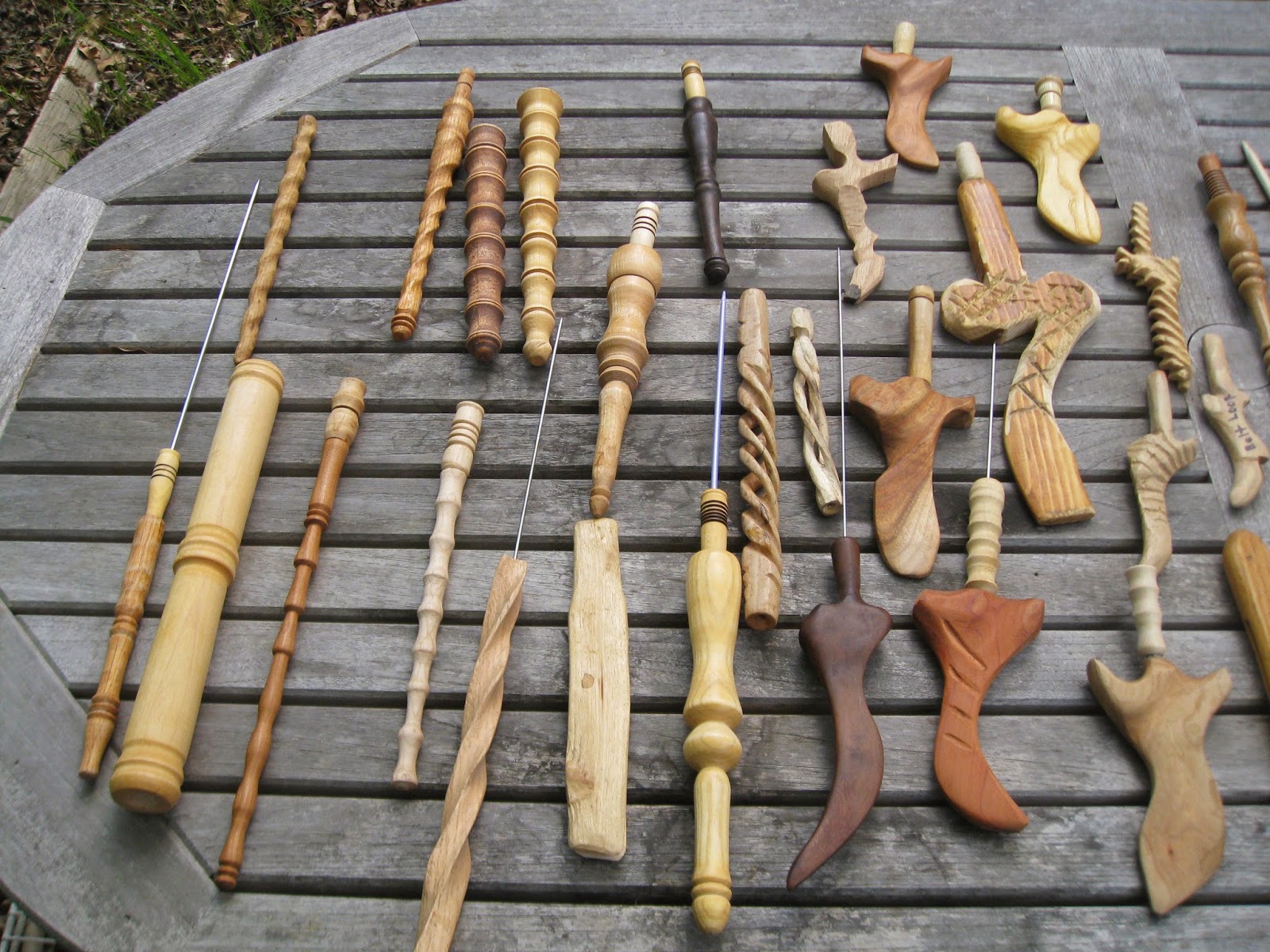
Below is a sample of the knitting sheaths that I have made, and keep for reference:


The needles shown work with at least one of the knitting sheaths, and the knitting sheaths work with at least one of the sizes/types of needles shown.

Making series of similar knitting sheaths of different sizes and proportions allow me to work out how size and proportion affected  functionality.

Thursday, March 12, 2015

Faster

One reason that I knit faster today than I did 6 years ago is better tools.

My current production gansey knitting sheath.


Crude, and ugly, but productive.   A block of maple, with a couple of holes drilled with countersinks to receive and fit needles that is then bolted to a very heavy work belt.  I use it with 12" and 18" needles in 2 mm and 2,3 mm sizes.  It is in its 4th or 5th iteration.  I have a hundred good knitting sheaths in the house, and still it is worth my time to tweak my ideas about knitting sheaths to make the process faster.

The 9 day gansey

I think there are pix of it on the blog - it was nothing special, Steps and Cable Filey pattern with a 44" chest and something over 700 cable crosses. This was the first sweater that I knit from Wingham  "gansey yarn".  Today, I could knit such a sweater much faster.  And today, I understand how to spin hand spun that produces warmer and more durable fabrics.

I knit it in 9 days/ ~90 hours, on gansey needles/ with sheath.  It was part of a Ravelry intensive knitting session - maybe TdF. I wore it for a few hours and went back, picked up stitches around the neck and knit a turtle neck using a very soft 4-ply yarn on 12" needles/ with sheath. The neck makes it much warmer, but means that it does not vent, so it is too hot to wear into a bar for a beer.

The sleeves were knit without taper to the wrist so they could be turned up when setting and retrieving down rigger weights for salmon fishing. It gives it a "Popeye" look, but it keeps the sleeves out of the water so they do not collect plankton and stink.  There is nothing like eating a sandwich when your sweater cuffs smell like rotting shrimp.


The "bars" are "steps" and the diagonals are cable crosses.  Each stitch panel is 10 stitches.

It has been fishing, sailing, and I have worn it to sleep in the snow many times.  Usually I wear it against the skin.  In foul weather, I wear a commercial rain suit over it.  It kept me warm when I wore it inner-tubing in the Big Sur River. It is now old and thread bare.  At some time, I had to re-knit the bottom of the  hip band.


3-ply again

After much wandering in the land of grist, I have decided that I really like 5,600 ypp singles  as a basis of knitting yarns.

I spin such singles from long wool like Romney, a blend of medium wools that I get from a  commercial vendor, and Anna Harvey's fine Rambouillet or  Royal Fibers CVM.  For knitting, these days, I am spinning everything semi-worsted.  Everything gets spinning oil and several passes through the drum carder.  Sometimes the batts are dized off to form roving and sometimes they are just torn into strips.  Then, they are all spun at 9 tpi.  The slight woolen character of the yarn means that these yarns are softer than worsted yarns of the same grist and twist and firmer than pure woolen yarns.  And the long wool yarns are more worsted in character and firmer than the singles from finer fibers.

I have been blending these singles into yarns of specific use.  Hiking socks are 3-ply all Romney and Cotswold - very durable.  Street socks and are 3-ply - all medium wool - not as firm as hiking socks.   A ply of each gives a mitten yarn that is durable, but which fulls into a soft, dense fabric.  The long wool singles help stabilize the fabric, and the fine wool provides fill. (These are gloves - no shrinking and felting allowed.)

I knit these yarns on needles in the 2 mm range.  Stitch counts run just under 10 spi, so the fabrics are not at all stiff.  In general, the fabrics are very light weight, low bulk, and warmer than commercial 2-ply worsted weight yarns knit at 5 spi.  Thus, I have warmth with less weight or bulk, and with much better drape.

I find these yarn somewhat less splitty and easier/faster to knit than the 6-strand yarns of the same grist that I produced from commercial warp yarn.  Since knitting takes longer than spinning, over all, I  find spinning my own 5,600 singles faster/easier than using the 2-ply, 5,600 ypp warp yarn to cable up this grist of yarn. I also like being able to control the fiber content.

My 3-ply yarns are about the same grist as Shetland 2-ply jumper yarns, that are often knit in the just under 8 spi range.  However, when my 3-ply medium wool yarn is knit at that gauge, the 3-py produces a warmer and actually softer fabric, with a better drape.  In the over all cost of the object from fleece to finished product, the cost of  the extra ply is trivial - on the order of  less than 10%.  In a commercial operation, seeking to control production costs to meet a price point, 10% production costs is a big deal.  For a craftsman seeking to produce a much better product, 10% higher production costs to produce a much higher quality product are a good investment.


Monday, March 09, 2015

Toward a Taxonomy 2

A very long time ago I wanted to knit faster. A group of very good, very fast knitters strongly suggested that I learn to knit "continental".  So, I did.  It was a little faster.  I know that by tweaking hand movements, I could improve my speed while knitting continental. However, ultimately the speed at which one can knit is limited by the physics of the process.  And the physics of knitting continental are the same as the physics of  say Irish Cottage Knitting meaning that ultimately the speed of knitting "continental" and  Irish Cottage Knitting are very similar.

From my point of view, Irish Cottage Knitting and Continental  (sorry about the ad) have the same basic physics and are variations on one technique of knitting. (There, I said it 3 times.  You think I need an editor, but I think it bears repeating over and over.)    Thus, in a room full of knitters with cable needles, knitting speed is dependent on the talent of the individual knitter. I will call this the Cable technique, because it does not require the use of  a knitting pouch  or knitting sheath and can be used with cable needles.  The tightness of the knitting is dependent on the strength of the knitter's hands and wrists.  Use of long needles with this method does not improve speed or tightness of knitting, but see Pit Knitting below. Note however that Miriam Tegels and  Miriam Tegels  (MT) sometimes uses somewhat longer needles and braces the working needle against her forearm. Thus, we have one knitter, with two techniques with different physics.  She does not differentiate between them, because with both, she follows the same precepts of small movements, etc.  Let us call the technique where the needle is braced, "Bracing". 

In Bracing, a longer needle does give her significantly more leverage, but the effort is in the fingers so the ergonomics of the technique are not great, and bracing against the forearm does not provide stability for working with small stitches.  It seems to be a technique advocated by folks who sell long needles as part of "gansey kits".  I find a knitting pouch or knitting sheath will produce better knitting with less effort and stress than bracing.

In Portuguese technique, yarn tension and the yarn is looped/wrapped with the thumb, but the physics and leverage of actual stitch formation are the same as with Cabling techniques.


Then, we have the Shetland leather knitting pouch and long (14") needles as demonstrated by my hero, Hazel Tindall . This technique has different physics from above, which allows faster, and more sustained knitting.  It is particularly good for Fair Isle knitting and was used by the Bohus knitters and is used by professional knitters today.  Unless you have tried it, you will not believe how much easier this technique makes Fair Isle and other stranding techniques.    I would add that it is very good for knitting on airplanes.  A knitting pouch also can help control the rather stiff needles sold in gansey kits.

Let us call the  technique using stiff, short double pointed needles used with a long knitting sheath, the Dutch Knitting Stick method. It is excellent for knitting small objects, very tightly and very rapidly. . This is how a Lithuanian bride could  produce 50 pair of good mittens to give away at her wedding. I like it for knitting boot socks from thick yarns.   The Scotch used this technique with many (9) needles to produce very tightly knit sweaters, knit in the round.  Using one needle per stitch panel, this is a very good way to knit complex patterns. It works very well in confined quarters.  I used this technique to knit a good gansey in a rather crowded doctor's waiting room.  Again, this is a group of techniques with similar physics that produce similar results.

True Gansey Knitting uses fine flexible needles as long as 18" long. A knitting sheath is firmly fixed over the right buttock, the working needle inserted into the knitting sheath and the needle is flexed forward under the right arm pit with the weight of the right hand resting on the needle.  The palm of the right hand  flexes the needle into the stitch as the forefinger carries the yarn loop forward, the needle is released, and the spring of the needle finishes the stitch.  Steel springs are faster than muscle, and this is the fastest and easiest way I know to knit large objects.  Also the uniform action of the spring produces a very uniform and excellent quality of knitting. The knitting can be very tight - much tighter than the Cable technique.  Gansey knitting works best with spring steel needles between 1.5 and 3 mm in diameter.

Swaving uses curved needles (pricks) that rotate in the socket of their knitting sheath, and the knitting sheath holds the needle aligned with the working stitch, allowing the use of the large muscles to make very fine stitches.  There is one effort per stitch, which pops the needle into the working stitch, yarn is looped, and the tension/spring of the fabric pops the needle out of the stitch to finish it.  This is the right way to knit fine gloves and socks from very fine yarns.  The rotating, curved pricks are a compound lever, that generate large leverages with a short lever.  This allow for the production of very tight fabrics.  It is perhaps the ideal way to knit Eastern Cross Stitch.   Also, miles and miles of fine "garter ribbon" were produced by swaving.  Longer needles tend to bind, so large objects (hose for pipers) require many, many needles - better to just use gansey needles.  Also, the needles are blunt, so decreases are difficult - I often knit the ankle and foot of a sock with pricks, and use short steel sock needles of the same diameter for the decreases at the heel and toe.  The fact that I am willing to keep two sets of needles handy (even when traveling)  while knitting socks and gloves is an indication of  the  power of  swaving.

A Knitting heart uses a pin attached to the clothing as a knitting sheath to support, 8" long lace needles.  This works best with rather fine needles, for small lace objects.  The technique is like gansey knitting in extreme miniature, but the angles are a little different and the weaker spring constant of the finer needles result in a softer fabric.

Aran Knitting used long, stiff needles with a short knitting sheath to generate huge leverage which could produce very dense fabrics from very heavy yarns, when knitting flat.  Aran knitting is on a seamless continuum of techniques with Dutch Knitting Sticks and Gansey knitting.

Pit knitting  uses a pad under the arm pit and likely appeared as a way to effectively use long DPN during the Victorian era as skills to make knitting sheaths become rare. Crease Knitting uses SPN braced against the body to increase leverage.  Again this likely appeared during the Victorian era as single pointed needles became more common and  knitting sheaths became less common.

In Tunisian knitting,  hooked knitting of the Portuguese, and hooking mittens, no leverage is likely developed, but ergonomics can be excellent allowing sustained and extended production.   However, because they require more muscle twitches per stitch and do have have the stabilization of a knitting sheath they cannot produces as many stitches per minute, or produce the very fine work of some knitting techniques.

Nalbinding is not strictly speaking, "knitting", as knitting is defined to use 2 mandrels.


Sunday, March 08, 2015

Towards a taxonomy of knitting

A knitting needle is a lever for moving loops of yarn.

See http://www.ohio.edu/people/williar4/html/haped/nasa/simpmach/lever.htm

Levers used in knitting are Class 1, Class 3 and various springs.  If we look at the elements of the various knitting techniques we see:

Yarn tension

  1. Right hand
  2. Left hand
  3. Both hands
  4. Pin on chest or around neck

Tools 

  1. Cable needles
  2.  Cable needles/ 2 sets
  3. Single point needles
  4. "Sock needles" (Short double pointed needles, which may more or less flexible but the flex is used for ergonomic comfort rather than for individual stitch formation. Sock needles may be bent or curved but the curve is for ergonomic comfort rather than individual stitch formation.
  5. Stiff, short double pointed straight needles, with knitting sheath to match
  6. Flexible double pointed straight needles, with knitting sheath to match and flexed into each stitch.
  7. Long double pointed straight needles with knitting pouch (may be stiff or flexible)
  8. Short curved stiff DPN used with knitting sheath to match, and rotated into each stitch.
  9. Hooked needles 

Fulcrum / mechanical advantage

  1. Thumb of hand holding working needle. / ~1:3
  2. Ball or base of thumb of hand holding working needle./ ~1:3
  3. Second finger hand holding working needle./ ~1:3
  4. Index finger hand holding working needle./ ~1:3
  5. Knitting sheath./ 1;20 => 1:50
  6. Center  or outside edge of  right palm./ 1;20 => 1:50
  7. None, spring action of needle.
  8. None, spring action of fabric.
  9. Shoulder joint / e.g., no mechanical advantage.

Effort (source of force to move loop)

  1. Rotation of right wrist
  2. Fingers in right hand (any or all)
  3. Forearm
  4. Bicep
  5. Deltoid
  6. Pectorals
  7. Tricep
  8. Rhomboideus
Now, a Ravelry forum might offer 200 different knitting styles that I would say all use left hand yarn tension, the right thumb as a fulcrum with wrist rotation as effort yielding a mechanical advantage of 1:3.   200 styles of knitting that offer the same mechanical advantage.  One or another may offer ergonomic advantages or minor advantages in speed, but they all have the same mechanical advantage and the same amount of hand movement, so they are going to produce very similar results. 

However, if one looks around there are knitting techniques that involve flexing a needle held in a knitting sheath with the palm of the hand, into the working stitch, looping the yarn, and allowing the spring action of the flexed needle to finish the stitch.  This is such a different concept of knitting, that in contrast the 200 versions of continental knitting are all one technique.  And using one set of cable needles or 2 sets cable needles or DPN or SPN or changing the mount of the stitches or purling backwards does not change the essential analysis of how the lever is used to move the loops of yarn.

There are knitting techniques that involve rotating needles held in knitting sheaths into the stitch, looping the yarn over the needle and then allowing the spring of the fabric to pop the needle out of the fabric and finish the stitch. This generates a very powerful compound leverage, and the effort for the entire stitch is one quick push of the needle, with the knitting sheath controlling direction. this is an old and very fast way to knit, but it is not something that is likely to be included in a Ravelry thread on ways to knit.  It works very well.  The fact that I do it everyday makes it science, and since it is the technique used by the Terrible Knitters of Dent makes it is also history.  It is the right way to knit fine gloves and socks from very fine yarns.  Would you like a demo?

And, then there are the long DPN used with a knitting pouch.  What can I say, but that it was a breath of fresh air.  

If you want to tell me there are a large number of different ways to knit  that I do not understand or cannot perform, then you need to tell me about knitting techniques that use physics and tools not listed above.  When I learned to knit, I was almost instantly dissatisfied, and I rapidly went through all the minor variations.  That is, I spent ~6 years trying all the variations of the standard modern knitting methods.  At than point, it became very clear that I was looking for something radically better.

There followed months of experimentation with gansey needles and years of  learning how to control them with knitting sheaths.  This blossomed into an entire spectrum of very powerful knitting techniques that were very different from hand held needles and quite different from each  other.

Then, came swaving, where curved needles are held in a knitting sheath and rotated into the stitch, and the stretch of the fabric acts as a spring to finish the stitch.  This is different from all other knitting.

So, yes I know  the common knitting styles and understand the variants of the common knitting styles.  

Cashmere

We stopped by Neiman Marcus yesterday, and one of our favorite department managers there (she is a great knitter) is leaving for Asia on an extended cashmere buying trip.

Anyway, as we hugged good by, she said, "Wow, what a soft sweater!."  Yes, sometimes I do wear soft sweaters. And, sometimes I knit lace.  However, others write about such things, so I do not write on such topics.

I do not have the details yet, but soon I expect that there will  be a new source of first class cashmere objects in the US, and we will not have to go to Paris for such things.

Saturday, March 07, 2015

Right under my nose

In seeking warmer wool garments, I went to the extremes of modern knitting mythology.  I knit a lot of harsh fabrics where the primary virtue was warmth and durability.  I do not regret this, as those fabrics have kept me warm in real cold, and saved my skin when I fell and skidded down steep rock faces. (Nylon is slippery and it lets one slide faster and faster down the rock or ice, until the nylon wears through and bare skin at high speed hits rock or ice and is turned into hamburger.)

Still most women wrinkle their faces as they touch these fabrics -- for good reason. So the question is: Can one produce such warm fabrics that are soft and friendly?

The answer is yes, and the how was right under our noses all the time. There are actually 3 parts to the how:


  1. Use more plies as you construct the yarn.
  2. Use reasonable fine wool.
  3. Knit reasonably firmly.
Traditional "worsted" weight  knitting yarn was constructed of 6 plies of 5,600 ypp singles. Now, most mill spun yarns of that weight (grist) are only 2-ply. Two-ply yarns are not nearly as warm as yarns constructed from more plies.  This is not my rule, it is Mother Nature's rule; see http://www.feynmanlectures.caltech.edu/ for details.  I merely recite it.

Reasonable fine wool keeps the yarn from being too harsh.  I may want "rug wool" between me and the rock, but most do not need that kind of durability.

The finer wool and softer yarns have more fill, so the yarn does not have to be nearly as tightly knit to ensure that air cannot easily advect heat through the gaps between the yarns.

I have been testing some commercial Shetland 2-ply jumper weight yarns that run 1800 ypp.  My 3-ply semi-worsted Rambouillet at 1870 ypp is softer, more durable, and much much warmer when knit at the same gauge on the same needles. It is softer, because it is a softer fiber.  It is more durable because there is more twist holding the yarn together.  And, it is warmer because 3-ply yarn has more "fill" than 2-ply yarn.  If you run your thermostat at 72F, you want the Shetland 2-ply jumper weight yarn.  If you run your thermostat at 62F, then you want the 3-ply semi-worsted fine wool yarn.

If I am knitting a fine Fair Isle object from hand spun, then most of the effort goes into the knitting. With a very fast wheel, spinning the singles for a sweater goes from a couple of days spinning for 2-ply jumper weight to ~4 days of spinning for 3-ply jumper weight.  However, an additional 16 hours of spinning is not a big deal compared to the 100 hours of knitting  - if you  consider that the additional spinning time will make the object much warmer and much more durable.  For 20% more effort, one gets 100% more value. The extra effort in spinning, increases the return on the large knitting effort.

On a commercial basis, doubling the required twist  (more and finer plies) would approximately double the price of the yarn, and most knitters would look at the price and decide that the much less expensive 2-ply was warm enough and durable enough.  Thus, the construction of modern commercial yarns is a function of competition and price point, rather then value considering warmth, softness, and  durability. This trade of price point for warmth and durability is a major reason why modern hand knitting is not as warm as the hand knitting in the old days.

Then when winter comes round, modern knitters decide that they need  something warmer and they turn to exotic, expensive, super fine fibers to make warm fabrics.  The problem is that the last few generations of knitters preferred a lower price point over warmth  and  durability, and the mill responded by making 2-ply yarns that are less expensive, but also not as warm or durable.  Likewise, the commercial mills optimized the 5-ply gansey yarns for stitches that "pop" rather than for warmth. The modern commercial 5-ply gansey yarns are much warmer than 2-ply yarns, but they are not nearly as warm as they could be if they were designed to be warm, rather than decorative.

Now, you can take the same semi-worsted, fine wool singles (5,600 ypp) and ply them up as 5-ply and knit the yarn at the same gauge on the same needles as the Shetland 2-ply jumper weight yarns, and you will have soft, dense fabric that is fully 4 times as warm as the fabric from the Shetland yarn.  The fabric is not stiff, it is not harsh, it is just warm.  I have not really run durability tests on it yet, but with all that twist holding the yarn together, it should be much more durable than the 2-ply.  This is a fabric for when your thermostat is set for 52F,

If you can knit the 2-ply at the gauge on the band then you can also knit the 3-ply at the same gauge with the same needles.  By the time you get to knitting 5-ply at that gauge, you are packing the yarn together and will want the leverage of a knitting sheath or at least a leather knitting pouch.

If your thermostat is set at 42F, then move on to real 6-ply, knit on slightly larger needles (3 mm), and enjoy.

If you want to spin your singles from long wool, spun worsted, then the fabric will have less drape, but will be more durable and it will be lustrous.  A stiffer fabric is a small price to pay for warmth that gleams.  Certainly, you can knit it less firmly, but then the fabric will not be as warm.

I would never have gotten here, if I had not been spinning for weaving, and fallen into the habit of plying- up singles spun for weaving as knitting yarns.  I stared spinning semi-worsted 5,600 ypp singles from carded batts to see how they would work as weft, but once I had a few cakes of such singles sitting there, it was very  little effort to ply it up into knitting yarn.


Noils and carding

A while back, I needed a very fine fleece.  I asked Anna Harvey to go through her stock and send me her "finest fleece".  It was very fine.

Now, everyone knows that I love my drum carder and when I die, I will likely have a tight grip on that drum carder handle.  Yes, they will have to pry my drum carder out of  my cold stiff fingers.

However, that fleece always tended to develop noils when carded on the drum carder - not surprising as fleece that are finer than the breed normal tend to be fragile.  In those days, I was drum carding everything, and when I got the noils, I just set the last half of the fleece aside.

However, I have been spinning woolen from Rambouillet, and  there was that bin of tender, snow white, super fine fleece.  I had the cotton cards out, so I tried carding it on the cotton cards and it works just fine.  And yes, when I run through the drum carder, it gets noils.

I spin it at about 5,600 ypp and 12 tpi, and do not notice the singles as being particularly weaker than the fiber from other  Rambouillet that I have been spinning.

My take away is that there are fleeces that do better being hand carded rather than drum carded.  Anyway, I have 4 or 5 pounds of this stuff and making up a thousand 2 gram rolags is a good way to get very good at making up little rolags.  On the other hand, the bats from the drum carder can be spun rather finely semi-worsted and the noils flicked off of the single with a finger nail before it enters the orifice.  This is an approach that  works for weft and some knitting yarns.

As 3-ply fingering, it knits easily on 00 or 000 to make a soft fabric at 8 spi.  It is not the kind thing that I would knit for myself,  As a 5-ply sport weight, it is a much softer yarn than the worsted yarns that I have been spinning, and  knit it makes a very soft, very very warm fabric.  With all that twist holding it together, it should be a much more durable fabric than any 2-ply mill spun of similar grist.

Friday, March 06, 2015

And if people cannot understand climate science

This year California Agriculture will get none of their Federal water allotment and only 10 to 15% of their state water allotment.  California Agriculture is on the verge of drying up and blowing away.

In the past California had a larger dairy industry than Wisconsin. And a larger beef industry than Oklahoma.   This means that all the voters that voted for politicians who do not understand climate change (e.g.,Jim  Inhofe,  Scott Walker) will pay more for all of their food starting NOW.

Climate change is making the drought worse, and raising food prices right now.

Most Americans accept climate change and want to do something about it. As these people realize that denialists are costing them money right now, they are going to turn on the denialists.   I expect the argument to get fierce and rude.  The denialists will rightfully be called fools, liars, and worse.

That leaves me with the question of,  "What should I call those who deny the virtues of my knitting and spinning?'  My first thought was "Wooly Heads", but that is a not strict correct ethnophaulism.

My cell phone decided the answer for me.  Despite its little knit covers, when it gets cold, its battery life is short. There is no reason in the world for me to waste limited time talking to people who do not want to understand. 

I need to go back to my old policy of selecting my students with care.  I need to remember the example of Dr. Long.  Before he would issue the card required to take Chem 110, he asked each of us if we knew calculus.  The correct answer to the first quiz on the first reading assignment was; "There is an error in the math in the assigned text." 466 of 500 students flunked out  --  on the second day of class. They studied the text and repeated the error on the quiz.  It was just as well, it was the easiest test that he gave us all year long.  I need to let more students just flunk out.

Tuesday, March 03, 2015

I see three choices  because there really are bullies.

It does not matter if one does climate science or evolutionary biology, or just warm knitting and advanced spinning, people who do not understand will try to bully those who do understand.

I spent part of the weekend with Dr. H., who is now, "Old and Bold", and has passed beyond knowledge and deals exclusively with "wisdom".  We had dim sum at Ton Kaing, and walked up Strawberry Hill.

If a group does not understand evolution, then they cannot understand biology, and they or their children will likely die of something like measles or polio.  Not my problem.

If a group does not understand warm knitting after I have explained it, then when they go out in snow to play they will get cold feet and be miserable.  Not my problem. I made a good faith effort to explain how they could have more and better play time in the snow. My moral duty is limited to explaining the process and its implications in excruciating detail.  If people want "science" they can do it themselves, or they can look at 500 years of knitting  history.

Now! California has snow again!  I am going to go play in the snow before that miserable little dusting of snow melts!

And if people cannot understand climate science, . . . . . 

Sunday, March 01, 2015

Woolen and Worsted


I hear that some are now teaching that for woolen prep, the fiber should be fed into the drum carder -- cross ways!!

Feeding fibers cross ways into the carder will result in (some) fibers that are parallel to the direction of drafting after the rolag is formed and this will result in a semi-woolen yarn.  Semi-woolen yarns are stronger for less twist than true woolen yarns, but have less loft.  The lower twist requirements are a real advantage when working with a spindle or slow wheel – or for weft. They are not bad yarns, they are just different.

There is certainty nothing inherently wrong with semi-woolen yarn.  In deed it has great virtues, such requiring significantly less twist to form a competent yarn.  However, it is not woolen and will never have the loft of a true woolen preparation yarn.  If I were a teacher facing a class with rather slow wheels, I might will very well teach feeding fiber into the carder crosswise because it would let the students produce more yarn faster and that will make them very happy. the teacher is betting is that nobody will look at the yarn they spin and announce "This is only only semi-woolen,  not woolen.".  A textile judge would simply rank it as "less lofty".  

Thus, in using the drum carder to make rolags for woolen spinning,  I think the fiber should be fed in parallel  with the rotation of the drum. The batts that I make rolags from are fragile and easy to split lengthwise if  I take them off the swift, but  as the rolag is rolled, all the fibers are at approximately right angles to the direction of drafting. and  yes the rolags are fragile.  See
 ( http://ssa.nls.uk/film/1129  ) at minute 5:58. The rolag is very easy  to pull apart if elongated without twist. As the rolag is elongated in drafting under twist the fibers spiral into the yarn producing the loftiest yarn, but requiring a lot of twist to make the yarn competent.  For very light and lofty woolen yarns, I use the cotton cards on fine fiber to make long white clouds of nothing.  These draft and spin into a very lofty yarn.  Somehow, hand cards seem to be able to produce lower density rolags than I can make on the drum carder. Spinning fine woolen yarns requires a 30% more twist then the same grist of semi-worsted.

Feeding the fiber in parallel  with the rotation of the drum, and then dizing off to form roving will produce a semi-worsted yarn, which has lower twist requirements, but has less loft.  On the other hand it is a much  more economical use of fiber than true worsted, particularly in applications like knitting and weft.

True worsted requires combing. Combing removes all the short fibers.  Worsted spinning produces the strongest, most durable, smoothest,  and for long wool, the most lustrous yarns.  Worsted spinning requires the least amount of twist for the grist, but low grist worsted yarns are harsh and unpleasant. Thus true worsted needs to be spun high grist . If a thick yarn is wanted, ply a lot of fine singles together. Thus, worsted has a very  high  total twist in the finished yarn.   Such yarns are a large effort on a slow wheel. Combing also result in large losses of fiber prior to spinning.  Thus, true worsted yarn is very expensive.  Worsted is best worked on long wool, so the waste is not ideal for either felting or woolen spun yarns. 

The bottom line is that true woolen and true worsted spinning want a lot more twist than the “semis”.  As a spinning teacher, facing a class of students with slow wheels, teaching semi-woolen and semi-worsted is the option of least resistance, and there is a tendency to fudge the terminology.  It is hard to tell a class of new spinners that they need to discard the shorts out of their rather expensive top in order to make true worsted. It is easier to just have them spin semi-worsted.  My point is that if one looks at sweaters in “Needless Markup” on Union Square in SF or 3 Bags Full in Santa Monica, a nice sweater from semi-worsted yarn is $800, while one with the gleam of true, finely spun, worsted yarn is $5,000. For an artisan spinner the difference is 30% extra fiber waste and 40 more tpi (more and finer plies) in the finished yarn. 

I am not saying that one should attempt to hand spin worsted yarn for the fashion houses of Paris and Rome, I am saying that the gleam of fine worsted spun yarns has an artistic and aesthetic appeal that sometimes makes the effort and expense to spin true worsted worthwhile even if its other properties  (warmth, durability, resistance to felting, . . .) are not required.

In my case, spinning the yarn for a 5-ply sport weight sweater worsted, rather than semi- worsted takes an additional pound of fiber. Spinning 4-ply jumper weight  as true woolen takes an extra 12 or 16 hours of spinning.  On the other hand, if I have a good supply of long wool and "Viking" combs (rather than cards) it is faster and easier to spin the yarn as worsted.  I think that on those harshly cold islands they sometimes did things the easy way.

Today, we think of Fair Isle as always knit from woolen  or semi-woolen yarn.  However, there is no reason why a modern artist cannot incorporate the luster and gleam of worsted spun yarns into Fair Isle style knitting patterns.